
Life, 1897-12-30 · page 12 of 21
Life — December 30, 1897 — page 12: what you’re looking at
What you’re looking at
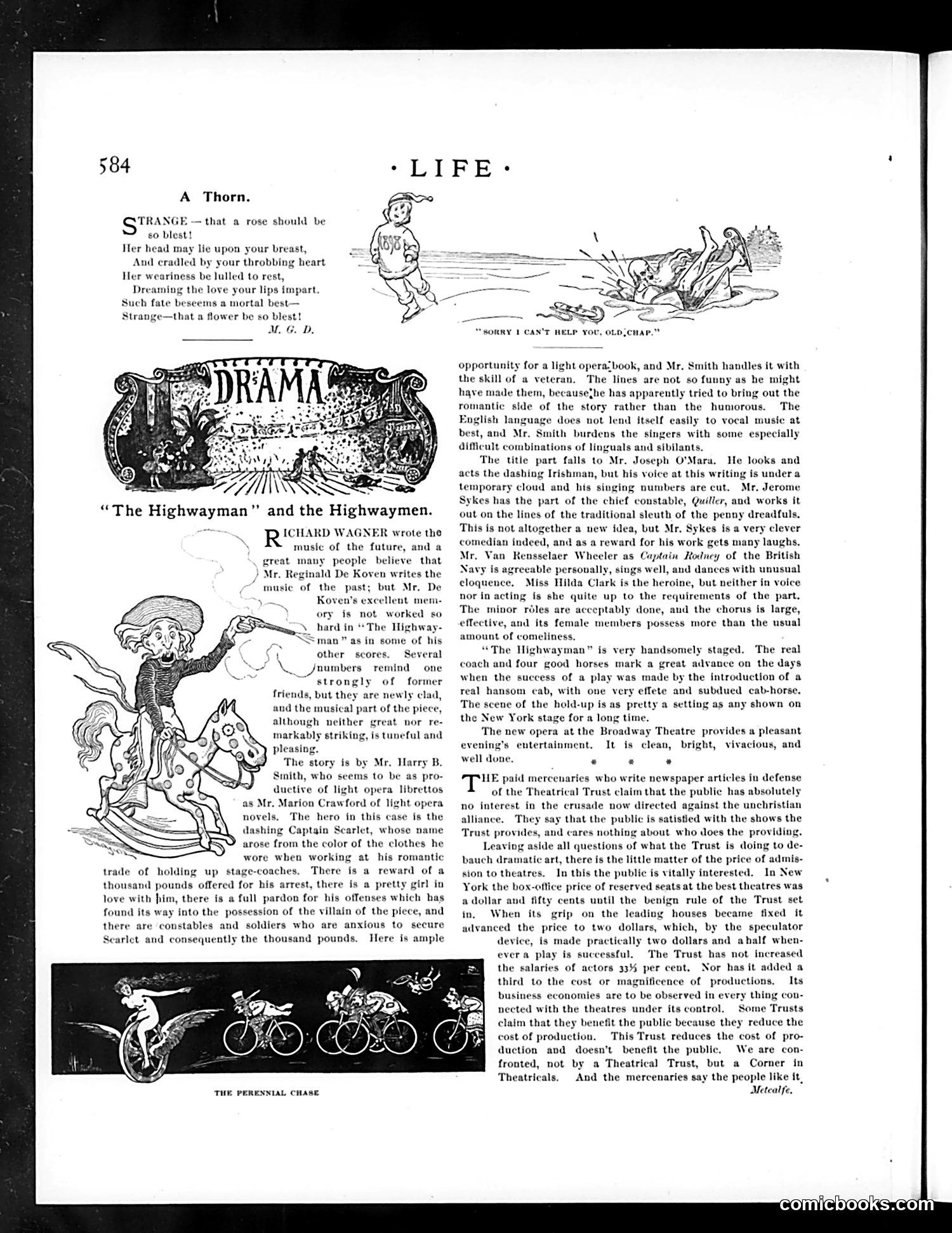
This page reviews a light opera called "The Highwayman," praising its staging and performances. The main illustration depicts a dramatic scene with a highwayman (a highway robber) holding up a stagecoach, which is the opera's plot device. The secondary article discusses the "Theatrical Trust"—a real business monopoly controlling theaters and ticket prices. The author criticizes how the Trust raised reserved-seat prices from fifty cents to two dollars, claiming they exploit both public and performers. The piece argues the Trust reduces production costs while charging audiences more, benefiting only themselves—a classic monopoly complaint about unfair pricing practices.
📄 Transcribed text from this page (OCR, searchable)
Machine-transcribed from the original scan — historical spelling and the odd misread are preserved.
A_ Thorn. TRANGE so ble: Her head may lie upon your breast, And cradled by your throbbing heart Her weariness be lulled to rest, Dreaming the love your lips impart. Such fate beseems a mortal best— range—that a flower be so blest! —that a rose should be hy v “The Highwayman” and the Highwaymen. - ICHARD WAGNER wrote the music of the future, and a great many people believe that Mr R 1 De Koven writes the music of the past; but Mr. De Koven’s excellent mem- ory is not worked so hard in “The Highway- SS man” as in some of his other veral ___Jnumbers remind one strongly of former friends, but they are newly clad, and the musical part of the piece, although neither great nor re- markably striking, is tuneful and pleasing. The story is by Mr. Harry B. Smith, who seems to be as pro- ductive of light opera librettos as Mr, Marion Crawford of light opera novels, The hero in this case is the dashing Captgin Scarlet, whose name arose from the color of the clothes he wore when working at his romantic trade of holding up stage-coaches, There is a reward of a thousand pounds offered for his arrest, there is a pretty girl in love with fim, there is a full pardon for his offenses which bas found its way into the possession of the villain of the piece, and there are constables and soldiers who are anxious to secure Searlet and consequently the thousand pounds. Here is ample scores. Se RAY 1 CAN'T HELP YoU, OLD cap.” opportunity for a light opera:book, and Mr. Smith handles it with the skill of a veteran, The lines are not so funny as he might have made them, becausethe has apparently tried to bring out the romantic side of the story rather than the huniorous. The En language does not lend itself easily to vocal music at best, and Mr, Smith burdens the singers with some especially dificult combinations of linguals and sibilants, The title part falls to Mr. Joseph O'Mara, He looks and acts the dashing Irishman, but his voice at this writing is under a temporary cloud and his singing numbers are cut. Mr, Jerome kes has the part of the chief constable, Quiller, and works it out on the lines of the traditional sleuth of the penny dreadfuls, This is not altogether a uew idea, but Mr, Sykes is a very clever comedian indeed, and as a reward for his work gets many laughs. Mr. Van Rensselaer Wheeler as Captain Rodney of the British Navy is agreeable personally, sings well, and dances with unusual eloquence, Miss Hilda Clark is the heroine, but neither in voice nor in acting is she quite up to the requirements of the part. The minor roles are acceptably done, aud the chorus is large, effective, and its female members possess more than the usual amount of comeliness. “The Highwayman” is very handsomely staged. The real coach and four good horses mark a great advance on the days when the success of a play was made by the introduction of a real hansom cab, with one very effete and subdued cab-horse. The scene of the hold-up is as pretty a setting as any shown on the New York stage for a long time The new opera at the Broadw evening's entertainment. It well done, * y Theatre provides a pleasant is clean, bright, vivacious, and id ates paid mercenaries who write newspaper articles in defense of the Theatrical Trust claim that the public has absolutely no interest in the crusade now directed against the unchristian alliance. The; the public is satisfied with the shows the Trust provides, and cares nothing about who does the providing. Leaving aside all questions of what the Trust is doing to de- bauch dramatic art, there is the little matter of the price of admis- sion to theatres. In this the public is vitally interested. In New York the box-office price of reserved seats at the best theatres was adollar and fifty cents until the benign rule of the Trust set in, When its grip on the leading houses became fixed it advanced the price to two dollars, which, by the speculator device, is made practically two dollars and ahalf when- ever a play is successful. The Trust has not increased the salaries of actors 33% per cent, Nor has it added a third to the cost or magnificence of productions, — Its business economies are to be observed in nected with the theatres under its control. claim that they benefit the public because they cost of production. This Trust reduces the cost of pro- duction and doesn't benefit the public, We are con- fronted, not by a Theatrical Trust, but a Corner in Theatricals, And the mercenaries say the people like it, Metcalfe, thing con- pme Trusts y reduce the