
Life, 1897-12-30 · page 4 of 21
Life — December 30, 1897 — page 4: what you’re looking at
What you’re looking at
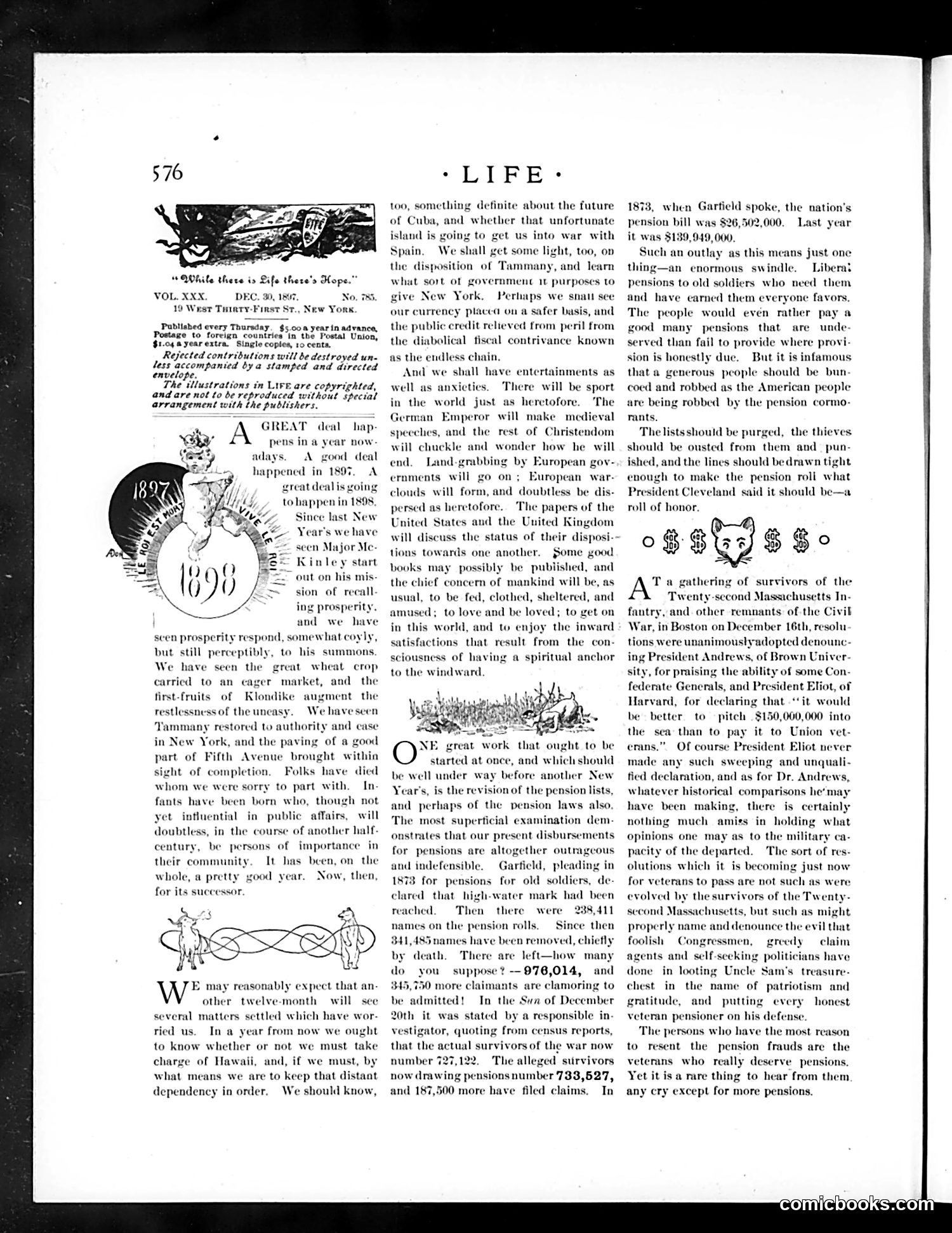
This page contains political commentary on late-1890s American issues. The main illustrations appear to be decorative circular designs labeled "1897," "1898," and "1899," symbolizing the passage of years. The text discusses pension fraud and reform. It references President Garfield's 1873 pension bill and criticizes fraud in Civil War pensions, mentioning specific numbers of fraudulent claimants (978,014 alleged survivors). The article advocates for pension list revision and removal of fraudulent names. The small illustrations at bottom—showing figures connected by lines—appear to be satirical cartoons, though details are unclear. They likely mock corruption or the tangled bureaucracy of pension administration. The overall theme: exposing pension system abuse and calling for governmental cleanup of fraudulent claims among supposed Civil War veterans.
📄 Transcribed text from this page (OCR, searchable)
Machine-transcribed from the original scan — historical spelling and the odd misread are preserved.
“While there is Life there's Hope.” VOL. XXX. DE 1, 18, 19 West Tainty-Finst St., New Yo No. Published every Thursday. $5.00 yearin advance, Postage to forcign countries in the Postal Union, $1.04 year extra. Single coples, 10 centa, Rejected contributions will be destroyed un- tess accompanied bya stamped and directed envelope. The illustrations in Live are copyrighted, and are not to be reproduced without special arrangement with the publishers. GREAT deal hap pens in a year now adays. A good deal happened in 1897. A great de tohappen in 1898, Since last New oing “s we have seen Major Me- Kinley start out on his mis- sion of recall ing prosperity. and have scen prosperity respond, somewhat coyly, but still perceptibly, to his summons. We have seen the great wheat crop carried to an cager market, and the first-fruits of Klondike augment the restlessness of the uncasy. We haveseen ‘Tammany restored to authority and case in New York, and the paving of a good part of Fifth Avenue brought within ht of completion, Folks have diced whom we were sorry to part with. In gh not will we fants have been born who, thou yet influential affairs, doubtless, in the course of another half. century, be persons of importance in their community. It has been, on the whole, a pretty good year. Now, then, for its successor. in public W* may reasonably expect that an- other twelve-month will see several matters settled which have wor- ried us. In a year from now we ought to know whether or not we must take charge of Hawaii, and, if we must, by what means we are to keep that distant dependency in order. We should know, *LIFE: too, something definite about the future of Cuba, and whether that unfortunate island is going to get us into war with Spain, We shall get some light, too, on the disposition of Tammany, and learn what sort of government 1t purposes to give New York, 1 our currency placed on a safer ba the public credit relieved from peril from the diabolical fiscal contrivance known as the endless chain. And we shall hav well as anxicti There will be sport in the world just as heretofore. The German Emperor will make medieval speeches, and the rest of Christendom will chuckle and wonder how he will Land-grabbing by European gov- ernments will go on; European war- clouds will form, and doubtless be dis- persed as heretofore. The papers of the United States and the United Kingdom will discuss the status of their disposi- Some good possibly be published, and thaps we shail see is, and entertainments as end ns towards one another, books ma; the chief concern of mankind will be, as usual, to be fed, clothed, sheltered, and amused; to love and be loved; to get on in this world, and to enjoy the inward satisfactions that from the con- sciousness of having a spiritual anchor to the windward result at idbl lh Ly et NE great work that ought to be started at once, and which should be well under way before another New Year's, is the revision of the pension lists, and perhaps of the pension laws also. The most superticial examination dem- onstrates that our present disbursements for pensions are altogether outragcous and indefensible. Gartield, pleading in 1873 for pensions for old soldiers, de elared that high-water mark had been ached. Then there were 238,411 mes on the pension rolls. Since then 341,485 names been removed, chiefly by death. There are left—how many do you suppose? —976,014, and 345,750 more claimants are clamoring to be admitted! In the Sua of December 20th it was stated by a responsible in- vestigator, quoting from census reports, that the actual survivors of the war now number 727,122. The alleged survivors now drawing pensions number 738,527, and 187,500 more have filed claims. In 1873, when Gartield spoke, the nation's pension bill was $26,502,000, Last year it was $139,949, 000. Such an outlay as this means just one thing—an enormous swindle. Liberal pensions to old soldiers who need them and have carned them everyone favors The people would even rather pay a good many pensions that are und served than fail to provide where provi- sion is honestly due. But it is infamous that a generous people should be bun coed and robbed as the American people are being robbed by the pension cormo- rants. The listsshould be purged, the thieve should be ousted from them and _ pun- ished, and the lines should be drawn tight enough to make the pension roll what President Cleveland said it should be—a roll of honor, oS BGy $ Go T a gathering of survivors of the Twenty-second Massachusetts In- fantry, and other remnants of the Ci War, in Boston on December 16th, resolu tions were unanimoustyadopted denoun ing President Andrews, of Brown Univer- sity, for praising the ability of some Con- federate Gencrals, and President Eliot, of Harvard, for declaring that ‘it would pitch .$150,000,000 into the sea than to pay it to Union vet- erans.” Of course President Eliot never made any such sweeping and unquali- fied declaration, and as for Dr. Andrews, whatever historical comparisons he‘may have been making, there is certainly nothing much amies in holding what opinions one may as to the military ca- pacity of the departed. The sort of res- olutions which it is becoming just now be better to for veterans to pass are not such as were evolved by the survivors of the Twenty second Massachusetts, but such as might properly name and denounce the evil that foolish greedy — claim agents and self-seeking politicians have done in looting Uncle Sam's treasure- chest in the name of patriotism and gratitude, and putting every honest joner on his defense. The persons who have the most reason to resent the pension frauds are the veterans who really deserve pensions. Yet it is a rare thing to hear from them any cry except for more pensions. Congressmen, veteran pens