
Life, 1897-12-30 · page 6 of 21
Life — December 30, 1897 — page 6: what you’re looking at
What you’re looking at
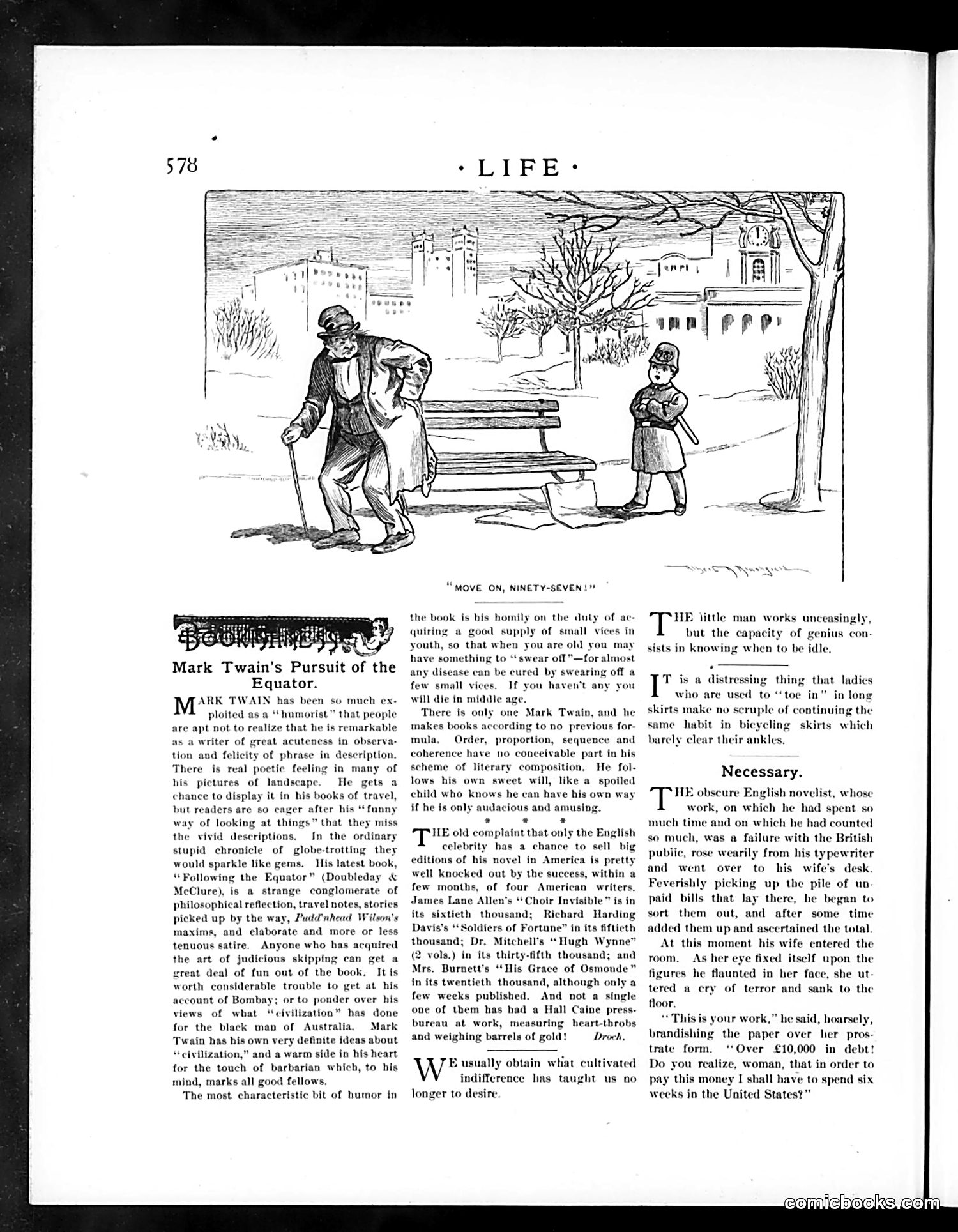
The main illustration depicts an adult figure telling a child to "Move on, ninety-seven!" in a public park setting. This cartoon satirizes poverty and homelessness, likely from the late 19th or early 20th century. The accompanying text discusses Mark Twain's "Following the Equator," praising his observational humor about human nature and civilization. The articles labeled "Necessary" critique an unnamed English novelist whose work failed commercially in Britain, forcing financial desperation. The "Move on" caption appears to mock police or authorities who routinely harass poor people from public spaces—a common Victorian-era social practice. The humor targets both arbitrary enforcement of vagrancy laws and the human tendency to displace society's uncomfortable realities.
📄 Transcribed text from this page (OCR, searchable)
Machine-transcribed from the original scan — historical spelling and the odd misread are preserved.
Equator. ARK TWAIN has be ploited as a “humorist” that people are apt not to realize that he is remarkable as a writer of great acuteness in observa- tion and felicity of phrase in description, There is real poetic z in many of his pictures of landscape. He gets a chance to display it in his books of travel, but readers are 5 rafter his “funny way of looking at things” that they miss the vivid descriptions, Jn the ordinary stupid chronicle of globe-trotting they would sparkle like gems. His latest book, “Following the Equator” (Doubleday « McClure), is a strange conglomerate of philosophical reflection, travel notes, stories picked up by the way, Pudd'nhead Wilson's maxims, and elaborate and more or less tenuous satire. Anyone who bas acquired the art of judicious skipping can get a great deal of fun out of the boc It is worth considerable trouble to get at his account of Bombay; or to ponder over bis views of what ‘‘civilization” has done for the black man of Australia, Mark Twain has his own very definite ideas about “civilization,” and a warm side in his heart for the touch of barbarian which, to his mind, marks all good fellows. The most characteristic bit of humor in so much ex- cag “MOVE ON, NINETY-SEVEN!'! the book is his homily on the duty of ac- quiring a good supply of small vices in youth, so that when you are old you may have something to “swear off "—for almost any disease can be cured by swearing off a few small vi If you haven't any you will die in middle age. There is only one Mark Twain, and he makes books according to no previous for- mula, Order, proportion, sequence and coherence have no conceivable part in his scheme of literary composition, He fol- lows his own sweet will, like a spoiled child who knows he can have bis own way if he is only audacious and amusing. * * . HE old complaint that only the English celebrity has a chance to sell big editions of his novel in America is pretty well knocked out by the success, within a few months, of four American writers. s Lane Allen's ‘Choir Invisible” is in s sixtieth thousand; Richard Harding Davis's “Soldiers of Fortune” in its fiftieth thousand; Dr, Mitchell's “Hugh Wynne” (2 vols.) in its thirty-fifth thousand; and Mrs. Burnett's “His Grace of Osmonde” in its twentieth thousand, although only a few weeks published, And not a single one of them has had a Hall Caine press- bureau at work, measuring heart-throbs and weighing barrels of gold! Droch. W* usually obtain what cultivated indifference has taught us no longer to desire. HE little man works unceasingly, but the capacity of genius con- sists in knowing when to be idle. T is a distressing thing that ladics who are used to “toe in” in long skirts make no scruple of continuing the same habit in bicycling skirts which barcly clear their ankles. Necessary. HE obscure English novelist, whose work, on which he had spent so much time and on which he had counted so much, was a failure with the British public, rose wearily from his typewriter and went over to his wife's desk. Feverishly picking up the pile of un paid bills that lay there, he began to sort them out, and after some time added them up and ascertained the total At this moment his wife entered the room. As her eye fixed itself upon the figures he flaunted in her face, she ut- tered a cry of terror and sank to the floor. “This is your work,” he said, hoarsely, Urandishing the paper over her pros- trate form. ‘Over £10,000 in debt! Do you realize, woman, that in order to pay this money I shall have to spend six weeks in the United States?”