
A complete issue · 20 pages · 1897
Life — December 9, 1897
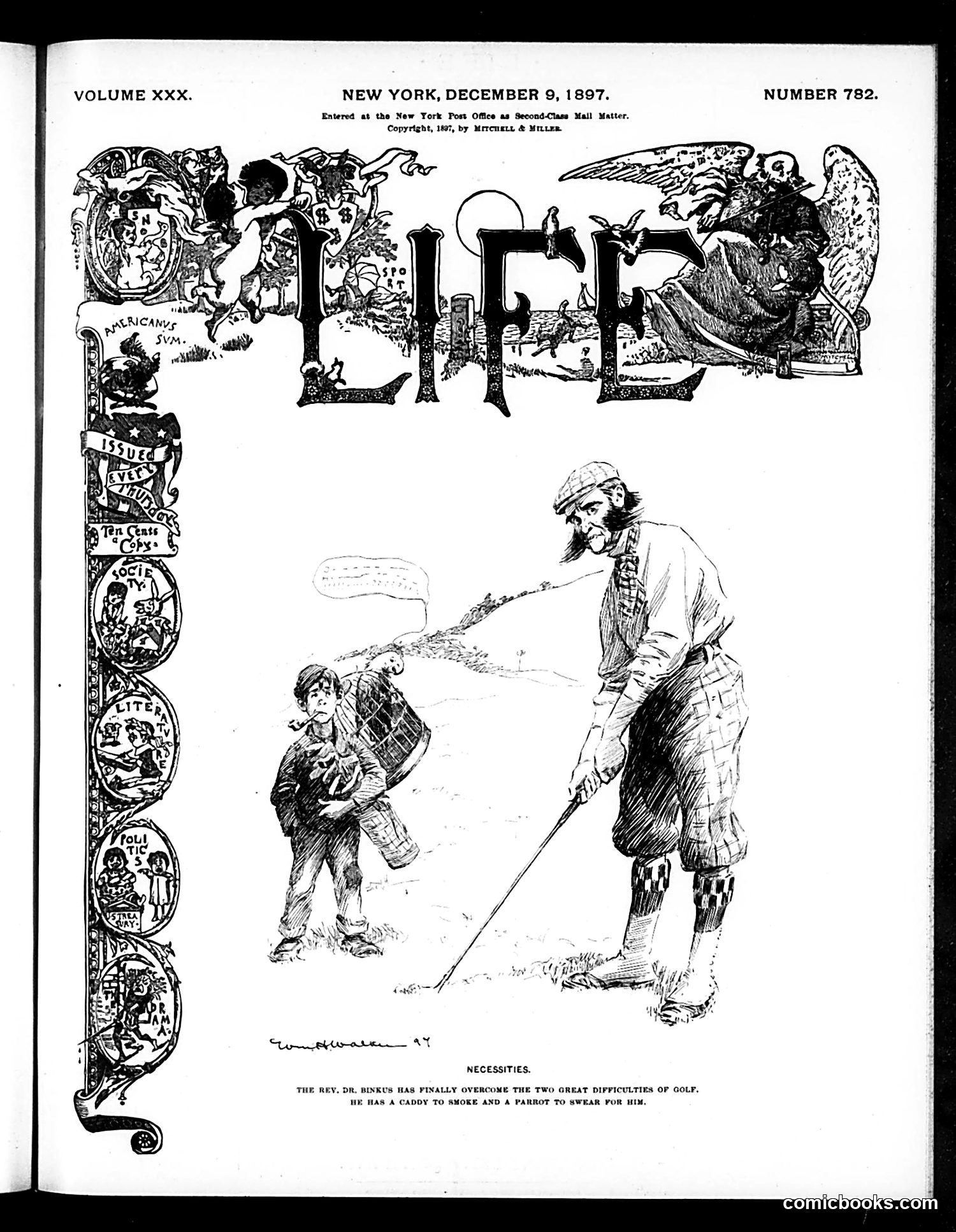
This December 1897 *Life* magazine page features a golf-themed cartoon titled "Necessities," with the caption: "The Rev. Dr. Birks has finally overcome the great difficulties of golf. He has a caddy to smoke and a parrot to swear for him." The satire mocks Reverend Dr. Birks (a real clergyman), who apparently struggled with golf's frustrations—specifically the profanity the sport naturally inspires. The joke plays on the contradiction between his religious vocation and the notorious bad language golfers produce. His solution: hire a caddy to smoke (suggesting stress relief) and employ a parrot to curse on his behalf, allowing him to maintain his clerical dignity while still expressing the anger the game provokes. This reflects late-Victorian golf's popularity among the upper classes and clergy, and period attitudes toward both religion and recreational frustration.
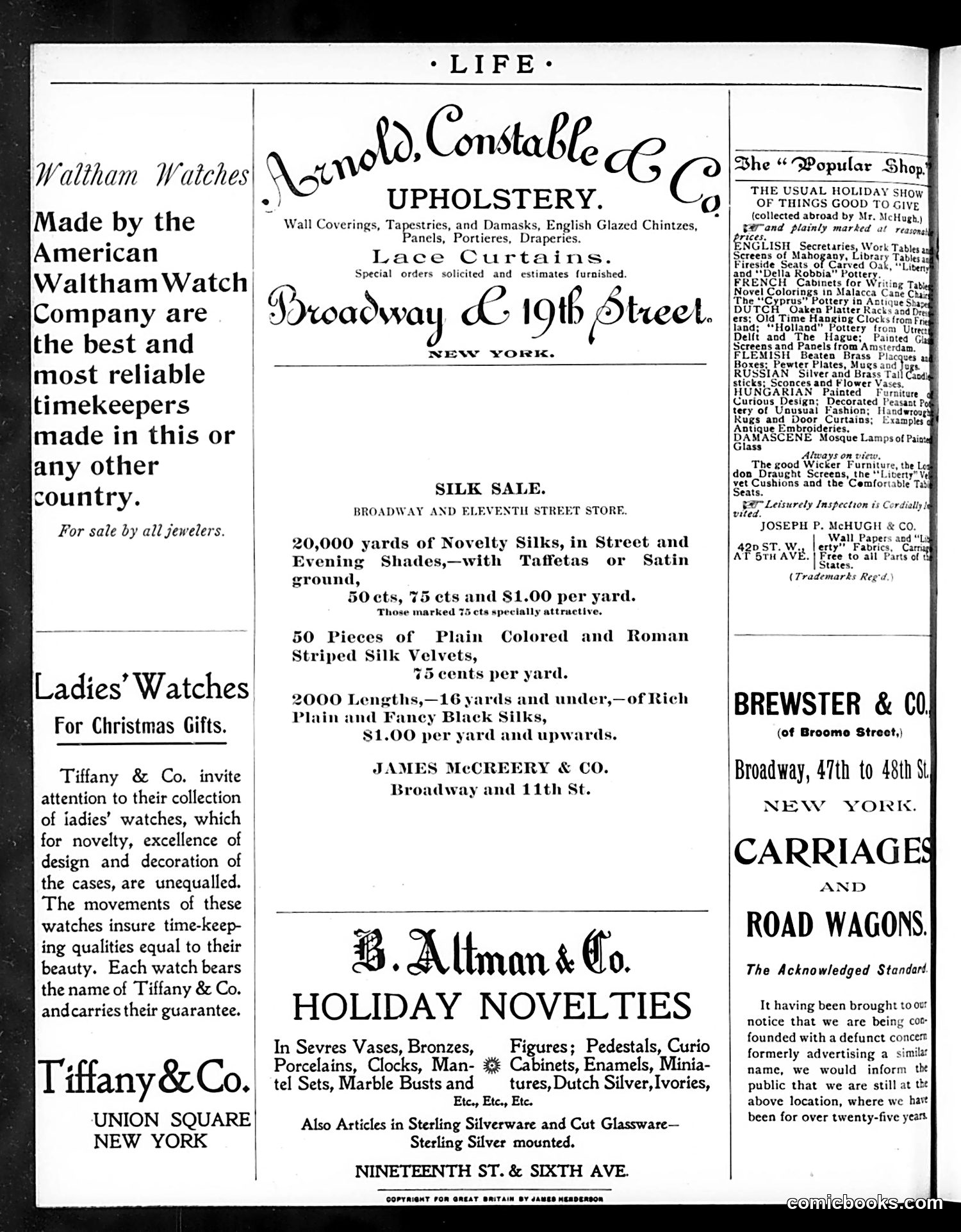
This page is **primarily advertising with no visible political cartoon or satirical content**. The page consists entirely of commercial advertisements from late 19th-century New York businesses, including: - Waltham Watch Company (timepieces) - Arnold, Constable & Co. (upholstery and lace curtains) - James McCreery & Co. (silk sales) - Tiffany & Co. (ladies' watches) - B. Altman & Co. (holiday novelties) - Brewster & Co. (carriages and wagons) While this *is* from **Life magazine**, a publication known for satire and humor, this particular page contains no editorial cartoons, jokes, or satirical commentary—only luxury goods advertisements targeting wealthy New York consumers of the period.
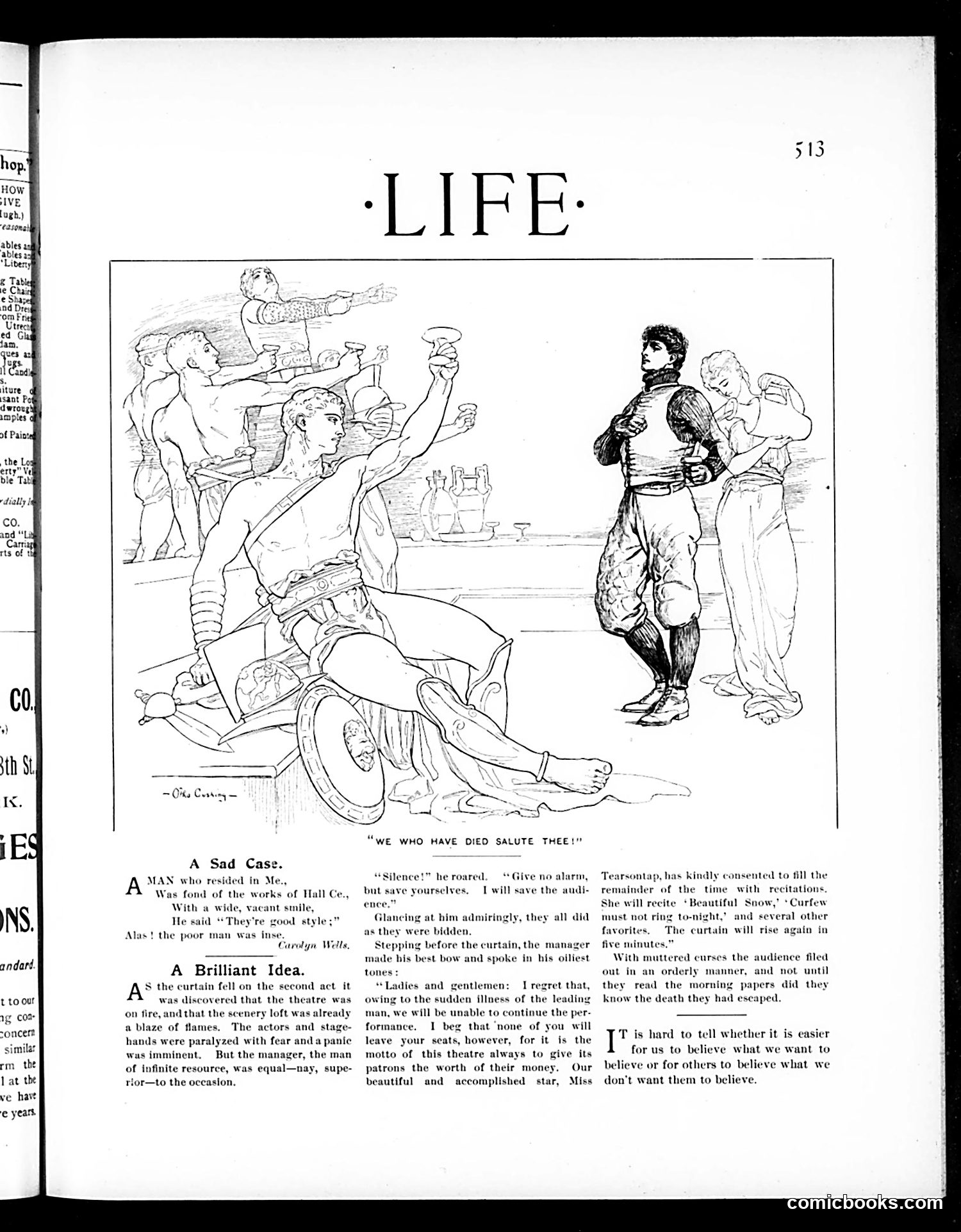
This page from *Life* magazine contains two theatrical anecdotes rather than political cartoons. **"A Sad Case"** describes a theater manager's dilemma: an actor became ill mid-performance, forcing the curtain to fall. The manager addressed the audience asking them to leave without refund, claiming the actress's illness made continuation impossible—though the text suggests he simply lacked resources to resolve the situation adequately. **"A Brilliant Idea"** recounts another theater mishap where a curtain fell during Act 2, damaging scenery. Rather than cancel, the manager announced the show would continue, keeping patrons seated. The satirical point appears to be mocking theater managers' desperation to proceed despite obvious problems, prioritizing ticket revenue over quality. Both anecdotes are humorous critiques of theater management priorities.
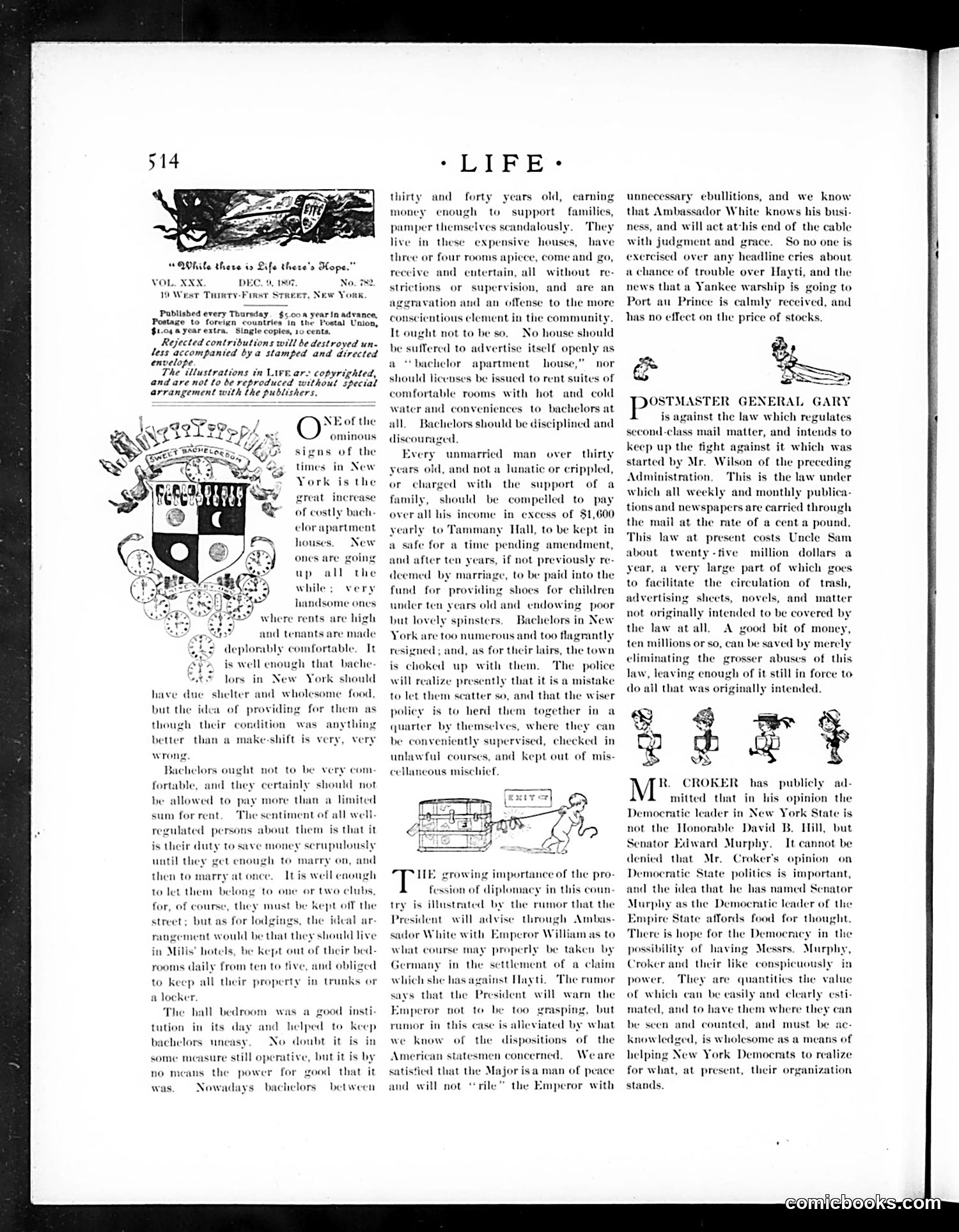
This page contains social commentary rather than political cartoons. The main article discusses New York City bachelor housing conditions, advocating for regulated "bachelor apartment houses" with supervised living arrangements to prevent moral problems. The text references **Postmaster General Gary** and his mail-censorship policies under the Wilson Administration, suggesting controversy over government control of publications and advertising materials through postal regulations. A separate section mentions **Mr. Croker's** statement that Democratic leader **David B. Hill** (not Senator Edward Murphy) represents New York Democratic politics, discussing internal party power dynamics and leadership questions. The small cartoon illustrations appear decorative rather than satirical—simple line drawings accompanying the text rather than conveying specific political messages.
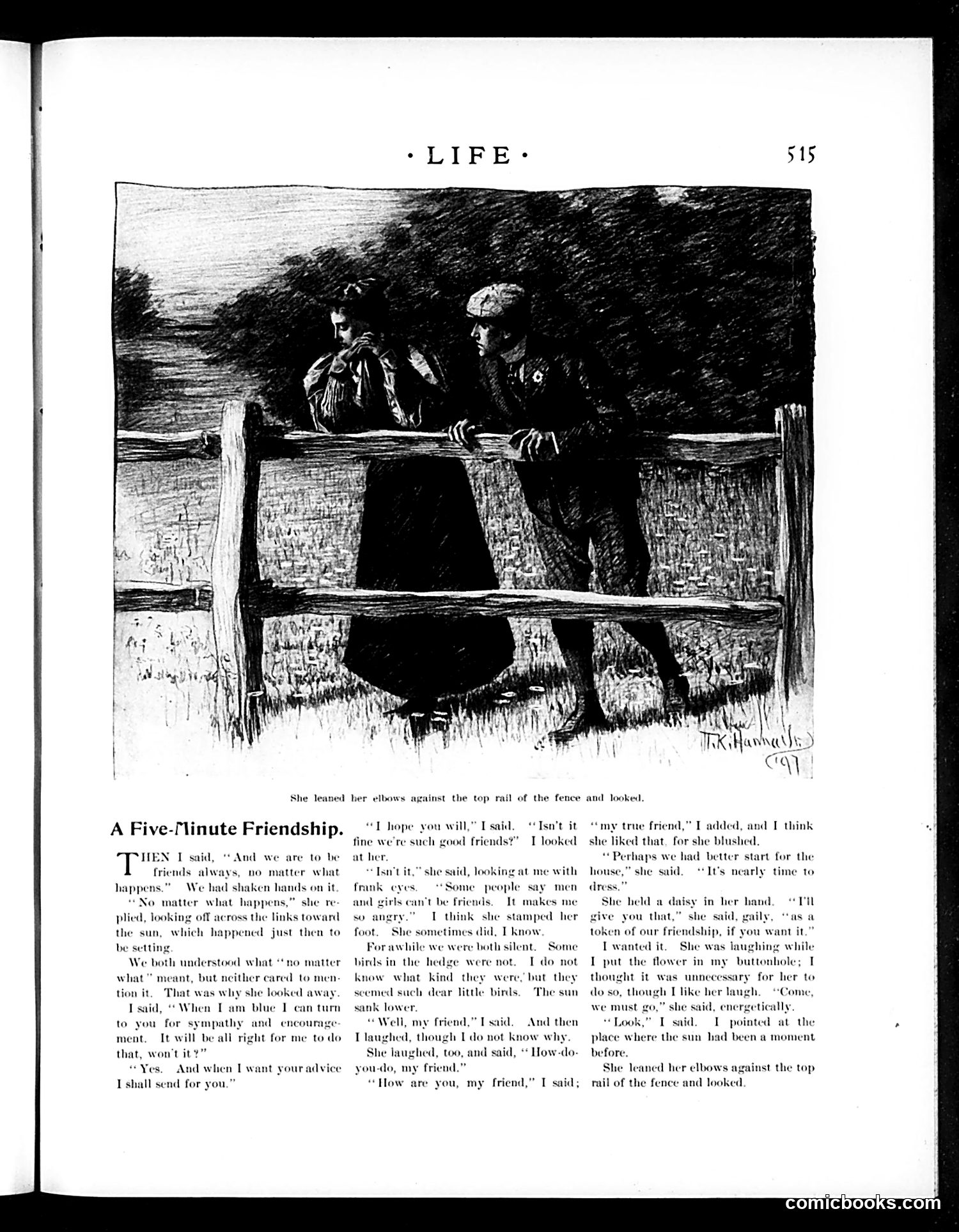
This page presents a short story about two young women meeting by a fence and quickly forming a friendship. The illustration shows them leaning together against a fence rail, gazing at the landscape. The narrative explores themes of female companionship and social connection. One character reassures the other that despite societal claims that "men and girls can't be friends," their budding relationship proves otherwise. The story emphasizes emotional honesty and spontaneous human connection—the women bond through vulnerability and shared understanding rather than pretense. The satire appears gentle rather than political, mocking conventional social wisdom about gender relations while celebrating the possibility of authentic, unpretentious friendships. The artwork's soft, romantic style reinforces the sentimental tone of this early 20th-century Life magazine piece.
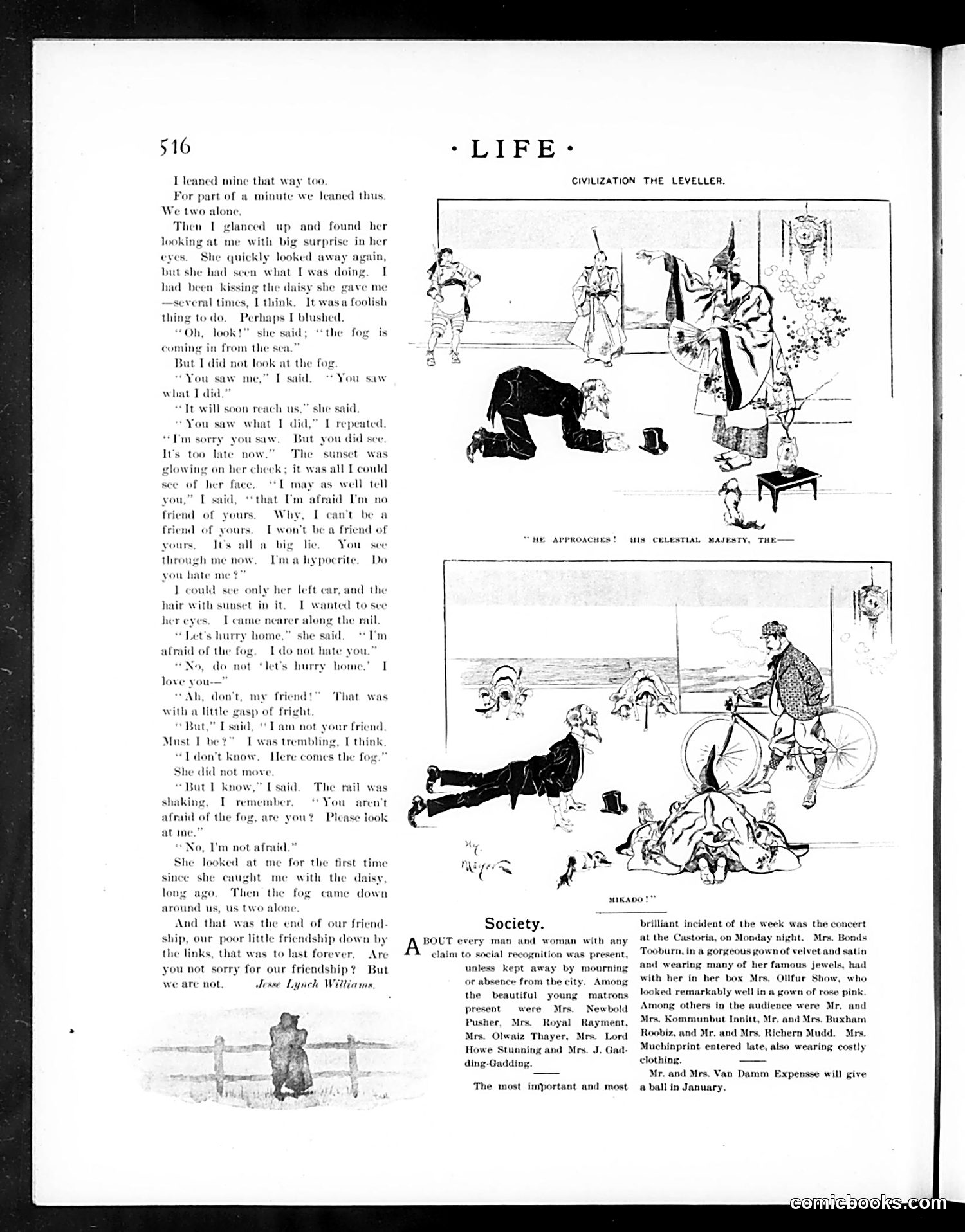
The top cartoon satirizes social pretension and hierarchy. A formally dressed figure (appearing to be of high status) is literally being leveled—knocked down—by figures representing common people or "civilization." The caption "He Approaches His Celestial Majesty" suggests mockery of someone's inflated sense of importance. The bottom cartoon, titled "Mikado!!," depicts what appears to be chaos or disruption involving bicycles and people in disarray, likely satirizing either reckless modern behavior or social disorder. The "Society" section discusses Manhattan social events and attendees from January. Together, these suggest *Life* magazine's recurring theme: mocking the pretensions of the wealthy and socially prominent, showing that progress and modernity have a leveling effect on traditional class hierarchies.
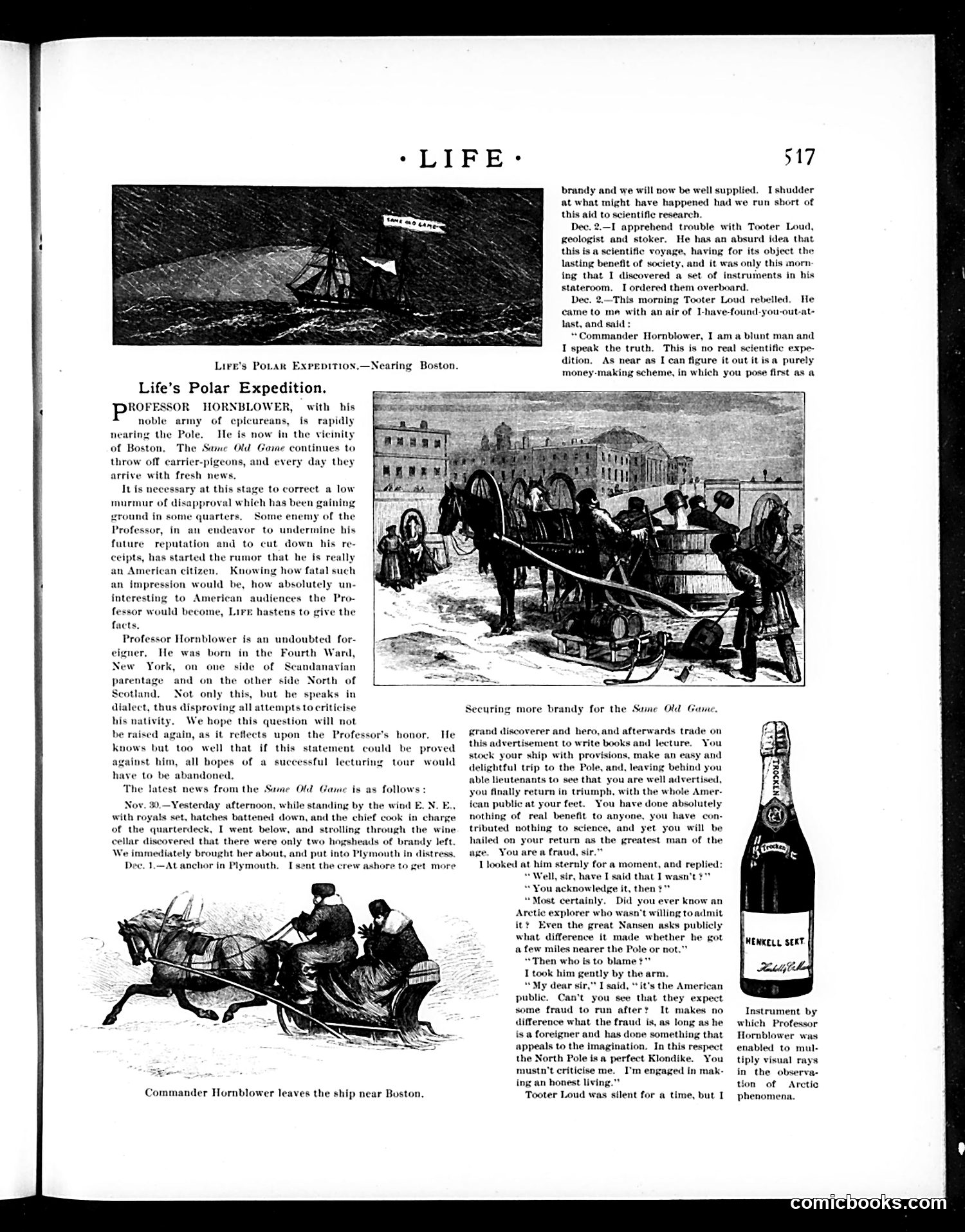
This page satirizes Professor Hornblower's Arctic expedition near Boston. The text reveals the satire's target: Hornblower is a "blunt man" conducting fraudulent polar research—he's actually just collecting brandy supplies near the city while falsely claiming Arctic exploration credentials. The illustrations show Hornblower's team securing provisions (the top image) and departing by sled near Boston (bottom). The joke mocks both the professor's scientific pretensions and the gullible public willing to believe an obviously fake polar venture occurring near a major American city. A character named Tooter Lord confronts Hornblower about the deception, calling him a "fraud." The satire targets scientific charlatanism and public credulity during an era when polar exploration captivated popular imagination.
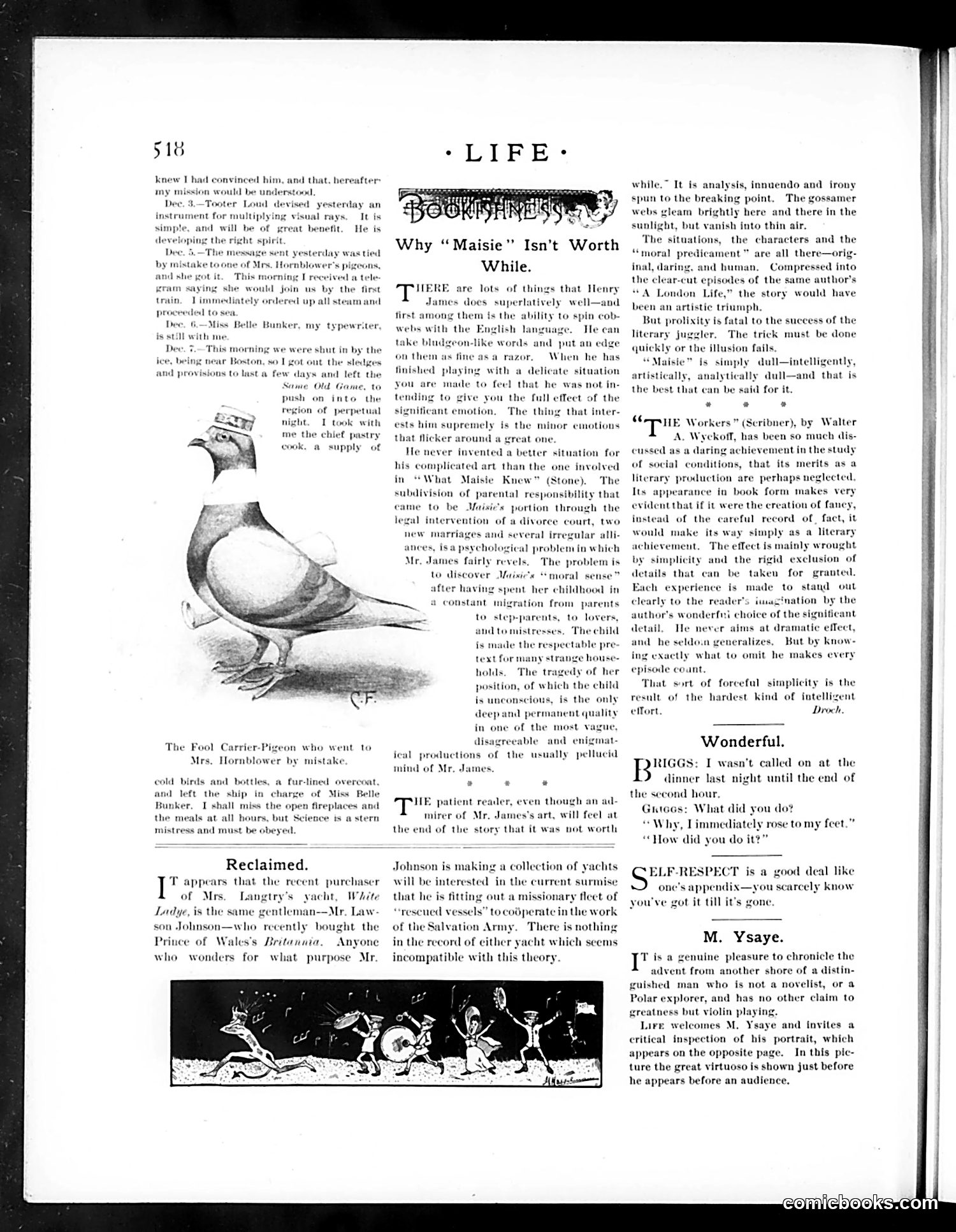
This page contains three distinct satirical pieces: 1. **"Why 'Maisie' Isn't Worth While"** - A literary critique of Henry James's short story "What Maisie Knew," praising James's sophisticated use of English but arguing the story's psychological complexity about parental custody and remarriage lacks sufficient "moral sense" to justify its difficulty. 2. **"The Fool Carrier Pigeon"** - An illustrated joke about a pigeon accidentally delivered to Mrs. Hornblower instead of its intended recipient, with accompanying sketch. 3. **"Reclaimed"** and **"M. Ysaye"** - Brief anecdotal pieces about yacht collecting and a celebrated violinist, respectively. The page exemplifies *Life*'s blend of literary criticism, humorous illustrations, and gossipy society commentary targeting educated urban readers.
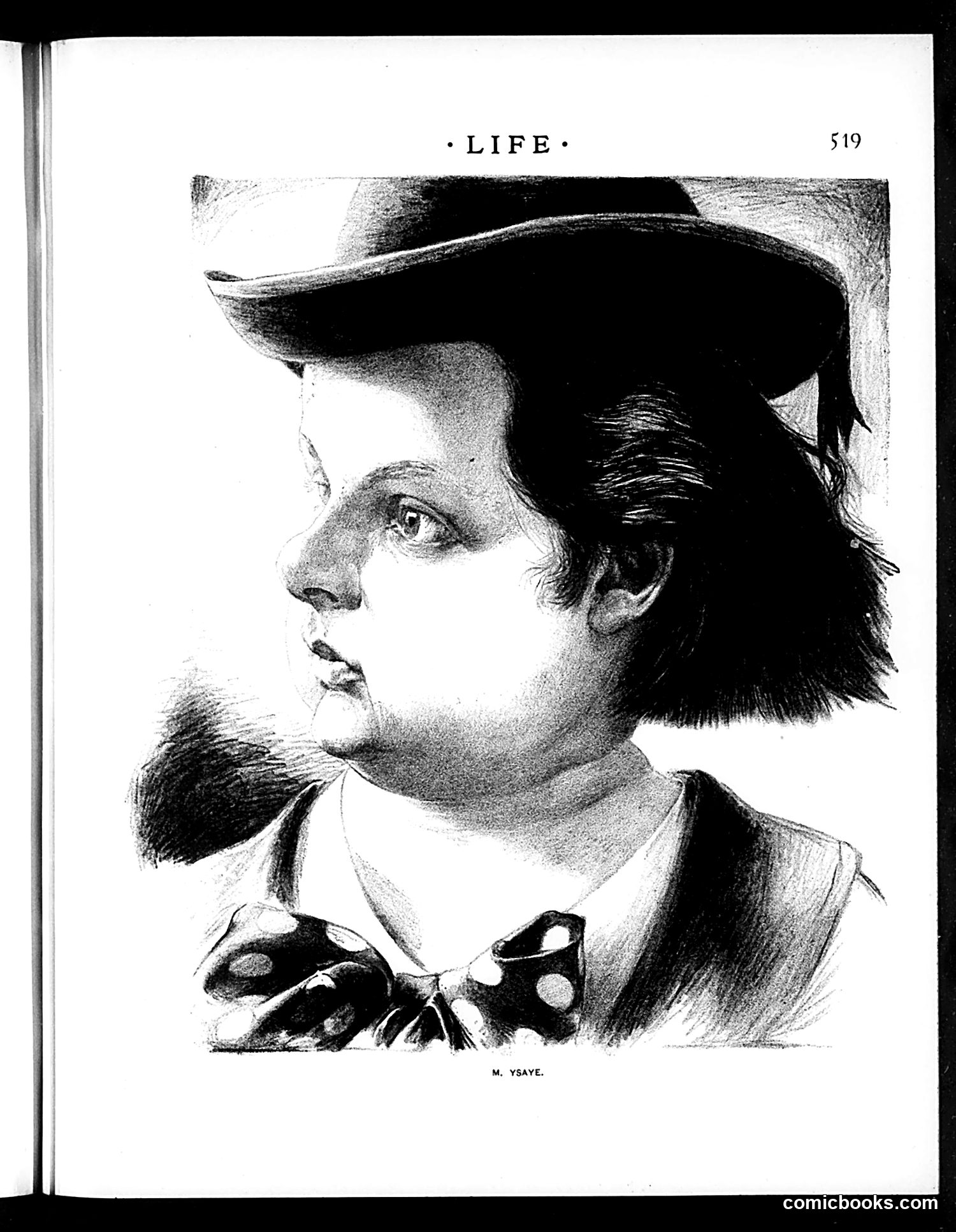
This is a portrait sketch labeled "M. YSAYE" from *Life* magazine (page 519). The image shows a man in profile wearing a distinctive wide-brimmed hat and a bow tie, rendered in black ink with careful attention to facial features and hair texture. Based on the name, this likely depicts Eugène Ysaÿe, a renowned Belgian violinist and composer of the late 19th/early 20th century. *Life* magazine frequently featured caricatures and portraits of prominent cultural figures of the era. Without additional context or caption text visible on this page, the specific satirical point—if any—is unclear. It appears to be a straightforward artistic portrait rather than a political cartoon, though the exaggerated facial proportions are typical of *Life*'s caricature style.
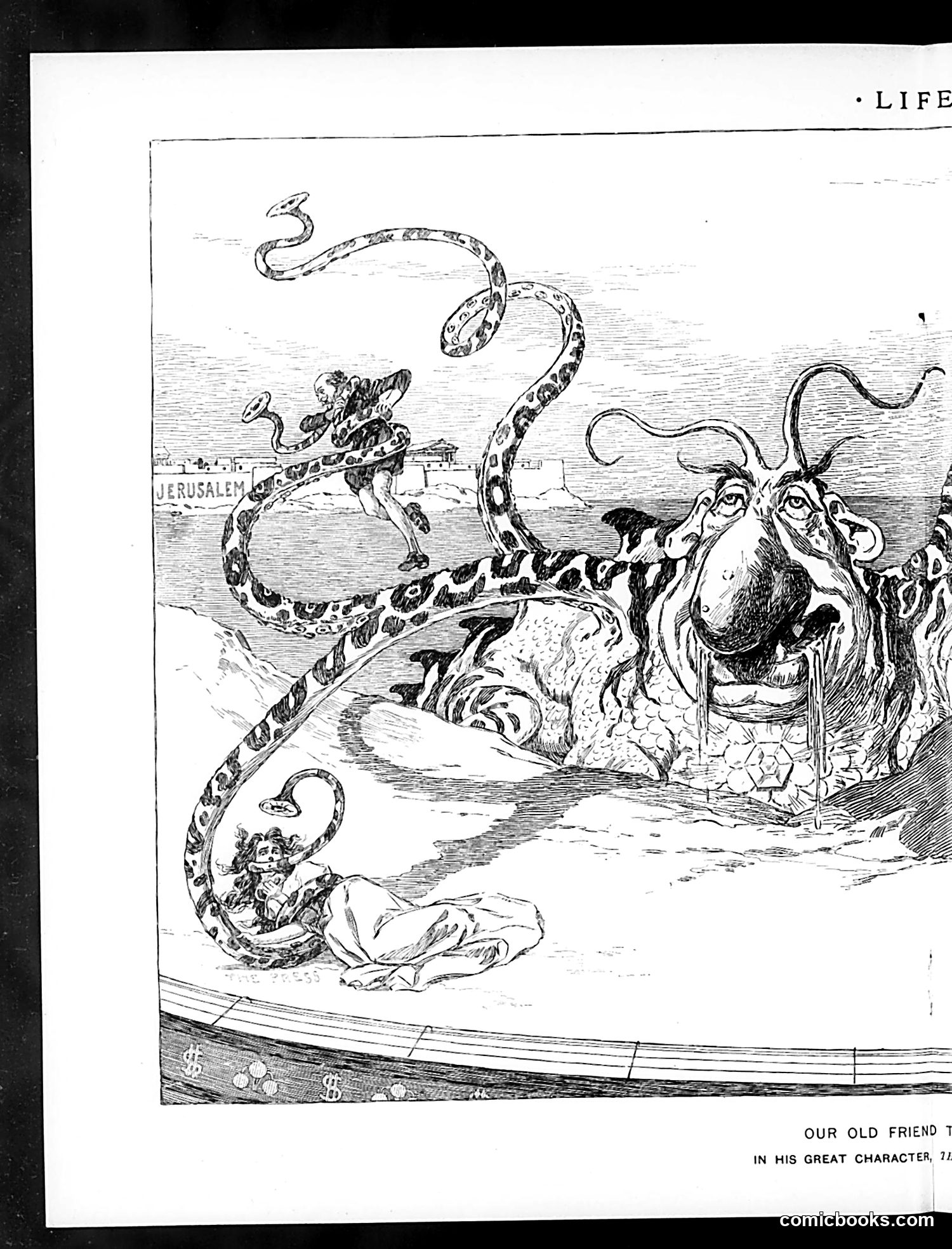
This Life magazine cartoon satirizes what appears to be Middle Eastern or colonial politics, with "Jerusalem" labeled in the background. The central figure is a goat with prominent horns, a common symbol of stubbornness or foolishness in political cartoons. Multiple serpents wrap around and entangle the goat, likely representing competing political interests or powers. The caption references "Our Old Friend" and "his great character," suggesting ironic commentary on a well-known political figure or nation. The snakes may represent various foreign powers or political factions attempting to control or manipulate the central figure. Without the complete caption, the specific historical context remains unclear, but the imagery suggests commentary on Middle Eastern geopolitical entanglement—possibly related to colonial-era power struggles or competing imperial interests.
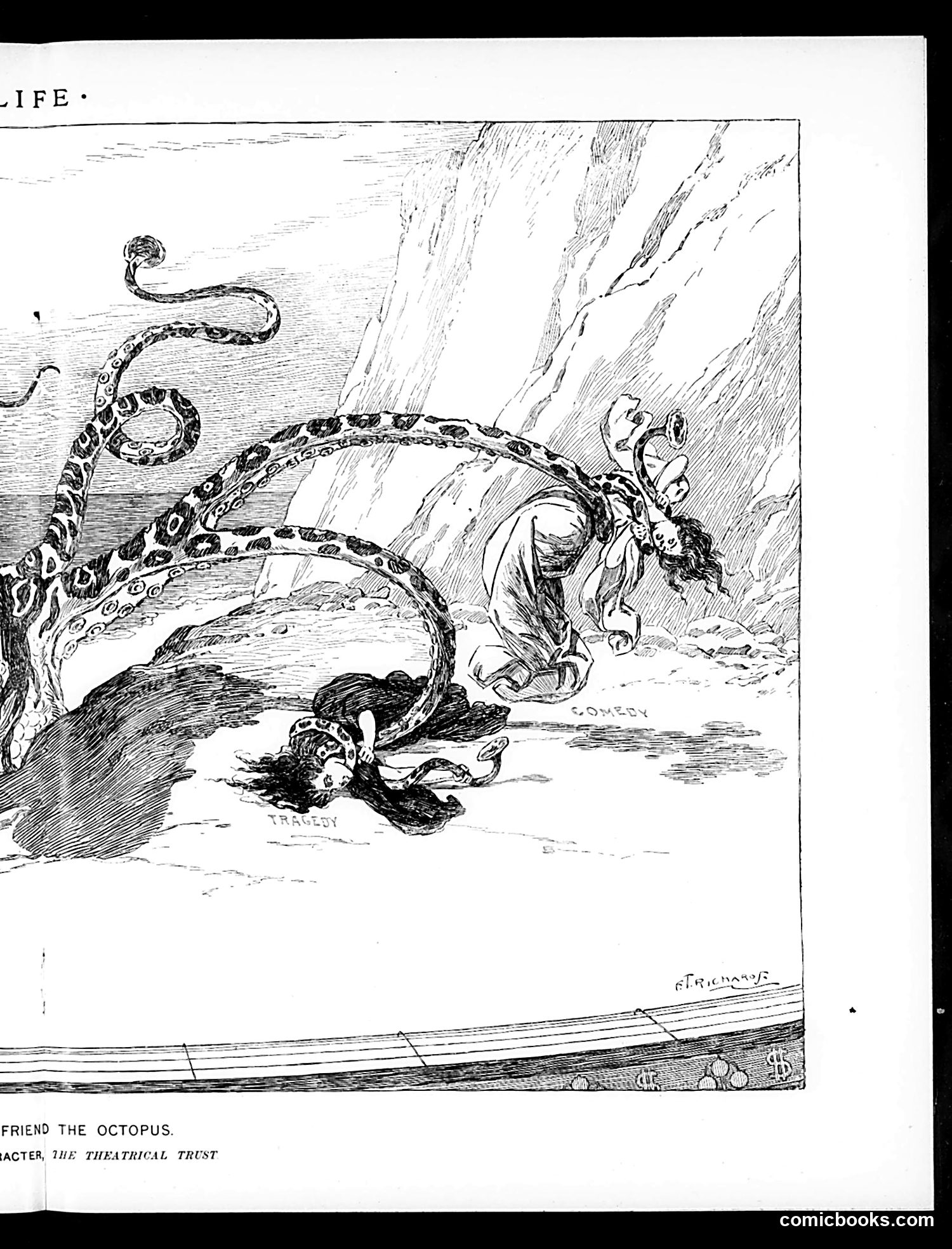
This satirical cartoon depicts a dramatic scene where a human figure labeled "COMEDY" flees in terror from a giant octopus, while another figure labeled "TRAGEDY" lies dead or dying on the ground below. The octopus likely represents a threatening force—possibly monopolistic power, censorship, or corporate control—that is destroying theatrical expression. The tentacles suggest suffocation and entanglement. The cartoon appears to reference threats to theatrical freedom, possibly related to "The Theatrical Trust" (mentioned in the caption), a real theatrical monopoly of the early 1900s that controlled distribution and theater access, forcing independent producers and performers into compliance or ruin. The cartoon warns that comedy and tragedy—essential to theater—are being destroyed by this predatory octopus.
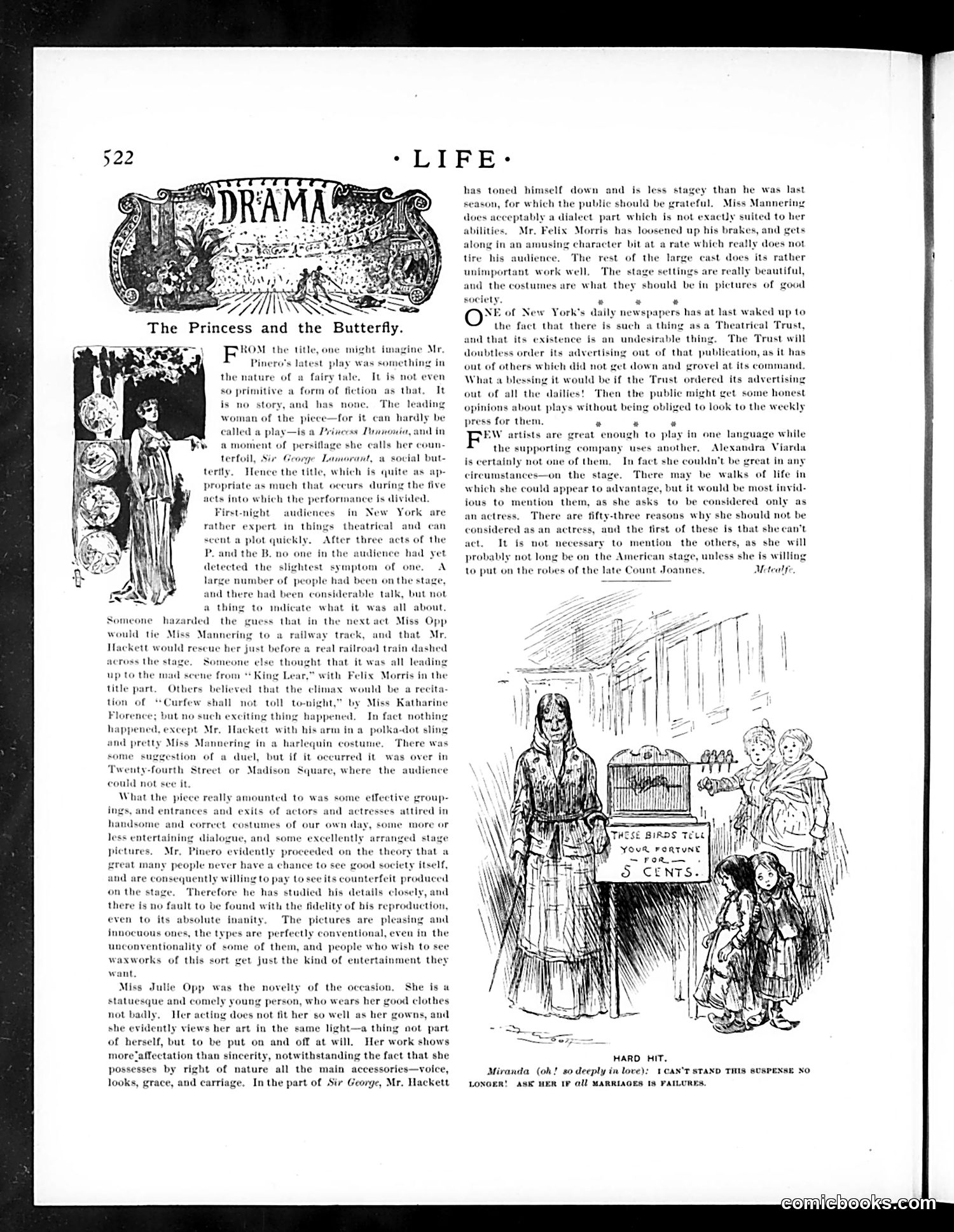
This is a theater review from *Life* magazine (page 522) critiquing a play called "The Princess and the Butterfly." The text praises the lead actress Miss Julie Opp's performance while critiquing other cast members and the overall production values. The cartoon below titled "Hard Hit" shows a fortune teller's booth scene. The gag references a line from the play: a character (Miranda) says she cannot endure suspense any longer and asks the fortune teller "if all marriages in Fairhaven" will fail. The cartoon satirizes theatrical drama by depicting the literal, awkward moment of this melodramatic plea—the exaggerated emotional earnestness typical of early 20th-century stage plays being mocked for its overwrought nature.
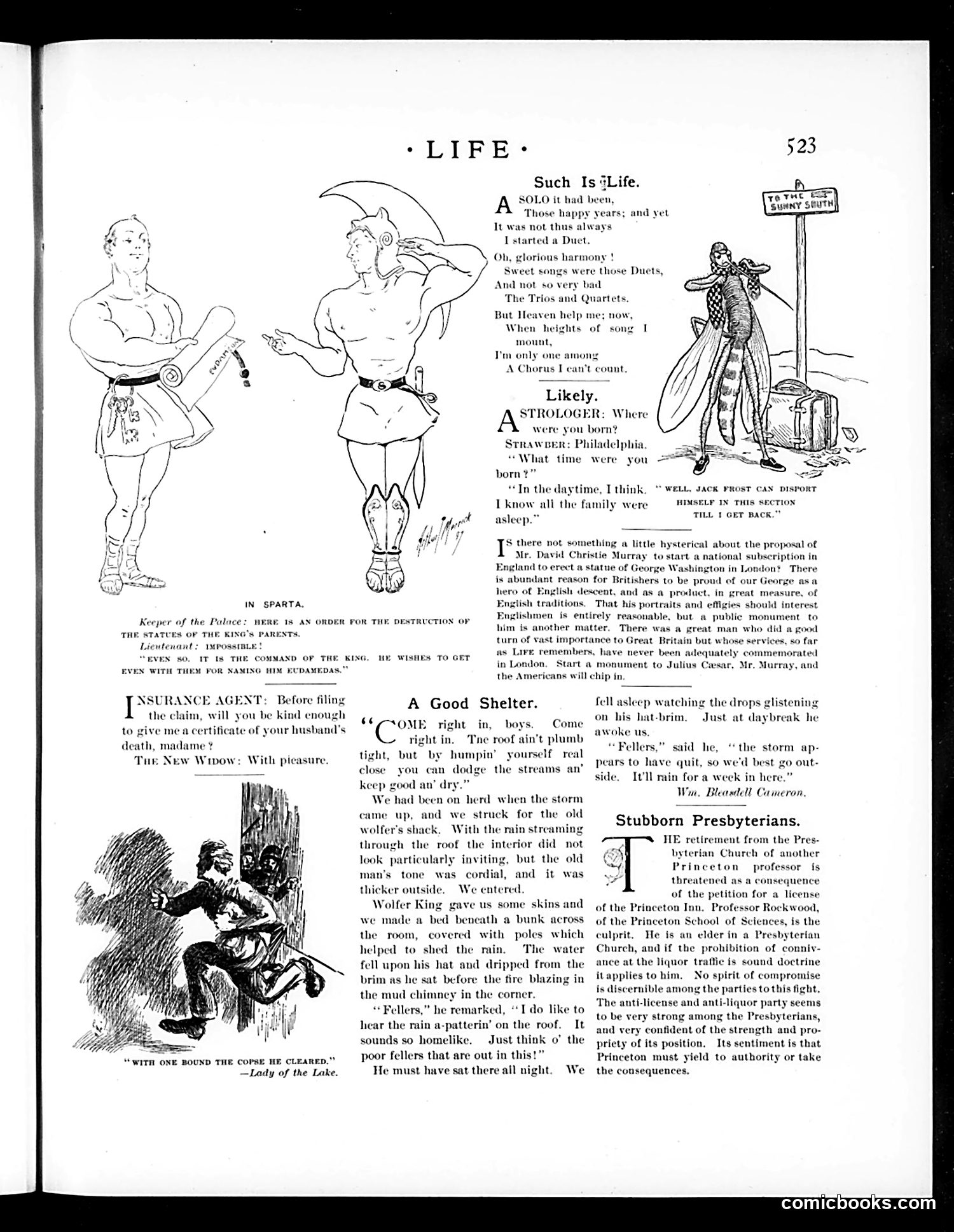
This page contains several satirical pieces typical of the era: **"In Sparta"** (left): A classical-style cartoon mocking military rigidity, showing a Spartan officer demanding obedience even regarding naming conventions—satirizing blind adherence to rules. **"Such Is Life"** (top right): A poem-dialogue between a solo singer and others lamenting the loss of group harmony (duets, trios, quartets), appearing to nostalgically critique modern individualism replacing communal traditions. **"Likely"** (middle): A humorous exchange where a strawberry asks a stroller where he was born; the reply that it was daytime "when the family were asleep" is absurdist comedy about absent-minded answers. **"A Good Shelter"** (center): A frontier story about weathering a storm in a shabby cabin—sentimental frontier fiction popular in the period. **"Stubborn Presbyterians"** (bottom right): Social commentary on Presbyterian Church rigidity regarding a license petition at Princeton Inn, satirizing inflexible religious doctrine conflicting with institutional realities. The page mixes humor, satire, and sentimental fiction typical of Life magazine's editorial approach.
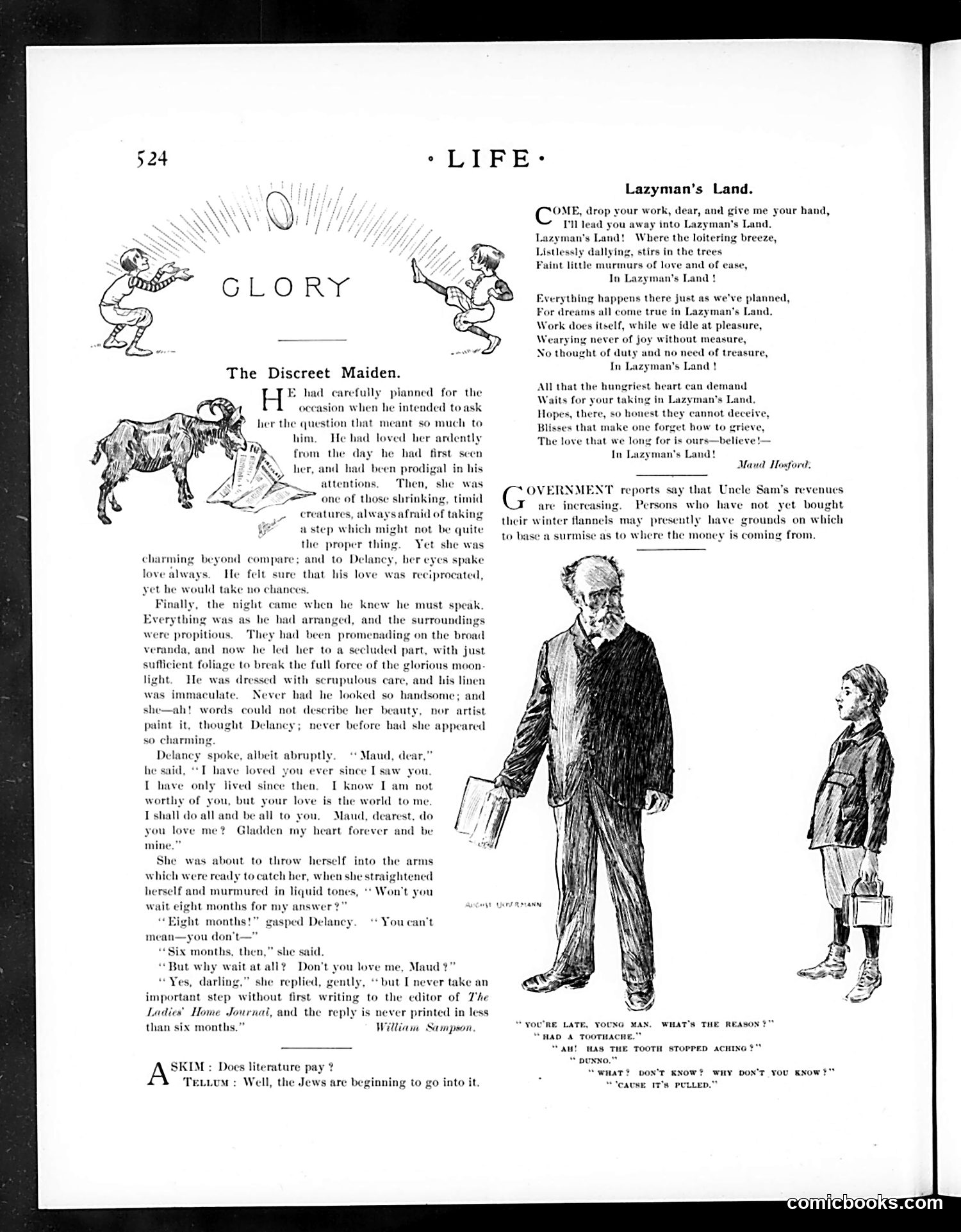
**"The Discreet Maiden"** satirizes the advice-column culture of the era. A man proposes to his sweetheart in romantic circumstances, but she refuses to give an answer without first consulting *The Ladies' Home Journal*—implying that women of the time relied so heavily on magazine advice that they couldn't make even major life decisions independently. The satire targets both the popularity of advice columns and the supposed dependency they fostered. **"Lazyman's Land"** is a whimsical poem mocking idleness and escapist fantasy, offering ironic promises that work will accomplish itself and dreams materialize without effort—social commentary on laziness. The **brief dialogue** at page bottom contains an antisemitic joke about Jews "going into" literature, reflecting unfortunately common prejudices of this early 20th-century publication. A political **reference to Uncle Sam's revenues** and winter flannels appears to comment on government finances or taxation during this period, though specific context is unclear without dating.
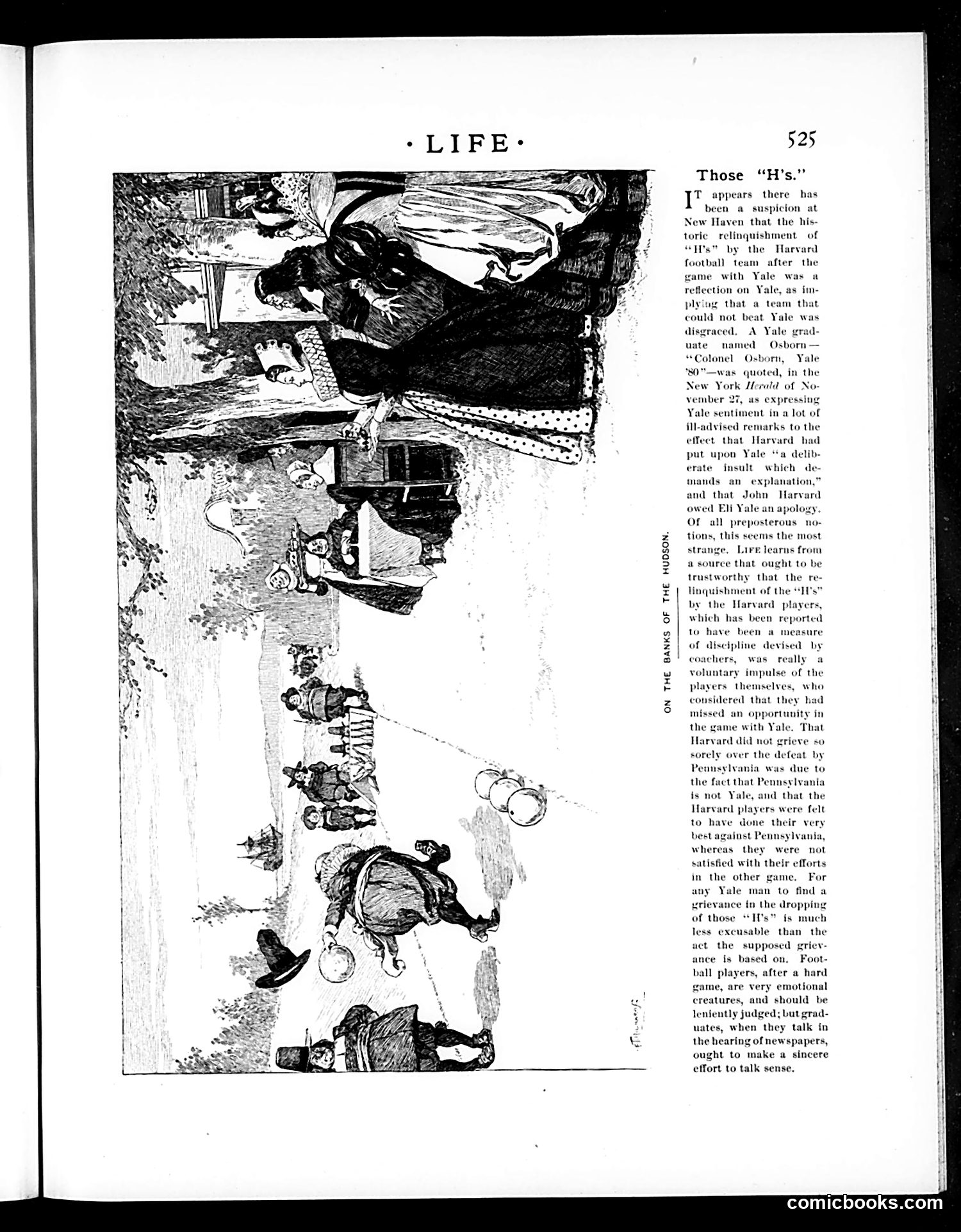
This page satirizes a controversy between Harvard and Yale universities over football team discipline. After Harvard's football team lost to Yale, Harvard players voluntarily removed their "H's" (letter insignia) as a self-imposed penalty for poor performance. A Yale graduate named Colonel Osborn publicly complained in the *New York Herald* that this gesture was an insulting reflection on Yale—implying Yale was so weak that losing to them was disgraceful. The *Life* article mocks Osborn's interpretation as absurd. It explains the "H's" removal was the players' own emotional response to underperforming, not a jab at Yale. The piece argues that football players deserve leniency after tough games, but alumni speaking to newspapers should "talk sense" rather than invent grievances. The cartoon (image details unclear from this reproduction) likely illustrates the inter-university rivalry's pettiness.
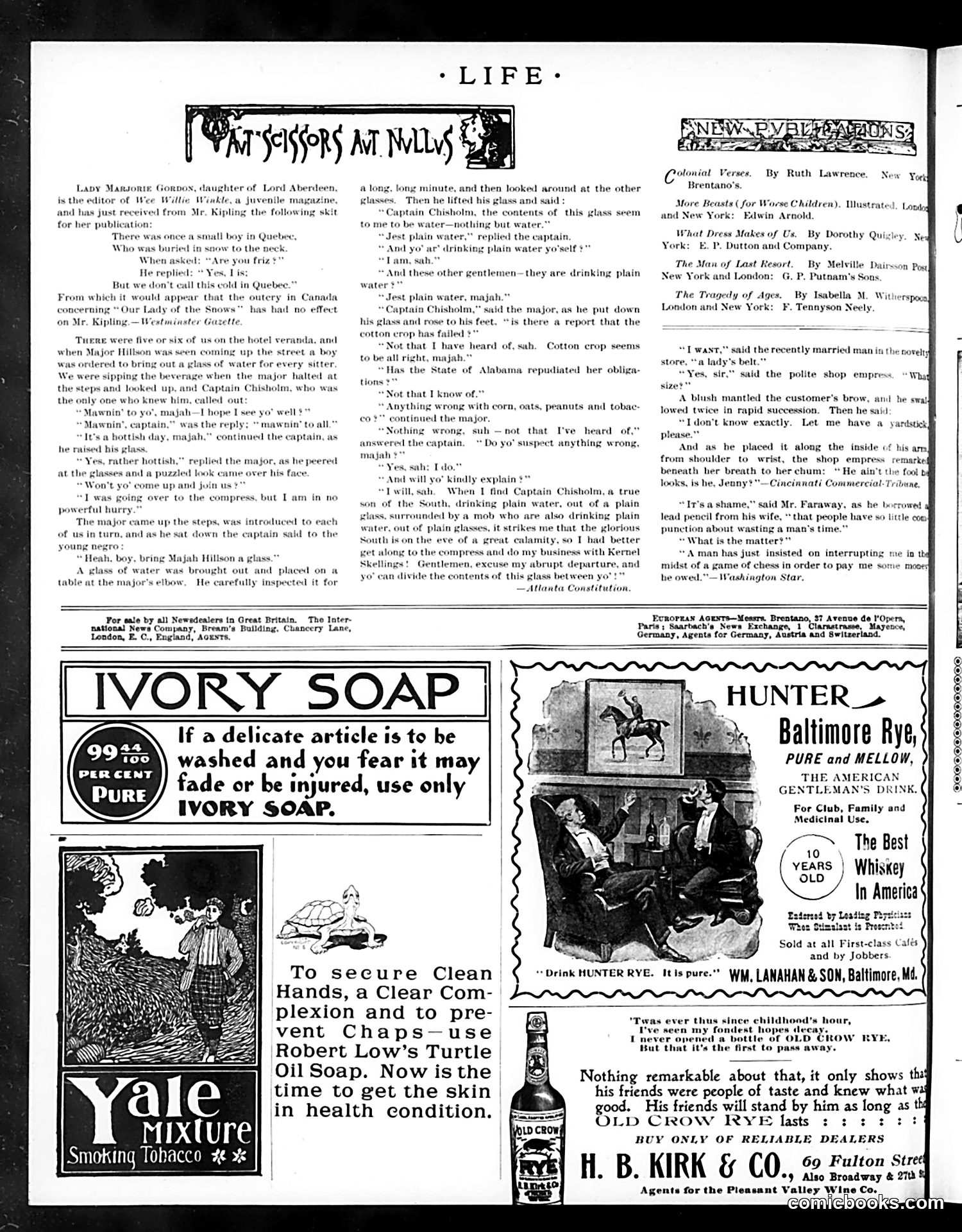
This page contains primarily **advertisements and literary notices** rather than political cartoons. The main content consists of: 1. **A humorous short story** (top) about Major Hillson discovering that Southern gentlemen are drinking plain water while pretending it's alcohol—a satirical jab at Southern pretension and the disconnect between appearance and reality. 2. **Multiple brief anecdotes** in the "New Publications" section mocking various social situations: a newlywed's complaint about wasted time, a shop employee's observation about a customer measuring his arm with a yardstick. 3. **Period advertisements** for Ivory Soap, Yale Mixture tobacco, Hunter Baltimore Rye whiskey, and Old Crow Rye—typical of early 1900s magazines. The satire is gentle and domestic rather than political, targeting universal human foibles like vanity, social pretense, and time-wasting rather than specific political figures or events. The humor relies on understated observations about everyday life.
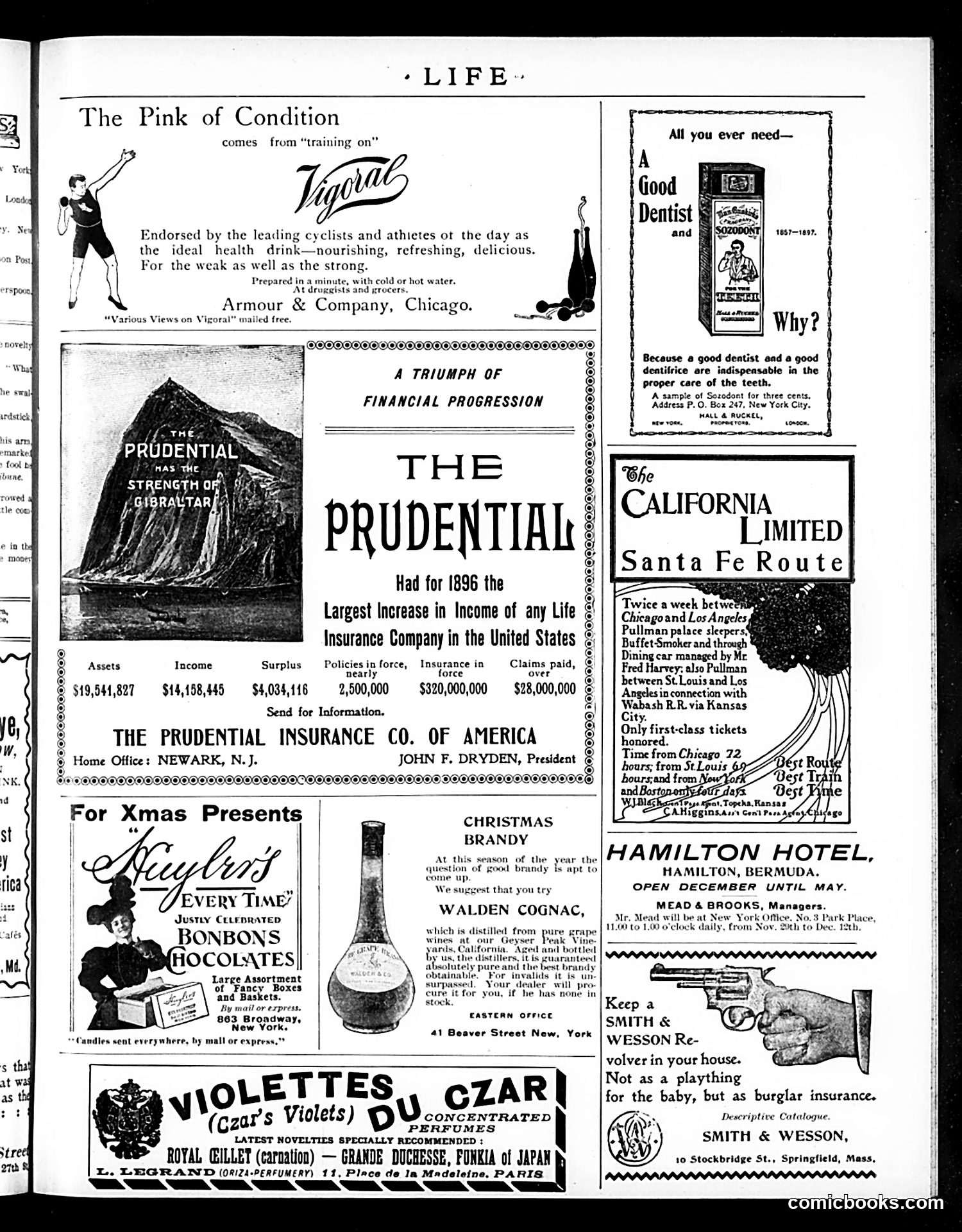
This is primarily an **advertising page**, not a political cartoon. It contains various product advertisements from the 1890s with no satirical content or political messaging. Key ads include: - **Vigoral** ("pink of condition"): A health drink endorsed by athletes and cyclists, marketed as nourishing and good for the weak - **The Prudential Insurance Company**: Boasts of its 1896 financial growth—largest income increase of any U.S. life insurance company - **Holiday products**: Walden Cognac brandy, Hayflurt bonbons chocolates, and Violettes du Czar perfume - **Transportation/Hotels**: California Limited train (Santa Fe Route) and Hamilton Hotel, Bermuda - **Smith & Wesson revolvers**: Advertised as "burglar insurance" for home protection The page reflects late-Victorian consumer capitalism: products marketed to the affluent through appeals to health, financial security, luxury, and personal safety. There is no cartoon satire present—this is straightforward period advertising.
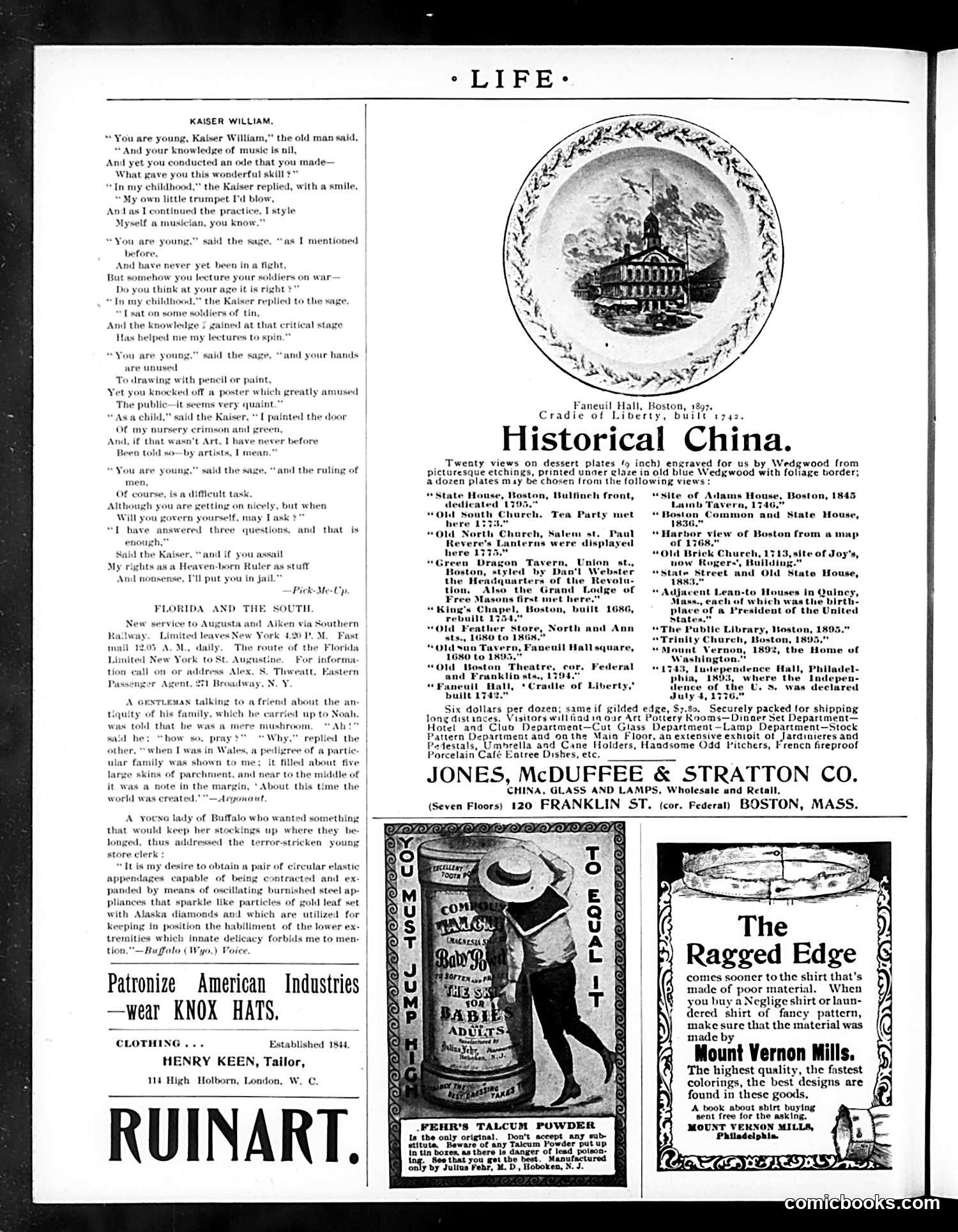
This page features a satirical poem mocking Kaiser Wilhelm II of Germany, presented as a dialogue between the Kaiser and an old sage. The satire works through **ironic reversal**: the sage questions how Wilhelm gained expertise in music, military strategy, and art despite lacking genuine training or experience. Wilhelm's replies reveal the joke—he credits childhood toys (a toy trumpet, toy soldiers, nursery painting) as the basis for adult mastery. **The political point**: This attacks Wilhelm's perceived arrogance and lack of legitimate qualifications to rule Germany and command its military. By attributing his confidence to mere childhood play rather than serious study or earned wisdom, the cartoon suggests he's dangerously unfit—a man-child playing at statecraft with real consequences. **Context**: This likely dates to tensions before World War I, when Wilhelm was frequently caricatured in American and British publications as an aggressive, incompetent autocrat. The "Pick-Me-Up" credit suggests British satirical origin. The page is otherwise advertising and historical content about Boston landmarks.
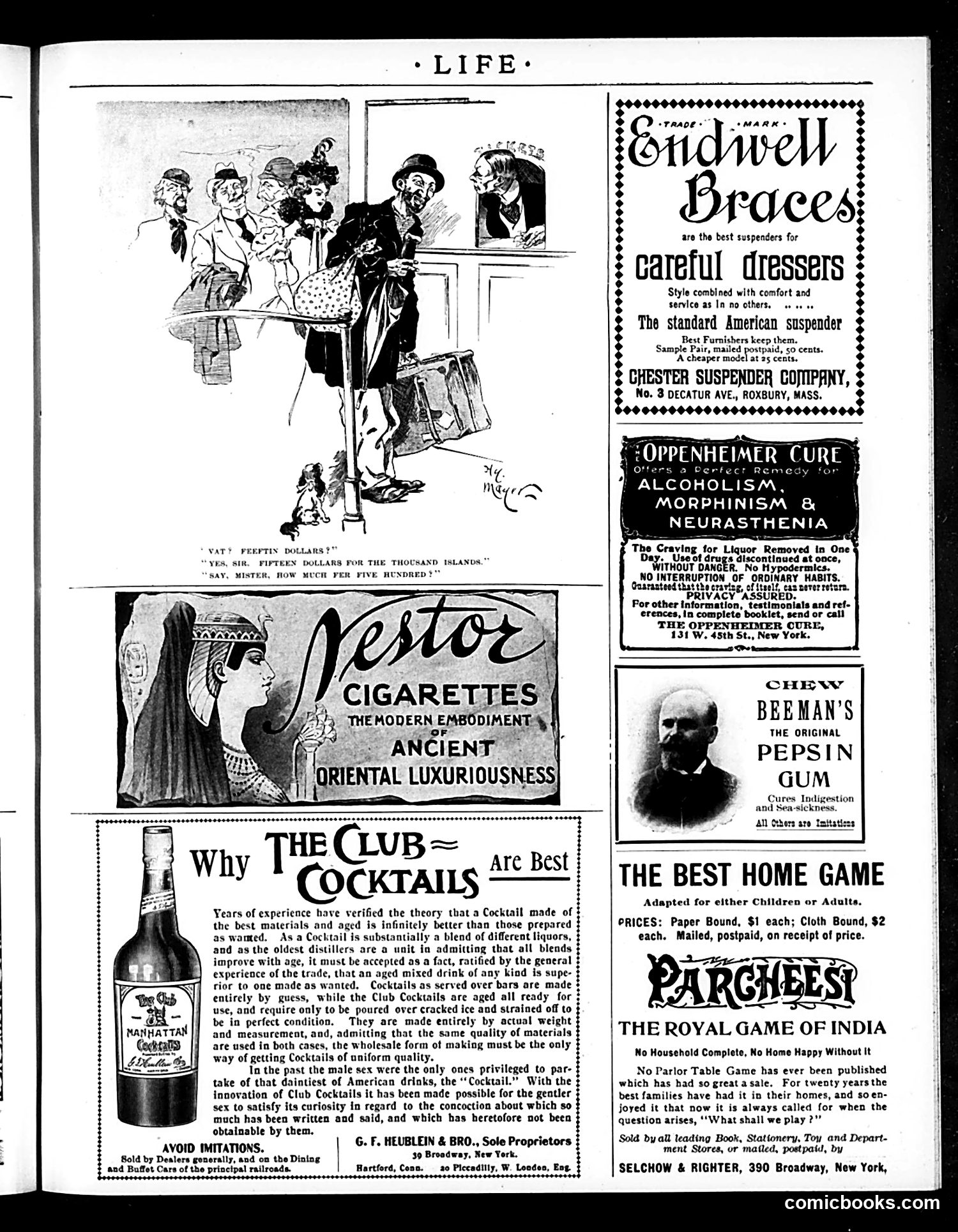
The main cartoon satirizes wealthy tourists' ignorance about currency exchange. A well-dressed man asks a vendor about prices for "thousand islands" (likely souvenirs), then questions the rate for half that amount—apparently believing the price should scale proportionally rather than understanding that unit costs remain constant. The humor lies in his assumption that halving the quantity halves the total cost, exposing upper-class obtuseness about basic arithmetic and commerce. The page is otherwise dominated by period advertisements, including remedies for alcoholism and morphine addiction (the "Oppenheimer Cure"), Nestlé cigarettes, Club Cocktails, and various consumer goods. These ads reflect early 20th-century American commercial culture and social attitudes toward substance abuse treatment.
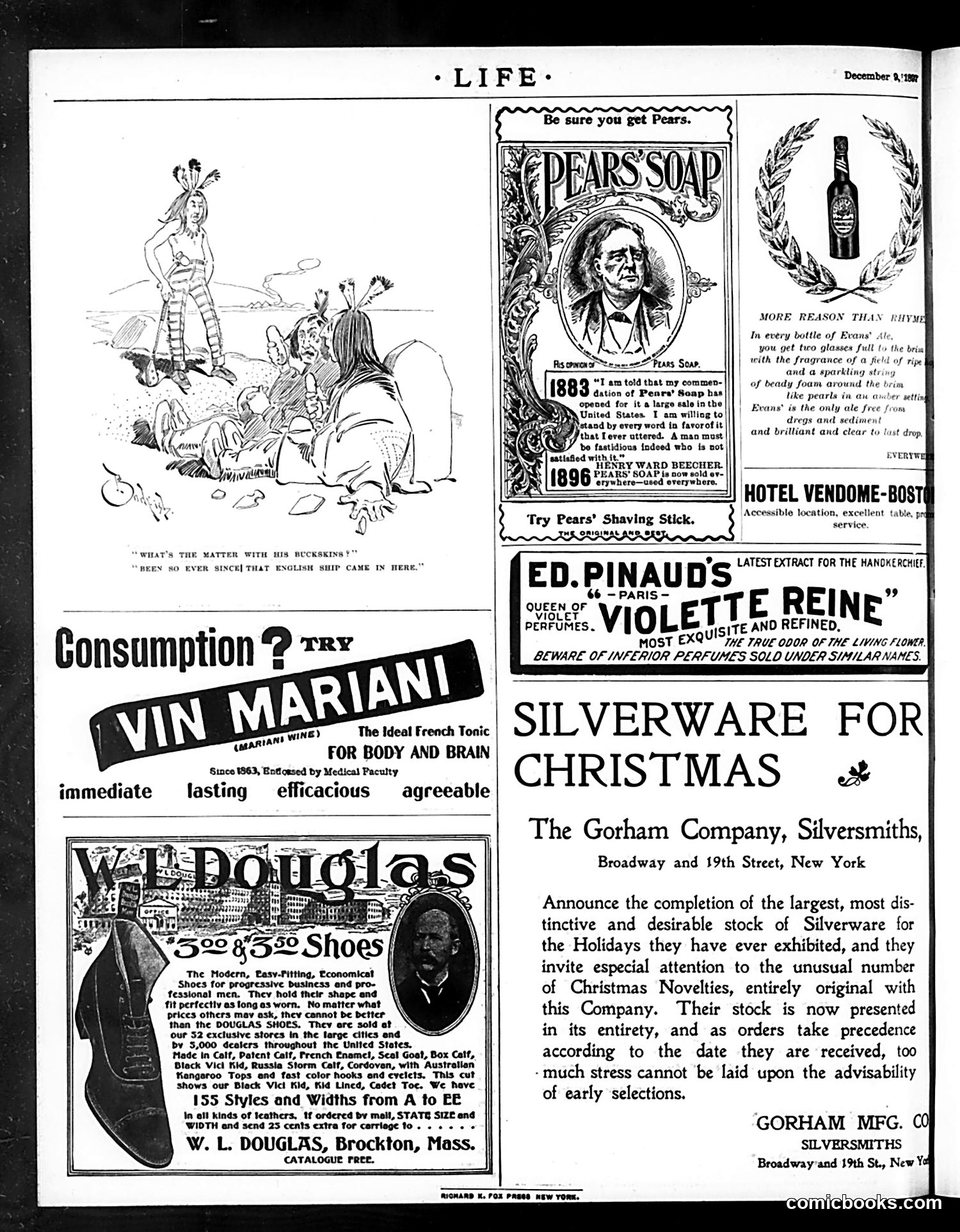
The main cartoon satirizes **Native American resistance to European colonization**, specifically depicting Indigenous people reacting with alarm to European encroachment. The caption—"What's the matter with his buckskins?" / "Been so ever since that English ship came in here"—suggests anxiety about the arrival of English settlers and the disruption of Indigenous life. The figure standing appears to be a caricatured Native American, while seated figures examine objects, likely representing confusion or distress over foreign goods and influence. The satire appears to mock Indigenous peoples' responses to colonization while normalizing European expansion as an inevitable historical force. The page is otherwise dominated by period advertisements (Pears' Soap, Vin Mariani wine, W.L. Douglas shoes), typical of Life's commercial content. The cartoon's perspective reflects the era's dismissive attitudes toward Native American concerns about colonization.