
Life, 1897-12-09 · page 8 of 20
Life — December 9, 1897 — page 8: what you’re looking at
What you’re looking at
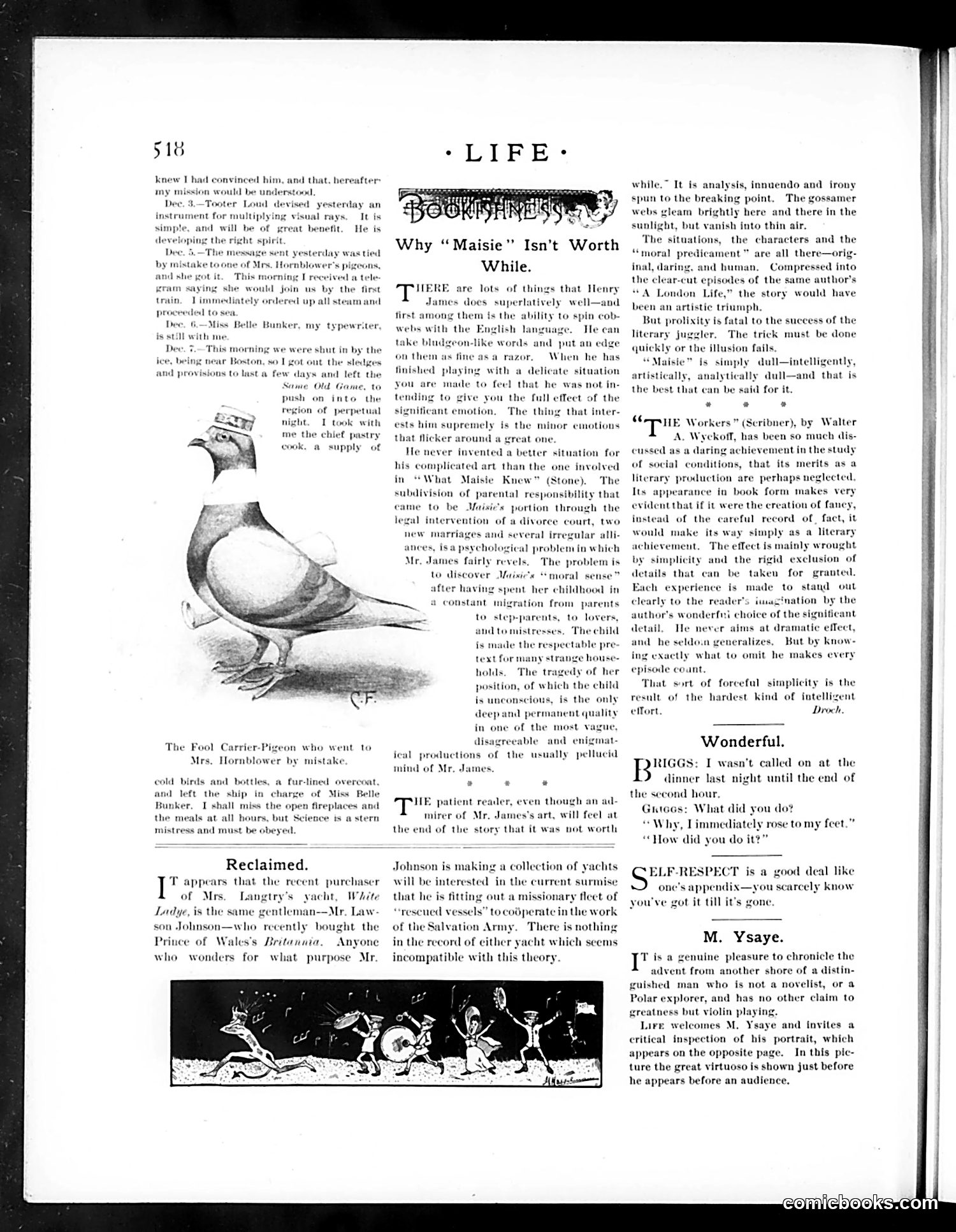
This page contains three distinct satirical pieces: 1. **"Why 'Maisie' Isn't Worth While"** - A literary critique of Henry James's short story "What Maisie Knew," praising James's sophisticated use of English but arguing the story's psychological complexity about parental custody and remarriage lacks sufficient "moral sense" to justify its difficulty. 2. **"The Fool Carrier Pigeon"** - An illustrated joke about a pigeon accidentally delivered to Mrs. Hornblower instead of its intended recipient, with accompanying sketch. 3. **"Reclaimed"** and **"M. Ysaye"** - Brief anecdotal pieces about yacht collecting and a celebrated violinist, respectively. The page exemplifies *Life*'s blend of literary criticism, humorous illustrations, and gossipy society commentary targeting educated urban readers.
📄 Transcribed text from this page (OCR, searchable)
Machine-transcribed from the original scan — historical spelling and the odd misread are preserved.
and that, hereafter: vised yesterday an It is He is visual nays. and will be at benefit ram saying she would join us by th train. Timmedia red up all st proceeded to sea Dee Miss Belle Bunker is still with me. Dev my typewriter This mor r Bost sto last a few g we were shut so T got ont the sledges lays and left th Same Old Game. t the of perpetual I took with 3 ot by the and provis! push on into regio night nh who went to . Hornblower by mistake cold birds and bottles, a fur-lined ¢ and left the ship in charge of Mi Bunker. I shall miss the open firey the meals at all hours, but Scienc mistress and must be obeyed. ‘coat, Belle es and stern Reclaimed. appears that the recent purchaser of Mrs. Langtry’s hit, White Jadye, is the same gentleman—Mr. Law son Johnson—who recently bought the of Wales's Britannia. Anyone wonders for what purpose Mr. Prince who Why “Maisie” Isn’t Worth While. TERE are lots of things that Henry James does superlatively well—and first among the ability to spin webs with the En: take blud: When he 1 playing with a delicate situati © to feel that he was not in- ive you the full effect of the The thing that int you are 1 tending to significant emotion, ests him supremely is the minor emotions that flicker He never round a great one. nvented a better situation for his complicated art than the one involved What Maisie Knew” (Stone). The subdivision of parental responsibility that e to be Muisie’s portion through the al intervention of new marri divorce court, two xes and several irregular alli- chological problem in which mes fairly revels. The problem is Muixie’s “moral sens at her childhood in ion from parents ances, isa p: Mr.d discover having spe to lovers, The child is made the respectable pre- text for many strange house- holds. The tragedy of her position, of which the child to. step-parents, and to mistresses, is unconscic is the only deep and permanent quality in one of the most v di eable and enigmat- 1s of the usually pellucid atient reader, even though an ad- mirer of Mr. James's art, will feel at end of the story that it was not worth Johnson is making a collection of yachts will be interested in the current surmise that he is fitting out a missionary flect of “rescued vessels” to codperate in the work of the Salvation Army. There is nothing in the record of either yacht which seems incompatible with this theory. while.” It is analysis, innuendo and irony spun to the breaking point, The goss webs gleam brightly here and there in the sunlight, but vanish into thin air, the characters and the ment” are all there—orig- human, Compressed into isodes of the same author's ndon Life,” the story would have tistic triumph. But prolixity is fatal to the success of the literary. ju The trick must be done quickly or the illusion fails, “ Maisie” dull—intelligently, artistically, analytically dull—and that is the best that ¢ id for it. . ° ° “tT! E Workers” (Scribner), by Walter A. Wyckoff, has been so much dis- cussed as a daring achievement in the study nditions, that its merits as a The situations moral predic inal, daring, a * is simply of social ¢ literary production are perhaps neglected, Its appearance in book form makes very evident that if it were the creation of fancy instead of the careful record of, fact, it would make its way simply as a literary achievement. The effect is mainly wrought plicity and the rigid exclusion of details that can be taken for granted. ach experience is made to stand out clearly to the reader's imagination by the author's wonderfui choice of the signitieant He never aims at dramatic effect, «lhe seldoin generalizes, But by know- ly what to omit he makes every by si detail ing exa isode count, jut sort of forceful simplicit the hardest kind of intelligent Droch. is the result ¢ effort. Wonderful. i RIGGS: I wasn’t called on at the dinner last night until the end of the second hh Gite “Why, Limmediate “How did you do it? ur, What did you do? rose tomy feet.” ELF-RESPE! one’s appendix— . is a good deal like ui scarcely know you've got it till it’s gone. M. Ysaye. asure to chronicle th her shore of a distin- ist, or a T is a genuine pI advent from an guished man who is not a no Polar explorer, and has no other claim to greatness but violin playing. Lire welcomes M, Ysaye and invites a critical inspection of his portrait, which appears on the opposite page. In this pic- ture the great virtuoso is shown just before he appears before an audience.