
Life, 1897-12-09 · page 15 of 20
Life — December 9, 1897 — page 15: what you’re looking at
What you’re looking at
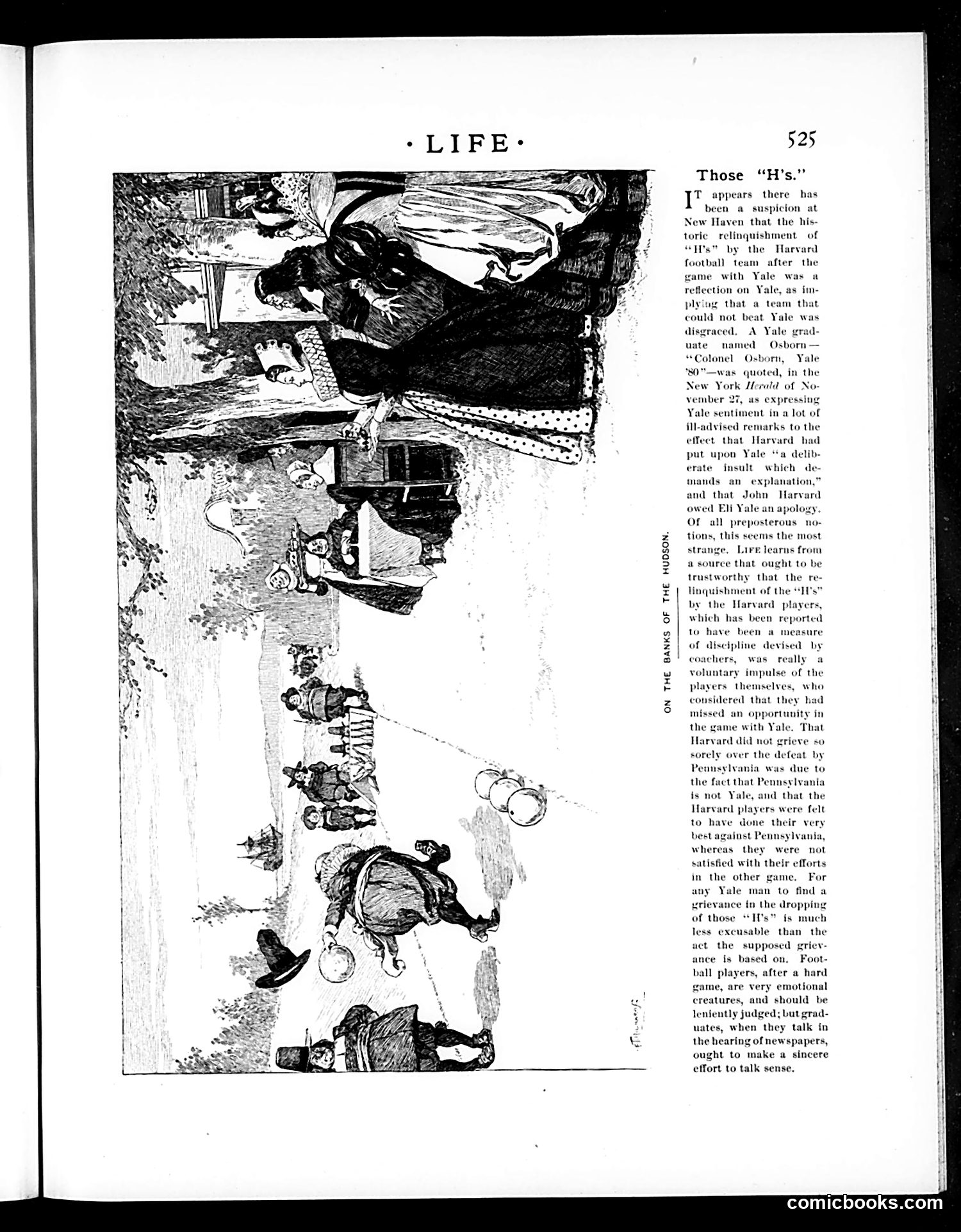
This page satirizes a controversy between Harvard and Yale universities over football team discipline. After Harvard's football team lost to Yale, Harvard players voluntarily removed their "H's" (letter insignia) as a self-imposed penalty for poor performance. A Yale graduate named Colonel Osborn publicly complained in the *New York Herald* that this gesture was an insulting reflection on Yale—implying Yale was so weak that losing to them was disgraceful. The *Life* article mocks Osborn's interpretation as absurd. It explains the "H's" removal was the players' own emotional response to underperforming, not a jab at Yale. The piece argues that football players deserve leniency after tough games, but alumni speaking to newspapers should "talk sense" rather than invent grievances. The cartoon (image details unclear from this reproduction) likely illustrates the inter-university rivalry's pettiness.
📄 Transcribed text from this page (OCR, searchable)
Machine-transcribed from the original scan — historical spelling and the odd misread are preserved.
525 Those ‘“H’s.” FE appears there has been a suspicion at New Haven that the his- toric relinquishment of “IPs” by the Harvard football team after the game with Yale was a reflection on Y plylug that a team that could not beat Yale was disgraced, A Yale uate named Osborn — onel Osborn, Yale s quoted, in the New York Jerald of No- vembe Yale sentiment in a lot of ill-advised remarks to the effect that Harvard bad put upon Yale “a delib- e insult’ which mands explanation and that John Har owed Eli Yale an apoloxy. Of all preposterous no- tions, this seems the most ris from a source that ought to be trustworthy that the re- Hnquishment of the “I's by the IL d_ players, which has been reported to have been a measure of discipline devise coachers, was really voluntary impulse of the players themselves, who considered that they had missed an opportunity in the game with Yale Harvard did 1 sorel by Pennsylvania was due to the fact that Pennsylvania is not wd that the Harvard players were felt to have done their very z fey 2 3 > x I faa & 3 g £4 Zz < a w x faa Zz f] best against Pennsylvania, whereas they were not satisfied with their efforts in the other game, Fe ale man to find a xrievance in the dropping of those “11's” is mach less excusable than the act the supposed grie ance is based on, Foot- ball players, after a hard ne, are very emotional creatures, and should be leniently judged; but grad- es, when they talk in the hearing of newspapers, ought to make a sincere effort to talk sense, comicbooks.com