
Life, 1897-12-09 · page 5 of 20
Life — December 9, 1897 — page 5: what you’re looking at
What you’re looking at
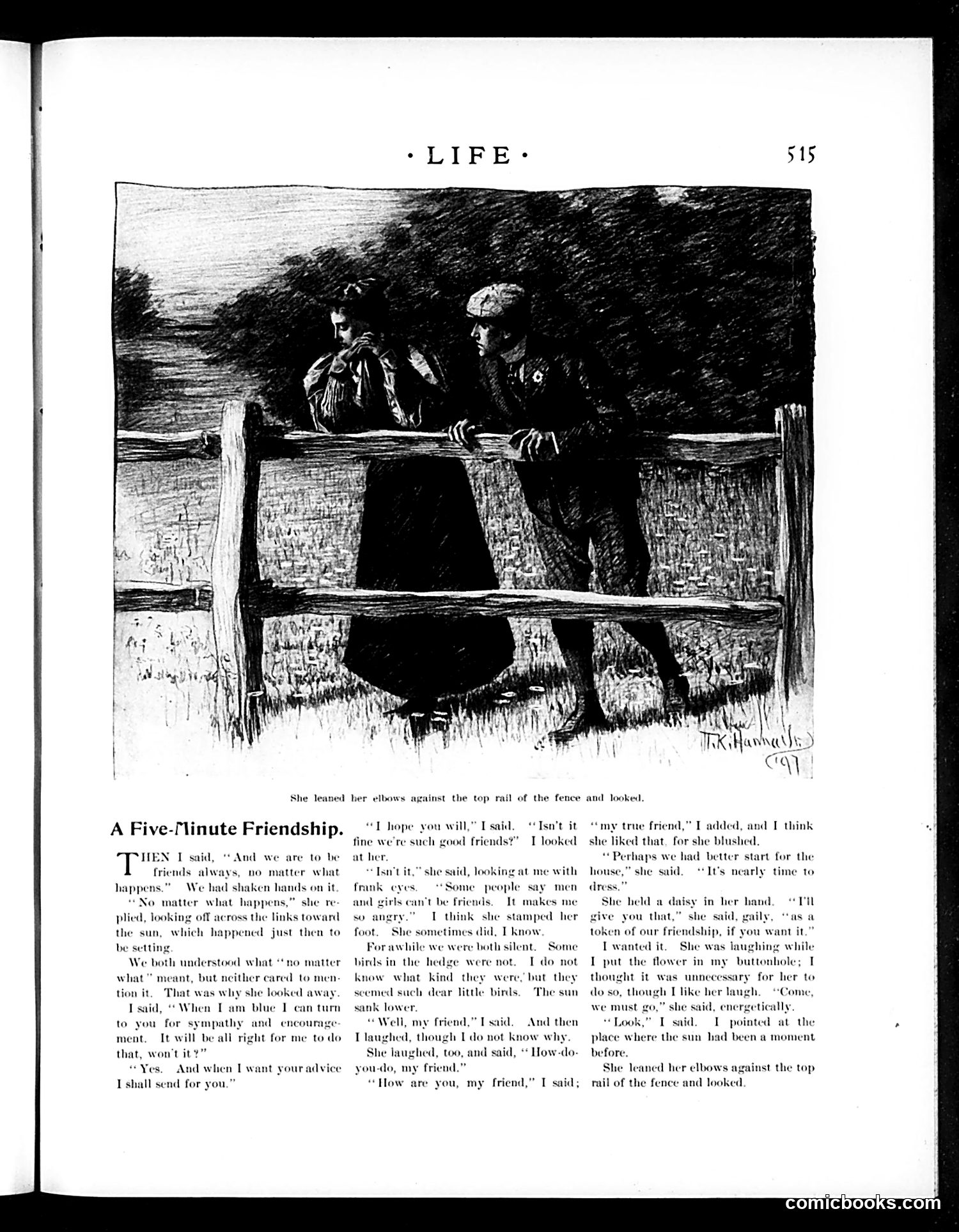
This page presents a short story about two young women meeting by a fence and quickly forming a friendship. The illustration shows them leaning together against a fence rail, gazing at the landscape. The narrative explores themes of female companionship and social connection. One character reassures the other that despite societal claims that "men and girls can't be friends," their budding relationship proves otherwise. The story emphasizes emotional honesty and spontaneous human connection—the women bond through vulnerability and shared understanding rather than pretense. The satire appears gentle rather than political, mocking conventional social wisdom about gender relations while celebrating the possibility of authentic, unpretentious friendships. The artwork's soft, romantic style reinforces the sentimental tone of this early 20th-century Life magazine piece.
📄 Transcribed text from this page (OCR, searchable)
Machine-transcribed from the original scan — historical spelling and the odd misread are preserved.
She leaned A Five-linute Friendship. Te I happens. aid, And we are to be s always, no matter what We had shaken y matter what happen: plied, lookin, ds on it * she re off across the links towand the sun, which happened just then to be setting. We both understood what ‘no matter what” tion it meant, but neither cared to men That was why she looked away I said, “When Tam blue 1 can turn to you for sympathy and encourage ment. It will be all right for me to do that, won't it?” es. And when [want your advice I shall send for you.” her elbow “T hope you will,” Tsaid. Isn't it fine we're such good friends?” T looked at her. Tsn'tit,” she said, looking at me with frink “Some people say men “tbe friends. It makes me I think she stamped her foot. She sometimes did, I know For awhile we were hoth silent. Some birds in the hedge were not. I do not know what kind they were, but they seemed such dear little birds. The sun sank lower. “Well, my friend,” T said. And then T laughed, though Ido not know why. She laughed, too, and said, ‘* How-do- you-do, my friend.” “How are you, my friend,” T said; nst the top rail of the fence and looked. “my true friend,” T added, and [think she liked that, for she blushed. Per house, aps we had better start for the she said. “It’s nearly time to dress.” She held a daisy in her hand. give you that,” she saic token of our friendship, if I wanted it “Tn aily, “as a mv want it.” ing while I put the flower in my buttonholc thought it was unnecessary for her to do so, though [like her laugh. “Come, we must go,” she said, enc! ically. She was la’ “Look,” [said place where the sun had been a moment before. She leaned her elbows against the top rail of the fence and looked