
A complete issue · 22 pages · 1897
Life — October 28, 1897
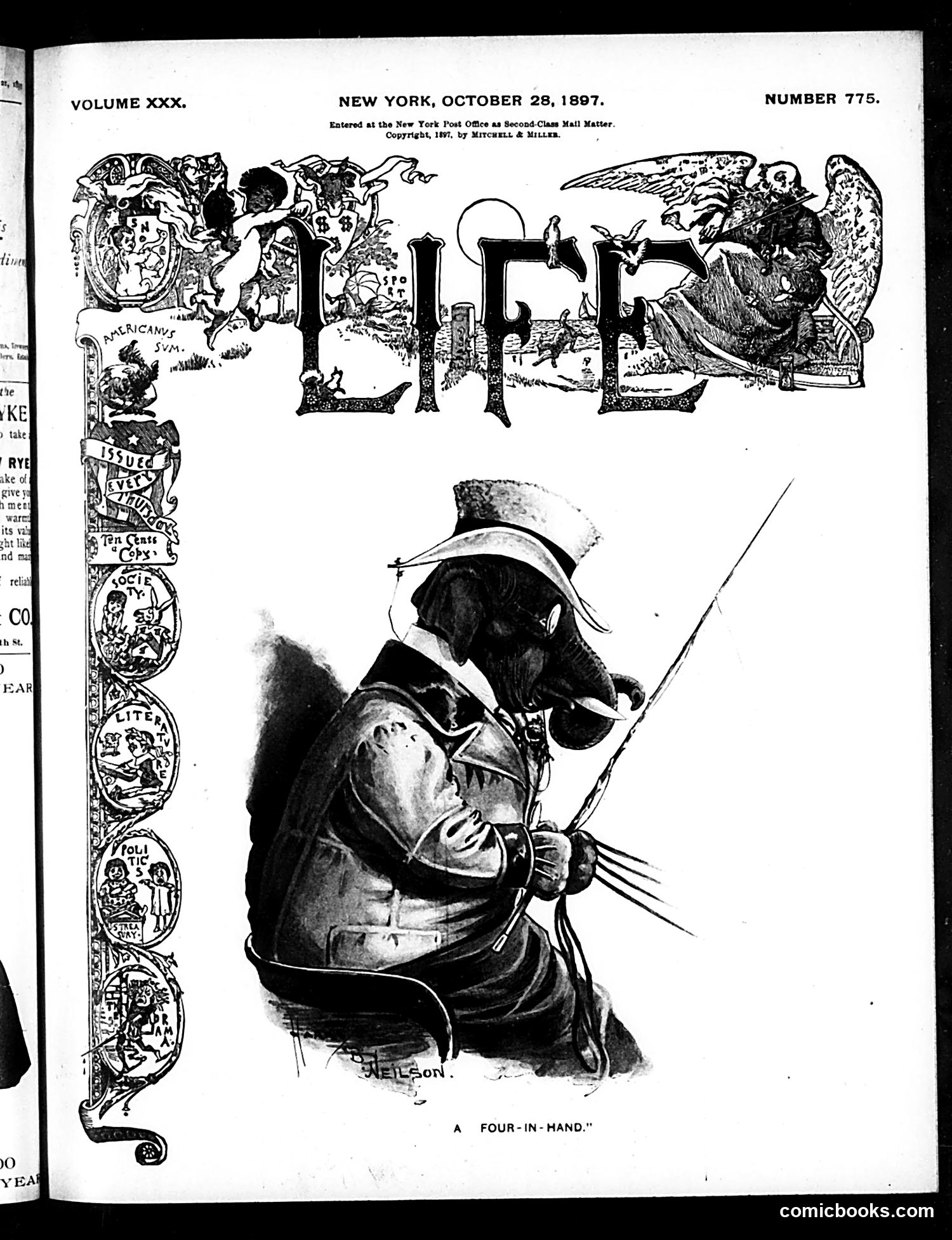
The main illustration, titled "A Four-in-Hand," depicts a figure in formal attire (top hat, overcoat) struggling to control four horses simultaneously while holding their reins. The artist's signature reads "Neilson." This appears to be political satire about managing multiple difficult responsibilities or constituencies at once. The "four-in-hand" (a type of carriage drawn by four horses) serves as metaphor for juggling competing demands. Without additional context from the article text, the specific political situation referenced is unclear, though the formal dress suggests this concerns a government or political figure attempting to maintain control over divergent interests or factions during this period.
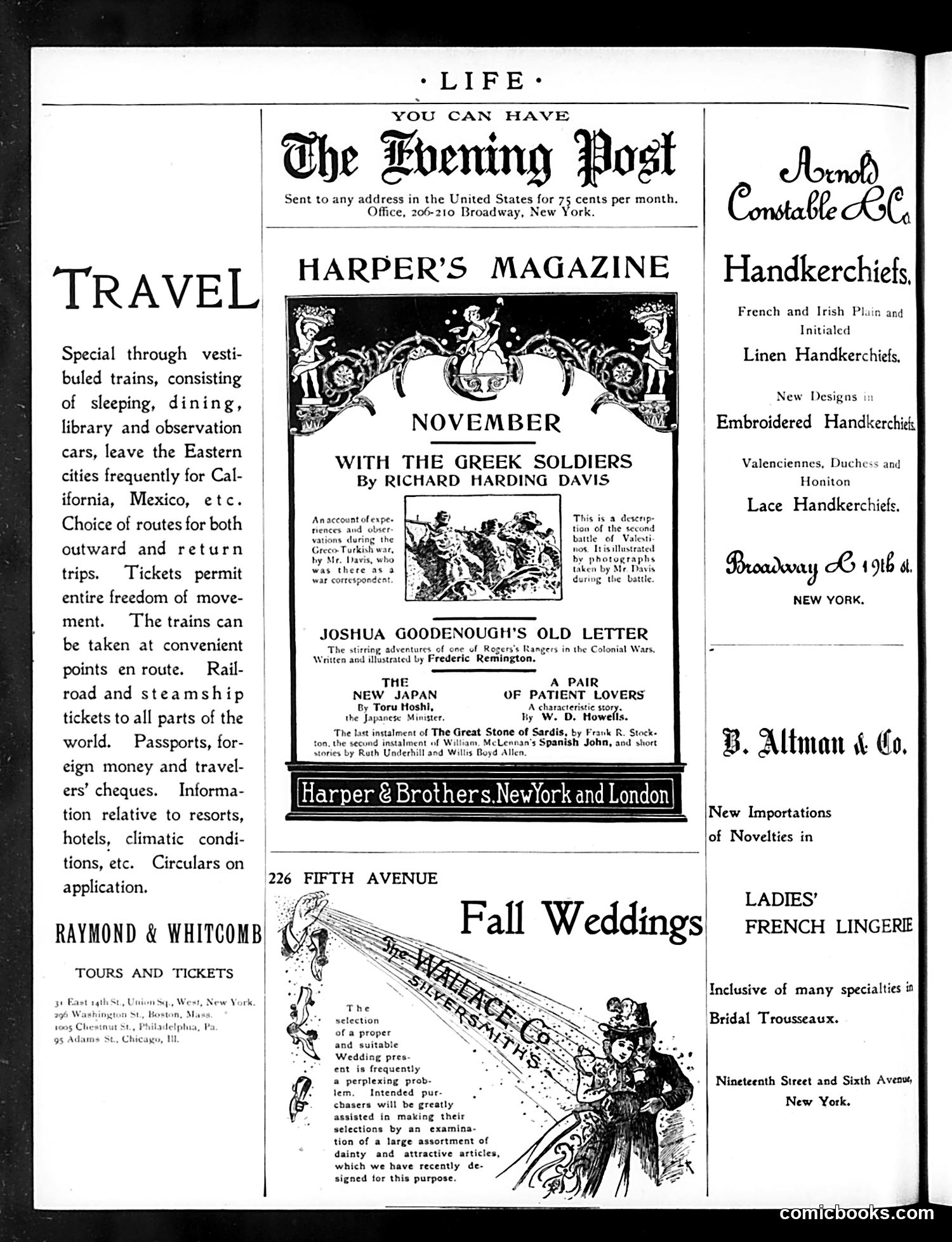
This page is primarily **advertising and editorial content** from Life magazine, not political satire. The main features are: 1. **Harper's Magazine advertisement** promoting November issue with articles on Greek soldiers (by Richard Harding Davis), Joshua Goodenough's colonial war letters, and Japanese and Japanese-American stories. 2. **Fall Weddings advertisement** for The Welch Co., a bridal shop at 226 Fifth Avenue, emphasizing their selection of wedding presents and accessories. 3. **Travel, handkerchief, and French lingerie advertisements** filling the margins. There is no apparent political cartoon or satirical content on this page—it represents standard commercial advertising typical of early 20th-century magazines. The page functions as revenue generation through classified advertisements rather than editorial commentary.
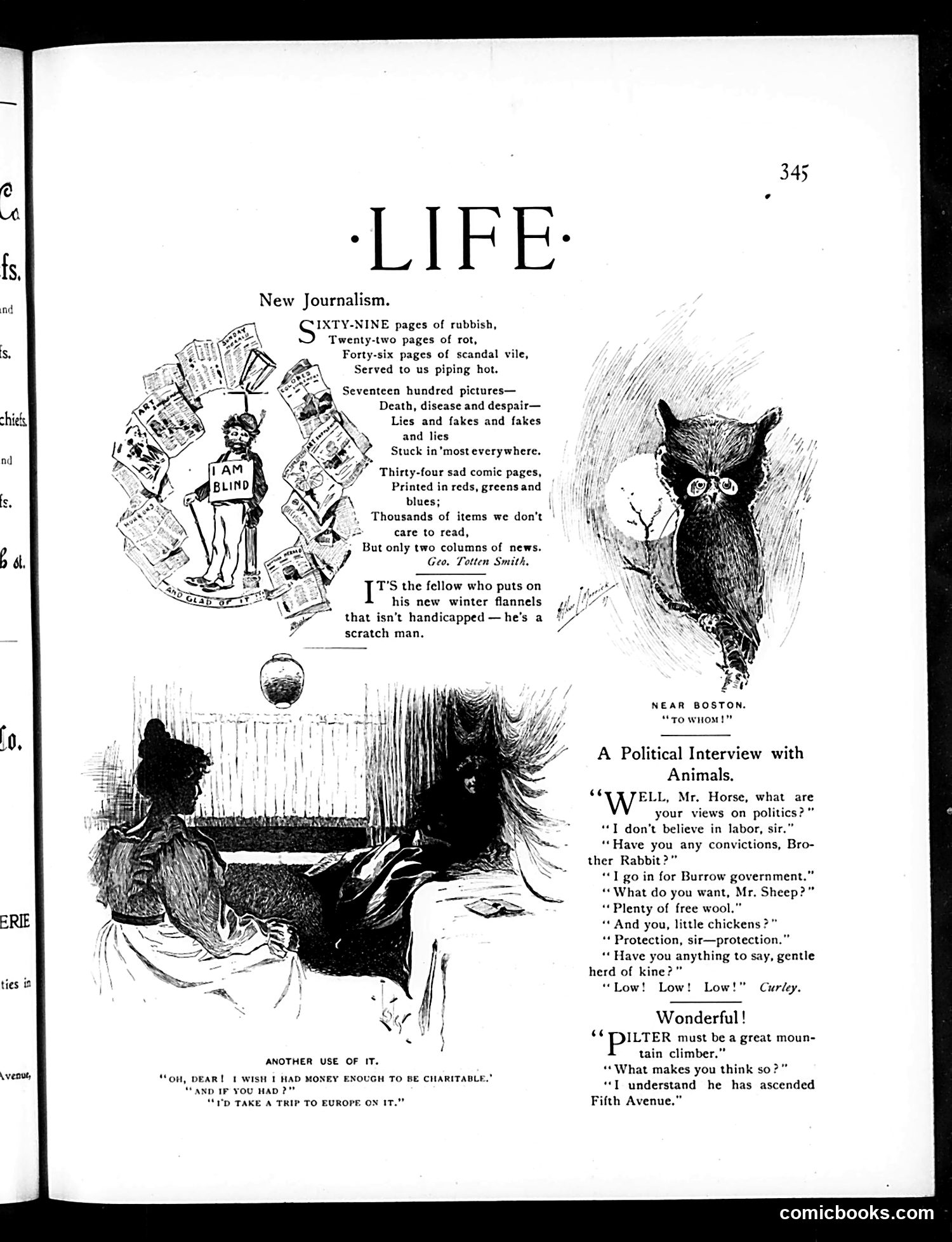
**"New Journalism" Section:** This satirizes sensationalist newspaper practices of the era. The blindfolded figure surrounded by newspapers critiques how papers flood readers with 69 pages of "rubbish," "rot," and "scandal" daily—emphasizing yellow journalism's proliferation of lies and sensational pictures rather than substantive news. The criticism attributes this to profit-driven editorial decisions. **"Political Interview with Animals":** A humorous piece where farm animals express political views—the horse opposes labor, the rabbit supports "burrow government," sheep want "free wool," and chickens demand "protection." This appears to satirize how different interest groups advocate for narrow self-interest in politics, using animals as transparent stand-ins for lobbying constituencies. **"Another Use of It":** A brief joke about charitable giving and European travel.
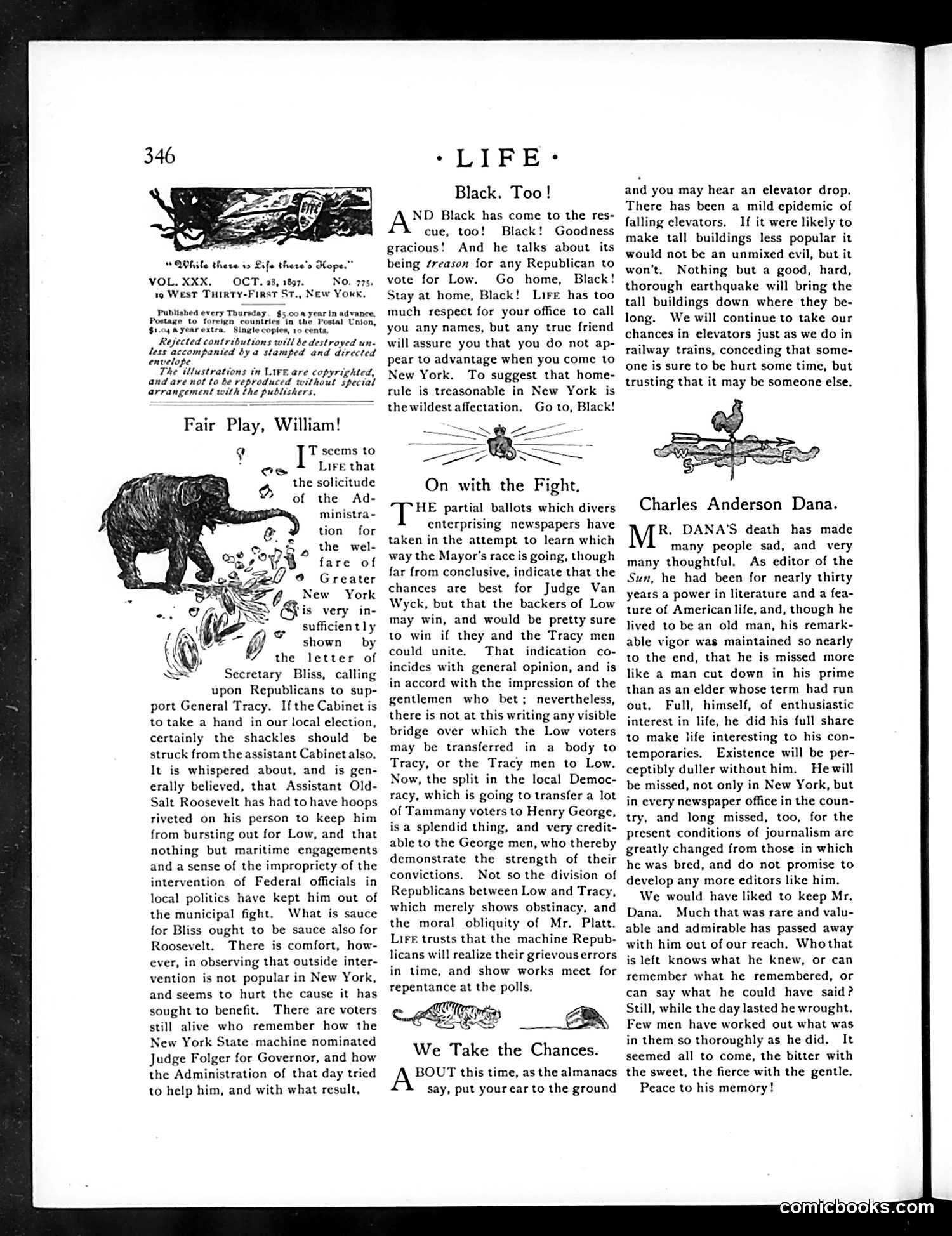
This page from *Life* magazine (October 28, 1897) contains three distinct political commentaries: **"Black, Too!"** mocks Republican pressure on a character named Black to leave New York, suggesting party loyalty overrides personal judgment. **"Fair Play, William!"** depicts an elephant (Republican Party symbol) crushing a small figure, satirizing Secretary Bliss's treatment of General Tracy in the Roosevelt administration. The text criticizes how Republican leadership discarded Tracy despite his service, viewing it as disloyal and politically damaging. **"Charles Anderson Dana"** is an obituary tribute to the *Sun* newspaper editor, praising his editorial influence and vigor while lamenting his passing. The overall theme critiques Republican Party infighting, loyalty conflicts, and machine politics during the McKinley era.
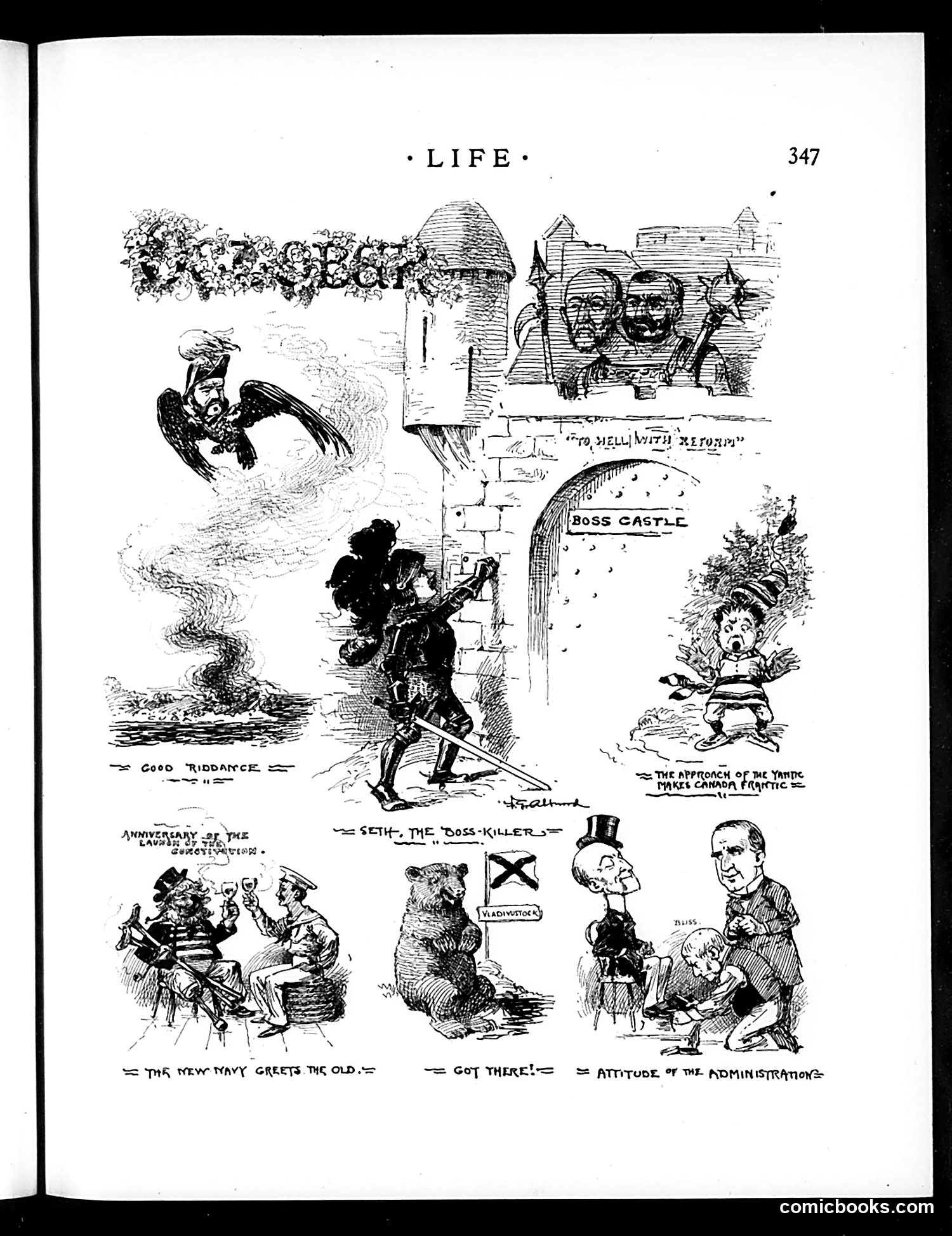
This page contains several satirical sketches commenting on American politics and culture, likely from the early 1900s based on the art style. The cartoons reference naval matters ("Good Riddance," "The New Navy Greets the Old") and military figures. "Seth, the Boss-Killer" and "Boss Castle" appear to mock political corruption or machine politics. "Got There!" and "Attitude of the Administration" likely comment on government policies or political appointments. The sketches employ caricature and exaggeration typical of Life's editorial style—using humor to critique contemporary political figures and institutions. Without clearer labels or OCR text, specific identities remain unclear, but the overall tone suggests criticism of governmental incompetence or moral compromise during this period of American political history.
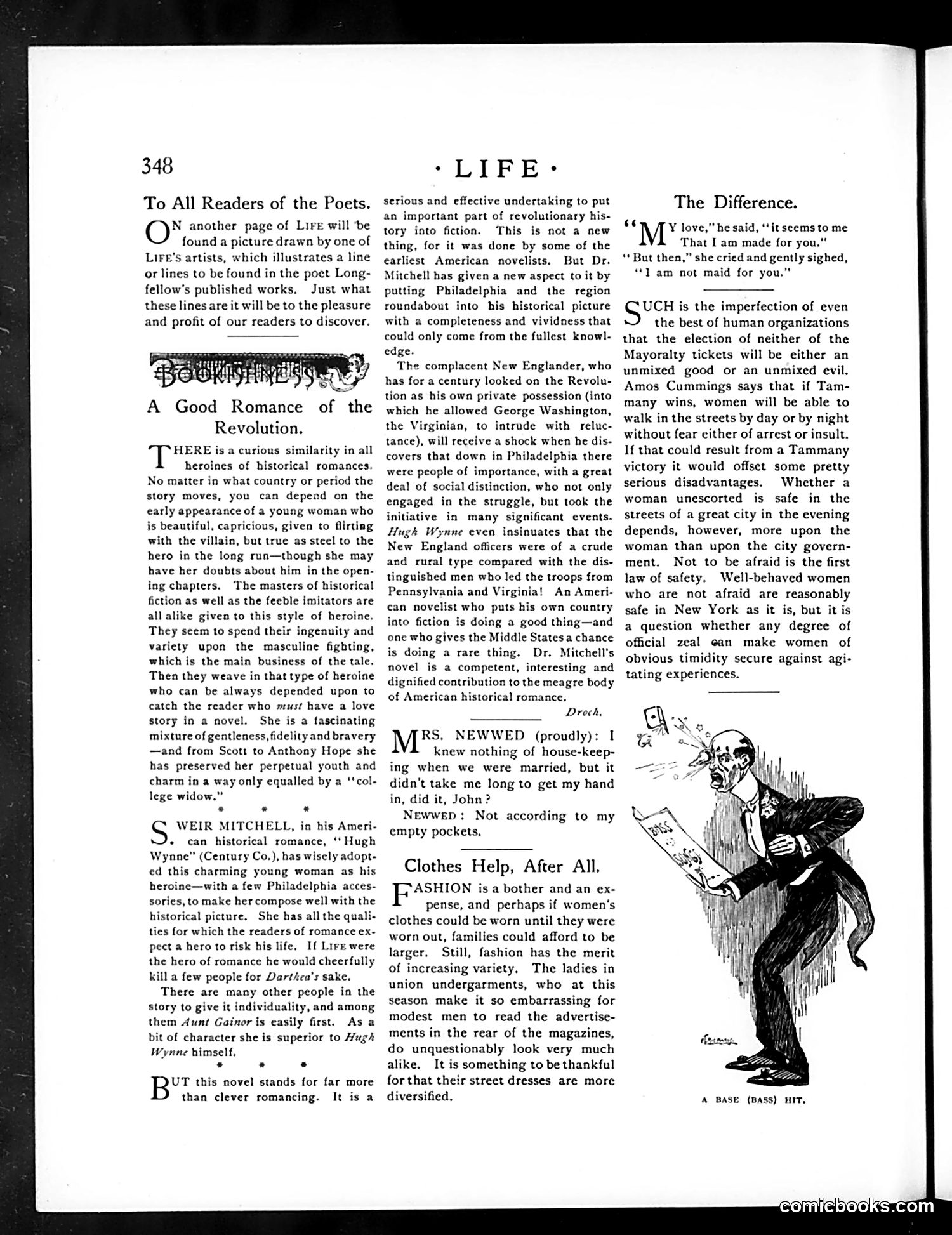
This cartoon depicts a figure labeled "A BASE (BASS) HIT" — a pun playing on baseball terminology. The exaggerated caricature shows a man in formal attire striking a base with a bat, literalizing the baseball term "base hit." The accompanying text discusses women's fashion and street safety in cities, touching on debates about whether women can safely navigate public spaces. The cartoon appears to be satirizing male behavior or attitudes toward women in urban environments — the "base" conduct being ridiculed is likely inappropriate male behavior or harassment, rendered as a crude pun. The artistic style and caricature suggest this targets a specific social type or behavior pattern contemporary readers would have recognized, though the precise reference remains unclear today.
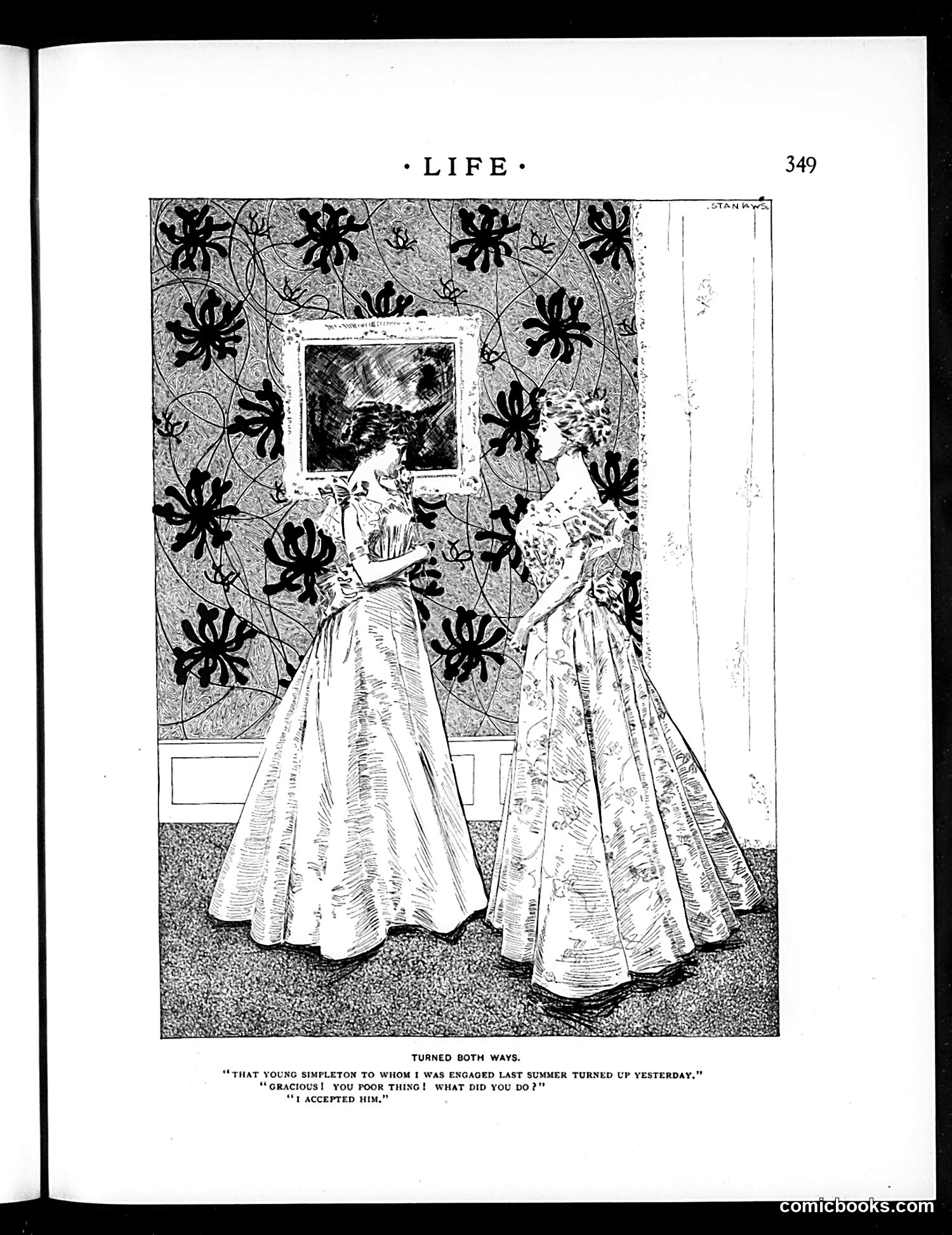
This cartoon satirizes a young woman's romantic fickleness. The title and caption reveal she rejected an engagement from "last summer" but has now accepted a new suitor—suggesting she's changed her mind about commitment. The illustration shows two elegantly dressed women viewing a framed portrait (likely of a rejected fiancé) on a decorative wall. The humor targets early 20th-century courtship conventions, where broken engagements were socially significant events. The joke plays on the phrase "turned both ways"—implying the woman has reversed her decision, while the visual composition shows her literally turning away from her previous romantic choice. This reflects period anxieties about women's increasing independence in choosing marriage partners.
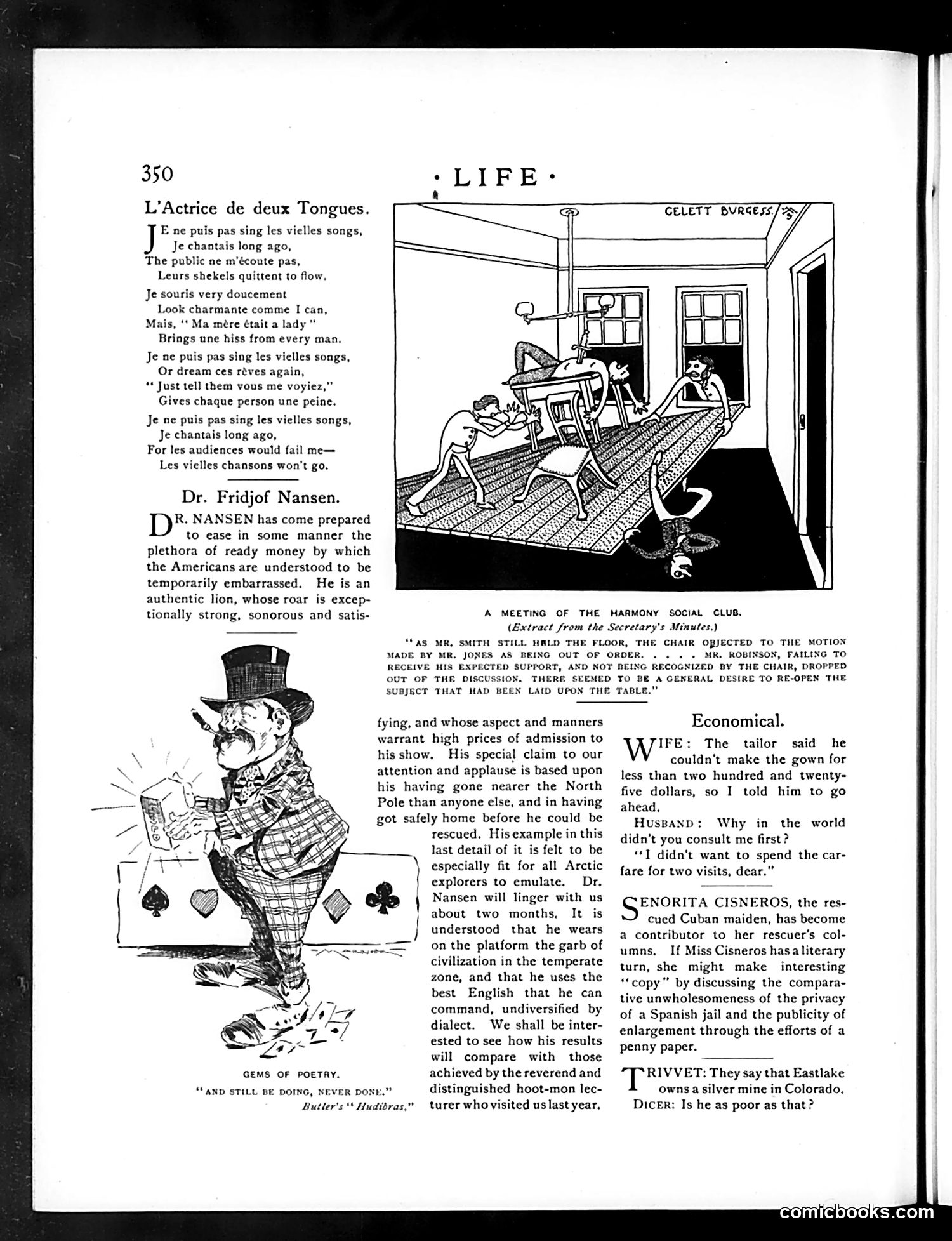
This page contains several distinct satirical pieces: **"L'Actrice de deux Tongues"** (top left): A poem mocking an actress who sings old songs in a affected manner, suggesting the public finds her tiresome and artificial. **Dr. Fridtjof Nansen** (center): The article describes Nansen, a famous Arctic explorer, visiting America. The text satirizes American financial anxieties by calling him an "authentic lion" whose presence commands high admission prices. The piece gently mocks both Nansen's celebrity status and Americans' willingness to pay to see him. **Cartoon (bottom left)**: An illustration labeled "Gems of Poetry" shows a figure with playing card symbols, likely satirizing sentimental or overwrought poetry of the era. **"Economical"** (right): A brief joke about a husband and wife haggling over dress costs. The page reflects early 20th-century American social satire.
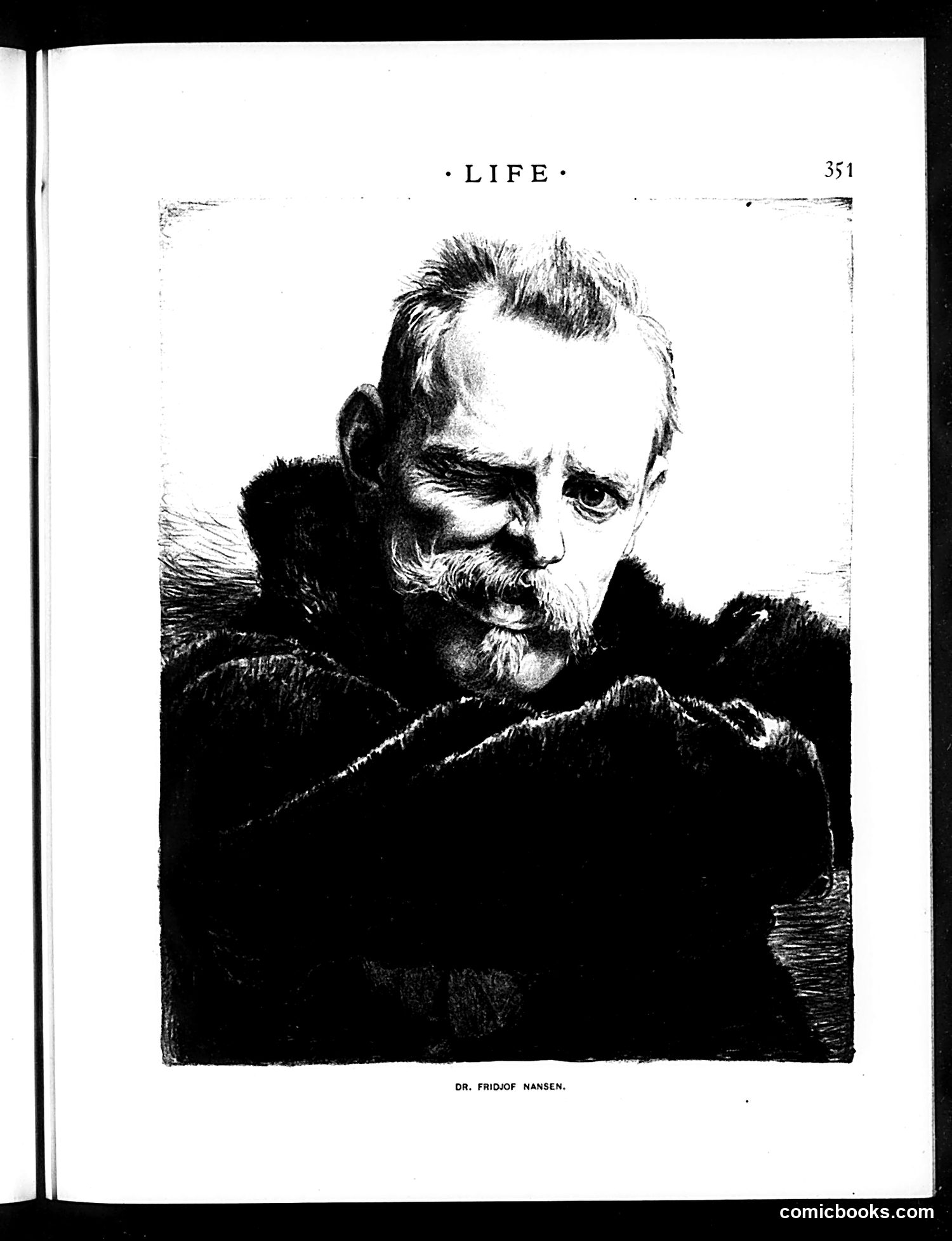
This page from *Life* magazine features a portrait of **Dr. Fridtjof Nansen**, identified in the caption below the image. Nansen was a Norwegian explorer, scientist, and diplomat famous for his Arctic expeditions. The sketch-style portrait emphasizes his distinctive features: full beard, receding hairline, and serious expression. The formal presentation suggests this was likely published to mark a significant achievement or public appearance by Nansen. Without additional context on the page, the specific occasion for this portrait cannot be determined from the image alone. The page number (351) indicates this appeared mid-publication.
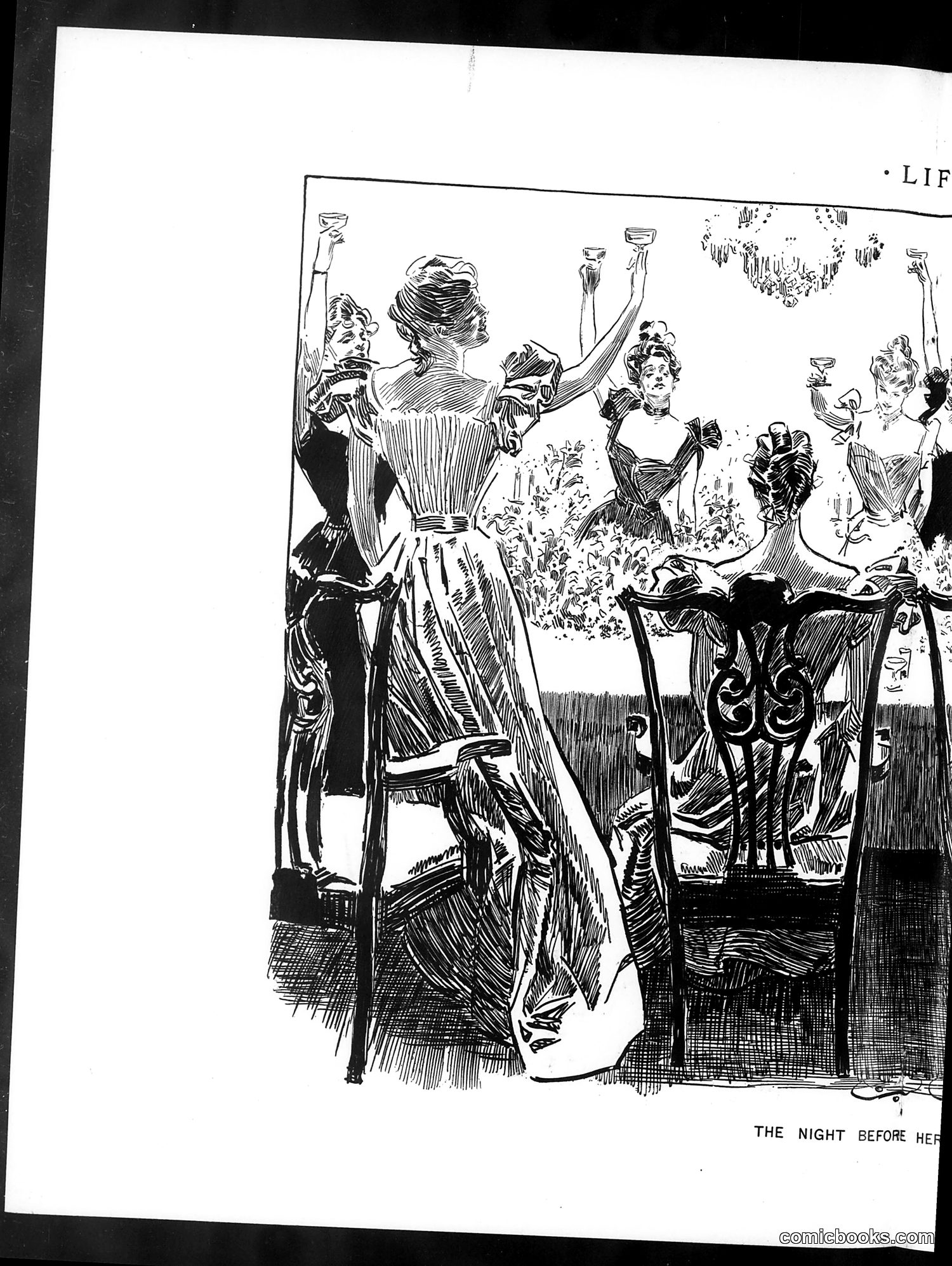
This appears to be a social satire illustration from Life magazine depicting an elegant pre-wedding celebration scene. The central figure is a woman in an elaborate gown with raised arms, surrounded by formally dressed guests holding what appear to be champagne glasses in a toast. The setting suggests a high-society event, likely depicting the evening before a wedding. The humor likely targets upper-class wedding traditions and the social rituals surrounding matrimony—possibly satirizing the excessive celebration, formal propriety, or the bride's mixed emotions about marriage itself. The exaggerated postures and detailed period clothing suggest commentary on Gilded Age or early 20th-century society conventions, though the specific social critique isn't entirely clear from the image alone.
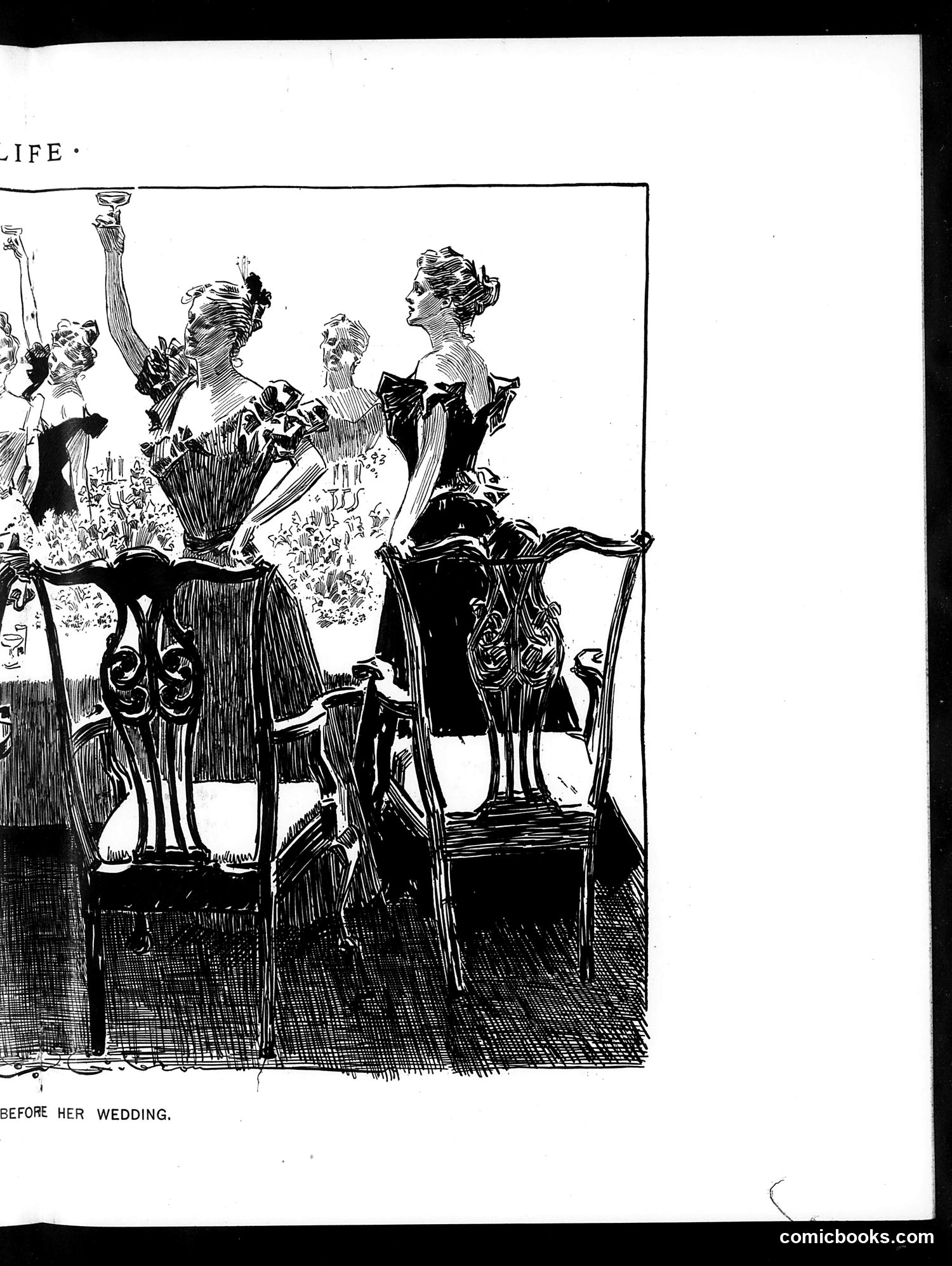
This satirical illustration from *Life* magazine depicts a bride-to-be's pre-wedding preparations, showing two elegantly dressed women arranging flowers and gifts. The ornate furniture and formal attire suggest upper-class society. The satire likely mocks the elaborate, materially-focused nature of wealthy women's wedding preparations—the abundance of floral arrangements and gifts suggesting excess and conspicuous consumption. The formal poses and decorative styling may be commenting on how pre-wedding rituals prioritize appearance and social display over deeper meaning. Without additional context, the specific social or political critique remains somewhat unclear, though the illustration's exaggerated elegance and focus on material accumulation suggests mockery of elite wedding culture and society women's preoccupations.
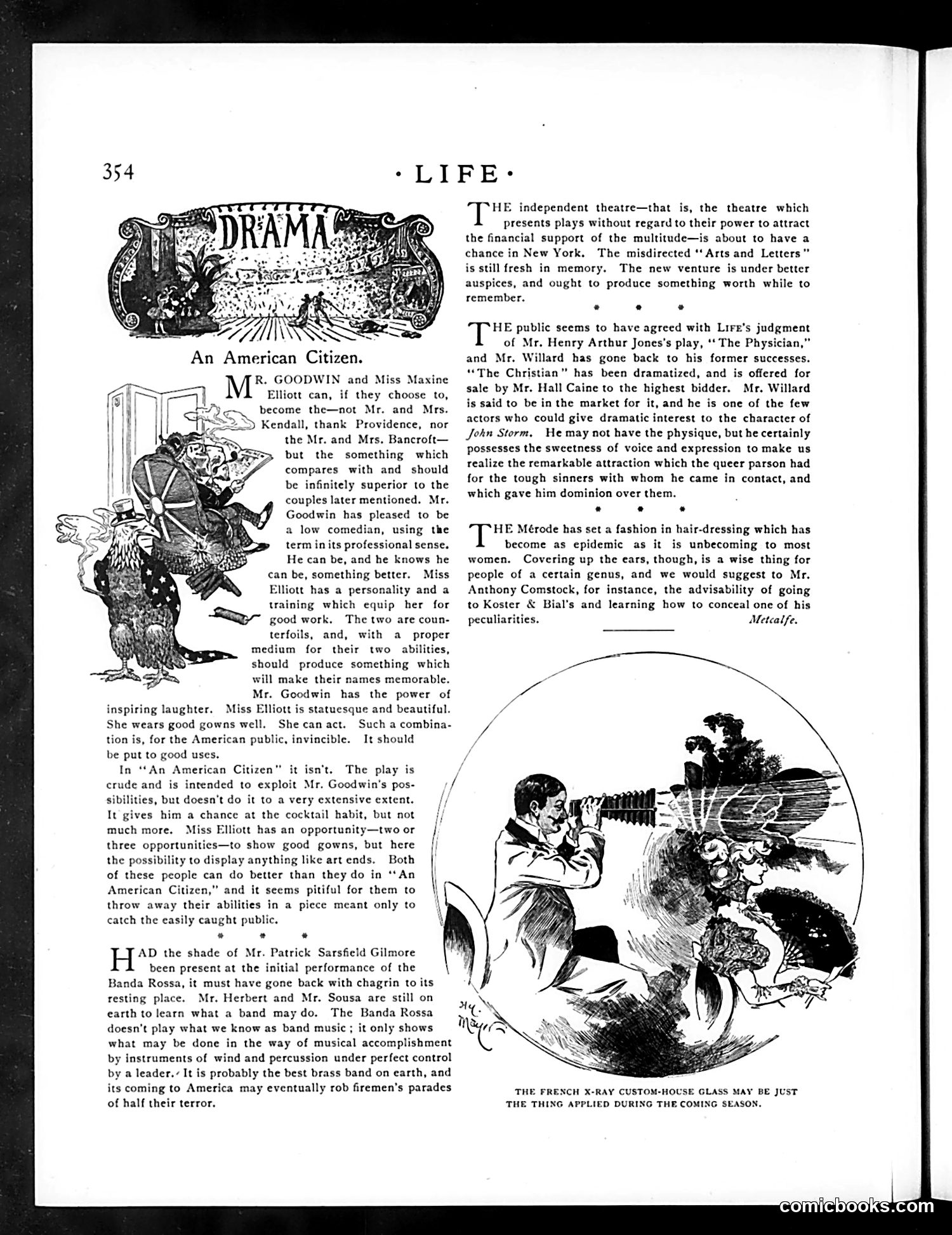
This page reviews theatrical productions. The main text critiques "An American Citizen," a play featuring actors Mr. Goodwin and Miss Maxine Elliott. The reviewer praises their abilities but judges the play itself as crude, designed merely to showcase the lead actor's talents rather than offer substantive drama. The circular illustration depicts a man using an early X-ray device or camera, captioned "THE FRENCH X-RAY CUSTOM-HOUSE GLASS MAY BE JUST THE THING APPLIED DURING THE COMING SEASON." This appears to be satirical commentary on fashion or theatrical costume inspection, possibly mocking French technological trends or customs procedures of the era. The page exemplifies Life magazine's role as a cultural critic of early 20th-century American theater and society.
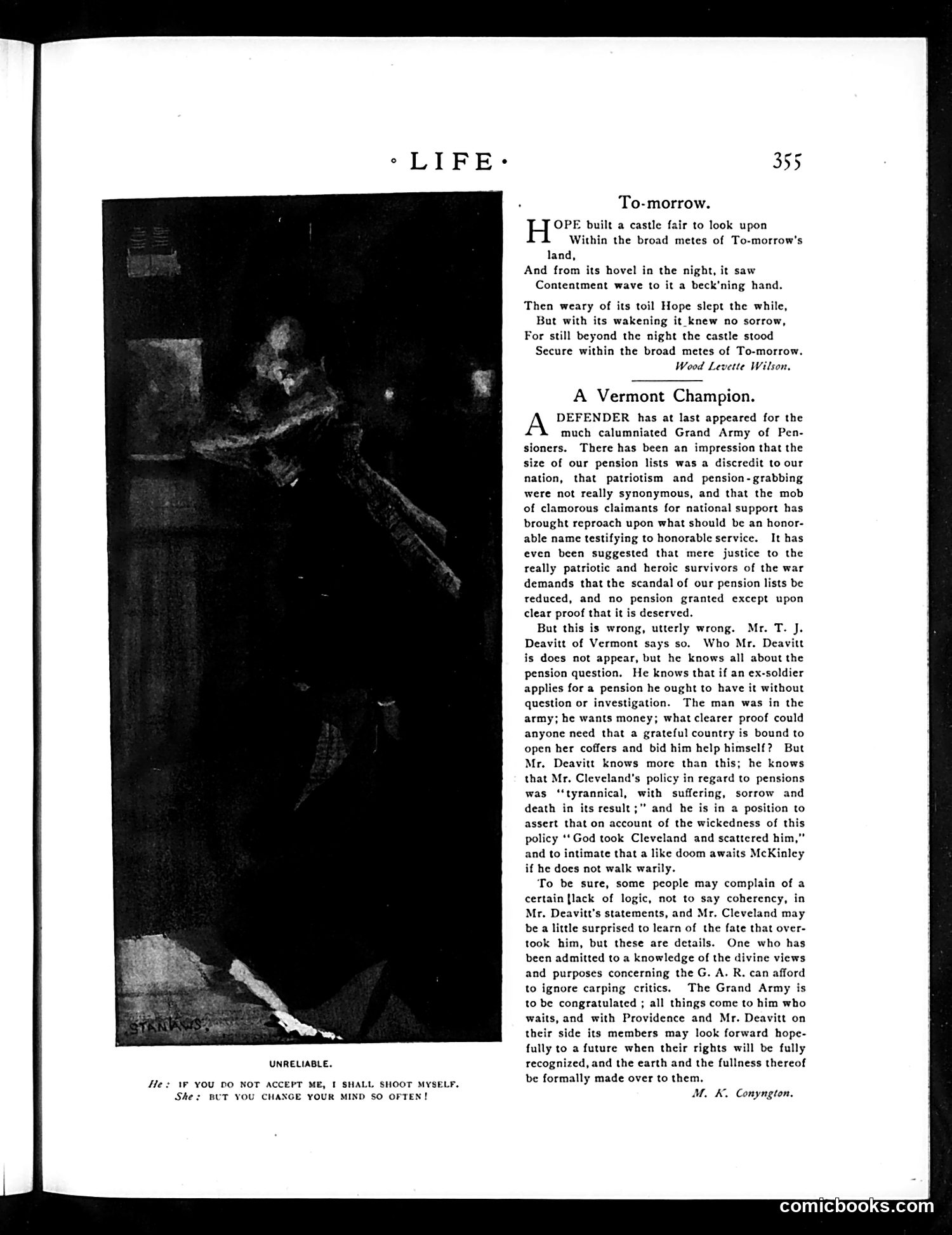
**The Main Cartoon:** The dramatic image shows a couple in an emotional confrontation. The man threatens suicide if rejected; the woman responds that he changes his mind too often. This is a joke about male emotional manipulation and inconstancy in romance—satirizing melodramatic courtship. **The Political Article:** "A Vermont Champion" mocks T.J. Deavitt of Vermont, who defended generous Civil War pensions for the Grand Army of the Republic (GAR). Life sarcastically attacks Deavitt's logic: he argues ex-soldiers deserve pensions simply for *having served*, without proof of need or merit. The article ridicules this as pension-grabbing, claiming Deavitt even invokes divine will against President Cleveland's stricter pension policies, suggesting God punished Cleveland for his "tyrannical" approach. Life uses heavy irony to expose what it sees as absurd entitlement rhetoric and magical thinking masquerading as patriotism.
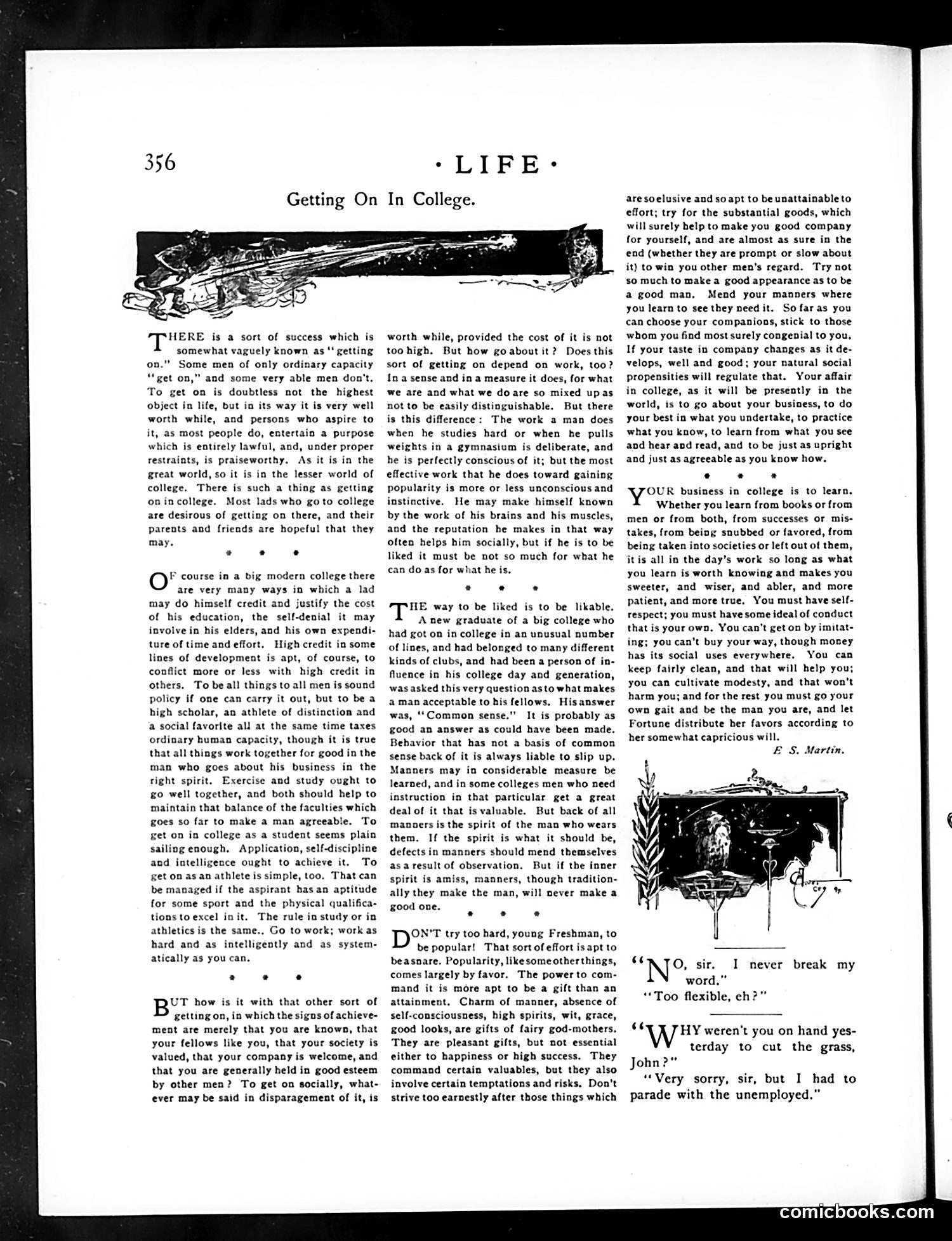
This page from *Life* magazine presents an earnest essay on college social success, accompanied by a humorous cartoon dialogue at the bottom. **The Main Article** discusses three forms of college achievement: academic excellence, athletic prowess, and social popularity. The author argues that while the first two require deliberate effort and hard work, social success depends less on what you *do* and more on what you *are*—your inherent likability and character. A prominent college graduate supposedly summed this up as "Common sense." **The Cartoon** at the page's bottom depicts the ironic contrast: a well-dressed employer asks his employee "Why weren't you on hand yesterday to cut the grass, John?" The worker replies he had to "parader with the unemployed"—meaning he was participating in unemployment demonstrations or protests. **The Satire** mocks the gap between the article's advice about earning respect through reliability and good character, and the economic reality facing working-class young men who struggle with joblessness and must engage in public protest. It's social commentary on labor conditions during this era.
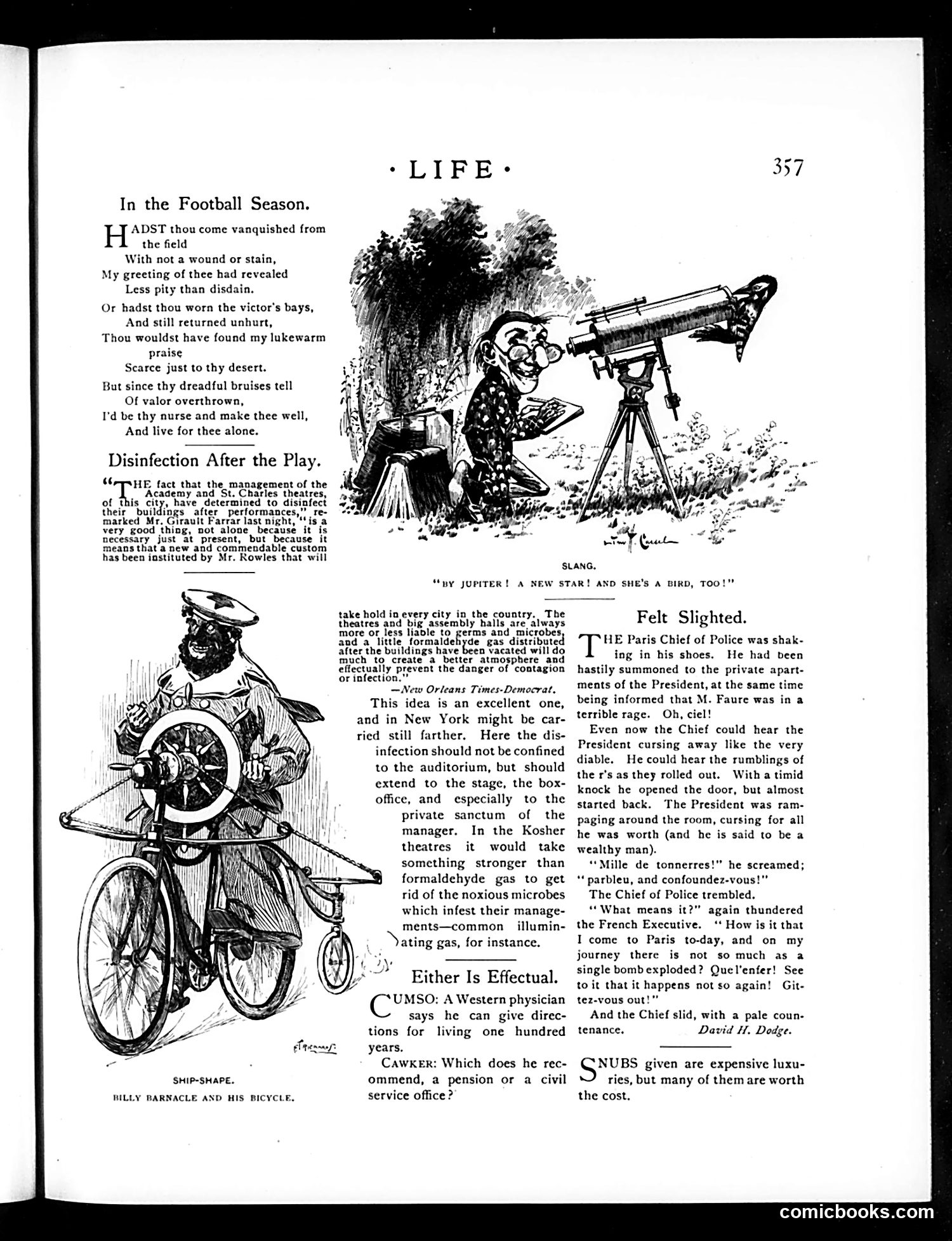
This page contains three distinct satirical pieces: **"In the Football Season"** presents romantic verse mocking sentimentality—praising injury over victory, suggesting masculine virtue requires visible wounds. **"Disinfection After the Play"** satirizes theater management. Life mocks the idea that disinfecting theaters prevents disease, extending the joke to suggest managers' offices need even stronger disinfection—and adds an antisemitic jab at "Kosher theatres," implying Jewish-owned venues require special cleaning. **"Felt Slighted"** parodies French President Faure, depicting him enraged that no bombs exploded during his Paris visit—satirizing anarchist violence plaguing France at the time. The joke: the President felt *insulted* by the absence of terrorism, treating bombings as a expected courtesy. The cartoon illustrations accompany lighter humor about a naval officer and bicycle mishaps. The page reflects turn-of-century American attitudes, including casual ethnic stereotyping alongside political commentary on European instability.
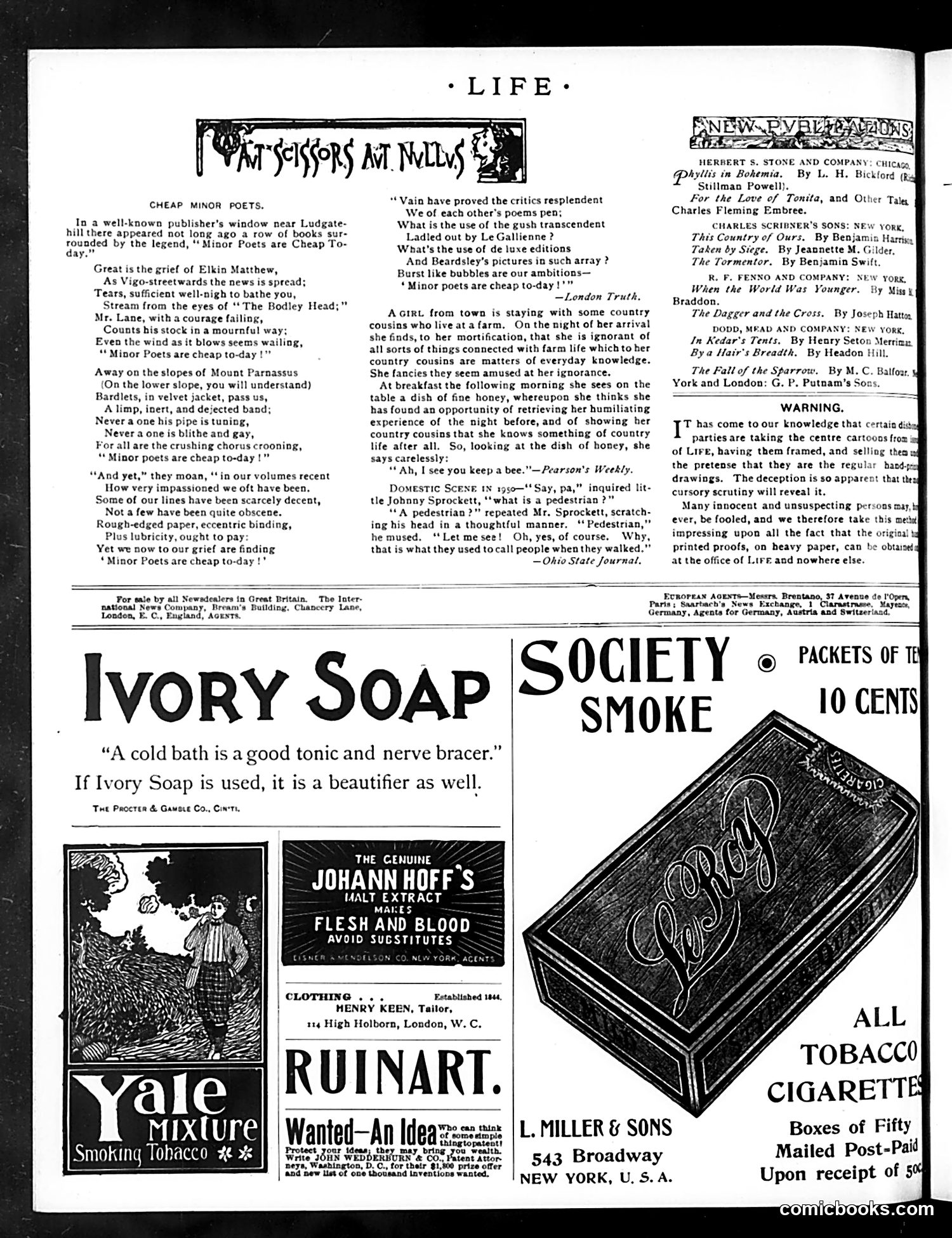
This page satirizes the oversupply of minor poets in the late Victorian literary market. The main article mocks young, ambitious poets ("bardlets") who publish through prestigious houses like The Bodley Head and Elkin Mathew, using experimental techniques—rough paper, Aubrey Beardsley illustrations, provocative content—to seem important. Yet their books remain unsold and cheap. The satire targets the poets' pretensions: they rely on critical puffery (Richard Le Gallienne's praise), de luxe editions, and shock value rather than genuine talent. The repeated refrain "Minor poets are cheap to-day!" captures their despair that even elaborate production cannot save mediocre work. This reflects a real publishing phenomenon: the 1890s saw an explosion of small-press poetry volumes marketed to aesthetes, many of which failed commercially. The joke is that experimental form cannot substitute for actual poetic merit.
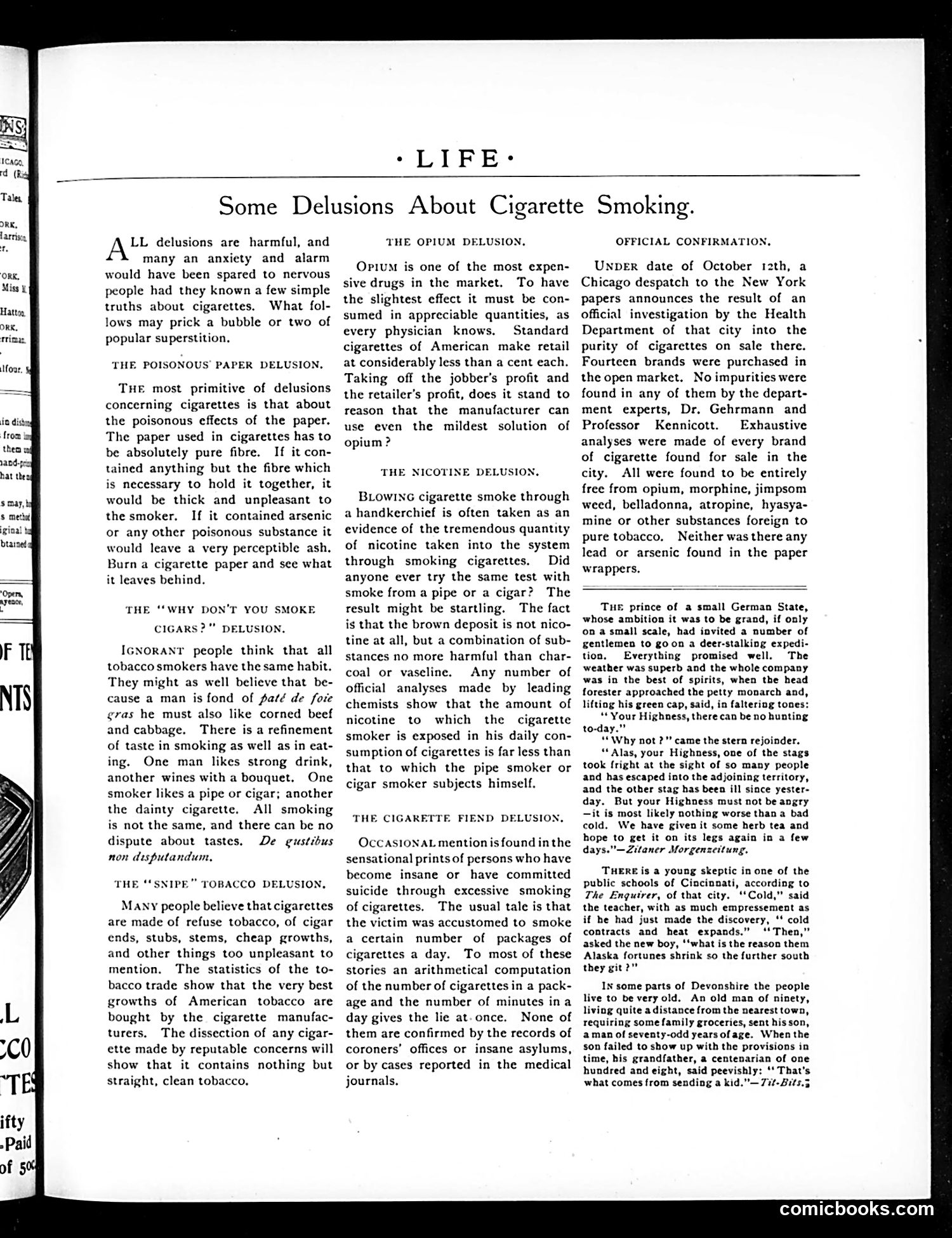
This is an editorial/informational article, not a cartoon, defending cigarettes against contemporary health and safety concerns. The piece systematically debunks popular anxieties about cigarette smoking circulating in early 20th-century America: that papers contained poison, that cigarettes used cheap tobacco scraps, that they contained opium, and that the brown residue from smoke proved dangerous nicotine exposure. The author argues these fears are unfounded superstitions, supported by tobacco industry claims about quality control and chemical analyses. A final section cites official government confirmation—a Chicago health department investigation finding fourteen cigarette brands "entirely free from opium." **For modern readers:** This reveals how cigarette manufacturers once openly marketed their product as safe, even as genuine health risks were becoming scientifically understood. The rhetorical strategy of calling health concerns "delusions" and "superstitions" is particularly striking given subsequent medical evidence.
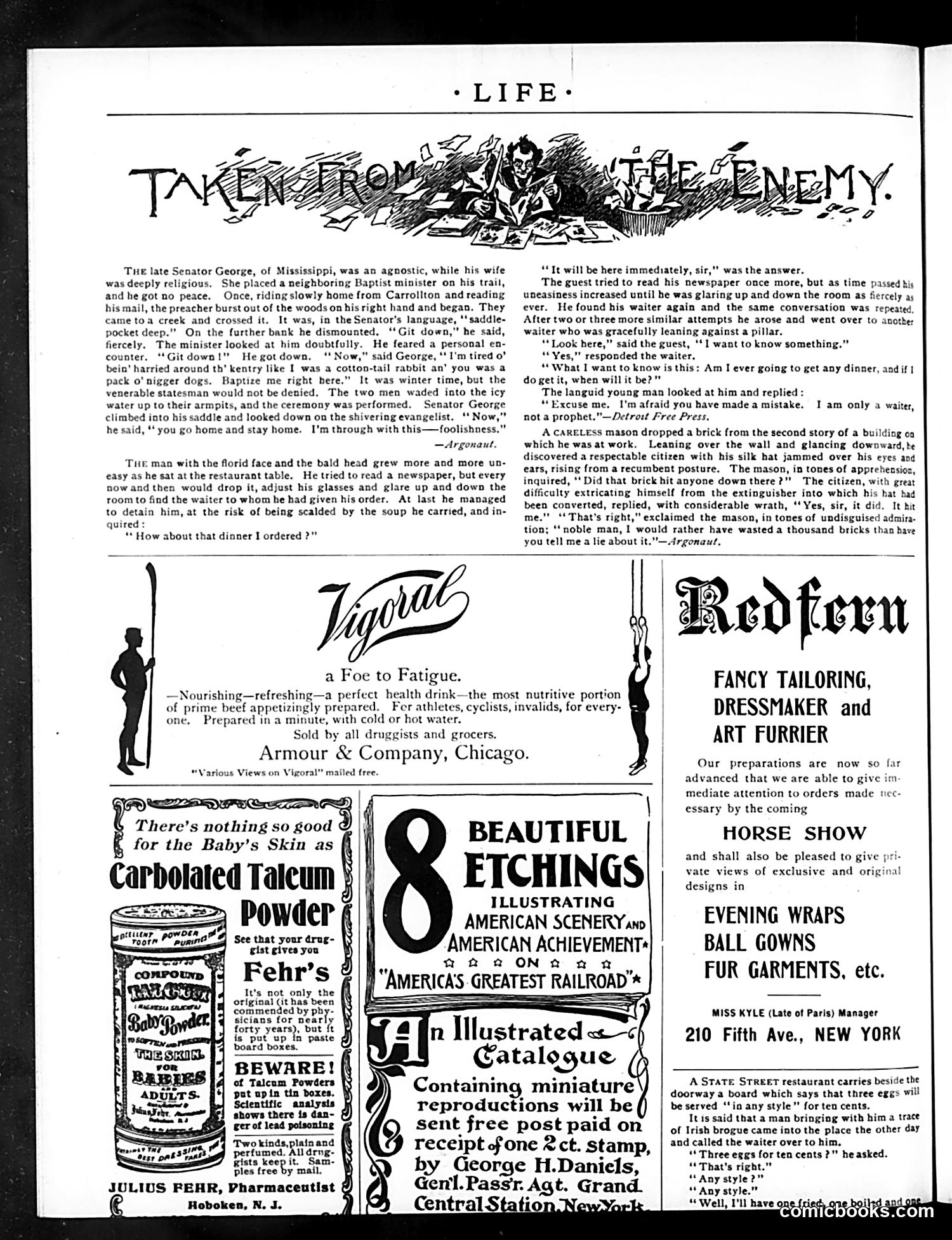
This page contains three humorous anecdotes typical of early Life magazine's satirical humor: 1. **Senator George story**: A Mississippi senator, described as agnostic, is relentlessly pursued by a Baptist minister. To end the harassment, George forces the minister to baptize him in an icy creek—a crude solution that uses religious ritual as a weapon rather than spiritual practice. The satire mocks both religious zealotry and aggressive evangelism. 2. **Restaurant waiter jokes**: Two brief comedic tales about impatient diners and unhelpful waiters—universal humor about service frustration that requires no historical context. 3. **Mason and brick anecdote**: Dark comedy about a careless worker who drops a brick on a citizen; the mason celebrates the victim's honesty rather than expressing remorse—satirizing misplaced priorities. The page is primarily **advertising**, with products for Vigoral (beef drink), Carbolated Talcum Powder, railroad etchings, and fashion services. The humor reflects genteel, turn-of-century American magazine satire targeting religious hypocrisy and social awkwardness.
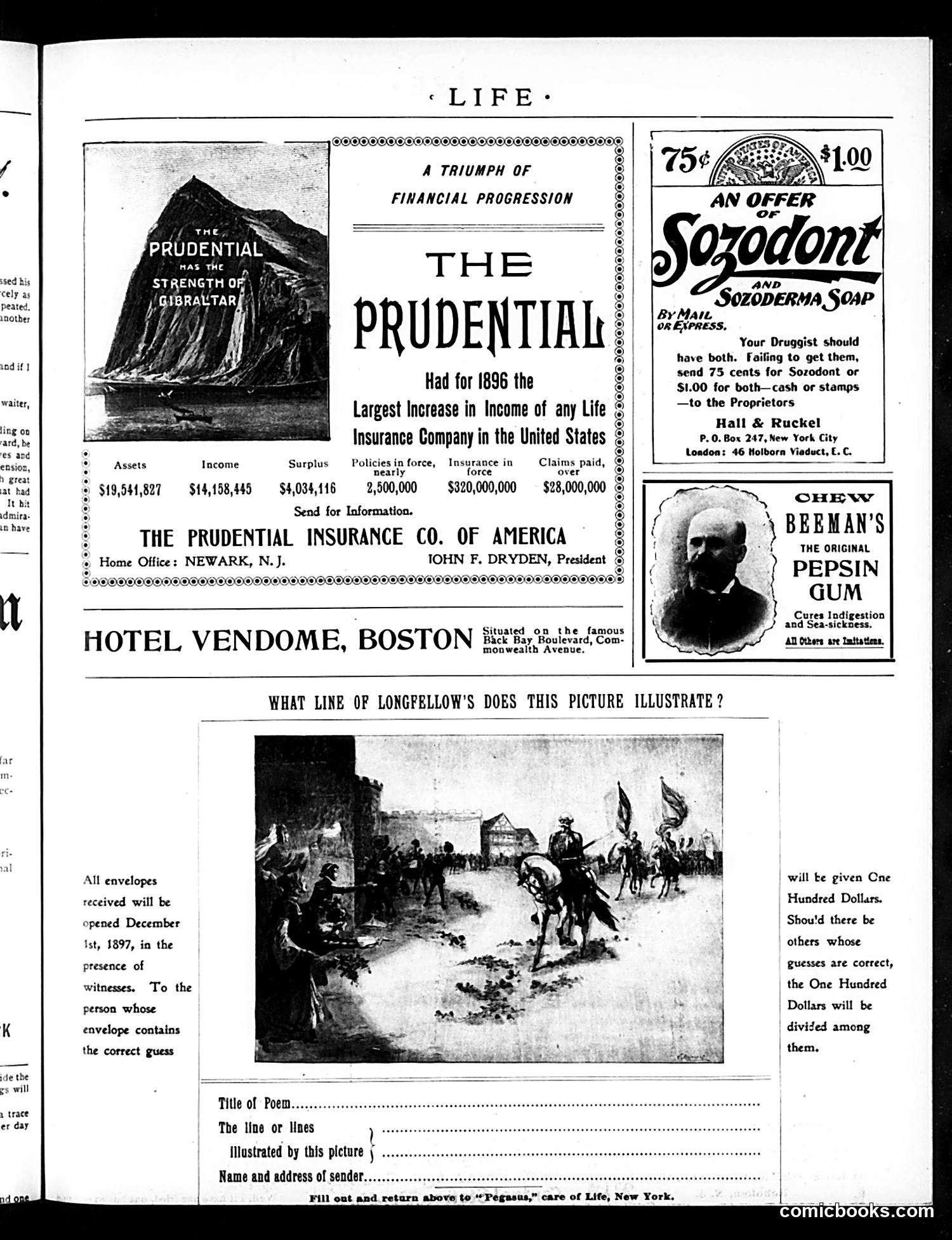
This page is primarily **advertising and a reader contest**, not political satire. The main content features a large advertisement for **The Prudential Insurance Company**, prominently displaying the company's 1896 financial statistics (assets, income, surplus, policies in force) and claiming "the Largest Increase in Income of any Life Insurance Company in the United States." This represents Gilded Age corporate boasting about financial success. Below is an **interactive contest** asking readers to identify a Longfellow poem line illustrated by a Longfellow painting depicting a frontier or military scene. Readers submit guesses for a chance to win $100—a substantial prize for 1897. The page also carries side advertisements for consumer goods: **Sozodont tooth powder/soap** and **Beeman's Pepsin Gum**, typical patent medicines and products of the era. There is **no political cartoon or satire** visible—the page reflects commercial Life magazine content from the 1890s.
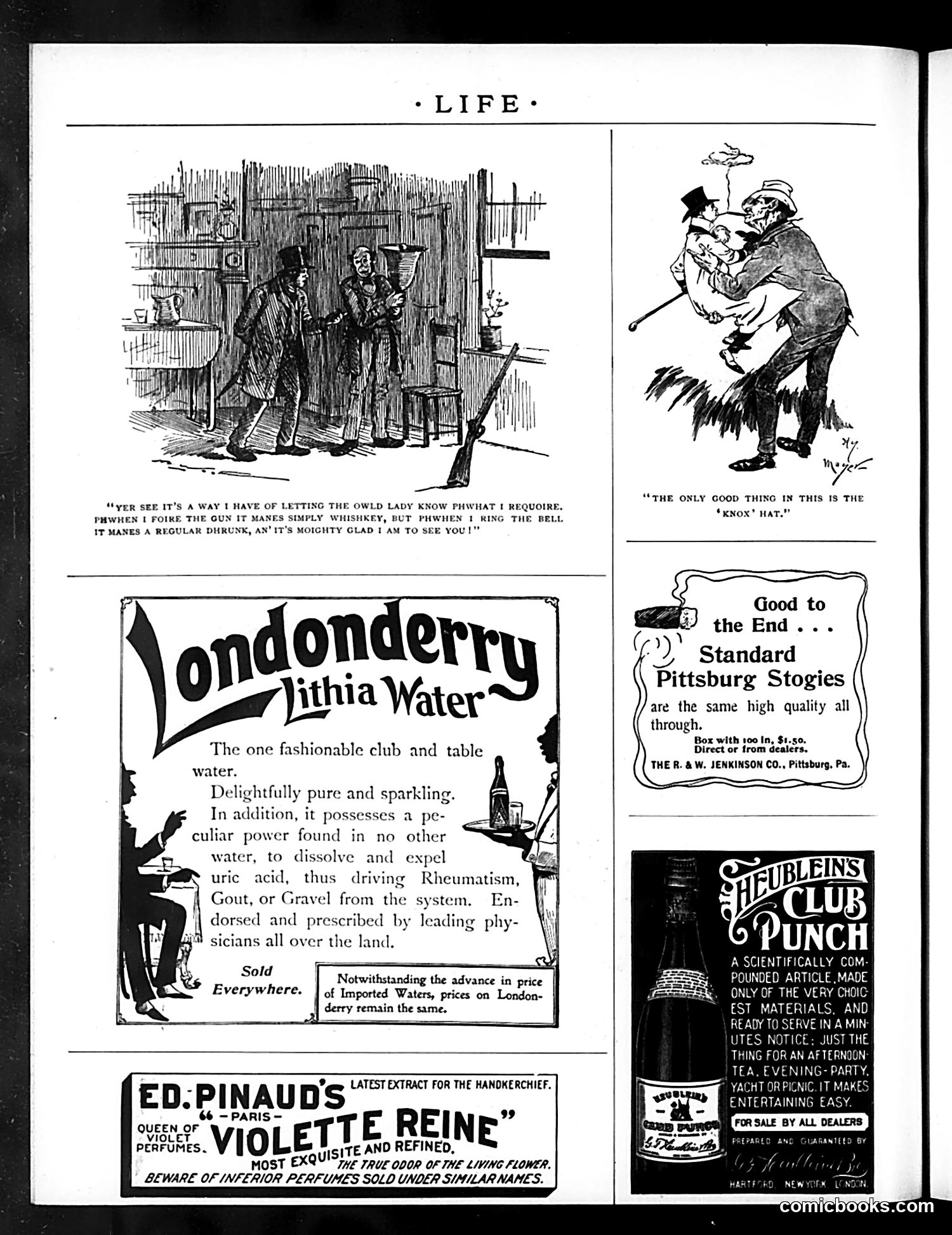
This page combines satirical cartoons with period advertisements. **Top left cartoon**: An Irish immigrant (marked by dialect: "phwhat," "phwhen") explains his signaling system to his landlady—firing a gun means he wants whiskey; ringing a bell means he wants to get drunk. The joke satirizes Irish stereotypes about alcoholism and working-class behavior common in early 20th-century American media. **Top right cartoon**: A man in a Knox hat (a fashionable brand) is being attacked or robbed, yet comments that "the only good thing in this is the Knox hat"—humor based on product placement and brand loyalty. **Advertisements**: The remaining content is commercial: Londonderry Lithia Water (claiming to cure gout and rheumatism), Ed. Pinaud's Violette Reine perfume, Standard Pittsburgh Stogies cigars, and Heublein's Club Punch (a cocktail mixer). The page reflects turn-of-the-century American consumer culture and ethnic stereotyping typical of Life magazine's satirical approach.
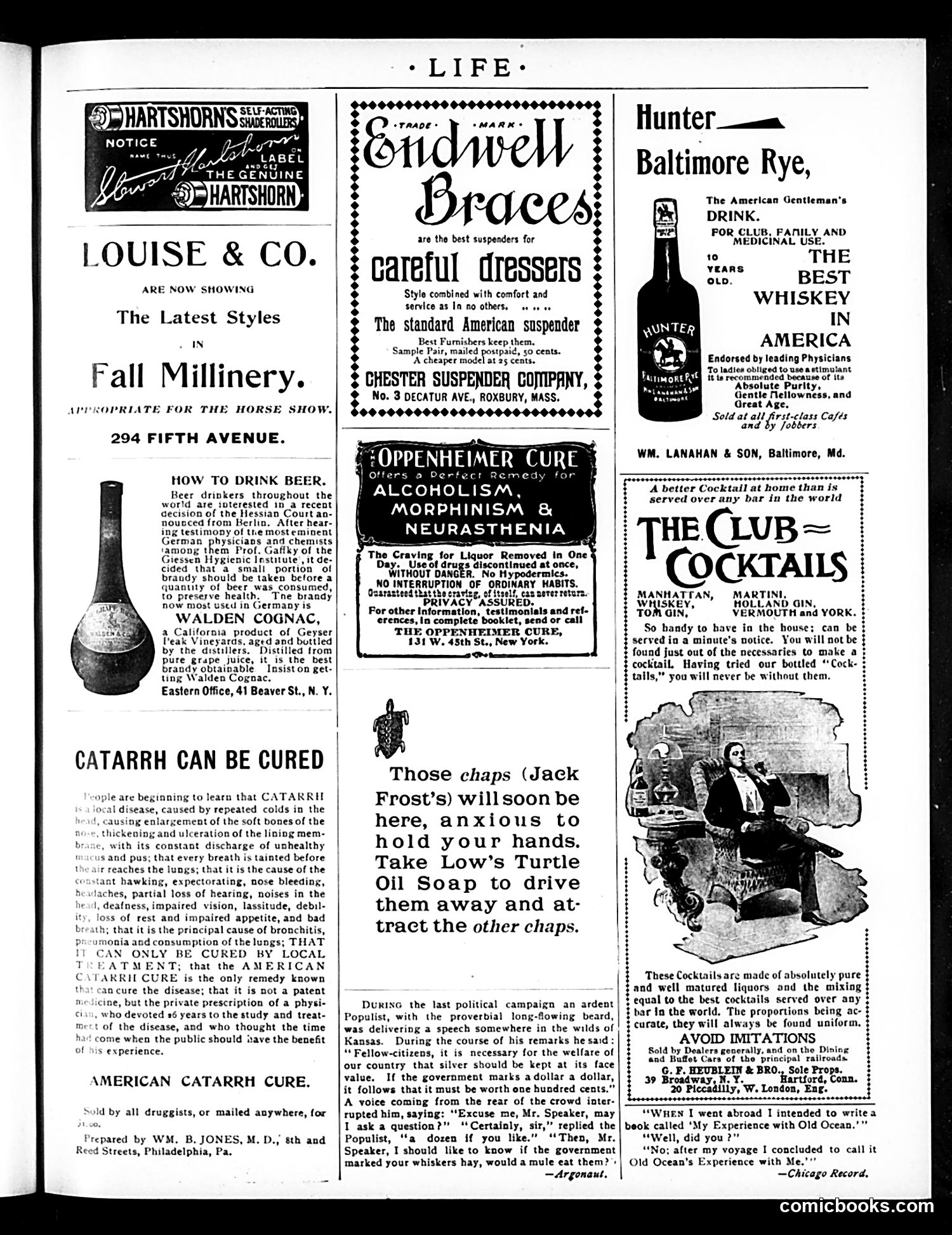
This page is primarily **advertising** with one embedded political joke. The main satirical content is a brief anecdote mocking a **Populist politician** during a recent political campaign (context suggests late 1890s). The joke features a bearded Populist speaker in Kansas arguing that silver currency should maintain face value—if the government marks a dollar as a dollar, it must be worth 100 cents. A heckler interrupts with a nonsensical rhetorical question: if the government marked the speaker's whiskers "hay," would a mule eat them? **The satire's point**: The joke ridicules Populist economic arguments as illogical and absurd. By juxtaposing the politician's serious monetary claim with an absurd parallel question, *Life* portrays Populist reasoning as nonsensical. The Populist movement advocated free silver coinage; this joke dismisses such arguments as laughably irrational rather than engaging them substantively. The remainder of the page consists of period advertisements for whiskey, cognac, suspenders, millinery, and dubious medical "cures" for catarrh and alcoholism—typical of the era's advertising standards.
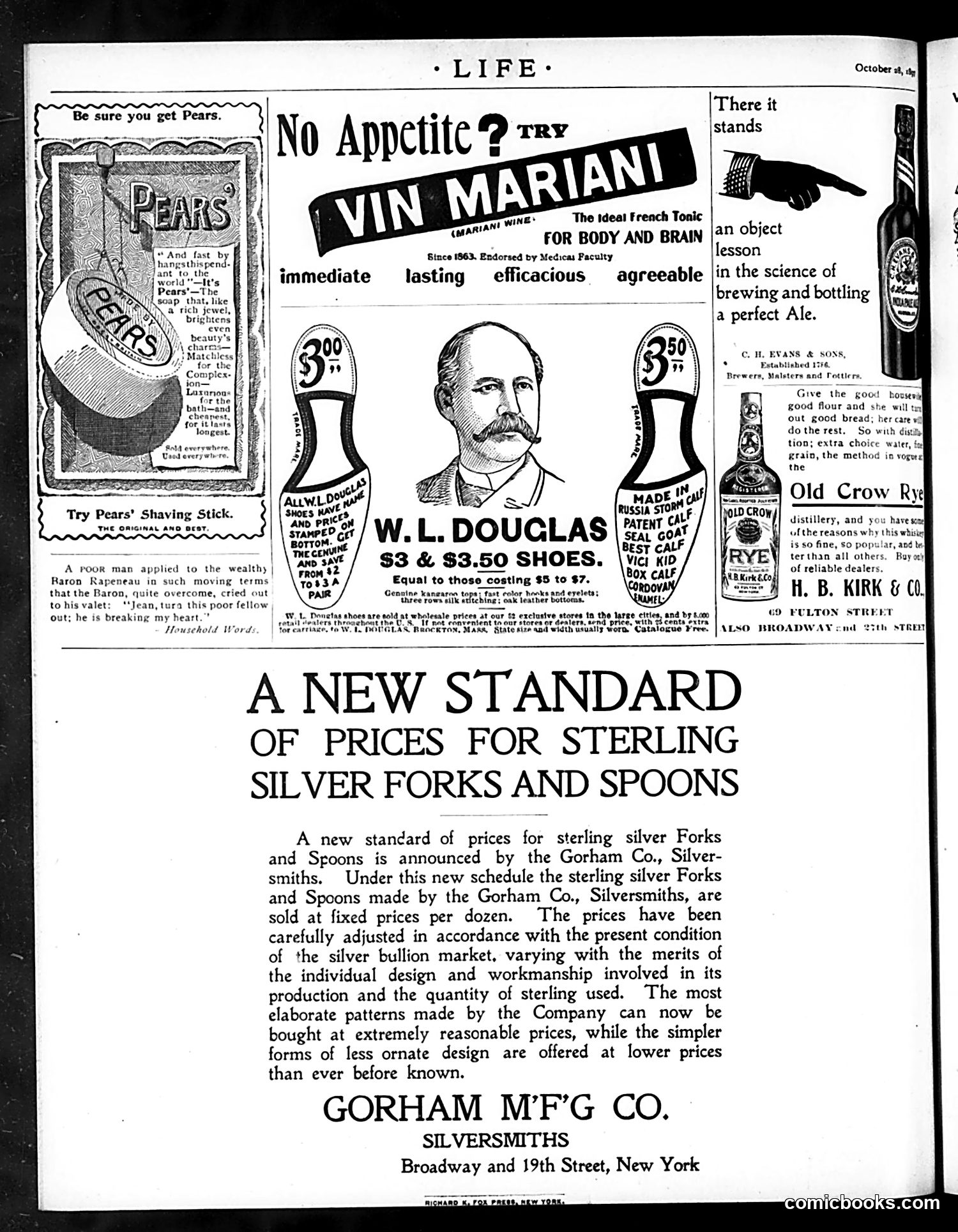
This page is primarily **advertising**, not political satire. The upper section contains multiple product ads typical of Life's commercial content: - **Pears' soap** and **Vin Mariani** (a French wine tonic marketed for appetite/health) - **W.L. Douglas shoes** ($3-$3.50, presented as affordable quality) - **Old Crow Rye whiskey** and **Evans & Sons ale** - A small anecdote (possibly satirical) about "Baron Rapeneau" ordering a poor man removed because he's "breaking my heart"—likely mocking wealthy indifference to suffering The lower half announces **Gorham Manufacturing's new sterling silver pricing**, responding to fluctuating silver bullion markets by offering both elaborate and simple designs at competitive prices. **For modern readers:** This reflects a consumer culture where advertisements dominated magazines, and dubious health claims (like wine tonics for vitality) were normalized and legally endorsed by "medical faculty."