
Life, 1897-10-28 · page 14 of 22
Life — October 28, 1897 — page 14: what you’re looking at
What you’re looking at
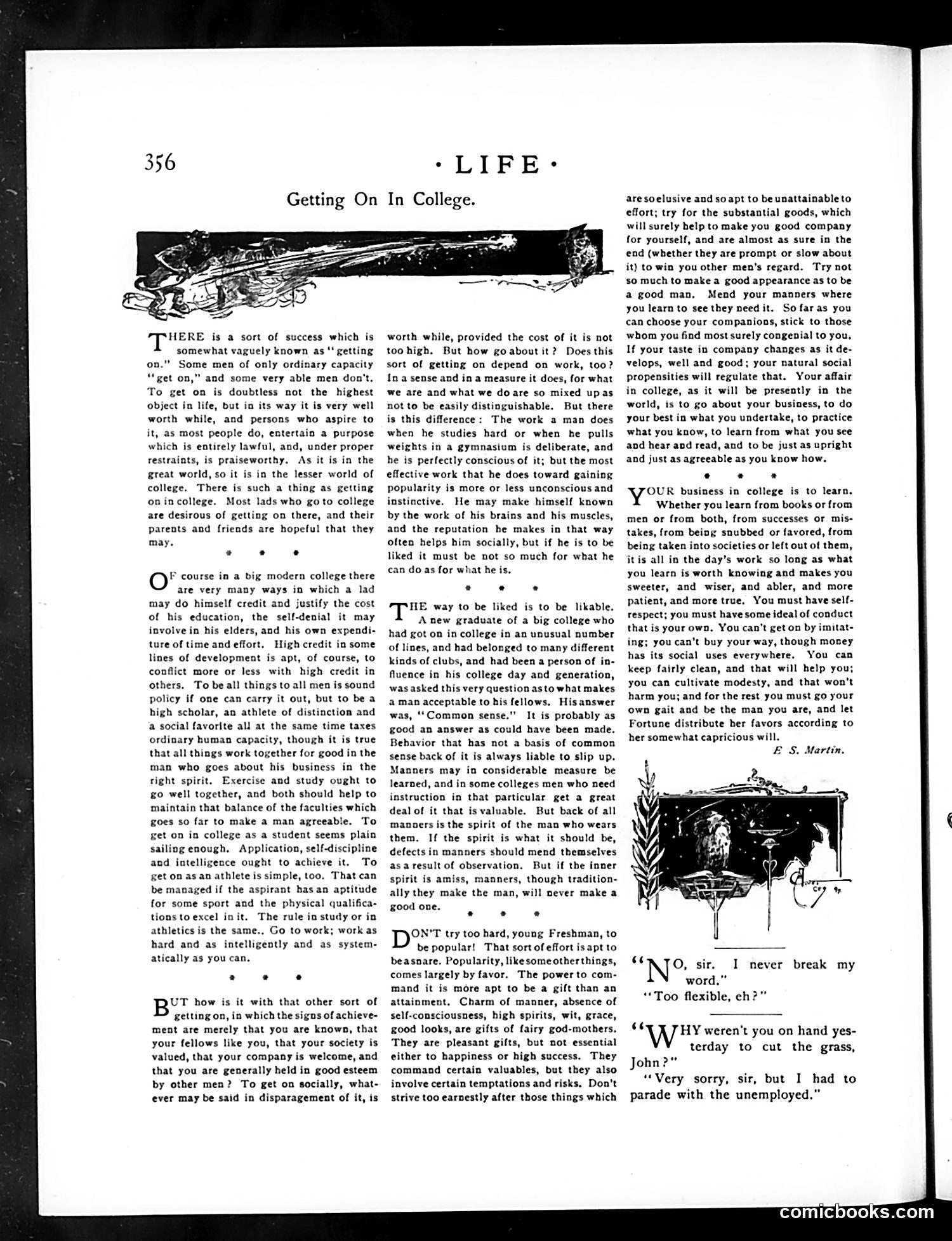
This page from *Life* magazine presents an earnest essay on college social success, accompanied by a humorous cartoon dialogue at the bottom. **The Main Article** discusses three forms of college achievement: academic excellence, athletic prowess, and social popularity. The author argues that while the first two require deliberate effort and hard work, social success depends less on what you *do* and more on what you *are*—your inherent likability and character. A prominent college graduate supposedly summed this up as "Common sense." **The Cartoon** at the page's bottom depicts the ironic contrast: a well-dressed employer asks his employee "Why weren't you on hand yesterday to cut the grass, John?" The worker replies he had to "parader with the unemployed"—meaning he was participating in unemployment demonstrations or protests. **The Satire** mocks the gap between the article's advice about earning respect through reliability and good character, and the economic reality facing working-class young men who struggle with joblessness and must engage in public protest. It's social commentary on labor conditions during this era.
📄 Transcribed text from this page (OCR, searchable)
Machine-transcribed from the original scan — historical spelling and the odd misread are preserved.
Getting On HERE is a sort of success which is somewhat vaguely known as “getting Some men of only ordinary capacity “get on,” and some very able men don't. To get on is doubtless not the highest object in life, but in its way it is very well worth while, and persons who aspire to it, as most people do, entertain a purpose which is entirely lawful, and, under proper restraints, is praiseworthy. As it is in the great world, so it is in the lesser world of college, There is such a thing as getting on incollege. Most lads who goto college are desirous of getting on there, and their parents and friends are hopeful that they may. 7 . . F course in a big modern college there are very many ways in which a lad may do himself credit and justify the cost of his education, the self-denial it may involve in his elders, and his own expendi- ture of time and effort. High credit in some lines of development is apt, of course, to conflict more or less with high credit in others. To be all things to all men is sound policy if one can carry it out, but to be a high scholar, an athlete of distinction and a social favorite all at the same time taxes ordinary human capacity, though it is true that all things work together for good in the man who goes about his business in the right spirit. Exercise and study ovght to go well together, and both should help to maintain that balance of the faculties which goes so far to make a man agreeable. To get on in college as a student seems plain sailing enough. Application, self-discipline and intelligence ought to achieve it. To get on as an athlete is simple, too. That can be managed if the aspirant hasan aptitude for some sport and the physical qualifica- tions toexcel init, The rule in study or in athletics is the same.. Go to work; work as hard and as intelligently and as system- atically as you can. UT how is it with that other sort of getting on, in which the signs of achieve- ment are merely that you are known, that your fellows like you, that your society is valued, that your company is welcome, and that you are generally held in good esteem by other men? To get on socially, what- ever may be said in disparagement of it, is *LIFE-: In College. worth while, provided the cost of it is not too high. But how goabout it? Does this sort of getting on depend on work, too? In a sense and in a measure it does, for what we are and what we doare so mixed upas not to be easily distinguishable. But there is this difference: The work a man does when he studies hard or when be pulls weights in a gymnasium is deliberate, and he is perfectly conscious of it; but the most effective work that he does toward gaining popularity is more or less unconscious and instinctive. He may make himself known by the work of his brains and his muscles, and the reputation he makes in that way often helps him socially, but if he is to be liked it must be not so much for what he can do as for what he is. HIE way to be liked is to be likable, Anew graduate of a big college who had got on in college in an unusual number of lines, and had belonged to many different kinds of clubs, and had been a person of in- fluence in his college day and generation, was asked this very question asto what makes a man acceptable to his fellows. His answer was, ‘Common sense." It is probably as good an answer as could have been made. Behavior that has not a basis of common sense back of it is always liable to slip up. Manners may in considerable measure be learned, and in some colleges men who need instruction in that particular get a great deal of it that is valuable. But back of all manners is the spirit of the man who wears them. If the spirit is what it should be, defects in manners should mend themselves asaresult of observation. But if the inner spirit is amiss, manners, though tradition- ally they make the man, will never make a good one. . é ON’T try too hard, young Freshman, to be popular! That sort of effort isapt to beasnare. Popularity, likesomeotherthings, comes largely by favor. The power to com- mand it is more apt to be a gift than an attainment, Charm of manner, absence of self-consciousness, high spirits, wit, grace, good looks, are gifts of fairy god-mothers, They are pleasant gifts, but not essential either to happiness or high success. They command certain valuables, but they also involve certain temptations and risks, Don't strive too earnestly after those things which are soelusive and so apt to be unattainableto effort; try for the substantial goods, which will surely help to make you good company for yourself, and are almost as sure in the end (whether they are prompt or slow about it) to win you other men’s regard. Try not so much to make a good appearance as to be a good man. Mend your manners where you learn to see they need it. Sofaras you can choose your companions, stick to those whom you find most surely congenial to you, If your taste in company changes as it de- velops, well and good; your natural social propensities will regulate that. Your affair in college, as it will be presently in the world, is to go about your business, to do your best in what you undertake, to practice what you know, to learn from what you see and hear and read, and to be just as upright and just as agreeable as you know how. . * * your business in college is to learn. Whether you learn from books or from men or from both, from successes or mis- takes, from being snubbed or favored, from being taken into societies or left out of them, itis all in the day’s work so long as what you learn is worth knowing and makes you sweeter, and wiser, and abler, and more patient, and more true, You must have self- respect; you must have some ideal of conduct that is your own, You can't get on by imitat- ing; you can't buy your way, though money has its social uses everywhere, You can keep fairly clean, and that will help you; you can cultivate modesty, and that won't harm you; and for the rest you must go your own gait and be the man you are, and let Fortune distribute her favors according to her somewhat capricious will. E S. Martin, ee O, sir, I never N word.” “Too flexible, eh?” break my “we weren't you on hand yes- terday to cut the grass, John?” “Very sorry, sir, but I had to parade with the unemployed.” comicbooks.com