
Life, 1897-10-28 · page 6 of 22
Life — October 28, 1897 — page 6: what you’re looking at
What you’re looking at
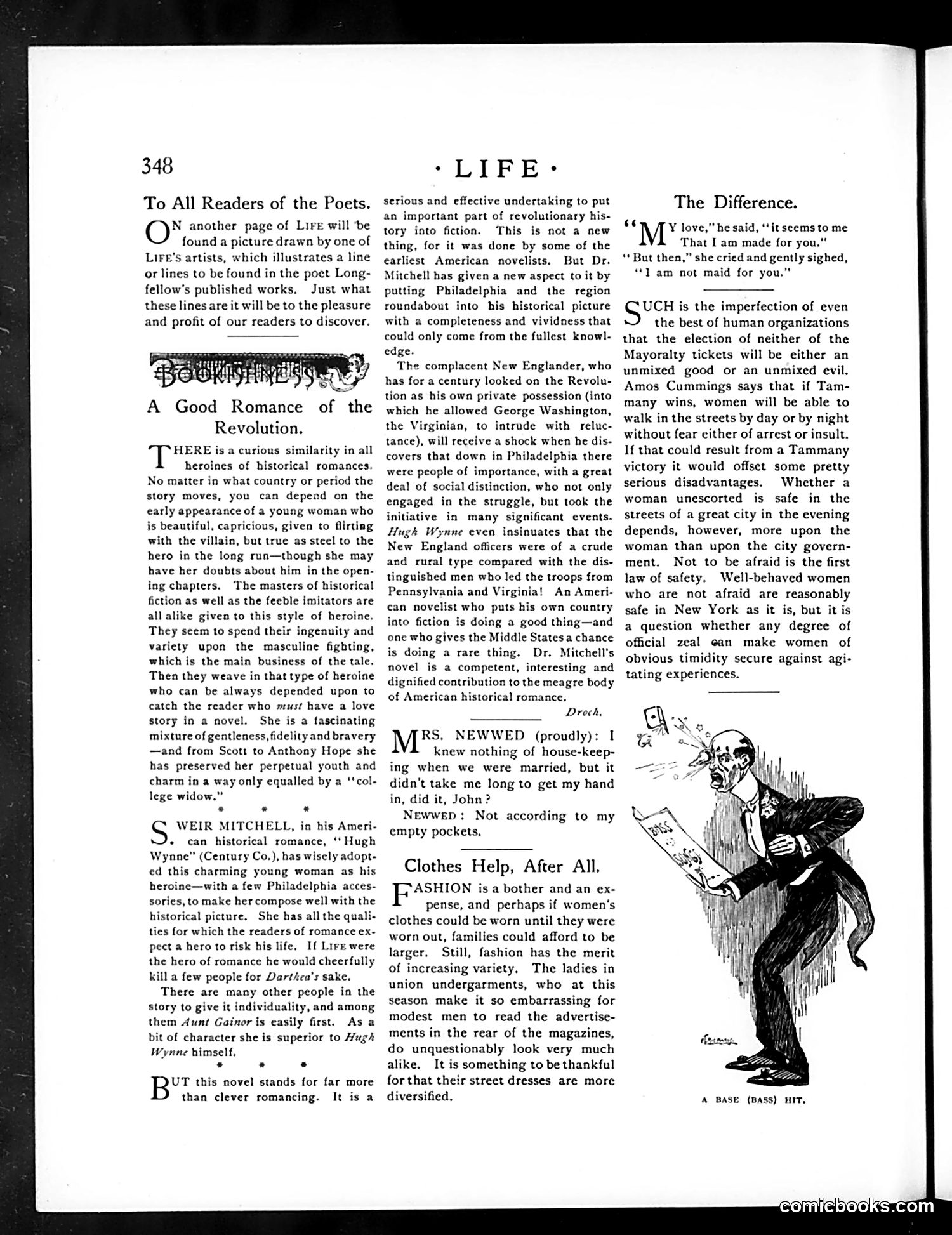
This cartoon depicts a figure labeled "A BASE (BASS) HIT" — a pun playing on baseball terminology. The exaggerated caricature shows a man in formal attire striking a base with a bat, literalizing the baseball term "base hit." The accompanying text discusses women's fashion and street safety in cities, touching on debates about whether women can safely navigate public spaces. The cartoon appears to be satirizing male behavior or attitudes toward women in urban environments — the "base" conduct being ridiculed is likely inappropriate male behavior or harassment, rendered as a crude pun. The artistic style and caricature suggest this targets a specific social type or behavior pattern contemporary readers would have recognized, though the precise reference remains unclear today.
📄 Transcribed text from this page (OCR, searchable)
Machine-transcribed from the original scan — historical spelling and the odd misread are preserved.
348 To All Readers of the Poets. O* another page of Lire will be found a picture drawn by one of Lire’s artists, which illustrates a line or lines to be found in the poet Long- fellow’s published works, Just what these lines are it will be to the pleasure and profit of our readers to discover. A Good Romance of the Revolution. HERE is a curious similarity in all heroines of historical romances. No matter in what country or period the story moves, you can depend on the carly appearance of a young woman who is beautiful, capricious, given to flirting with the villain, but true as steel to the hero in the long run—though she may have her doubts about him in the open- ing chapters. The masters of historical fiction as well as the feeble imitators are all alike given to this style of heroine. They seem to spend their ingenuity and variety upon the masculine fighting, which is the main business of the tale. Then they weave in that type of heroine who can be always depended upon to catch the reader who must have a love story in a novel, She is a fascinating mixture of gentleness, fidelity and bravery —and from Scott to Anthony Hope she has preserved her perpetual youth and charm in a way only equalled by a ‘‘col- lege widow.” * * * WEIR MITCHELL, in his Ameri- + can historical romance, “Hugh Wynne” (Century Co.), has wisely adopt- ed this charming young woman as his heroine—with a few Philadelphia acces- sories, to make her compose well with the historical picture. She has all the quali- ties for which the readers of romance ex- pect a hero to risk his life. If Lire were the hero of romance he would cheerfully kill a few people for Darthea's sake. There are many other people in the story to give it individuality, and among them Aunt Gainor is easily first. As a bit of character she is superior to Hugh Wynne himself. * * . UT this novel stands for far more than clever romancing. It is a > LIFE: serious and effective undertaking to put an important part of revolutionary his- tory into fiction. This is not a new thing, for it was done by some of the earliest American novelists. But Dr. Mitchell has given a new aspect to it by putting Philadelphia and the region roundabout into his historical picture with a completeness and vividness that could only come from the fullest knowl- edge. The complacent New Englander, who has for a century looked on the Revolu- tion as his own private possession (into which he allowed George Washington, the Virginian, to intrude with reluc- tance), will receive a shock when he dis- covers that down in Philadelphia there were people of importance, with a great deal of social distinction, who not only engaged in the struggle, but took the initiative in many significant events. Hugh Wynne even insinuates that the New England officers were of a crude and rural type compared with the dis- tinguished men who led the troops from Pennsylvania and Virginia! An Ameri- can novelist who puts his own country into fiction is doing a good thing—and one who gives the Middle States a chance is doing a rare thing. Dr. Mitchell's novel is a competent, interesting and dignified contribution to the meagre body of American historical romance. Droch. RS. NEWWED (proudly): I knew nothing of house-keep- ing when we were married, but it didn't take me long to get my hand in, did it, John? Newwep: Not according to my empty pockets, Clothes Help, After All. ASHION is a bother and an ex- pense, and perhaps if women's clothes could be worn until they were worn out, families could afford to be larger. Still, fashion has the merit of increasing variety. The ladies in union undergarments, who at this season make it so embarrassing for modest men to read the advertise- ments in the rear of the magazines, do unquestionably look very much alike, It is something to be thankful for that their street dresses are more diversified. The Difference. € ‘M* love,” he said, ‘it seems to me That I am made for you.” “But then,” she cried and gently sighed, “1am not maid for you.” UCH is the imperfection of even the best of human organizations that the election of neither of the Mayoralty tickets will be either an unmixed good or an unmixed evil. Amos Cummings says that if Tam- many wins, women will be able to walk in the streets by day or by night without fear either of arrest or insult. If that could result from a Tammany victory it would offset some pretty serious disadvantages. Whether a woman unescorted is safe in the Streets of a great city in the evening depends, however, more upon the woman than upon the city govern- ment. Not to be afraid is the first law of safety. Well-behaved women who are not afraid are reasonably safe in New York as it is, but it is a question whether any degree of official zeal ean make women of obvious timidity secure against agi- tating experiences, A BASE (BASS) HIT.