
Life, 1897-10-28 · page 12 of 22
Life — October 28, 1897 — page 12: what you’re looking at
What you’re looking at
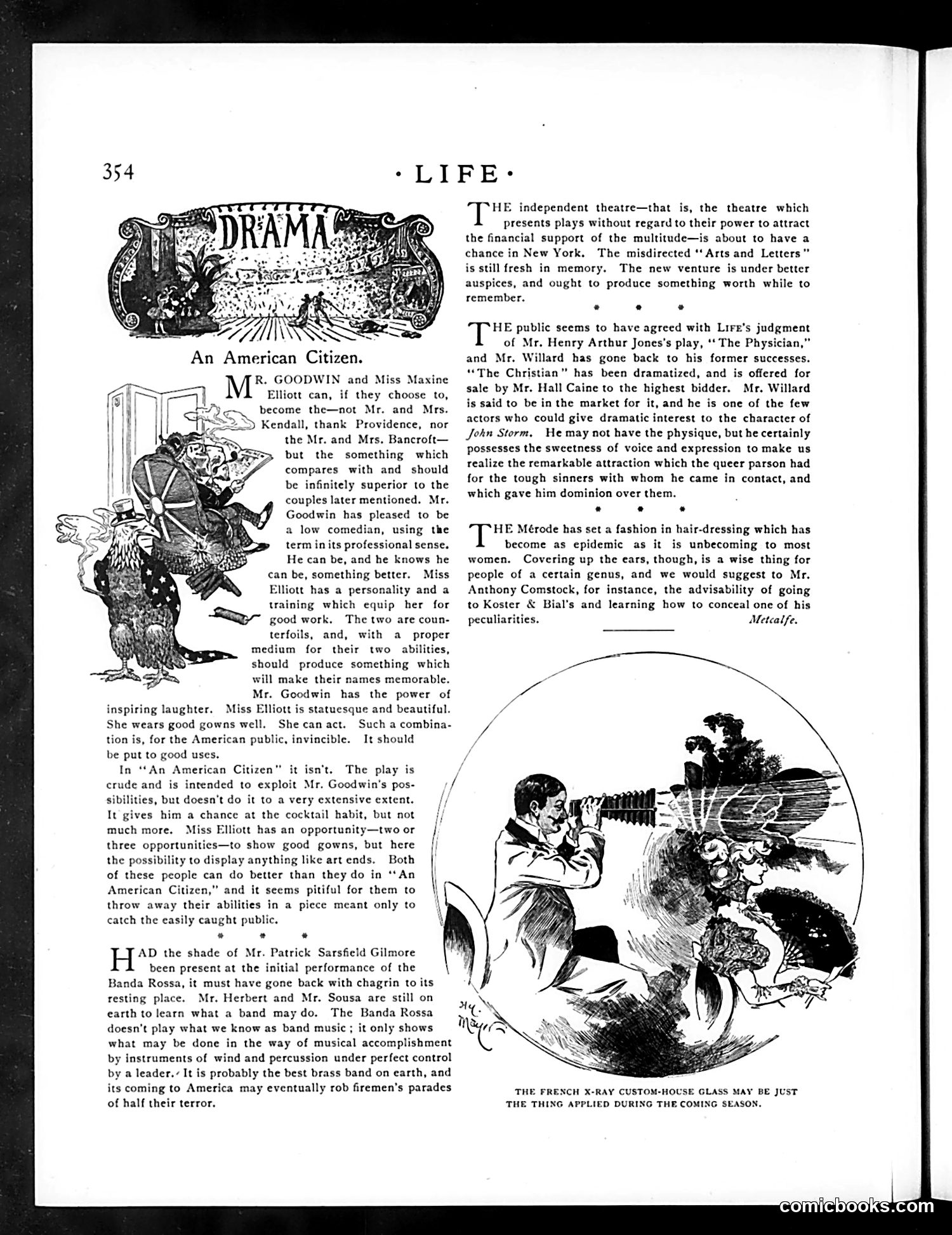
This page reviews theatrical productions. The main text critiques "An American Citizen," a play featuring actors Mr. Goodwin and Miss Maxine Elliott. The reviewer praises their abilities but judges the play itself as crude, designed merely to showcase the lead actor's talents rather than offer substantive drama. The circular illustration depicts a man using an early X-ray device or camera, captioned "THE FRENCH X-RAY CUSTOM-HOUSE GLASS MAY BE JUST THE THING APPLIED DURING THE COMING SEASON." This appears to be satirical commentary on fashion or theatrical costume inspection, possibly mocking French technological trends or customs procedures of the era. The page exemplifies Life magazine's role as a cultural critic of early 20th-century American theater and society.
📄 Transcribed text from this page (OCR, searchable)
Machine-transcribed from the original scan — historical spelling and the odd misread are preserved.
* LIFE: An American Citizen. M* GOODWIN and Miss Maxine Elliott can, if they choose to, ry become the—not Mr. and Mrs. 2S Kendall, thank Providence, nor the Mr. and Mrs. Bancroft— but the something which compares with and should be infinitely superior to the couples later mentioned. Mr. Goodwin has pleased to be a low comedian, using the term in its professional sense. He can be, and he knows he can be, something better. Miss Elliott has a personality and a training which equip her for good work. The two are coun- terfoils, and, with a proper medium for their two abilities, should produce something which will make their names memorable. Mr. Goodwin has the power of inspiring laughter. Miss Elliott is statuesque and beautiful. She wears good gowns well. Shecanact. Such a combina- tion is, for the American public, invincible. It should be put to good uses. In “An American Citizen” it isn't. The play is crude and is intended to exploit Mr. Goodwin's pos- sibilities, but doesn't do it to a very extensive extent. It gives him a chance at the cocktail habit, but not much more. Miss Elliott has an opportunity—two or three opportunities—to show good gowns, but here the possibility to display anything like art ends. Both of these people can do better than they do in **An American Citizen,” and it seems pitiful for them to throw away their abilities in a piece meant only to catch the easily caught public. * * * H*? the shade of Mr. Patrick Sarsfield Gilmore been present at the initial performance of the Banda Rossa, it must have gone back with chagrin to its resting place. Mr. Herbert and Mr. Sousa are still on earth to learn what a band may do. The Banda Rossa doesn't play what we know as band music; it only shows what may be done in the way of musical accomplishment by instruments of wind and percussion under perfect control by a leader.’ It is probably the best brass band on earth, and its coming to America may eventually rob firemen’s parades of half their terror. a HE independent theatre—that is, the theatre which presents plays without regard to their power to attract the financial support of the multitude—is about to have a chance in New York. The misdirected ‘Arts and Letters” is still fresh in memory. The new venture is under better auspices, and ought to produce something worth while to remember. . ° ° HE public seems to have agreed with Lire’s judgment of Mr. Henry Arthur Jones's play, ‘‘ The Physician,” and Mr. Willard has gone back to his former successes. “The Christian” has been dramatized, and is offered for sale by Mr. Hall Caine to the highest bidder. Mr. Willard is said to be inthe market for it, and he is one of the few actors who could give dramatic interest to the character of John Storm, He may not have the physique, but he certainly possesses the sweetness of voice and expression to make us realize the remarkable attraction which the queer parson had for the tough sinners with whom he came in contact, and which gave him dominion over them. * . . HE Mérode has set a fashion in hair-dressing which has become as epidemic as it is unbecoming to most women. Covering up the ears, though, is a wise thing for people of a certain genus, and we would suggest to Mr. Anthony Comstock, for instance, the advisability of going to Koster & Bial’s and learning how to conceal one of his peculiarities. Metcalfe.