
A complete issue · 22 pages · 1897
Life — October 14, 1897
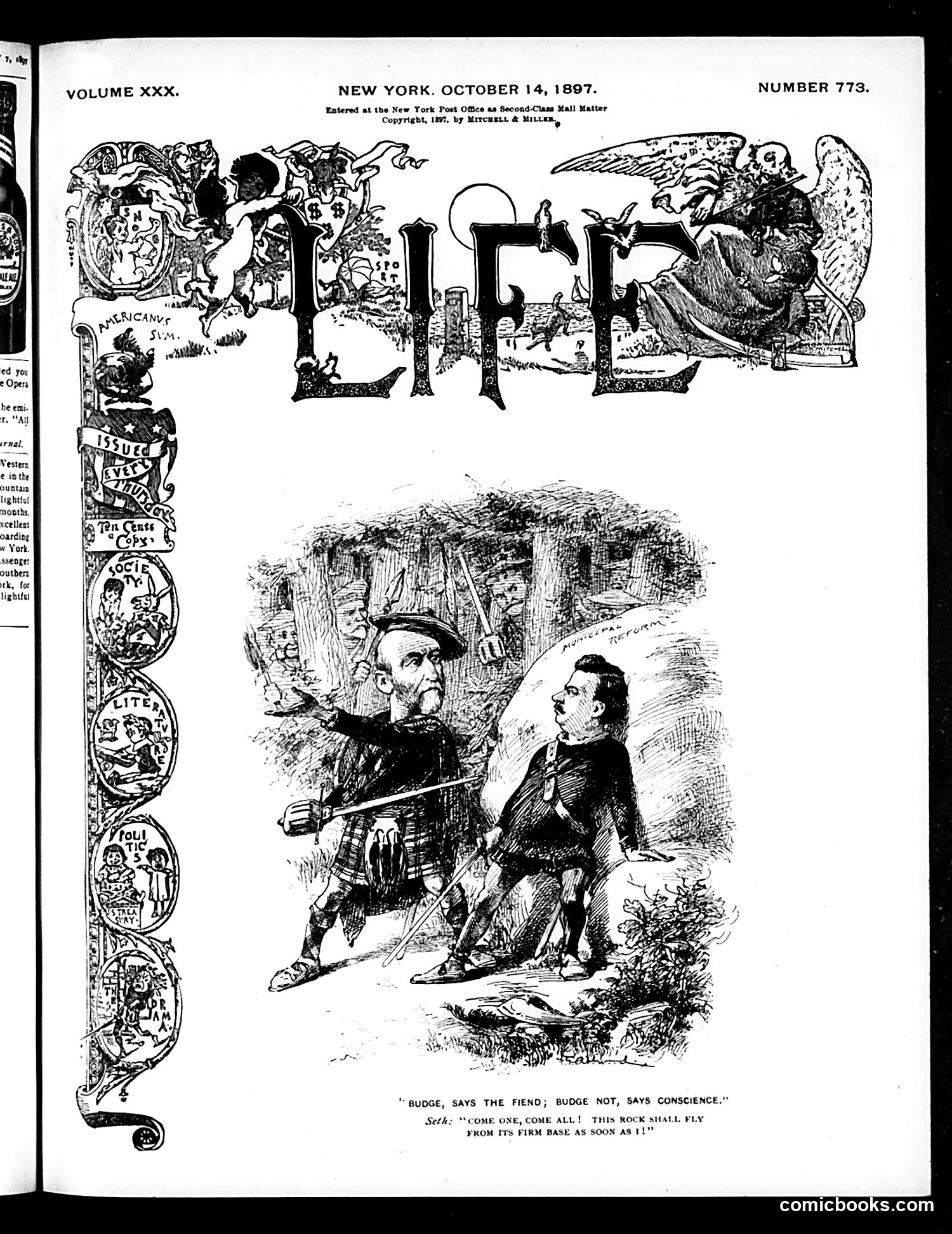
This satirical cartoon depicts a military or political confrontation. A figure in Scottish Highland dress (identifiable by tartan) holds a rifle pointed at another man, representing a conflict of conscience versus duty or impulse. The caption reads: "BUDGE, SAYS THE FIEND; BUDGE NOT, SAYS CONSCIENCE" with dialogue: "COME ON, COME ALL! THIS ROCK SHALL FLY FROM ITS FIRM BASE AS SOON AS I!" The imagery suggests internal moral struggle, with the Highland-dressed figure embodying either a specific historical or political figure facing pressure to act against his principles. Without additional context, the exact political reference remains unclear, though it likely relates to late-19th-century British imperial or Scottish affairs. The ornate decorative border contains smaller illustrated vignettes typical of Life's design aesthetic.
This page is **primarily advertising**, not political satire or comics. It contains commercial advertisements for: - Travel services (Raymond & Whitcomb tours to California) - Women's fashion (Arnold Constable & Co. fall/winter clothing; James McCreery & Co. cloaks and suits) - Watches (B. Altman & Co.'s Fasso Corset and American Waltham Watches) - Bicycles (Columbia Bicycles) The only visual element beyond product illustrations is a small decorative trade mark for the Fasso Corset. There are no political cartoons, caricatures, or satirical commentary visible on this page. The content reflects typical early 20th-century consumer advertising in a general-interest magazine.
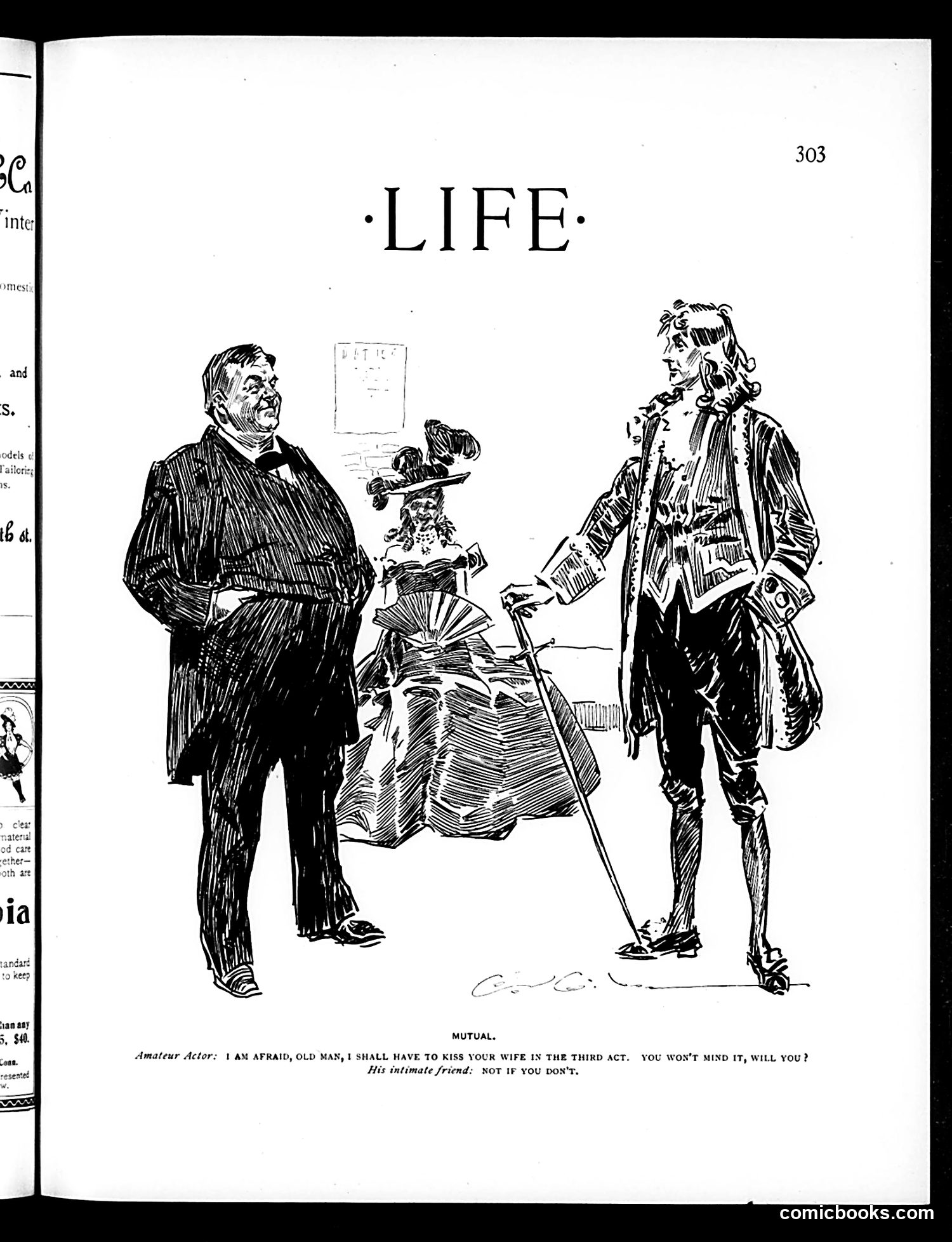
This satirical cartoon depicts theatrical humor about stage conventions. An "Amateur Actor" (left, in modern dress) nervously consults with his "intimate friend" (right, in 18th-century costume) about an upcoming theatrical performance. The joke centers on an awkward dramatic requirement: the amateur must kiss his co-star's wife in Act Three. The anachronistic clothing contrast—modern businessman versus period-dressed gentleman—emphasizes the absurdity of old theatrical traditions persisting in contemporary theater. The humor lies in the friend's reassurance ("You won't mind it, will you?") and the amateur's nervous hesitation, mocking both theatrical melodrama conventions and bourgeois social anxieties about propriety. The cartoon satirizes outdated stage traditions and amateur performers' discomfort with their demands.
This October 1897 *Life* magazine page contains three sections critiquing New York politics and governance: **"Four Candidates for Mayor"** discusses Republican General Tracy as mayoral candidate, contrasting his "old-time Tammany" machine politics methods with Judge Van Wyck. The satire targets Tammany Hall's political dominance and corrupt practices. **"Mr. Cockran Finds Fault"** criticizes Burke Cockran's vague political positions on taxes, parks, and transit—mocking his eloquent oratory while avoiding specifics. **"The Force of Example"** and **"Send Him to Congress"** address lynching violence in Indiana and the South, sarcastically suggesting Northern and Southern examples of lawlessness justify each other. The final section mentions Grover Cleveland and Edward Murphy regarding congressional representation from New York. The cartoons use satirical drawings to accompany these political critiques.
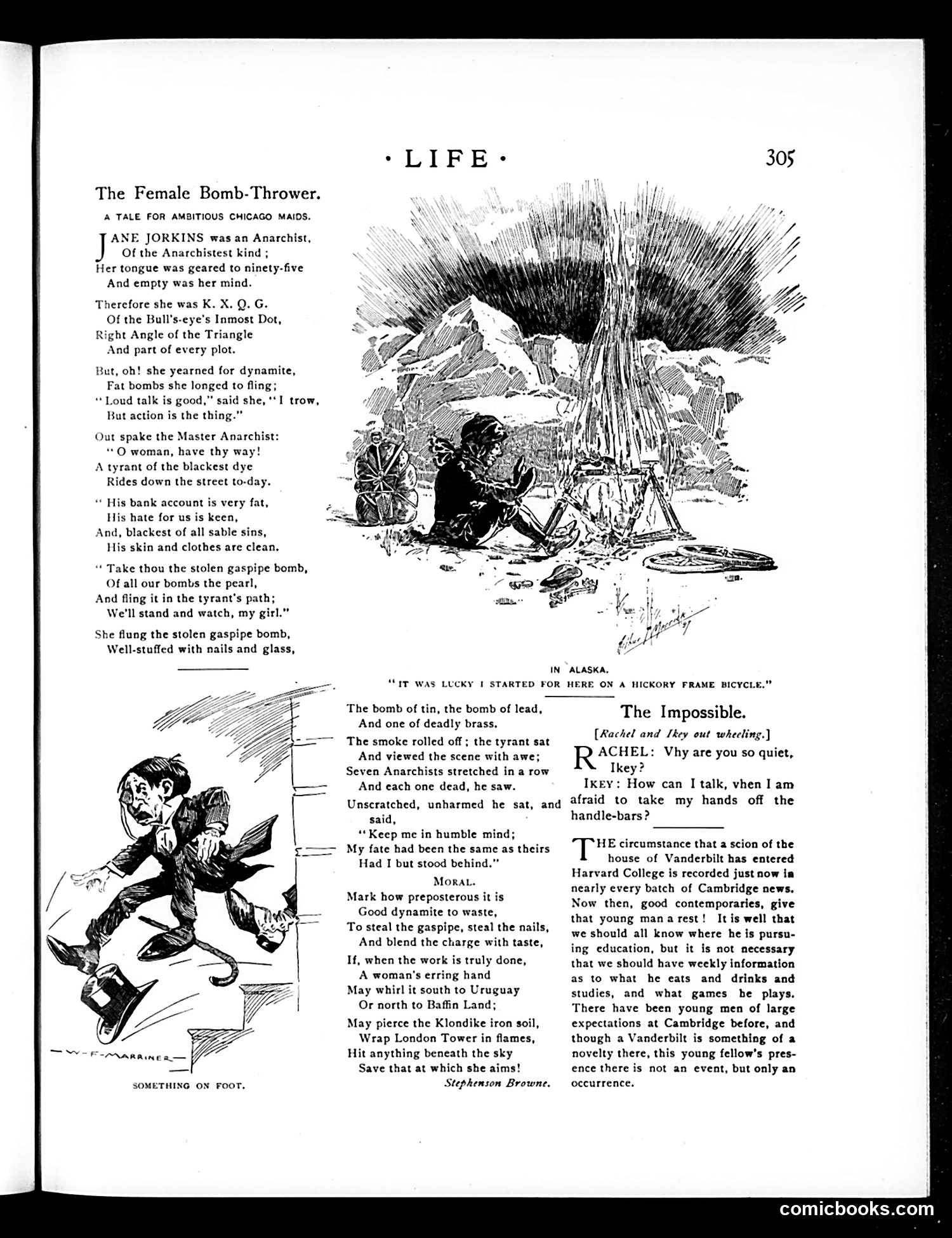
**"The Female Bomb-Thrower"** satirizes anarchist activism, specifically women's involvement. Jane Jorkins, described as an anarchist with an empty mind, is encouraged by "the Master Anarchist" to throw a stolen bomb at a tyrant. The poem mocks anarchists' grandiose rhetoric versus actual effectiveness—the bomb kills only other anarchists, not the intended target. The satire targets both anarchism's violent methods and the perceived foolishness of its adherents. **"The Impossible"** is a brief dialogue about a Cambridge student's social awkwardness at Harvard. It's a light joke about upper-class college life and social etiquette—specifically, the difficulty of dining with refined people when one lacks proper manners. Both pieces reflect Life's conservative editorial stance criticizing radical politics and satirizing social pretension.
This page contains three distinct literary pieces rather than political cartoons. "The Usual Way" features an illustration of a cherub or cupid figure with small bat-like creatures, accompanying a dialogue about romantic relationships and courtship behavior. The illustration appears decorative rather than satirical. Below are two short poems: "Love's Lesson" and "Too Considerate," with a small sketch of what appears to be a classical urn or decorative object. The content focuses on romance, gender relations, and social etiquette—typical Light magazine fare of the early 20th century. There are no clear political references or identifiable caricatures. This appears to be the magazine's literary/humor section rather than its satirical editorial content.
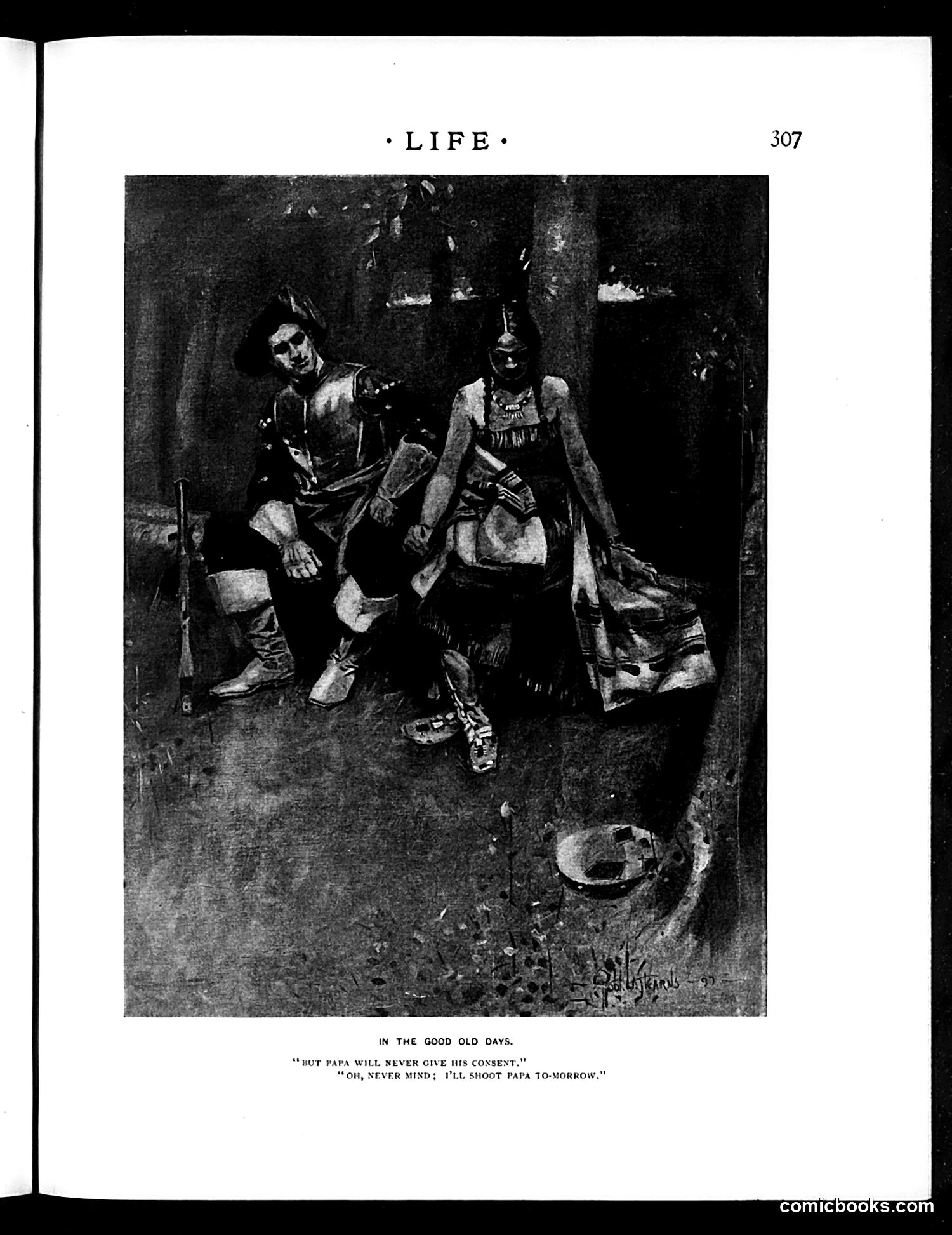
This page from *Life* magazine presents an illustration titled "IN THE GOOD OLD DAYS" with a caption reading: "BUT PAPA WILL NEVER GIVE HIS CONSENT." / "OH, NEVER MIND; I'LL SHOOT PAPA TO-MORROW." The image depicts two figures in what appears to be period costume (possibly depicting a historical or theatrical scene) in a darkened interior. The satire seems to reference a melodramatic scenario—likely poking fun at both romantic plot conventions and the casual attitude toward parental authority or even violence suggested by the caption's dark humor. The specific historical or political reference is unclear without additional context. The "good old days" reference may be satirizing nostalgia for earlier eras. The joke's punch depends on understanding contemporary attitudes toward family authority and possibly period literature conventions that modern readers would need more context to fully appreciate.
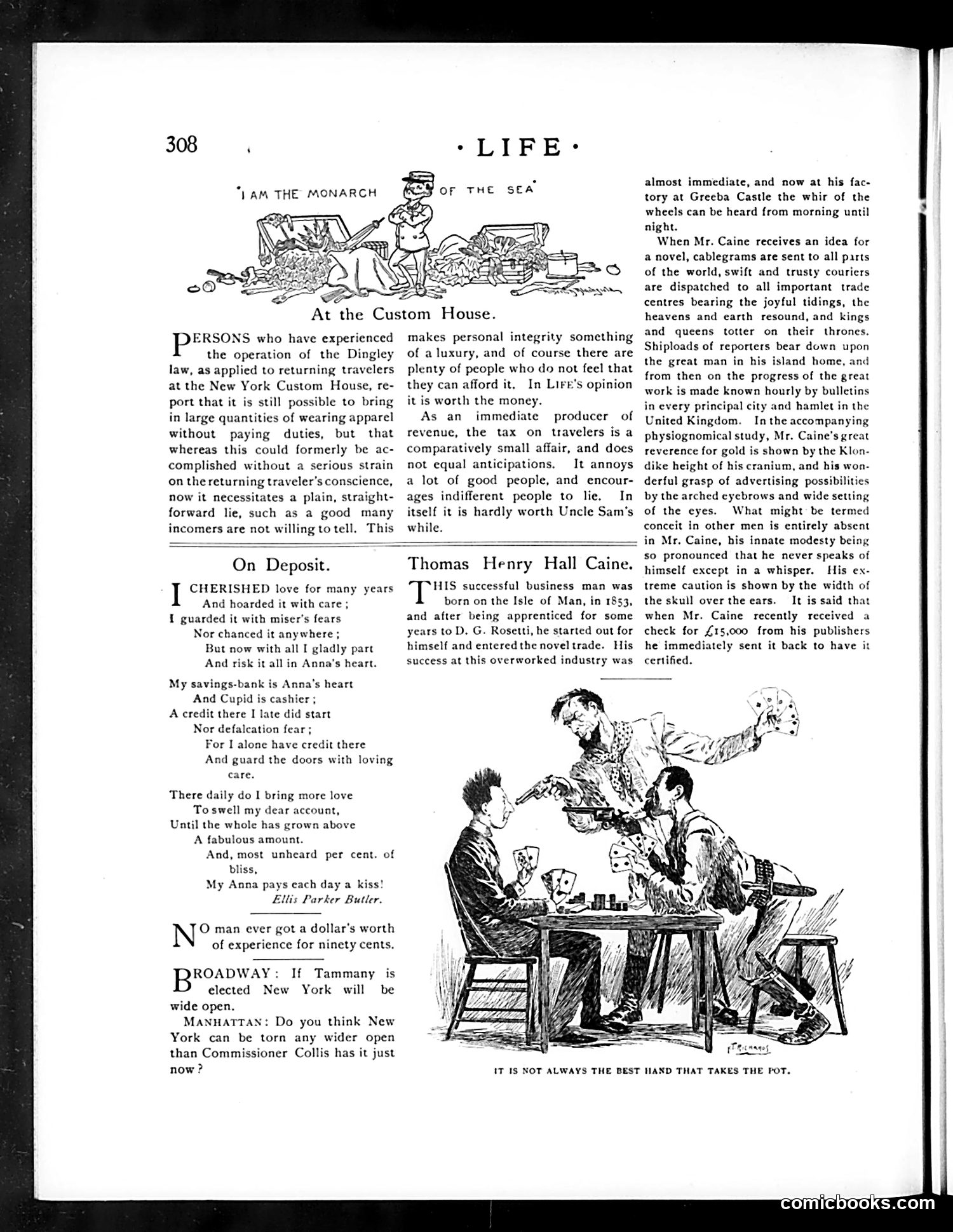
This page contains three distinct sections: 1. **"At the Custom House"** - A satirical commentary on tariffs affecting returning travelers. The text argues that import duties on clothing are burdensome and questions their fairness, suggesting wealthy travelers can afford them while ordinary people cannot. 2. **"On Deposit"** - A biographical sketch of Thomas Henry Hall Caine, a successful novelist born on the Isle of Man in 1853. The text celebrates his business acumen and modesty, noting he recently received a £15,000 check from publishers. 3. **"It Is Not Always the Best Hand That Takes the Pot"** - A cartoon depicting men playing cards, with one winning despite not having the strongest hand—likely social commentary on luck versus skill in business or life. The page reflects early 20th-century concerns about tariffs and celebrates literary success.
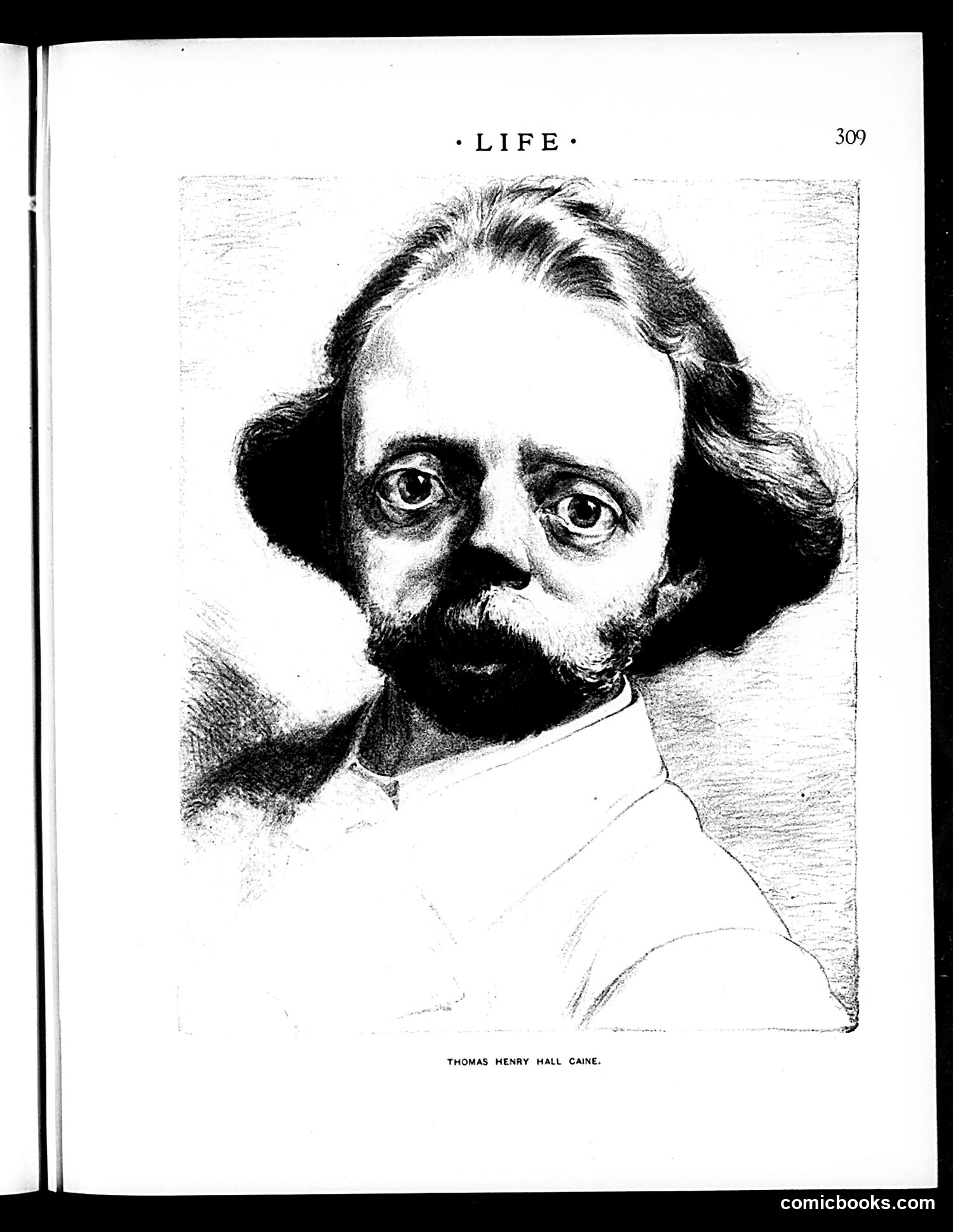
This page from *Life* magazine (page 309) features a portrait sketch labeled "THOMAS HENRY HALL CAINE." The image shows a bearded man with distinctive facial features in what appears to be a formal portrait style typical of early 20th-century magazine illustration. However, this page contains **only a portrait and caption**—no cartoon or satirical content is visible. It appears to be a straightforward biographical or tribute illustration rather than political or social satire. Without additional context about Hall Caine or the surrounding article text, I cannot determine the specific satirical point or social commentary this portrait may have been intended to convey within its original publication context.
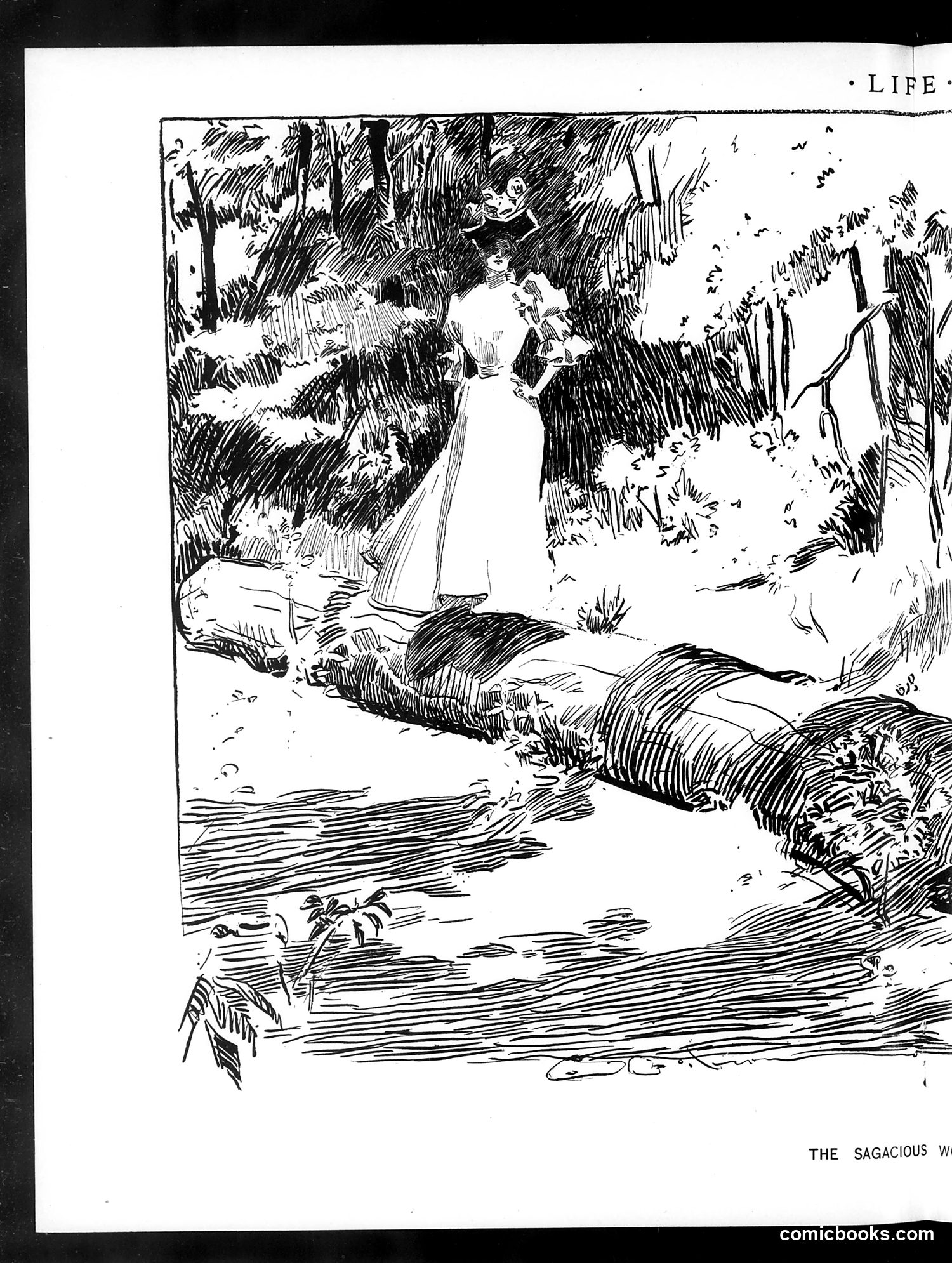
This appears to be a page from *Life* magazine featuring an ink illustration titled "The Sagacious W[oman]" (title cut off). The sketch depicts a woman in early 20th-century dress standing in a wooded landscape near a fallen log and stream, observed by figures in the background. Without the complete title and OCR text, the specific satirical meaning remains unclear. However, given *Life's* style, this likely comments on women's behavior, intelligence, or social role during the Progressive Era. The woman's solitary, contemplative pose in nature might suggest independence or foolishness—the satire's direction depends on the full caption and context, which aren't fully legible here.
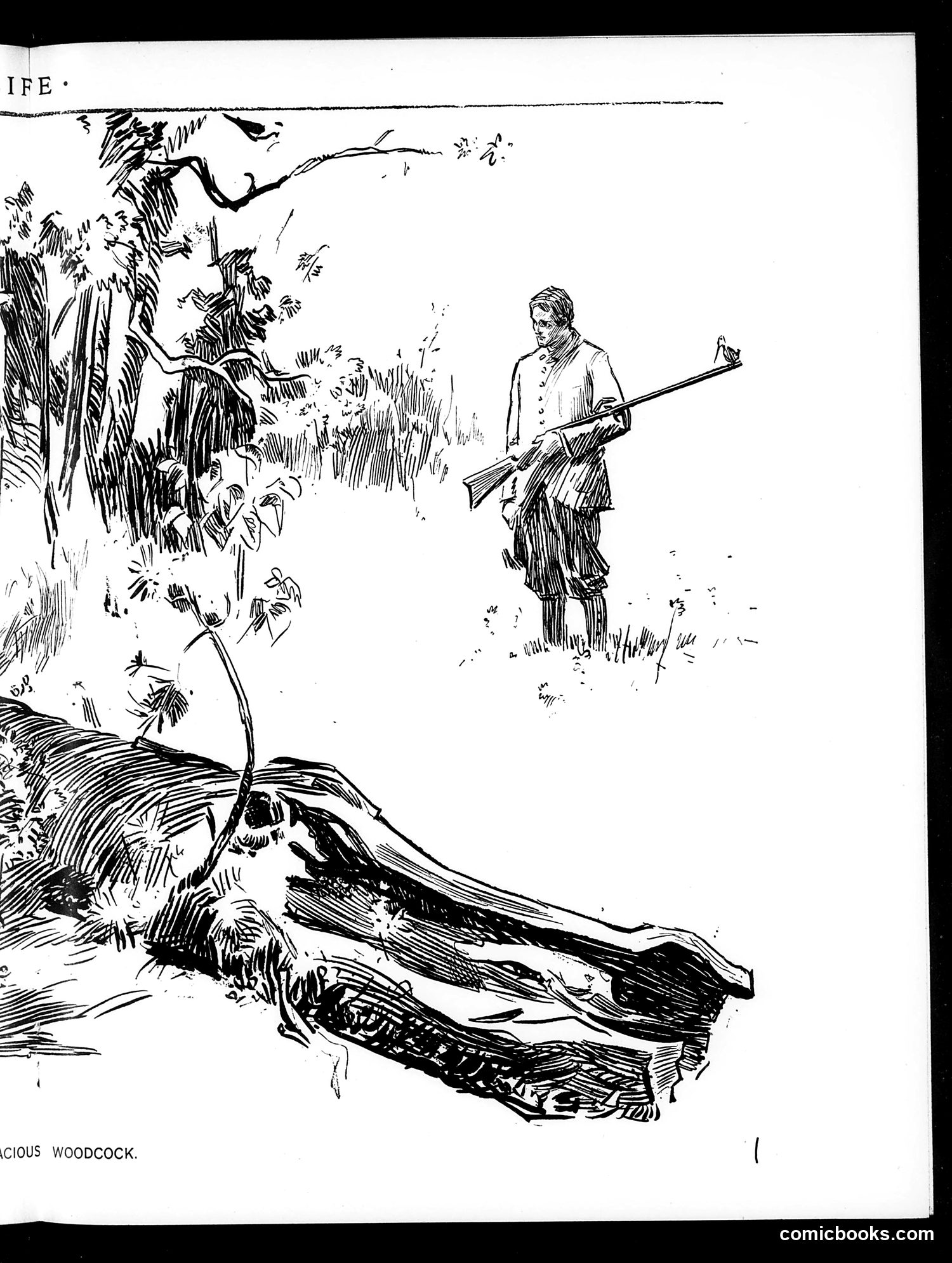
This appears to be a satirical illustration from Life magazine showing a hunter with a rifle encountering a woodcock in a natural setting with fallen logs and vegetation. The caption "A Gracious Woodcock" suggests ironic commentary—likely about the bird's behavior or, more probably, this is a political cartoon using "woodcock" as a term of mockery. Historically, "woodcock" was sometimes used as slang for a foolish or gullible person. Without additional context or visible text identifying specific political figures, the exact satirical target remains unclear. The illustration could be commenting on political naiveté, failed diplomacy, or social pretension during the early 20th century when Life published such material. The hunter's confident posture suggests he believes he's in control of the situation.
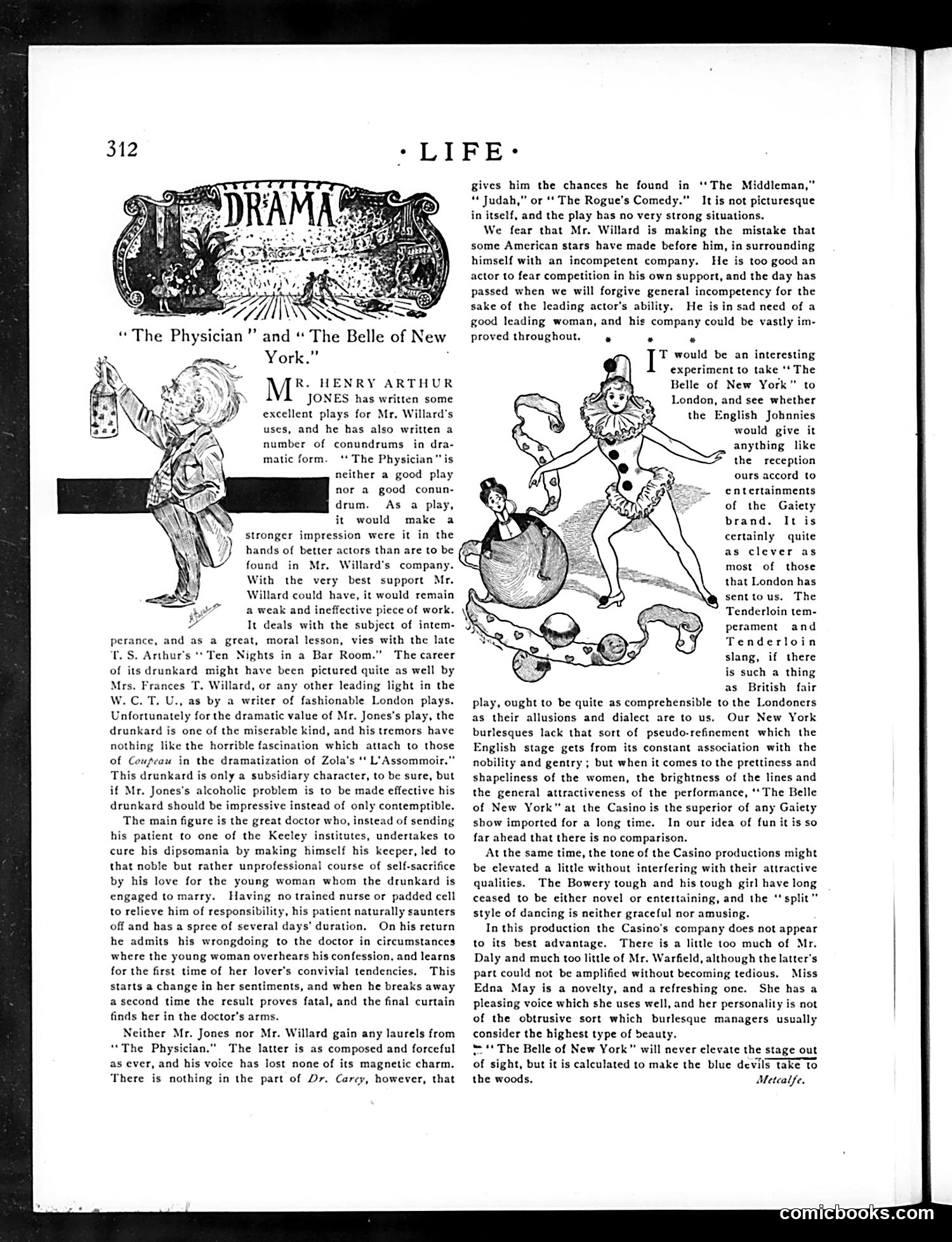
This page reviews theatrical productions, primarily discussing M. Henry Arthur Jones's plays "The Physician" and "The Belle of New York." The left illustration shows a theatrical character in period costume (appears to be from "The Physician"), while the right illustration depicts dancers in comedic poses, likely representing the lighter musical comedy style of "The Belle of New York." The critic praises Jones's writing but criticizes lead actor Mr. Willard for surrounding himself with an "incompetent company." The review suggests Willard lacks a strong leading lady and would benefit from better supporting actors. The piece compares American and British theatrical standards, noting "The Belle of New York" would receive different reception in London versus New York audiences.
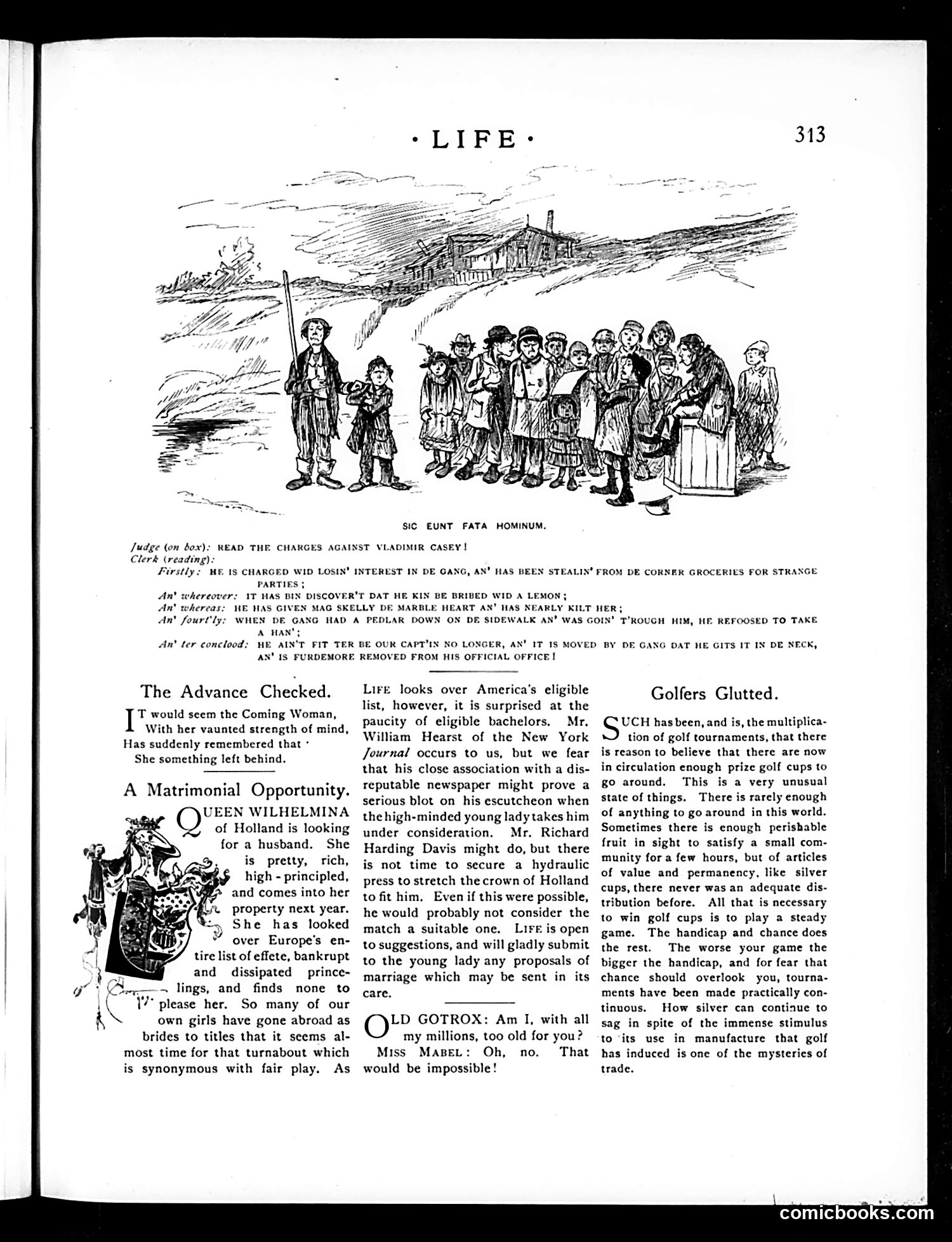
**Top Cartoon**: A street court scene satirizing urban immigrant crime. "Vladimir Casey" is tried for various petty crimes—stealing from groceries, being bribed with a lemon, involvement in gang violence. The dialect spelling ("WID," "DE," "GITS IT IN DE NECK") reflects period ethnic stereotyping common in early 20th-century American humor. The Latin epigraph "Sic eunt fata hominum" ("Thus go the fates of men") adds mock-serious irony to this trivial street gang matter. **Middle Section**: Satirical marriage commentary. Life jokingly proposes Queen Wilhelmina of Holland consider American bachelors (William Hearst, Richard Harding Davis) for marriage, mocking both European royalty's marriage market and America's eligible men as inadequate. **Lower Section**: Brief joke about golf's popularity, noting the proliferation of tournament prize cups has somehow failed to stimulate silver prices—a paradoxical economic observation offered as humor. The overall tone is characteristic of Life's turn-of-the-century satirical approach to social commentary.
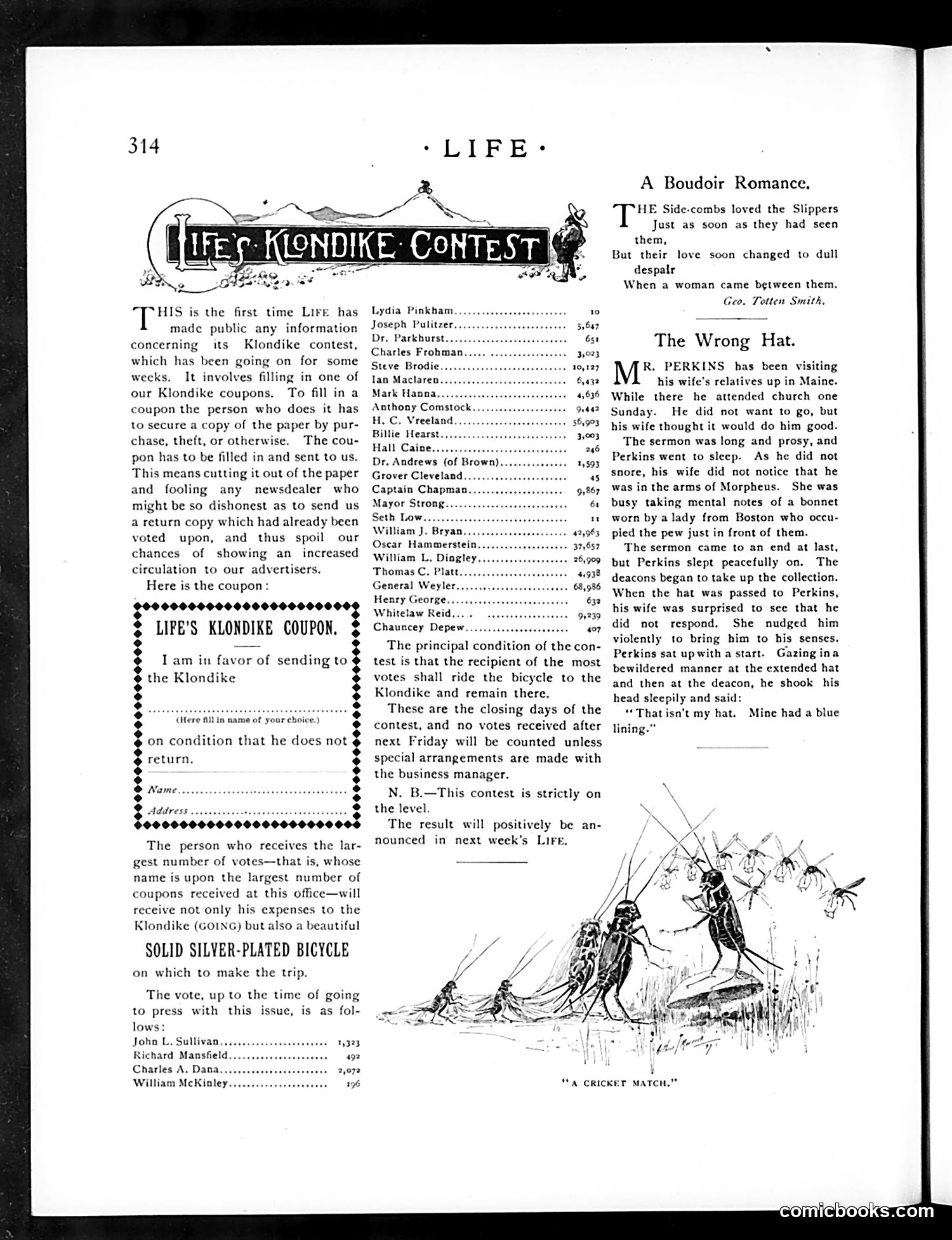
This page announces Life magazine's satirical "Klondike Contest"—a running joke about the Yukon gold rush craze. Readers vote to send a public figure to the Klondike, with the condition he stays there permanently. The ballot lists prominent Americans: John L. Sullivan (boxer), William McKinley, Grover Cleveland, William Jennings Bryan, and others. The satire is caustic: Life frames this as banishment disguised as prize. The "solid silver-plated bicycle" reward is mockery—useless in Arctic conditions. Vote totals reveal public sentiment; notably, Chauncey Depew leads with 99,239 votes, suggesting he was particularly unpopular or the target of organized voting. The contest is a circulation scheme—readers must buy the paper to get coupons, then cut them out and mail them back. Life openly admits this ("involves filling in one of our Klondike coupons"), and even acknowledges potential fraud from dishonest newsdealers. The accompanying stories—a boudoir romance and "The Wrong Hat"—are filler content typical of the era's humor magazines.
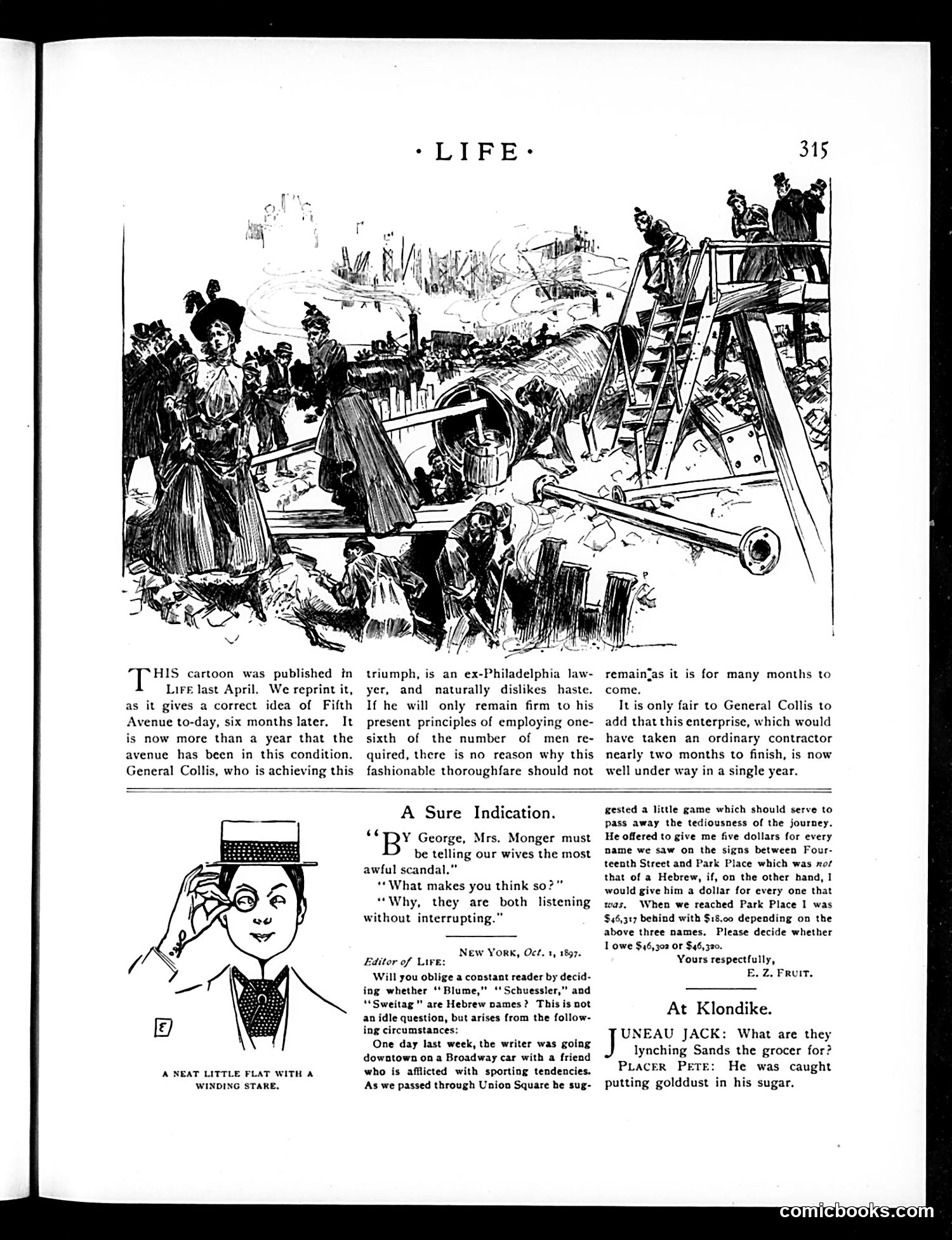
The main cartoon satirizes Fifth Avenue construction delays under General Collis (an ex-Philadelphia lawyer). The text mockingly praises his "triumph" of deliberately employing only one-sixth the necessary workers, ensuring what should take two months stretches to over a year. The satire targets bureaucratic incompetence and wasteful project management masquerading as principle. Below are three separate humor items: 1. **"A Sure Indication"**: A joke about wives gossiping—two women listen without interruption, supposedly indicating scandalous conversation. 2. **Editor's Letter**: A reader documents walking Broadway from 14th to Park Place, betting his friend about non-Hebrew business names on storefronts. He lost dramatically ($46,317), suggesting the neighborhood had predominantly Jewish-owned businesses—presented as an amusing wager but reflecting period ethnic demographics and attitudes. 3. **"At Klondike"**: A brief joke about a grocer caught adulterating sugar with gold dust during the Klondike Gold Rush era.
This page presents three satirical anecdotes mocking male vanity and social pretension: 1. **The Ex-Wife Joke**: A man boasts about his wife's intelligence to a stranger, then admits her faults. The stranger reveals he's her ex-husband—the punchline being the man's embarrassment at having his wife critiqued by someone with actual authority to judge her. 2. **The Newspaper Vanity**: An Indiana legislator pays to plant a self-deprecating notice in the newspaper, claiming he doesn't care about publicity while clearly orchestrating it. The newspaper humorously exposes his transparent vanity by printing exactly what he's trying to hide. 3. **The Prince and the Magistrate**: A working-class magistrate tries impressing the Prince of Wales by offering him a half-day appearance at a park dedication. The Prince declines politely; the magistrate's crude persistence ("Canna tha spare half a day") emphasizes the class gap. All three mock male ego, social climbing, and the gap between what men claim to want and what they actually desire—particularly regarding public recognition and status.
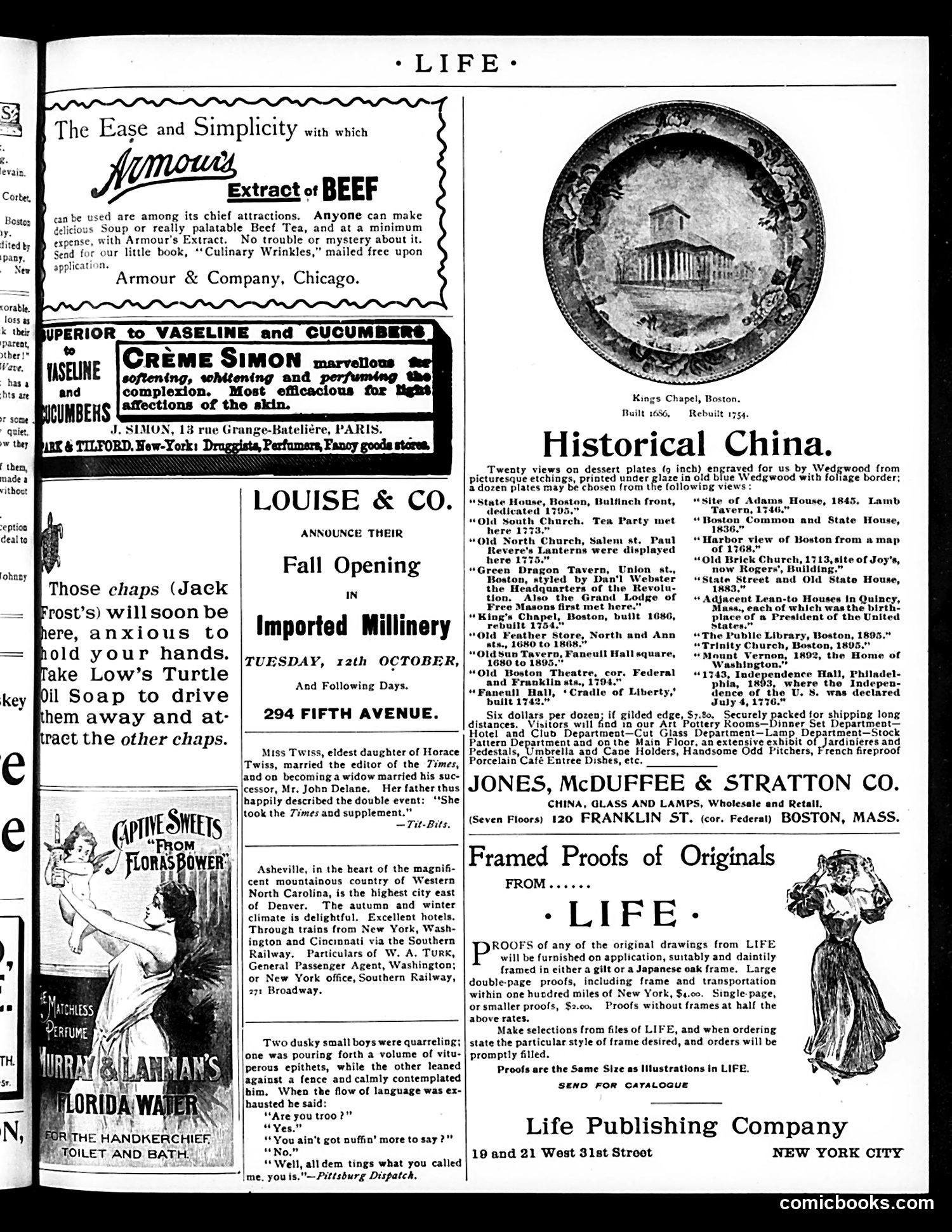
This is primarily a **advertisements and announcements page** from *Life* magazine, with limited satirical content. The main visual joke appears in the **small anecdote at bottom left**: two Black boys quarreling, where one insults the other extensively, then when asked if he has more to say, replies "No"—then when pressed, simply repeats the other boy's insults back at him: "Well, all dem tings what you called me, you is." The humor relies on a common turn-of-the-century racist stereotype: depicting Black dialect and supposed simplistic logic as comedic fodder. The "joke" is that the boy has no original comeback, only repetition—a crude attempt at humor that modern readers would recognize as offensive caricature. The rest of the page consists of period advertisements (Armour's Beef Extract, millinery, travel to Asheville, china plates depicting historical Boston sites), offering little satirical content. The **"Historical China" section** advertises Wedgwood dessert plates decorated with American Revolutionary War sites—marketing nostalgia and patriotism.
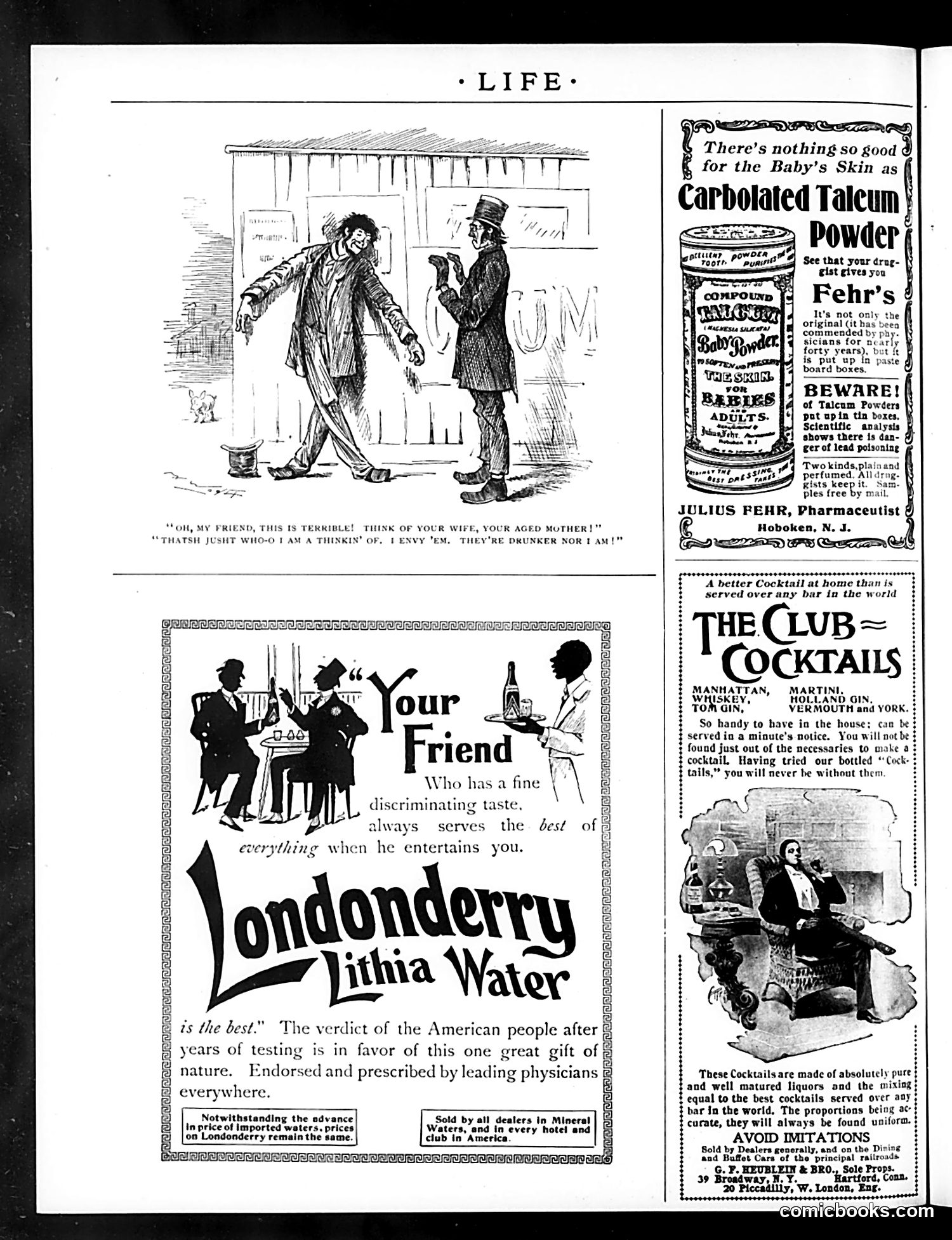
The main cartoon depicts a drunk man being confronted by a concerned friend about his drinking and its effects on his family. The drunk's slurred response—that he envies his wife and mother because "they're drunker nor I am"—is the satirical joke. It's absurdist humor playing on the irony that his concern for them has inverted into envying their supposed greater intoxication, revealing both his impaired reasoning and the era's casual attitude toward widespread drinking. The page is primarily **advertising**, dominated by product placements for Londonderry Lithia Water, Fehr's talcum powder, and Heublein Club Cocktails. These ads are notable for modern readers because they casually promote alcohol and make health claims (like medicinal water and talc safety) that would face regulatory scrutiny today. The cocktail ad emphasizes home preparation during what appears to be the Prohibition era context, though the magazine's date is unclear from this excerpt.
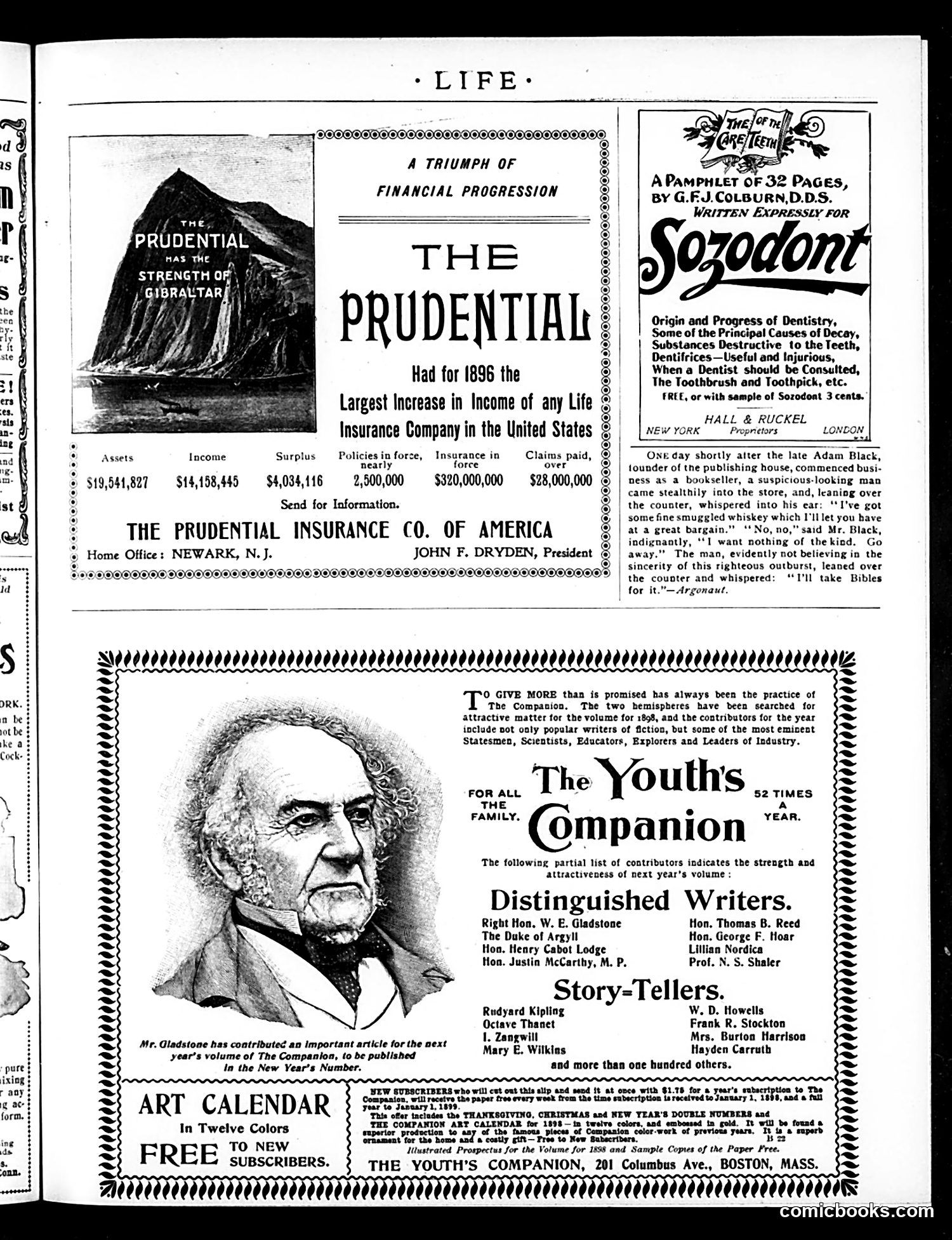
This page consists primarily of **advertisements and promotional content** rather than satirical cartoons. The main elements are: **Top section:** The Prudential Insurance Company ad features an image of Gibraltar with text advertising their "triumph of financial progression"—emphasizing their assets, income, and insurance in force for 1896. This is straightforward commercial promotion. **Right side:** Advertisement for Sozodont tooth product, with an anecdote about publisher Adam Black being offered smuggled whiskey, then Bibles—a humorous pitch for a product. **Bottom section:** Large advertisement for *The Youth's Companion* magazine, featuring a portrait (appears to be William Gladstone, as the text mentions his contribution) and listing distinguished contributors including Rudyard Kipling, William Dean Howells, and political figures like W.E. Gladstone. **No political satire is evident.** This is a typical late-19th-century magazine page combining advertisements with promotional material for competitor publications—common revenue practice of the era.
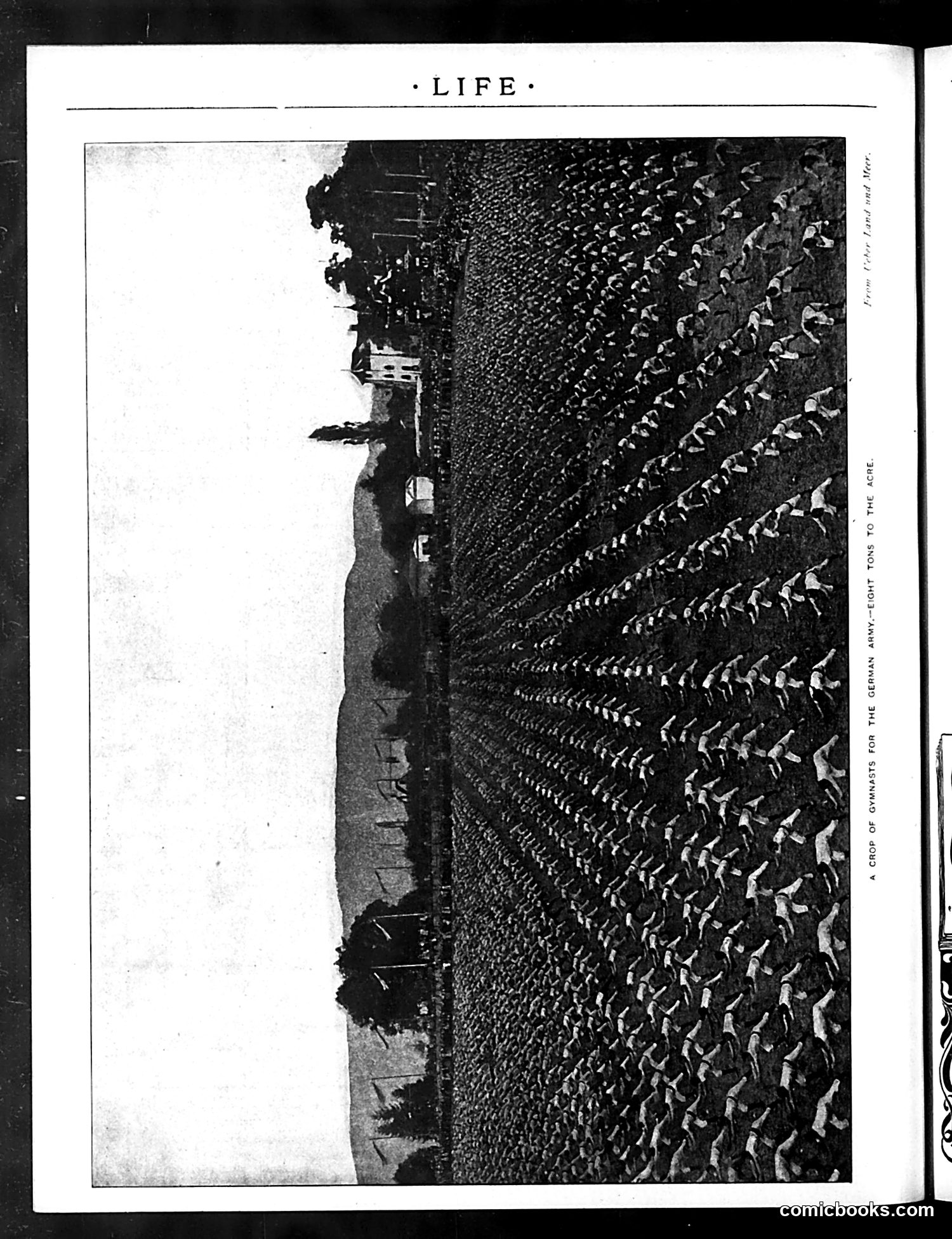
This appears to be a page from *Life* magazine featuring a photograph (rotated 90 degrees) showing what the caption describes as "a crop of dwarfs for the German army right now to the scene." The image displays many small figures arranged in orderly rows, likely a staged or satirical photograph. Given the reference to "dwarfs" and "German army," this is political satire mocking Nazi Germany—probably from the 1930s-40s era. The joke appears to be a cruel, darkly humorous jab at German military recruitment or leadership during this period, though the exact historical context is unclear without additional dating information. The satire relies on dehumanizing caricature typical of wartime propaganda and period magazine humor.
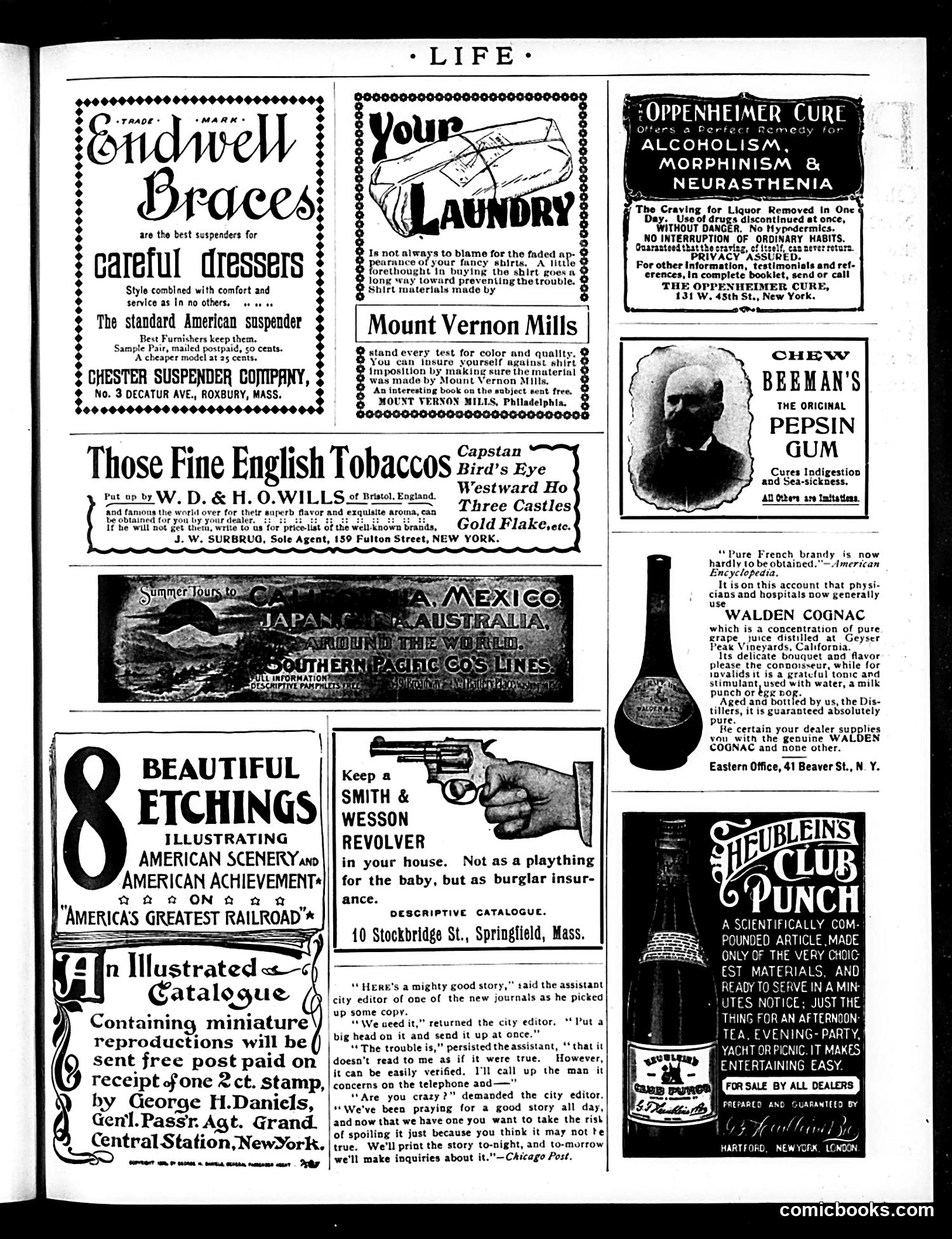
This is primarily an **advertising page** from Life magazine, featuring product ads typical of the early 1900s. The notable exception is a small **joke** (credited to Chicago Post) about newspaper ethics. The joke satirizes a conflict between journalistic integrity and commercial pressures: a newspaper's assistant editor wants to verify a story's truth before publishing, but his supervisor refuses—arguing they've been desperate for good copy and should print it first, investigate *later*. The satire critiques how newspapers prioritize attention-grabbing stories over accuracy and truth. The advertisements reveal period concerns: suspenders, laundry services, burglar alarms (marketed to homeowners), and notably, treatments for alcoholism and morphine addiction—suggesting these were significant social problems. Other ads (cognac, tobacco, punch) ironically appear alongside the addiction remedies, reflecting the era's contradictory attitudes toward substances. Overall, the page captures early-20th-century consumer culture and professional journalism's emerging ethical tensions.
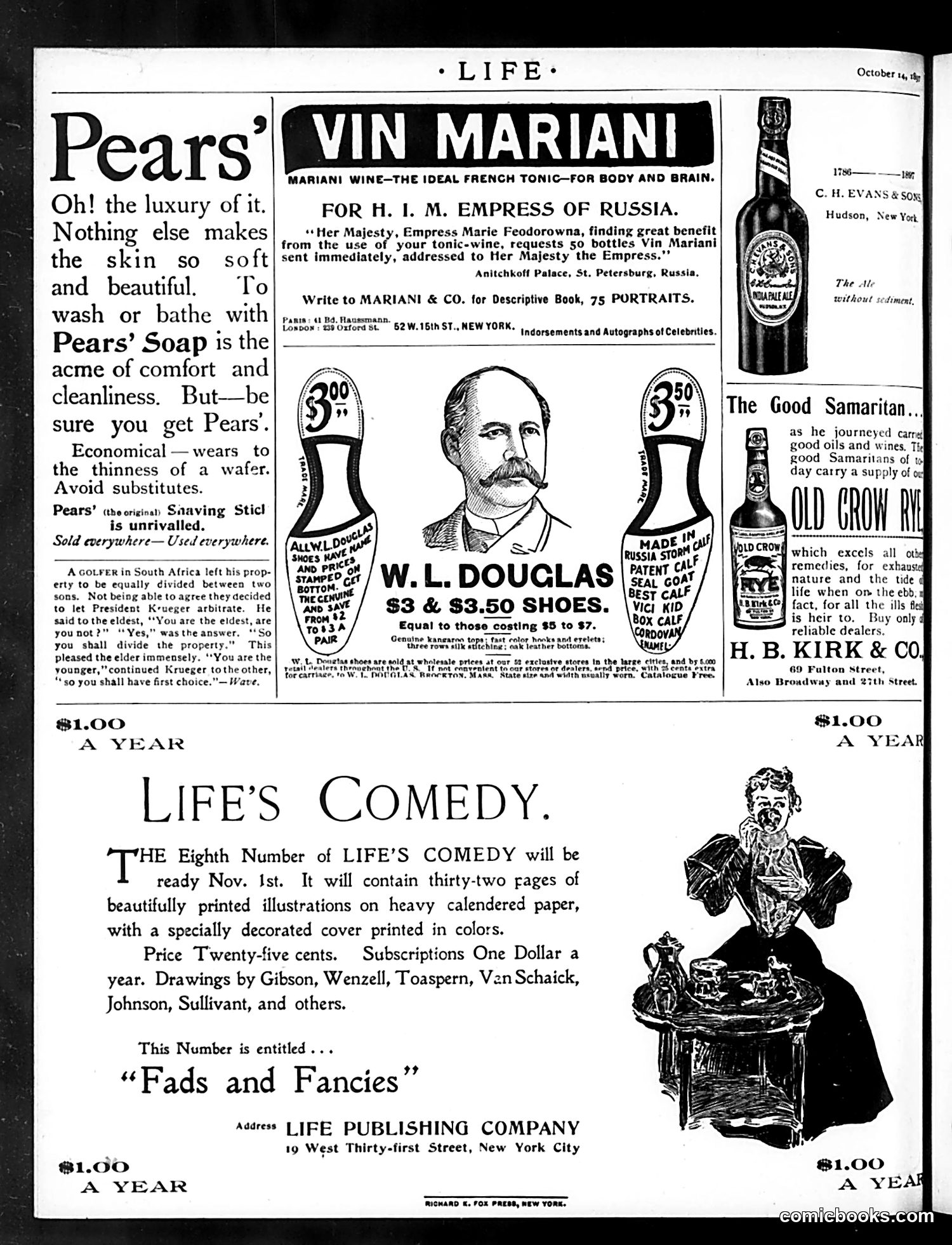
This page is primarily **advertising**, not political satire. However, it contains one humor piece worth noting: ## The Kruger Anecdote The small story about a South African golfer's property dispute references **President Paul Kruger** of the Transvaal Republic. The joke plays on Kruger's reputation for cunning arbitration: he tricks both sons by telling the younger he can choose first, making the "first choice" worthless since the older son already claimed the better property. **Context**: This reflects late-1890s tensions preceding the Boer War (1899-1902), when Kruger was a prominent international figure. The anecdote portrays him as slyly manipulative—a common Western characterization of the Afrikaner leader. The remainder of the page consists of product advertisements (Pears' Soap, W.L. Douglas Shoes, Vin Mariani wine, Old Crow whiskey) and a promotion for Life's Comedy series. The magazine itself cost $1.00 annually.