
Life, 1897-10-14 · page 4 of 22
Life — October 14, 1897 — page 4: what you’re looking at
What you’re looking at
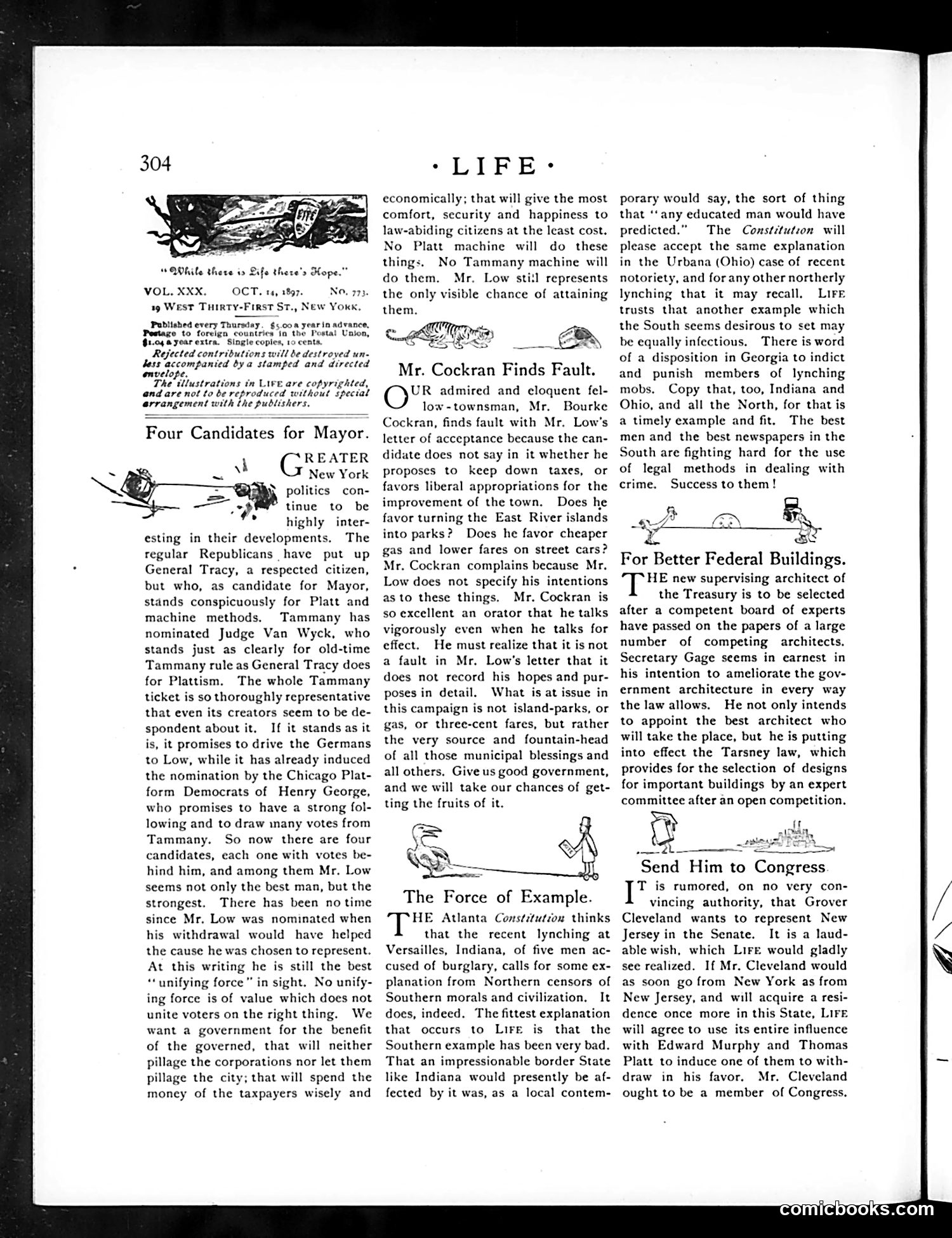
This October 1897 *Life* magazine page contains three sections critiquing New York politics and governance: **"Four Candidates for Mayor"** discusses Republican General Tracy as mayoral candidate, contrasting his "old-time Tammany" machine politics methods with Judge Van Wyck. The satire targets Tammany Hall's political dominance and corrupt practices. **"Mr. Cockran Finds Fault"** criticizes Burke Cockran's vague political positions on taxes, parks, and transit—mocking his eloquent oratory while avoiding specifics. **"The Force of Example"** and **"Send Him to Congress"** address lynching violence in Indiana and the South, sarcastically suggesting Northern and Southern examples of lawlessness justify each other. The final section mentions Grover Cleveland and Edward Murphy regarding congressional representation from New York. The cartoons use satirical drawings to accompany these political critiques.
📄 Transcribed text from this page (OCR, searchable)
Machine-transcribed from the original scan — historical spelling and the odd misread are preserved.
“Ohile there is Life there's Hope.” XX, OCT. 14, 1897. Now 773. ag West Tuirty-First St., New You. Published every Thursday. 5.008 yearin advance, © to foreign countries in the Postal Union, G1.04ayoar extra. Single copies, 10 cents, Rejected contributions will be destroyed un- bess accompanied bya stamped and directed envelope. The illustrations in Live are copyrighted, and are not to be reproduced without special arrangement with the publishers. Four Candidates for Mayor. i REATER New York politics con- tinue to be highly inter- esting in their developments, The regular Republicans have put up General Tracy, a respected citizen, but who, as candidate for Mayor, stands conspicuously for Platt and machine methods. Tammany has nominated Judge Van Wyck, who stands just as clearly for old-time Tammany rule as General Tracy does for Plattism. The whole Tammany ticket is so thoroughly representative that even its creators scem to be de- spondent about it, If it stands as it is, it promises to drive the Germans to Low, while it has already induced the nomination by the Chicago Plat- form Democrats of Henry George, who promises to have a strong fol- lowing and to draw inany votes from Tammany. So now there are four candidates, each one with votes be- hind him, and among them Mr. Low seems not only the best man, but the strongest. There has been no time since Mr. Low was nominated when his withdrawal would have helped the cause he was chosen to represent. At this writing he is still the best “unifying force” in sight. No unify- ing force is of value which does not unite voters on the right thing. We want a government for the benefit of the governed, that will neither pillage the corporations nor let them pillage the city; that will spend the money of the taxpayers wisely and ‘LIFE: economically; that will give the most comfort, security and happiness to law-abiding citizens at the least cost. No Platt machine will do these things. No Tammany machine will do them. Mr. Low stiil represents the only visible chance of attaining Mr. Cockran Finds Fault. UR admired and cloquent fel- low-townsman, Mr. Bourke Cockran, finds fault with Mr. Low's letter of acceptance because the can- didate does not say in it whether he proposes to keep down taxes, or favors liberal appropriations for the improvement of the town. Does he favor turning the East River islands into parks? Does he favor cheaper gas and lower fares on street cars? Mr. Cockran complains because Mr. Low does not specify his intentions as to these things. Mr. Cockran is so excellent an orator that he talks vigorously even when he talks for effect. He must realize that it is not a fault in Mr. Low's letter that it does not record his hopes and pur- poses in detail. What is at issue in this campaign is not island-parks, or gas, or three-cent fares, but rather the very source and fountain-head of all those municipal blessings and all others, Give us good government, and we will take our chances of get- ting the fruits of it. s& The Force of Example. HE Atlanta Constitution thinks that the recent lynching at Versailles, Indiana, of five men ac- cused of burglary, calls for some ex- planation from Northern censors of Southern morals and civilization, It does, indeed. The fittest explanation that occurs to Lire is that the Southern example has been very bad. That an impressionable border State like Indiana would presently be af- fected by it was, as a local contem- porary would say, the sort of thing that ‘‘any educated man would have predicted.” The Constétut:on will please accept the same explanation in the Urbana (Ohio) case of recent notoriety, and for any other northerly lynching that it may recall. LIFE trusts that another example which the South seems desirous to set may be equally infectious. There is word of a disposition in Georgia to indict and punish members of lynching mobs. Copy that, too, Indiana and Ohio, and all the North, for that is a timely example and fit. The best men and the best newspapers in the South are fighting hard for the use of legal methods in dealing with crime. Success to them! S For Better Federal Buildings. HE new supervising architect of the Treasury is to be selected after a competent board of experts have passed on the papers of a large number of competing architects. Secretary Gage seems in carnest in his intention to ameliorate the gov- ernment architecture in every way the law allows. He not only intends to appoint the best architect who will take the place, but he is putting into effect the Tarsney law, which provides for the selection of designs for important buildings by an expert committee after an open competition. Send Him to Congress T is rumored, on no very con- vincing authority, that Grover Cleveland wants to represent New Jersey in the Senate. It is a laud- able wish, which Lire would gladly see realized. If Mr. Cleveland would as soon go from New York as from New Jersey, and will acquire a resi- dence once more in this State, LIFE will agree to use its entire influence with Edward Murphy and Thomas Platt to induce one of them to with- draw in his favor, Mr. Cleveland ought to be a member of Congress.