
Life, 1897-10-14 · page 12 of 22
Life — October 14, 1897 — page 12: what you’re looking at
What you’re looking at
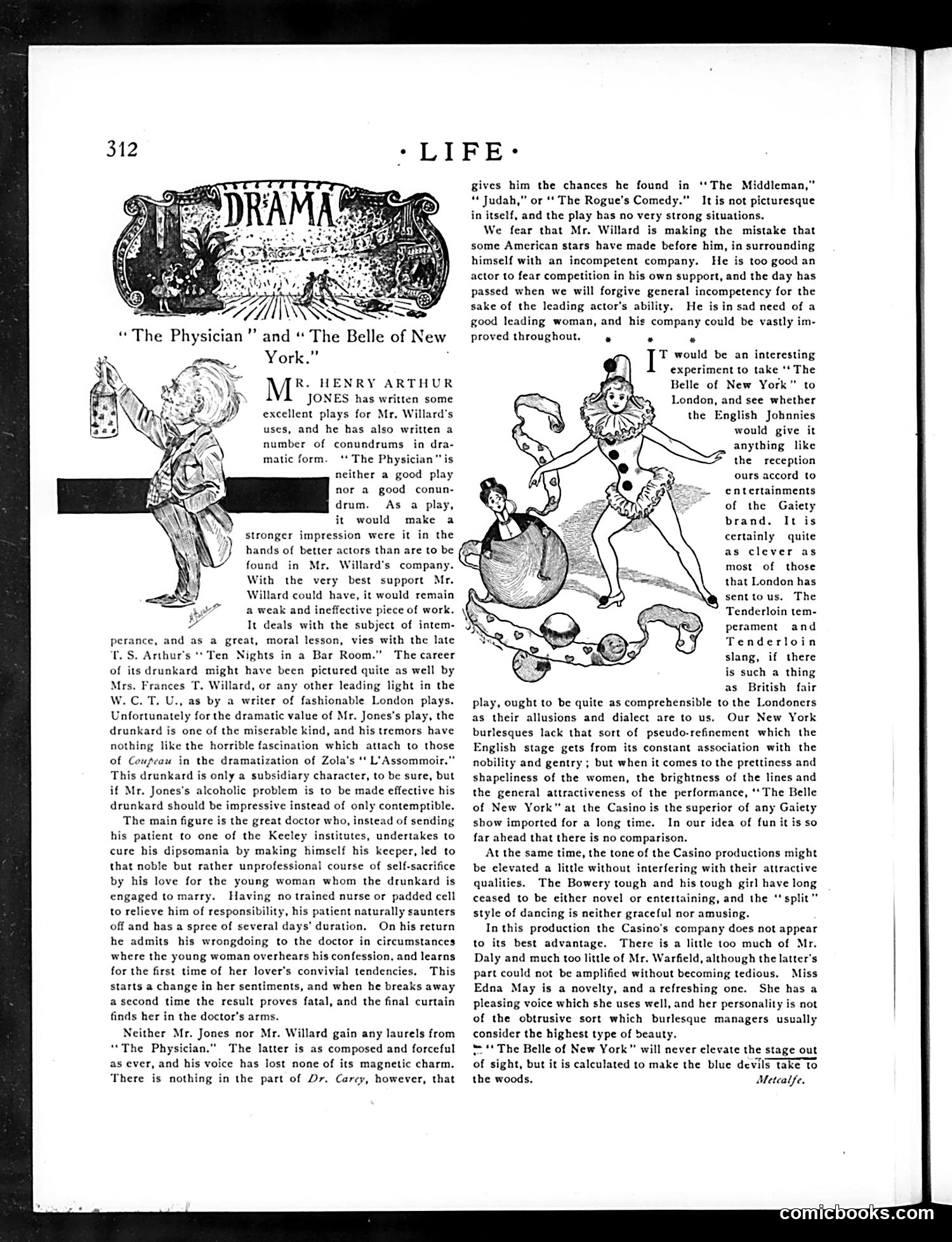
This page reviews theatrical productions, primarily discussing M. Henry Arthur Jones's plays "The Physician" and "The Belle of New York." The left illustration shows a theatrical character in period costume (appears to be from "The Physician"), while the right illustration depicts dancers in comedic poses, likely representing the lighter musical comedy style of "The Belle of New York." The critic praises Jones's writing but criticizes lead actor Mr. Willard for surrounding himself with an "incompetent company." The review suggests Willard lacks a strong leading lady and would benefit from better supporting actors. The piece compares American and British theatrical standards, noting "The Belle of New York" would receive different reception in London versus New York audiences.
📄 Transcribed text from this page (OCR, searchable)
Machine-transcribed from the original scan — historical spelling and the odd misread are preserved.
+LIFE: and “ The Belle of New York.” , M R. HENRY ARTHUR JONES has written some excellent plays for Mr. Willard’s uses, and he has also written a number of conundrums in dra- matic form. ‘* The Physician" is neither a good play nor a good conun- drum. As a play, it would make a stronger impression were it in the hands of better actors than are to be found in Mr, Willard’s company. With the very best support Mr. Willard could have, it would remain a weak and ineffective piece of work. It deals with the subject of intem- perance, and a great, moral lesson, vies with the late {. S. Arthur's ** Ten Nights in a Bar Room.” The career of its drunkard might have been pictured quite as well by Mrs, Frances T. Willard, or any other leading light in the W.C. T. U., as by a writer of fashionable London plays. Unfortunately forthe dramatic value of Mr. Jones's play, the drunkard is one of the miserable kind, and his tremors have nothing like the horrible fascination which attach to those of Coupeau in the dramatization of Zola's ‘ L'Assommoir.” This drunkard is only a subsidiary character, to be sure, but if Mr. Jones's alcoholic problem is to be made effective his drunkard should be impressive instead of only contemptible. The main figure is the great doctor who, instead of sending his patient to one of the Keeley institutes, undertakes to cure his dipsomania by making himself his keeper, led to that noble but rather unprofessional course of self-sacrifice by his love for the young woman whom the drunkard is engaged to marry. Having no trained nurse or padded cell to relieve him of responsibility, his patient naturally saunters off and has a spree of several days’ duration, On his return he admits his wrongdoing to the doctor in circumstances where the young woman overhears his confession, and learns for the first time of her lover's convivial tendencies, This starts a change in her sentiments, and when he breaks away asecond time the result proves fatal, and the final curtain finds her in the doctor’s arms. Neither Mr. Jones nor Mr. Willard gain any laurels from ‘‘The Physician.” The latter is as composed and forceful as ever, and his voice has lost none of its magnetic charm. There is nothing in the part of Dr. Carcy, however, that gives him the chances he found in ‘tThe Middleman,” ** Judah,” or ‘‘ The Rogue's Comedy.” It is not picturesque in itself, and the play has no very strong situations. We fear that Mr. Willard is making the mistake that some American stars have made before him, in surrounding himself with an incompetent company. He is too good an actor to fear competition in his own support, and the day has passed when we will forgive general incompetency for the sake of the leading actor's ability. He is in sad need of a good leading woman, and his company could be vastly im- proved throughout. . . ry I" would be an interesting experiment to take ‘¢ The Belle of New York" to London, and see whether the English Johnnies would give it anything like the reception ours accord to entertainments of the Gaiety brand. It is certainly quite as clever as most of those that London has senttous. The Tenderloin tem- perament and Tenderloin slang, if there is such a thing as British fair play, ought to be quite as comprehensible to the Londoners as their allusions and dialect are to us. Our New York burlesques lack that sort of pseudo-refinement which the English stage gets from its constant association with the nobility and gentry ; but when it comes to the prettiness and shapeliness of the women, the brightness of the lines and the general attractiveness of the performance, ‘* The Belle of New York” at the Casino is the superior of any Gaiety sbow imported for a long time. In our idea of fun it is so far ahead that there is no comparison. At the same time, the tone of the Casino productions might be elevated a little without interfering with their attractive qualities. The Bowery tough and his tough girl have long ceased to be either novel or entertaining, and the ‘‘ split” style of dancing is neither graceful nor amusing. In this production the Casino's company does not appear to its best advantage. There is a little too much of Mr. Daly and much too little of Mr. Warfield, although the latter's part could not be amplified without becoming tedious. Miss Edna May is a novelty, and a refreshing one. She has a pleasing voice which she uses well, and her personality is not of the obtrusive sort which burlesque managers usually consider the highest type of beauty. wr‘ The Belle of New York” will never elevate the stage out of sight, but it is calculated to make the blue devils take to the woods. Metcalfe.