
A complete issue · 20 pages · 1897
Life — August 26, 1897
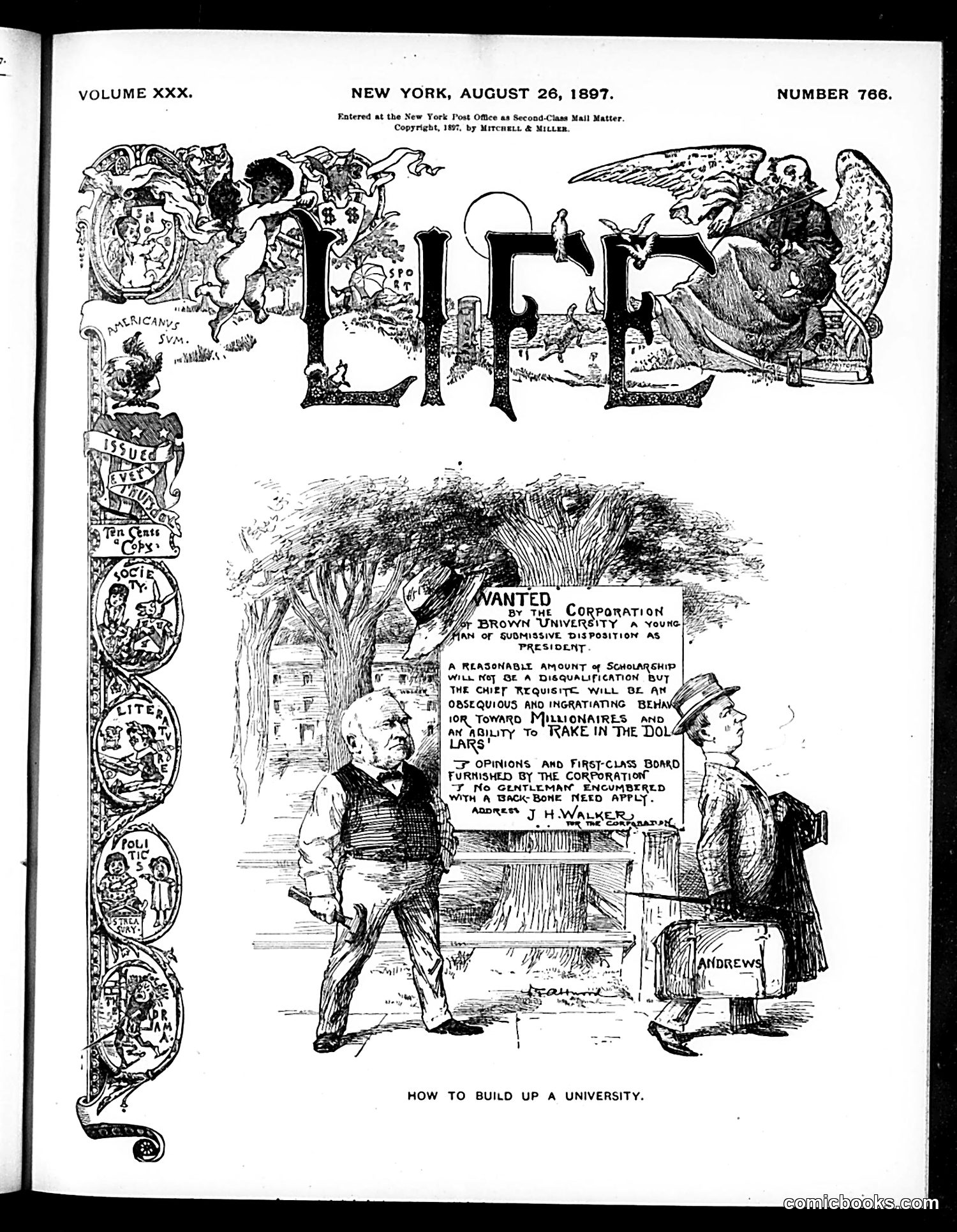
This satirical cartoon titled "How to Build Up a University" mocks Brown University's fundraising efforts. Two figures—one holding a wanted poster—advertise a "Corporation of Brown University" seeking a young man of "submissive disposition" to serve as president. The satire critiques university leadership by suggesting the ideal candidate must be obsequious toward wealthy donors ("millionaires"), willing to "rake in the dollars," and suppress personal opinions. The phrase about needing "a gentleman encumbered with a back-bone" is ironic—the position actually requires spinelessness. The name "J.H. WALKER" appears at bottom, likely the cartoonist. This reflects late-19th-century anxieties about wealthy donors controlling academic institutions and compromising educational integrity.
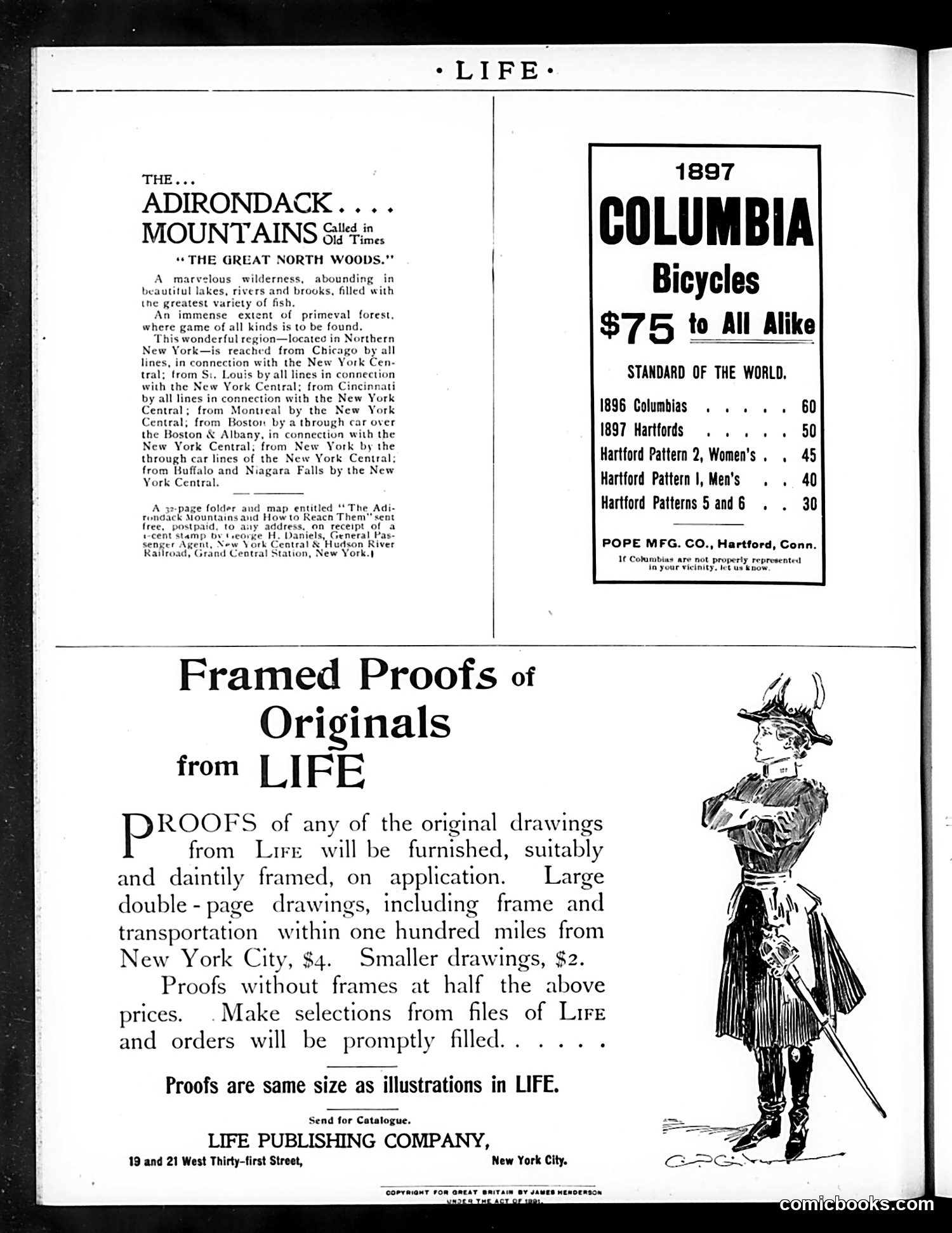
This page is primarily **advertising and promotional content** rather than political cartoons or satire. The top half features two advertisements: one promoting tourism to the Adirondack Mountains in Northern New York (accessible via various railroad lines), and a major ad for Columbia bicycles priced at $75, marketed as the "Standard of the World." The bottom half promotes **Life magazine's framed art prints service**—offering reproduced original drawings from Life, with pricing for different sizes and framing options ($2-$4). The illustration on the right shows a fashionably dressed woman in what appears to be 1890s attire, likely used as decorative imagery to attract readers. **No political satire or meaningful cartoon content is present on this page.** It represents typical late-19th-century magazine advertising and self-promotion.
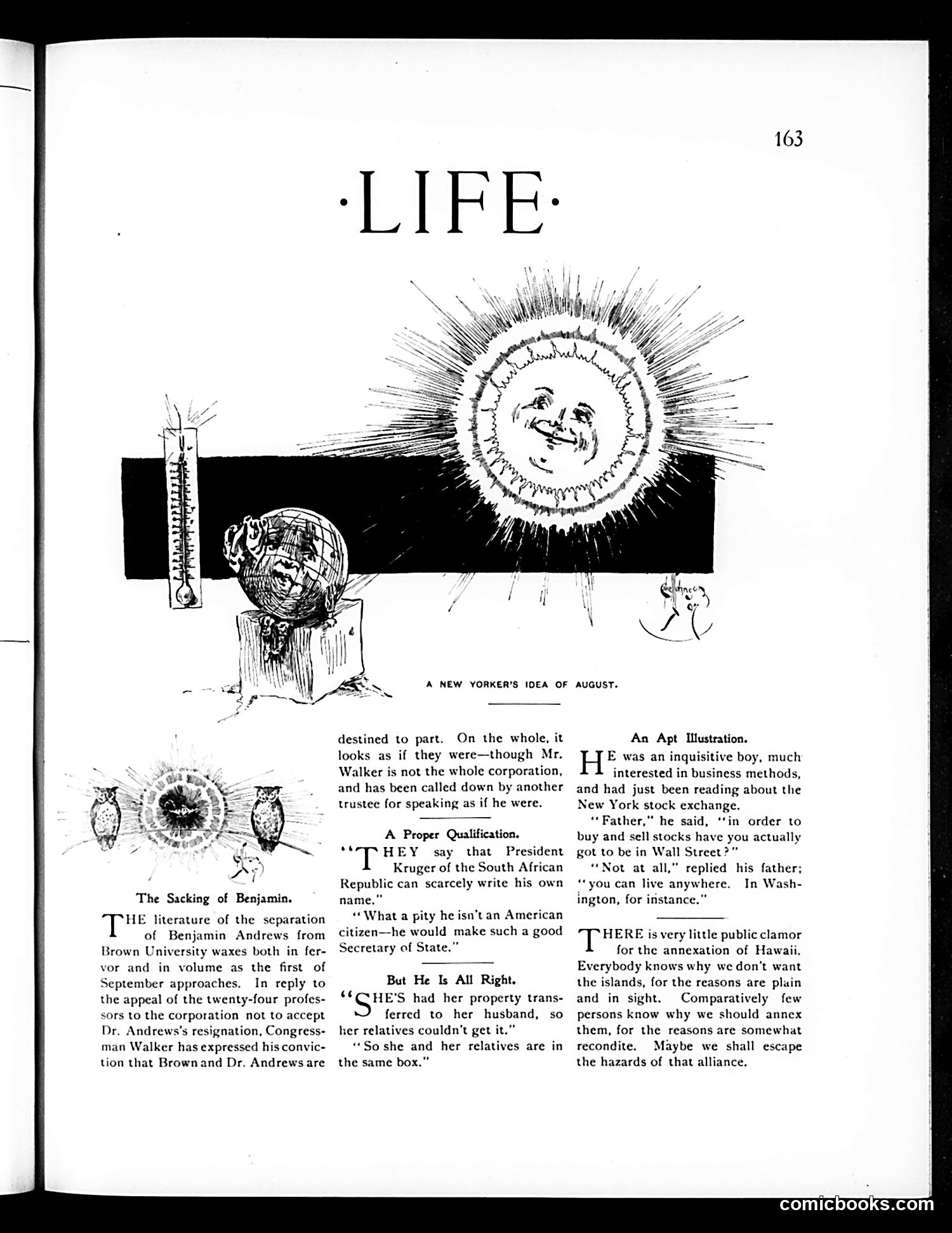
The main cartoon depicts a smiling sun with a thermometer, satirizing summer heat in New York. Below are smaller illustrations of wilted figures, suggesting the oppressive August weather. The text sections discuss contemporary political and business matters: **"The Sacking of Benjamin"** references a separation controversy involving Benjamin Andrews from Brown University, where professors opposed his resignation during September. **"A Proper Qualification"** jokes about South African President Kruger's inability to write his own name, questioning his fitness for office. **"But He Is All Right"** discusses property transfer issues between spouses. **"An Apt Illustration"** tells of a boy interested in Wall Street stock exchange, illustrating themes of business acumen. **Hawaii annexation** briefly addresses why Americans oppose annexing Hawaii.
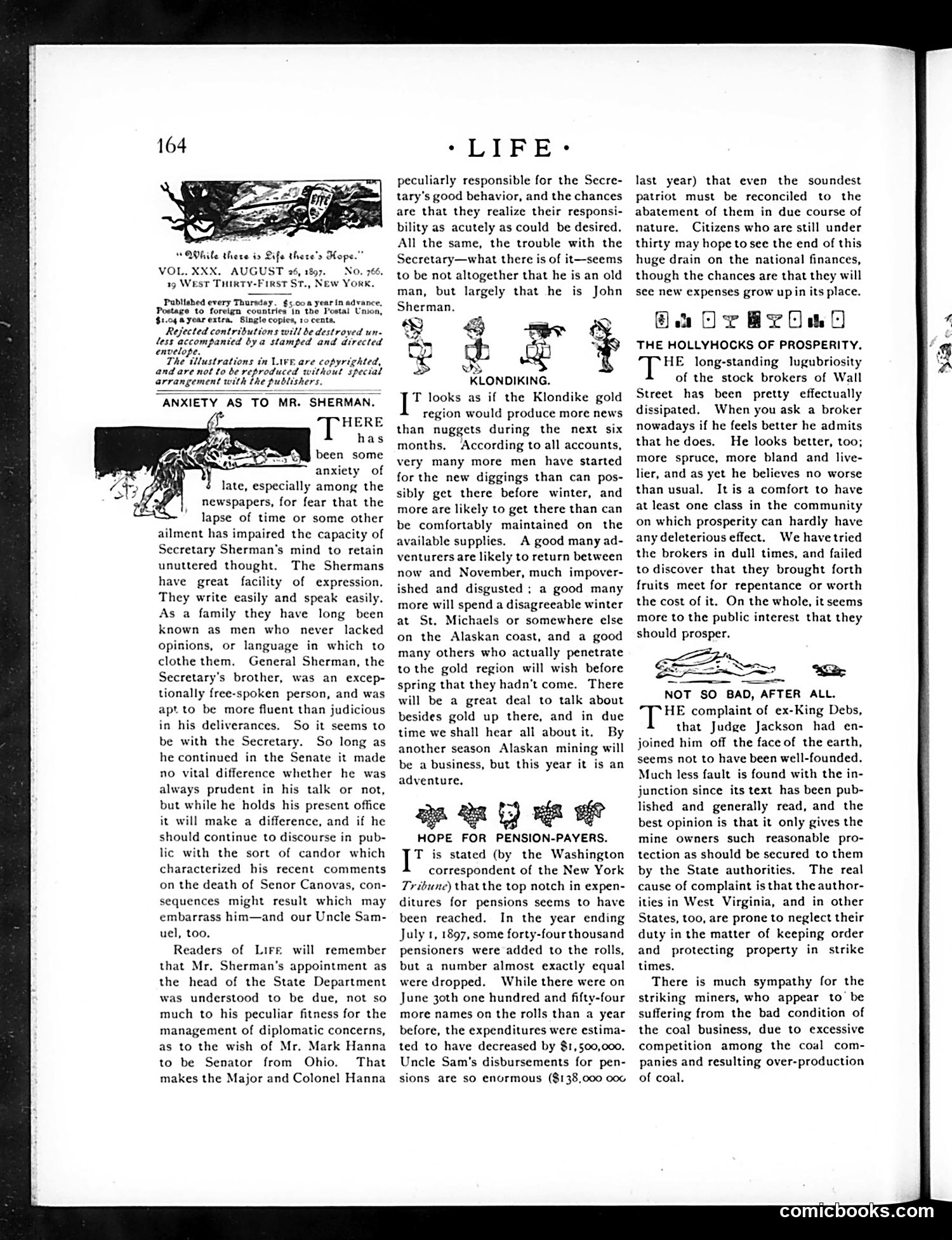
The page contains three distinct sections: **"Anxiety as to Mr. Sherman"** cartoon: Depicts worried figures, likely referencing Secretary John Sherman's political position. The text explains Sherman's family has "great facility of expression" and speaks easily, raising concern his candid remarks might embarrass the administration. **"The Hollyhocks of Prosperity"** discusses Wall Street stock brokers appearing more optimistic during Klondike gold rush excitement, suggesting economic confidence tied to mining speculation. **"Not So Bad, After All"** addresses ex-King Debs complaint about Judge Jackson, suggesting the court ruling wasn't entirely unfounded. **"Hope for Pension-Payers"** reports pension expenditure reductions under newly added pensioners, noting decreased overall costs despite expanded rolls. The satire critiques political anxieties, financial speculation, and bureaucratic management.
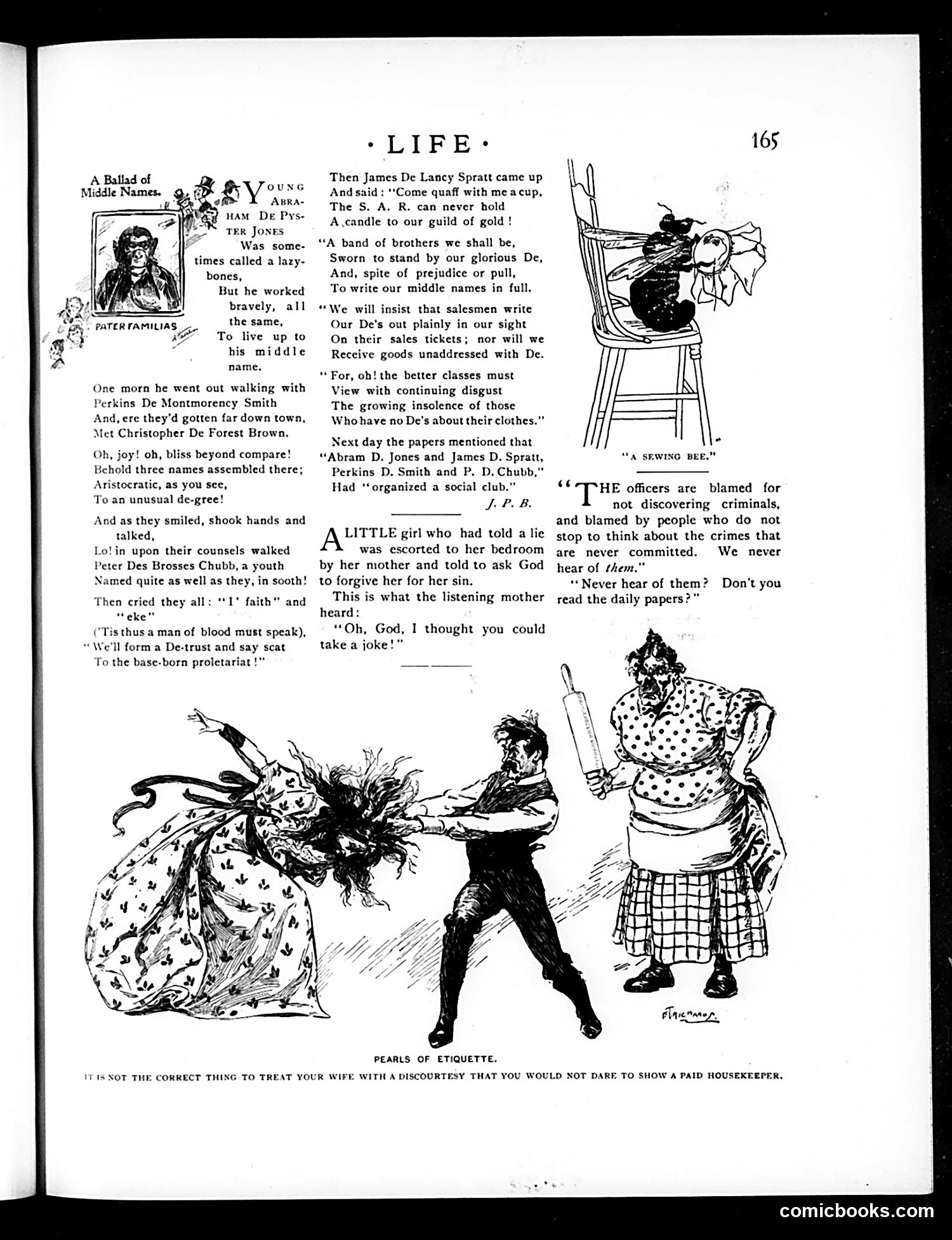
This page combines satirical verse and illustration addressing early 20th-century class tensions. "A Ballad of Middle Names" mocks salesmen who used middle initials (like "A. D. Jones") to appear more respectable—a pretension the poem ridicules. The story mentions a "social club" formed by Perkins De Montmorency Smith and others, suggesting mockery of working-class people adopting aristocratic-sounding names. The bottom illustration, "Pearls of Etiquette," depicts a man apparently striking his wife with a rolling pin while she gestures wildly. The caption sarcastically states it's improper to treat one's wife with discourtesy "that you would not dare show a paid housekeeper"—satirizing domestic abuse and class hypocrisy among husbands who respected paid servants more than wives.
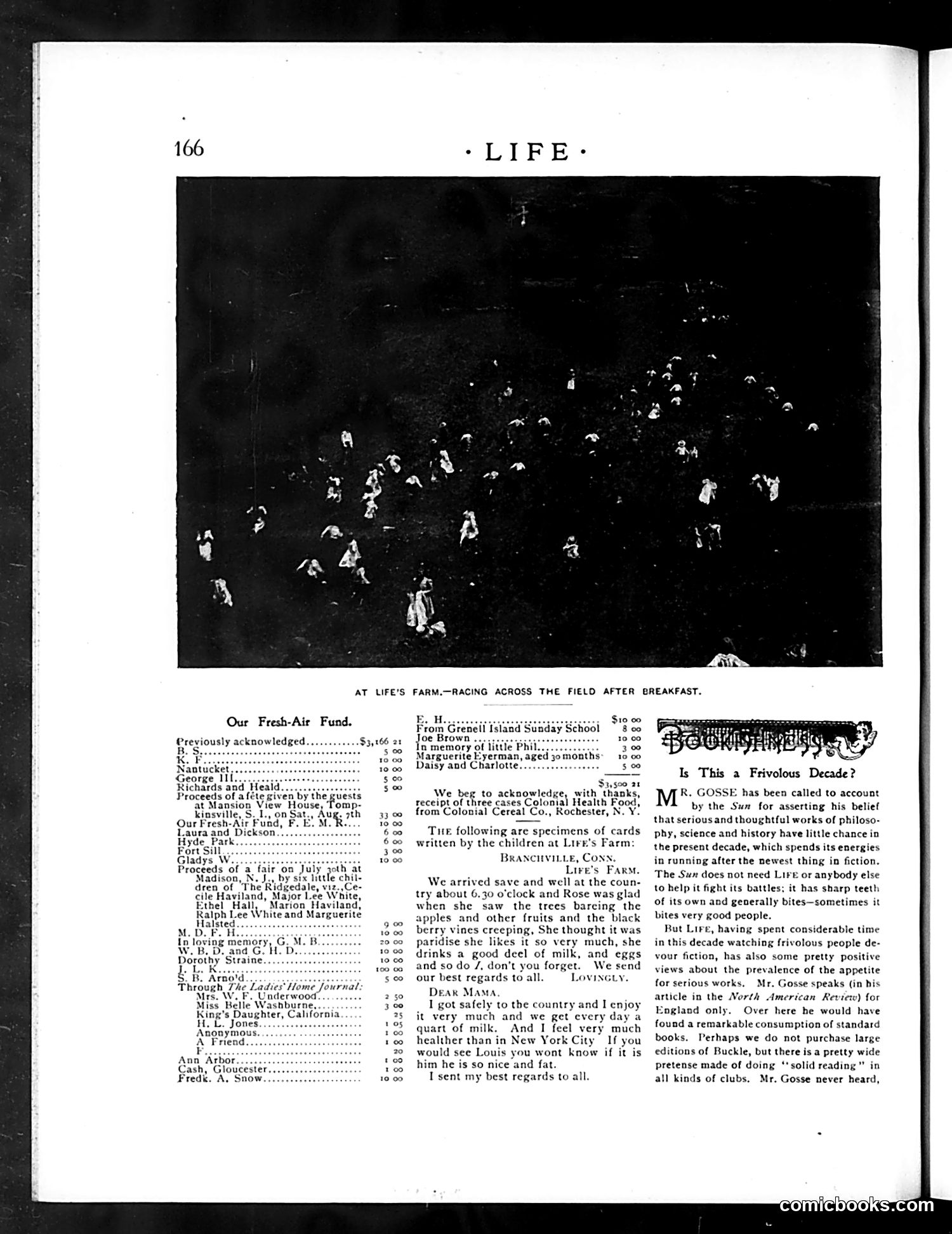
This page contains no political cartoon. Instead, it features a photograph labeled "At Life's Farm—Racing Across the Field After Breakfast," showing people scattered across a field in what appears to be a recreational or pastoral scene. The bulk of the page consists of two elements: a "Fresh-Air Fund" donation list acknowledging contributors (ranging from $3 to $10 contributions), and an article titled "Is This a Frivolous Decade?" where Mr. Gosse defends serious literary and philosophical works against accusations that the era prioritizes only entertainment. He argues that Life magazine and similar publications do publish substantive content alongside lighter material. The page is primarily informational rather than satirical.
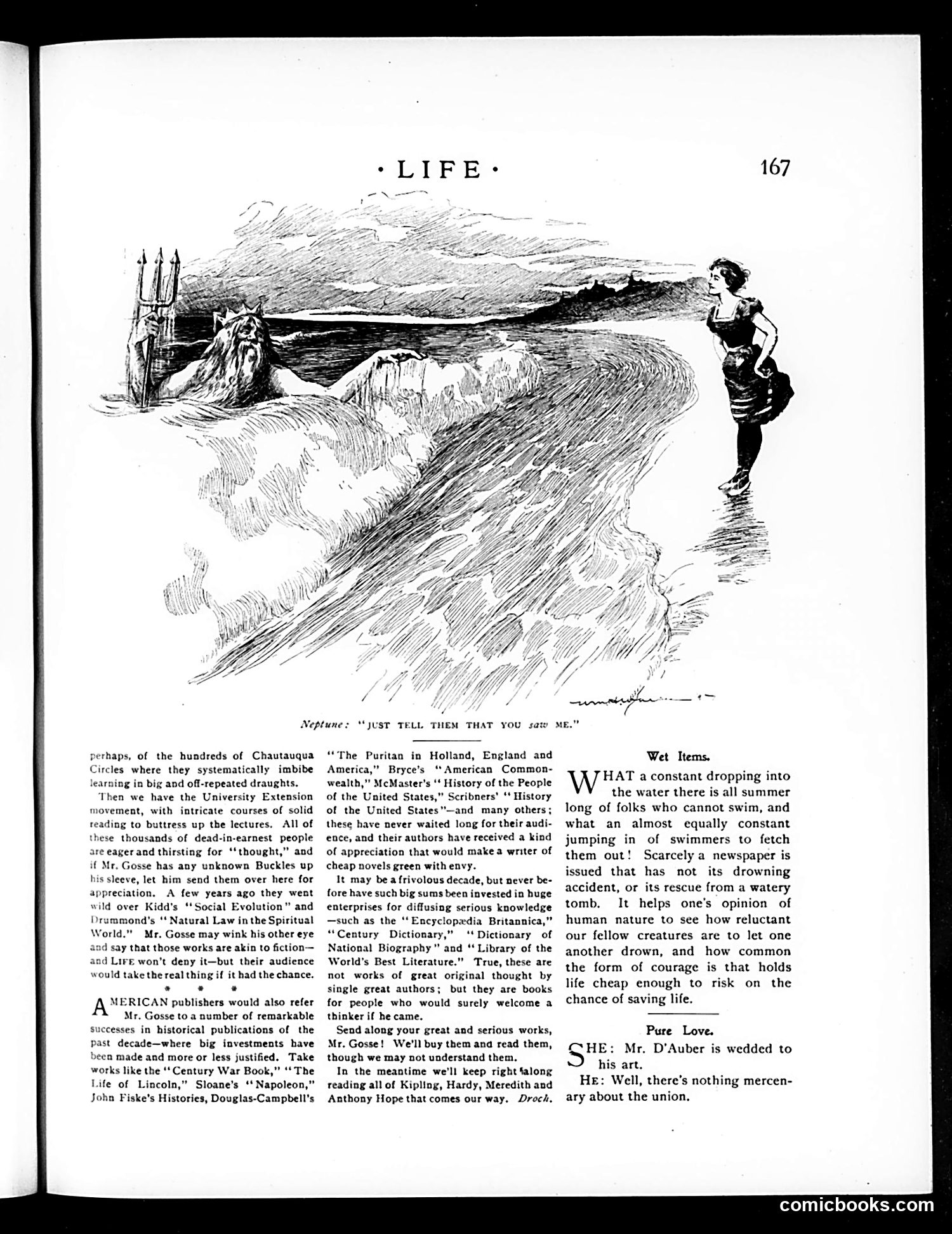
The illustration depicts a woman in classical/mythological dress standing on a beach, confronting what appears to be Neptune (the bearded sea god with his trident). The caption reads: "JUST TELL THEM THAT YOU ARE ME." This appears to be satirizing claims of identity or impersonation in a classical/mythological context. The accompanying text discusses various literary and historical works, suggesting this may relate to debates about authorship or authenticity. Below is a brief dialogue titled "Pure Love" about a character Mr. D'Auber's wedding, where someone notes "there's nothing mercenary about the union"—likely satirizing mercenary marriages or false declarations of love. The exact historical or political reference remains unclear without additional context about Life magazine's contemporary concerns.
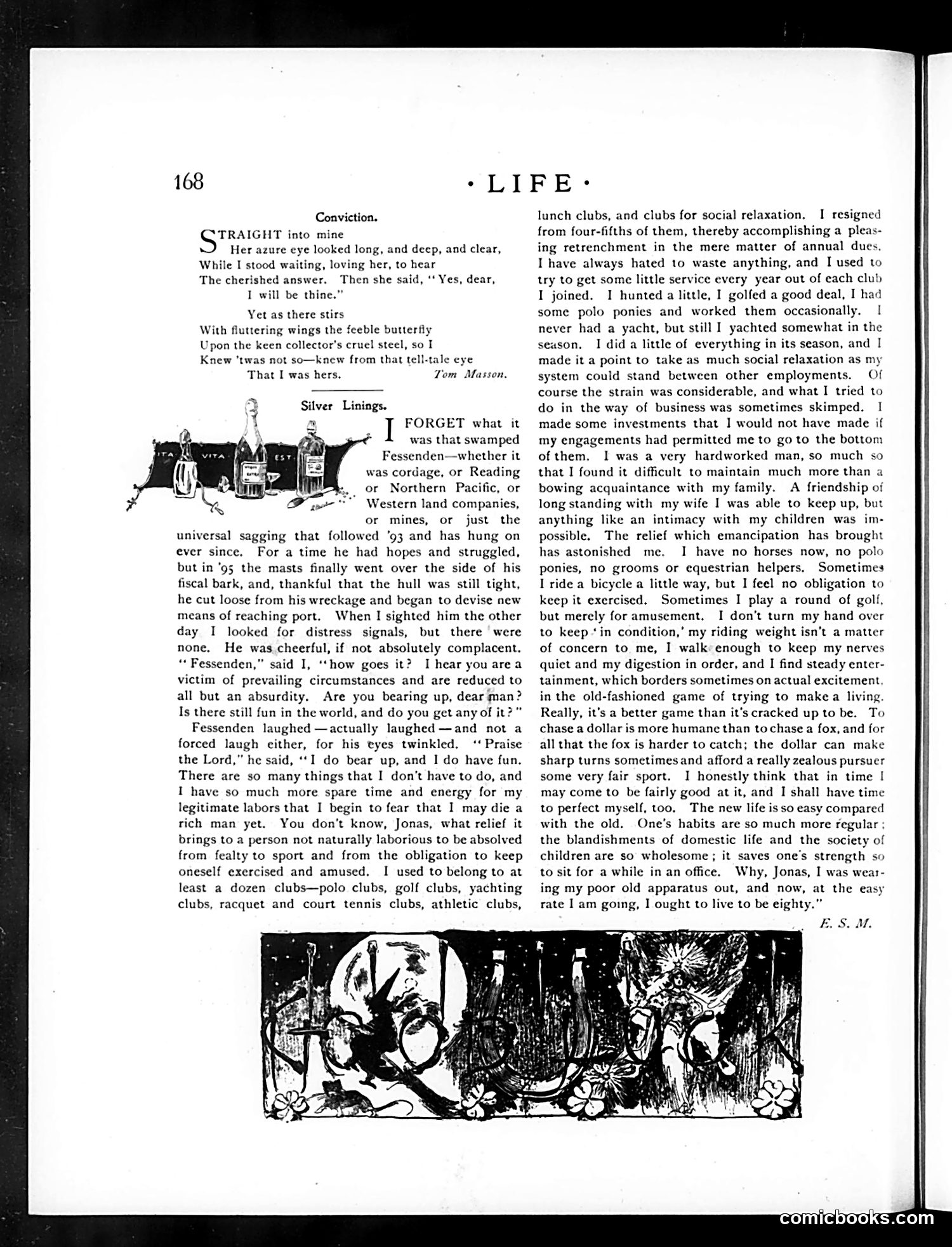
This page contains two separate pieces: 1. **"Conviction"** - A poem by Tom Mason about romantic certainty, illustrated with a decorative initial letter. 2. **"Silver Linings"** - A prose essay (signed E.S.M.) describing the author's relief at retiring from numerous social clubs—polo clubs, golf clubs, yacht clubs, athletic clubs, and others. The author humorously catalogs the exhaustion of maintaining memberships and social obligations, arguing that elderly life is better simplified. He contrasts the relief of domesticity with the burden of trying to "keep in condition" through constant club activities. 3. **Illustrations** - The page includes decorative bottle/vessel illustrations at the top and a detailed black-and-white woodcut-style illustration at the bottom depicting figures in a garden or natural setting, though its exact relationship to the text is unclear. The content satirizes upper-class social obligations and club culture of the era.
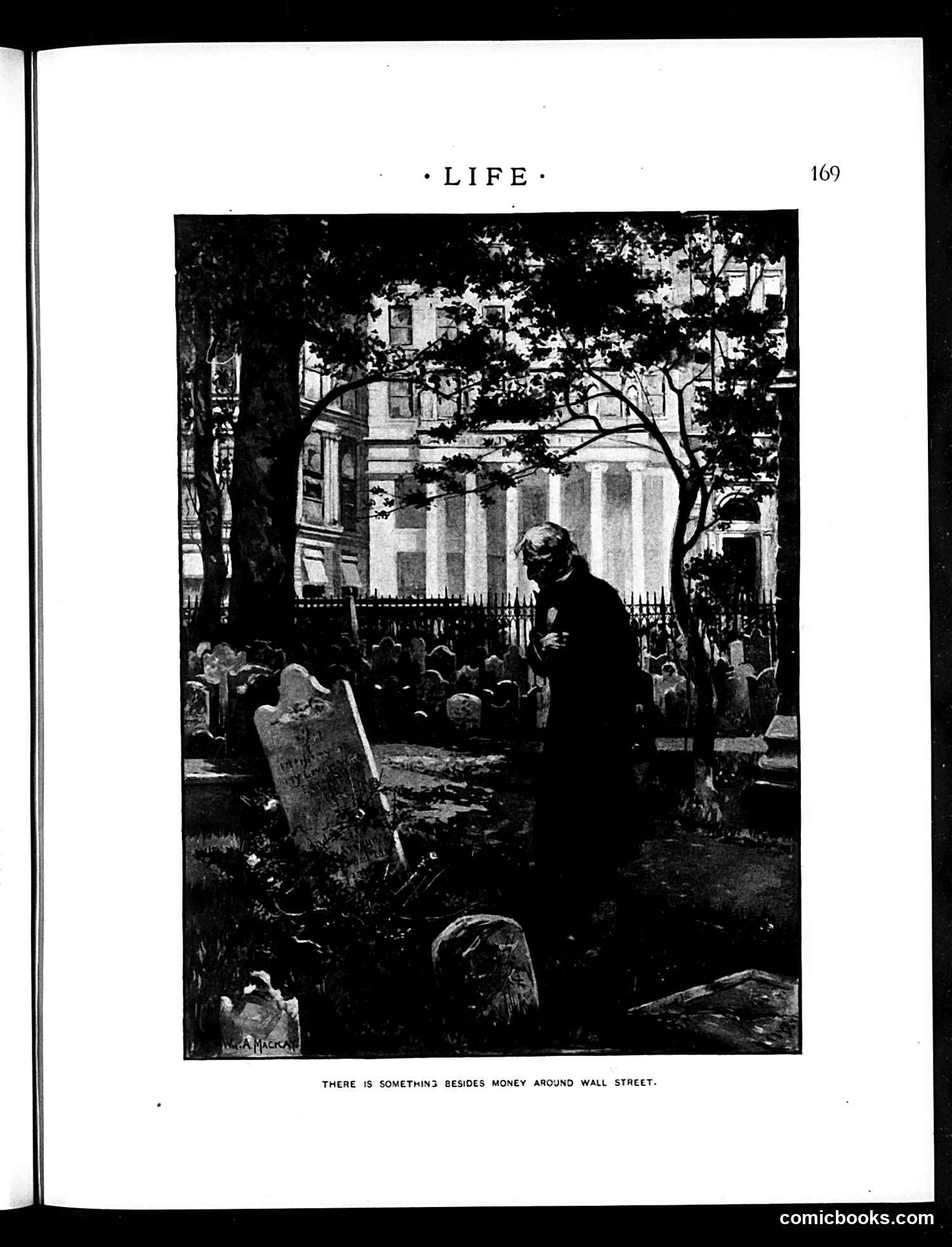
This is a black and white photograph, not a cartoon, showing a man in dark clothing standing in what appears to be a cemetery or graveyard, with gravestones visible and a classical building (possibly a church or government building with columns) in the background. The caption reads: "THERE IS SOMETHIN'S BESIDES MONEY AROUND WALL STREET." The image appears to be satirical social commentary, suggesting that despite Wall Street's association with financial wealth and materialism, death and mortality exist alongside it—a memento mori message. The juxtaposition of the graveyard with Wall Street's proximity implies that even in the heart of American capitalism, human mortality remains indifferent to financial concerns. The rural, solemn tone contrasts sharply with Wall Street's usual bustling commercialism.
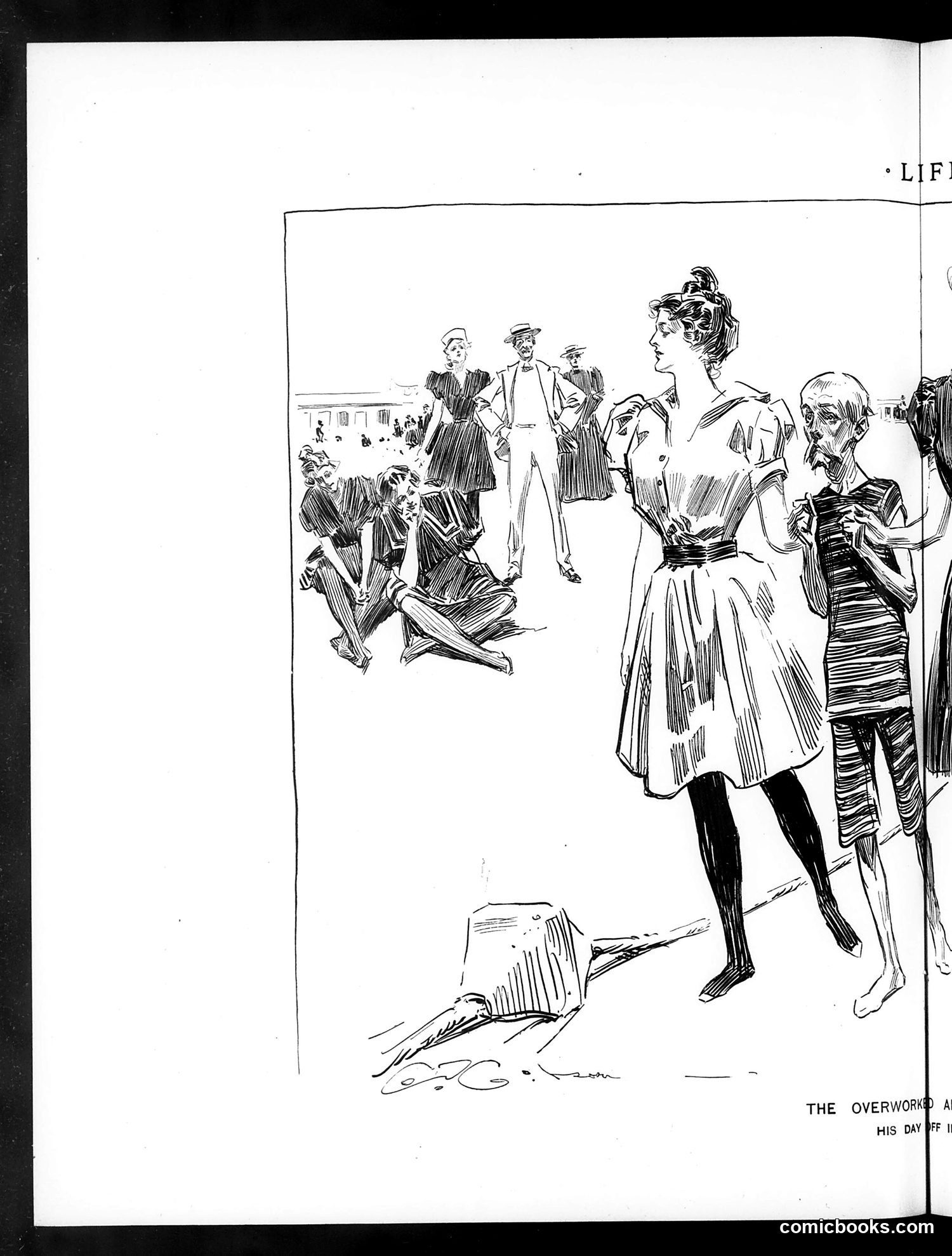
This is a satirical illustration titled "THE OVERWORKED AND HIS DAY OFF" (partially visible at bottom). The cartoon depicts a social scene where a well-dressed woman in the center appears to be the focus of attention from various figures around her, including men in suits and what appears to be working-class or service figures on the left side. The satire seems to comment on leisure time and social dynamics—possibly mocking how even someone's "day off" remains consumed by social obligations and the demands of others. The contrast between the formally dressed central figures and those appearing more disheveled or subservient on the left suggests class commentary on how "rest" remains elusive for certain individuals, likely the overworked person of the title. Without additional context, the specific identity of the figures remains unclear.
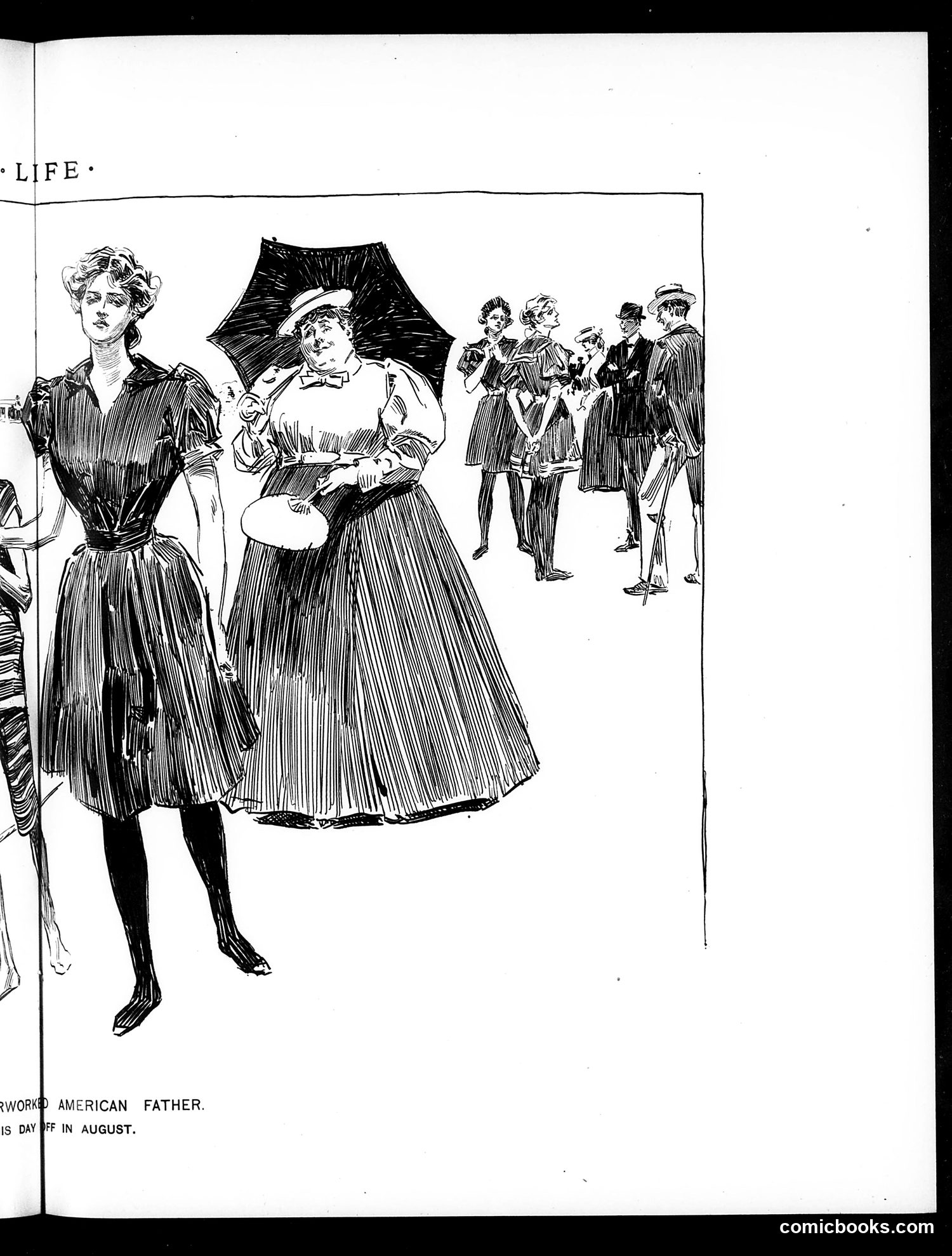
This is a page from *Life* magazine showing a satirical illustration about fashion and social class in early 20th-century America. The image depicts two women in prominent positions: a stylish, slender woman in a dark dress on the left, and a larger woman with an umbrella in the center—likely contrasting idealized versus "unfashionable" body types or social stations of the era. The background shows additional figures in formal attire, suggesting a social gathering or public event. The partially visible OCR text references "American Father" and "August," though the complete caption is unclear. The satire likely critiques contemporary fashion standards, body image expectations, or the social pretensions of different classes—common *Life* magazine themes mocking American social conventions and vanity during this period.
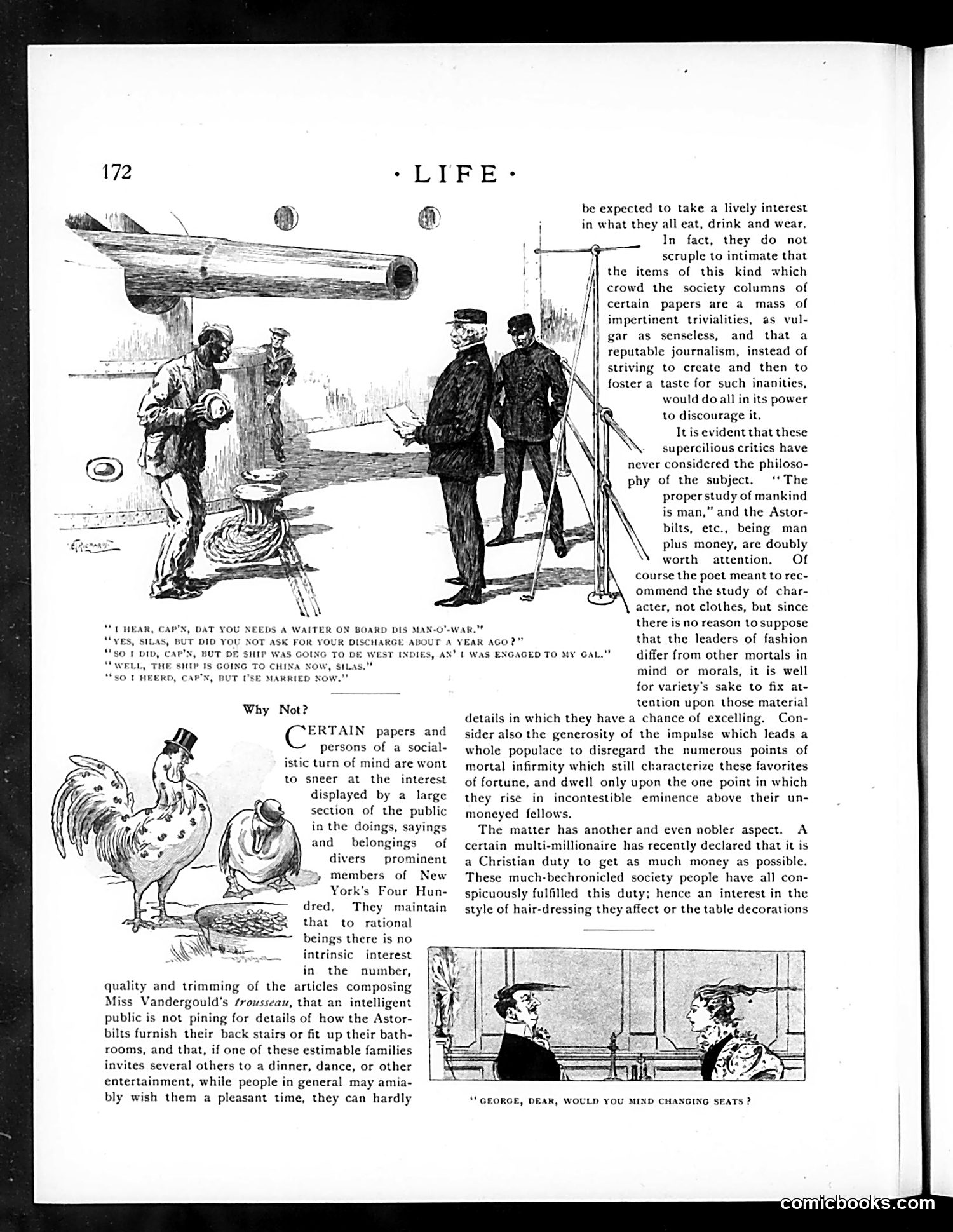
This page satirizes the wealthy elite's obsession with trivial social details. The top cartoon shows sailors discussing a waiter's employment—a joke about the leisure class's preoccupation with domestic staff and their histories rather than substantive matters. The middle section ("Why Not?") mocks "certain papers and persons of a socialistic turn of mind" who criticize the wealthy's consumption habits. The accompanying rooster illustration suggests these critics are hypocritically gossiping while claiming moral superiority. The text argues that fashion and décor details are worthy subjects because the wealthy set cultural trends. It defends society journalism against critics who dismiss it as trivial, ultimately justifying coverage of the Astorbilts and similar prominent families' material lives and entertainment. The bottom cartoon appears to show domestic small talk, reinforcing the theme of banal social preoccupations.
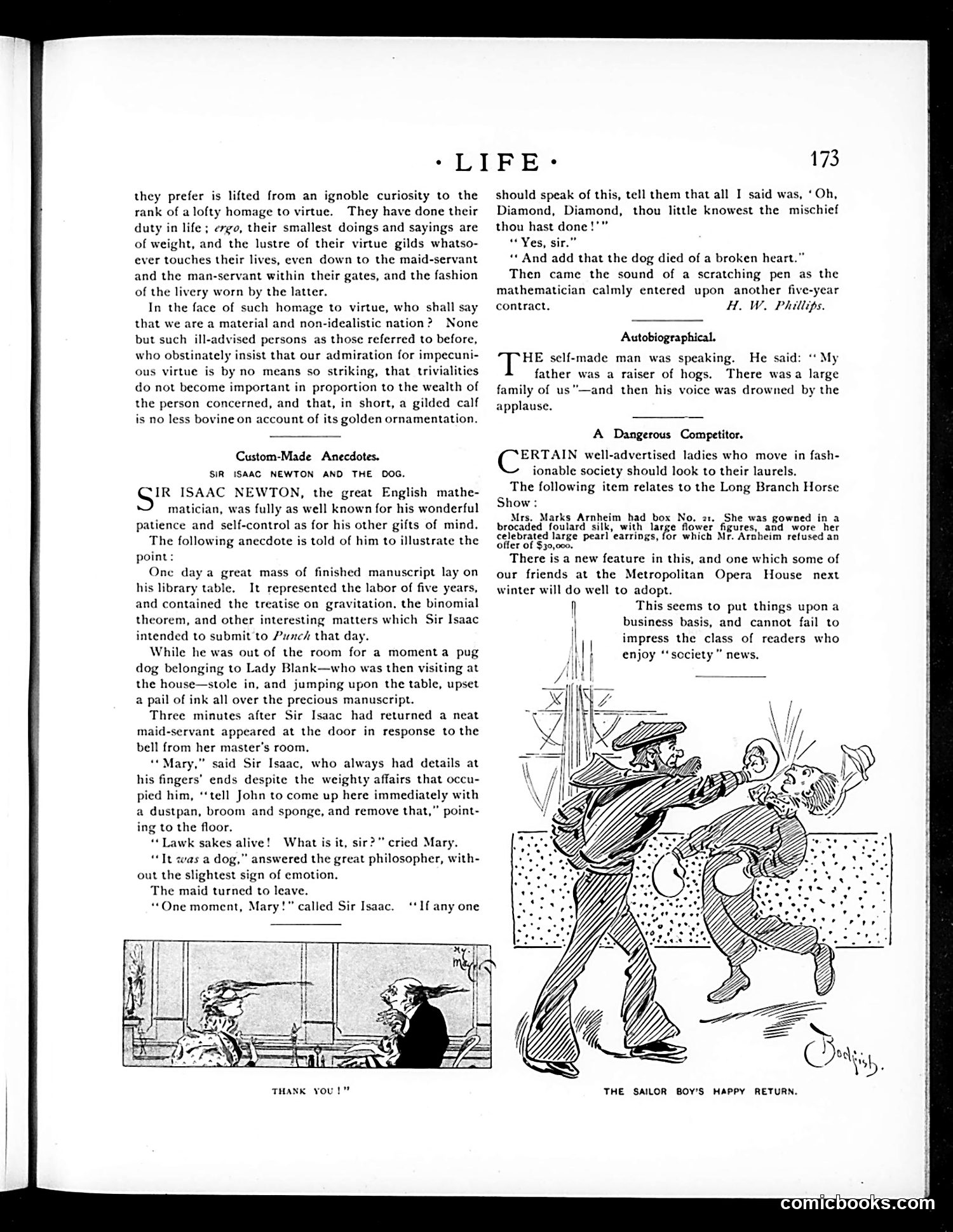
This page contains three satirical pieces typical of early-20th-century American humor: **"Sir Isaac Newton and the Dog"** mocks aristocratic pretension. The anecdote presents Newton as so devoted to maintaining his dignified reputation that when his manuscript is ruined by a dog, he instructs his maid to claim he sentimentally named the animal "Diamond"—fabricating a touching story to protect his image. The satire targets how the wealthy and famous carefully curate their legacies, transforming trivial or embarrassing incidents into virtuous narratives. **"Autobiographical"** is a brief joke about a self-made man whose origin story—that his father raised hogs—draws applause. The humor lies in the audience's enthusiasm drowning out his modest background, suggesting society celebrates self-made success while glossing over humble origins. **"A Dangerous Competitor"** satirizes society women's obsession with displaying wealth and fashion at public events like horse shows. The cartoon (illustrating "The Sailor Boy's Happy Return") and accompanying text mock how society women compete through ostentatious display of jewelry and clothing, reducing social events to competitive fashion shows. All three pieces critique vanity, status-consciousness, and the gap between appearance and reality in American society.
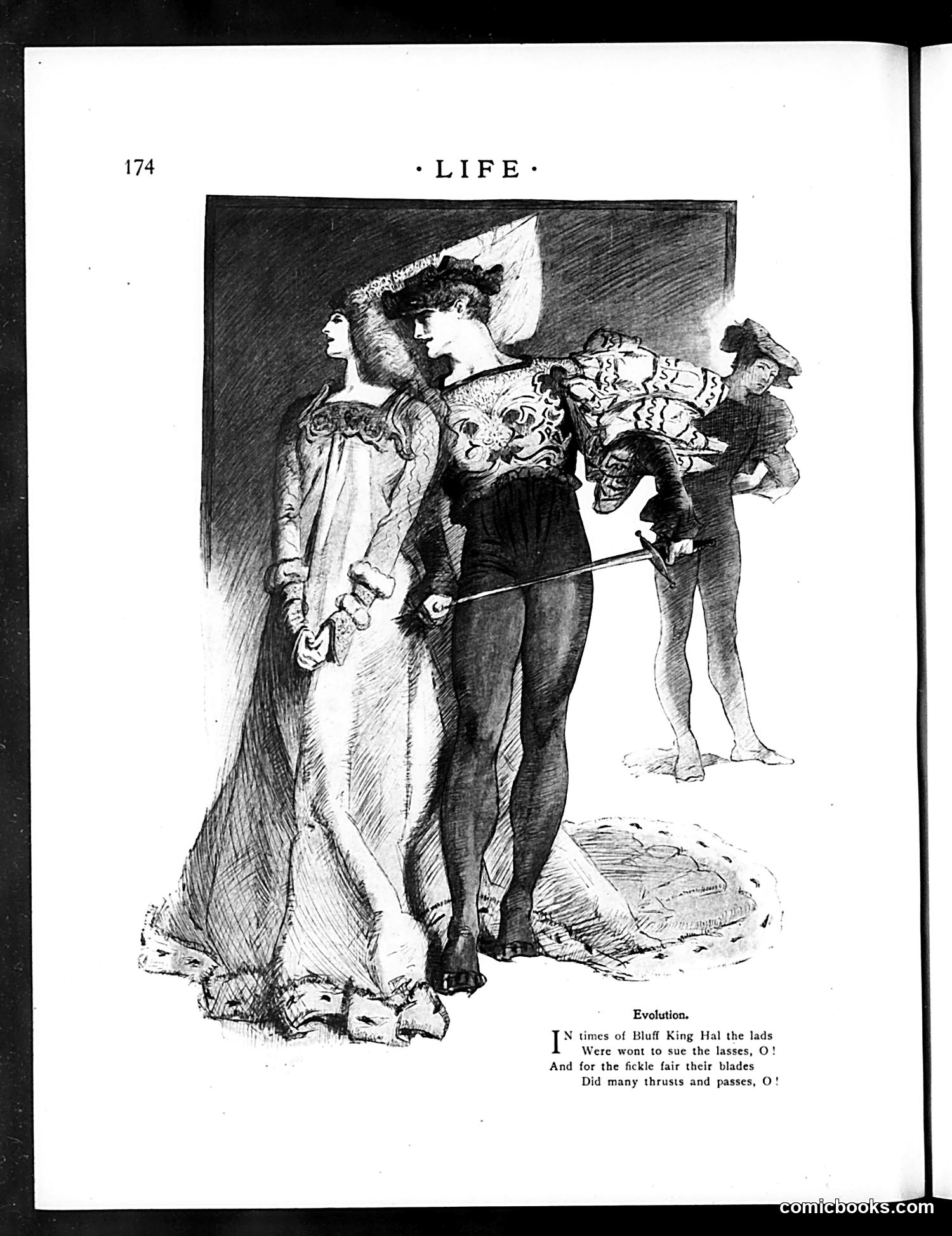
This satirical cartoon titled "Evolution" compares courtship practices across historical periods. The verse references "Bluff King Hal" (Henry VIII), noting that in Tudor times, men courted women through sword fighting and dueling for their affections. The illustration contrasts this with contemporary (early 20th-century) courtship: elegantly dressed women on the left represent the traditional ideal, while on the right, men in increasingly ridiculous costumes and poses—including what appears to be a devil or demon figure with a sword—suggest modern courting has become absurd theatrical performance. The satire mocks how Edwardian-era male courtship behavior, while no longer literally violent, had become equally performative and foolish—just in different, more comical ways. The "evolution" is ironic: behavior has supposedly progressed, but men still look equally ridiculous trying to win women's affections.
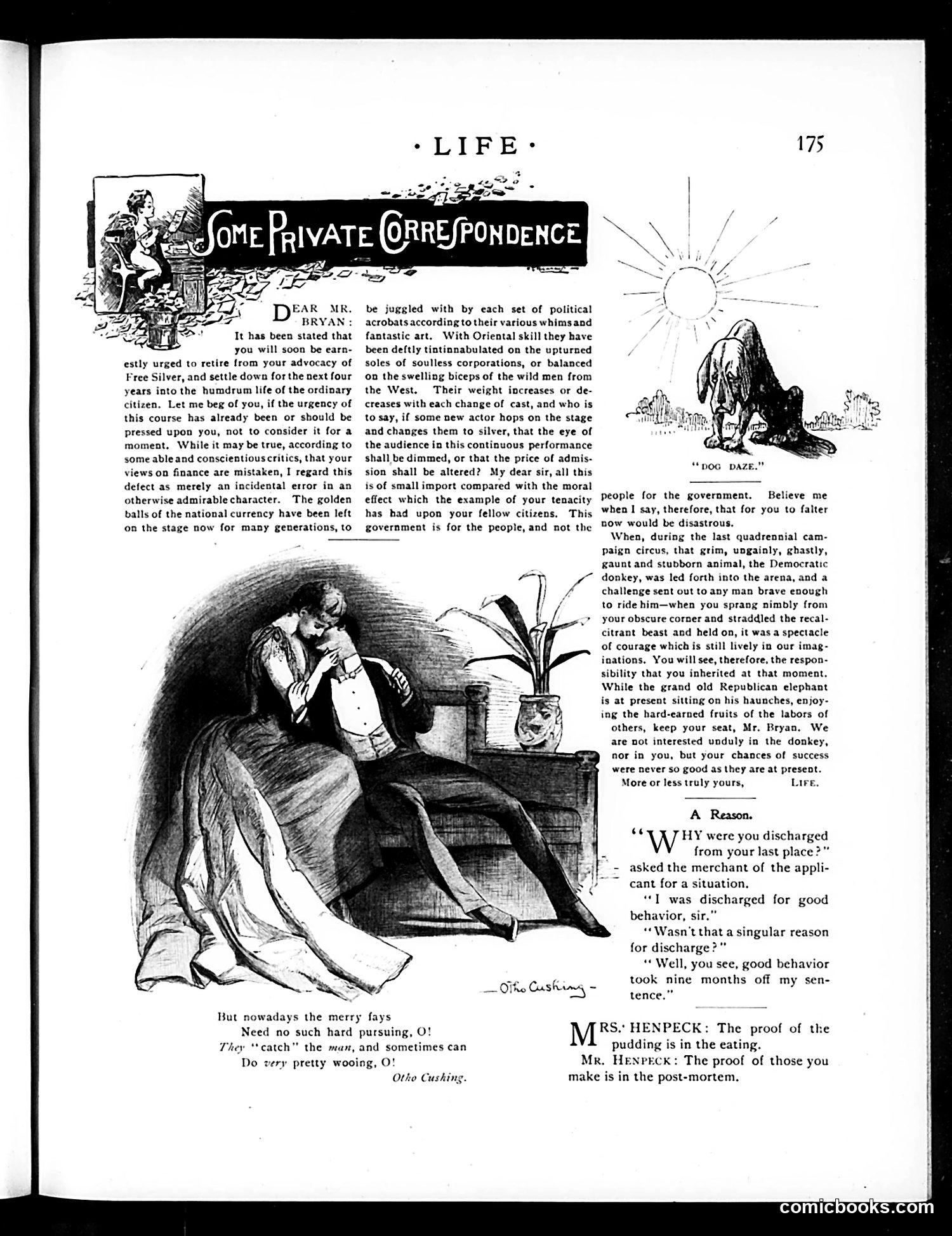
This page contains political satire regarding **William Jennings Bryan**, the Democratic presidential candidate who championed "Free Silver" (unlimited silver coinage). **"Some Private Correspondence"** is a mock letter urging Bryan not to abandon his advocacy. The author uses elaborate metaphors comparing currency policy to circus acrobats juggling "golden balls" and political performers on stage. The letter sarcastically suggests that while Bryan's economic views may be "mistaken," his *moral example* of tenacity matters more—referencing his bold ride on the "Democratic donkey" during the recent campaign, contrasting it with the Republican elephant now "sitting on his bunches, enjoying...the fruits of the labors of others." The satire cuts both ways: praising Bryan's courage while mocking Free Silver as economically questionable. Below are unrelated humor items: a brief poem about courtship and two short jokes about discharge/punishment and pudding quality. The artwork by Otho Cushing shows a man in contemplative repose, fitting the correspondence section's tone.
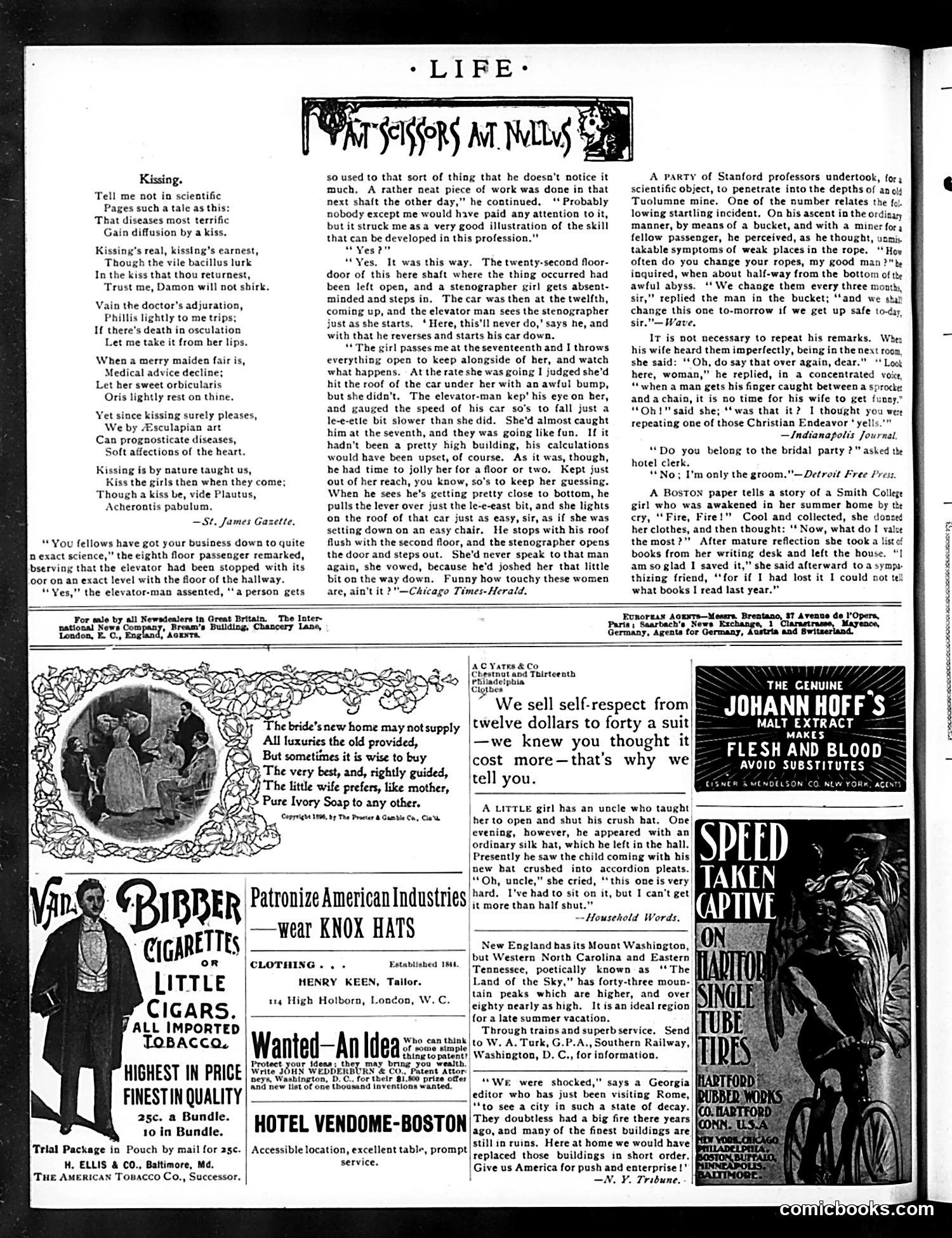
This page contains three separate humorous anecdotes satirizing different professions and their practitioners: 1. **The Elevator Operator Story**: Mocks the inflated self-importance of skilled tradesmen. An eighth-floor passenger listens as an elevator operator boasts about precise technical work—specifically, a colleague who allegedly caught a falling stenographer by timing his descending elevator to match her fall speed. The tale becomes increasingly implausible, serving as satire of working-class men exaggerating their competence. 2. **The Mine Safety Anecdote**: A Stanford professor descending into a mine asks a bucket-operator about rope maintenance. The casual response—"we change this one tomorrow if we get up safe today"—reveals shocking workplace negligence, satirizing both mining industry safety practices and workers' cavalier attitudes toward life-threatening conditions. 3. **Poetry Section**: Opens with verses mocking medical warnings against kissing due to disease transmission, satirizing Victorian-era germ theory anxieties. The page is primarily satirical commentary on American labor and safety practices circa early 1900s.
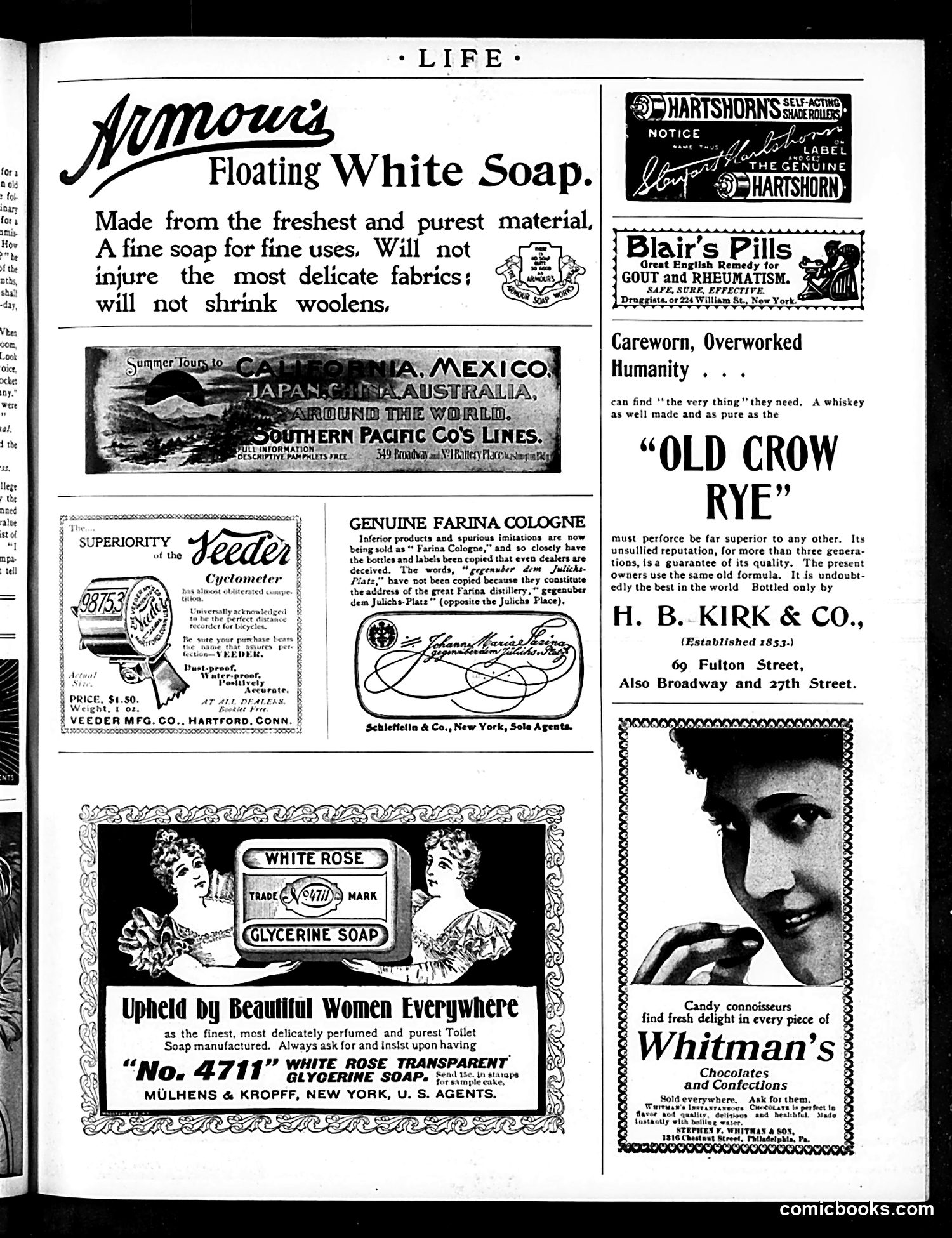
This is **not a cartoon or satirical content** — it's a straightforward advertisement page from Life magazine, likely from the early 1900s. The page features period product advertisements including: - **Armour's Floating White Soap** — marketed as gentle for delicate fabrics - **Keeler Cyclometer** — a bicycle odometer device - **Farina Cologne** — a German fragrance, with the ad explicitly warning against counterfeit imitations - **White Rose Glycerine Soap** — targeted at "Beautiful Women Everywhere" - **Blair's Pills** — a supposed English remedy for gout and rheumatism - **Old Crow Rye** — whiskey marketed to "careworn, overworked humanity" - **Whitman's Chocolates** The ads reflect early-20th-century consumer culture and advertising tactics: health claims (often unsubstantiated), appeals to status and beauty, and warnings about counterfeits. There is no political satire or cartoon content present.
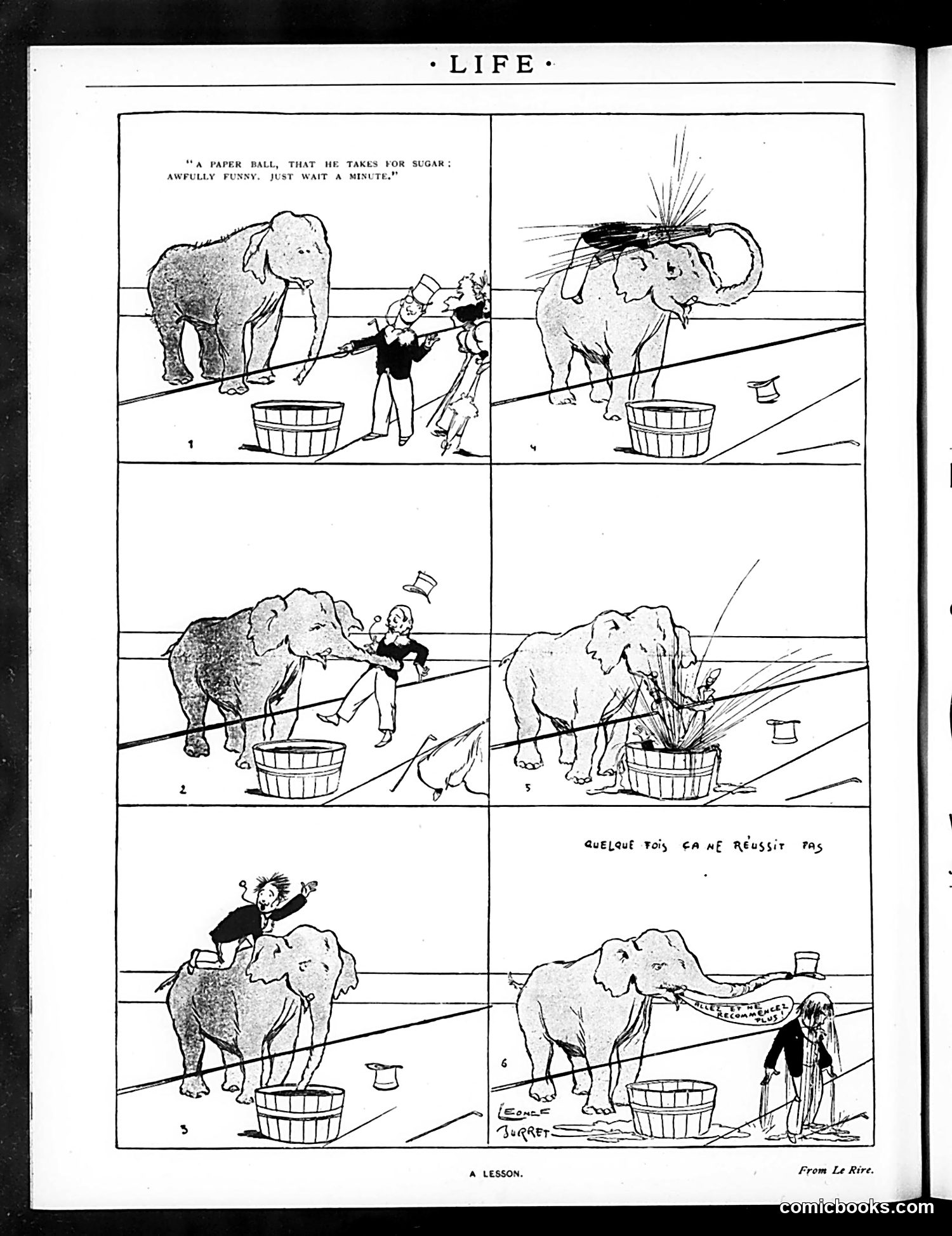
This six-panel comic depicts a circus trainer attempting to teach an elephant to perform tricks using what he believes is sugar but is actually a paper ball. The humor is straightforward slapstick: the elephant repeatedly fails to comply with commands, creating chaos in each panel—spraying water, tossing the trainer, and generally behaving unpredictably. The joke's title, "A Lesson," suggests the trainer is the one being taught, not the elephant. The satire appears to mock human arrogance: the trainer's fundamental miscalculation (mistaking paper for sugar) leads to predictable failure. The French caption "Quelque fois, ça ne réussit pas" ("Sometimes it doesn't work") reinforces this theme of overconfidence meeting reality. The cartoon is credited "From Le Rire," a French satirical publication, suggesting this is a reprinted international piece poking fun at misguided human assumptions.
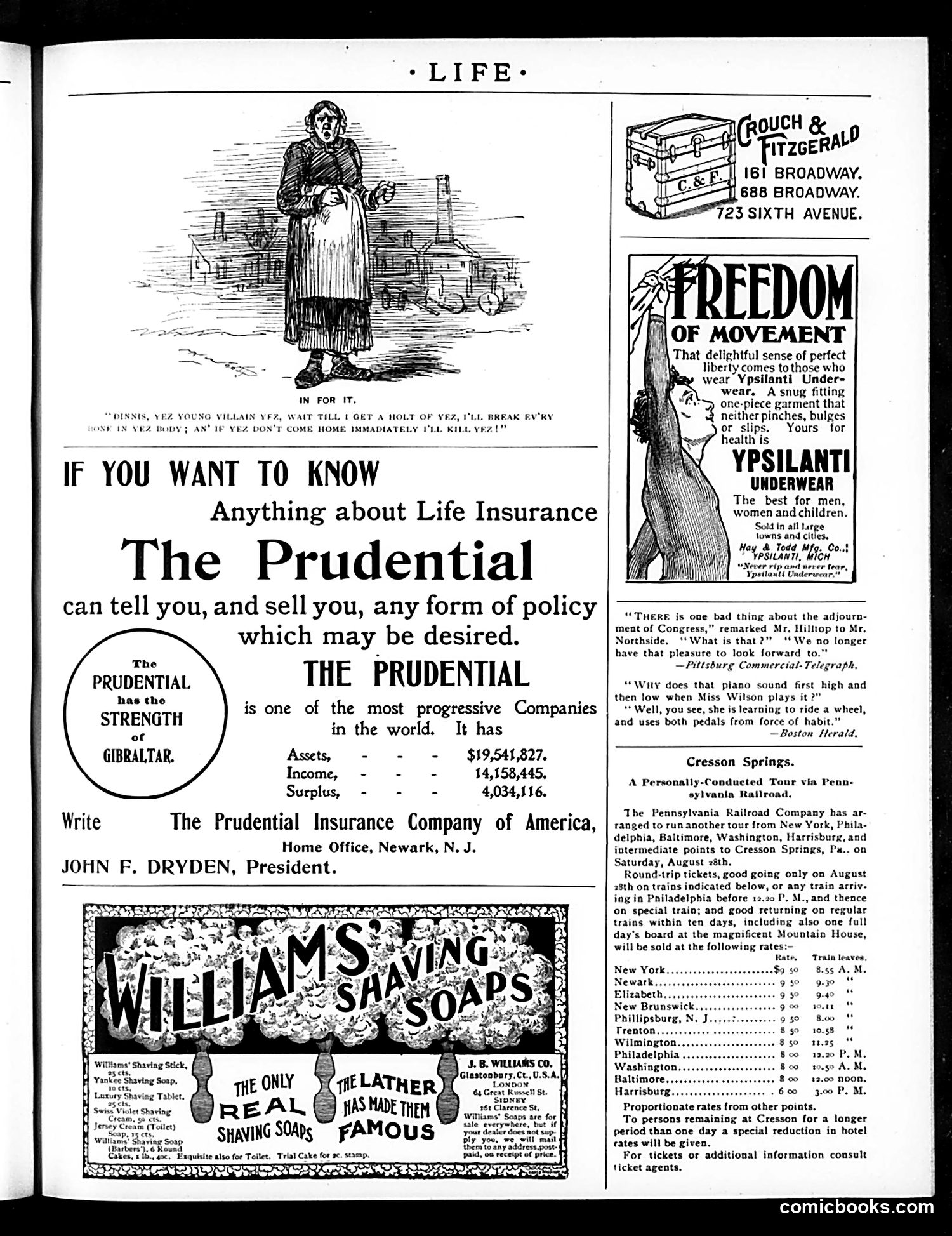
The top cartoon depicts a working-class woman (identifiable by her dress and bonnet) threatening violence against "young villains," using thick Irish-accented dialect ("Dinnis," "yez," "honk"). She warns she'll "break every bone" in their bodies if they don't come home immediately or she'll "kill yez." The satire targets **class anxieties about immigrant working-class mothers and urban youth crime**. The exaggerated Irish accent and crude threat humor at the expense of poor families struggling with juvenile delinquency. For modern readers, this reflects turn-of-the-century nativist attitudes—the joke assumes readers will find both the dialect and the domestic violence threat amusing rather than troubling. The page is otherwise filled with period advertisements (insurance, soap, underwear, railroad tours), typical of Life magazine's format.
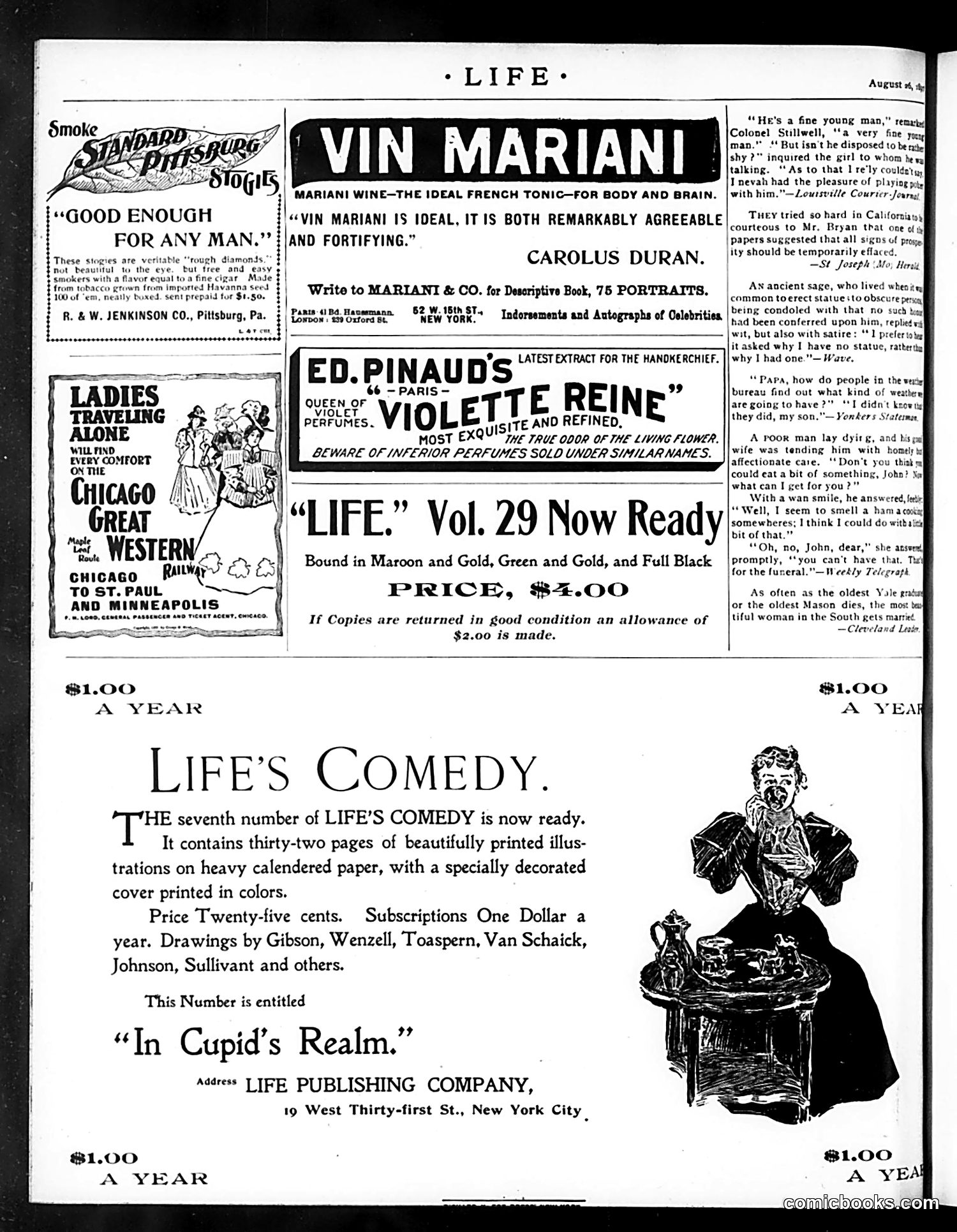
This is primarily a **advertising and promotional page** from *Life* magazine, circa 1907. The page showcases the magazine's commercial focus rather than political satire. **Key advertisements include:** - **Vin Mariani wine**: A French "tonic" endorsed by celebrity artist Carolus Duran, claiming body and brain benefits—typical of patent medicine advertising from this era - **Ed. Pinaud's Violette Reine perfume**: A Paris fragrance marketed as "exquisite and refined" - **Life magazine Vol. 29**: Advertised at $4.00, bound in decorative covers - **Life's Comedy series**: The seventh installment, titled "In Cupid's Realm," featuring drawings by Gibson and other illustrators, priced at 25 cents The right column contains **humorous anecdotes** about Bryan (likely William Jennings Bryan) and courtship/marriage scenarios—typical *Life* magazine humor. **No political cartoons appear on this page.** The content reflects *Life*'s business model: mixing satirical content with upscale advertising targeting middle and upper-class readers.