
Life, 1897-08-26 · page 8 of 20
Life — August 26, 1897 — page 8: what you’re looking at
What you’re looking at
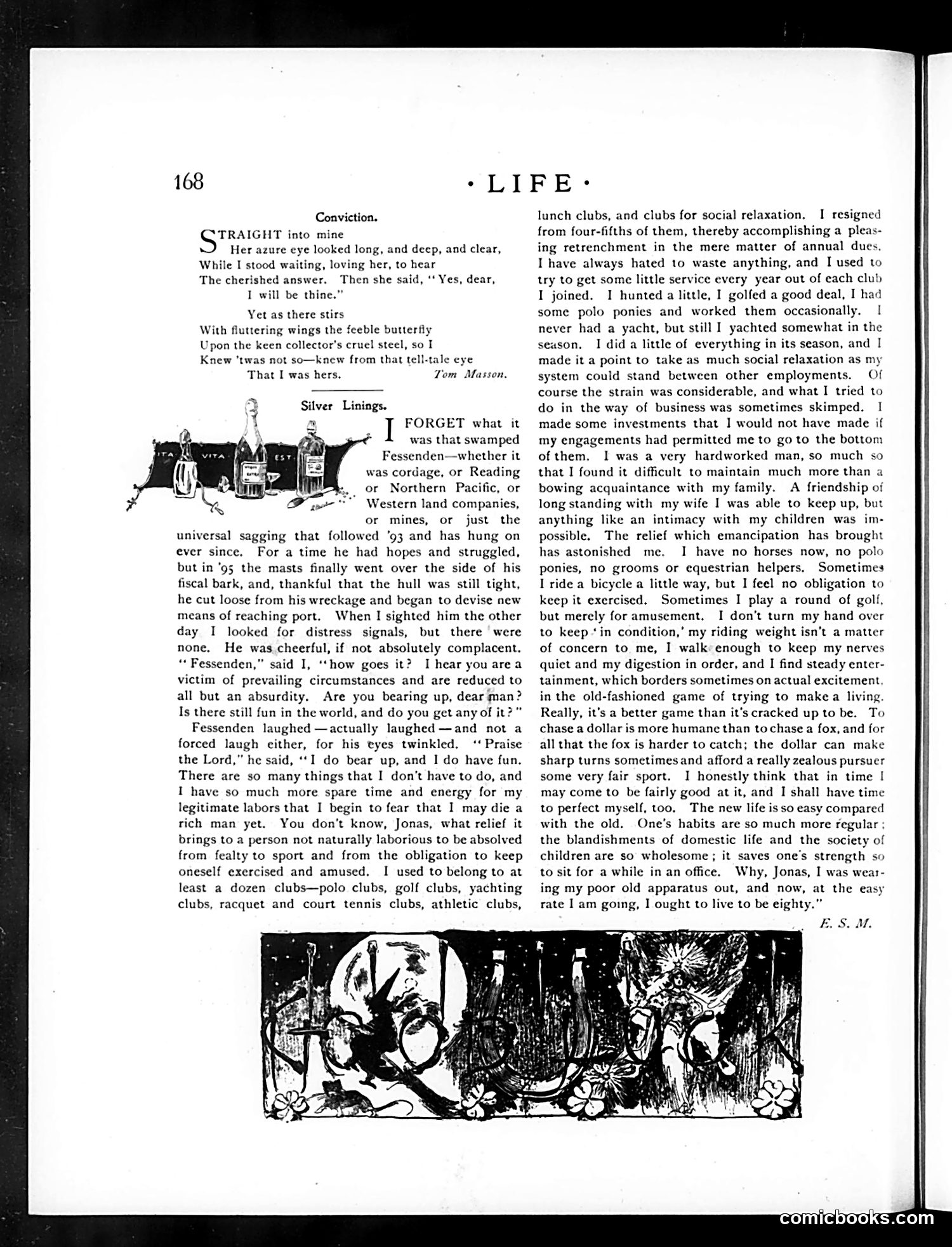
This page contains two separate pieces: 1. **"Conviction"** - A poem by Tom Mason about romantic certainty, illustrated with a decorative initial letter. 2. **"Silver Linings"** - A prose essay (signed E.S.M.) describing the author's relief at retiring from numerous social clubs—polo clubs, golf clubs, yacht clubs, athletic clubs, and others. The author humorously catalogs the exhaustion of maintaining memberships and social obligations, arguing that elderly life is better simplified. He contrasts the relief of domesticity with the burden of trying to "keep in condition" through constant club activities. 3. **Illustrations** - The page includes decorative bottle/vessel illustrations at the top and a detailed black-and-white woodcut-style illustration at the bottom depicting figures in a garden or natural setting, though its exact relationship to the text is unclear. The content satirizes upper-class social obligations and club culture of the era.
📄 Transcribed text from this page (OCR, searchable)
Machine-transcribed from the original scan — historical spelling and the odd misread are preserved.
*LIFE: Conviction. TRAIGHT into mine Her azure eye looked long, and deep, and clear, While I stood waiting, loving her, to hear The cherished answer. Then she said, ‘* Yes, dear, I will be thine.” Yet as there stirs With fluttering wings the feeble butterfly Upon the keen collector's cruel steel, so I Knew ‘twas not so—knew from that tell-tale eye That I was hers. Tom Masson. Q Silver Linings. i x FORGET what it ‘as that swamped Fessenden—whether it was cordage, or Reading or Northern Pacific, or Western land companies, or mines, or just the universal sagging that followed '93 and has hung on ever since, For a time he had hopes and struggled, but in ‘95 the masts finally went over the side of his fiscal bark, and, thankful that the hull was still tight, he cut loose from his wreckage and began to devise new means of reaching port. When I sighted him the other day I looked for distress signals, but there | were none. He was cheerful, if not absolutely complacent. “Fessenden,” said I, ‘‘how goes it? I hear you area victim of prevailing circumstances and are reduced to all but an absurdity. Are you bearing up, dear man? Is there still fun in the world, and do you get any of it?” Fessenden laughed —actually laughed —and not a forced laugh either, for his tyes twinkled. ‘ Praise the Lord,” he said, ‘1 do bear up, and I do have fun. There are so many things that I don't have to do, and I have so much more spare time and energy for my legitimate labors that I begin to fear that I may die a rich man yet. You don't know, Jonas, what relief it brings to a person not naturally laborious to be absolved from fealty to sport and from the obligation to keep oneself exercised and amused. I used to belong to at least a dozen clubs—polo clubs, golf clubs, yachting clubs, racquet and court tennis clubs, athletic clubs, lunch clubs, and clubs for social relaxation. I resigned from four-fifths of them, thereby accomplishing a pleas- ing retrenchment in the mere matter of annual dues. I have always hated to waste anything, and I used to try to get some little service every year out of each club I joined. I hunted a little, I golfed a good deal, I had some polo ponies and worked them occasionally. | never had a yacht, but still I yachted somewhat in the season. I did a little of everything in its season, and | made it a point to take as much social relaxation as my system could stand between other employments. Of course the strain was considerable, and what I tried to do in the way of business was sometimes skimped. | made some investments that 1 would not have made if my engagements had permitted me to go to the bottom ofthem, I was a very hardworked man, so much so that I found it difficult to maintain much more than a bowing acquaintance with my family. A friendship of long standing with my wife I was able to keep up, but anything like an intimacy with my children was im- possible. The relief which emancipation has brought has astonished me. I have no horses now, no polo ponies, no grooms or equestrian helpers. Sometimes I ride a bicycle a little way, but I feel no obligation to keep it exercised. Sometimes I play a round of golf, but merely for amusement. I don’t turn my hand over to keep ‘in condition,’ my riding weight isn’t a matter of concern to me, I walk: enough to keep my nerves quiet and my digestion in order, and I find steady enter- tainment, which borders sometimes on actual excitement in the old-fashioned game of trying to make a living. Really, it’s a better game than it’s cracked up to be. To chase a dollar is more humane than tochase a fox, and for all that the fox is harder to catch; the dollar can make sharp turns sometimesand afford a really zealous pursucr some very fair sport. I honestly think that in time I may come to be fairly good at it, and I shall have time to perfect myself, too, with the old. The new life is so easy compared One's habits are so much more regular ; the blandishments of domestic life and the society of children are so wholesome ; it saves one’s strength so to sit for a while in an office. Why, Jonas, I was wear- ing my poor old apparatus out, and now, at the easy rate | am going, I ought to live to be eighty.” ELS. M.