
Life, 1897-08-26 · page 12 of 20
Life — August 26, 1897 — page 12: what you’re looking at
What you’re looking at
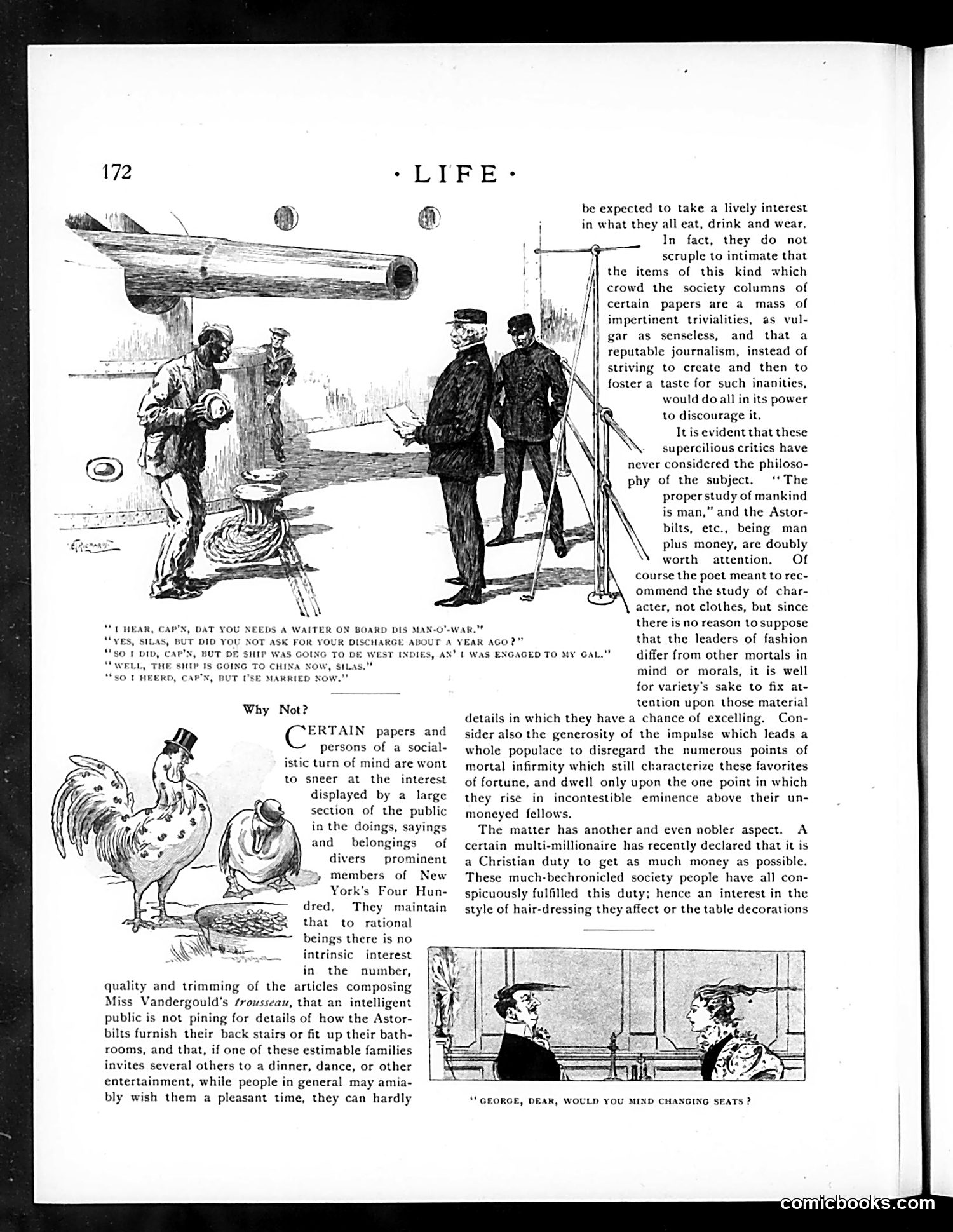
This page satirizes the wealthy elite's obsession with trivial social details. The top cartoon shows sailors discussing a waiter's employment—a joke about the leisure class's preoccupation with domestic staff and their histories rather than substantive matters. The middle section ("Why Not?") mocks "certain papers and persons of a socialistic turn of mind" who criticize the wealthy's consumption habits. The accompanying rooster illustration suggests these critics are hypocritically gossiping while claiming moral superiority. The text argues that fashion and décor details are worthy subjects because the wealthy set cultural trends. It defends society journalism against critics who dismiss it as trivial, ultimately justifying coverage of the Astorbilts and similar prominent families' material lives and entertainment. The bottom cartoon appears to show domestic small talk, reinforcing the theme of banal social preoccupations.
📄 Transcribed text from this page (OCR, searchable)
Machine-transcribed from the original scan — historical spelling and the odd misread are preserved.
0 \ A\ “1 HEAR, CAP'N, DAT YOU NEEDS A WAITER ON BOARD DIS MAN-O'-WaR."" “YES, SILAS, BUT DID YOU NOT ASK FOR YOUR DISCHARGE ABOUT A YEAR AGO?” VEST INDIES, ANT LW. SO f DID, CAP'N, BUT DE SHIP WAS GOING TO DE “WELL, THE SHIP IS GOING TO CHINA NOW, SILas.”” “SO 1 HEERD, CAP'N, BUT I'SE MARRIED Now,”? Why Not? ERTAIN papers and persons of a social- istic turn of mind are wont to sneer at the interest displayed by a large section of the public in the doings, sayings and belongings of divers — prominent ~ members of New ~ York's Four Hun- dred. They maintain that to rational beings there is no intrinsic interest in the number, quality and trimming of the articles composing Miss Vandergould’s /rowsseau, that an intelligent public is not pining for details of how the Astor- bilts furnish their back stairs or fit up their bath- rooms, and that, if one of these estimable families invites several others to a dinner, dance, or other entertainment, while people in general may amia- bly wish them a pleasant time, they can hardly be expected to take a lively interest in what they all eat, drink and wear. In fact, they do not scruple to intimate that the items of this kind which crowd the society columns of certain papers are a mass of impertinent trivialities, as vul- gar as senseless, and that a reputable journalism, instead of striving to create and then to foster a taste for such inanities, would do all in its power to discourage it. It is evident that these \ supercilious critics have never considered the philoso- phy of the subject. ‘* The proper study of mankind is man,” and the Astor- bilts, etc., being man plus money, are doubly worth attention. Of course the poet meant to rec- ommend the study of char- acter, not clothes, but since there is no reason to suppose that the leaders of fashion S ENGAGED TO MY GAL." differ from other mortals in mind or morals, it is well for variety’s sake to fix at- tention upon those material details in which they have a chance of excelling. Con- sider also the generosity of the impulse which leads a whole populace to disregard the numerous points of mortal infirmity which still characterize these favorites of fortune, and dwell only upon the one point in which they rise in incontestible eminence above their un- moneyed fellows. The matter has another and even nobler aspect. A certain multi-millionaire has recently declared that it is a Christian duty to get as much money as possible. These much-bechronicled society people have all con- spicuously fulfilled this duty; hence an interest in the style of hair-dressing they affect or the table decorations “GEORGE, DEAR, WOULD YOU MIND CHANGING SEATS ?