
Life, 1897-08-26 · page 7 of 20
Life — August 26, 1897 — page 7: what you’re looking at
What you’re looking at
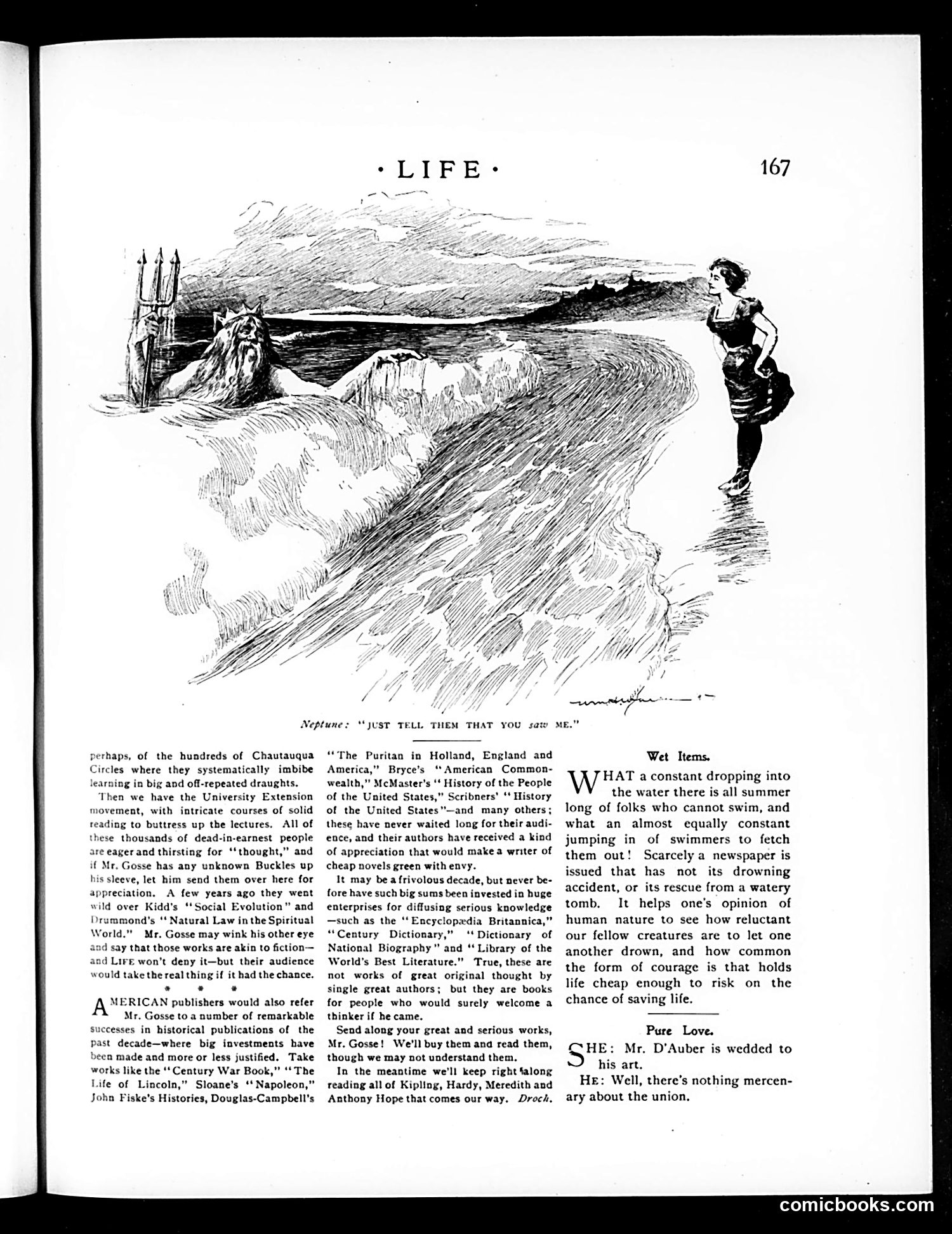
The illustration depicts a woman in classical/mythological dress standing on a beach, confronting what appears to be Neptune (the bearded sea god with his trident). The caption reads: "JUST TELL THEM THAT YOU ARE ME." This appears to be satirizing claims of identity or impersonation in a classical/mythological context. The accompanying text discusses various literary and historical works, suggesting this may relate to debates about authorship or authenticity. Below is a brief dialogue titled "Pure Love" about a character Mr. D'Auber's wedding, where someone notes "there's nothing mercenary about the union"—likely satirizing mercenary marriages or false declarations of love. The exact historical or political reference remains unclear without additional context about Life magazine's contemporary concerns.
📄 Transcribed text from this page (OCR, searchable)
Machine-transcribed from the original scan — historical spelling and the odd misread are preserved.
Neptune : perhaps, of the hundreds of Chautauqua Circles where they systematically imbibe learning in big and off-repeated draughts. Then we have the University Extension movement, with intricate courses of solid reading to buttress up the lectures. All of these thousands of dead-in-earnest people are eager and thirsting for “thought,” and if Mr. Gosse has any unknown Buckles up his sleeve, let him send them over here for appreciation. A few years ago they went wild over Kidd's ‘Social Evolution” and Drummond's ** Natural Law in the Spiritual World.” Mr. Gosse may wink his other eye and say that those works are akin to fiction— and Lire won't deny it—but their audience would take the real thing if it had the chance. . . * MERICAN publishers would also refer Mr. Gosse to a number of remarkable successes in historical publications of the past decade—where big investments have been made and more or less justified. Take works like the “Century War Book,” ‘The Life of Lincoln,” Sloane's ‘* Napoleon,” John Fiske’s Histories, Douglas-Campbell’s “JUST TELL THEM THAT YOU saw “The Puritan in Holland, England and America,” Bryce's “American Common- wealth,” McMaster’s ‘ History of the People of the United States,” Scribners’ ‘* History of the United States"—and many others; these have never waited long for their audi- ence, and their authors have received a kind of appreciation that would make a writer of cheap novels green with envy. It may bea frivolous decade, but never be- fore have such big sums been invested in huge enterprises for diffusing serious knowledge —such as the ‘‘Encyclopadia Britannica,” ‘Century Dictionary,” ‘* Dictionary of tional Biography" and ‘‘ Library of the World's Best Literature.” True, these are not works of great original thought by single great authors; but they are books for people who would surely welcome a thinker if he came. Send along your great and serious works, Mr. Gosse! We'll buy them ana read them, though we may not understand them. In the meantime we'll keep right falong reading all of Kipling, Hardy, Meredith and Anthony Hope that comes our way. Droch. ME.” Wet Items. HAT a constant dropping into the water there is all summer long of folks who cannot swim, and what an almost equally constant jumping in of swimmers to fetch them out! Scarcely a newspaper is issued that has not its drowning accident, or its rescue from a watery tomb. It helps one’s opinion of human nature to see how reluctant our fellow creatures are to let one another drown, and how common the form of courage is that holds life cheap enough to risk on the chance of saving life. Pure Love. HE: Mr. D'Auber is wedded to his art. HE: Well, there’s nothing mercen- ary about the union, comicbooks.com