
A complete issue · 20 pages · 1897
Life — June 3, 1897
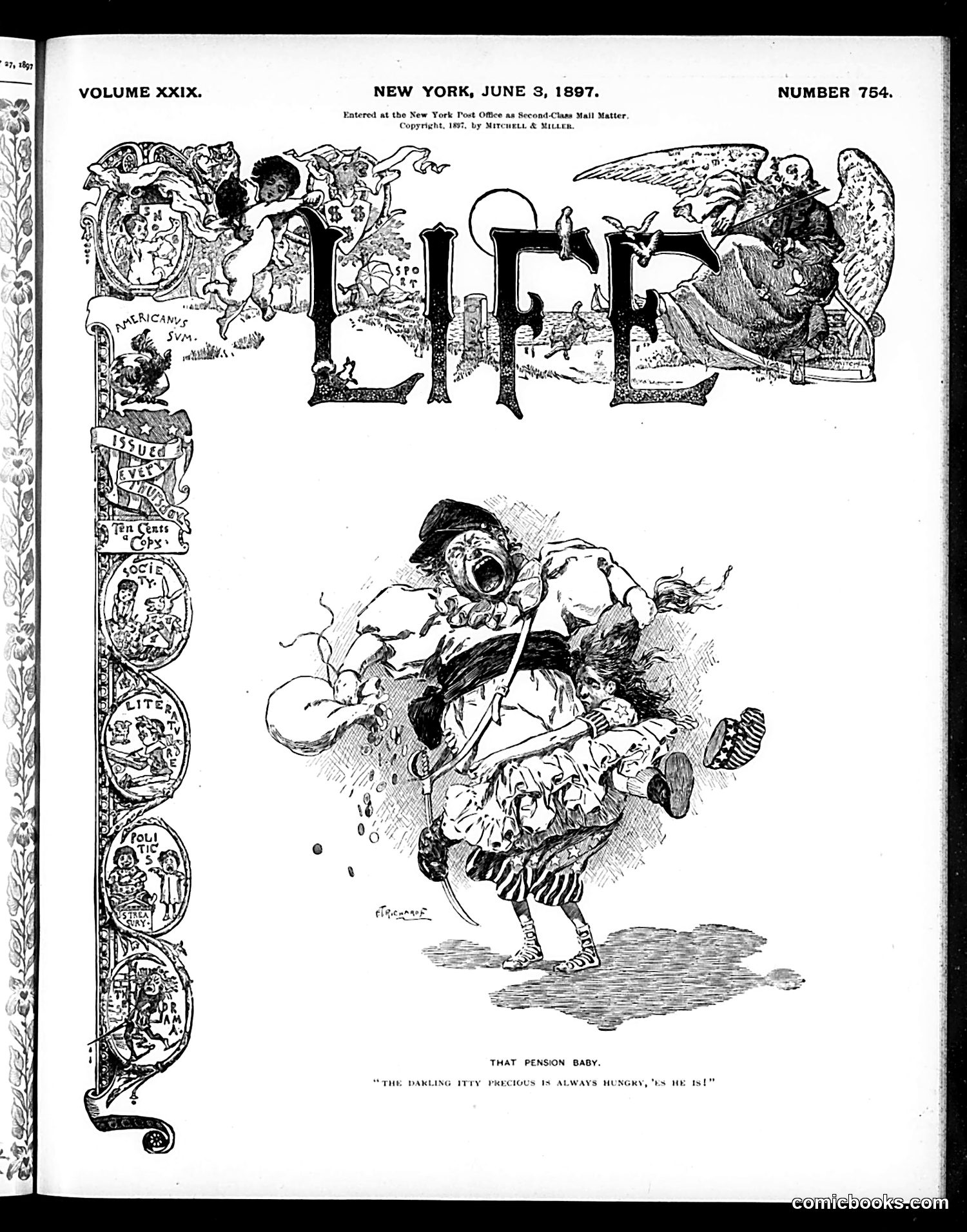
This satirical cartoon depicts a disheveled figure struggling to carry an enormous, crying baby labeled "That Pension Baby." The caption reads: "The darling itty precious is always hungry, 'is he is!'" The cartoon criticizes the U.S. pension system, likely referring to Civil War veterans' pensions that had become increasingly expensive and controversial by the 1890s. The "hungry" baby represents the insatiable financial demands of the pension program, portrayed as a burden on government resources. The exhausted caretaker symbolizes taxpayers or government officials struggling under this weight. This reflects genuine 1890s debate about pension costs ballooning beyond their original purpose, with critics viewing them as wasteful spending that drained federal budgets.
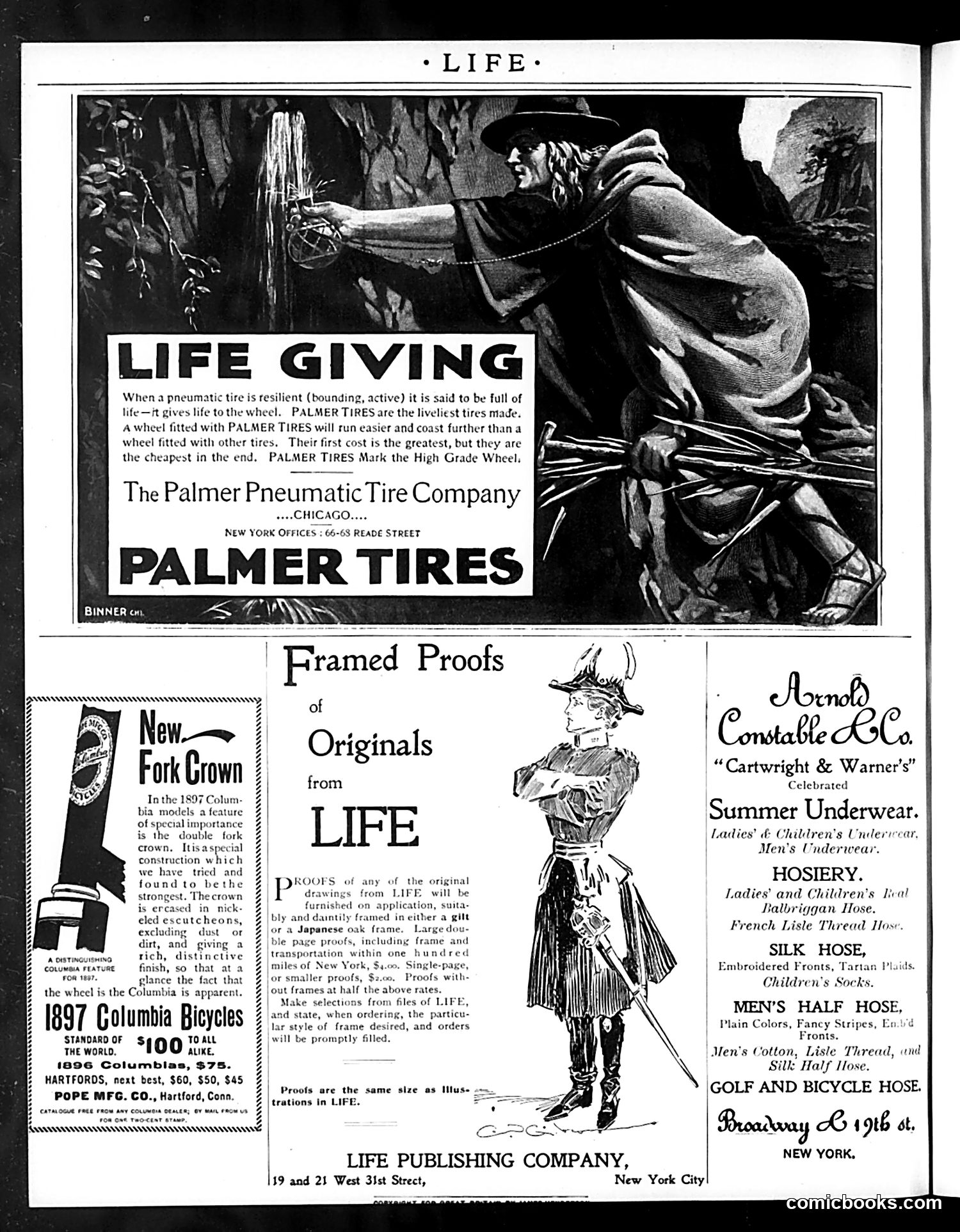
This page is primarily **advertising**, not satire or political commentary. The top advertisement for **Palmer Pneumatic Tires** uses an allegorical illustration of a figure (possibly representing a laborer or traveler) to suggest that pneumatic tires provide "life-giving" performance—they're resilient and energetic ("full of life"). The metaphor equates tire quality with vitality. Below are additional commercial ads for **1897 Columbia Bicycles**, **framed art proofs from Life magazine**, and **Arnold Constable & Co. undergarments and hosiery**. The central illustration shows a fashionably dressed woman, likely representing contemporary style rather than political commentary. This appears to be a standard turn-of-the-century magazine page mixing entertainment content with commercial sponsorships.
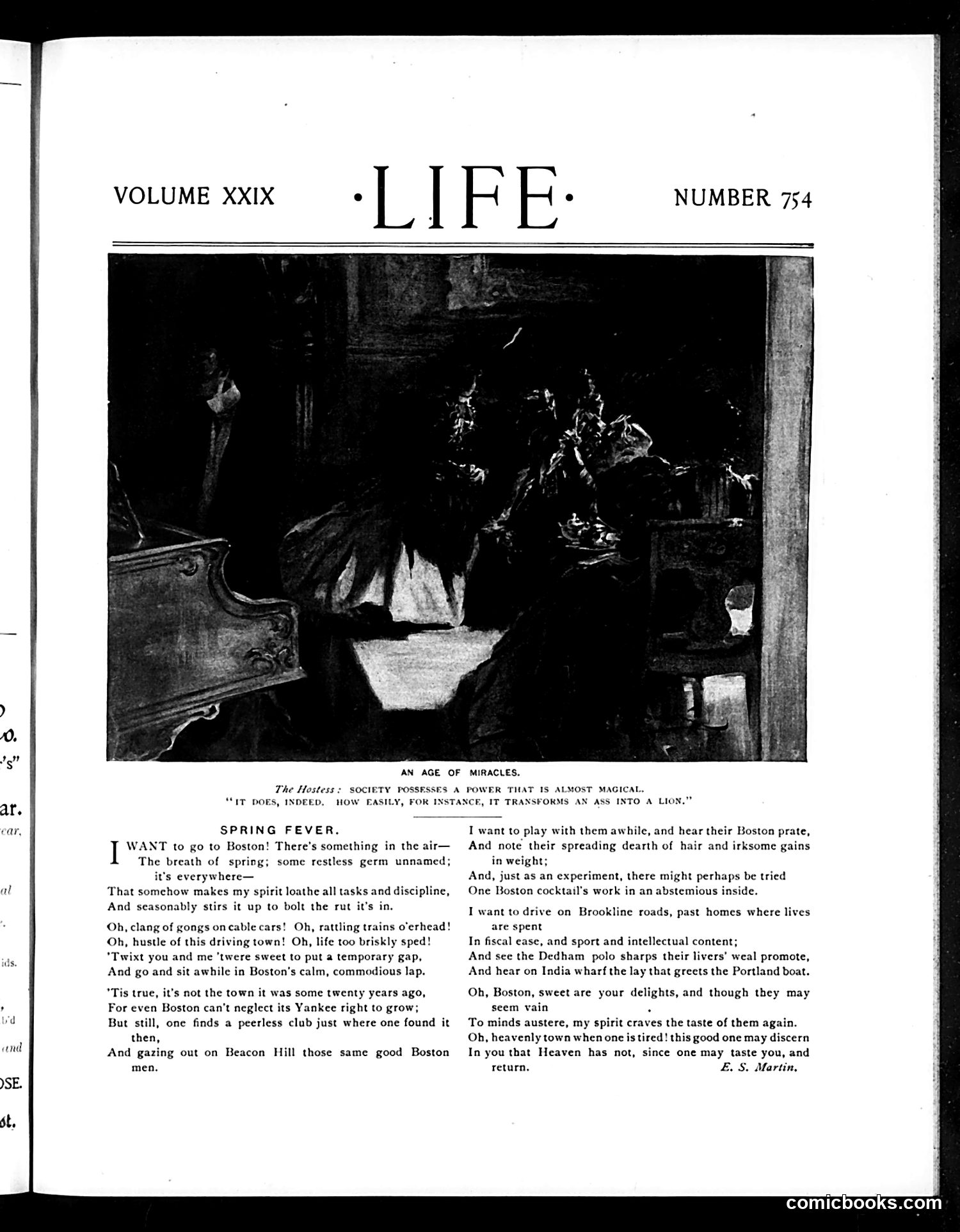
This page features "Spring Fever," a poem by E.S. Martin expressing nostalgic longing for Boston. The accompanying photograph titled "An Age of Miracles" depicts what appears to be a social gathering or séance scene, with the caption noting "Society possesses a power that is almost magical" and referencing transforming "an ass into a lion." The juxtaposition suggests satirical commentary on high society's supposed sophistication. The poem romanticizes Boston's charm and intellectual culture, while the image's caption implies skepticism about society's actual transformative powers—using the ass-to-lion reference (likely from Aesop's Fables) to mock pretensions of social elevation. The humor targets both nostalgic Bostonians and society's inflated self-regard.
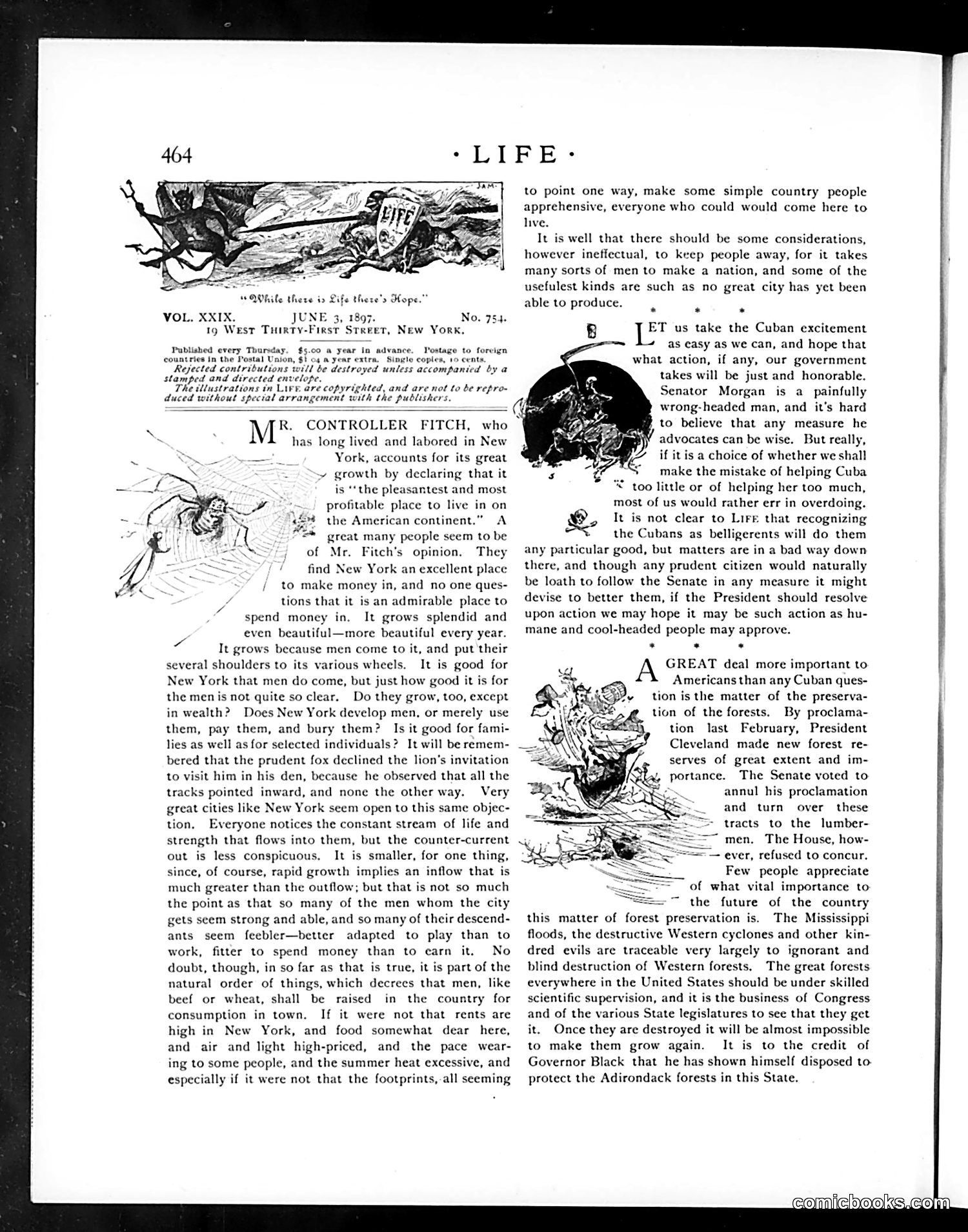
The page contains two distinct editorial sections: **Left Column:** Discusses Mr. Controller Fitch's views on New York City's growth and desirability as a place to live and work, despite high rents and summer heat. The accompanying sketch appears to be a humorous illustration of urban life or congestion. **Right Column:** Addresses Cuban independence and American foreign policy. The text criticizes Senator Morgan as "painfully wrong-headed" regarding U.S. intervention in Cuba, suggesting Americans should help Cuba judiciously but not excessively. It also praises forest preservation efforts, particularly Governor Black's protection of Adirondack forests, arguing that forest destruction causes floods and cyclones—a conservation issue deemed vital to America's future. The cartoon illustrations support these editorials with satirical commentary on urban and political themes of the 1890s.
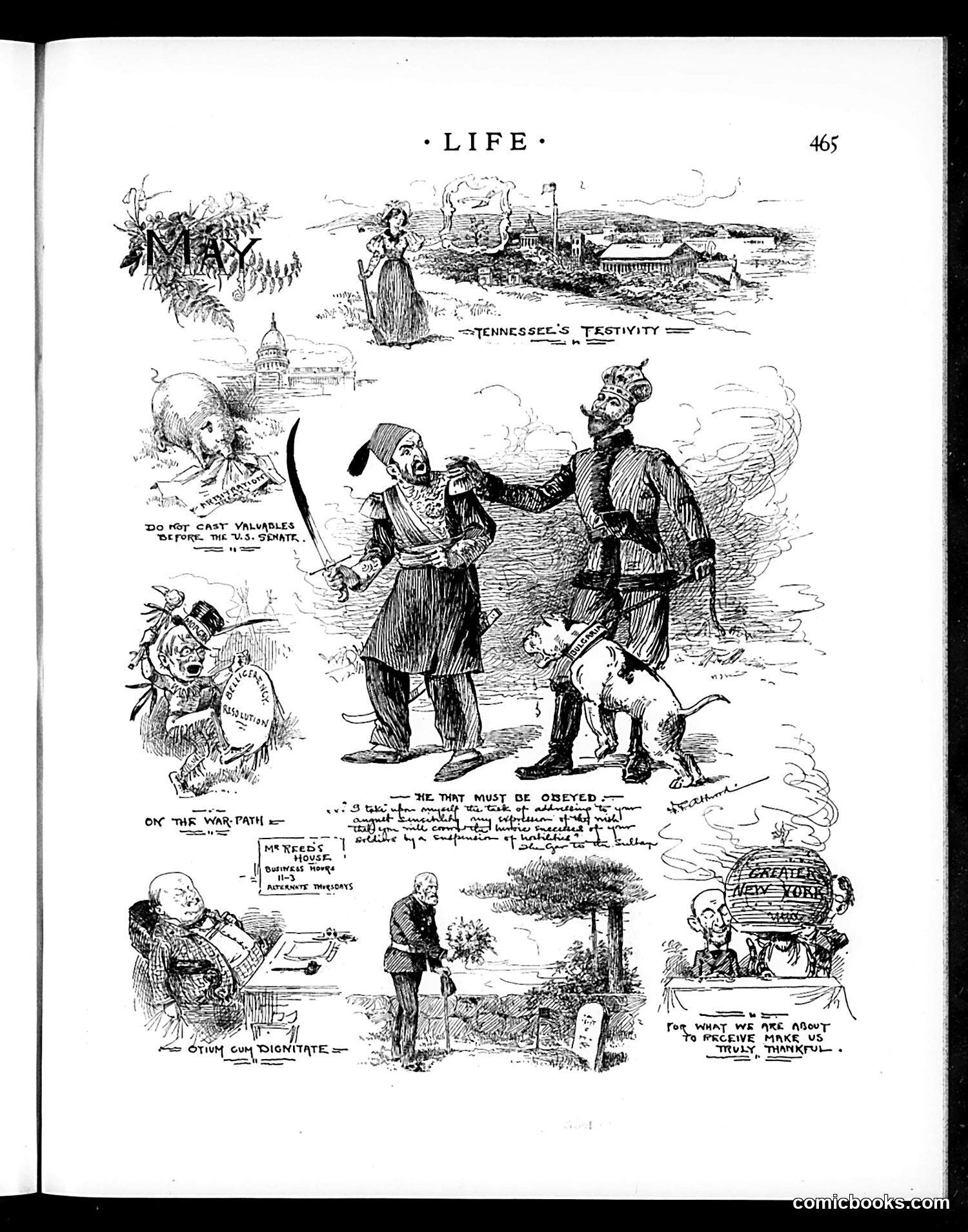
This page contains several interconnected satirical cartoons commenting on American politics and society, likely from the early 20th century. The central panel titled "He That Must Be Obeyed" depicts military figures (appearing to represent authoritarian leadership) with a small dog, suggesting concerns about militarism or autocratic control. Other panels reference "Tennessee's Testivity" (possibly mocking Tennessee politics), "On the War Path" (military aggression), and "Other Gun Dignitate" (Latin phrase suggesting pompous authority). The bottom right panel references something "we are about to receive" with a "grateful nation" reference, likely satirizing political hypocrisy or false patriotism. The cartoons collectively critique military overreach, political pretension, and the gap between official rhetoric and actual public benefit. The caricature style and exaggerated features were typical of early-20th-century American political satire.
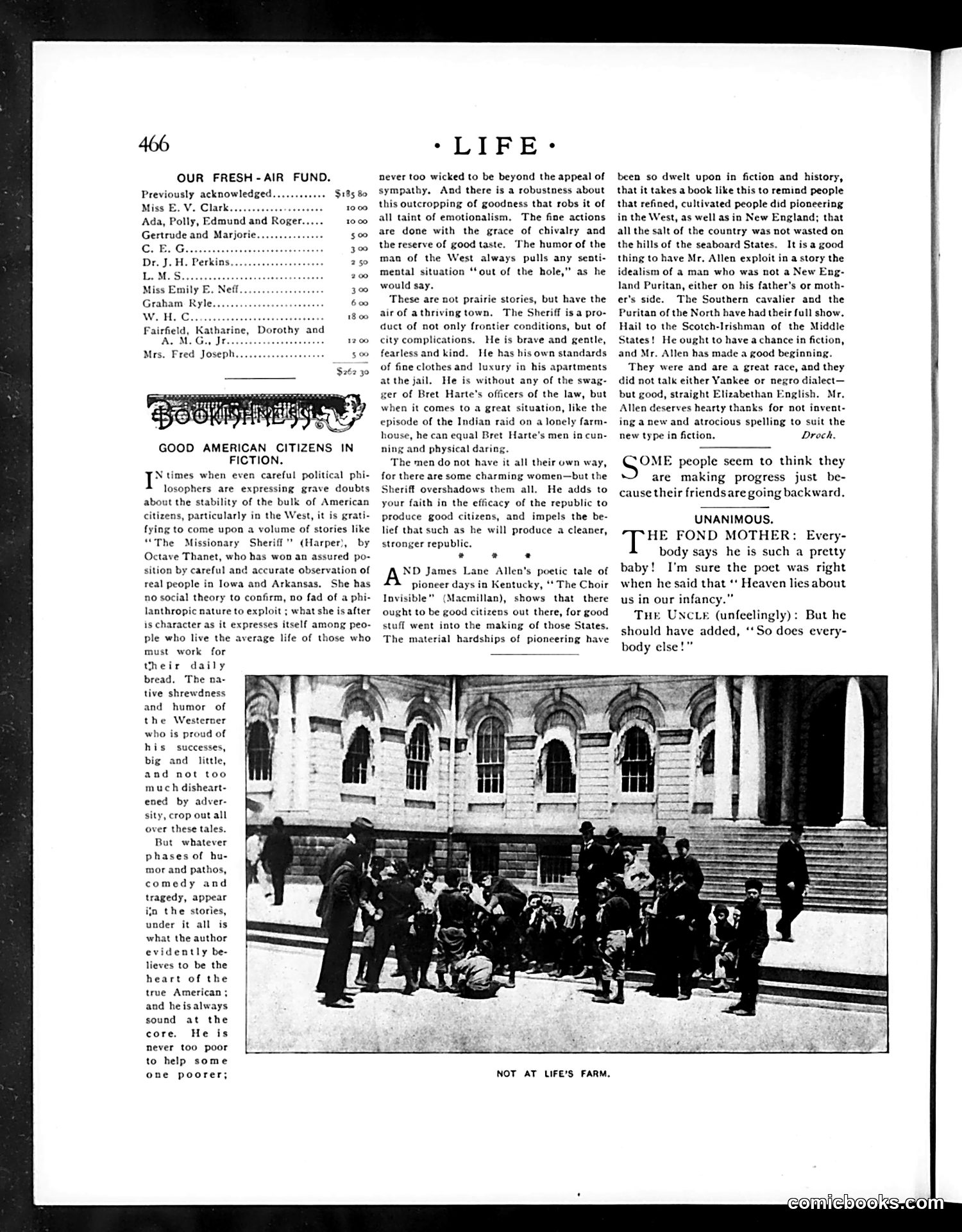
This page contains **book reviews** rather than political cartoons. The main content discusses American fiction promoting good citizenship, specifically praising *The Missionary Sheriff* by Outing Thane and *The Cities Invisible* by James Lane Allen. The photograph labeled "NOT AT LIFE'S FARM" shows a group of people gathered outside a classical building. Without additional context identifying the specific individuals or location, I cannot determine what particular event or satire this image illustrates. The page also lists contributors to "OUR FRESH-AIR FUND," indicating a philanthropic initiative, likely providing outdoor experiences for underprivileged urban children—a common Progressive-era social reform effort. The content emphasizes literature's role in shaping American character and civic virtue.
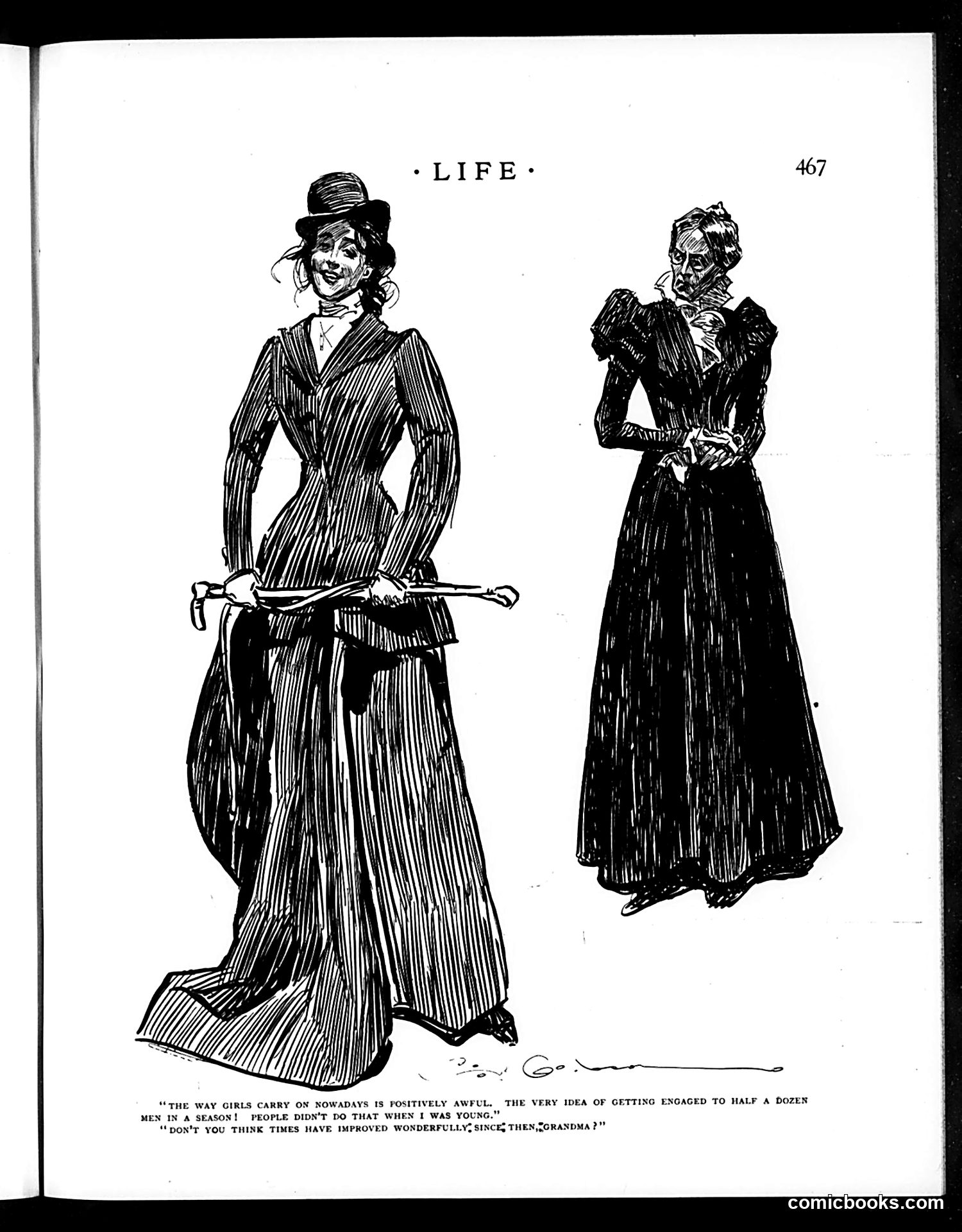
This page presents a single illustration with accompanying dialogue, appearing to satirize changing social attitudes toward courtship and engagement. The cartoon depicts two women in Edwardian-era dress. The left figure, wearing a striped dress and hat, holds a riding crop and appears animated or exasperated. The right figure stands more formally in dark clothing. The quoted dialogue critiques modern dating practices: the speaker (likely an older woman, possibly "Grandma" based on the text) complains that contemporary girls' behavior regarding engagements is "positively awful," contrasting it with her youth when women "didn't do that." She then asks if times have improved since then. The satire targets generational anxiety about changing courtship norms—specifically, women's increasingly active role in romantic pursuits and engagement decisions, which older generations viewed as improper. The illustration mocks both the older woman's nostalgia and implicit disapproval of female independence.
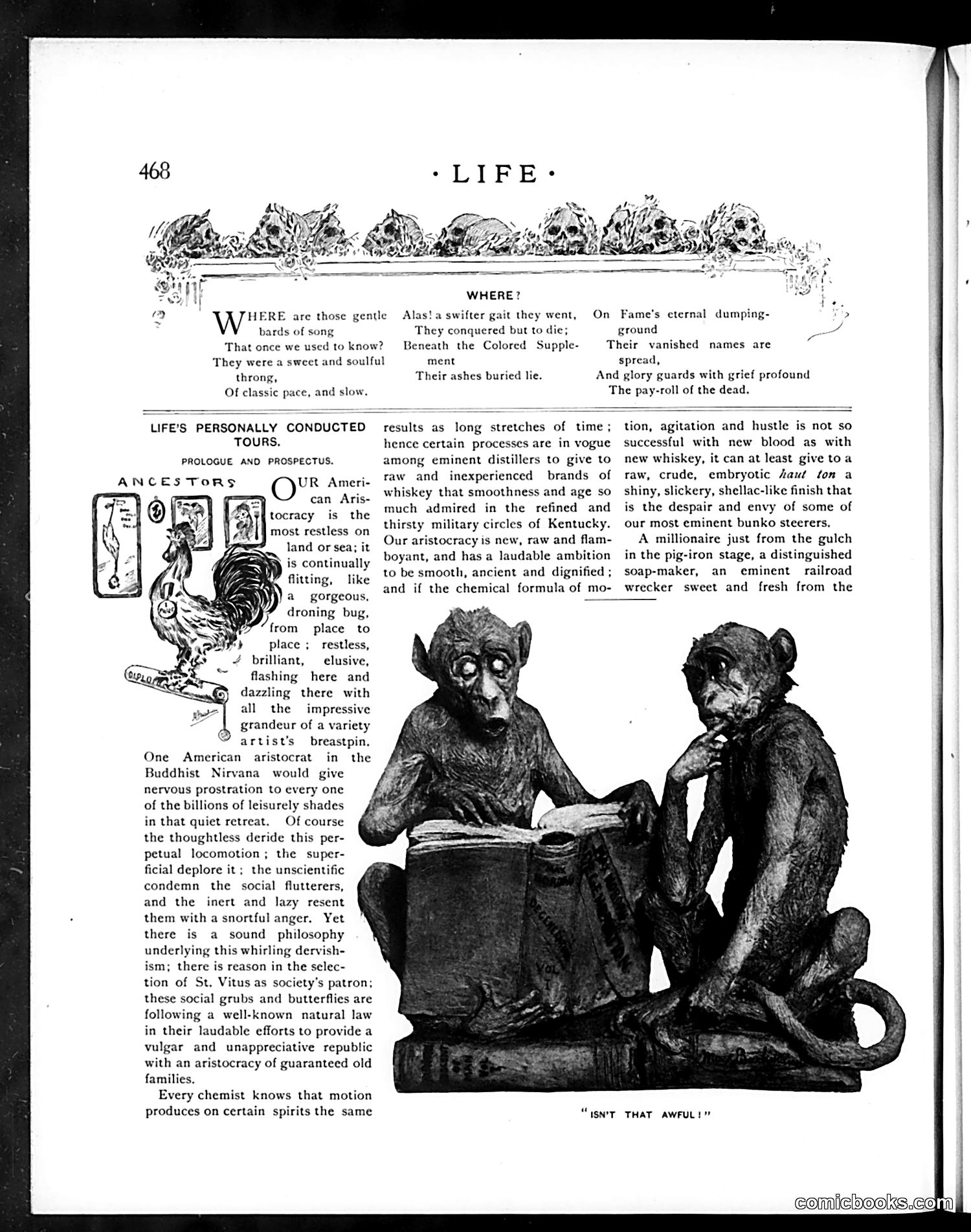
This page satirizes American wealth and aristocratic pretension. The decorative header depicts skulls, establishing a memento mori theme about mortality and vanity. The main text mocks newly rich American industrialists ("Our aristocracy is new, raw and flamboyant") who mimic European refinement. It criticizes their conspicuous consumption—specifically whiskey aging and collecting—as hollow status-seeking. The illustration shows two ape-like caricatures examining documents, captioned "ISN'T THAT AWFUL!" This appears to reference the "Ancestors" section header (visible at left), likely satirizing how wealthy Americans fabricate genealogies to claim old-money legitimacy. The comparison to primates emphasizes their perceived lack of breeding or genuine cultural sophistication. The satire targets the gap between Americans' actual social origins and their aspirations to established gentility.
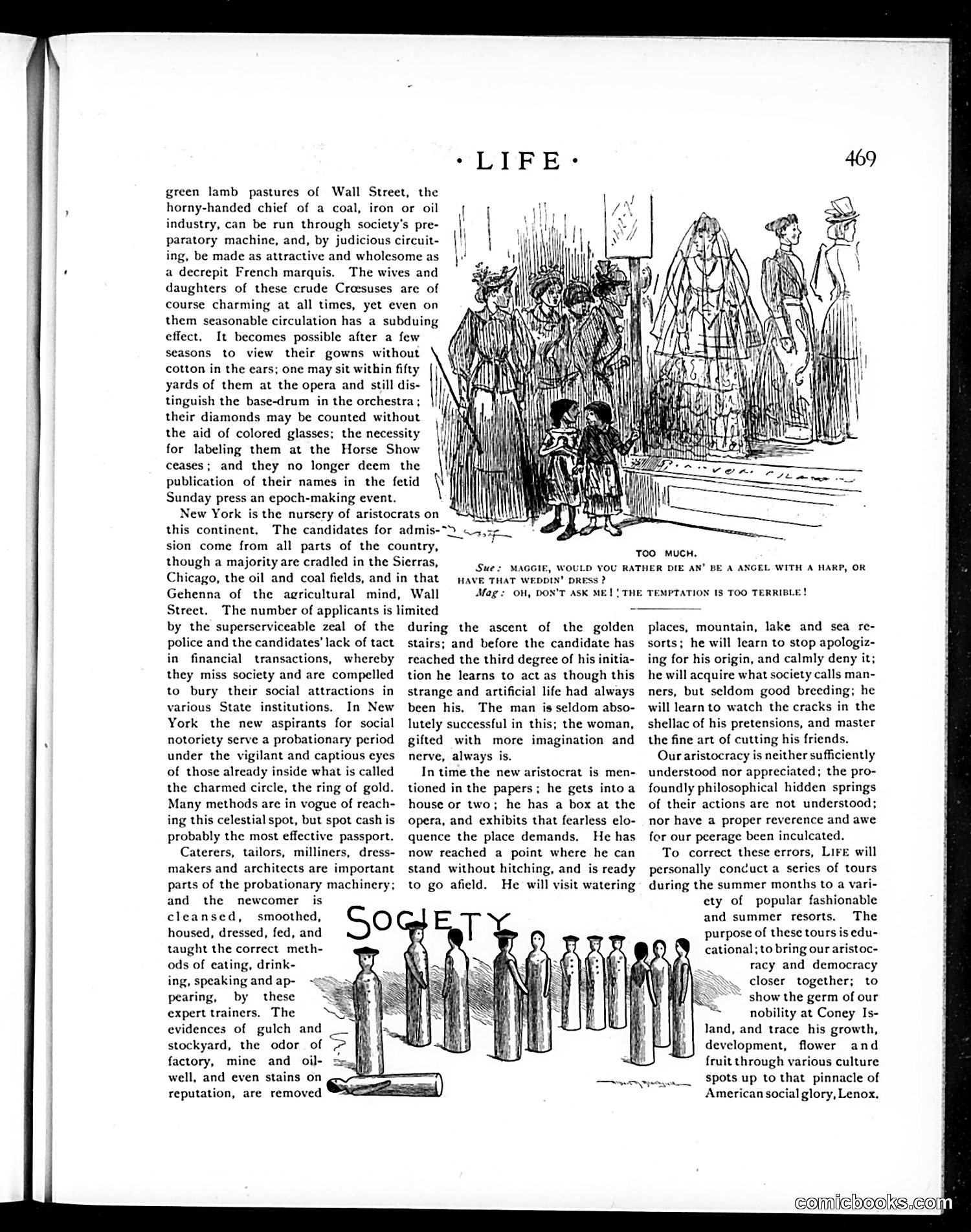
This cartoon satirizes the pretensions of New York's newly wealthy industrial class ("Cresuses") attempting to enter high society. The caption dialogue between "Sue" and "Mag" concerns whether to wear an angel costume with a harp or a wedding dress to an event—a joke about the absurd, ostentatious displays expected at aristocratic gatherings. The accompanying text mocks how coal, oil, and railroad magnates from rough backgrounds try to become "refined" through society's preparatory machinery: hiring etiquette coaches, acquiring diamonds, and performing at charitable events. The satire targets both the nouveaux riches' desperate social climbing and established society's superficial acceptance of them for their wealth rather than actual breeding or genuine culture.
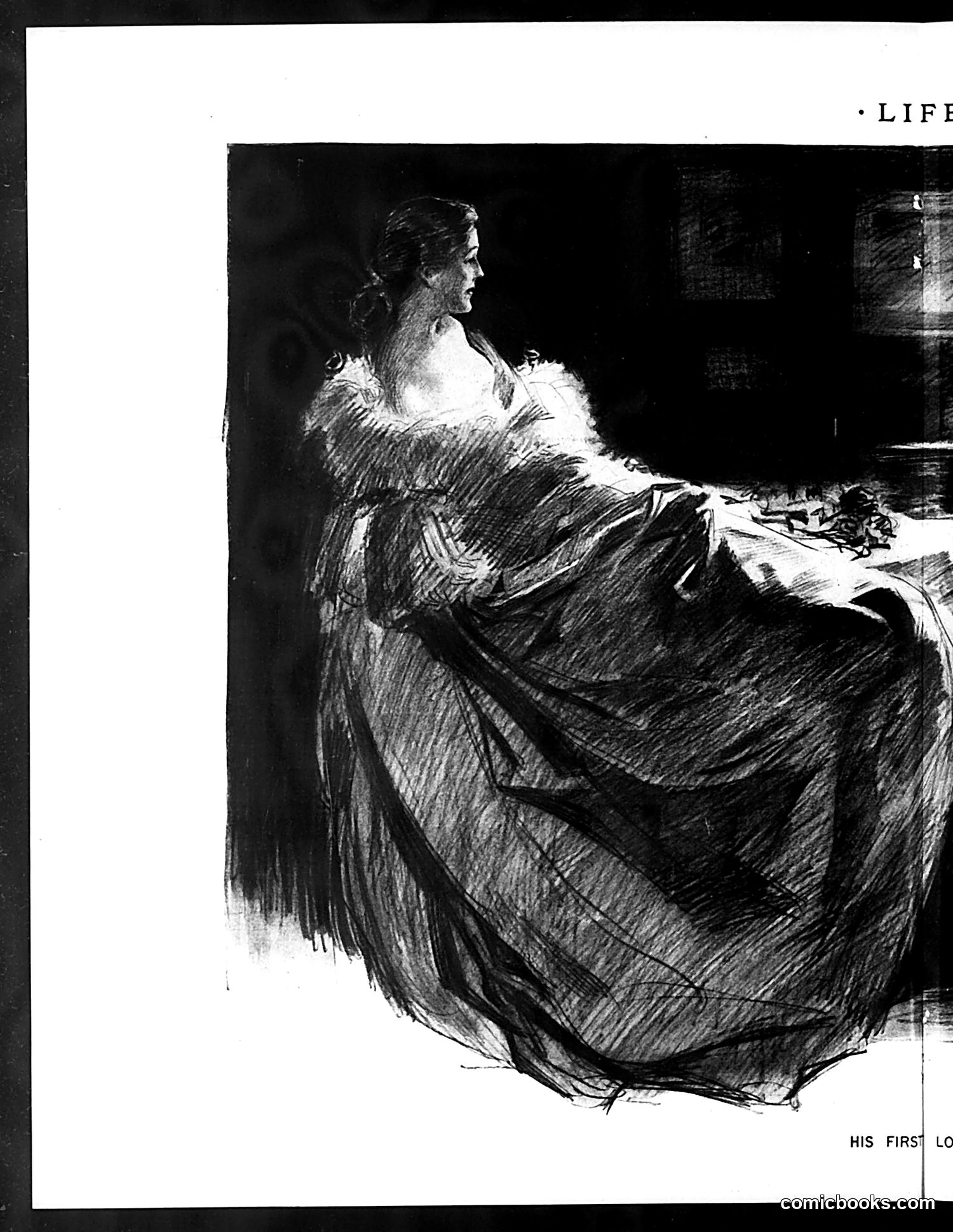
This appears to be an illustration from *Life* magazine showing a woman in an elaborate, flowing dark gown seated at what looks like a writing desk. The partial caption at bottom reads "HIS FIRST LO[VE]" (likely "His First Love"), suggesting this is romantic or biographical commentary. The sketch-style artwork emphasizes the woman's elegant posture and elaborate Victorian or Edwardian-era clothing with distinctive ruffled details. The "LIFE" masthead confirms the magazine's satirical context. Without the complete caption or date, the specific identity and satirical point remain unclear. The image likely comments on a notable figure's romantic history or relationship, typical of *Life*'s celebrity-focused humor, but I cannot definitively identify who is depicted or what social/political commentary is intended.
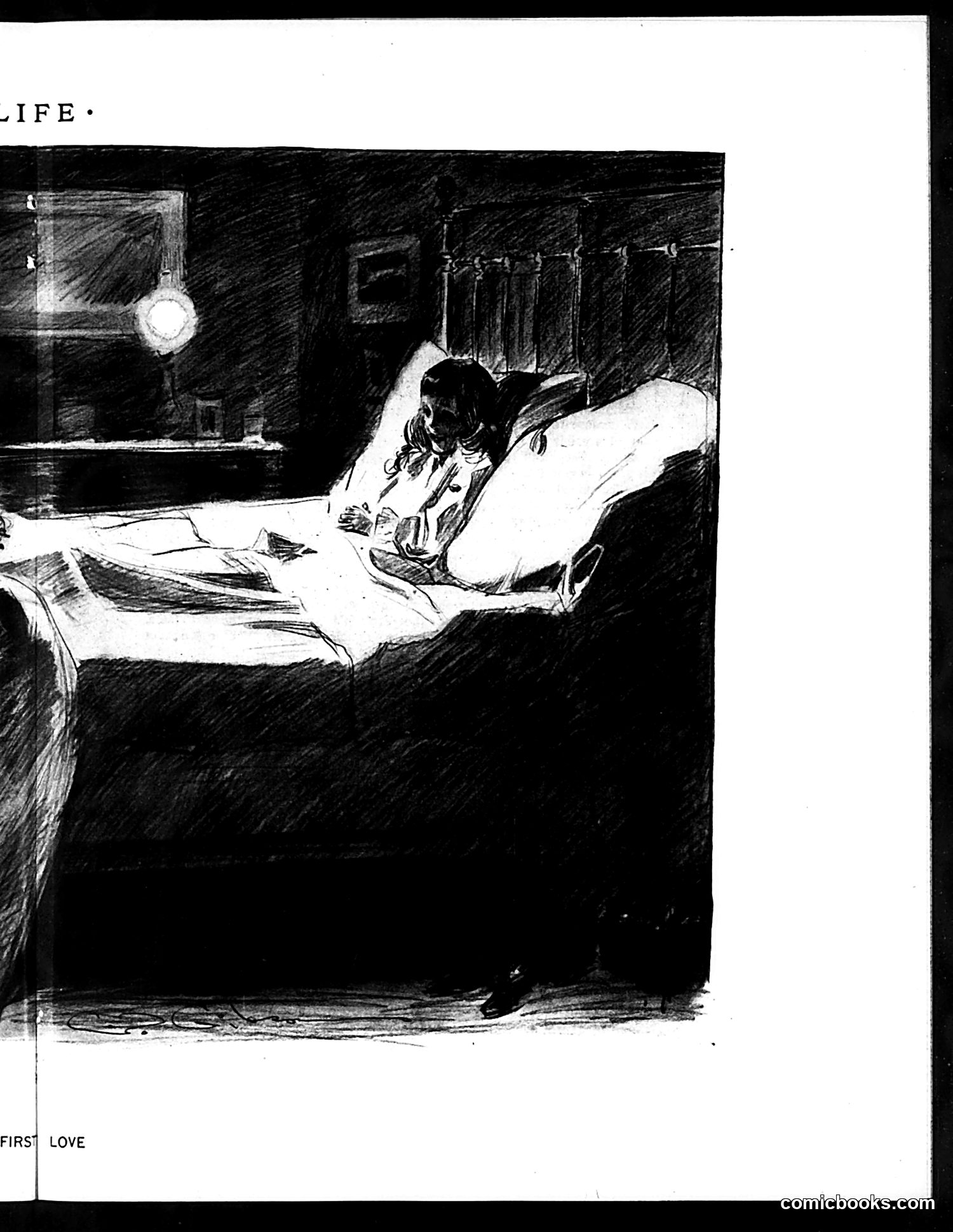
This appears to be an illustration from *Life* magazine depicting a intimate domestic scene. A figure in bed is reading by lamplight while reclining against pillows. The sketch style and title "First Love" suggest this is illustrating a romantic or sentimental narrative about early courtship or marriage. Without additional context from the magazine's text or surrounding material, the specific satirical or social commentary intent remains unclear. The image could be commenting on domestic life, romantic idealization, or literary themes popular to the era, but the exact target of satire—if any—is not evident from the image alone. The artistic rendering emphasizes the quiet, intimate moment rather than obvious caricature or political reference.
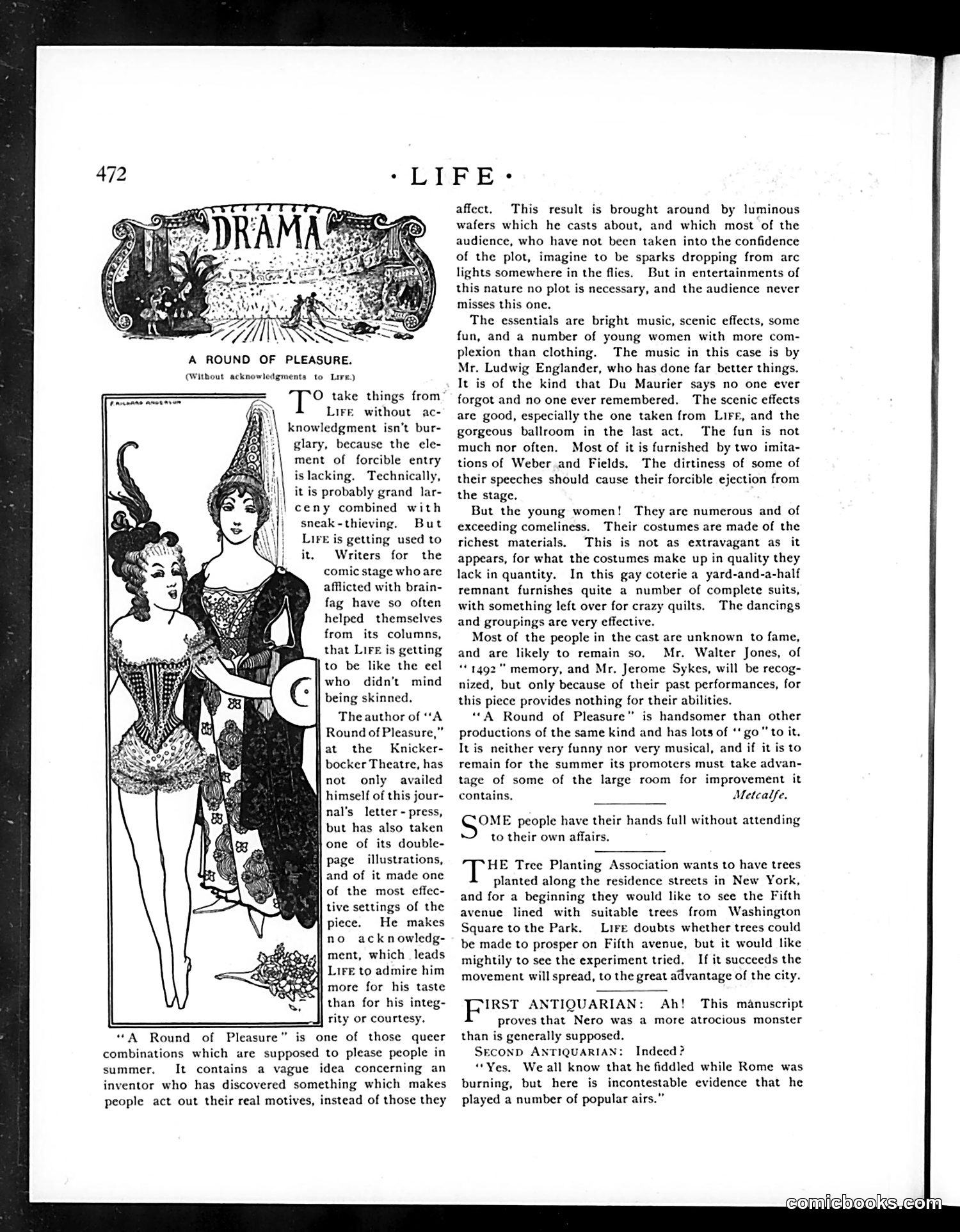
This page reviews "A Round of Pleasure," a theatrical production at the Knickerbocker Theatre. The illustration depicts a woman in elaborate costume with ornate decorative elements, typical of early 20th-century stage design. The review criticizes the play as lightweight entertainment—a "vague idea concerning an inventor" designed to distract audiences from real concerns by featuring spectacle over substance. The critic acknowledges the production's technical merits (music, scenic effects, costumes on young women) while dismissing its artistic value and humor. The text suggests the play exemplifies frivolous summer entertainment that prioritizes visual spectacle and physical attractiveness of performers over genuine wit or meaningful content—satirizing both the production and audiences willing to accept such shallow theatrical fare.
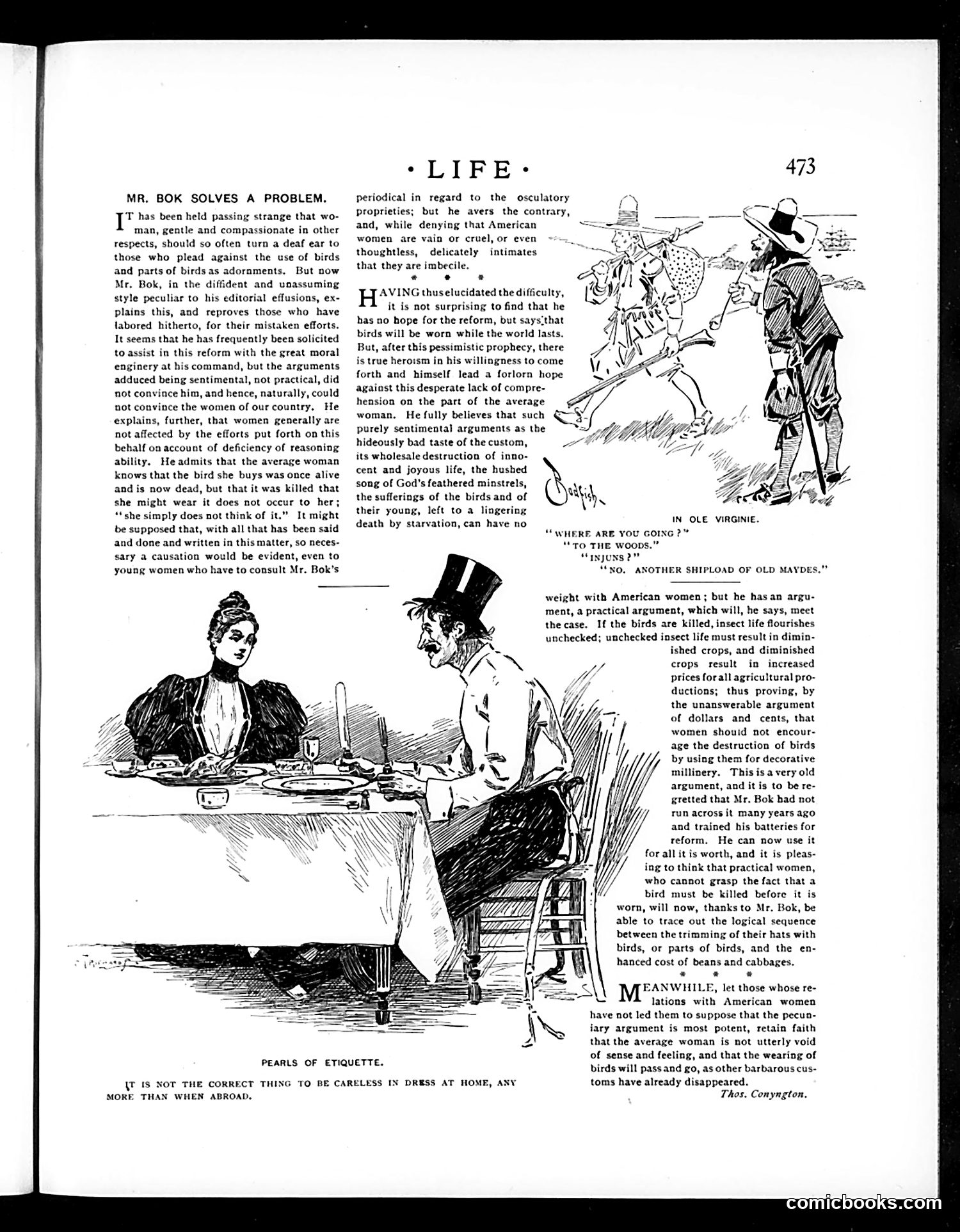
This page satirizes **Edward Bok**, editor of *The Ladies' Home Journal*, who opposed women wearing bird feathers in hats. The satire mocks Bok's condescending approach to reform. **The setup:** Bok argued that sentimental pleas (birds suffer, die, lose their songs) fail because women lack reasoning ability. He claims women literally don't *think* about killed birds—they're essentially "imbecile." **The joke:** Bok then proposes his "practical argument": killing birds increases insects, which destroys crops, raising food prices. Only this economic logic, he believes, will persuade women. **The satire's point:** The author ridicules Bok's insulting assumption that women can't grasp obvious moral arguments but *can* follow economic cause-and-effect. The cartoons ("Pearls of Etiquette," the dining scene) further mock genteel society's superficiality. The lower illustration captioned "In Ole Virginie" appears to mock outdated Southern romanticism, reinforcing themes about fashion and frivolous values.
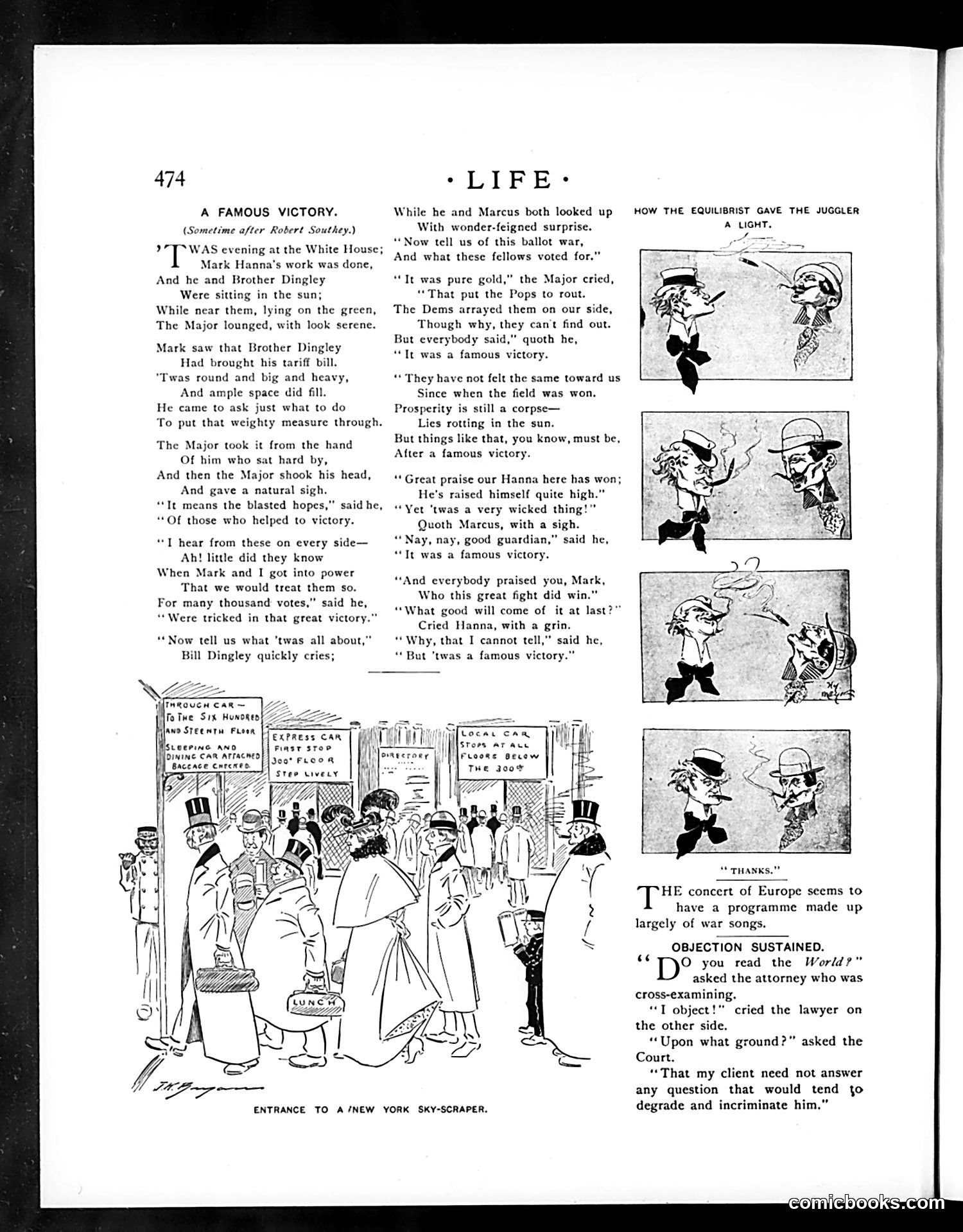
This page satirizes the Republican victory of 1896 (McKinley's election) and its aftermath. The poem "A Famous Victory" parodies Robert Southey's "The Battle of Blenheim," mocking how Republicans—particularly **Mark Hanna** (McKinley's campaign manager) and **Nelson Dingley** (tariff advocate)—won through political manipulation yet failed to deliver promised prosperity. The satire's point: despite their "famous victory," the Republicans made backroom deals with Democrats, betrayed voters who expected economic benefits, and prosperity remained elusive. The repeated refrain "famous victory" becomes increasingly ironic—what seemed glorious was hollow and compromised. The comic strips on the right humorously depict acrobatic performers ("equilibrist" and "juggler"), possibly representing the political balancing act required to maintain their coalition. The bottom item mocks newspaper cross-examination tactics, unrelated to the main political content.
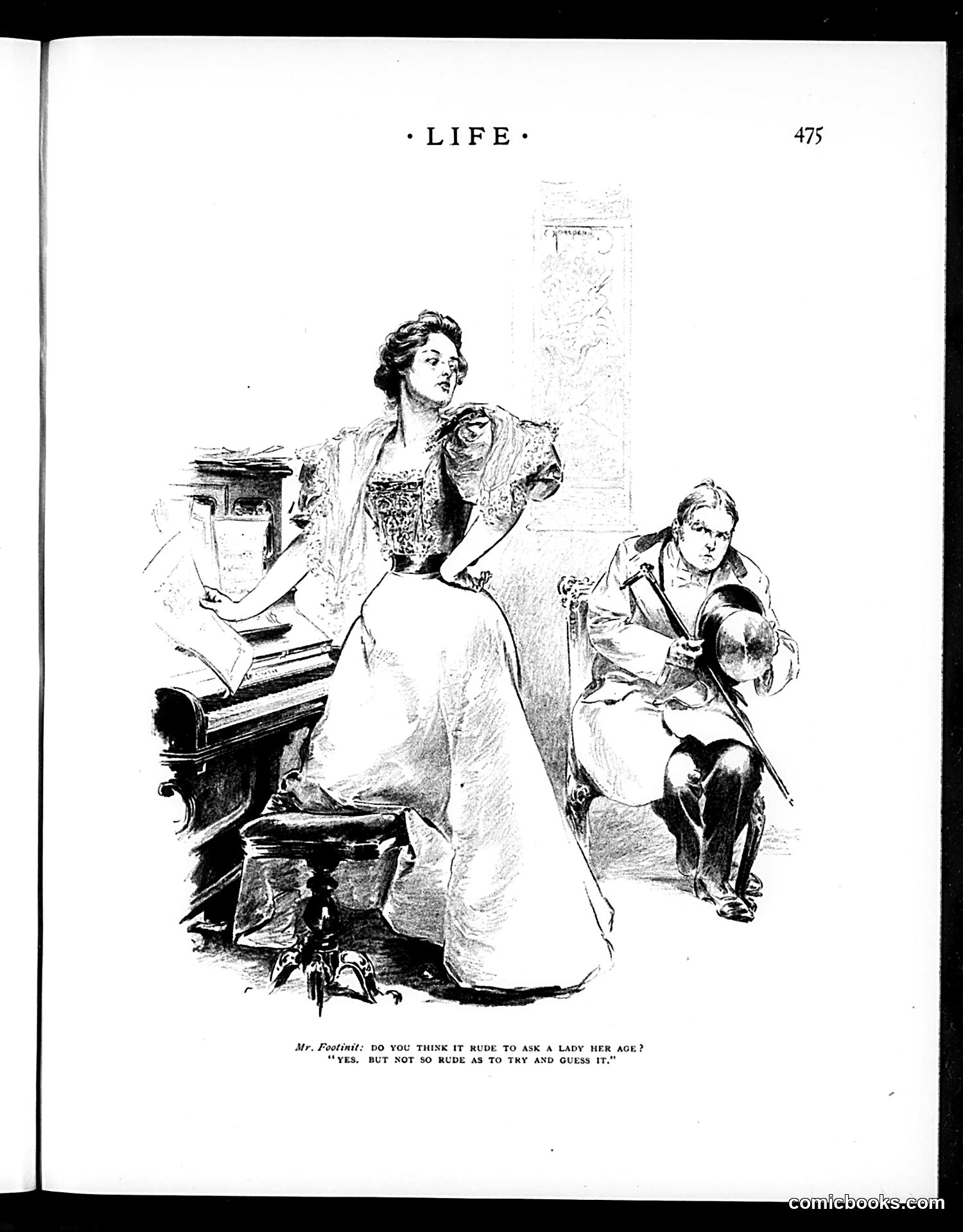
This is a single-panel joke cartoon from *Life* magazine (page 475). A man identified as "Mr. Footinit" asks whether it's rude to inquire about a lady's age. Her response—that guessing is *more* rude than asking—is a witty reversal. The humor relies on a social convention: asking a woman's age was considered impolite etiquette. However, the lady's comeback suggests that *attempting to guess* her age is even worse, as it implies she looks older than she might actually be. This plays on period anxieties about female aging and vanity, while celebrating the woman's sharp wit in deflating the man's presumption. The cartoon satirizes social pretension and male awkwardness around gender relations.
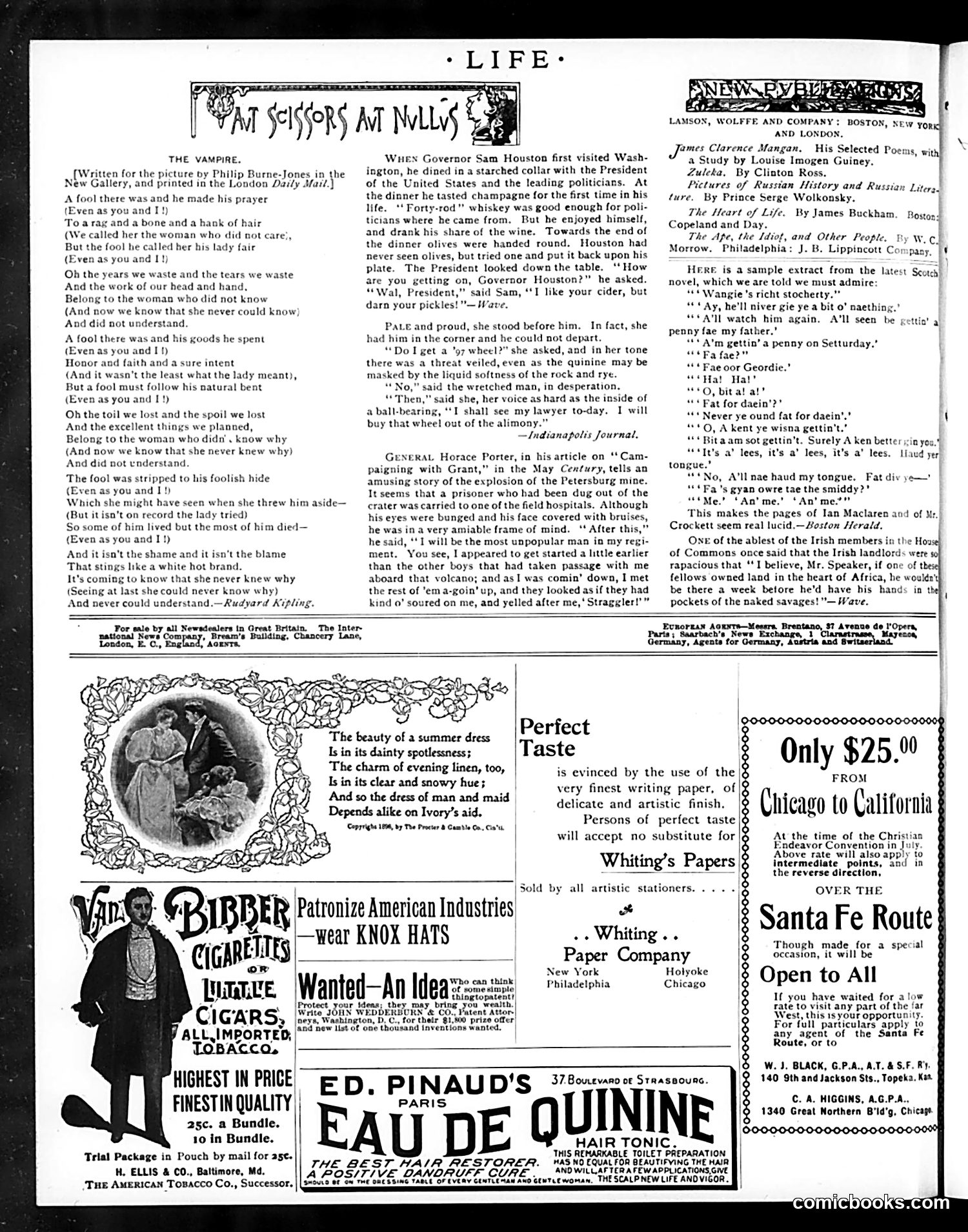
This page contains **primarily advertising and literary content** rather than political cartoons. The main literary piece is "The Vampire," a poem by Philip Burne-Jones (credited as written for a New Gallery picture), depicting a cautionary tale about male foolishness. The poem uses repetitive structure to warn men about wasting resources and life pursuing indifferent women who "did not care" and "did not understand." It's a morality tale about romantic self-destruction. Below are two anecdotes: one about Governor Sam Houston's unfamiliarity with olives (humorously mistaking them for pickles), and a Civil War story about a soldier who was blown out of a crater during the Petersburg mine explosion. The remainder consists of **period advertisements** for writing paper, the Santa Fe Route railway, hair tonic, Knox Hats, and tobacco products—typical turn-of-the-century marketing with no satirical content visible.
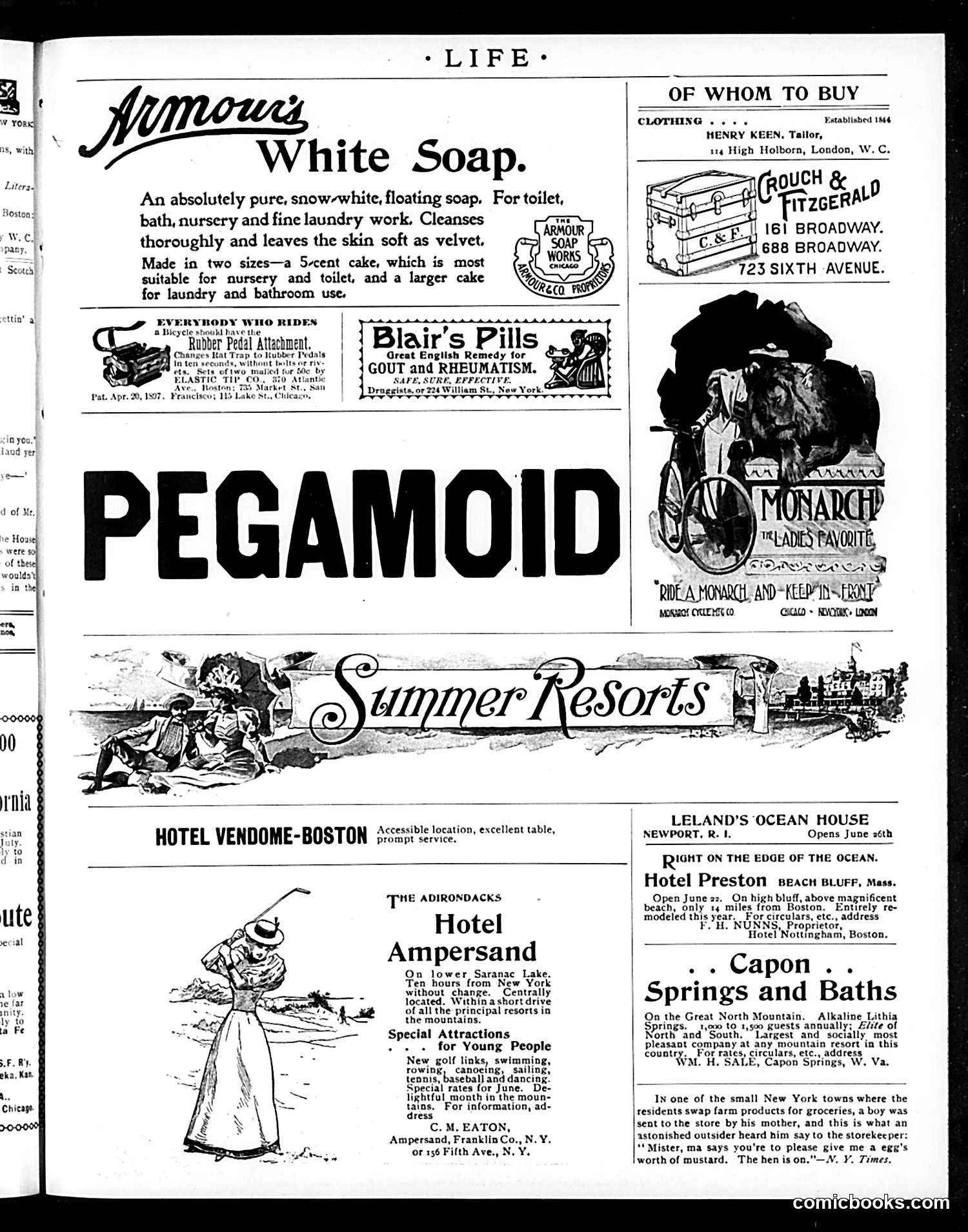
This is primarily a **commercial advertising page** with no political cartoon. The content consists of product advertisements and resort promotions typical of early 1900s Life magazine. Notable ads include: - **Armour's White Soap** (top): A pure, floating soap marketed for toilets, nurseries, and laundry - **Blair's Pills**: A patent medicine claiming to treat gout and rheumatism - **Pegamoid**: A large advertisement (product unclear from context) - **Summer Resorts section**: Multiple luxury hotel promotions (Hotel Vendome-Boston, Hotel Ampersand in the Adirondacks, Capon Springs) At bottom is a brief humorous anecdote about a rural New York boy asking a shopkeeper for "a egg's worth of mustard," satirizing rural barter economies where farm products substituted for currency—a mild social commentary on economic disparity between urban and rural America. The page reflects turn-of-century consumer culture and leisure marketing to affluent readers.
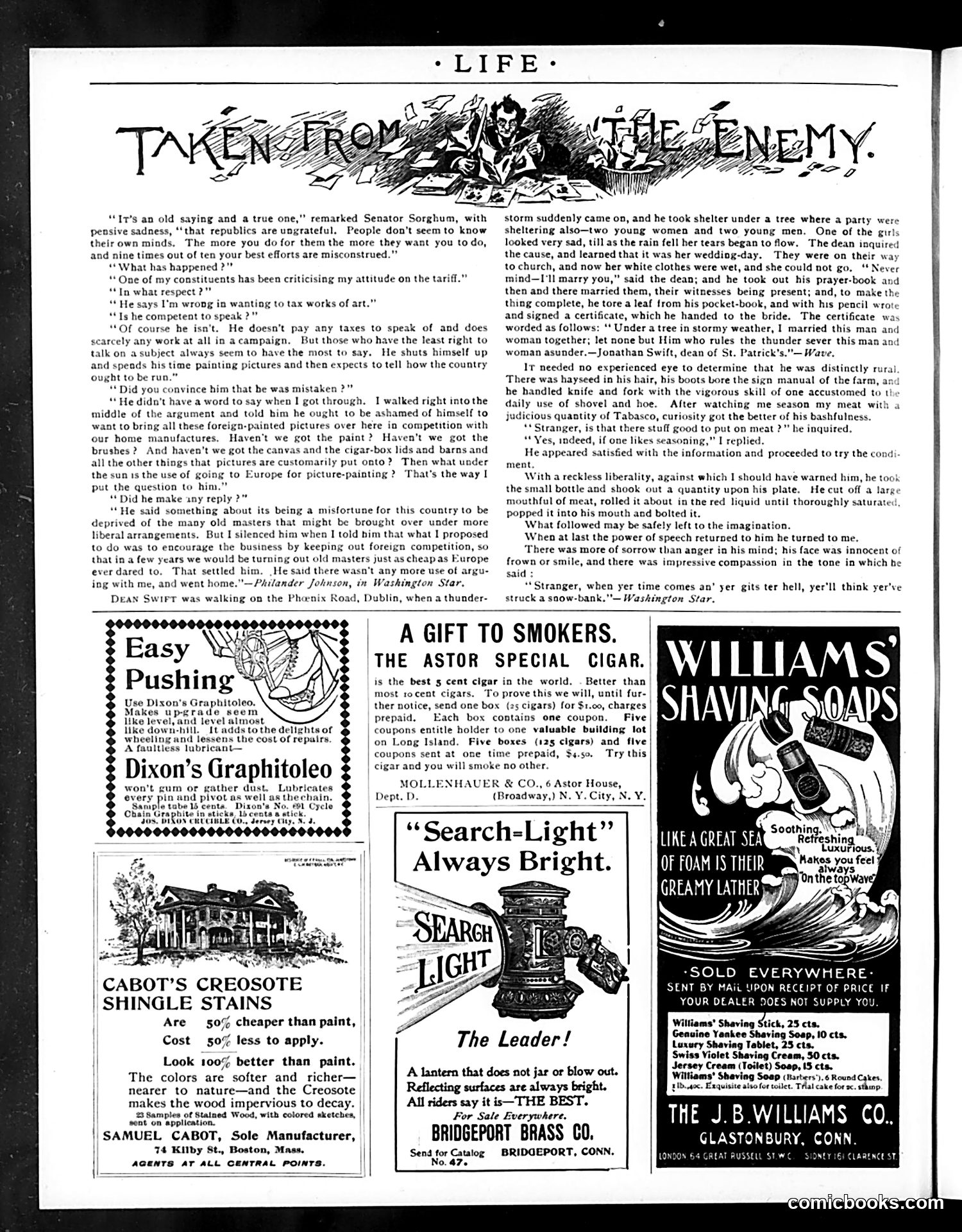
This page features a satirical dialogue between "Senator Sorghum" and an unnamed interlocutor, attacking protectionist trade policy—specifically tariffs on imported artworks. **The satire targets:** - A senator defending high tariffs on foreign paintings as "protection" for American artists - The absurdity of his argument: he claims America has paint, brushes, canvas, and barns, so why import European masters? - His self-satisfied certainty that he's silenced legitimate artistic and economic concerns through bluster rather than logic - The hypocrisy of claiming to help artists while actually impoverishing American culture through import restrictions **The political context:** This reflects real late-19th/early-20th century debates over protective tariffs. The author (Philander Johnson) uses the pompous senator character to mock protectionist politicians who wrapped economic self-interest in nationalist rhetoric, all while genuine cultural loss occurred. The remainder of the page contains anecdotes and period advertisements unrelated to the cartoon's political message.
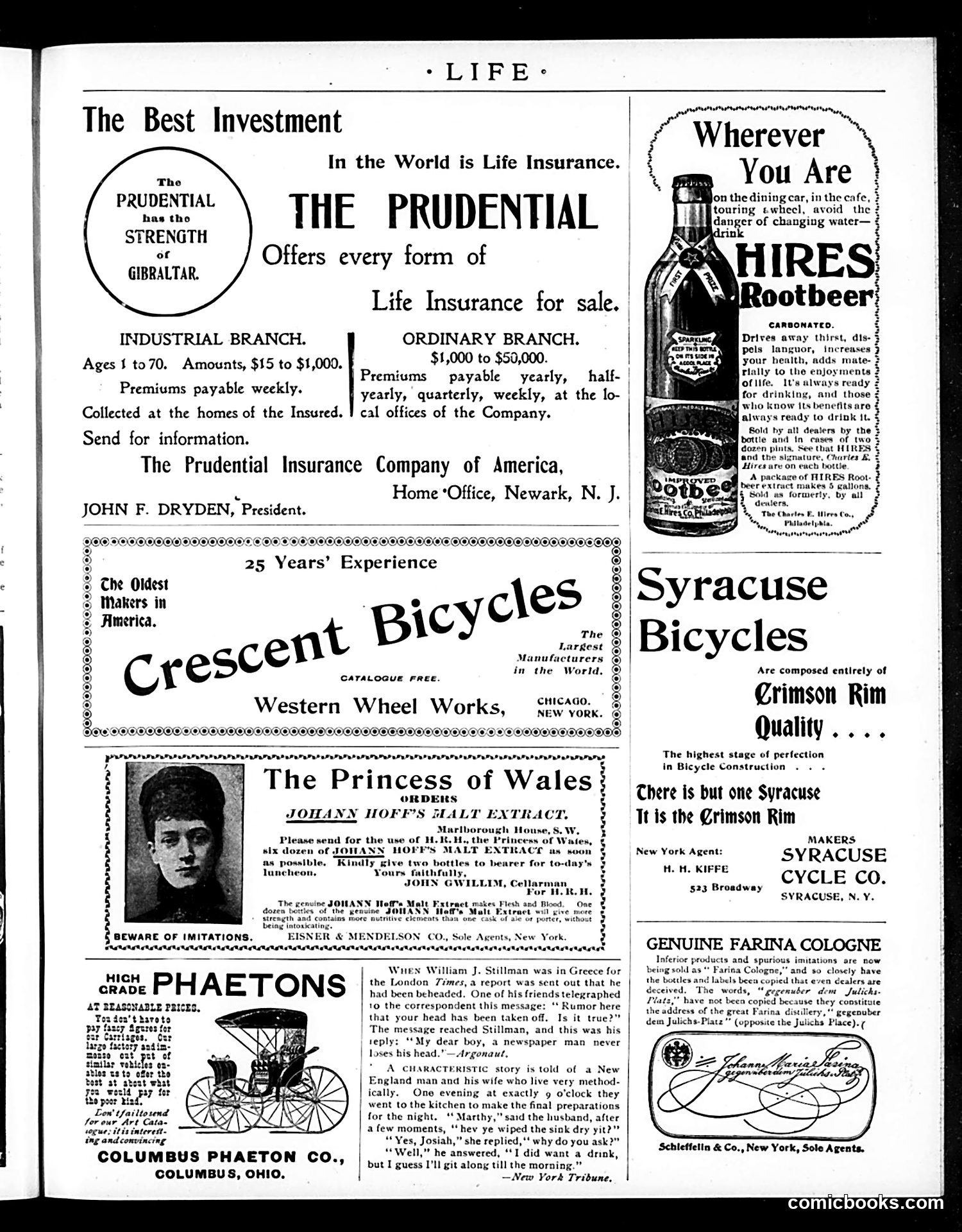
This is primarily an **advertising page**, not satirical content. It features six major product advertisements typical of late-19th/early-20th century America: **Key Ads:** - **Prudential Insurance**: Emphasizes financial security with the metaphor "strength of Gibraltar" - **Crescent & Syracuse Bicycles**: Competing bicycle manufacturers promoting quality and manufacturing scale - **Hires Rootbeer**: A carbonated beverage marketed for refreshment during travel - **Columbus Phaeton Co.**: Horse-drawn carriage manufacturer - **Farina Cologne**: Warns against counterfeit products **Notable Elements:** The page includes a brief anecdote about newspaper correspondent William J. Stillman and a humorous New England domestic story about a methodical couple—typical "filler" humor for the era. The **Princess of Wales** endorsement for Johann Hoff's Malt Extract represents celebrity advertising, lending aristocratic credibility to patent medicines. Overall, this reflects consumer culture and manufacturing pride of the industrial era, with no apparent political satire.
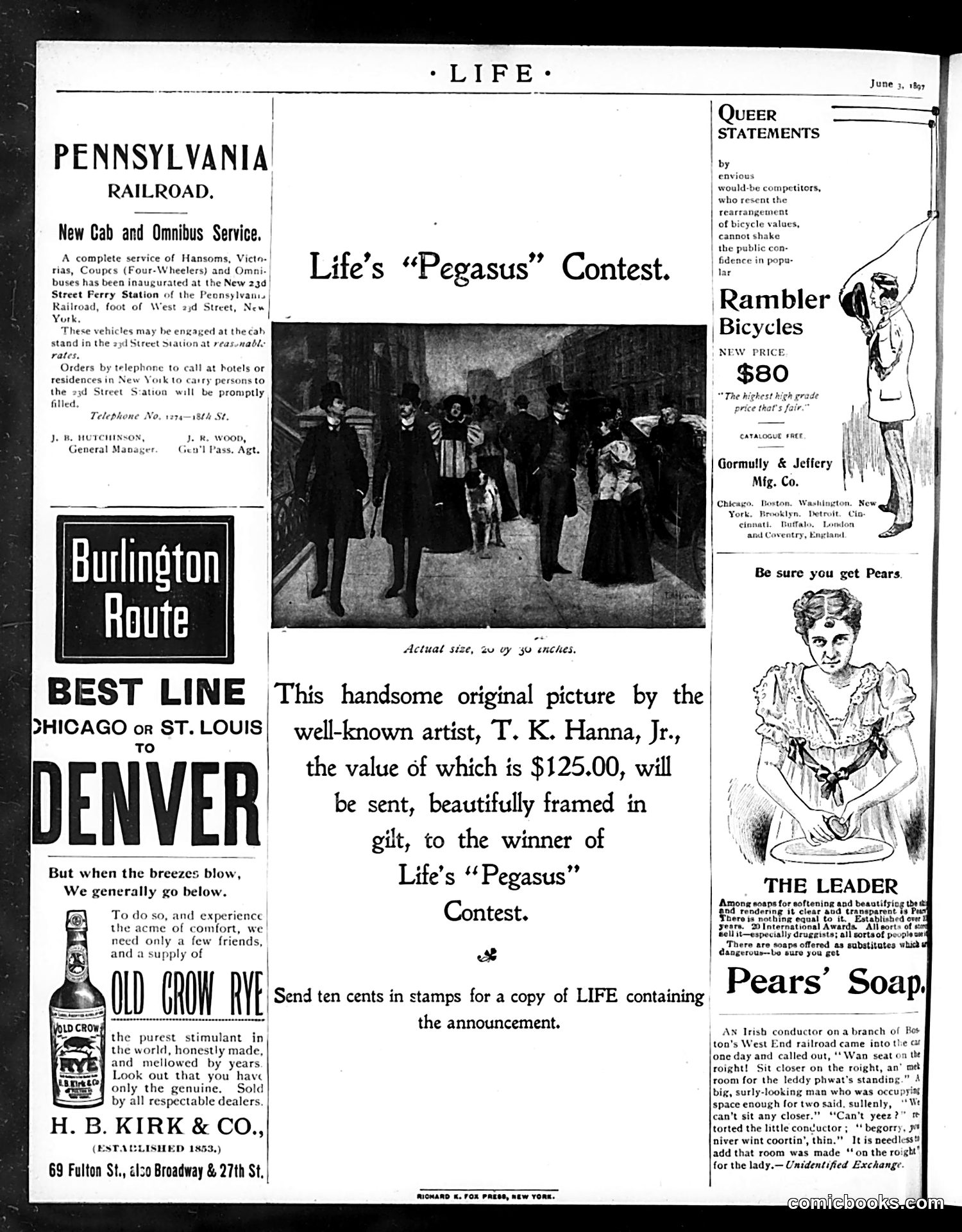
This page is primarily **advertising** with one central editorial feature: Life's "Pegasus" Contest. **The Contest:** Life magazine is promoting a giveaway of an original painting by artist T.K. Hanna Jr. (valued at $125) titled "Pegasus"—depicted in the center photograph as a classical winged horse sculpture surrounded by formally-dressed figures. Readers could enter by sending ten cents for an announcement copy. **The Advertisements** include: - Pennsylvania Railroad's new cab service - Burlington Route rail line to Denver - Old Crow Rye whiskey - Rambler Bicycles ($80, defending against "envious" competitors) - Pears' Soap (with an unrelated Irish joke about a railroad conductor) **Context for Modern Readers:** This reflects the 1890s advertising model where magazines subsidized content through extensive ads. The "Pegasus" contest—offering classical fine art—positioned *Life* as a sophisticated publication for educated readers, distinguishing it from cheaper competitor magazines.