
Life, 1897-06-03 · page 6 of 20
Life — June 3, 1897 — page 6: what you’re looking at
What you’re looking at
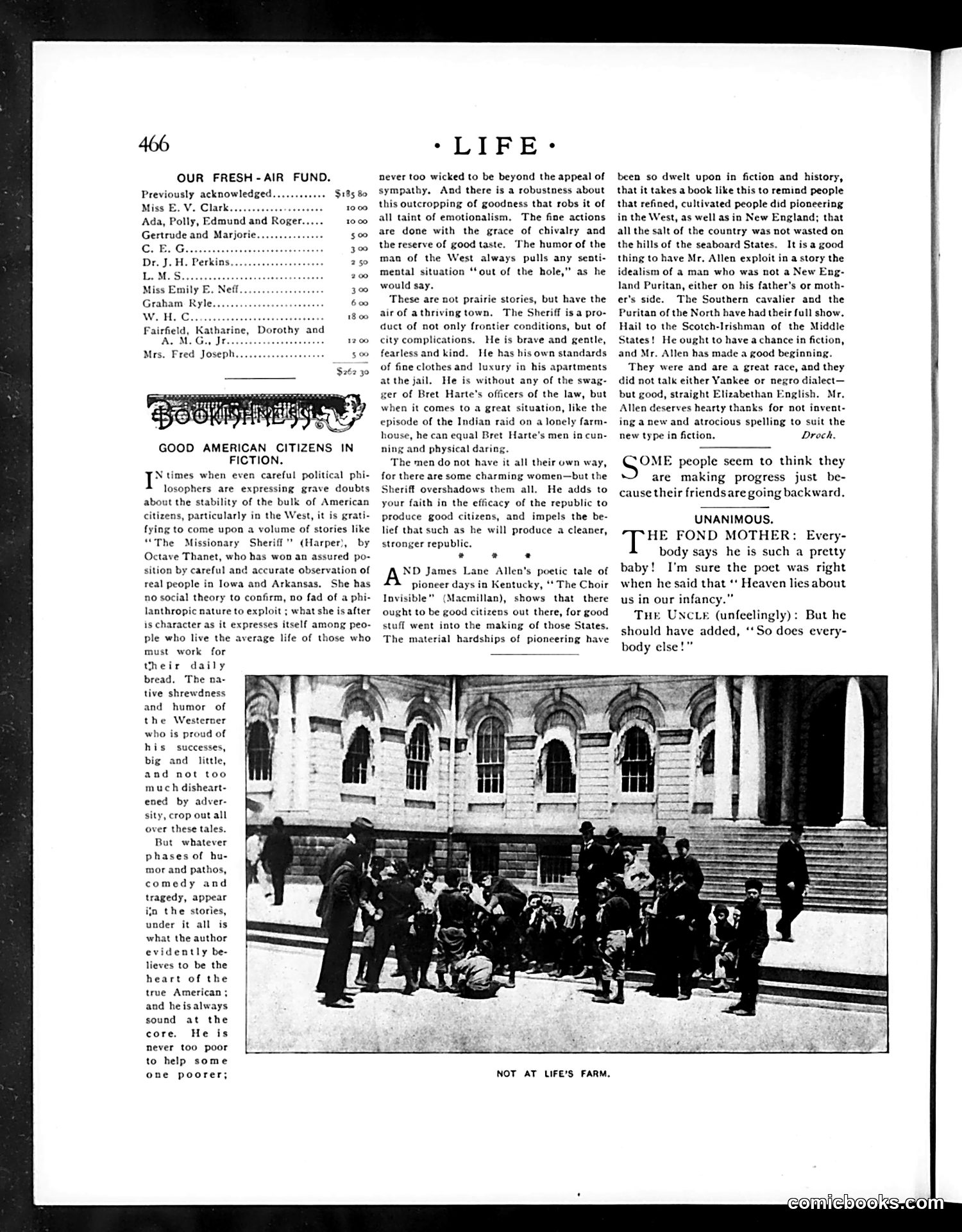
This page contains **book reviews** rather than political cartoons. The main content discusses American fiction promoting good citizenship, specifically praising *The Missionary Sheriff* by Outing Thane and *The Cities Invisible* by James Lane Allen. The photograph labeled "NOT AT LIFE'S FARM" shows a group of people gathered outside a classical building. Without additional context identifying the specific individuals or location, I cannot determine what particular event or satire this image illustrates. The page also lists contributors to "OUR FRESH-AIR FUND," indicating a philanthropic initiative, likely providing outdoor experiences for underprivileged urban children—a common Progressive-era social reform effort. The content emphasizes literature's role in shaping American character and civic virtue.
📄 Transcribed text from this page (OCR, searchable)
Machine-transcribed from the original scan — historical spelling and the odd misread are preserved.
466 OUR FRESH -AIR FUND. Previously acknowledged Miss E. V. Clark Ada, Polly, Edmund and Roger. Gertrude and Marjorie. C.E.G Dr. J. H. Perkin: L.M.S Miss Emily E. Neff. Graham Ryle. W. H.C Fairfield, Katharine, A.M. Jr Mrs. Fred Joseph. $185 8 1000 1000 $00 300 250 200 300 600 18 00 Dorothy and GOOD AMERICAN CITIZENS FICTION. Ntimes when even careful political phi- losophers are expressing grave doubts about the stability of the bulk of American citizens, particularly in the West, it is grati- fying to come upon a volume of stories like The Missionary Sheriff’ (Harper), by Octave Thanet, who has won an assured po- sition by careful and accurate observation of real people in Iowa and Arkansas. She has no social theory to confirm, no fad of a phi- lanthropic nature to exploit ; what she is after is character as it expresses itself among peo- ple who live the average life of those who work for their daily bread. The na- tive shrewdness and humor of the Westerner who is proud of his successes, big and little, and not too much disheart- ened by adver- sity, crop out all over these tales. But whatever phases of hu- mor and pathos, comedy and tragedy, appear ijn the stories, under it all is what the author evidently be- lieves to be the heart of the true American; and heis always sound at the core. He is never too poor to help some one poorer; IN must * LIFE: never too wicked to be beyond the appeal of sympathy. And there is a robustness about this outcropping of goodness that robs it of all taint of emotionalism, The fine actions are done with the grace of chivalry and the reserve of good taste. The humor of the man of the West always pulls any senti- mental situation “out of the hole,” as he would say. ‘These are not prairie stories, but have the air of athriving town, The Sheriff isa pro- duct of not only frontier conditions, but of city complications. He is brave and gentle, fearless and kind. He has his own standards of fine clothes and luxury in his apartments at the jail. He is without any of the swag- ger of Bret Harte’s officers of the law, but when it comes to a great situation, like the episode of the Indian raid on a lonely farm- house, he can equal Bret Harte’s men in cun- ning and physical daring. ‘The men do not have it all their own way, for there are some charming women—but the Sheriff overshadows them all, He adds to your faith in the efficacy of the republic to produce good citizens, and impels the be- lief that such as he will produce a cleaner, stronger republic. * 2 @ ND James Lane Allen's poetic tale of pioneer days in Kentucky, * The Choir Invisible" (Macmillan), shows that there ought to be good citizens out there, for good stuff went into the making of those States. The material hardships of pioneering have AT LIFE’S FARM, been so dwelt upon in fiction and history, that it takes a book like this to remind people that refined, cultivated people did pioneering in the West, as well as in New England; that all the salt of the country was not wasted on the hills of the seaboard States. It is a good thing to have Mr, Allen exploit in a story the idealism of a man who was not a New Eng- land Puritan, either on his father's or moth- er’s side. The Southern cavalier and the Puritan of the North have had their full show. Hail to the Scotch-Irishman of the Middle States! He ought to have achance in fiction, and Mr. Allen has made a good beginning. They were and are a great race, and they did not talk either Yankee or negro dialect— but good, straight Elizabethan English. Mr. Allen deserves hearty thanks for not invent- ing a new and atrocious spelling to suit the new type in fiction, Droch. ~ OME people seem to think they are making progress just be- cause their friends are going backward. UNANIMOUS. HE FOND MOTHER: Every- body says he is such a pretty baby! I'm sure the poet was right when he said that ‘' Heaven lies about us in our infancy.” THE UNCLE (unfeelingly): But he should have added, ‘‘So does every- body else!”