
Life, 1897-06-03 · page 4 of 20
Life — June 3, 1897 — page 4: what you’re looking at
What you’re looking at
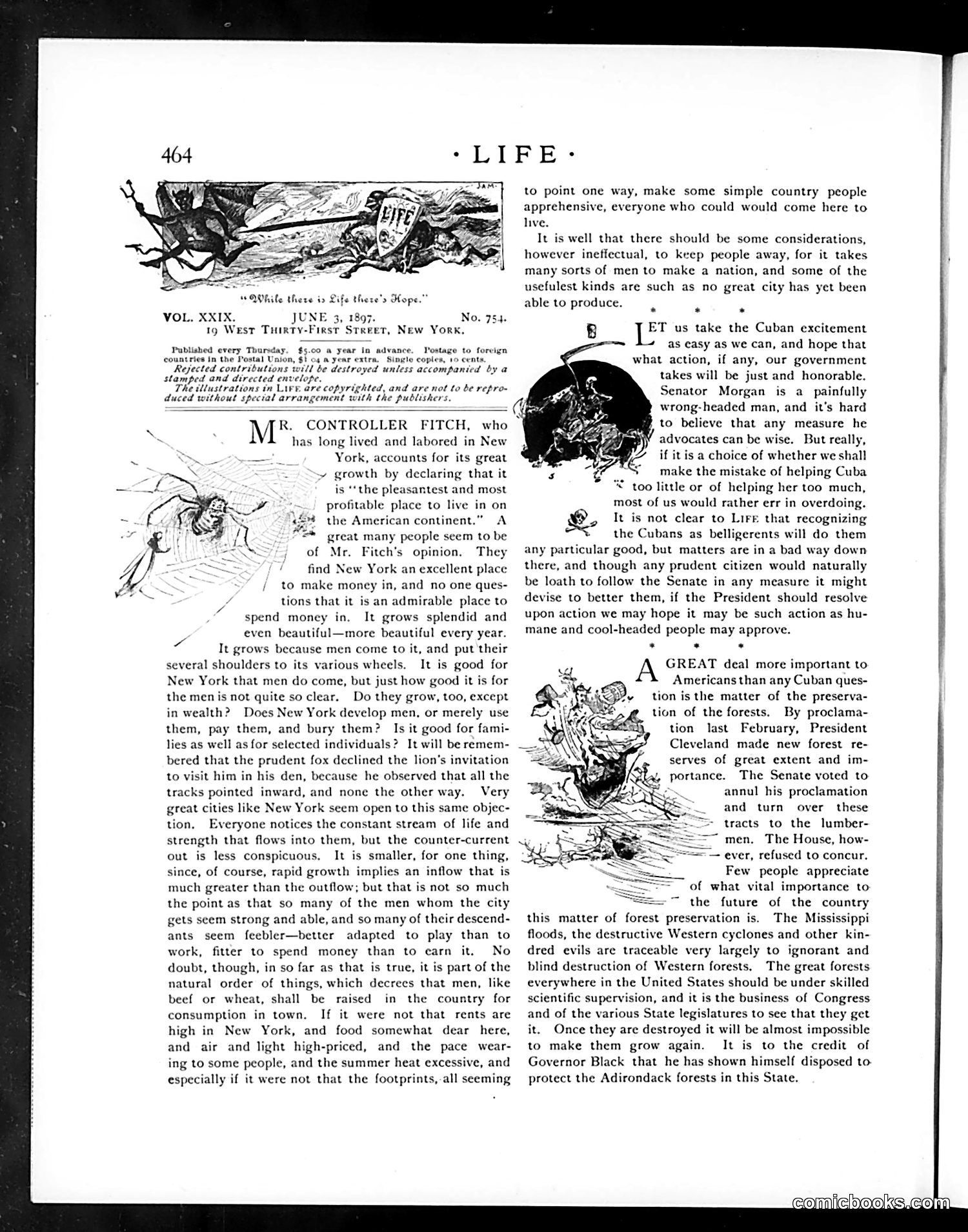
The page contains two distinct editorial sections: **Left Column:** Discusses Mr. Controller Fitch's views on New York City's growth and desirability as a place to live and work, despite high rents and summer heat. The accompanying sketch appears to be a humorous illustration of urban life or congestion. **Right Column:** Addresses Cuban independence and American foreign policy. The text criticizes Senator Morgan as "painfully wrong-headed" regarding U.S. intervention in Cuba, suggesting Americans should help Cuba judiciously but not excessively. It also praises forest preservation efforts, particularly Governor Black's protection of Adirondack forests, arguing that forest destruction causes floods and cyclones—a conservation issue deemed vital to America's future. The cartoon illustrations support these editorials with satirical commentary on urban and political themes of the 1890s.
📄 Transcribed text from this page (OCR, searchable)
Machine-transcribed from the original scan — historical spelling and the odd misread are preserved.
“While there is Life there's Hope.” VOL, XXIX, ju 1g West THirty 3, 1897. rst Street, New York, Published every Thursday. $5.00 a year in advance. Tostage to foreign countries in the Postal Union, $1 c 16 coples, 10 cents Rejected contributions will be destroyed unless accompanied by @ stamped and directed envelope. The illustrations in Live. are copyrighted, and are not to be repro= duced without special arrangement with the publishers. M&* CONTROLLER FITCH, who has long lived and labored in New — York, accounts for its great » growth by declaring that it is ‘‘the pleasantest and most profitable place to live in on 8 the American continent.” A at many people seem to be ‘itch's opinion, They find New York an excellent place / to make money in, and no one ques- tions that it is an admirable place to spend money in. It grows splendid and even beautiful—more beautiful every year. It grows because men come to it, and put their several shoulders to its various wheels. It is good for New York that men do come, but just how good it is for the men is not quite so clear. Do they grow, too, except in wealth? Does New York develop men, or merely use them, pay them, and bury them? Is it good for fami- lies as well as for selected individuals? It will be remem- bered that the prudent fox declined the lion’s invitation to visit him in his den, because he observed that all the tracks pointed inward, and none the other way. Very great cities like New York seem open to this same objec- tion, Everyone notices the constant stream of life and strength that flows into them, but the counter-current out is less conspicuous. It is smaller, for one thing, since, of course, rapid growth implies an inflow that is much greater than the outflow; but that is not so much the point as that so many of the men whom the city gets seem strong and able, and so many of their descend- ants seem feebler—better adapted to play than to work, fitter to spend money than to carn it, No doubt, though, in so far as that is true, it is part of the natural order of things, which decrees that men, like beef or wheat, shall be raised in the country for consumption in town. If it were not that rents are high in New York, and food somewhat dear here, and air and light high-priced, and the pace wear- ing to some people, and the summer heat excessive, and especially if it were not that the footprints, all seeming Fd to point one way, make some simple country people apprehensive, everyone who could would come here to live. It is well that there should be some considerations, however ineffectual, to keep people away, for it takes many sorts of men to make a nation, and some of the usefulest kinds are such as no great city has yet been abletoproduce. . |, ET us take the Cuban excitement as casy as we can, and hope that what action, if any, our government takes will be just and honorable. Senator Morgan is a_ painfully wrong-headed man, and it’s hard to believe that any measure he advocates can be wise. But really, if it is a choice of whether we shall make the mistake of helping Cuba “© too little or of helping her too much, most of us would rather err in overdoing. It is not clear to Lire that recognizing the Cubans as belligerents will do them any particular good, but matters are in a bad way down there, and though any prudent citizen would naturally be loath to follow the Senate in any measure it might devise to better them, if the President should resolve upon action we may hope it may be such action as hu- mane and cool-headed people may approve. . . . GREAT deal more important to Americans than any Cuban ques- tion is the matter of the preserva- tion of the forests. By proclama- tion last February, President Cleveland made new forest re- serves of great extent and im- portance. The Senate voted to 2 annul his proclamation and turn over these tracts to the lumber- men, The House, how- — ever, refused to concur. Few people appreciate of what vital importance to the future of the country this matter of forest preservation is. The Mississippi floods, the destructive Western cyclones and other kin- dred evils are traceable very largely to ignorant and blind destruction of Western forests. The great forests everywhere in the United States should be under skilled scientific supervision, and it is the business of Congress and of the various State legislatures to see that they get it. Once they are destroyed it will be almost impossible to make them grow again. It is to the credit of Governor Black that he has shown himself disposed to protect the Adirondack forests in this State.