
A complete issue · 20 pages · 1897
Life — April 29, 1897
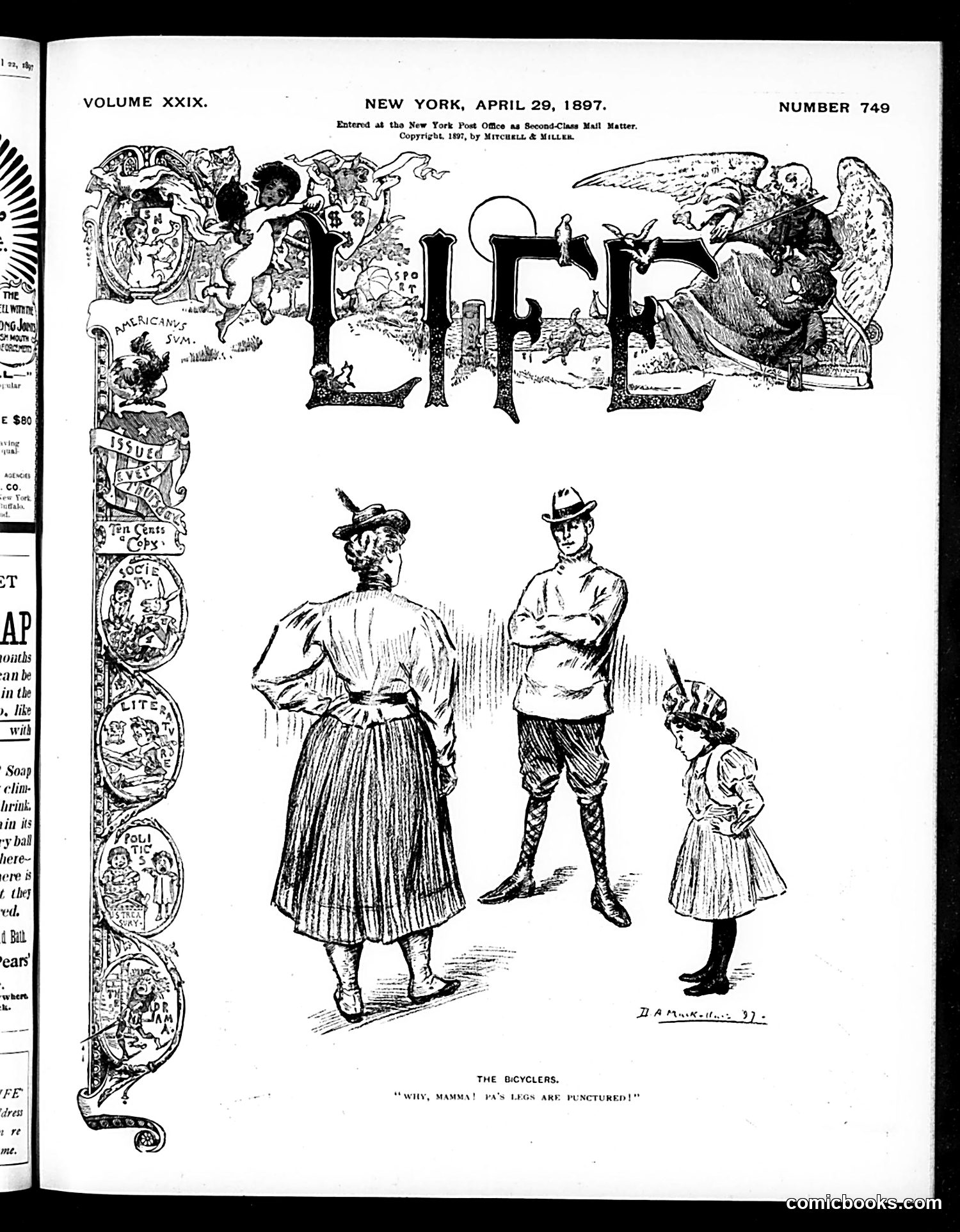
This cartoon satirizes the late-1890s bicycle craze and its social implications. The image shows three figures—a woman in a long skirt, a man in athletic wear, and a young girl—all posed as cyclists. The caption reads: "Why, Mamma! Pa's legs are punctured!" This is a double entendre joke. "Punctured" literally refers to bicycle tire damage (common complaints of the era), but it's also sexual innuendo mocking the man's masculinity or virility. The joke plays on anxieties about bicycling's effects on gender roles—the "New Woman" on a bicycle challenged Victorian propriety, while the man appears emasculated by comparison. The decorative border features advertising vignettes typical of Life's commercial content.
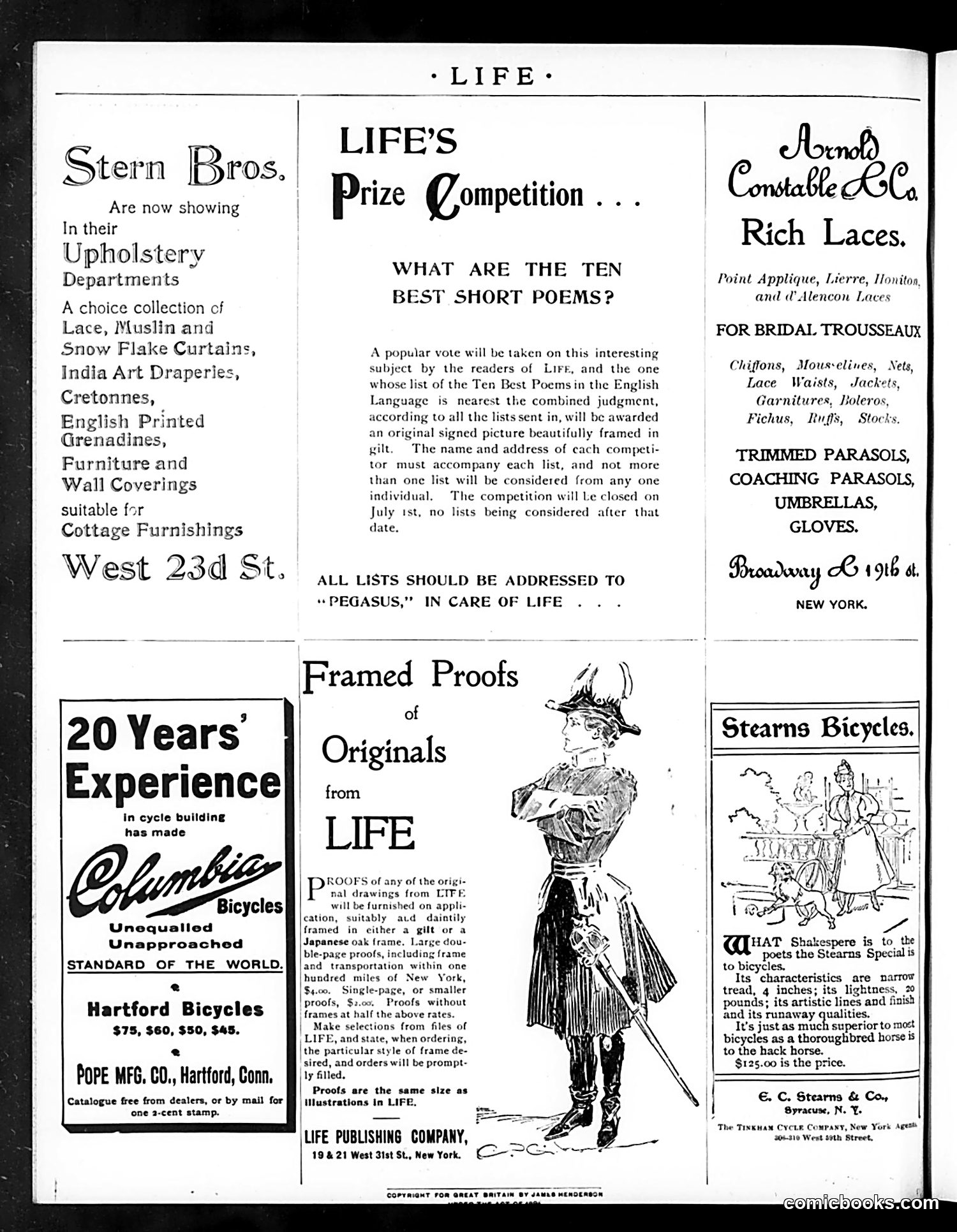
This page is **primarily advertising** with no significant political cartoons or satire. The central illustration depicts a fashionable woman in early 1900s attire (large feathered hat, fitted jacket, riding crop), likely representing a Gibson Girl–type figure. This serves as decoration for Life Publishing Company's advertisement offering "Framed Proofs of Originals from LIFE." The surrounding ads promote bicycles (Columbia, Hartford, Stearns), laces, parasols, and upholstery. One ad humorously compares the Stearns bicycle to "Shakespeare...to the poets" and a "thoroughbred horse," using exaggerated praise typical of early advertising. The page's main content is a poetry competition announcement asking readers to vote on "the ten best short poems," with results to be awarded a framed picture.
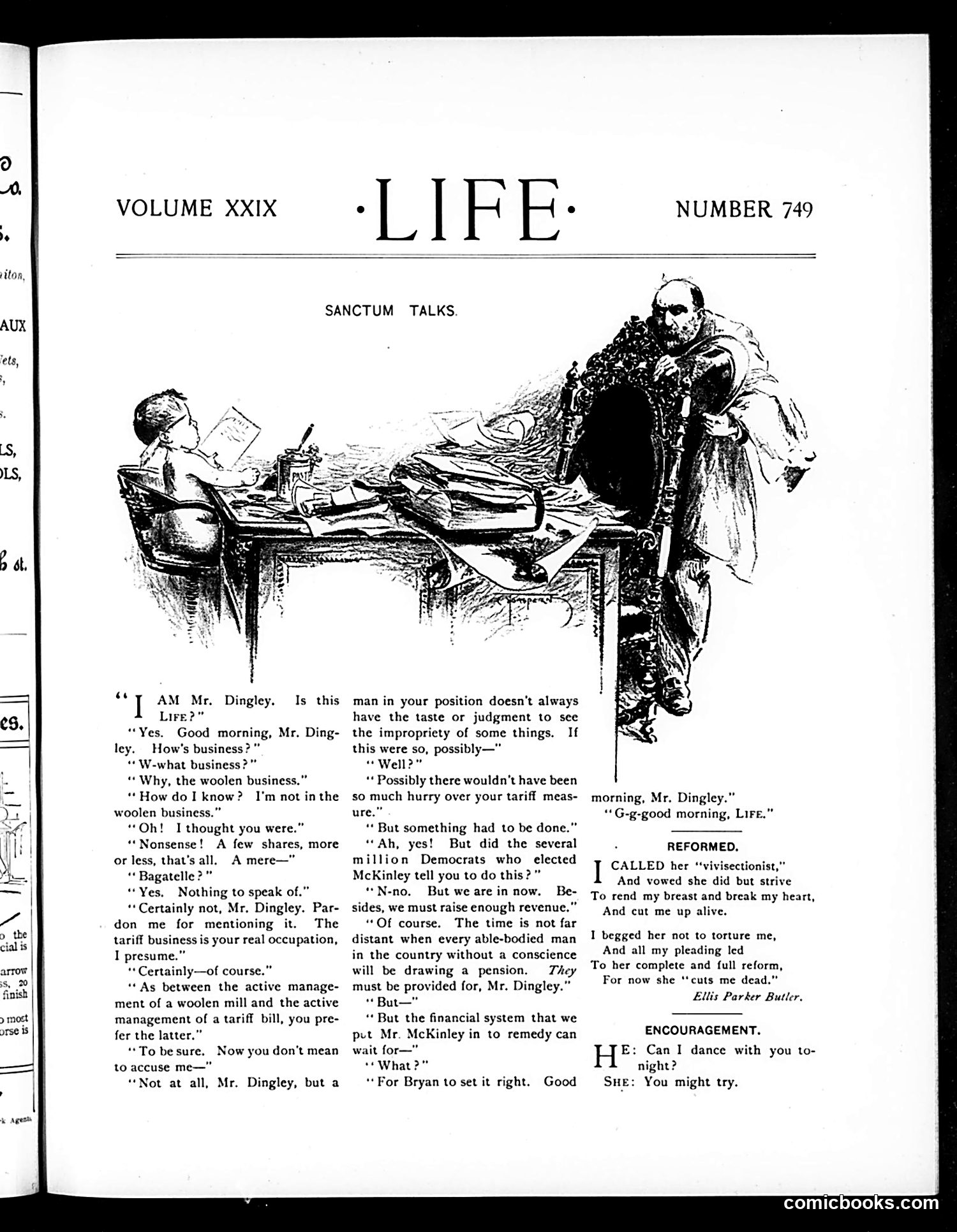
This political cartoon depicts a conversation between two men at a desk, likely satirizing tariff policy debates. One figure, identified as "Mr. Dingley," discusses wool industry tariffs and revenue collection with another man. The dialogue references "McKinley" and "Bryan," appearing to critique the McKinley administration's tariff policies during the 1896-1900 period. The satire targets government fiscal policy: the cartoon suggests politicians prioritize tariff revenue over fair taxation or economic principles. The reference to Bryan (likely William Jennings Bryan, McKinley's opponent) and the debate over "financial systems" indicate this mocks Republican economic management. The page also includes unrelated poems ("Reformed" and "Encouragement"), typical of Life's mixed content format. The cartoon's point: politicians implement unpopular policies while offering weak justifications.
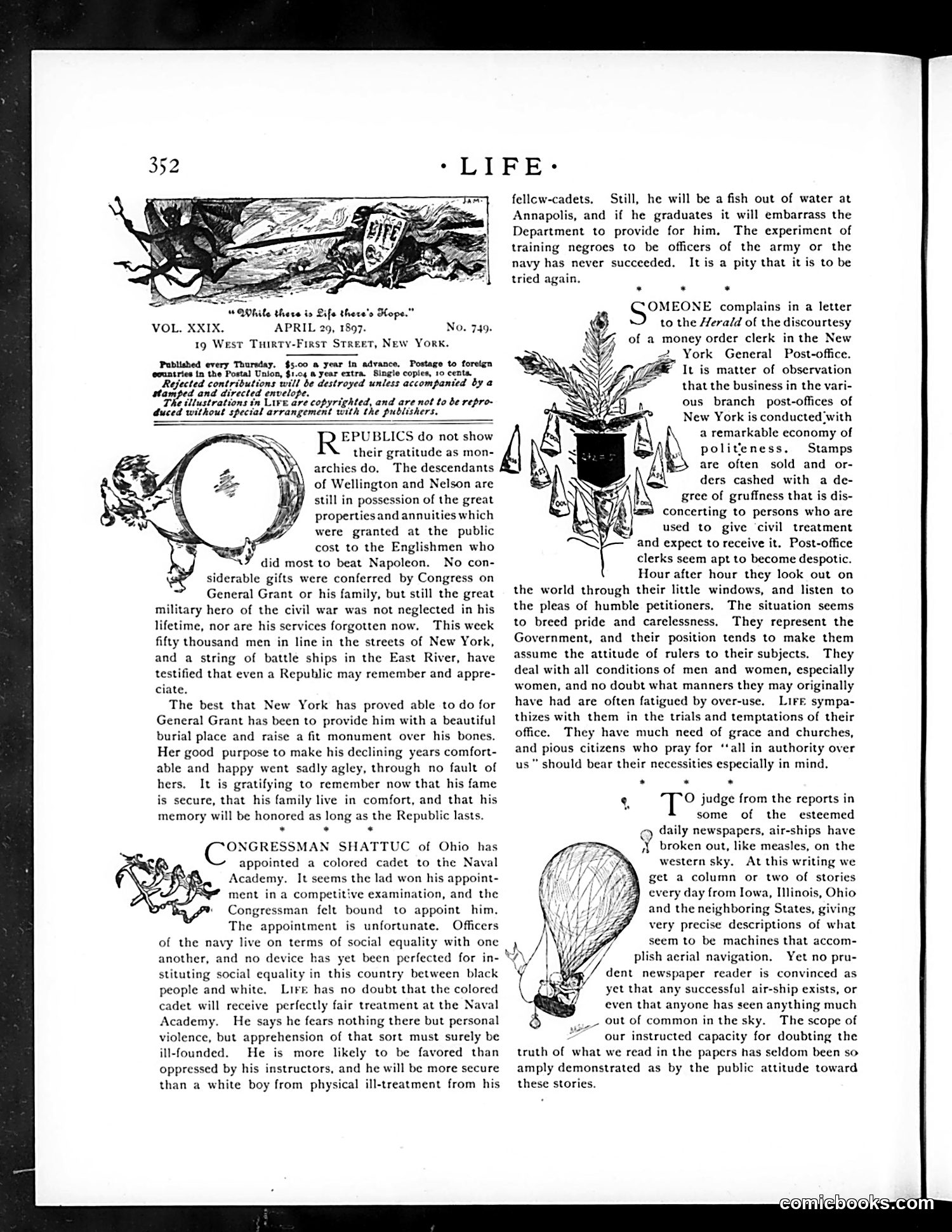
This page contains three distinct editorial pieces without unified cartoon narrative. **Top section** discusses General Grant's legacy and a recent military parade in New York, praising republican gratitude while noting Grant's fame remains secure. **Middle section** critiques Post Office clerks' discourtesy in New York branches, suggesting their government position makes them dismissive toward the public. The satirical point: clerks treat citizens poorly, displaying "pride and carelessness" despite representing the government. **Bottom section** skeptically addresses airship reports in newspapers, noting Ohio papers claim frequent aerial machine sightings despite no verified successful aircraft existing. The satire targets credulous journalism—papers publish unsubstantiated aviation stories that readers increasingly doubt. All three pieces exemplify Life's tradition of social and institutional criticism through short editorial commentary.
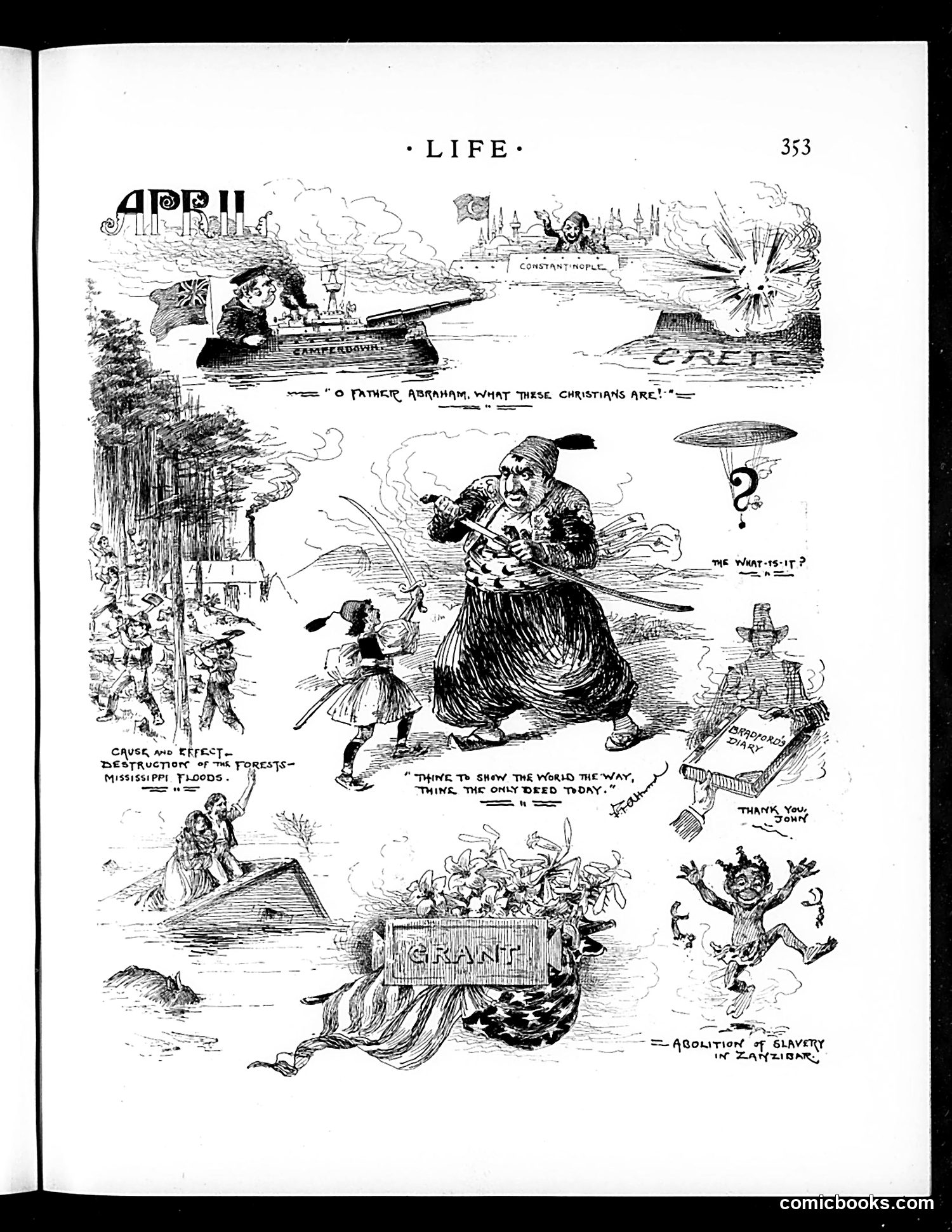
This page contains multiple political cartoons satirizing events from April, likely early 20th century based on the artistic style. The top cartoon depicts naval warfare near Constantinople, with a figure asking "O Father Abraham, what these Christians are!" — referencing religious conflict in the Ottoman Empire. The central cartoon shows a large figure telling a child: "Think to show the world the way, think the only deed today," likely commenting on political leadership and moral responsibility. Lower sections reference: - Forest destruction and Mississippi floods (environmental/disaster commentary) - "Abolition of Slavery in Zanzibar" (celebrating an anti-slavery achievement) The cartoons collectively address military intervention, environmental crisis, moral leadership, and social progress — typical Life magazine satirical concerns of the era.
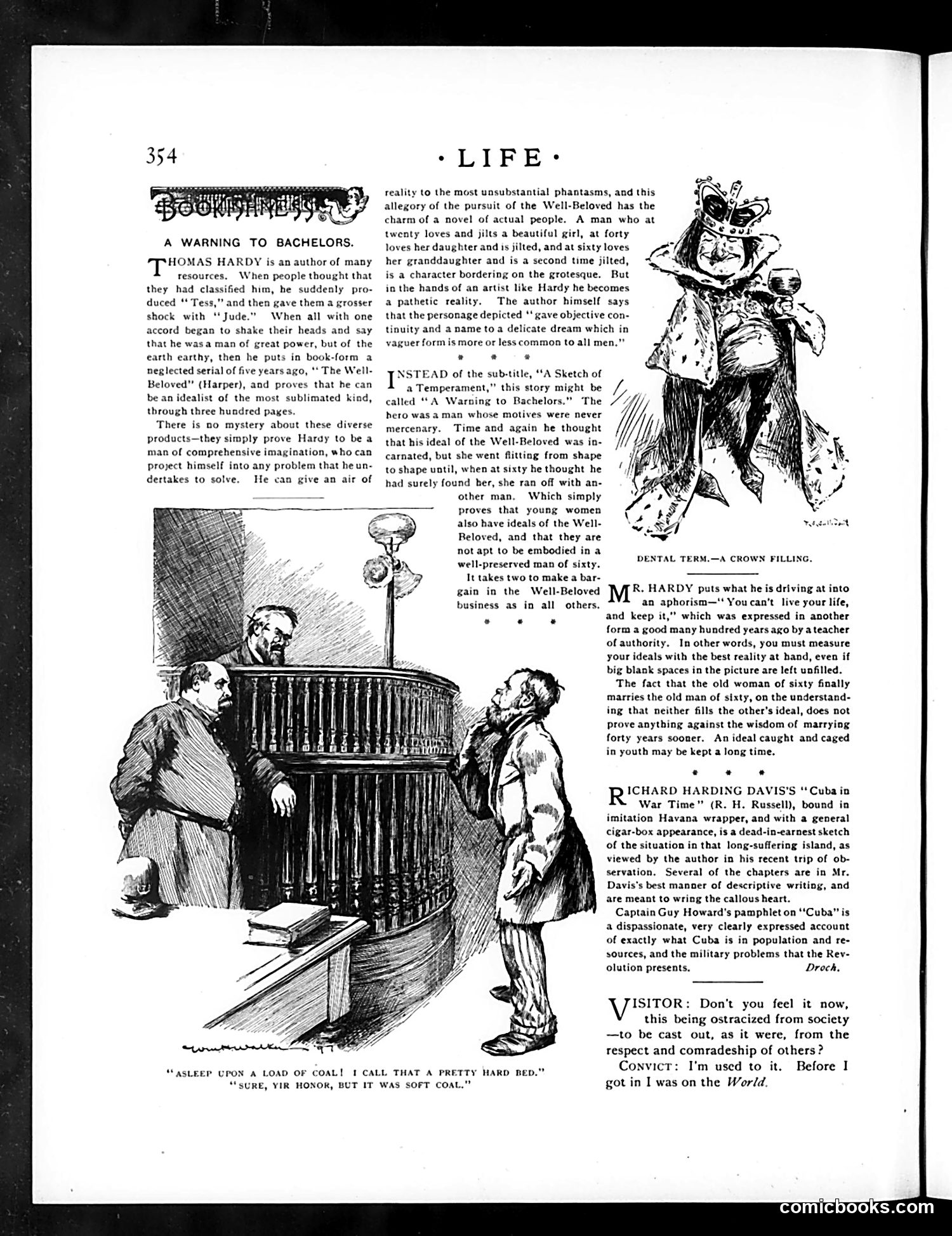
This page satirizes Thomas Hardy's literary work through a cartoon showing two men examining what appears to be a cradle or crib. The accompanying text critiques Hardy's tendency to depict idealized romance that inevitably disappoints—his characters pursue the "Well-Beloved" only to discover reality falls short. The cartoon's caption, "Asleep upon a load of coal! I call that a pretty hard bed. Sure, Vir Honor, but it was soft coal," suggests domestic discomfort and compromised expectations in marriage. The satire warns bachelor readers that Hardy's novels depict men whose romantic ideals—seeking the perfect woman—lead to disillusionment. The message: real relationships involve settling for less than one's youthful dreams, a theme Life's editors found darkly humorous for unmarried male readers.
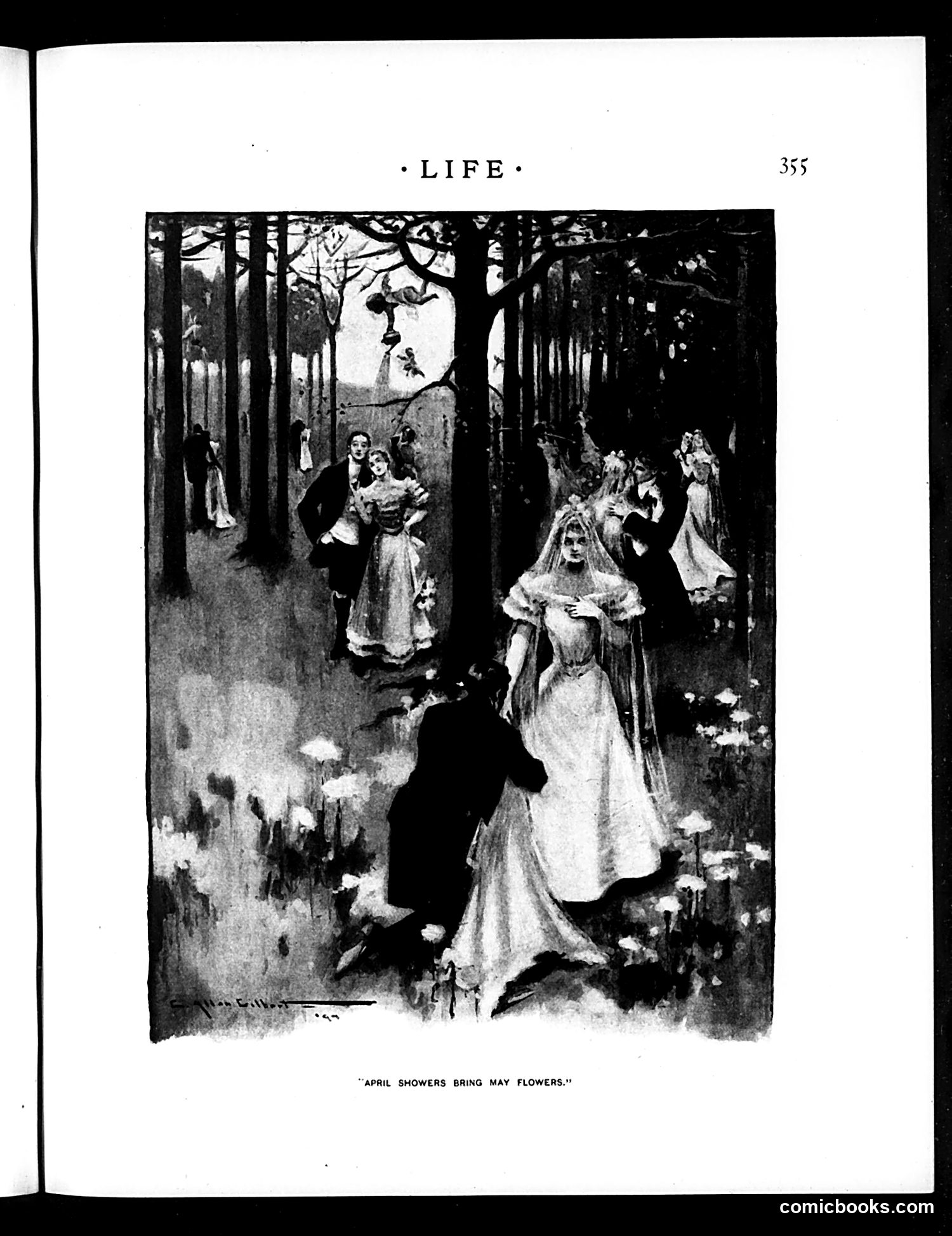
This illustration depicts a romantic forest scene with elegantly dressed figures in what appears to be early 20th-century attire. A woman in a white wedding dress stands prominently in the foreground, surrounded by other figures in formal dress scattered throughout a wooded path lined with flowering plants. The caption references the traditional saying "April showers bring May flowers," likely using spring's renewal as metaphor for romance, courtship, or marriage. The formal dress and woodland setting suggest themes of love, social gatherings, or matrimonial occasions that were common satirical subjects in *Life* magazine. Without additional context or byline visible, the specific social commentary—whether satirizing marriage customs, romantic pretense, or seasonal social rituals—remains somewhat unclear from the image alone.
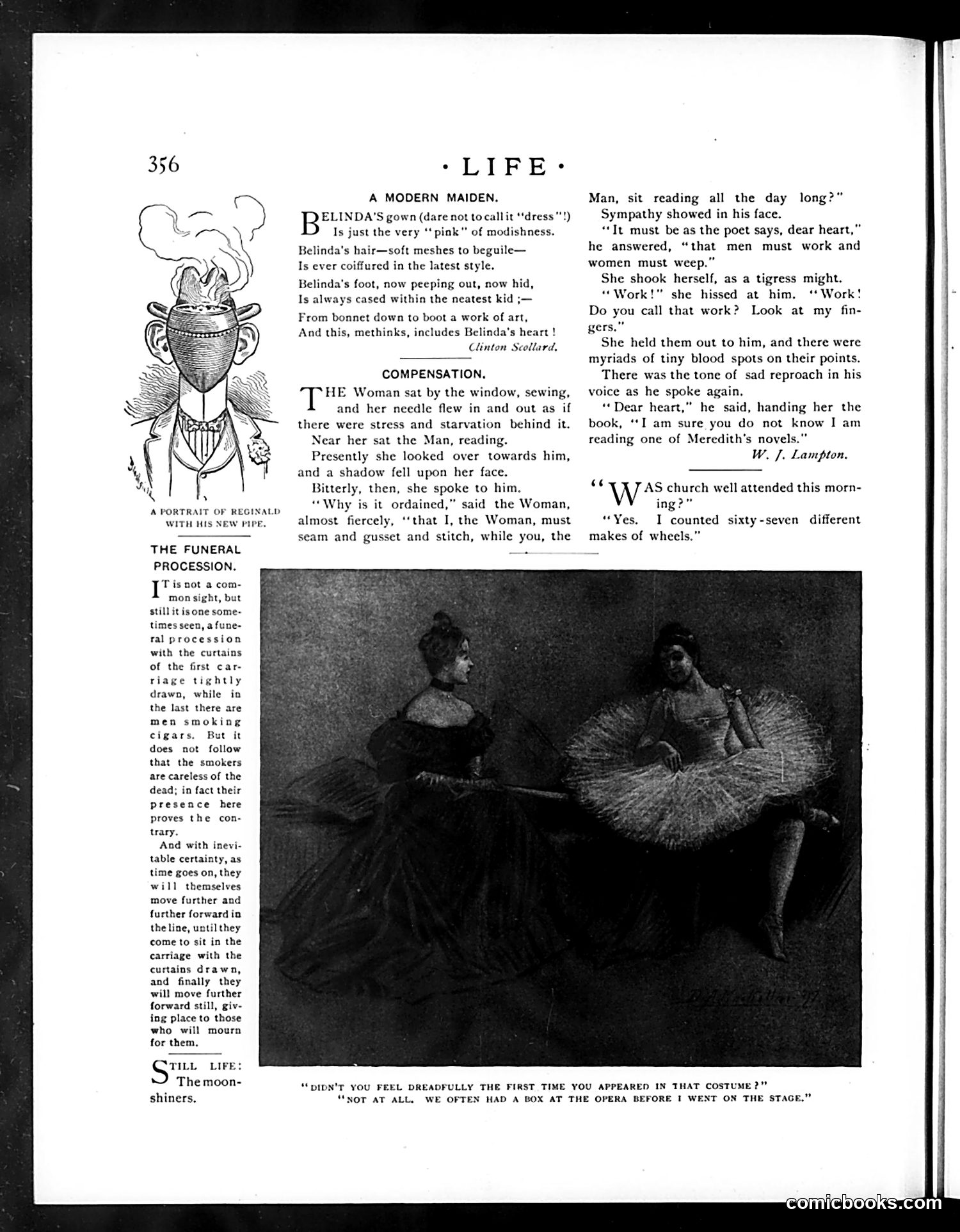
This page contains three literary pieces with satirical commentary on gender roles and social expectations. **"A Modern Maiden"** mocks fashionable women's obsession with appearance—specifically Belinda's elaborate hairstyles and footwear—while neglecting substance. **"Compensation"** presents a domestic dispute where a woman challenges her husband's complaint about her sewing by pointing out his idleness. She sarcastically asks if he considers reading "work," highlighting the unequal labor expectations placed on wives versus husbands. **"The Funeral Procession"** and accompanying photograph satirize theatrical pretension, with the caption joking about an actress's first costume appearance at the opera. Overall, the page critiques Victorian-era gender hypocrisy: men's leisure contrasted against women's domestic demands, and superficiality valued over substance in women's social roles.
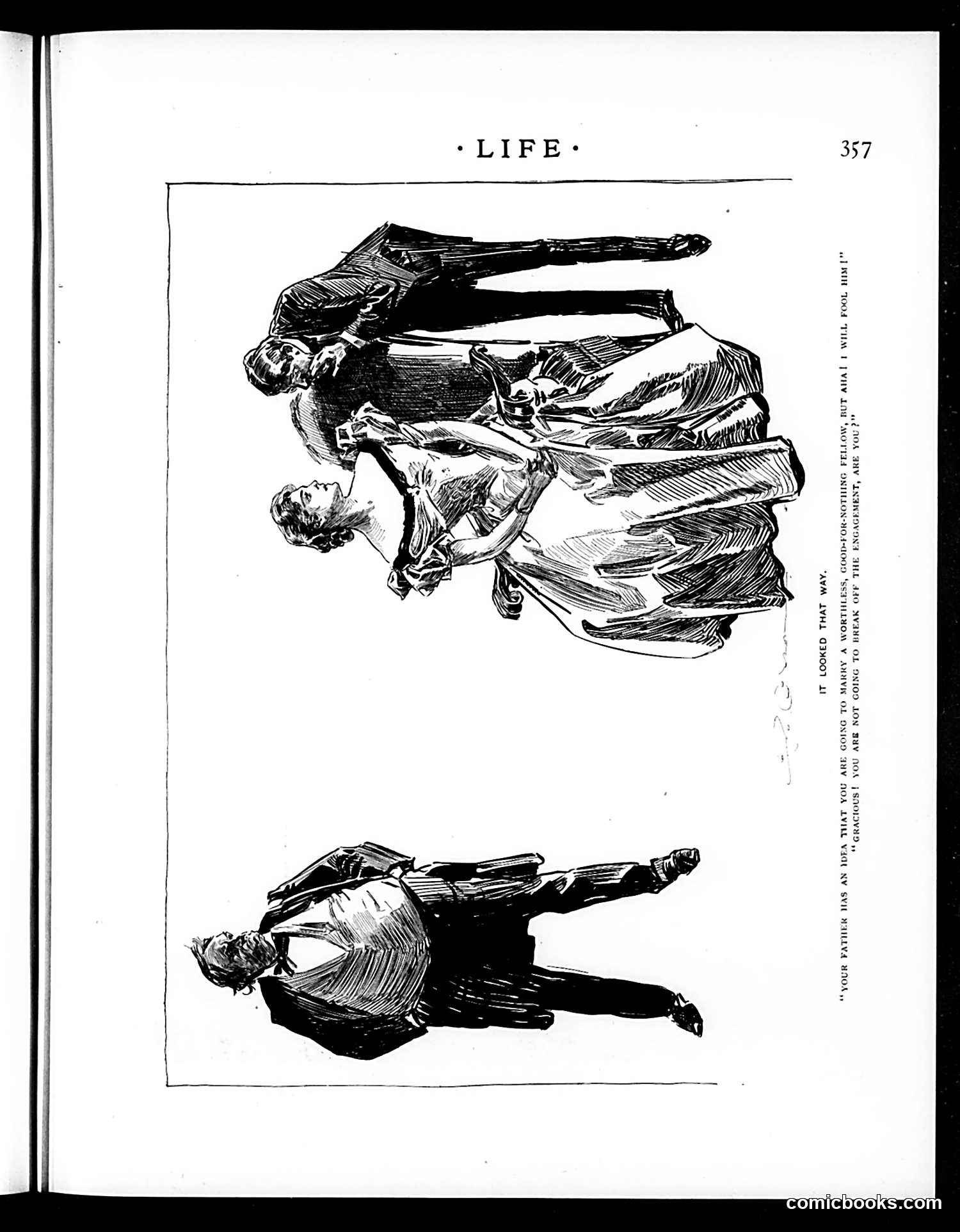
This page from *Life* magazine (page 357) contains two ink sketches showing figures in formal attire viewed from above, appearing upside-down or rotated. The OCR text is largely illegible in the provided excerpt, making it difficult to identify the specific figures or political references with certainty. Based on the artistic style and *Life*'s satirical nature, these appear to be caricatures of public figures, likely politicians or celebrities of the era. The unusual perspective—viewing subjects from overhead—may be meant to mock or diminish their importance. However, without readable caption text or clearer identifying details in the sketches themselves, I cannot confidently identify who these figures represent or what specific event or scandal the cartoon references. The cartoons' intent remains unclear from the image alone.
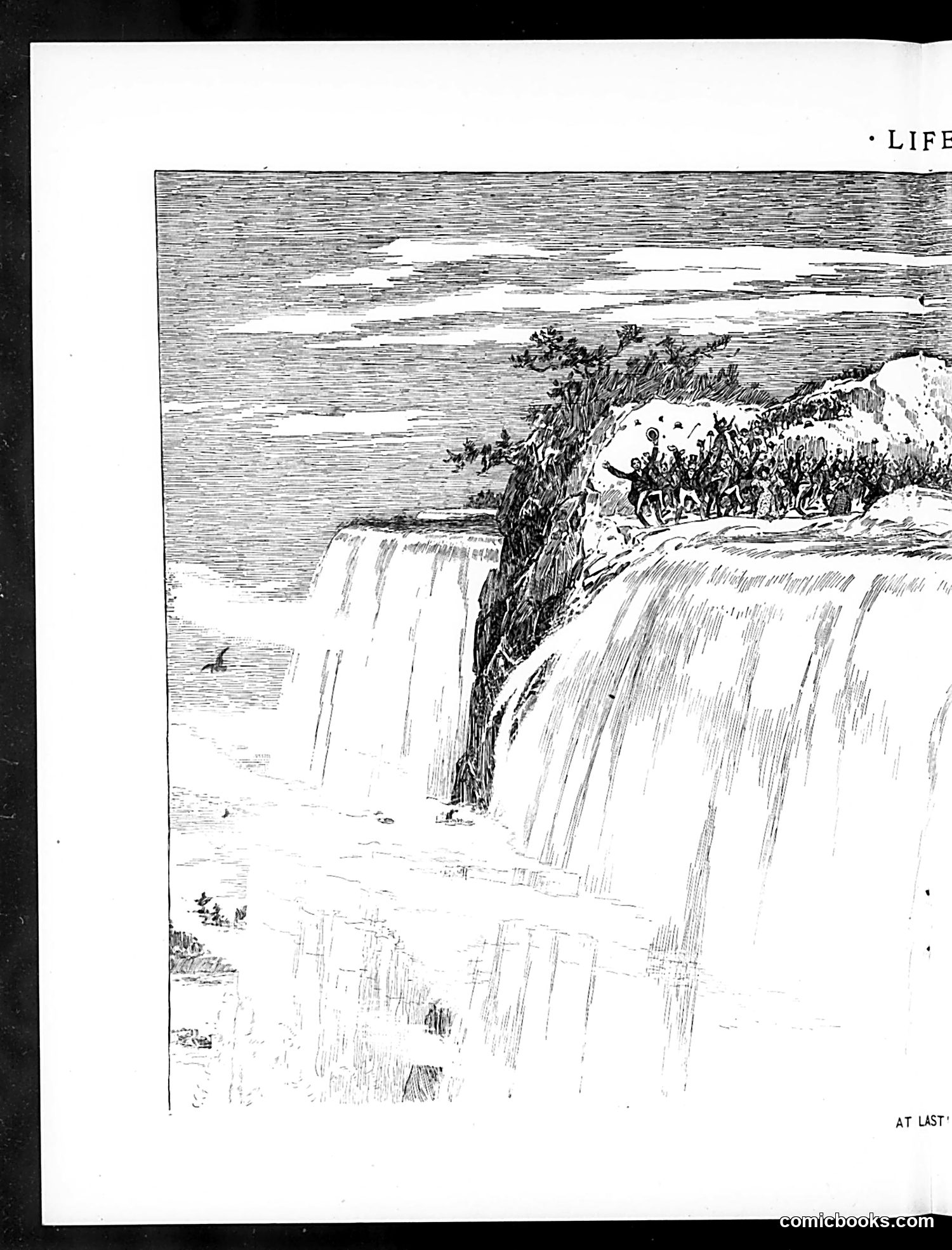
This engraving depicts Niagara Falls with a group of figures standing on the precipice above the cascading water. The caption reads "AT LAST," suggesting this represents a significant achievement or destination finally reached. The style and setting suggest this is likely a 19th-century satirical commentary, possibly referencing a historical expedition, exploration, or political goal. The figures appear to be surveying or celebrating from the vantage point overlooking the falls—a location symbolizing the frontier or natural wonder of America. Without clearer text or additional context visible on this page fragment, the specific political or satirical point remains unclear. The image could reference westward expansion, tourism, industrial development, or another contemporary issue, but I cannot definitively identify which figures are caricatured or what event is being satirized.
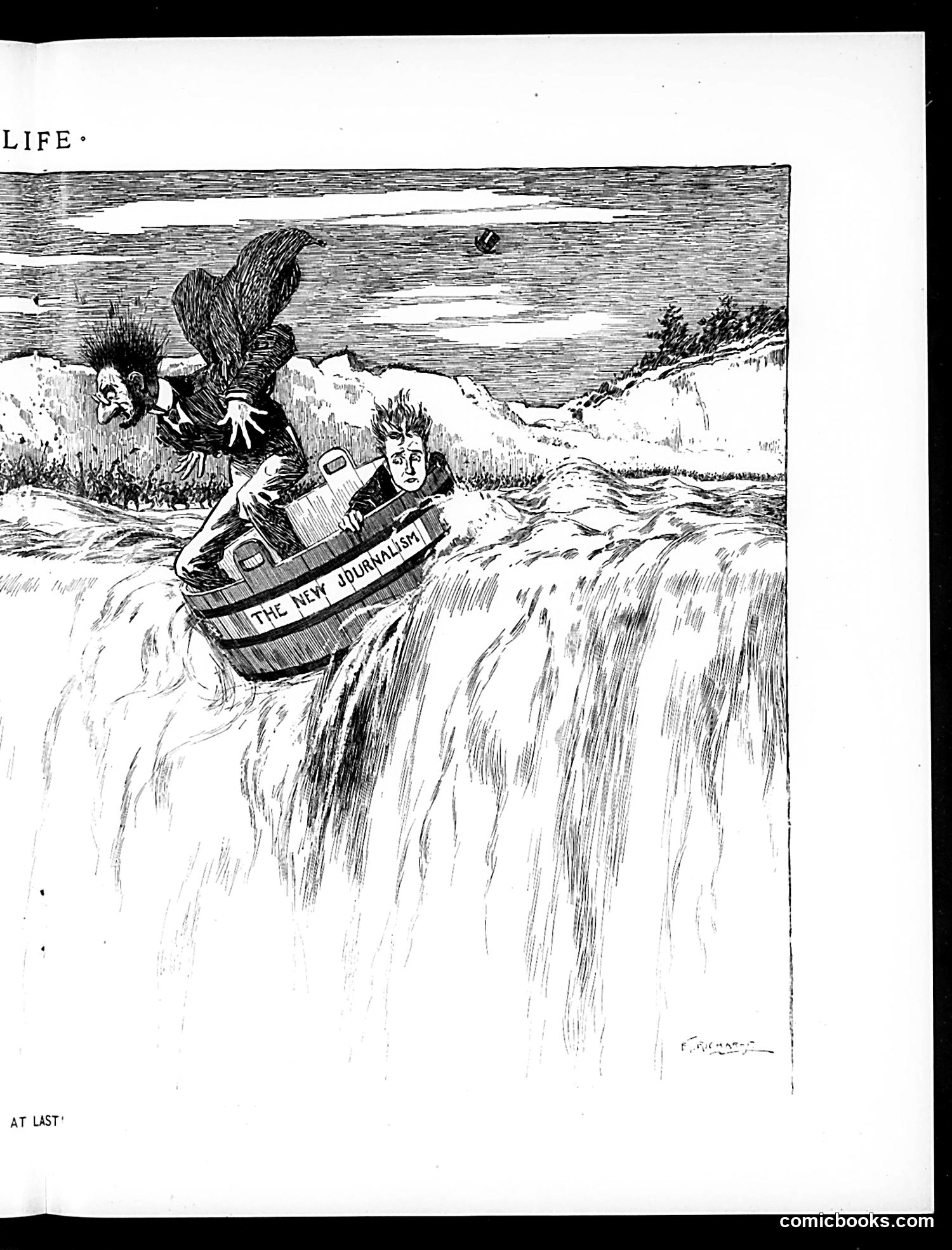
This cartoon satirizes **The New Journalism**, depicted as a barrel being swept over a waterfall. A disheveled figure with wild hair rides inside the barrel, representing sensationalized or reckless journalism going over the edge—literally and figuratively. The bird-like creature with elaborate feathers pushing the barrel suggests exaggerated, theatrical elements driving this journalistic style. The satire criticizes "The New Journalism" as dangerous and out of control, careening toward catastrophe. The waterfall represents impending doom or societal harm. This likely references early 20th-century yellow journalism or sensationalist newspaper practices that prioritized scandal and spectacle over responsible reporting. The title "At Last" suggests readers have finally gotten what they deserved—implying consequences for irresponsible press.
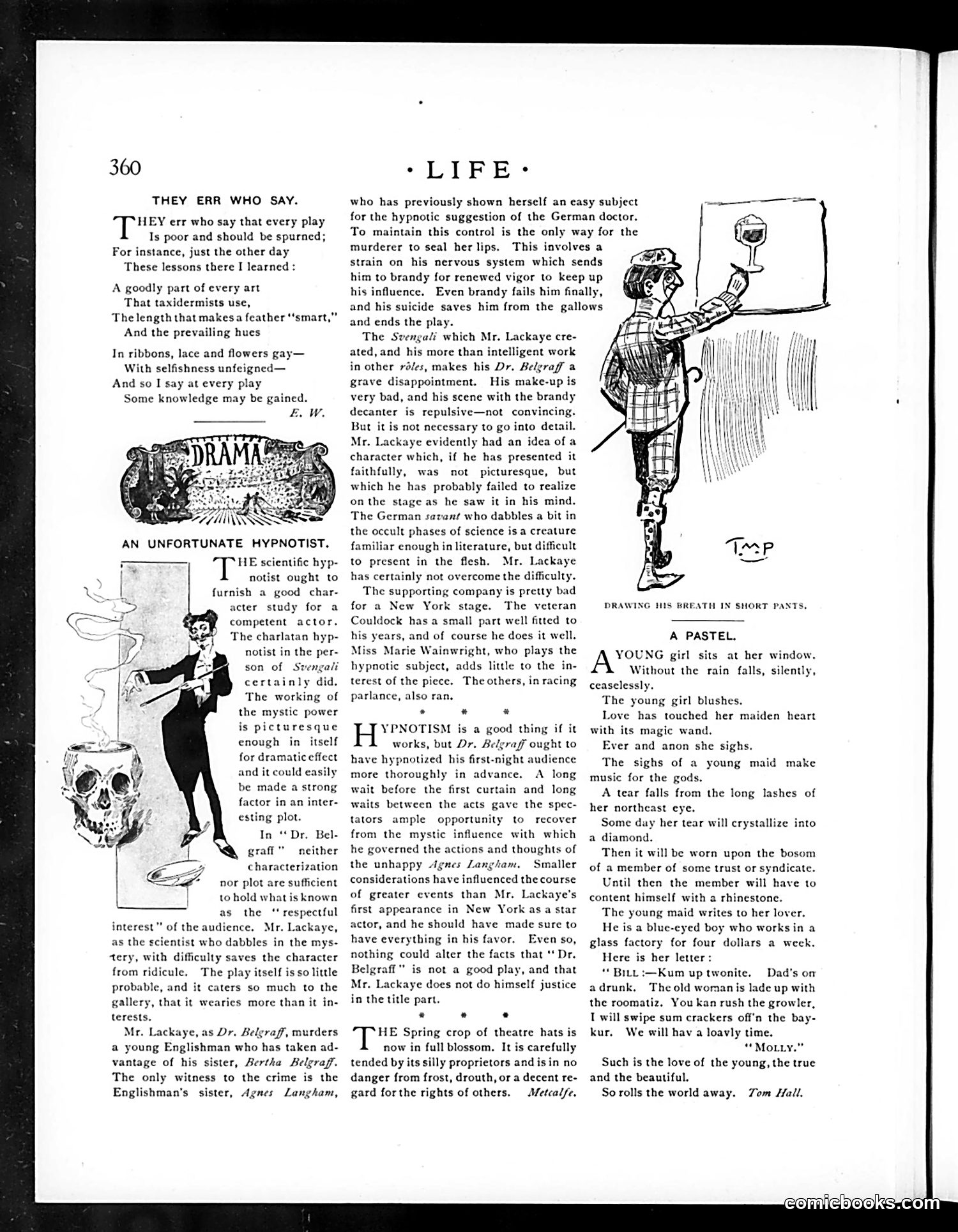
This page critiques a theatrical production of "Dr. Belgraf," a play about a murderer who uses hypnosis to control his sister into silence. The cartoon ridicules the hypnotist character as poorly executed—the performer struggles to make the "mystic power" convincing on stage. The reviewer criticizes actor Lackaye's portrayal as unconvincing, noting the supporting cast (including Marie Wainwright) fails to elevate the material. The satire targets the play itself as melodramatic and implausible, while the accompanying cartoon depicts a hapless hypnotist unable to command his audience's attention—a visual joke about the play's failure to captivate viewers despite its sensational subject matter about murder and mind control.
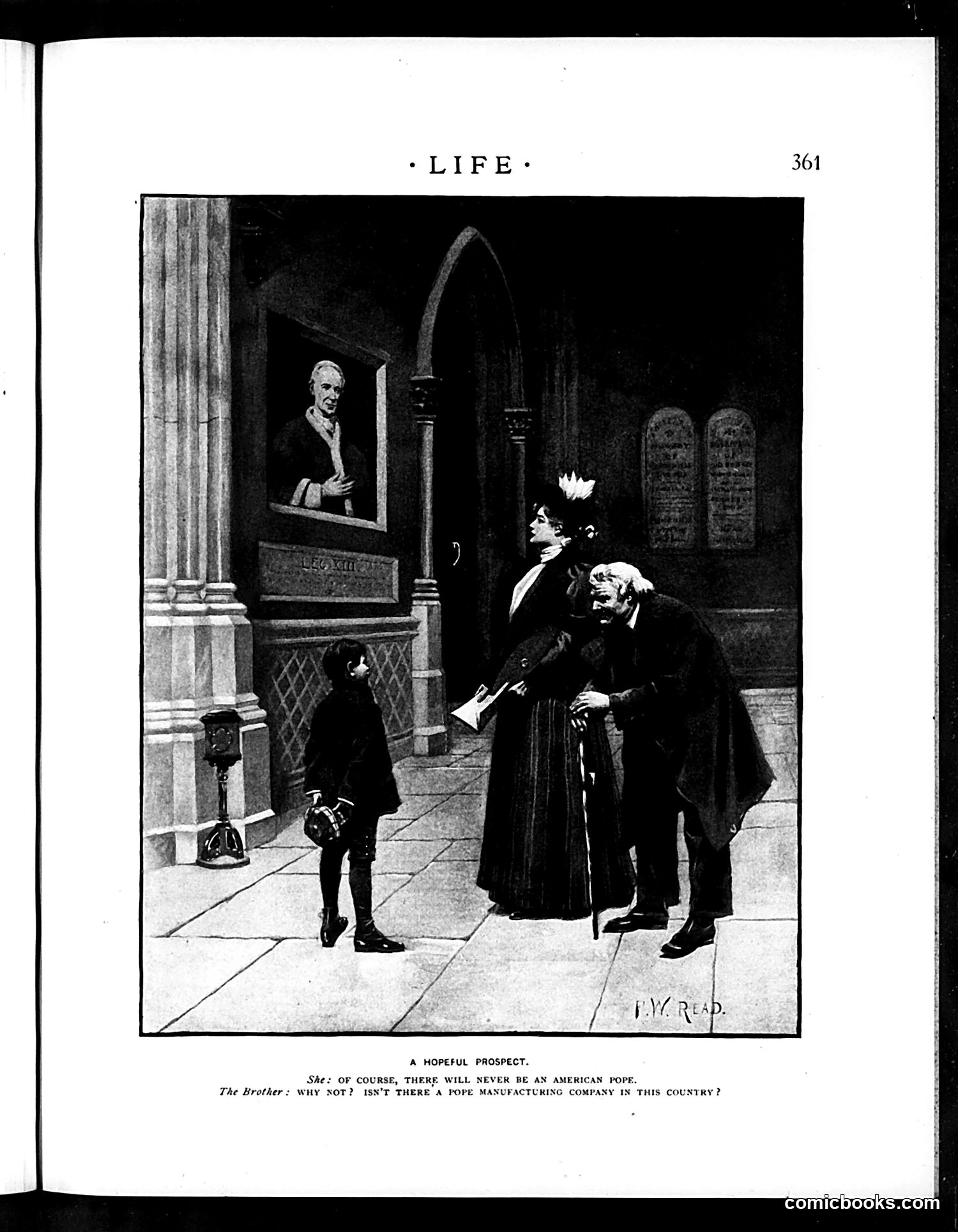
This cartoon satirizes American industrial optimism and entrepreneurial spirit. A woman states confidently that America will never produce a pope, but her brother challenges this with mock-serious logic: if America manufactures everything else, why not popes? The joke relies on two layers: first, the absurdity of treating the papacy as a manufactured commodity rather than a spiritual position; second, a dig at American confidence that industrial production can solve or accomplish anything. The brother's response is deadpan sarcasm—he's not actually suggesting pope manufacturing, but rather mocking the presumption that American business ingenuity has no limits. The ecclesiastical setting and formal dress suggest this reflects early 20th-century anxieties about American secularism and the reduction of sacred institutions to commercial enterprises.
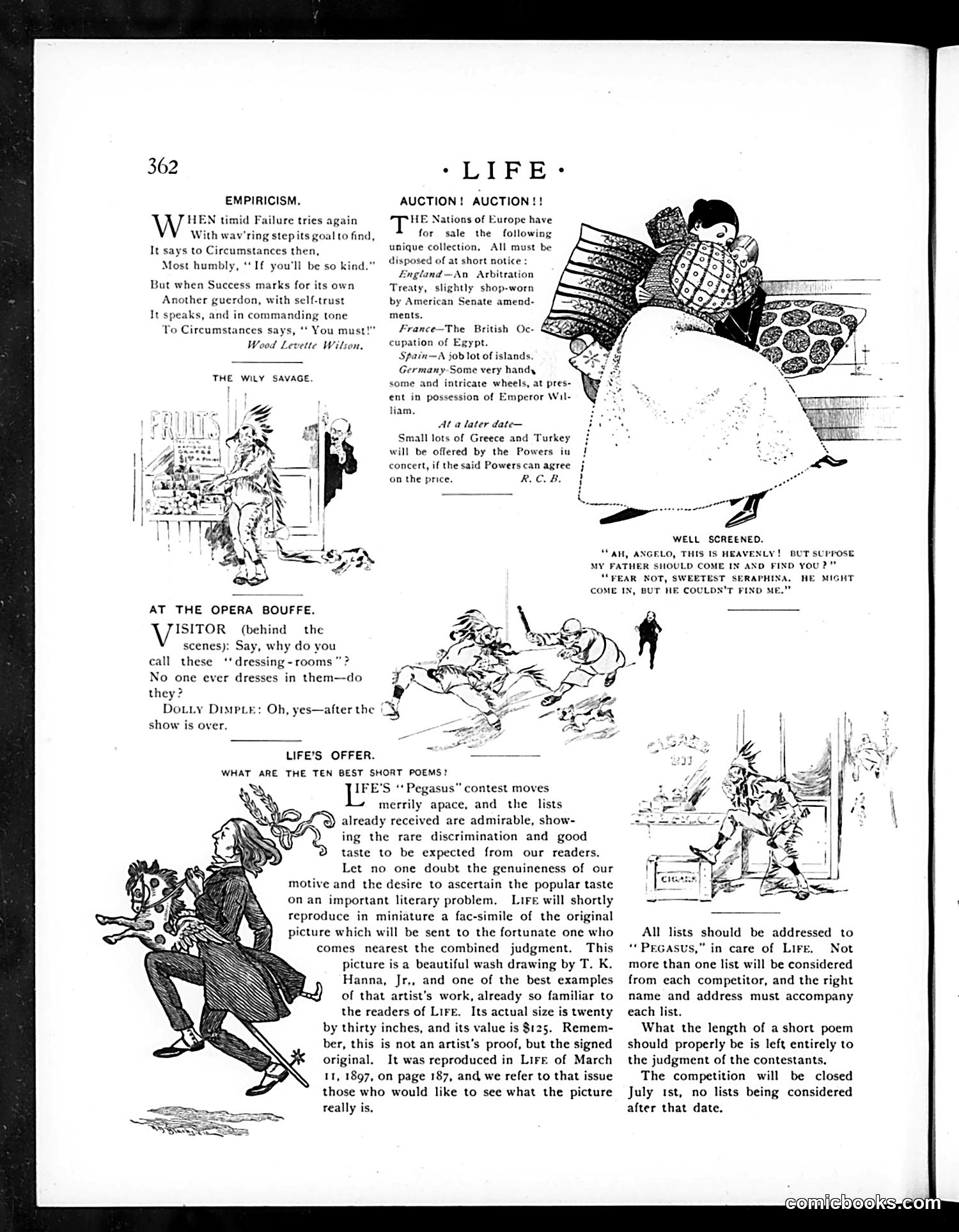
This page contains several satirical pieces targeting late 19th-century political and social issues: **"Auction! Auction!!"** mocks European imperial powers by treating their possessions as items for sale. It references: - Britain's occupation of Egypt (a colonial controversy) - Spain's loss of colonial islands (likely referencing the Spanish-American War era) - Germany's military power under Emperor Wilhelm II ("intricate wheels") - A cynical note that Greece and Turkey might be "offered" if European powers can agree on price—satirizing Great Power politics dividing weaker nations. **"The Wily Savage"** cartoon (lower left) appears to satirize Native Americans or colonial subjects, though details are unclear from the image. **"Well Screened"** jokes about lovers' privacy, likely mocking romantic melodrama popular in theater. **"At the Opera Bouffe"** contains a double-entendre about "dressing rooms" where women don't actually dress until *after* the show—innuendo about backstage behavior. The remaining content announces a poetry contest, unrelated to satire.
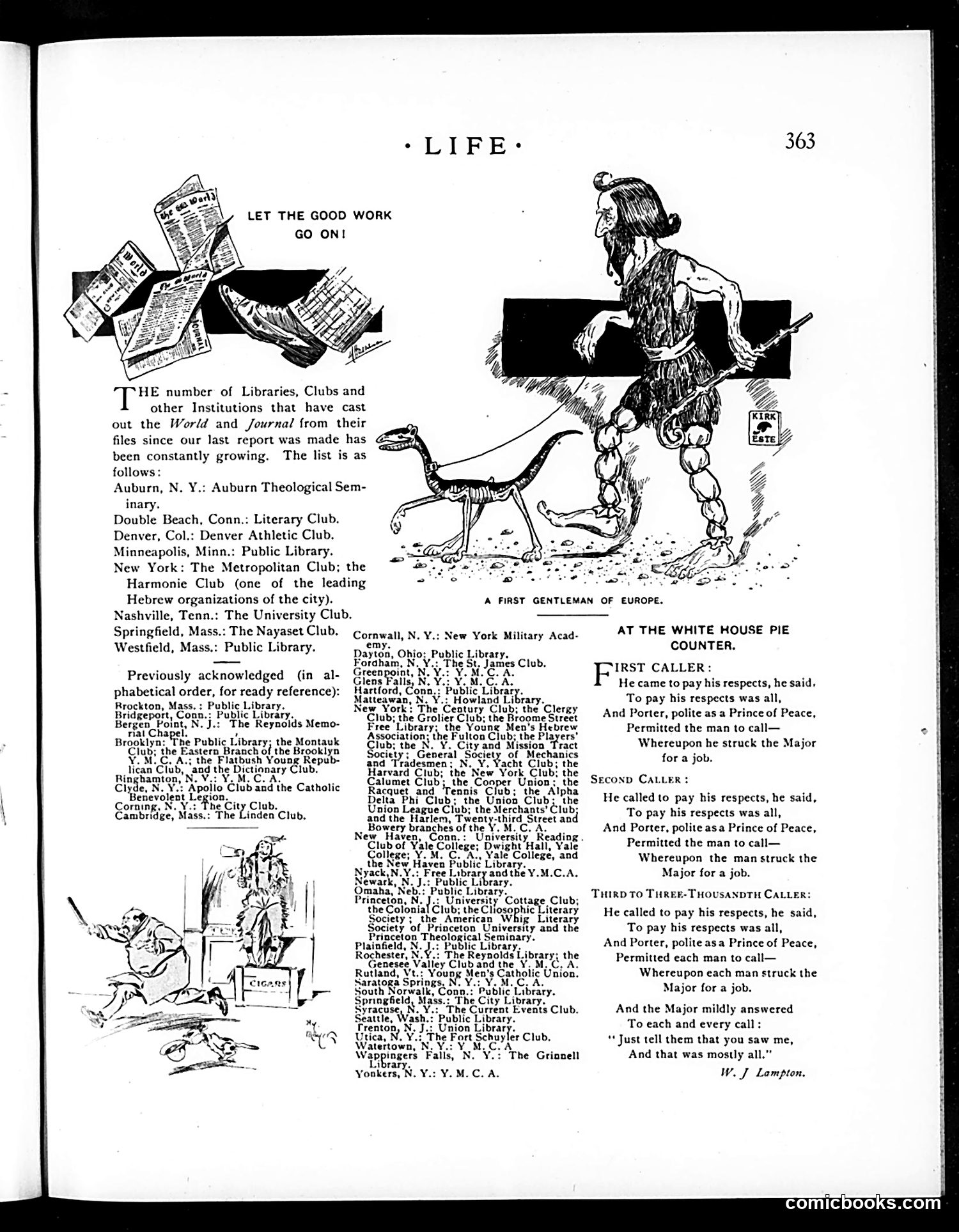
This page contains two distinct satirical pieces: **Left section ("Let the Good Work Go On!"):** Life celebrates institutions removing *The World* and *Journal* newspapers from their files. The list of libraries, clubs, and organizations suggests these publications were considered objectionable enough to purge—likely due to editorial positions or content Life's audience approved of censoring. **Right section ("A First Gentleman of Europe" and "At the White House Pie Counter"):** The cartoon depicts a wild, unkempt European figure—possibly caricaturing European nobility or a specific diplomat. Below, the poem mocks White House job-seekers who pretend to "pay respects" but actually solicit positions from the Major (likely a White House staff member). The satire criticizes the hypocrisy of political patronage: visitors claim courtesy calls while transparently seeking employment, and the Major politely accepts obvious pretense. This reflects Progressive-era critique of spoils-system corruption at the highest government levels.
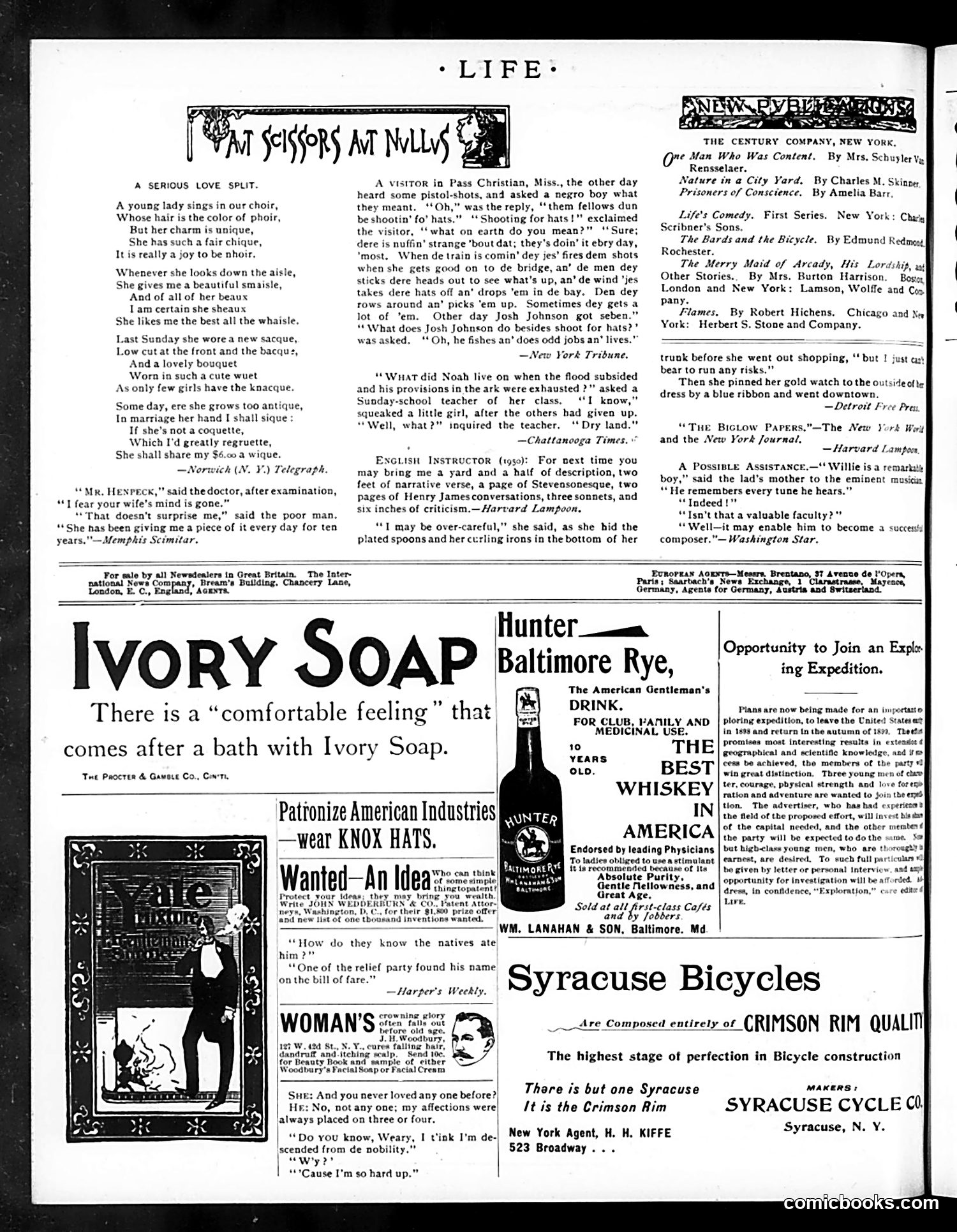
This appears to be primarily a **humor/joke page** rather than political satire. The content consists of light comedic verse and anecdotes published in Life magazine. **Main Cartoon**: The title references a romantic poem about a choir member's unrequited affection—written in playful, rhyming dialect with invented words ("smaisle," "sheaux," "whaisle"). It's gentle satire on sentimental love poetry rather than social critique. **Accompanying Jokes**: Include: - A doctor joke about a nagging wife (domestic humor) - A story about Southern Black men shooting at hats from passing trains to recover them from water - A Sunday school riddle about Noah - A woman paranoid about thieves while shopping **Context for Modern Readers**: This represents **late 19th-century American humor magazine content**—lighthearted, focusing on romantic misadventure, regional dialect humor, and domestic comedy. The racist caricature and dialect humor reflects period prejudices normalized in popular media. The page is primarily **comic entertainment rather than political commentary**.
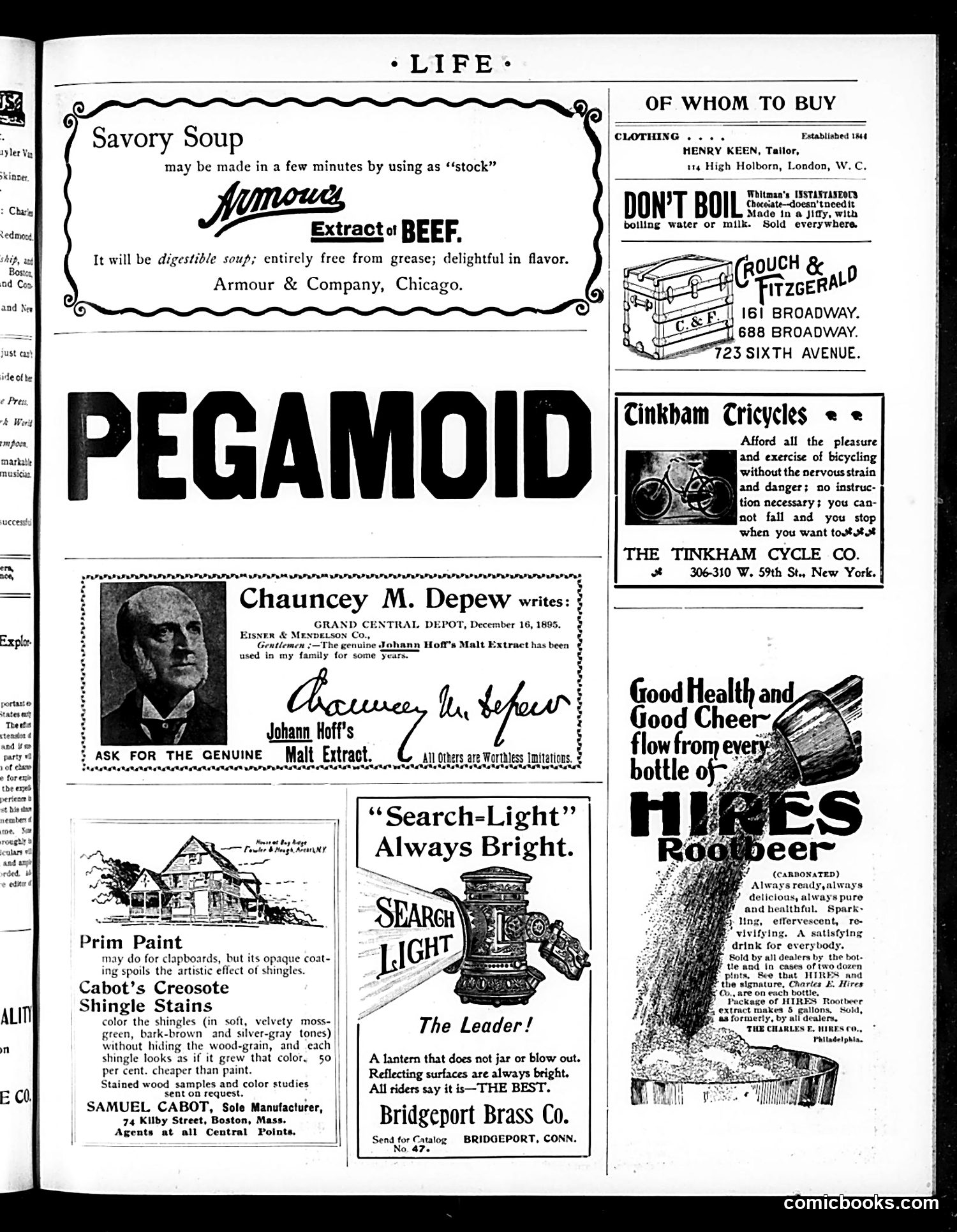
This is primarily an **advertising page**, not a satirical cartoon page. The dominant content is commercial advertisements from the 1890s. The one notable editorial element is a **testimonial from Chauncey M. Depew**, a prominent Gilded Age businessman and politician, endorsing Johann Hoff's Malt Extract. Depew's inclusion lends celebrity credibility to the product—a common advertising tactic of the era. The advertisements themselves reflect period concerns: Armour's Beef Extract promises digestibility and grease-free soup; Hiles Rootbeer emphasizes health benefits; Tinkham Tricycles stress safety ("you cannot fall"); Cabot's Creosote offers aesthetic wood staining. **There is no satire visible here**—this appears to be a standard late-Victorian advertising section of *Life* magazine, using testimonials and product claims typical of 1890s American commerce.
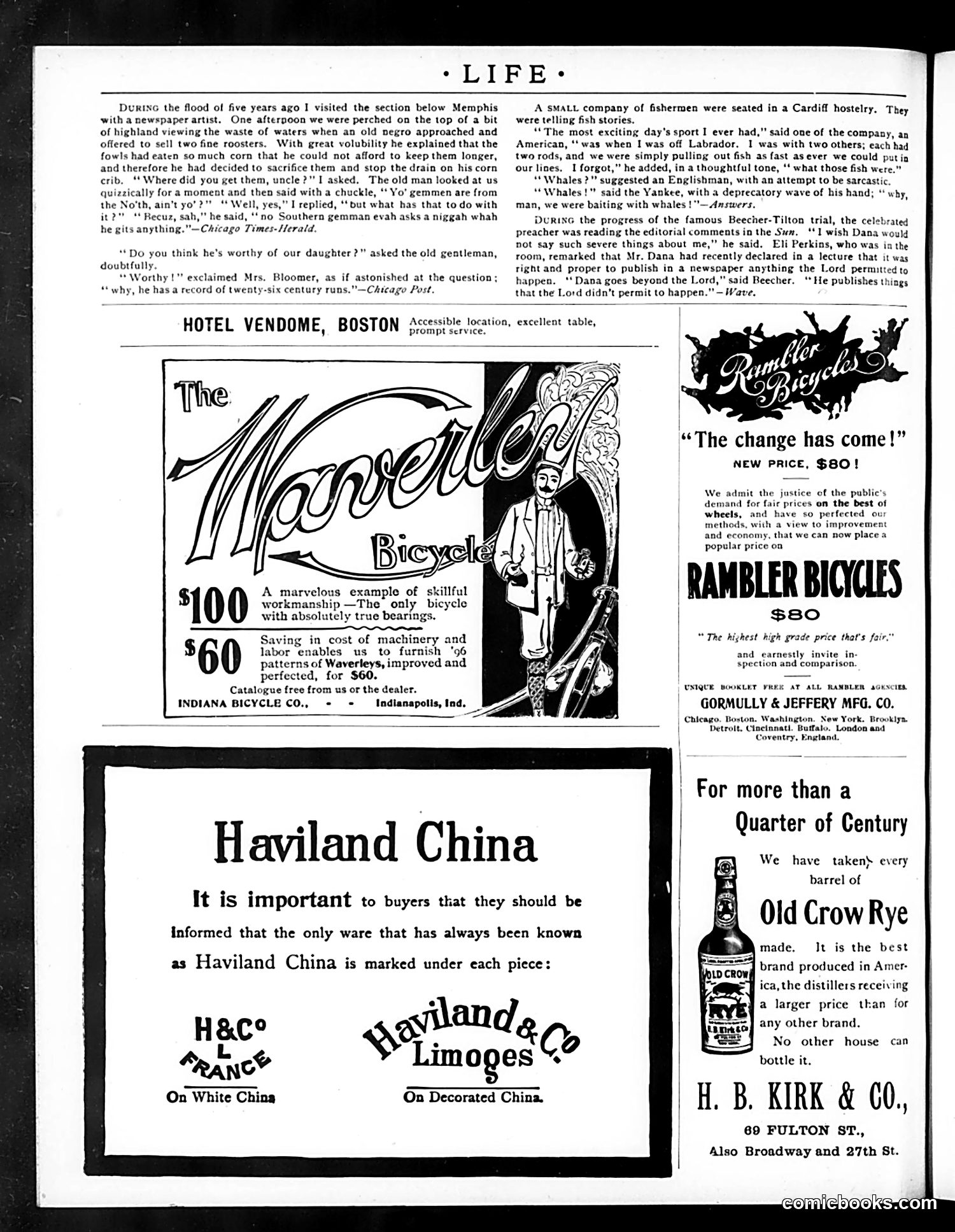
This page contains several short humorous anecdotes rather than political cartoons: 1. **The "Niggah" Story**: A post-Civil War anecdote from the Memphis flood region. A Black man selling roosters makes a racial joke suggesting Northern gentlemen (Yankees) lack Southern manners—they ask "rude" questions that Southern gentlemen wouldn't. The humor relies on contemporary racist assumptions. 2. **The Cricket Reference**: A woman defends her suitor by noting his "record of twenty-six century runs"—cricket terminology suggesting his athletic/sporting prowess makes him worthy. 3. **The Fish Story**: Fishermen compete with tall tales; an American claims he was using *whales* as bait, outsizing the Englishman's sarcastic suggestion. 4. **The Beecher-Tilton Reference**: A joke about Henry Ward Beecher (involved in a famous 1870s scandal) reading critical newspaper editorials. The preacher complains the editor publishes things "the Lord didn't permit"—ironic given Beecher's own scandals. The page is primarily **advertising** (bicycles, china, whiskey, hotels), with these brief satirical items scattered throughout.
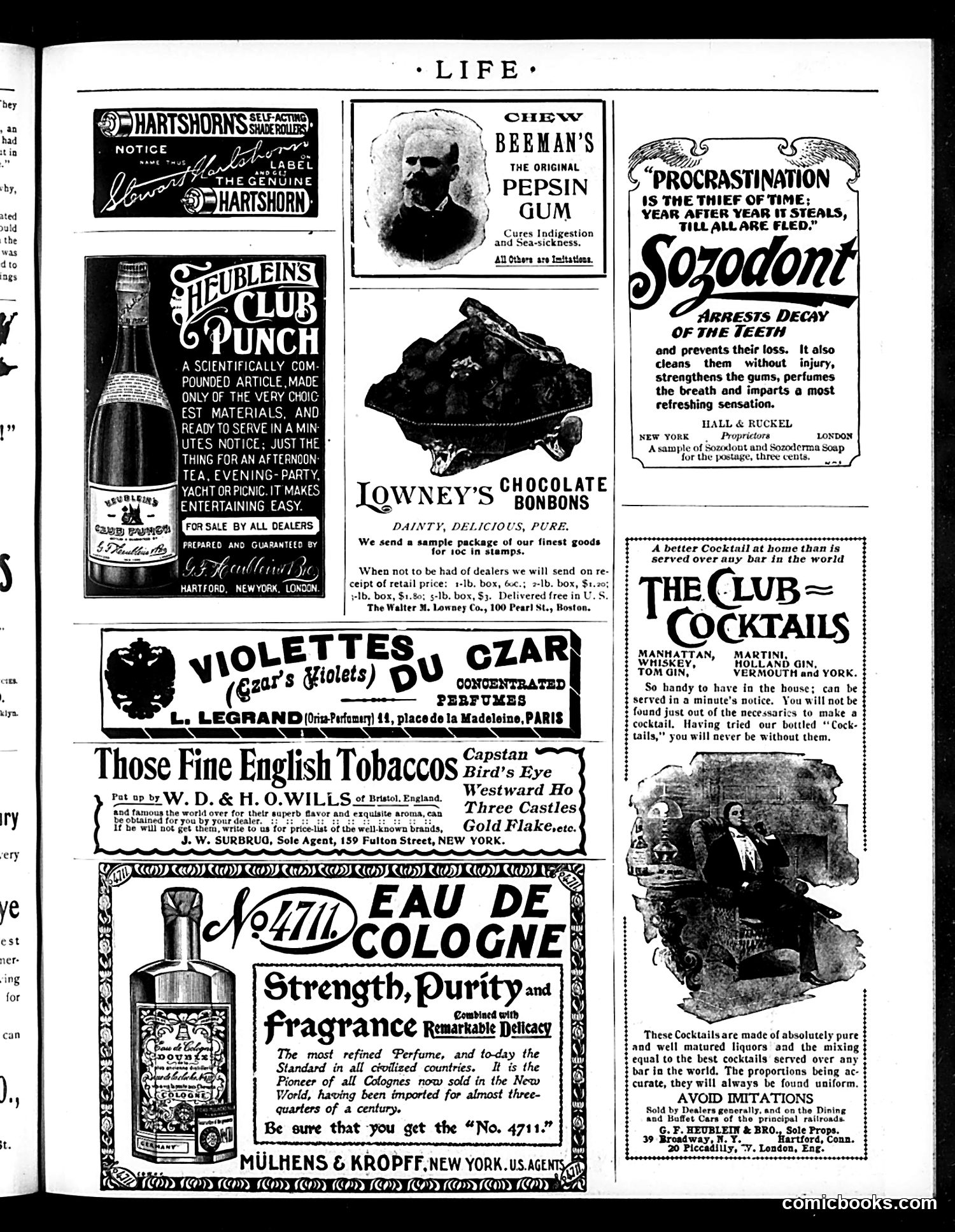
This page is primarily **advertising**, not political cartoons or satire. It displays vintage product advertisements from what appears to be an early 20th-century *Life* magazine. The ads include patent medicines and luxury goods typical of the era: Hartshorn (smelling salts), Beeman's Pepsin Gum (marketed to aid digestion), Lowney's Chocolates, Sozodont toothpaste, English tobaccos, Eau de Cologne perfume, and bottled cocktails by Heublein & Bros. Notable to modern readers: these ads reflect period attitudes toward health—pepsin gum and "Sozodont" claim medical benefits that would today be considered unproven marketing claims. The Sozodont ad includes a literary quote about procrastination, a rhetorical flourish common in vintage advertising. The "Club Cocktails" ad is perhaps most quaint, marketing pre-mixed cocktails as convenient home bar solutions—a novelty in that era. No political commentary or satirical cartoons appear on this page.
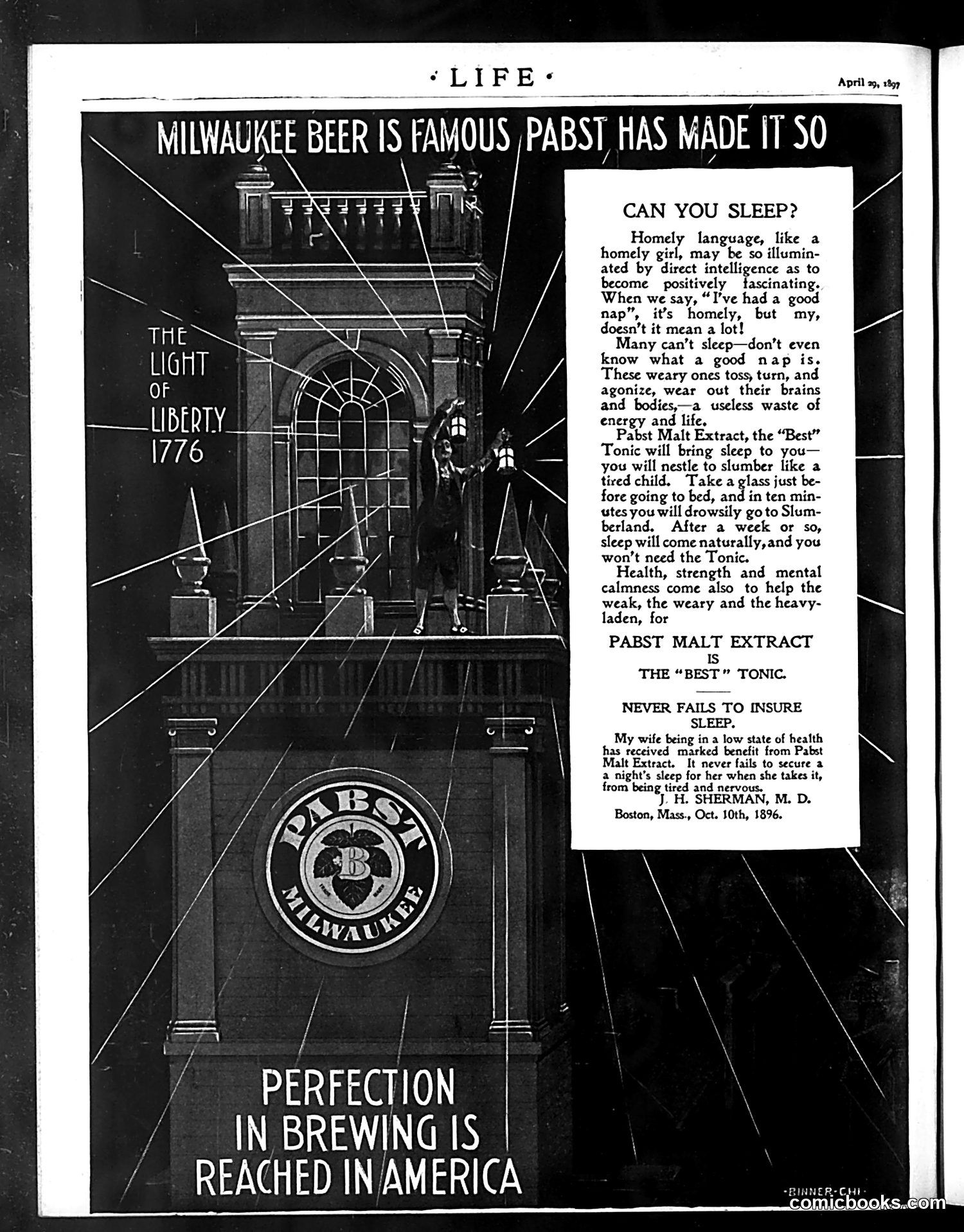
This page is primarily **advertising, not satire**. It promotes Pabst Malt Extract as a sleep aid and tonic, using appeals common to late-19th-century patent medicine marketing. **The imagery**: The left side shows an industrial brewery interior with "The Light of Liberty 1776"—patriotic framing suggesting American manufacturing excellence. The Pabst Milwaukee Beer logo anchors the bottom. **The content**: The right column uses testimonial-style copy claiming the product cures insomnia and "weakness." A Boston doctor's endorsement (dated 1896) adds false medical credibility. The language emphasizes health benefits beyond beer's actual properties. **Historical context**: This reflects an era when alcohol-based tonics were marketed as medicines with unproven health claims, before FDA regulations and modern advertising standards. The "perfection in brewing" slogan equates beer production with American industrial progress. For modern readers: this is a straightforward commercial advertisement exploiting consumer anxieties about sleep and health.