
Life, 1897-04-29 · page 12 of 20
Life — April 29, 1897 — page 12: what you’re looking at
What you’re looking at
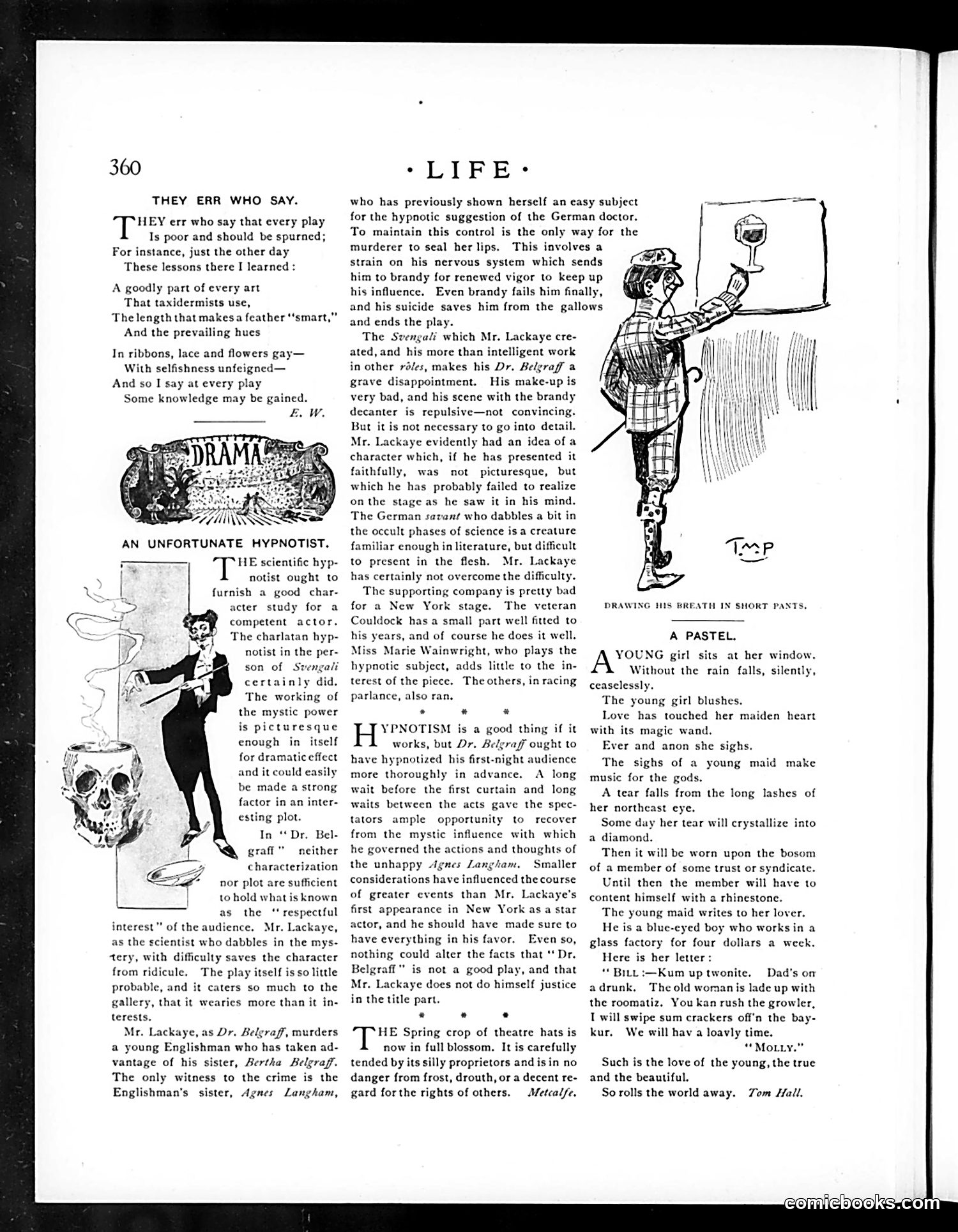
This page critiques a theatrical production of "Dr. Belgraf," a play about a murderer who uses hypnosis to control his sister into silence. The cartoon ridicules the hypnotist character as poorly executed—the performer struggles to make the "mystic power" convincing on stage. The reviewer criticizes actor Lackaye's portrayal as unconvincing, noting the supporting cast (including Marie Wainwright) fails to elevate the material. The satire targets the play itself as melodramatic and implausible, while the accompanying cartoon depicts a hapless hypnotist unable to command his audience's attention—a visual joke about the play's failure to captivate viewers despite its sensational subject matter about murder and mind control.
📄 Transcribed text from this page (OCR, searchable)
Machine-transcribed from the original scan — historical spelling and the odd misread are preserved.
360 THEY ERR WHO SAY. HEY err who say that every play Is poor and should be spurned; For instance, just the other day These lessons there I learned: A goodly part of every art That taxidermists use, The length that makesa feather ‘‘smart,” And the prevailing hues In ribbons, lace and flowers gay— With selfishness unfeigned— And so I say at every play Some knowledge may be gained. AN UNFORTUNATE HYPNOTIST. HE scientific hyp- notist ought to furnish a good char- acter study for a competent actor. The charlatan hyp- notist in the per- son of Svengali certainly did. The working of the mystic power is picturesque enough in. itself for dramatic effect and it could easily be made a strong factor in an inter- esting plot. n ‘Dr. Bel- graff” neither characterization nor plot are sufficient to hold what is known as the ‘respectful of the audience. Mr. Lack. as the scientist who dabbles in the my: tery, with difficulty saves the character from ridicule, The play itself is so little probable, and it caters so much to the gallery, that it wearies more than it in- terests. Mr. Lackaye, as Dr. Belgraf, murders a young Englishman who has taken ad- vantage of his sister, Bertha Belgraf’. The only witness to the crime is the Englishman's sister, Agnes Langham, interest” LIFE who has previously shown herself an casy subject for the hypnotic suggestion of the German doctor. To maintain this control is the only way for the murderer to seal her lips. This involves a strain on his nervous system which sends him to brandy for renewed vigor to keep up his influence, Even brandy fails him finally, and his suicide saves him from the gallows and ends the play. The Svengali which Mr. Lackaye cre- ated, and his more than intelligent work in other rdles, makes his Dr. Belgraff a grave disappointment. His make-up is very bad, and his scene with the brandy decanter is repulsive—not convincing. But it is not necessary to go into detail. Mr. Lackaye evidently had an idea of a character which, if he has presented it faithfully, was not picturesque, but which he has probably failed to realize onthe stage as he saw it in his mind. The German savant who dabbles a bit in the occult phases of science is a creature familiar enough in literature, but difficult to present in the flesh. Mr. Lackaye has certainly not overcome the difficulty. The supporting company is pretty bad for a New York fe. The veteran Couldock has a small part well fitted to his years, and of course he does it well. Miss Marie Wainwright, who plays the hypnotic subject, adds little to the in- terest of the piece. The others, in racing parlance, also ran, * * H* PNOTISM is a good thing if it works, but Dr. Belgraf{ ought to have hypnotized his first-night audience more thoroughly in advance. A long wait before the first curtain and long waits between the acts gave the spec- tators ample opportunity to recover from the mystic influence with which he governed the actions and thoughts of the unhappy Agnes Langham. Smaller considerations have influenced the course of greater events than Mr. Lackaye’s first appearance in New York as a star actor, and he should have made sure to have everything in his favor. Even so, nothing could alter the facts that * Dr. Belgraff" is not a good play, and that Mr. Lackaye does not do himself justice in the title part. * * . HE Spring crop of theatre hats is now in full blossom. It is carefully tended by its silly proprietors and isin no danger from frost, drouth, or a decent re- gard forthe rights of others. Metcalfe. DRAWING HIS BREATH IN SHORT PANTS, A PASTEL. iA YouNs girl sits at her window, Without the rain falls, silently, ceaselessly. The young girl blushes. Love has touched her maiden heart with its magic wand. Ever and anon she sighs. The sighs of a young maid make music for the gods, A tear falls from the long lashes of her northeast cye. Some day her tear will crystallize into a diamond. Then it will be worn upon the bosom of a member of some trust or syndicate. Until then the member will have to content himself with a rhinestone. The young maid writes to her lover. He is a blue-eyed boy who works in a glass factory for four dollars a week. Here is her letter: “* Bitt:—Kum up twonite. Dad's on adrunk, The old woman is lade up with the roomatiz. You kan rush the growler, I will swipe sum crackers off'n the bay- kur. We will hav a loavly time. “MoLLy.” Such is the love of the young, the true and the beautiful. So rolls the world away. Zom Hall.