
Life, 1897-04-29 · page 6 of 20
Life — April 29, 1897 — page 6: what you’re looking at
What you’re looking at
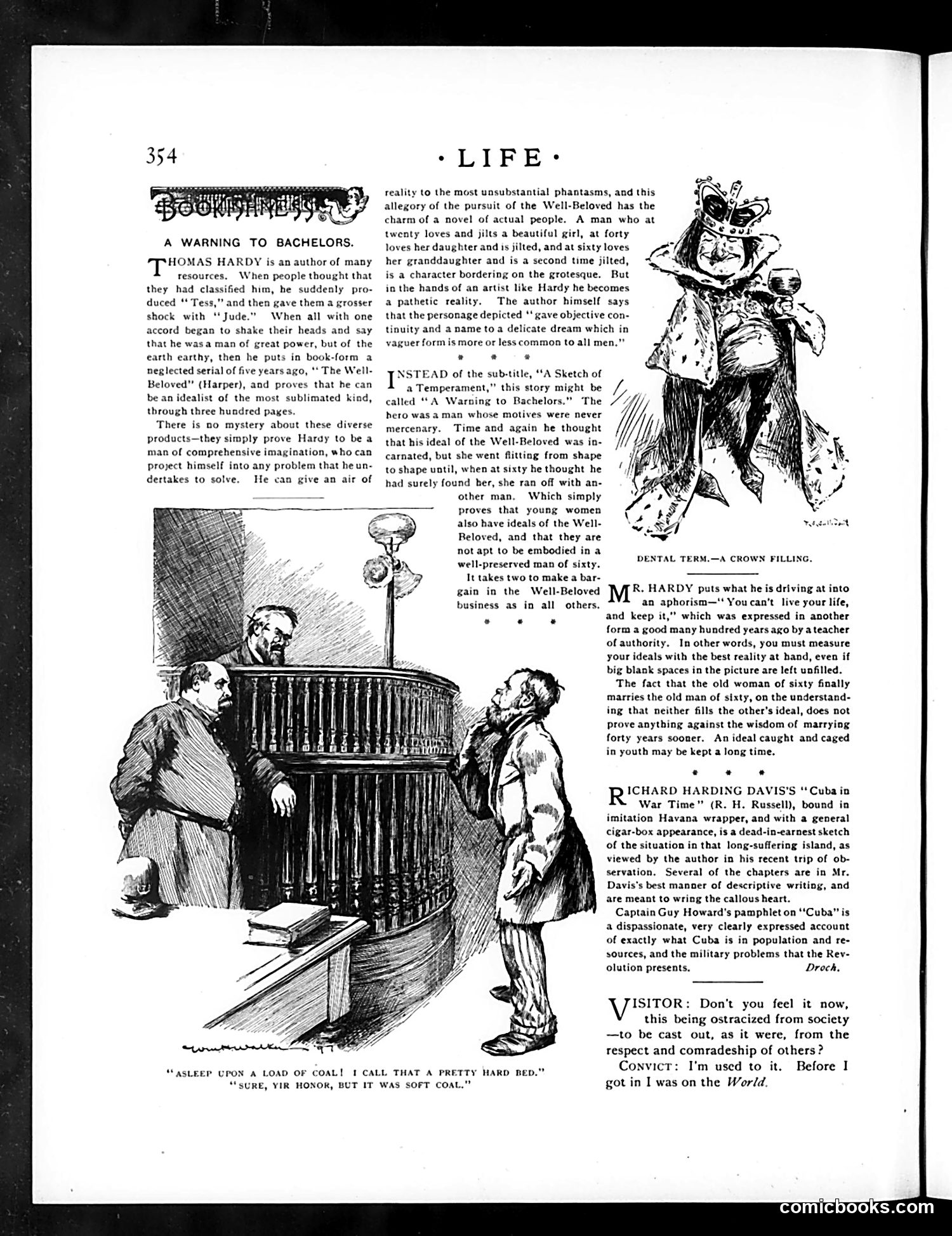
This page satirizes Thomas Hardy's literary work through a cartoon showing two men examining what appears to be a cradle or crib. The accompanying text critiques Hardy's tendency to depict idealized romance that inevitably disappoints—his characters pursue the "Well-Beloved" only to discover reality falls short. The cartoon's caption, "Asleep upon a load of coal! I call that a pretty hard bed. Sure, Vir Honor, but it was soft coal," suggests domestic discomfort and compromised expectations in marriage. The satire warns bachelor readers that Hardy's novels depict men whose romantic ideals—seeking the perfect woman—lead to disillusionment. The message: real relationships involve settling for less than one's youthful dreams, a theme Life's editors found darkly humorous for unmarried male readers.
📄 Transcribed text from this page (OCR, searchable)
Machine-transcribed from the original scan — historical spelling and the odd misread are preserved.
A WARNING TO BACHELORS. THOMAS HARDY is an author of many When people thought that they had classified him, he suddenly pro- duced “ Tess," and then gave them a grosser shock with ‘ Jude.” When all with one accord began to shake their heads and say that he wasa man of great power, but of the earth earthy, then he puts in book-form a neglected serial of five years ago, ** The Well- Beloved" (Harper), and proves that he can be an idealist of the most sublimated kind, through three huadred pages. There is no mystery about these diverse products—they simply prove Haray to be a man of comprehensive imagination, who can project himself into any problem that heun- dertakes to solve. He can give an air of resources, ““ASLEEP UPON A LOAD OF COAL! * LIFE: reality to the most unsubstantial phantasms, and this allegory of the pursuit of the Well-Beloved has the charm of a novel of actual people. A man who at twenty loves and jilts a beautiful girl, at forty loves her daughter and is jilted, and at sixty loves her granddaughter and is a second time jilted, is a character bordering on the grotesque. But in the hands of an artist like Hardy he becomes a pathetic reality, The author himself says that the personage depicted *' gave objective con- tinuity and a name to a delicate dream which in vaguer form is more or less common to all men,” NSTEAD of the sub-title, “A Sketch of a Temperament,” this story might be called “*A Warning to Bachelors.” The hero was a man whose motives were never a Time and again he thought that his ideal of the Well-Beloved was in- carnated, but she went flitting from shape to shape until, when at sixty he thought he had surely found ber, she ran off with an- other man, Which simply proves that young women also have ideals of the Well- Reloved, and that they are Not apt to be embodied in a well-preserved man of sixty. It takes two to make a bar- gain in the Well-Beloved business as in all others, 1 CALL THAT A PRETTY HARD RED.” “SURE, YIR HONOR, BUT IT WAS SOFT Coat.” DENTAL TERM.—A CROWN FILLING. M R, HARDY puts what he is driving at into an aphorism—'‘ You can’t live your life, and keep it,” which was expressed in another form a good many hundred years ago by ateacher of authority. In other words, you must measure your ideals with the best reality at hand, even if big blank spaces in the picture are left unfilled. The fact that the old woman of sixty finally marries the old man of sixty, on the understand- ing that neither fills the other's ideal, does not prove anything against the wisdom of marrying forty years sooner. An ideal caught and caged in youth may be kept a long time. * * * ICHARD HARDING DAVIS'S “Cuba in War Time" (R. H. Russell), bound in imitation Havana wrapper, and with a general cigar-box appearance, is a dead-in-earnest sketch of the situation in that long-suffering island, as viewed by the author in his recent trip of ob- servation. Several of the chapters are in Mr. Davis's best manner of descriptive writing, and are meant to wring the callous heart. Captain Guy Howard's pamphlet on “Cuba” is a dispassionate, very clearly expressed account of exactly what Cuba is in population and re- sources, and the military problems that the Rev- olution presents. Droch. \ASIEOR: Don't you feel it now, this being ostracized from society —to be cast out, as it were, from the respect and comradeship of others? Convicr: I'm used to it. Before I got in I was on the World. comicbooks.com