
Life, 1897-04-29 · page 4 of 20
Life — April 29, 1897 — page 4: what you’re looking at
What you’re looking at
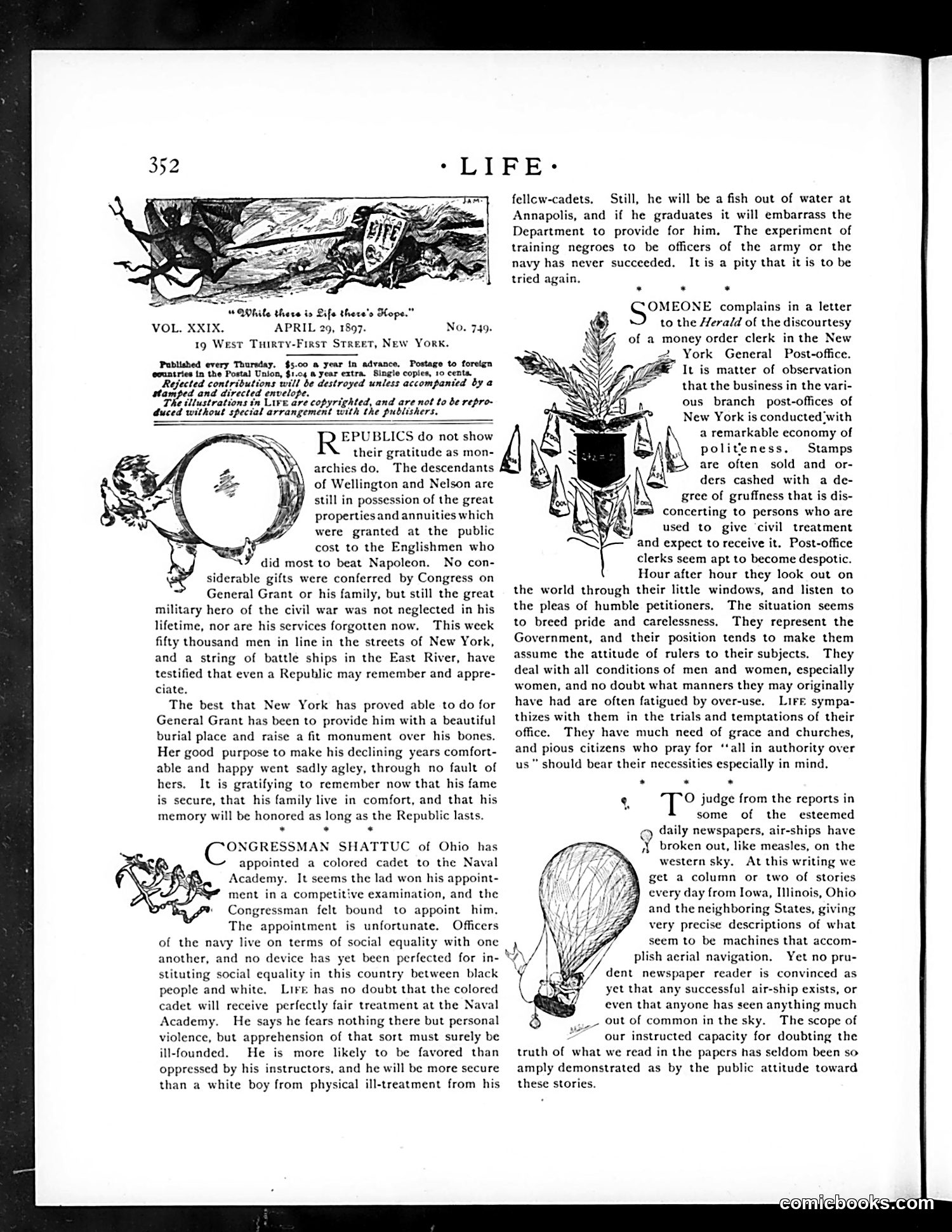
This page contains three distinct editorial pieces without unified cartoon narrative. **Top section** discusses General Grant's legacy and a recent military parade in New York, praising republican gratitude while noting Grant's fame remains secure. **Middle section** critiques Post Office clerks' discourtesy in New York branches, suggesting their government position makes them dismissive toward the public. The satirical point: clerks treat citizens poorly, displaying "pride and carelessness" despite representing the government. **Bottom section** skeptically addresses airship reports in newspapers, noting Ohio papers claim frequent aerial machine sightings despite no verified successful aircraft existing. The satire targets credulous journalism—papers publish unsubstantiated aviation stories that readers increasingly doubt. All three pieces exemplify Life's tradition of social and institutional criticism through short editorial commentary.
📄 Transcribed text from this page (OCR, searchable)
Machine-transcribed from the original scan — historical spelling and the odd misread are preserved.
* LIFE: “While there is Life there's Hope.” VOL. XXIX. APRIL 29, 1897. No. 749. 19 West Tuirty-First Street, New York. Published every Thursday, $5.00 a year In advance. Postage to foreign evuntries in the Postal Union, $1.04 & year extra. Single copies, 10 cents, Rejected contributions will be destroyed unless accompanied by a stamped and directed envelope. . The illustrations in Live are copyrighted, and are not to be repro- duced without special arrangement with the publishers. EPUBLICS do not show their gratitude as mon- archies do, The descendants of Wellington and Nelson are still in possession of the great properties and annuities which were granted at the public i cost to the Englishmen who ¥ did most to beat Napoleon. No con- siderable gifts were conferred by Congress on General Grant or his family, but still the great military hero of the civil war was not neglected in his lifetime, nor are his services forgotten now, This week fifty thousand men in line in the streets of New York, and a string of battle ships in the East River, have testified that even a Republic may remember and appre- ciate. The best that New York has proved able to do for General Grant has been to provide him with a beautiful burial place and raise a fit monument over his bones. Her good purpose to make his declining years comfort- able and happy went sadly agley, through no fault of hers. It is gratifying to remember now that his fame is secure, that his family live in comfort, and that his memory will be honored as long as the Republic lasts. . . . ONGRESSMAN SHATTUC of Ohio has appointed a colored cadet to the Naval Academy. It seems the lad won his appoint- ment in a competitive examination, and the Congressman felt bound to appoint him. The appointment is unfortunate. Officers of the navy live on terms of social equality with one another, and no device has yet been perfected for in- ‘Y stituting social equality in this country between black people and white. Lire has no doubt that the colored cadet will receive perfectly fair treatment at the Naval Academy. He says he fears nothing there but personal violence, but apprehension of that sort must surely be ill-founded. He is more likely to be favored than oppressed by his instructors, and he will be more secure than a white boy from physical ill-treatment from his fellcw-cadets. Still, he will be a fish out of water at Annapolis, and if he graduates it will embarrass the Department to provide for him. The experiment of training negroes to be officers of the army or the navy has never succeeded. It is a pity that it is to be tried again. . . . OMEONE complains in a letter to the Hera/d of the discourtesy of a money order clerk in the New <2, York General Post-office. f It is matter of observation that the business in the vari- ous branch post-offices of New York is conducted‘with a remarkable economy of politieness. Stamps are often sold and or- ders cashed with a de- gree of gruffness that is dis- concerting to persons who are used to give ‘civil treatment " and expect to receive it. Post-office clerks seem apt to become despotic. Hour after hour they look out on the world through their little windows, and listen to the pleas of humble petitioners. The situation seems to breed pride and carelessness, They represent the Government, and their position tends to make them assume the attitude of rulers to their subjects. They deal with all conditions of men and women, especially women, and no doubt what manners they may originally have had are often fatigued by over-use. Lire sympa- thizes with them in the trials and temptations of their office. They have much need of grace and churches, and pious citizens who pray for ‘‘all in authority over us” should bear their necessities especially in mind. * * Te judge from the reports in " some of the esteemed daily newspapers, air-ships have broken out, like measles, on the western sky. At this writing we get a column or two of stories every day from Iowa, Illinois, Ohio and the neighboring States, giving very precise descriptions of what “i cem to be machines that accom- Wf) plish aerial navigation. Yet no pru- dent newspaper reader is convinced as yet that any successful air-ship exists, or even that anyone has seen anything much _- out of common in the sky. The scope of our instructed capacity for doubting the truth of what we read in the papers has seldom been so amply demonstrated as by the public attitude toward these stories.