
A complete issue · 24 pages · 1897
Life — March 25, 1897
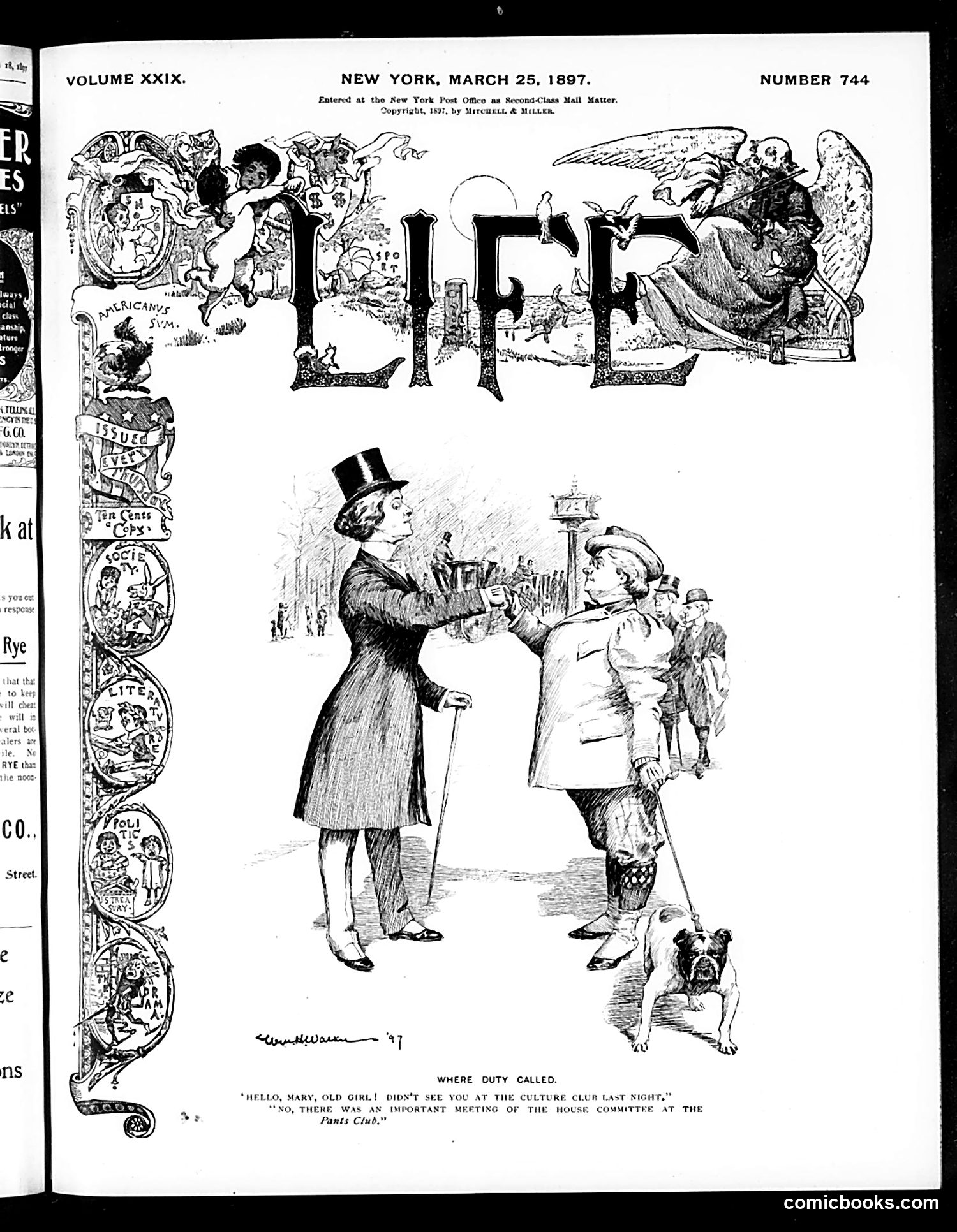
This cartoon satirizes social priorities among the wealthy elite. Two well-dressed gentlemen encounter each other on the street; one explains he missed a "Culture Club" event because of an "important meeting of the House Committee at the Pants Club." The joke mocks the pretension of high society: while one man claims cultural sophistication by attending a "Culture Club," his acquaintance reveals he was occupied with the "Pants Club"—seemingly a frivolous gentlemen's social organization. The satire suggests that despite pretenses of refined taste and intellectual pursuits, the wealthy are actually preoccupied with trivial social clubs and leisurely pursuits. A small dog accompanies one figure, emphasizing the leisurely, inconsequential nature of their concerns.
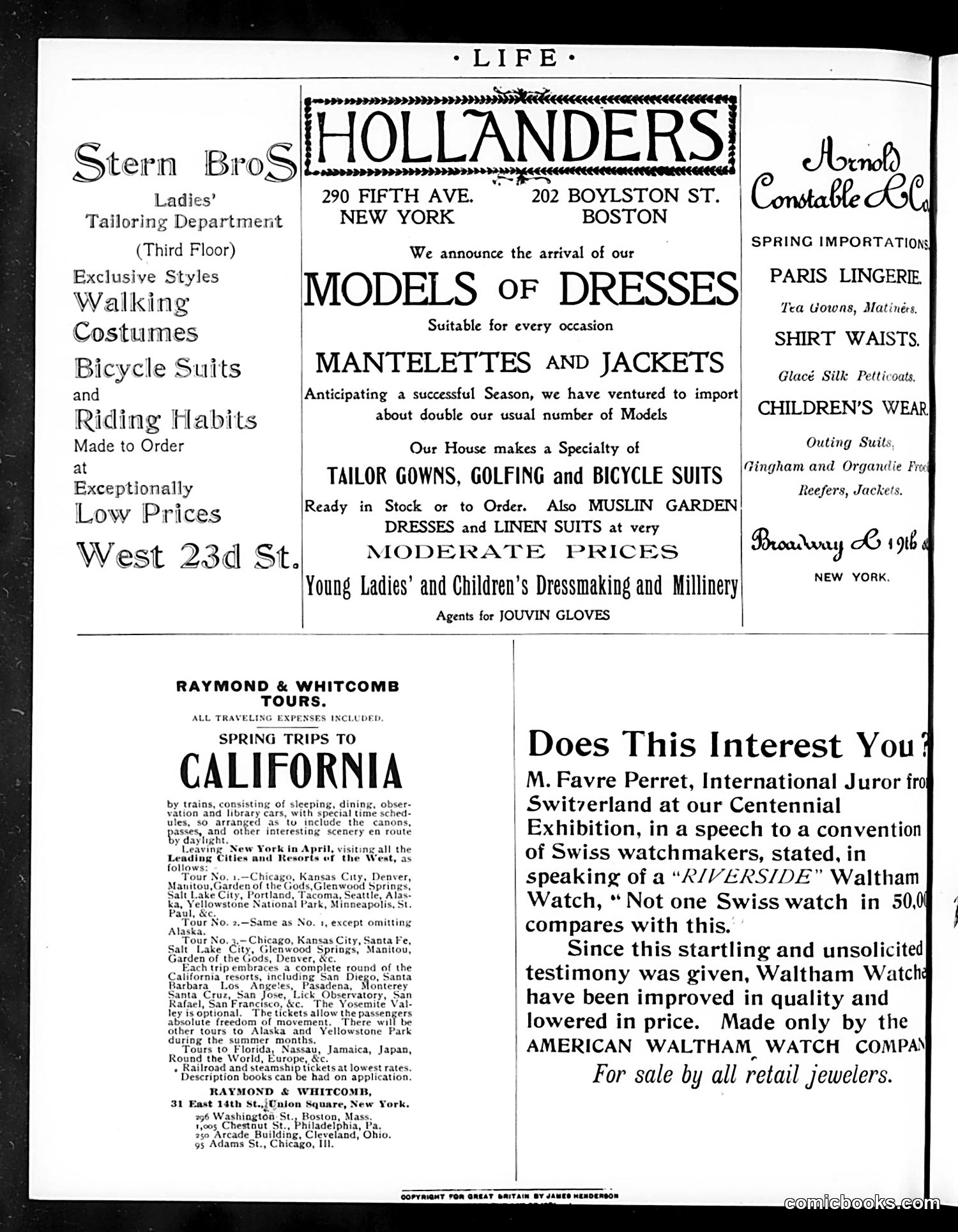
This page is primarily **advertising content** rather than political satire or editorial cartoons. It contains four distinct advertisements: 1. **Stern Bros.** (left) - Women's tailoring and bicycle suits 2. **Hollanders** (center) - Fashion models, dresses, mantels, jackets, and tailor gowns 3. **Arnold Constable & Co.** (right) - Spring importations including Paris lingerie and children's wear 4. **Raymond & Whitcomb Tours** (lower left) - California spring trips 5. **American Waltham Watch Company** (lower right) - Advertisement featuring a testimonial from an international Swiss juror praising their watches There are no political cartoons, caricatures, or satirical commentary visible on this page. It represents typical early 20th-century magazine advertising focused on women's fashion, travel services, and luxury goods.
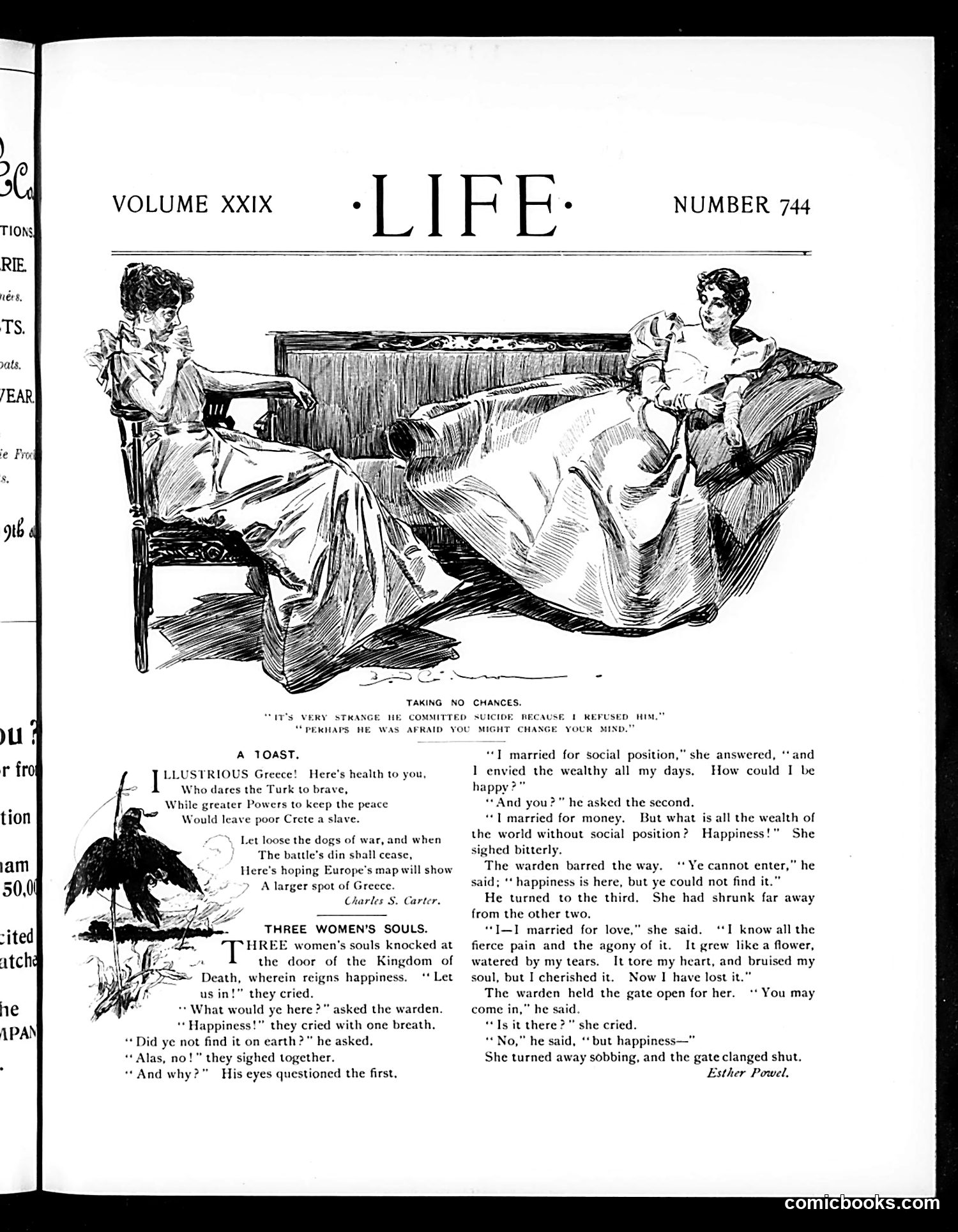
This page contains two pieces of satirical social commentary: **"Taking No Chances"** (top illustration): Two women discuss a man's suicide. One explains he refused her, fearing she might change her mind—a darkly humorous jab at women's perceived fickleness in romance and marriage. **"A Toast"** and **"Three Women's Souls"**: These verses mock European geopolitical ambitions and examine women's marital motivations. "A Toast" satirizes Turkish and Greek conflicts while praising larger territorial gains for Europe. "Three Women's Souls" presents an allegory where three women seeking happiness enter Death's kingdom—one married for position, one for money, one for love—all disappointed. The satire critiques materialistic marriage while questioning whether romantic love provides genuine fulfillment either. The overall theme: social hypocrisy surrounding marriage, wealth, and women's limited agency.
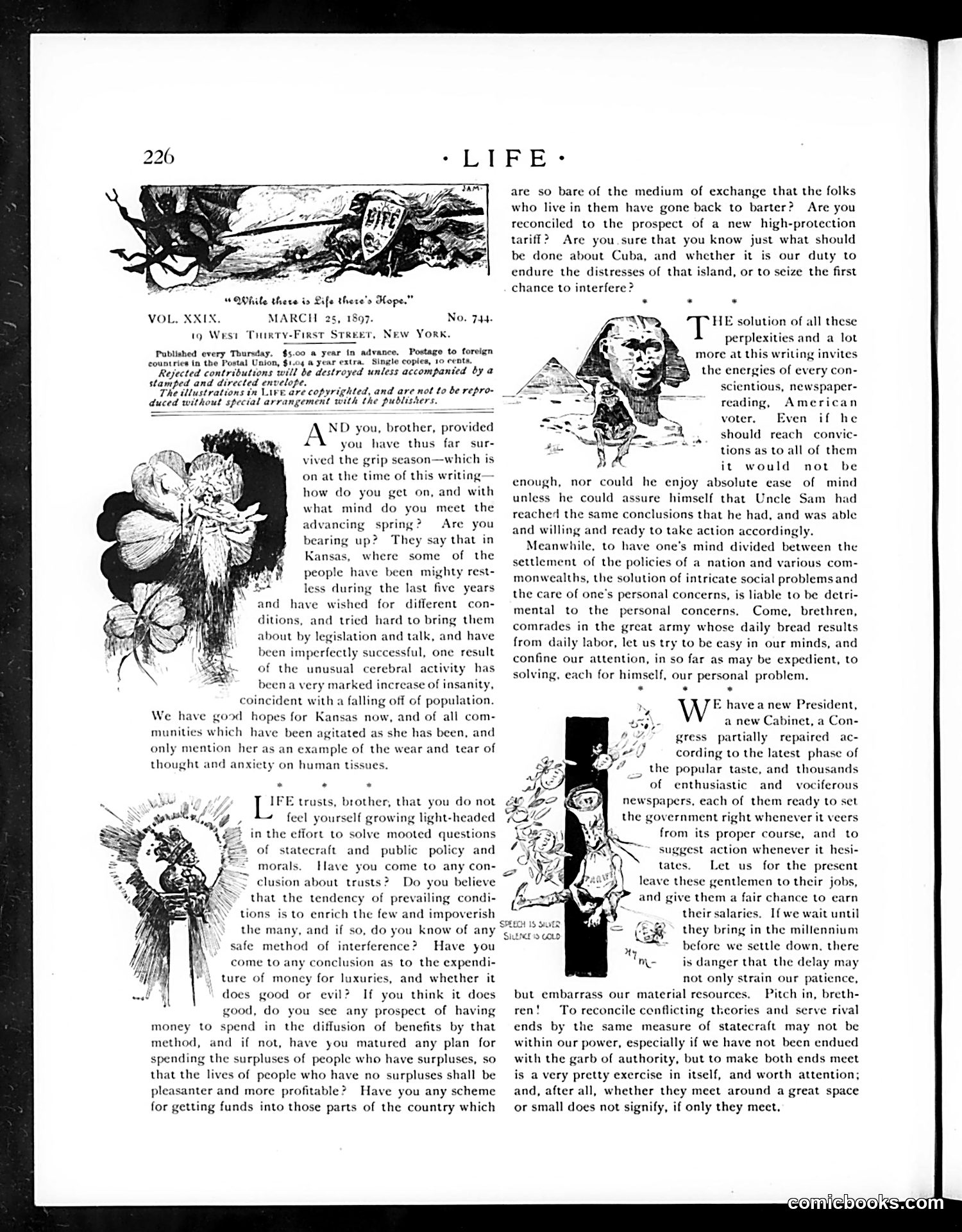
This page contains editorial text addressing multiple pressing issues of the 1897 period: tariff policy, Cuba (likely referencing tensions preceding the Spanish-American War), and newly elected President William McKinley's administration. The illustrations appear to be decorative political cartoons rather than specific caricatures. The text urges American voters to engage thoughtfully with complex policy questions—particularly regarding trade protectionism, interference in foreign conflicts, and equitable distribution of national wealth. The editor argues that citizens should balance concern for national policy with personal concerns, while cautioning against "light-headed" responses to political agitation. The tone suggests skepticism toward both radical economic proposals and hasty foreign intervention, appealing for measured deliberation rather than emotional reaction to contemporary crises.
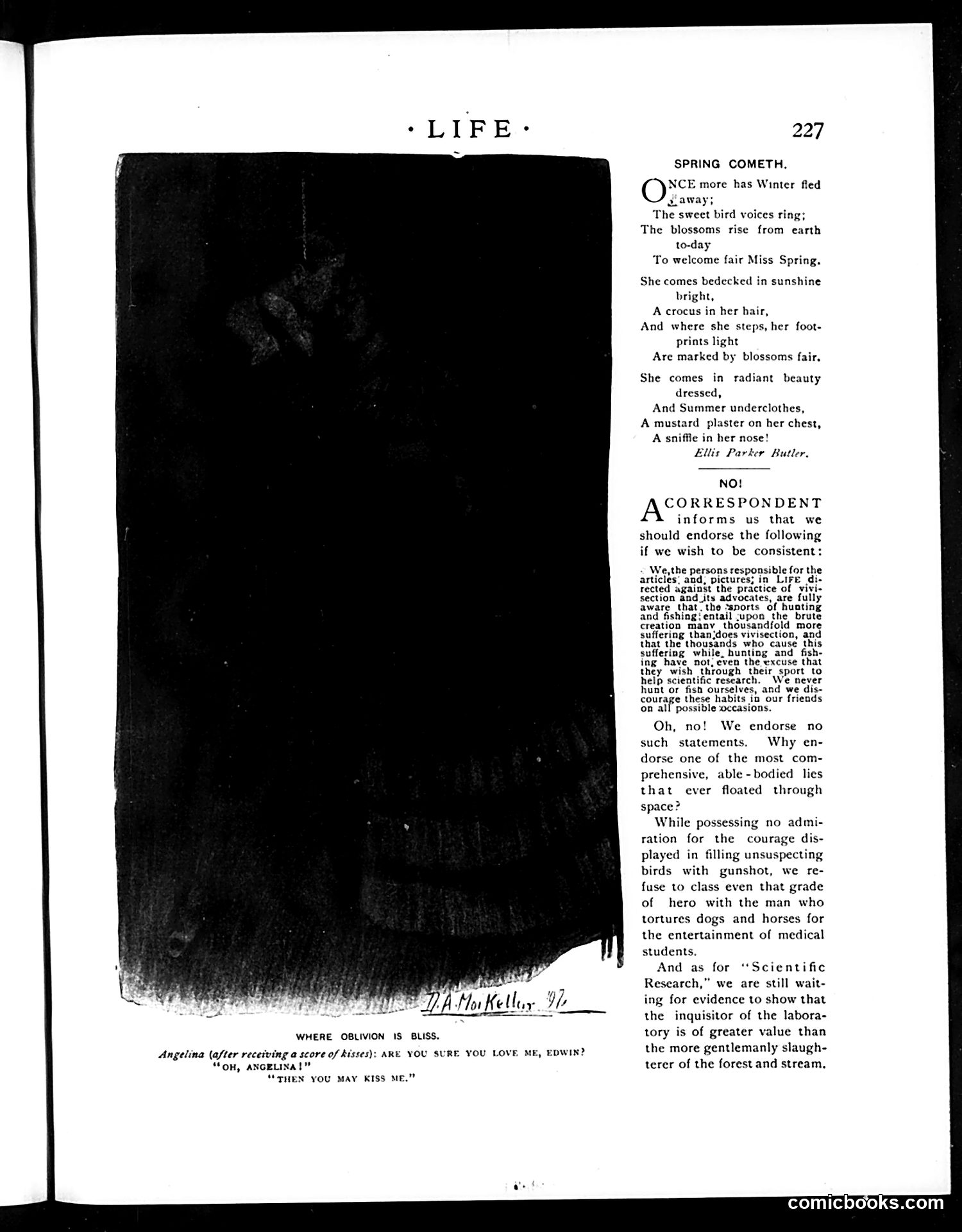
This page contains two distinct elements: **"Spring Cometh" (poem):** A lighthearted verse by Ellis Parker Butler celebrating Spring's arrival, personified as an attractive woman bringing warm weather and flowers. **"No! A Correspondent" (editorial):** Life magazine's response to reader mail defending their hunting and fishing coverage. The editors reject criticism that such content promotes animal cruelty, arguing they don't endorse "unsuspecting birds with gunshot" or torturing animals for medical entertainment. They refuse to equate hunters with vivisectionists performing laboratory experiments. **The cartoon** (credited to J.A. Horsley) depicts a romantic scene titled "Where Oblivion is Bliss," showing a kissing couple with dialogue about love. The page reflects early 20th-century debates about animal welfare versus recreational hunting—still contentious today. Life positioned itself as defending traditional pastimes against growing animal-protection criticism.
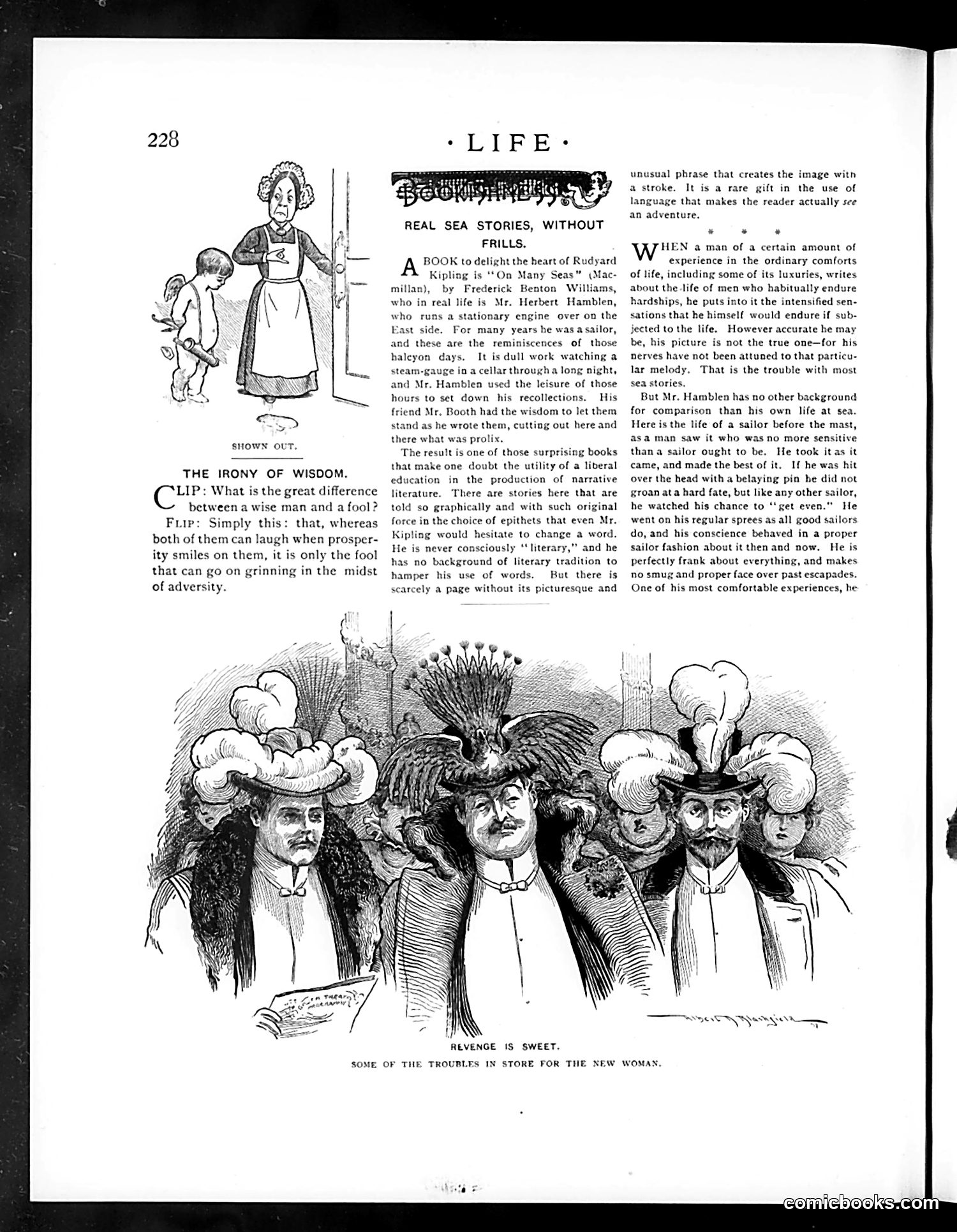
**Top Section - "The Irony of Wisdom":** This brief text piece contrasts wise men and fools, noting that both can laugh at prosperity's smiles, but only fools find humor in adversity—"the tool that can go grinding in the midst of adversity." **Main Content - Book Review:** The page reviews Rudyard Kipling's "On Many Seas" (Macmillan), a collection of sea stories by Herbert Hamblen, a former sailor and stationary engine operator. The reviewer praises Hamblen's authentic sailor perspective and vivid storytelling, though noting his lack of literary training. The work contains picturesque language and original narrative force comparable to Kipling's standards. **Bottom Cartoon - "Revenge is Sweet":** The illustration captioned "Some of the Troubles in Store for the New Woman" depicts five men wearing elaborate, ornate hats with large plumes—apparently satirizing fashion-conscious men's anxieties about the emerging "New Woman" movement of the era.
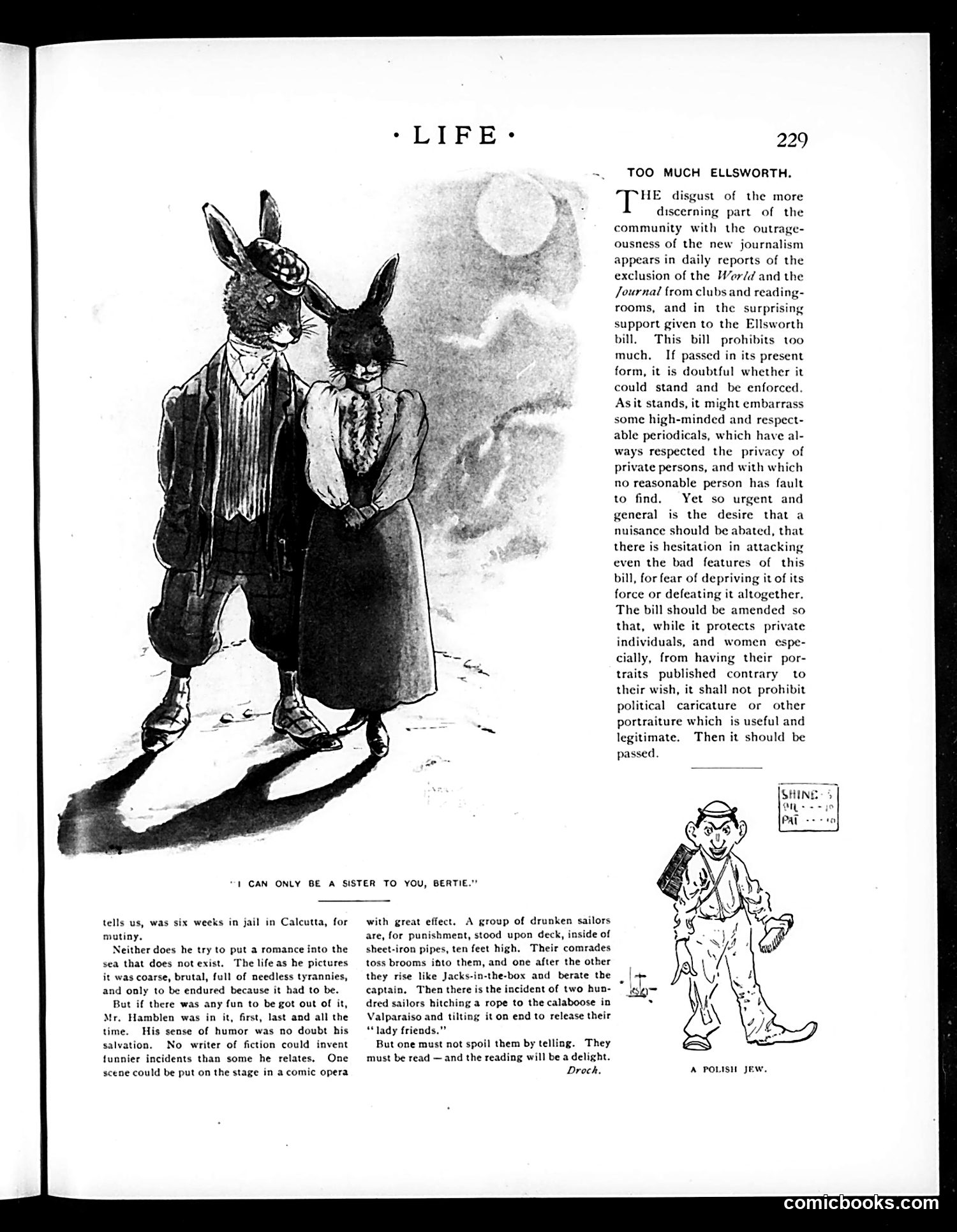
The main cartoon depicts two anthropomorphic rabbits in formal dress with the caption "I CAN ONLY BE A SISTER TO YOU, BERTIE." This appears to be a romantic or domestic joke, playing on Victorian courtship conventions through animal caricature. The article "TOO MUCH ELLSWORTH" critiques the "Ellsworth bill," apparently a proposed law restricting press coverage. The piece argues the bill, while well-intentioned in protecting privacy (especially for women), goes too far by potentially prohibiting legitimate political satire and caricature. A smaller cartoon labeled "A POLISH JEW" shows a caricatured figure—likely reflecting period ethnic humor conventions of the magazine. The page exemplifies early-20th-century satirical commentary on journalism, privacy legislation, and social attitudes expressed through both visual and written criticism.
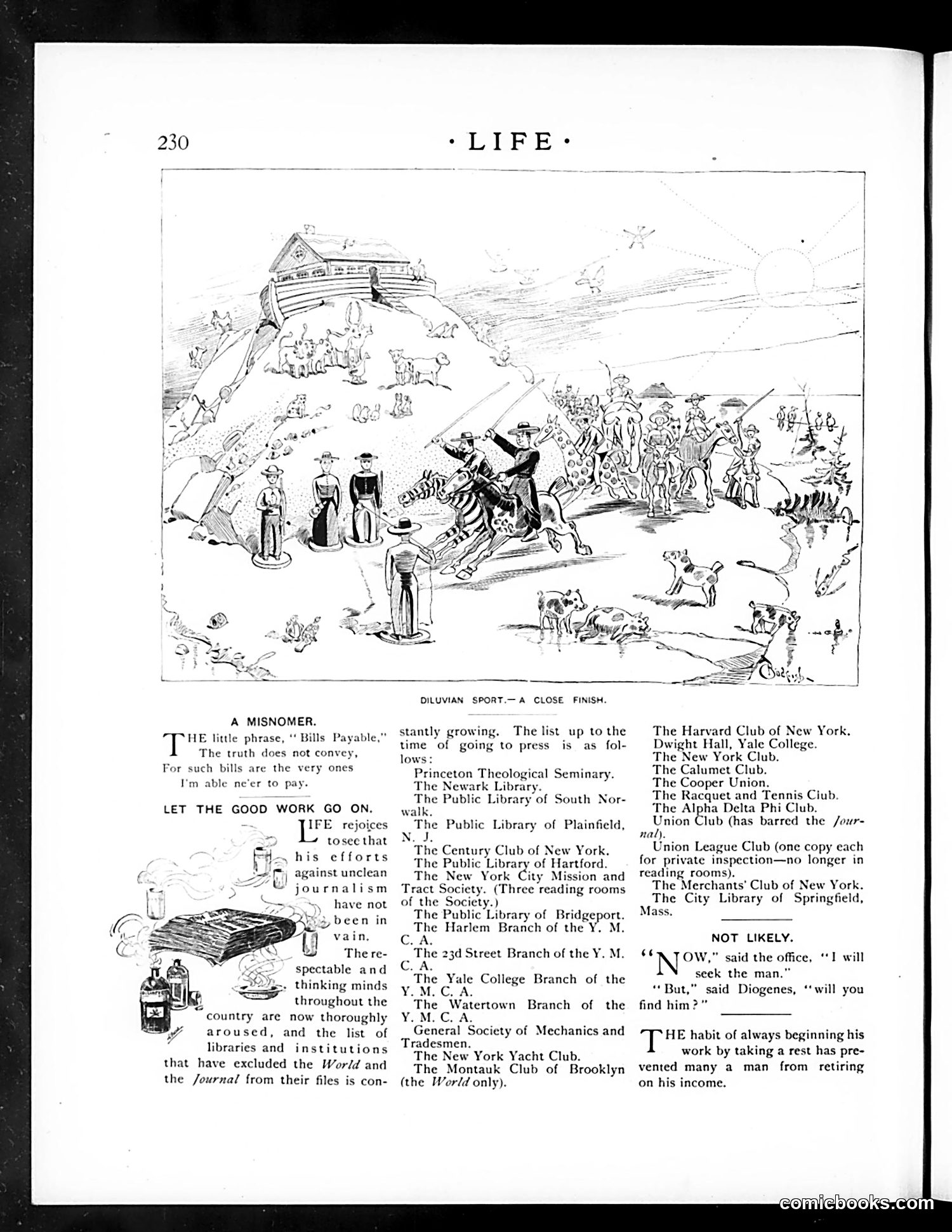
This cartoon depicts Noah's Ark as the setting for a satirical sporting event. Figures in period dress observe what appears to be a chaotic race or competition near the ark, with various animals scattered about. The title "Diluvian Sport" references the biblical flood. The satire likely mocks fashionable sporting pursuits of the era by placing them in an absurd historical/religious context. The detailed crowd and formal observers suggest commentary on how people treat sports competitions with unwarranted seriousness, even in circumstances (like a world-ending flood) where such frivolity would be inappropriate. The cartoon's humor derives from the incongruity between the solemn biblical scenario and the trivial athletic competition occurring within it.
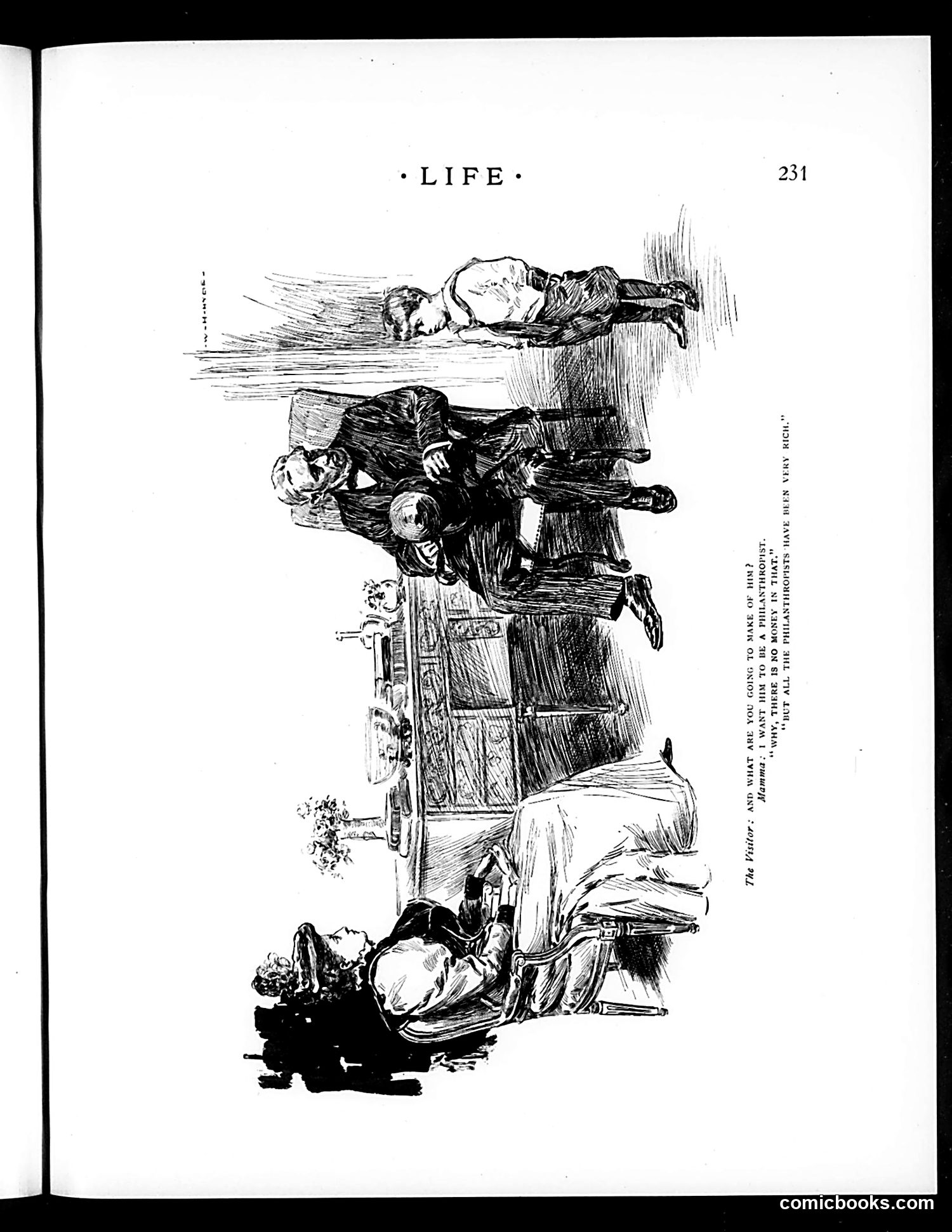
This page from *Life* magazine (page 231) contains a single editorial cartoon titled "The Harness" that appears to satirize political or social control. The image shows multiple figures arranged vertically—some appearing constrained or weighted down by various mechanisms or constraints, while others stand above them in positions of authority or control. The caption's text (partially legible in the image) suggests commentary on restrictions imposed upon citizens or groups. The sketch style and composition indicate this critiques some form of oppressive system or governance structure, with the "harness" metaphor suggesting that people are being controlled like animals or subjected to limiting constraints against their will. Without clearer visibility of all textual elements, the specific political figures or events referenced remain unclear, though the overall message concerns loss of freedom or autonomy.
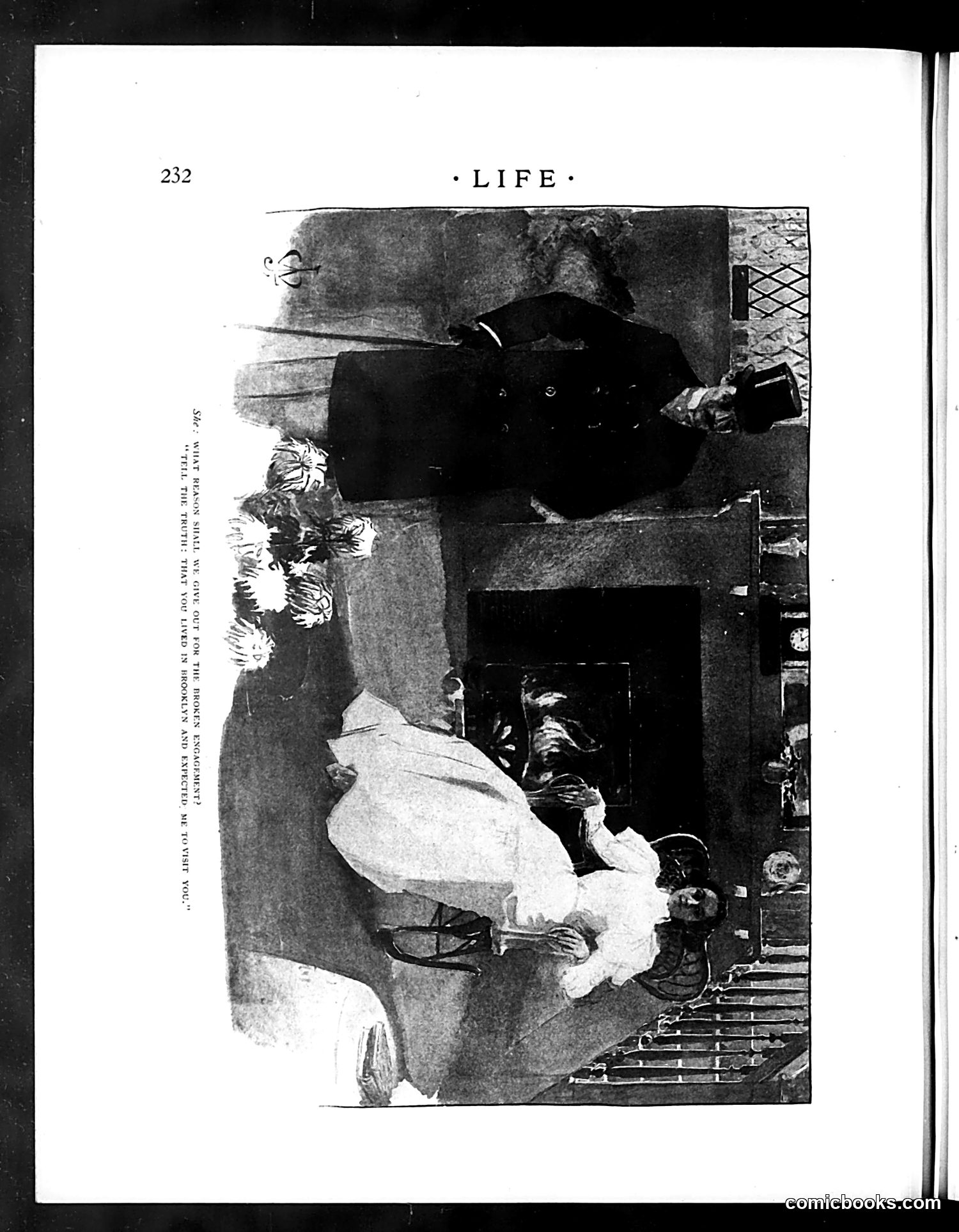
This page from *Life* magazine (page 232) shows a photograph rather than a cartoon. The image depicts what appears to be a formal or official scene, rotated 90 degrees, showing a woman in a white dress and a man in dark formal attire near a doorway with flowers visible. The caption text along the left margin is partially legible but difficult to read completely in this reproduction. Without being able to clearly read the identifying text or caption, I cannot definitively identify the specific figures or the satirical point being made. To properly explain this content to a modern reader, I would need clearer text or additional context about the issue date and subject matter. The page number and "LIFE" header confirm this is from the magazine, but the specific reference remains unclear from this image alone.
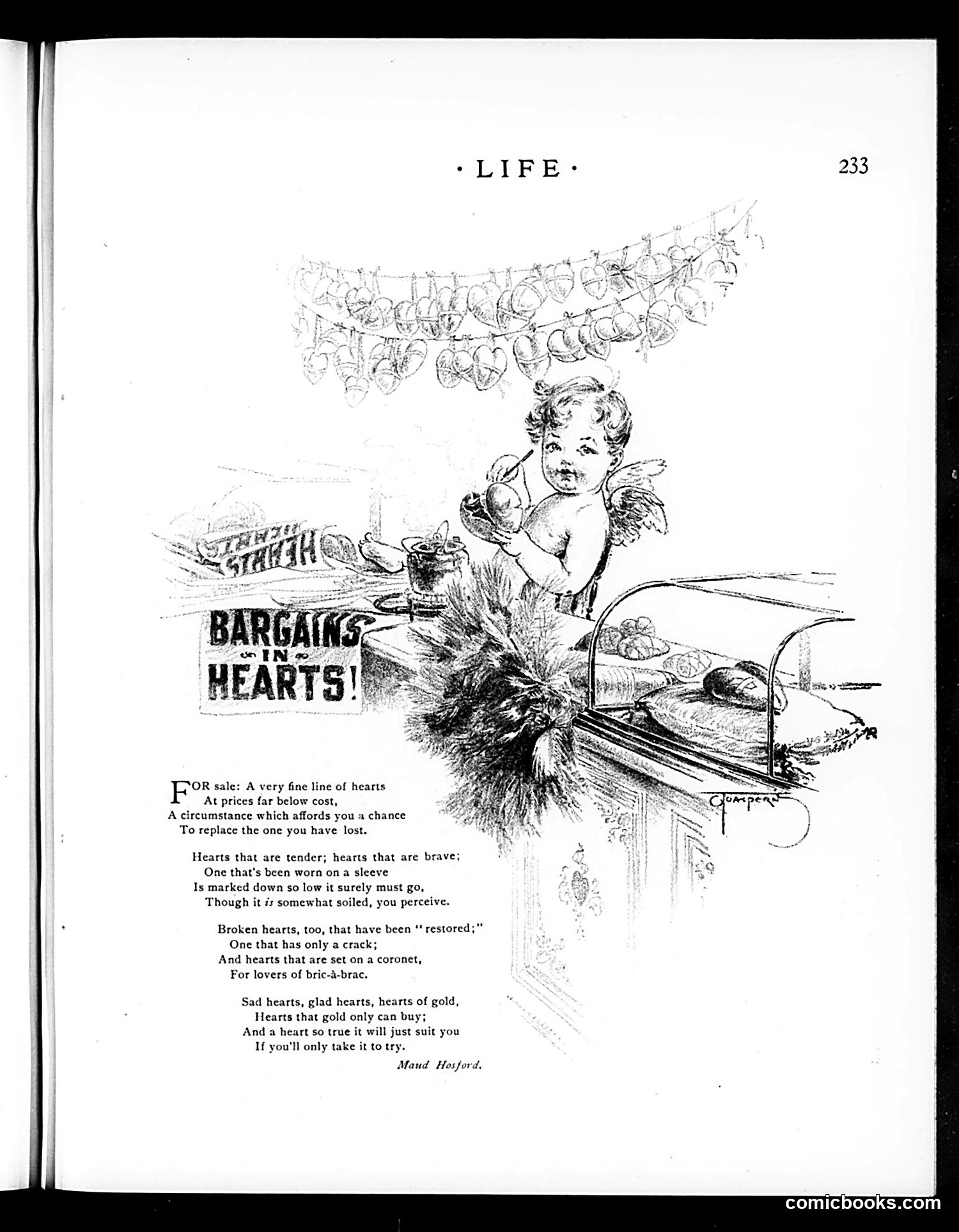
This page features a whimsical illustration by a cupid figure offering "hearts for sale" at bargain prices. The poem by Maud Holford beneath uses heart metaphors to satirize romance and relationships: hearts that are "tender" or "brave," worn-out hearts, broken hearts that have been "restored," and hearts "set on a coronet" (suggesting mercenary marriage to nobility). The satire critiques the commercialization of romance and love in modern society. It mocks various relationship types—sentimental, damaged, social-climbing—by treating hearts as merchandise with different values and conditions. The cupid's street-vendor setup transforms romantic love into a literal marketplace transaction, suggesting that in contemporary society, even the most intimate human emotions have been reduced to commodities to be bought and sold.
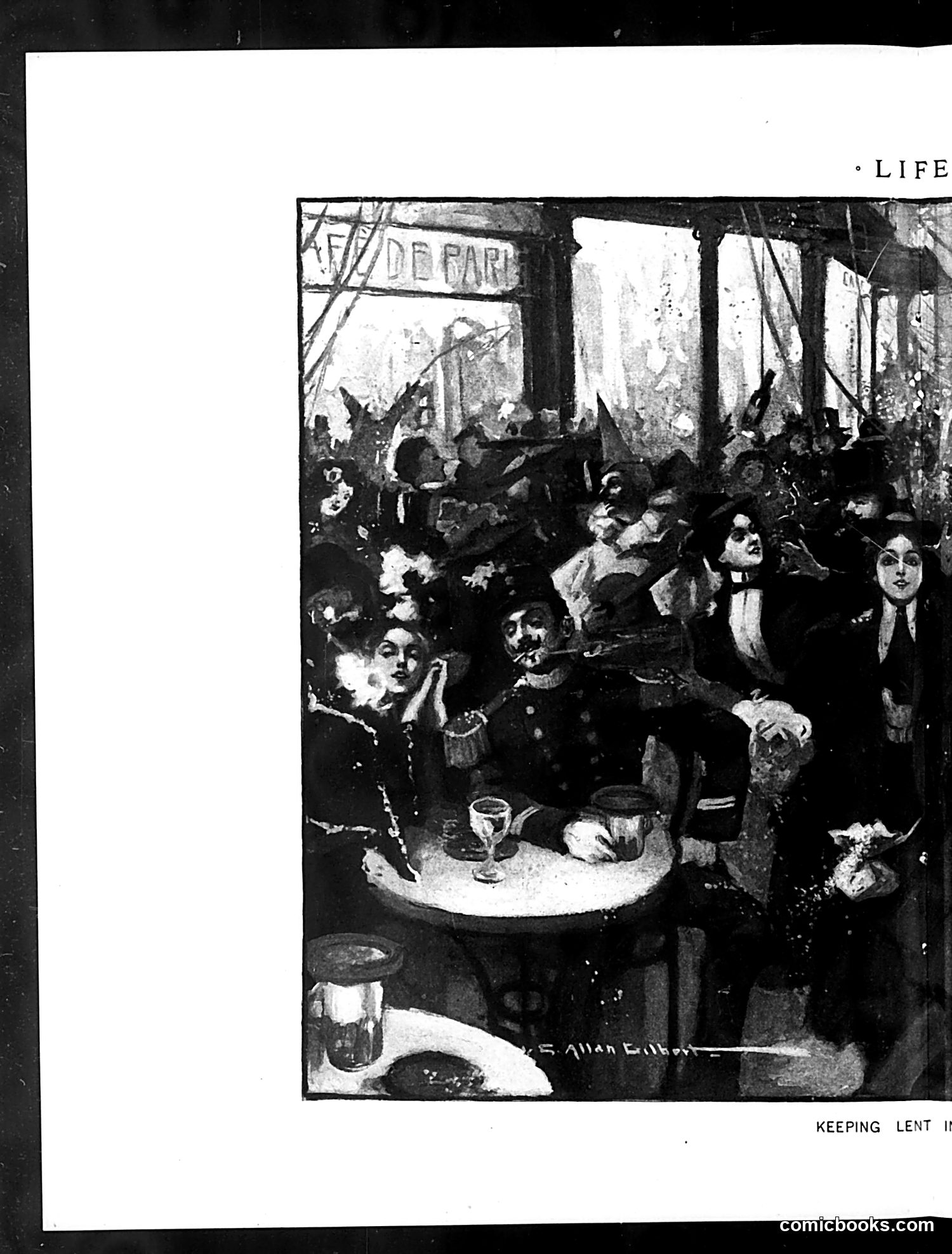
This appears to be a satirical illustration from *Life* magazine depicting a crowded indoor scene, possibly a café or restaurant, signed by Allan Gillbert. The caption reads "KEEPING LENT IN..." (text cut off). The image shows numerous well-dressed figures in early 20th-century attire gathered in what appears to be an elegant establishment with large windows. Given the "Keeping Lent" reference—a Catholic observance period of fasting and abstinence—this is likely satirizing the hypocrisy of wealthy or fashionable people who claim religious observance while indulging in luxury dining and social pleasures. The crowded, opulent setting contrasts with the supposed spiritual restraint of Lenten practice, making the joke about performative religiosity among the elite.
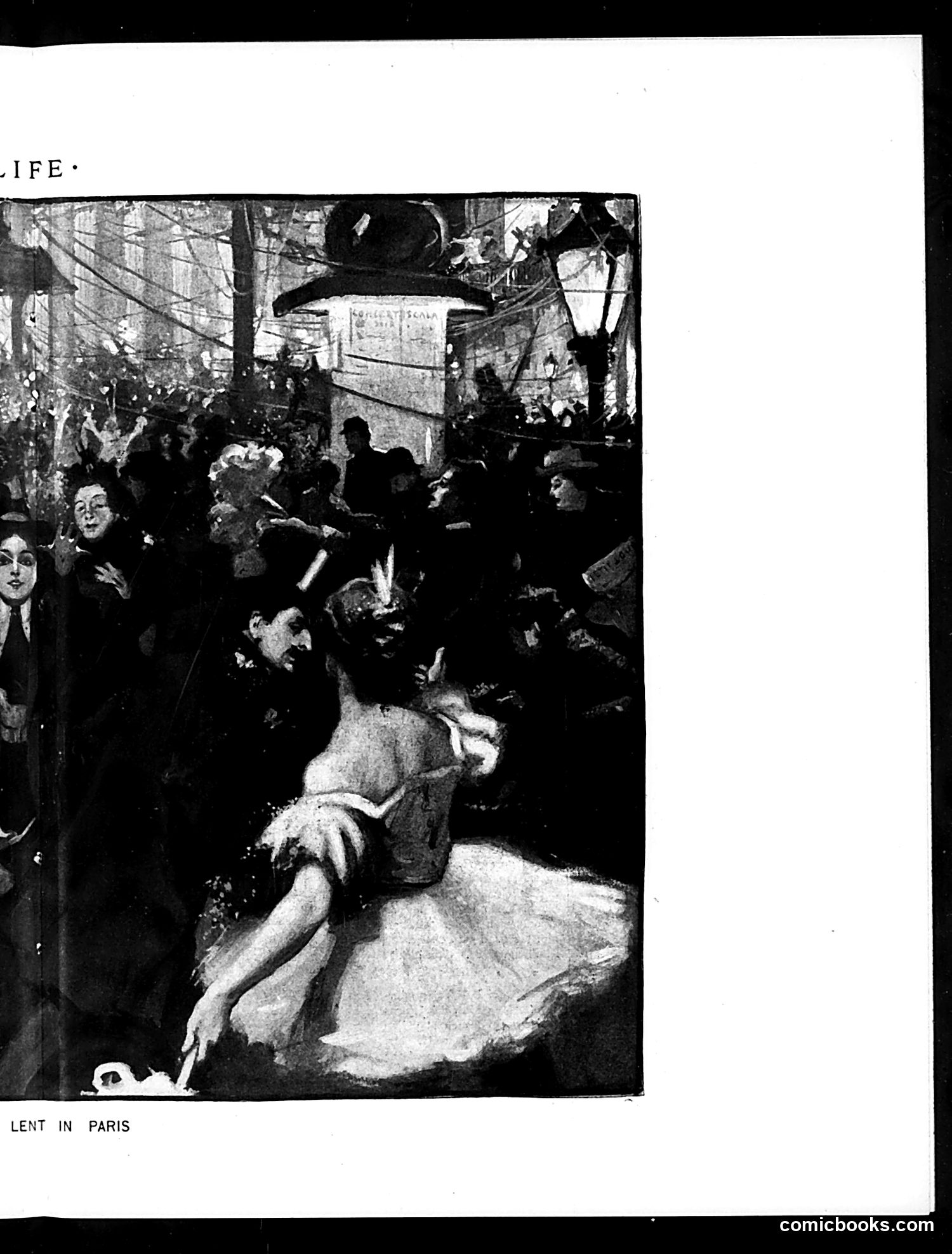
This photograph documents a Parisian Lenten celebration, likely from the early-to-mid 20th century. The image shows a large crowd gathered around a central figure—a woman in a light-colored dress performing what appears to be a theatrical or carnival performance. The onlookers are densely packed and dressed in dark winter clothing, suggesting a public street gathering. The caption "Lent in Paris" suggests satirical commentary on the contrast between Lenten religious observance (traditionally a period of restraint and penance) and Parisian revelry and entertainment. Life magazine frequently used such juxtapositions to mock both religious hypocrisy and Parisian culture stereotypes popular with American audiences. The crowded, chaotic scene emphasizes the abandonment of restraint characteristic of pre-Lenten celebration.
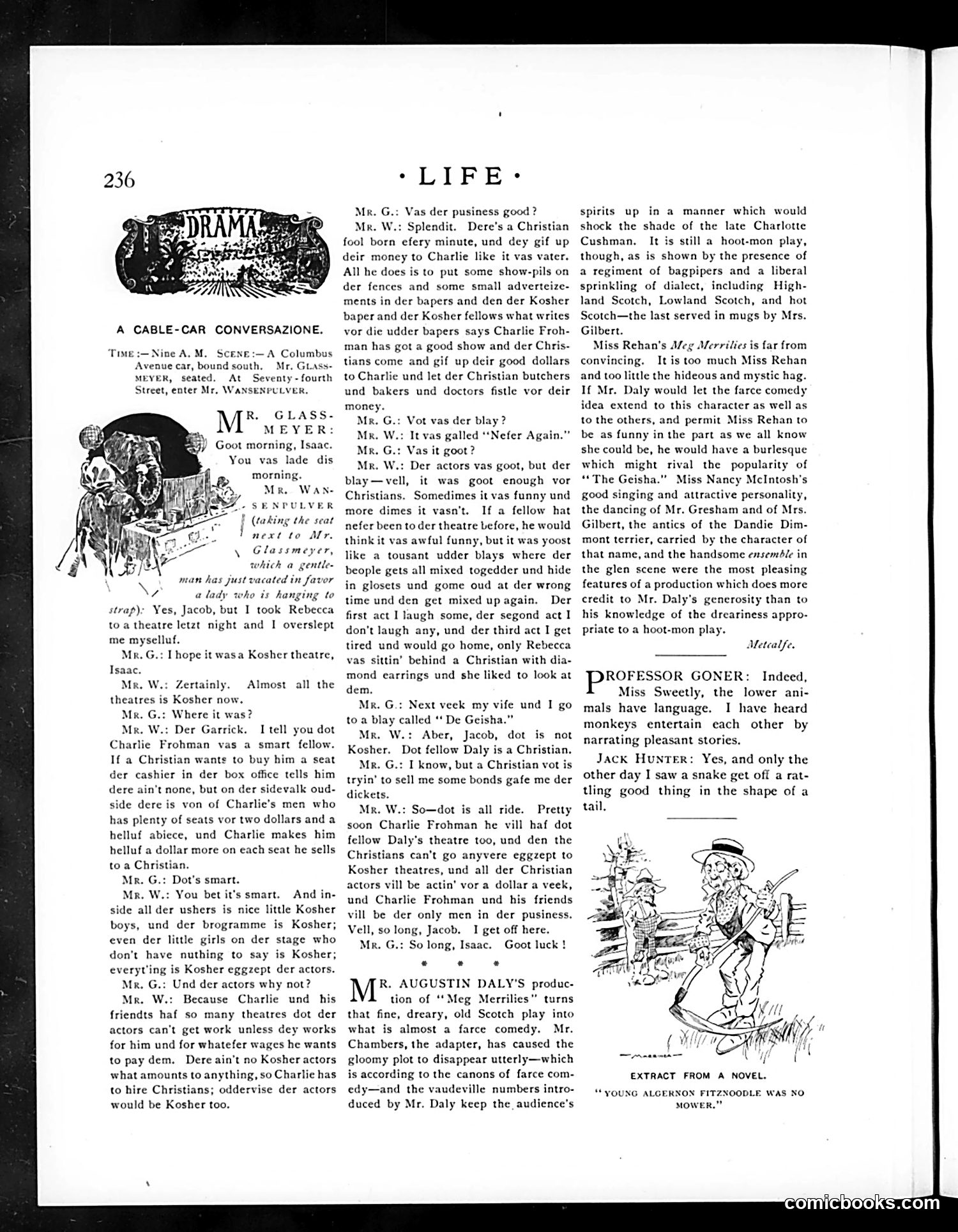
This satirical dialogue mocks Jewish immigrant theater operators, specifically Charlie Frohman, a real Broadway producer of the era. Two Yiddish-accented Jewish characters discuss Frohman's business practices on a Columbus Avenue cable car. The satire alleges that Frohman deliberately employs only Jewish staff (ushers, stagehands) and reserves Christian actors for stage roles while paying them minimal wages. The joke hinges on portraying Jewish businessmen as shrewd exploiters who monopolize theaters and manipulate Christian audiences and workers—playing on common turn-of-the-century antisemitic stereotypes about Jewish financial control. The heavy Yiddish dialect in the dialogue itself is part of the mockery. While framed as humor, the piece reflects genuine prejudices about Jewish immigrants dominating American entertainment at that time.
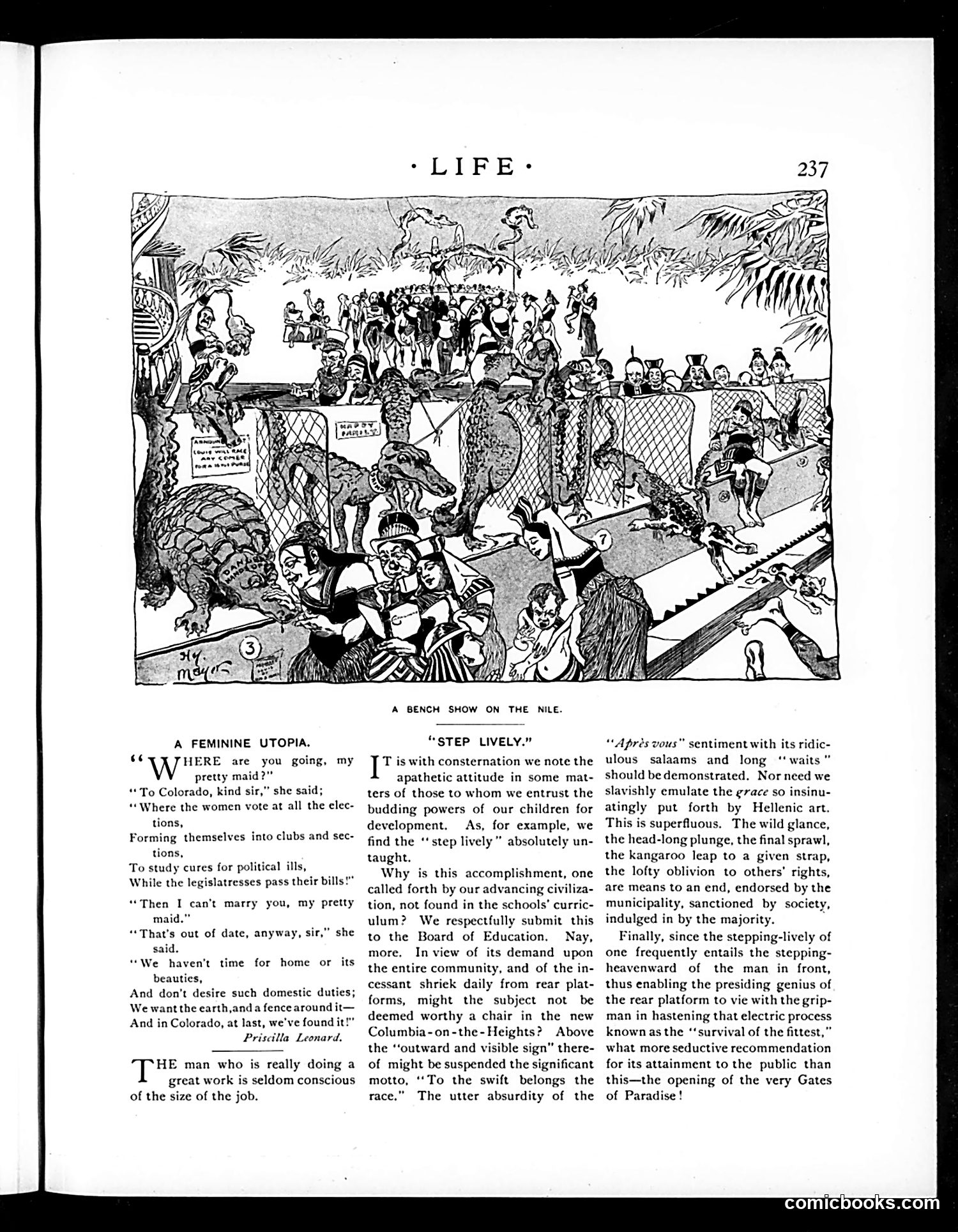
This Life magazine page contains two distinct satirical pieces: **"A Feminine Utopia"** mocks women's suffrage and activism in Colorado (which had granted women voting rights in 1893). The poem presents a young woman rejecting marriage and domestic life to join women's clubs studying "political ills" and passing legislation. The satire suggests that female political participation makes women unsuitable wives and represents an absurd inversion of natural gender roles—reflecting widespread anti-suffrage sentiment of the era. **"A Bench Show on the Nile"** and its accompanying cartoon satirize New York City transit conditions, specifically the aggressive, rude behavior of subway passengers rushing to board cars. The text sarcastically proposes teaching "step lively" (hurrying) as an official school subject, mocking both the chaos of modern urban transportation and the brutish competitiveness it encourages. The exotic "Nile" reference adds ironic distance to critique contemporary American society. Both pieces reflect turn-of-the-century anxieties about modernization, women's rights, and urban life.
This is primarily a **humor and advertising page** from Life magazine, not a political cartoon. The main content consists of brief anecdotes and jokes typical of the period. The largest illustrated humor piece depicts a **Professor arriving home late**, unable to remember what he wanted to do—the punchline being he simply wanted to sleep. This is gentle domestic humor. Other items include: - A **minstrel character** (George Clarke) being cross-examined as a witness—using the common "low profession" stereotype of the era - A joke about "horseless carriages" (early automobiles), mocking people's indifference to this new invention - A soldier receiving a Transvaal half-crown coin with President Kruger's image, finding it amusing The advertisements dominate the lower half, promoting Knox hats, Whiting paper, and other products. The tone is lighthearted rather than satirically biting—typical of Life's genteel humor format for this period.
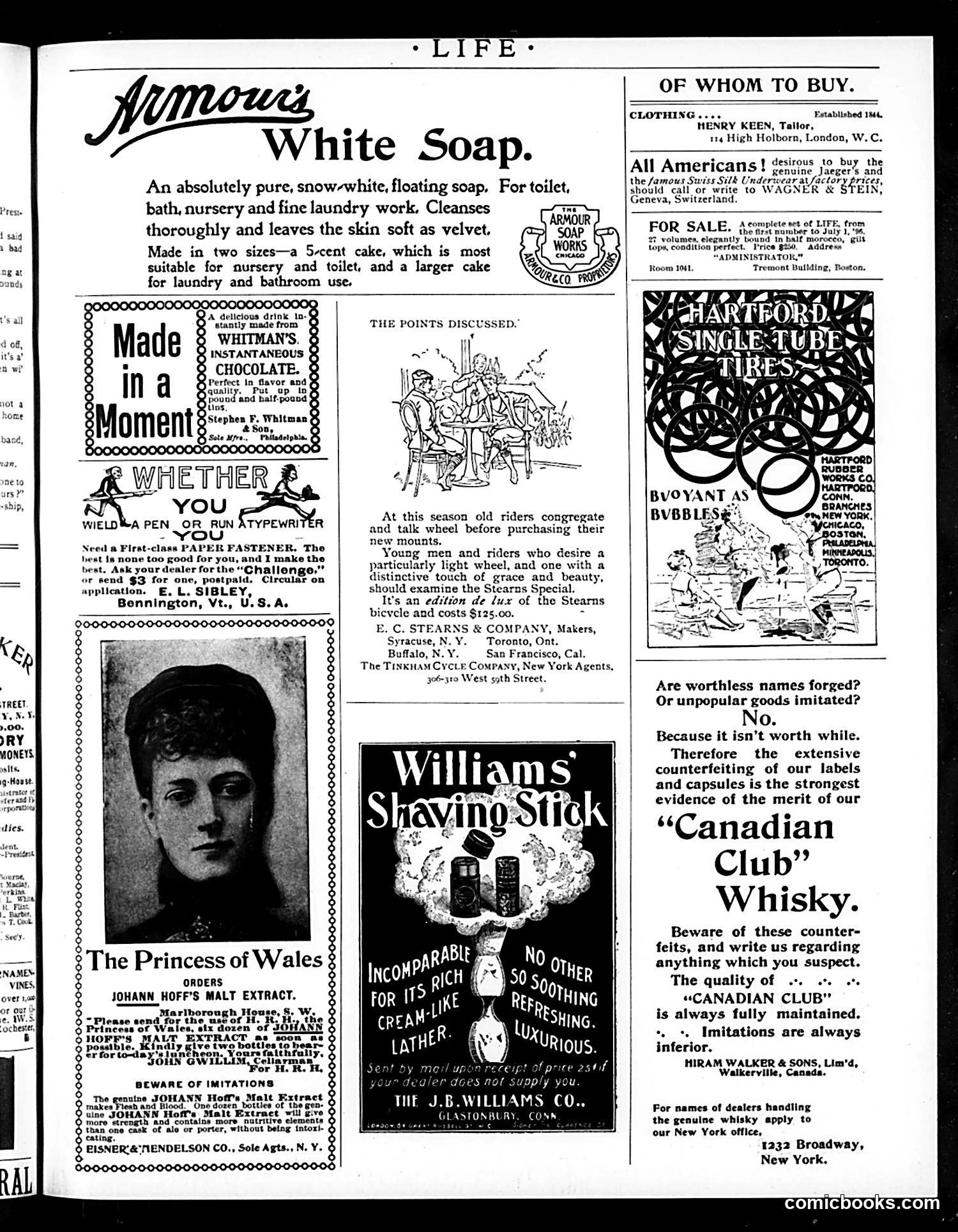
This is primarily a **Victorian-era advertisement page** (circa 1890s-1900s), not a political cartoon. The page features product ads rather than satire. Notable content includes: - **Armour's White Soap**: Standard product pitch emphasizing purity and gentleness - **Johann Hoff's Malt Extract**: Features a testimonial allegedly from the Princess of Wales, leveraging royal endorsement for credibility—a common marketing tactic of the era - **Bicycles and shaving products**: Period-appropriate consumer goods - **"Canadian Club" Whisky**: An anti-counterfeiting message, acknowledging that the brand's popularity made it worth imitating The sole humorous element is a small illustration labeled "The Points Discussed" showing cyclists debating bicycles—light social commentary on consumer preferences rather than satire. The page reflects how turn-of-century *Life* magazine blended advertising with editorial content, and how brands used celebrity endorsement and warnings about fakes to build consumer trust.
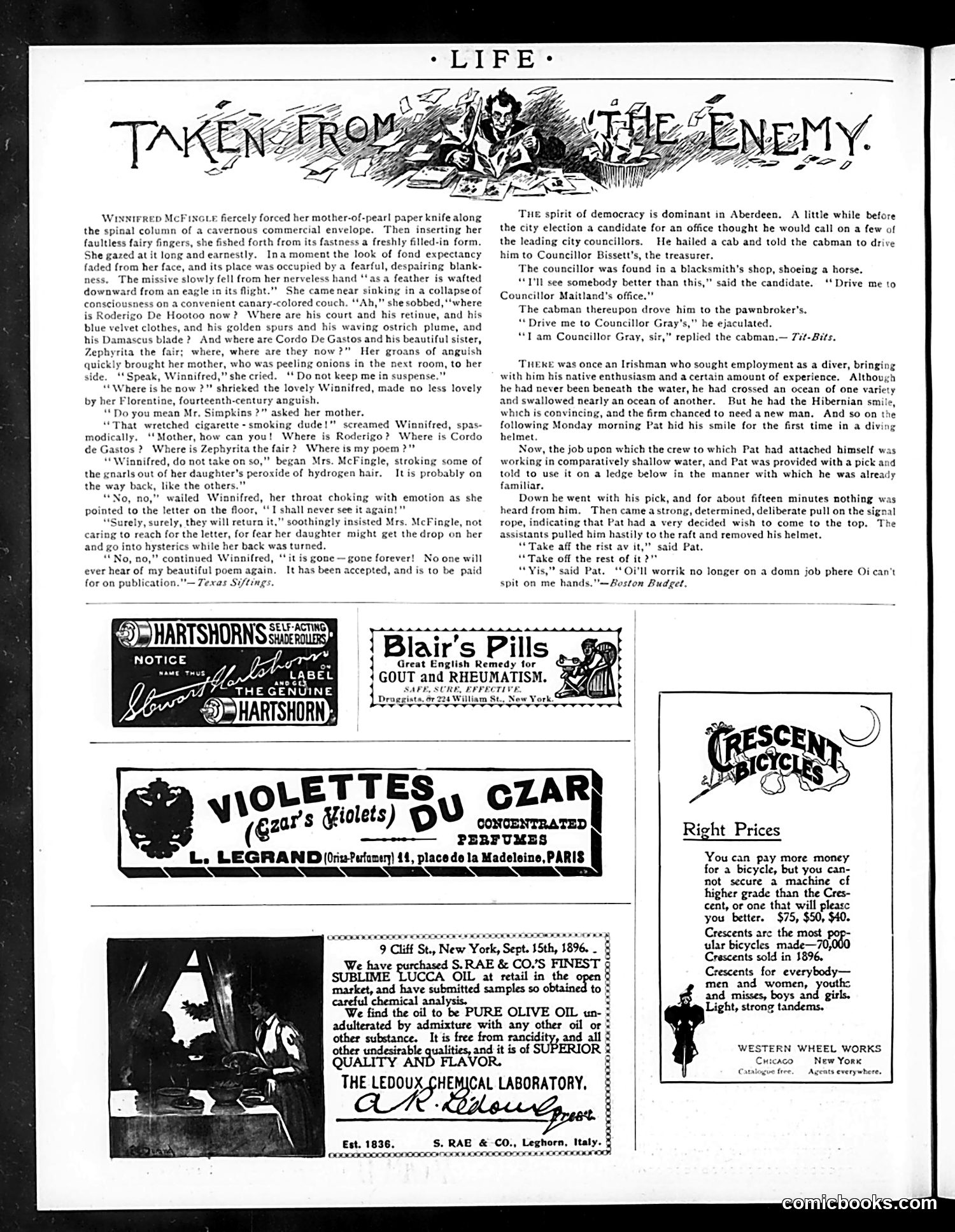
This page contains three humorous stories typical of Life's satirical format: **Main Story**: A melodramatic parody about "Winnifred McFingle," a young woman who receives rejection of her submitted poem/manuscript. The overwrought prose mocks both overly-sentimental romantic fiction and frustrated aspiring writers. The joke: her poem's "acceptance for publication" is actually bad news—it means the editor wants to print it, destroying her fantasy of its brilliance. **Aberdeen Democracy Story**: Satirizes small-town class pretensions. A political candidate seeking wealthy councillors discovers they actually work as a blacksmith, pawnbroker, and cabman—mocking the gap between democratic ideals and actual social hierarchy. **Irish Diver Story**: Plays on Irish stereotypes (drinking, enthusiasm without competence), setting up an apparently comedic mishap. The advertisements below (Blair's Pills, Crescent Bicycles, olive oil) are period-typical product placements. The page exemplifies early-1900s American humor: literary satire, class commentary, and ethnic stereotyping.
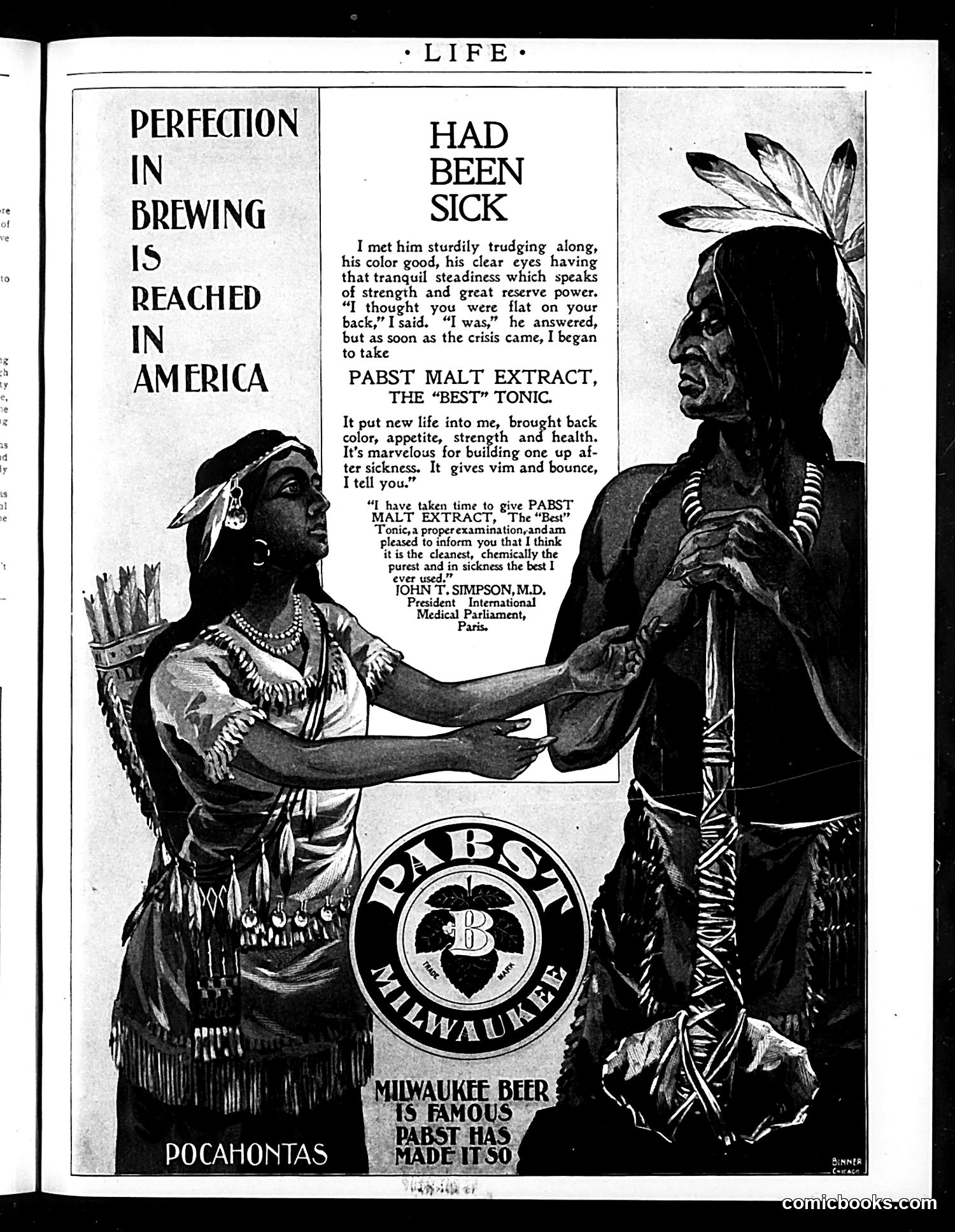
This is a **Pabst Malt Extract advertisement** disguised as editorial content in *Life* magazine. The ad uses a narrative format where a Native American man (labeled "Pocahontas," though the figure appears masculine) encounters another man who has recovered from illness through Pabst Malt Extract. **The satire/messaging:** - The ad claims malt extract cures sickness and restores vigor - A doctor's testimonial (John T. Simpson) endorses it as the "cleanest" and "purest" tonic - The Native American figure represents exotic authenticity and natural health—a common advertising trope of the era **Historical context:** Malt extract was marketed as medicinal during Prohibition, allowing breweries to continue operating. The image exploits both racist stereotyping and nostalgic "noble savage" imagery to sell a health product. Modern readers should note: such medical claims are now illegal, and the racial caricature reflects deeply problematic advertising practices of that period.
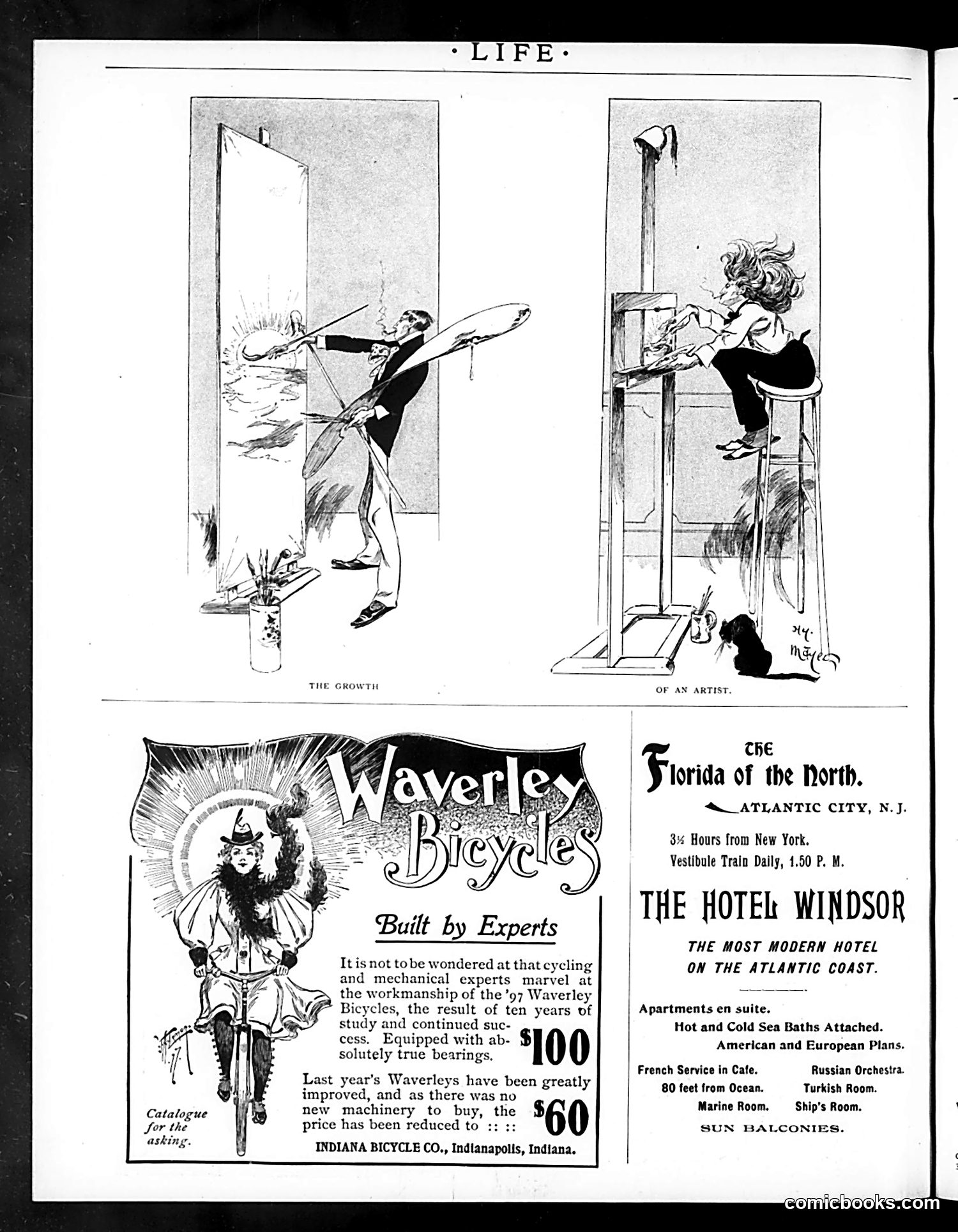
**Top Cartoons:** Two satirical panels titled "The Growth of an Artist" show an artist's progression. The left panel depicts a young man enthusiastically painting a landscape with energetic brushstrokes. The right panel shows him older, sitting passively at an easel, suggesting artistic decline or loss of vigor over time. The joke critiques how artists' creative energy and passion diminish with age or commercialization. **Advertisements:** The page is dominated by period advertising (circa 1897, based on "97 Waverley Bicycles"). The Waverley bicycle ad emphasizes mechanical precision and reduced pricing ($60). The Hotel Windsor and Florida of the North ads promote Atlantic City as a fashionable destination with modern amenities—reflecting the era's growing leisure travel industry. The cartoons and ads together represent typical Life magazine content: satirical social commentary paired with contemporary consumer advertisements targeting the magazine's middle-class readership.
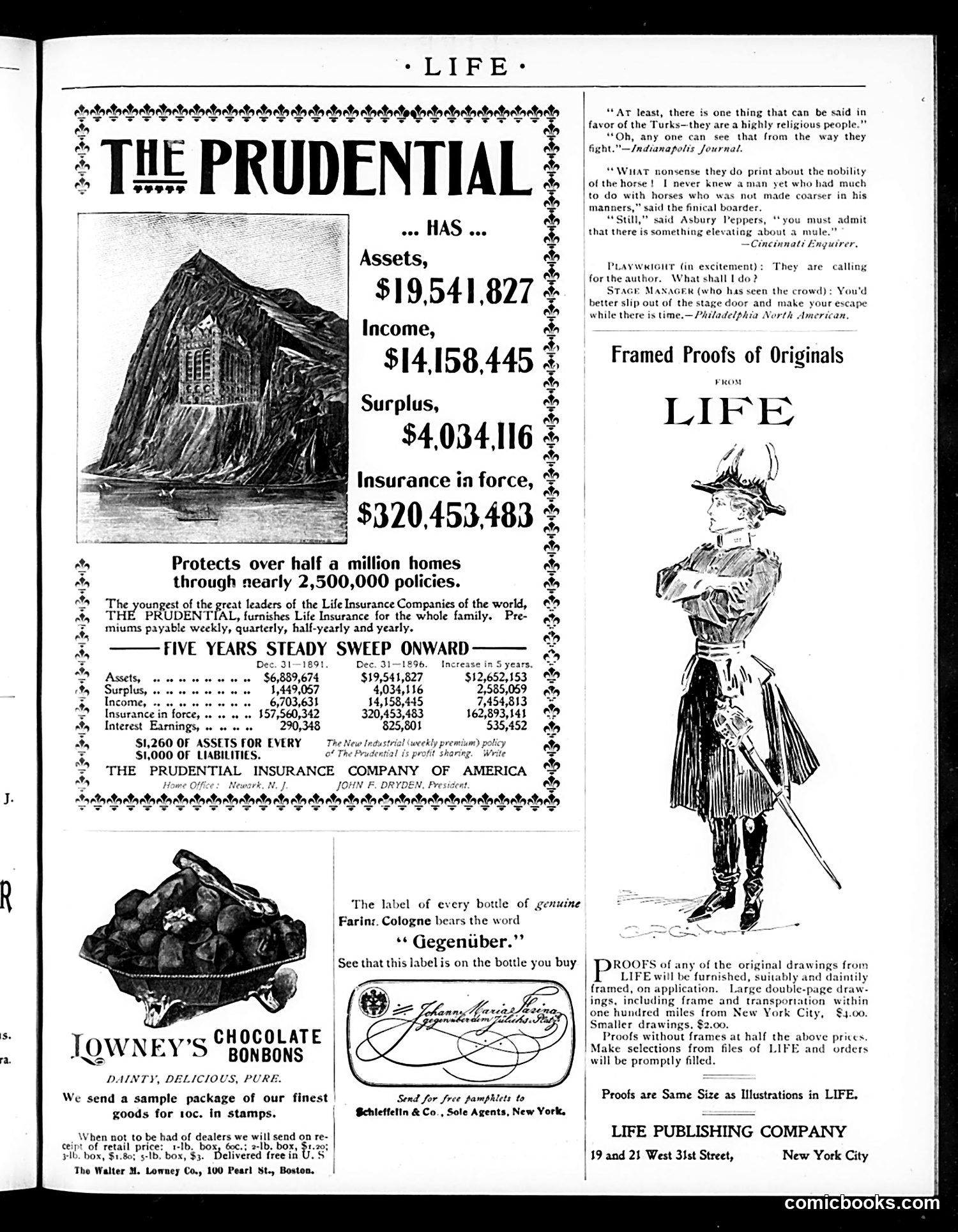
This page is primarily **advertising and business content**, not political satire. The dominant feature is a large advertisement for The Prudential Insurance Company, showcasing its financial growth from 1891-1896 with an impressive engraving of a rocky coastal formation (likely Palisades). The page includes three unrelated jokes in the upper right: - A quip about Turkish soldiers' religiosity - A boarder's comment that horses make men coarse, but mules are "elevating" - A playwright being told to escape through the stage door during a crowded performance Below are standard period advertisements for **Lowney's Chocolate Bonbons** and **Farinz Cologne**, plus a service announcement offering framed reproductions of Life magazine illustrations for sale. The content reflects turn-of-the-century American magazine conventions: financial institutions used Life's pages to establish legitimacy through published statistics, while consumer goods companies advertised luxury items to the magazine's middle-class readership.
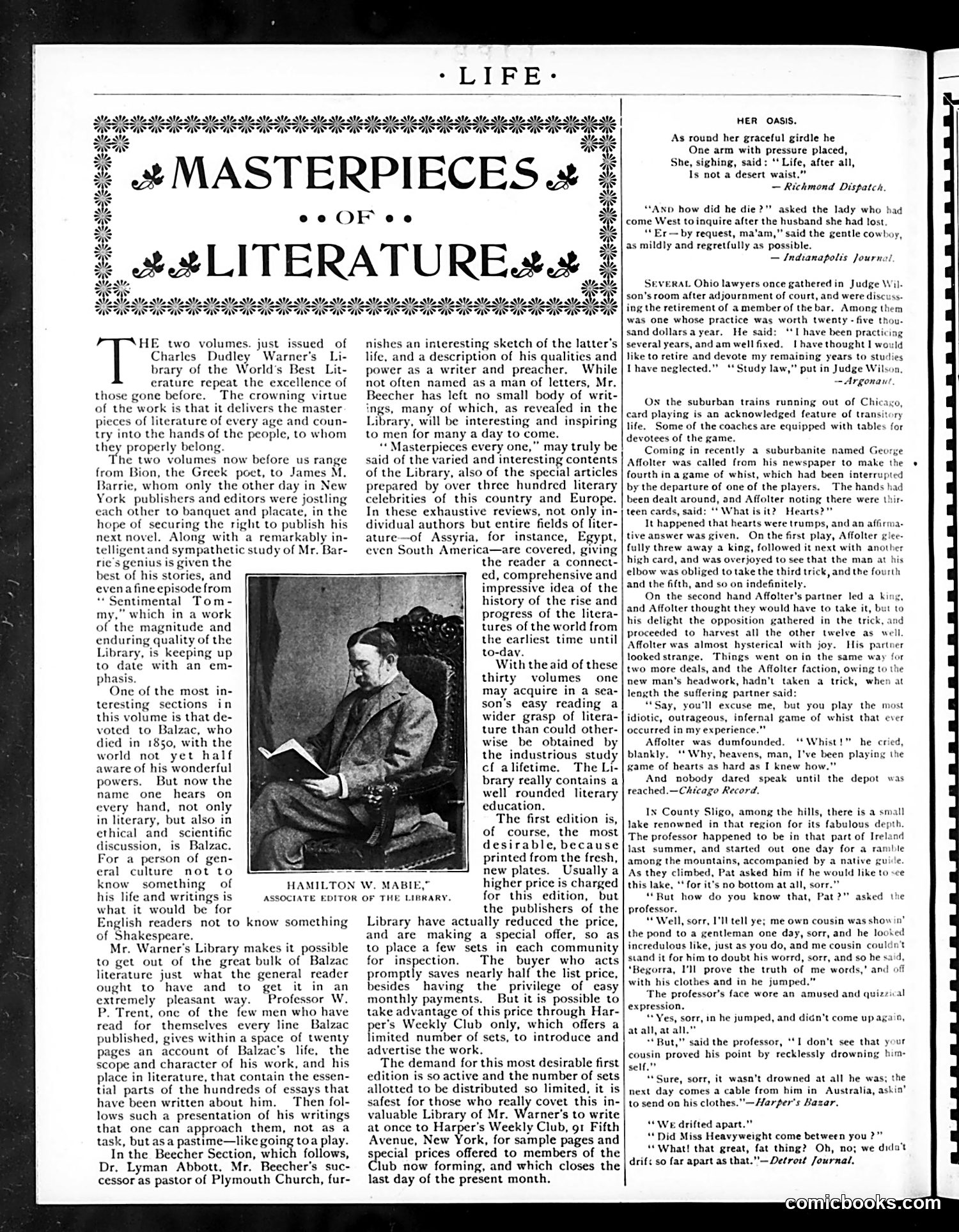
This page announces Charles Dudley Warner's newly-issued Library of World's Literature, a 30-volume collection. The portrait shows Hamilton W. Mabie, the library's associate editor. The editorial content promotes the collection as democratizing access to great literature across ages and nations—from ancient Greek poet Bion to contemporary James M. Barrie. It emphasizes inclusivity ("into the hands of the people, to whom they properly belong") and breadth, covering Balzac, Beecher, Assyrian literature, and South American works. The satirical edge (typical for *Life*) appears subtle here—the enthusiasm for making literature universally accessible and affordable is presented earnestly rather than mockingly. The piece celebrates the publisher's decision to reduce prices on the first edition despite printing costs. For modern readers: this represents Victorian-era belief in "self-improvement through literature" and the era's optimistic faith that mass-produced culture could elevate public taste.
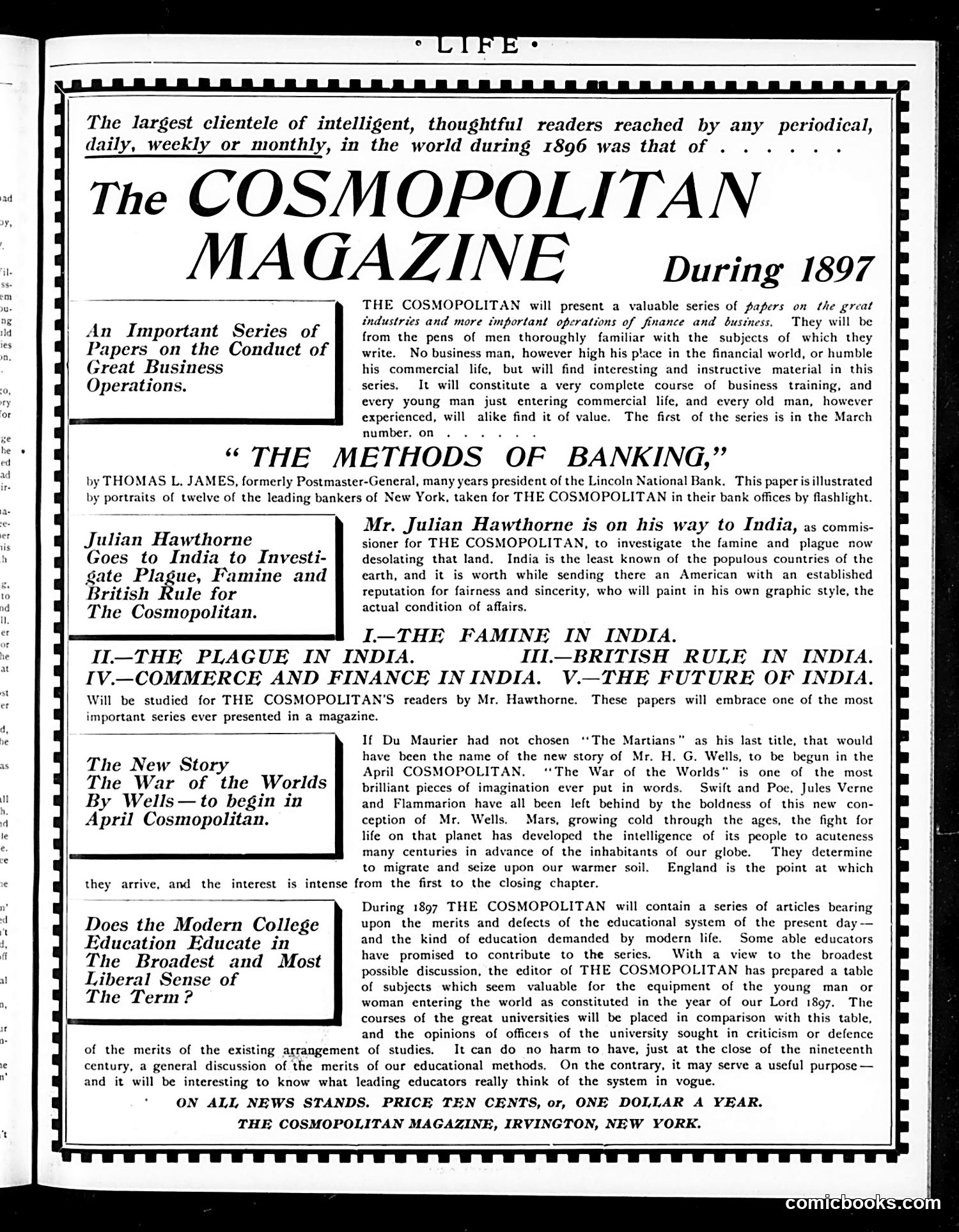
This is primarily a **title/advertising page for The Cosmopolitan Magazine's 1897 content**, not a satirical cartoon page. The page announces the magazine's upcoming series: Thomas L. James (former Postmaster-General) will write "The Methods of Banking" illustrated with portraits of New York bankers; journalist Julian Hawthorne is traveling to India as a correspondent to investigate the famine and plague there, producing five articles on India's condition under British rule; and H.G. Wells's science fiction story "The War of the Worlds" will debut in April. There's also a notice promising articles debating whether modern college education actually educates. **The satire is subtle**: by juxtaposing business journalism with exotic reportage and speculative fiction, the page humorously suggests *The Cosmopolitan* offers everything—practical instruction for businessmen alongside sensationalist foreign coverage and imaginative escapism. The implicit joke: this magazine serves every appetite at once.
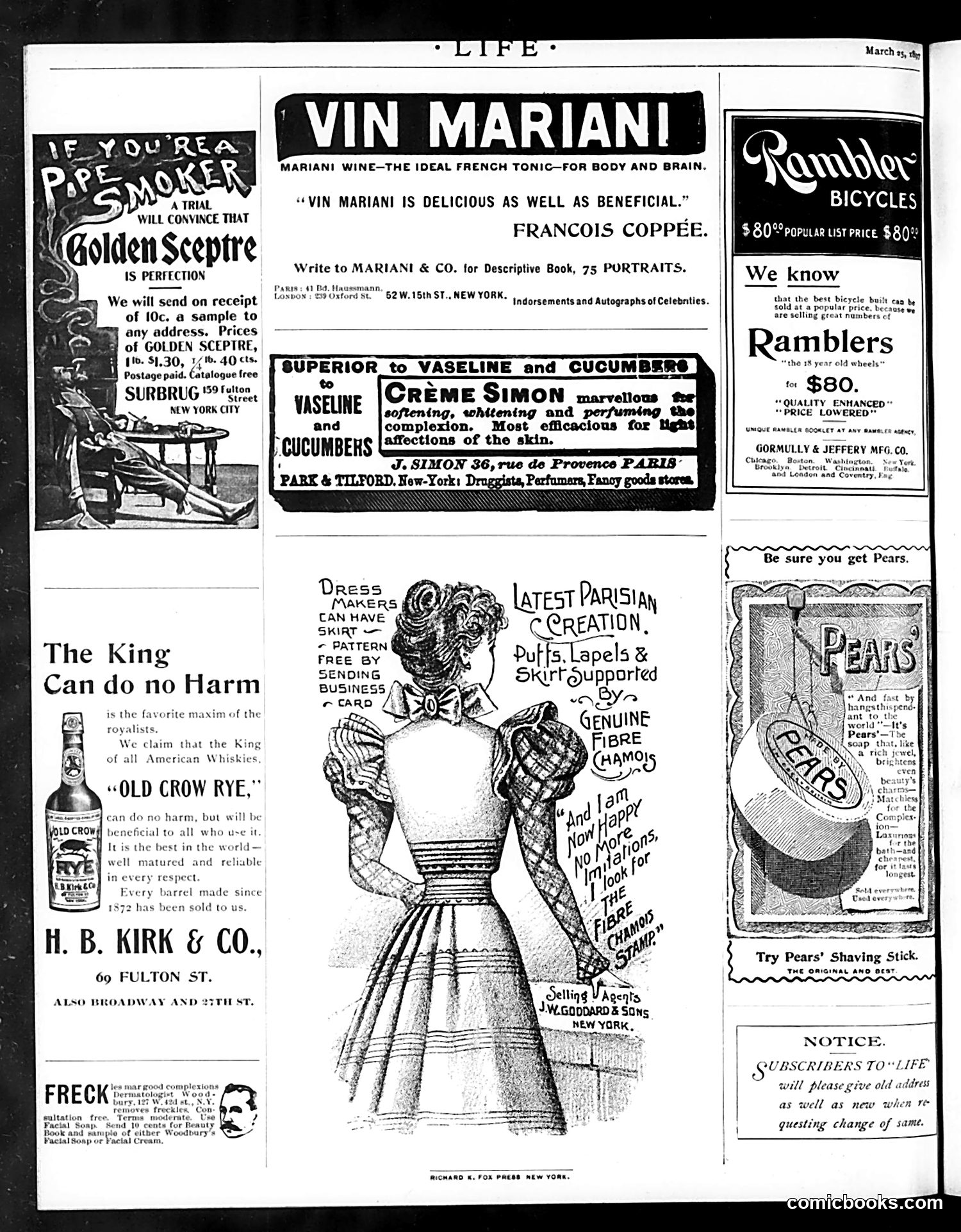
This is primarily an **advertising page** from Life magazine's March 1902 issue, with no political cartoons or satire. The central illustration shows a fashionable woman modeling the "Latest Parisian Creation"—a dress with puffed sleeves, decorative lapels, and a supported skirt. This advertises a free dress pattern available through J.W. Goddard & Sons in New York, representing the fashion industry's promotion of Parisian styles to American consumers. The surrounding ads promote various consumer products typical of the era: Vin Mariani (a French wine tonic endorsed by writer François Coppée), Crème Simon complexion cream, Rambler bicycles, Pears' soap, Old Crow whiskey, and Golden Sceptre pipe tobacco. The page reflects early 20th-century consumer culture and advertising conventions. The notice at bottom requests subscribers provide both old and new addresses when changing residences—a practical administrative note for the magazine.