
Life, 1897-03-25 · page 7 of 24
Life — March 25, 1897 — page 7: what you’re looking at
What you’re looking at
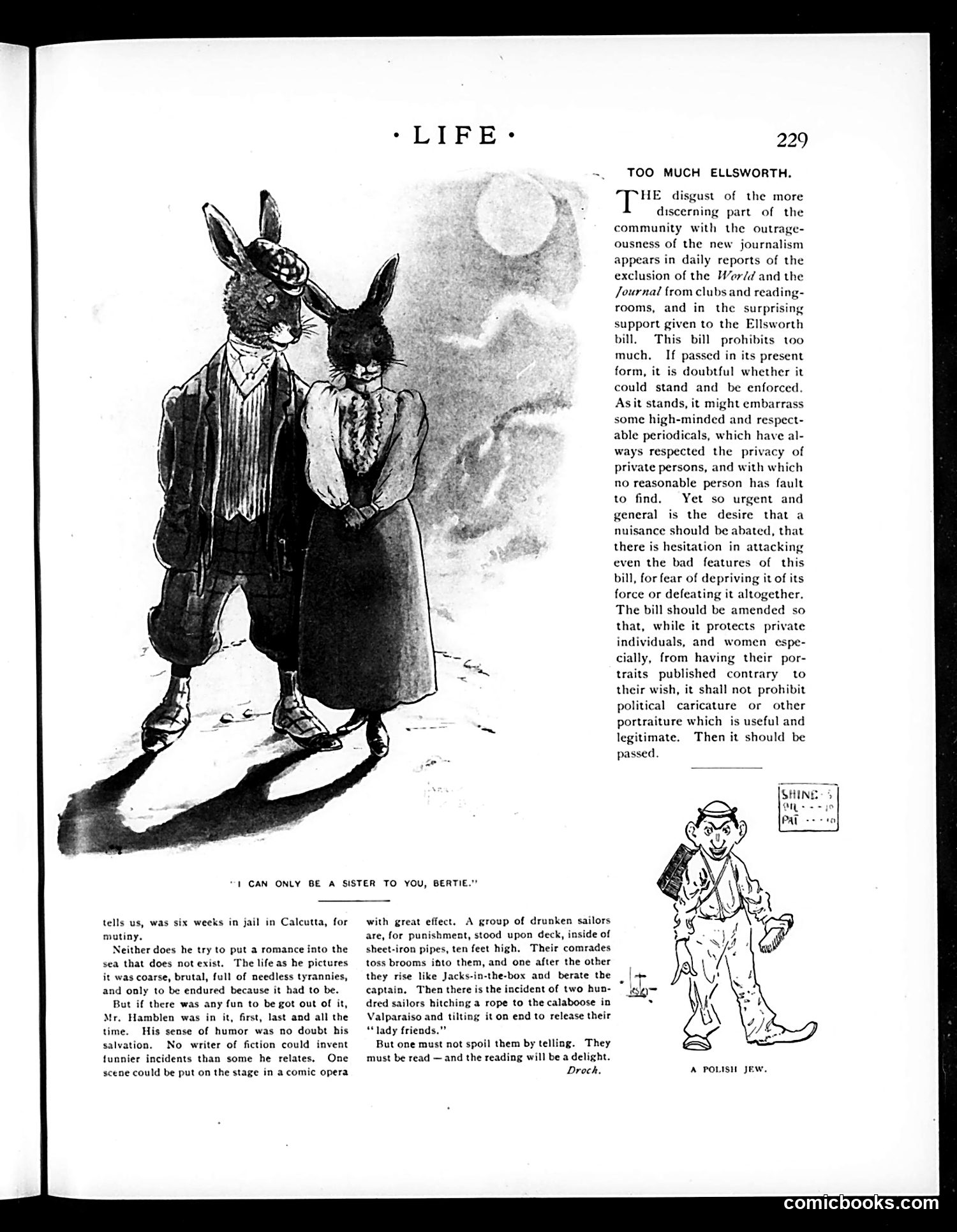
The main cartoon depicts two anthropomorphic rabbits in formal dress with the caption "I CAN ONLY BE A SISTER TO YOU, BERTIE." This appears to be a romantic or domestic joke, playing on Victorian courtship conventions through animal caricature. The article "TOO MUCH ELLSWORTH" critiques the "Ellsworth bill," apparently a proposed law restricting press coverage. The piece argues the bill, while well-intentioned in protecting privacy (especially for women), goes too far by potentially prohibiting legitimate political satire and caricature. A smaller cartoon labeled "A POLISH JEW" shows a caricatured figure—likely reflecting period ethnic humor conventions of the magazine. The page exemplifies early-20th-century satirical commentary on journalism, privacy legislation, and social attitudes expressed through both visual and written criticism.
📄 Transcribed text from this page (OCR, searchable)
Machine-transcribed from the original scan — historical spelling and the odd misread are preserved.
1 CAN ONLY BE A SISTER TO YOU, BERTIE." tells us, was six weeks in jail in Calcutta, for mutiny, Neither does he try to put a romance into the sea that does notexist. The life as he pictures it was coarse, brutal, full of needless tyrannies, and only to be endured because it had to be. But if there was any fun to be got out of it, Mr. Hamblen was in it, first, last and all the time. His sense of humor was no doubt his salvation. No writer of fiction could invent funnier incidents than some he relates. One scene could be put on the stage in a comic opera with great effect. A group of drunken sailors are, for punishment, stood upon deck, inside of sheet-iron pipes, ten feet high. Their comrades toss brooms ito them, and one after the other they rise like Jacks-in-the-box and berate the captain, Then there is the incident of two hun- dred sailors hitching a rope to the calaboose in Valparaiso and tilting it on end to release their “lady friends.” But one must not spoil them by telling. They must be read — and the reading will be a delight. Drock. 229 TOO MUCH ELLSWORTH. HE the more discerning part of the community with the outrage- disgust of ss of the new journalism appears in daily reports of the exclusion of the Wor/d and the Journal from clubs and reading- rooms, and in the surprising support given to the Ellsworth bill. This bill prohibits too much. If passed in its present form, it is doubtful whether it could stand and be enforced. Asit stands, it might embarrass some high-minded and respect- able periodicals, which have al- s respected the privacy of private persons, and with which no reasonable person has fault to find. Yet so urgent and general is the desire that a nuisance should be abated, that there is hesitation in attacking even the bad features of this bill, for fear of depriving it of its force or defeating it altogether. The bill should be amended so that, while it protects private individuals, and women espe- cially, from having their por- traits published contrary to their wish, it shall not prohibit political caricature or other portraiture which is useful and legitimate. Then it should be passed. A POLISH JEW, comicbooks.com