
Life, 1897-03-25 · page 6 of 24
Life — March 25, 1897 — page 6: what you’re looking at
What you’re looking at
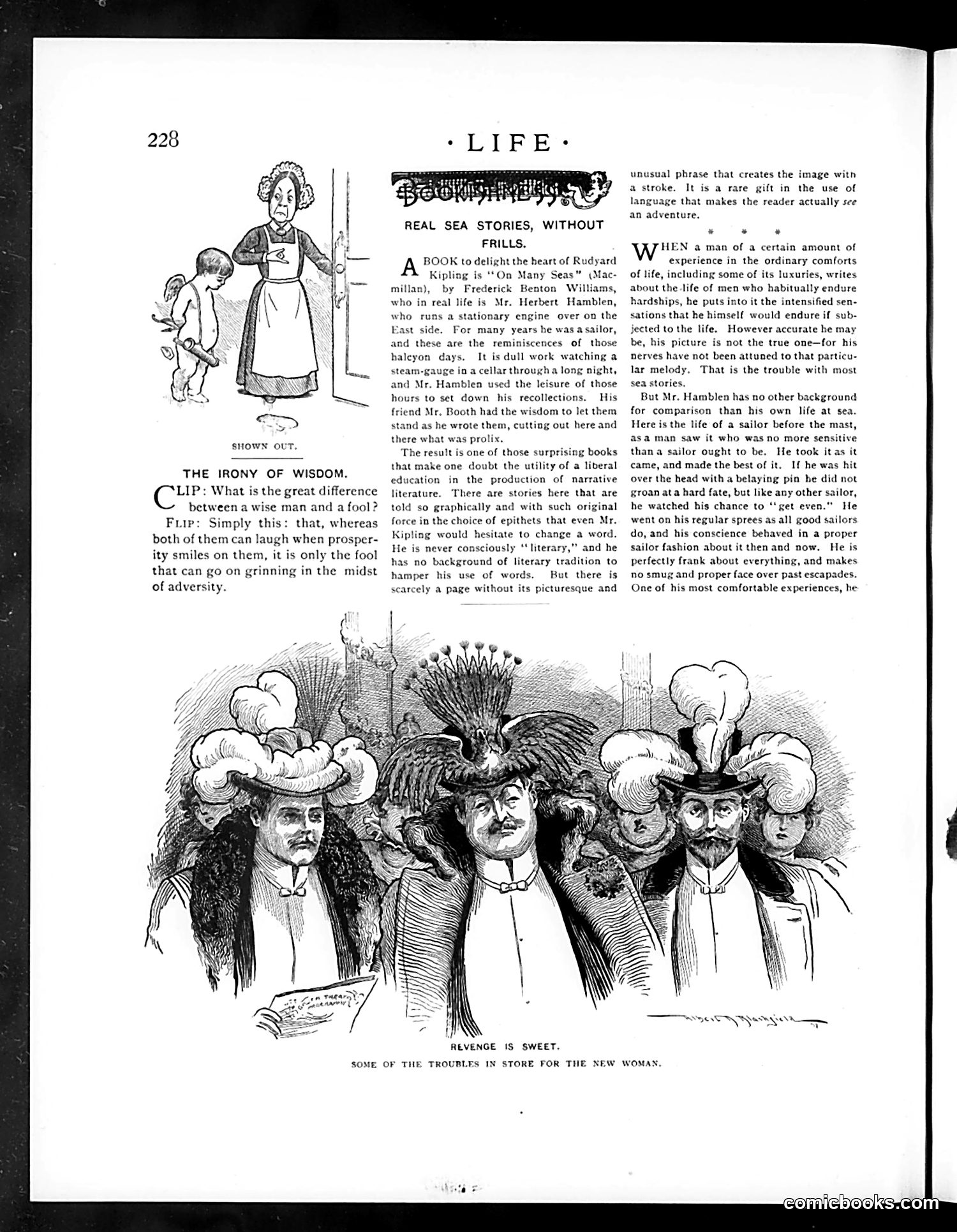
**Top Section - "The Irony of Wisdom":** This brief text piece contrasts wise men and fools, noting that both can laugh at prosperity's smiles, but only fools find humor in adversity—"the tool that can go grinding in the midst of adversity." **Main Content - Book Review:** The page reviews Rudyard Kipling's "On Many Seas" (Macmillan), a collection of sea stories by Herbert Hamblen, a former sailor and stationary engine operator. The reviewer praises Hamblen's authentic sailor perspective and vivid storytelling, though noting his lack of literary training. The work contains picturesque language and original narrative force comparable to Kipling's standards. **Bottom Cartoon - "Revenge is Sweet":** The illustration captioned "Some of the Troubles in Store for the New Woman" depicts five men wearing elaborate, ornate hats with large plumes—apparently satirizing fashion-conscious men's anxieties about the emerging "New Woman" movement of the era.
📄 Transcribed text from this page (OCR, searchable)
Machine-transcribed from the original scan — historical spelling and the odd misread are preserved.
SHOWN OUT. THE IRONY OF WISDOM. LIP: What is the great difference between a wise man and a fool ? Fiip: Simply this: that, whereas both of them can laugh when prosper- ity smiles on them, it is only the fool that can go on grinning in the midst of adversity. soME REAL SEA STORIES, WITHOUT FRILLS. BOOK to delight the heart of Rudyard Kipling is ‘On Many Seas” (Mac- millan), by Frederick Benton Williams, who in real life is Mr. Herbert Hamblen, who runs a stationary engine over on the For many years he was a sailor, and these are the reminiscences of those haleyon days. It is dull work watching a steam-gauge in a cellarthrougha long night, and Mr. Hamblen used the leisure of those hours to set down his recollections. His friend Mr. Booth had the wisdom to let them stand as he wrote them, cutting out here and there what was prolix. The result is one of those surprising books that make one doubt the utility of a liberal education in the production of narrative literature. There are stories here that are told so graphically and with such original force in the choice of epithets that even Mr. Kipling would hesitate to change a word. He is never consciously “literary,” and he has no background of literary tradition to hamper his use of words. But there is scarcely a page without its picturesque and East side. REVENGE IS SWEET. unusual phrase that creates the image witn a stroke. It is a rare gift in the use of language that makes the reader actually see an adventure. * 8 « HEN a man of a certain amount of experience in the ordinary comforts of life, including some of its luxuries, writes about the life of men who habitually endure hardships, he puts into it the intensified sen- sations that he himself would endure if sub- jected to the life. However accurate he may be, his picture is not the true one—for his nerves have not been attuned to that particu- lar melody. That is the trouble with most sea stories. But Mr. Hamblen has no other background for comparison than his own life at sea. Here is the life of a sailor before the mast, asa man saw it who was no more sensitiv thana sailor ought to be. He took it as it came, and made the best of it. If he was hit over the head with a belaying pin he did not groan ata hard fate, but like any other sailor, he watched his chance to ‘‘get even." He went on his regular sprees as all good sailors do, and his conscience behaved in a proper sailor fashion about it then and now. He is perfectly frank about everything, and makes no smug and proper face over past escapades. One of his most comfortable experiences, he OOTY OL OF THE TROUBLES IN STORE FOR THE NEW WOMAN,