
A complete issue · 20 pages · 1897
Life — March 18, 1897
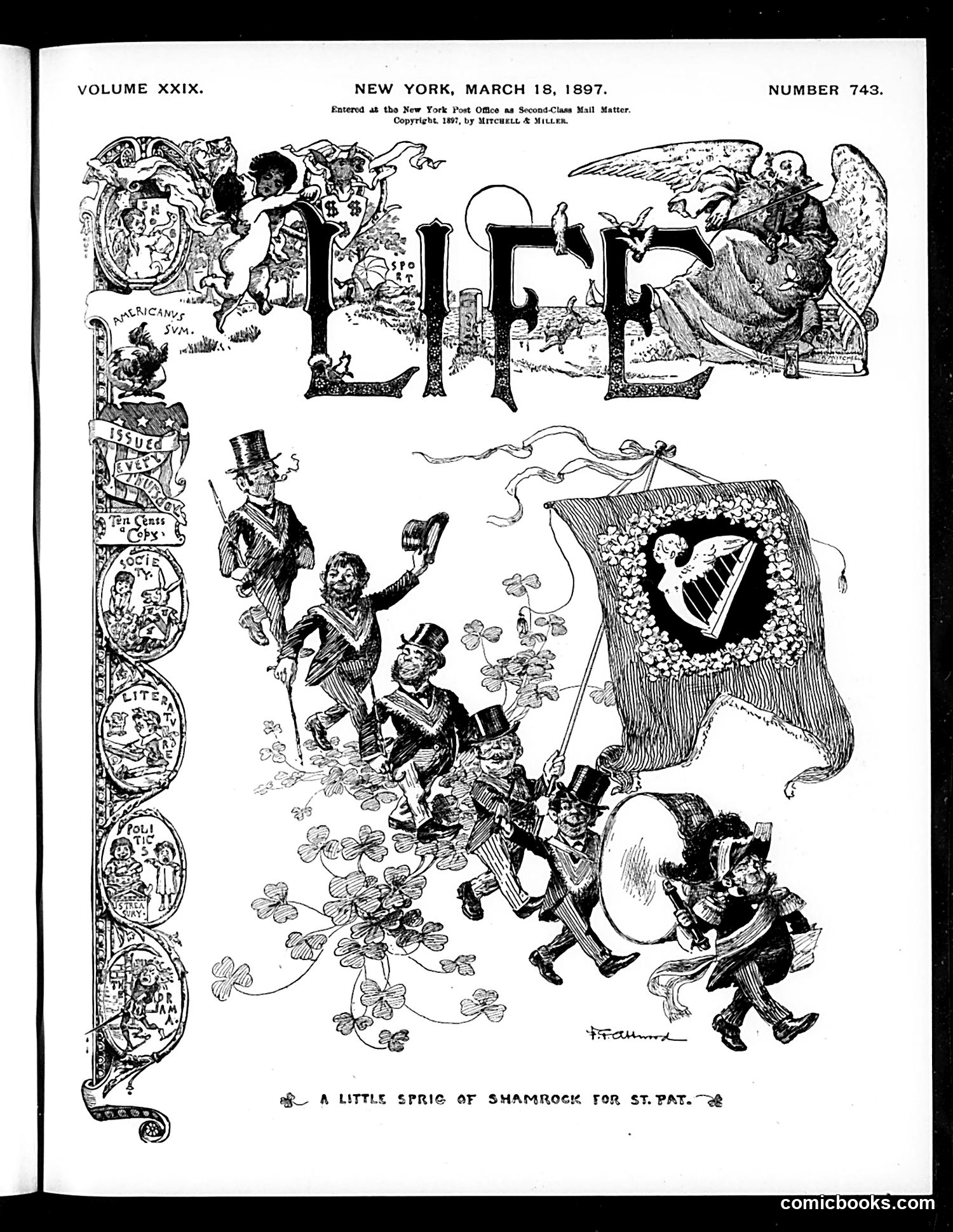
This is the cover of Life magazine featuring a St. Patrick's Day theme, as indicated by the subtitle "A Little Sprig of Shamrock for St. Pat." The central illustration shows leprechauns and Irish figures dancing around shamrocks and carrying a drum, celebrating St. Patrick's Day. The large Irish harp with a female figure (symbolizing Ireland) appears on the right side. The ornate left border contains smaller vignettes depicting various scenes, likely related to Irish-American cultural celebrations or stereotypes of the period. The elaborate decorative header spelling "LIFE" features classical allegorical figures typical of the magazine's artistic style. This appears to be standard holiday-themed satirical content rather than commentary on specific political events, celebrating Irish-American culture during the late 19th century.
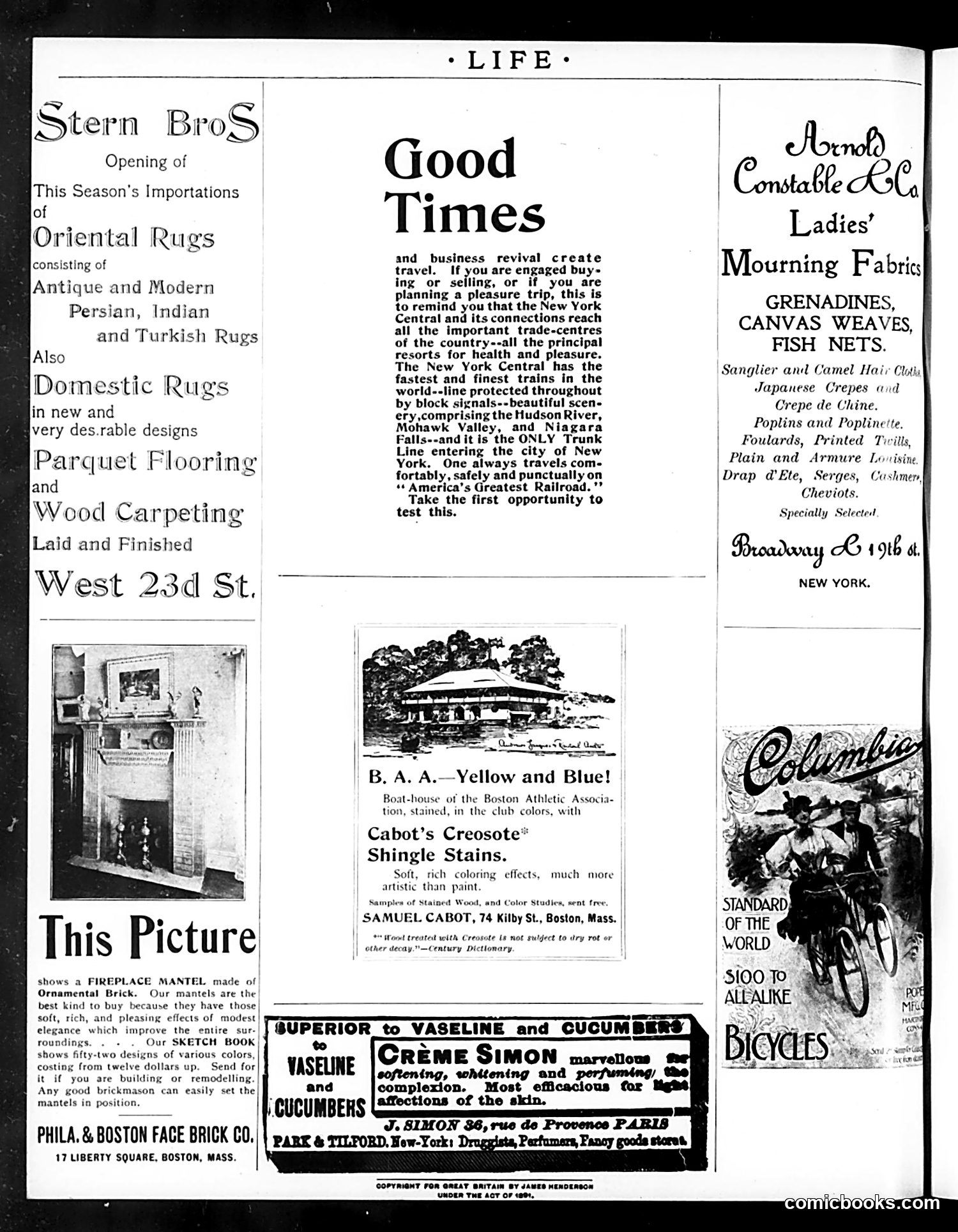
This page is **primarily advertisements** with no discernible political cartoon or satirical content. The page contains four separate ads: Stern Bros. (Oriental rugs and flooring), a "Good Times" travel article promoting New York Central Railroad, Arnold Constable & Co. (mourning fabrics), and Cabot's Creosote wood stain. There's also an ad for Columbia bicycles and Crème Simon cosmetics. The "Good Times" section discusses business revival and travel opportunities via the New York Central Railroad, emphasizing its efficiency and famous routes (Hudson River, Mohawk Valley, Niagara Falls). This reflects turn-of-the-century optimism about rail travel and business expansion, but contains **no satire or political commentary**—it's straightforward promotional content typical of Life magazine's advertising pages.
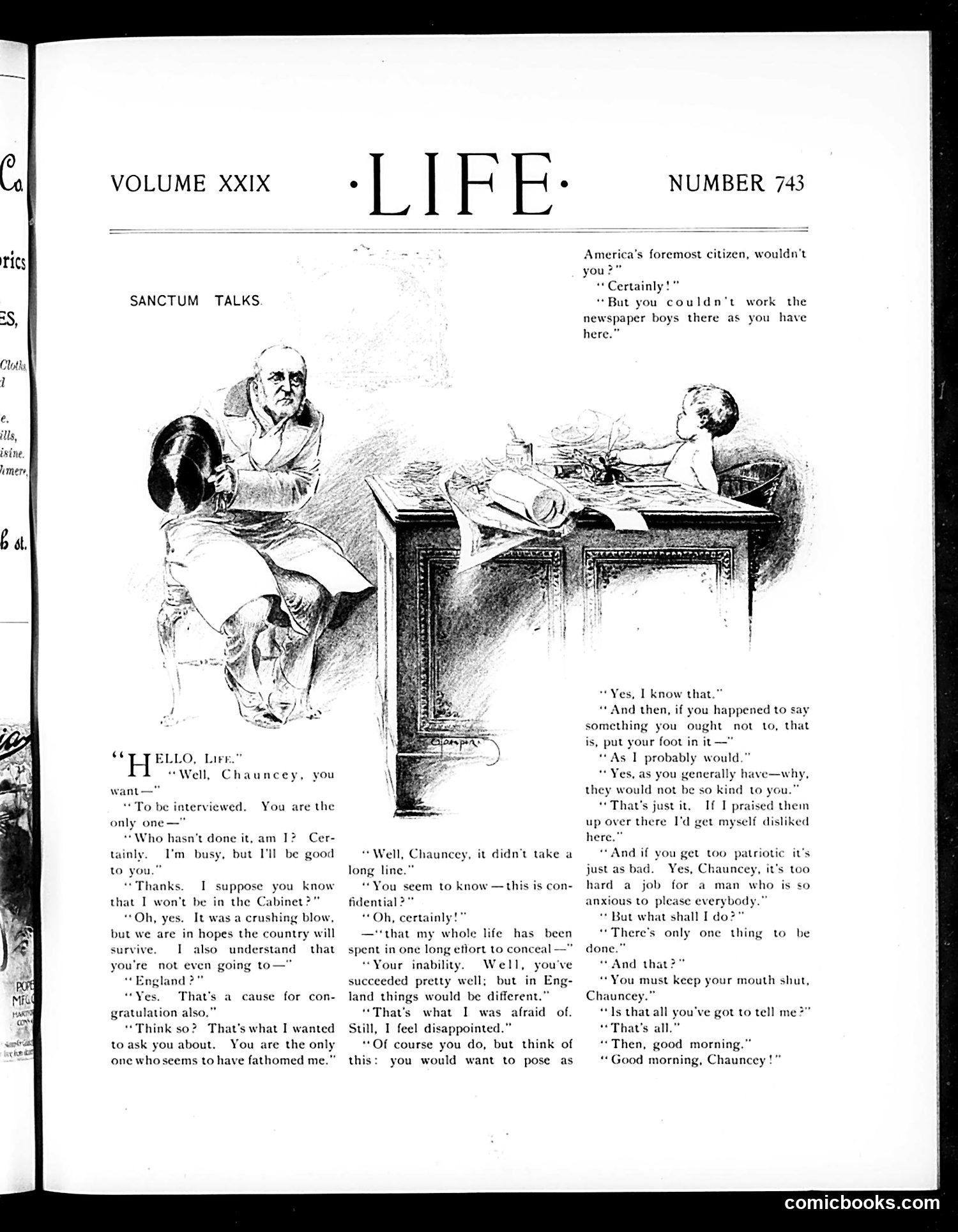
This cartoon depicts a conversation between an older man (likely an editor or authority figure) and "Chauncey," a younger person seeking advice about journalism or public service. The satire centers on the tension between idealism and pragmatism in public life. Chauncey is warned that if he enters public service or newspaper work, he'll face criticism for any statement deemed inappropriate. The editor advises keeping quiet as the safest course—the only way to avoid "dislike." The joke critiques how fear of public opinion discourages honest discourse and meaningful participation. By suggesting silence as the solution to political criticism, the cartoon mocks both cautious institutions and a culture where fear of controversy suppresses authentic engagement. This reflects early 20th-century debates about free speech and journalistic independence.
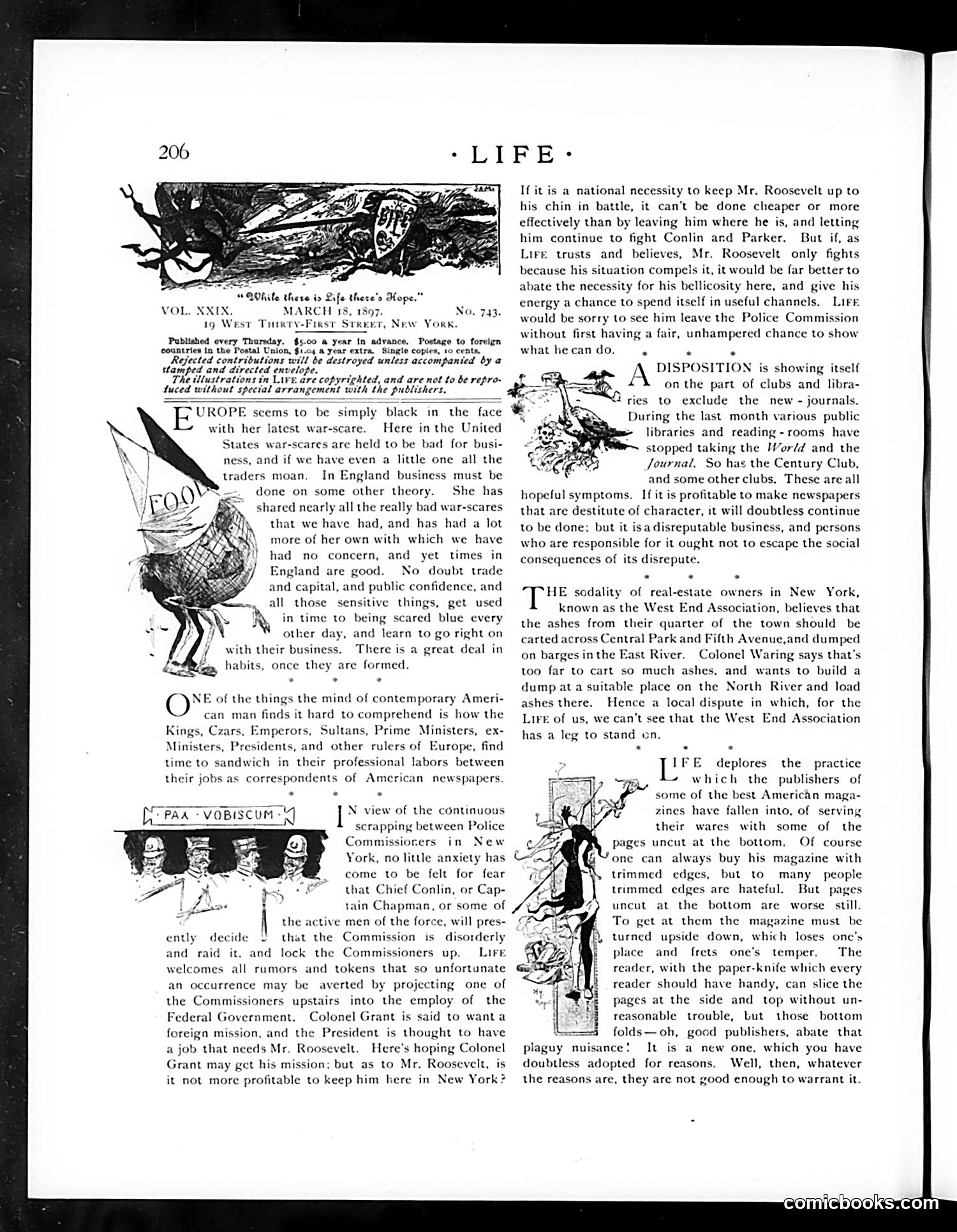
The page contains editorial commentary rather than a traditional political cartoon. The main satirical points target: **Roosevelt's Police Commission role**: Life argues Roosevelt should remain as NYC Police Commissioner to demonstrate his effectiveness, rather than be reassigned to military service or government positions. The publication defends Roosevelt's continued presence in New York. **European business anxiety**: A small cartoon labeled "FOO" depicts Europe as fearful and unstable ("simply black in the face with war-scars"), contrasting with American stability. **Editorial complaints**: Life critiques: newspaper exclusion from clubs, ash-dumping disputes by West End Association near Central Park, and magazine publishers trimming uncut pages at the bottom—a design practice Life calls "plaguy nuisance." The tone is protective of Roosevelt while lamenting various civic annoyances.
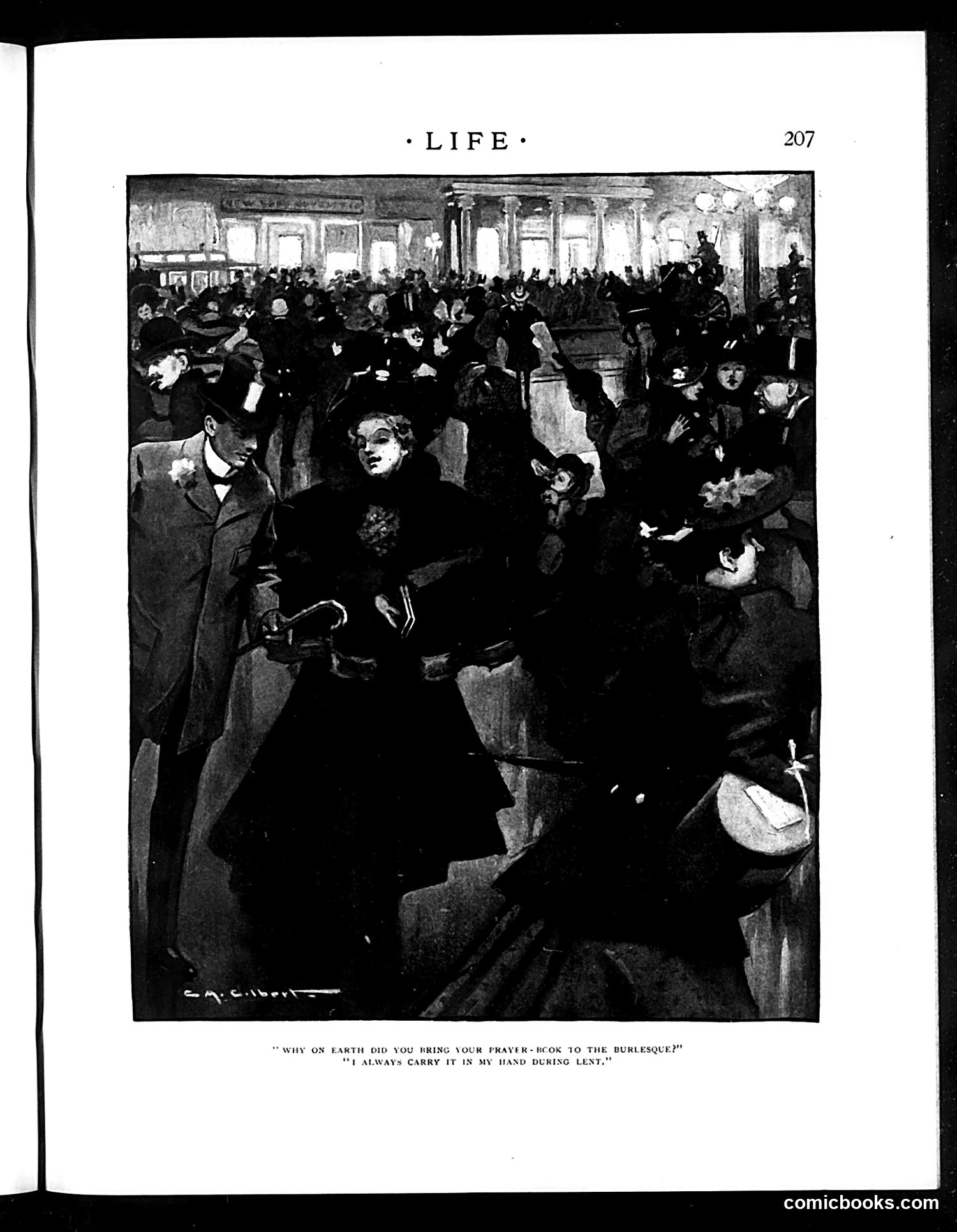
This appears to be a satirical cartoon from Life magazine (page 207) depicting a crowded public venue, likely a theater or burlesque house given the caption's reference to "the burlesque." The cartoon shows a well-dressed woman prominently featured in the center, surrounded by crowds of men in dark coats and hats. The caption reads: "Why on earth did you bring your prayer-book to the burlesque?" with the response "I always carry it in my hand during Lent." The satire likely mocks religious hypocrisy—specifically, the contradiction of attending burlesque (entertainment considered morally questionable) while maintaining pious religious observance during Lent. The crowded scene suggests burlesque's popularity despite its dubious moral standing. The cartoon critiques those who compartmentalize their faith and behavior, attending risqué entertainment while publicly maintaining religious propriety.
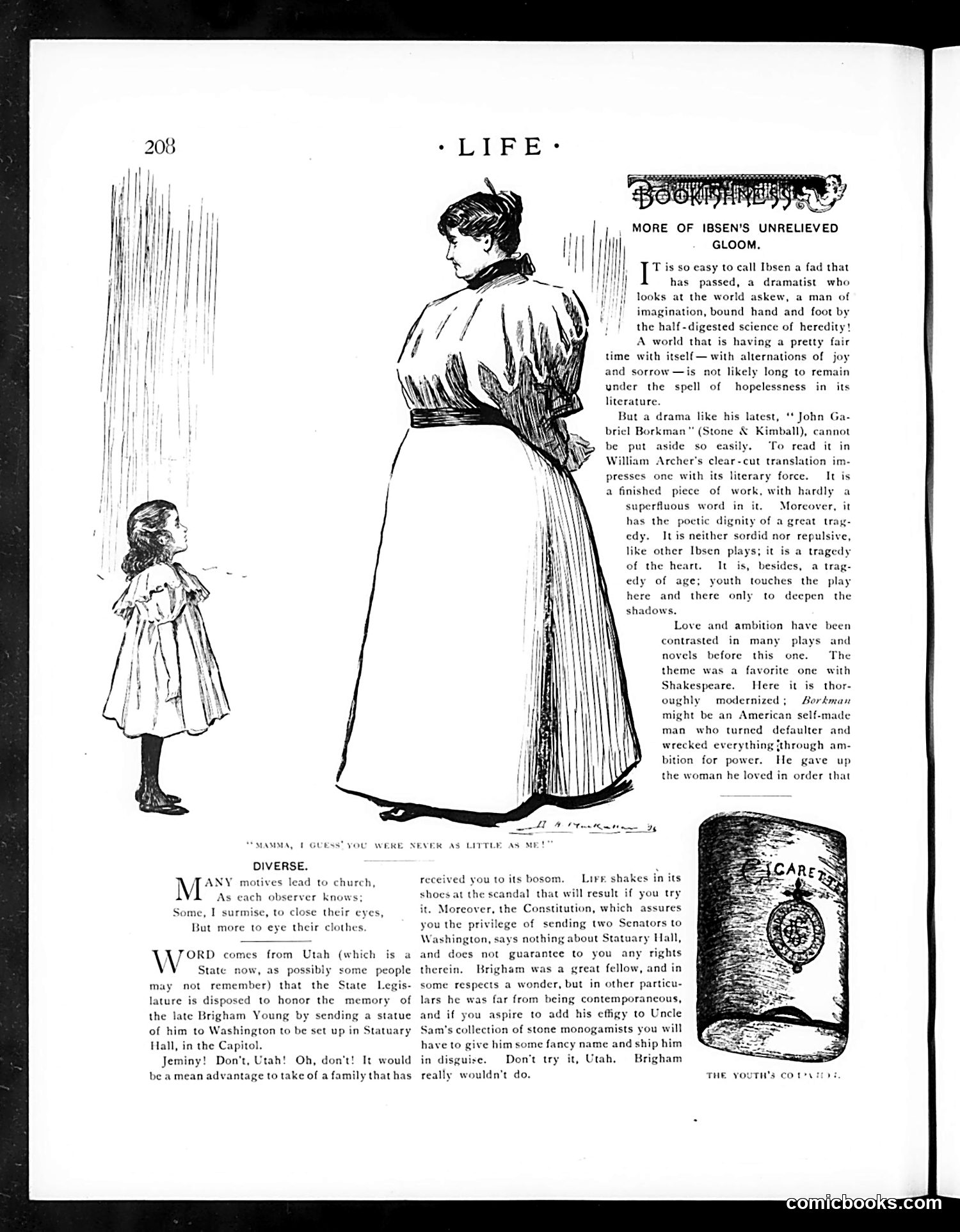
This page discusses Henrik Ibsen's play "John Gabriel Borkman," praising its literary merit despite Ibsen's reputation for pessimism and gloom. The article defends the work against dismissals of Ibsen as merely a "fad." The illustration shows a woman and child in a striking size contrast, captioned "Mamma, I guess you were never as little as me!" This likely satirizes the generational or social gap between parent and child—possibly commenting on how modern society (or modern literature like Ibsen's) creates distance between generations or how childhood innocence contrasts with adult cynicism. The "Diverse" section contains political satire about Utah's Brigham Young statue and state politics, mocking Utah's cultural pretensions. The page is primarily literary criticism with incidental social commentary rather than straightforward political cartooning.
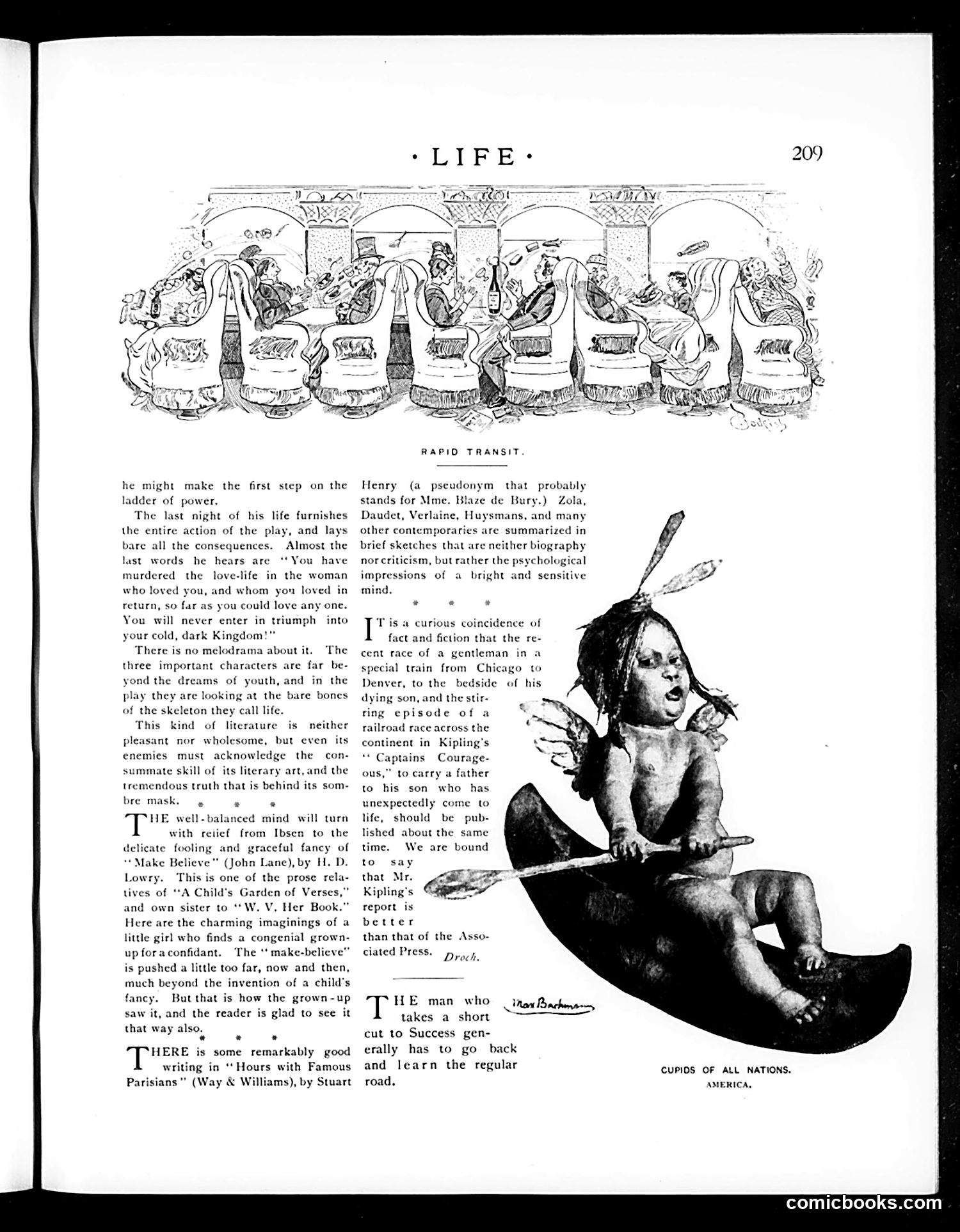
The top cartoon depicts crowded subway cars—a visual commentary on urban congestion and rapid transit systems, likely referencing early 20th-century concerns about overcrowded public transportation in American cities. The illustrated figure on the right, labeled "Cupids of All Nations: America," shows a cherub or cupid character in a somewhat unflattering caricature style, appearing to ride or propel himself forward. This likely satirizes American approaches to love, courtship, or romance compared to other nations—a common theme in Life's "nations" series of comparative humor. The surrounding text discusses various literary works and authors, providing cultural context for the satirical commentary on contemporary society and literature.
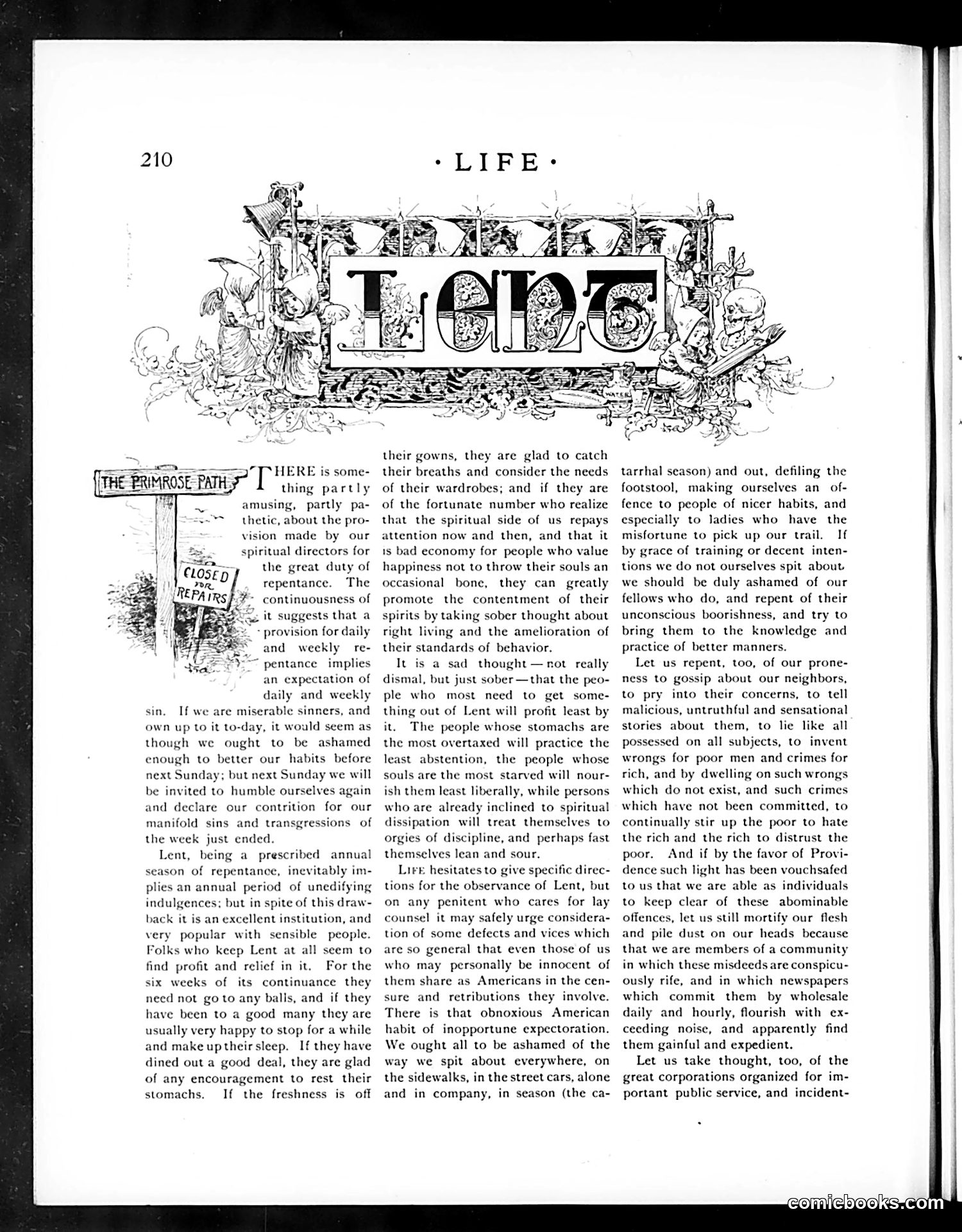
This is a satirical editorial piece titled "LENT" with an accompanying small cartoon labeled "THE PRIMROSE PATH" showing a sign reading "CLOSED FOR REPAIRS." The text discusses Lenten observance and penitence, critiquing Americans' casual approach to the religious season. The author mocks people who abandon restraint during Lent despite professing to value it, and attacks what he sees as American hypocrisy: spitting in public, gossiping maliciously, and committing social crimes while claiming respectability. The "Primrose Path" cartoon appears to satirize the temptation to sin, suggesting that the path to vice is temporarily closed for maintenance—a joke about people's weakness during periods supposedly dedicated to moral improvement. The piece advocates for genuine spiritual reflection over performative religious observance.
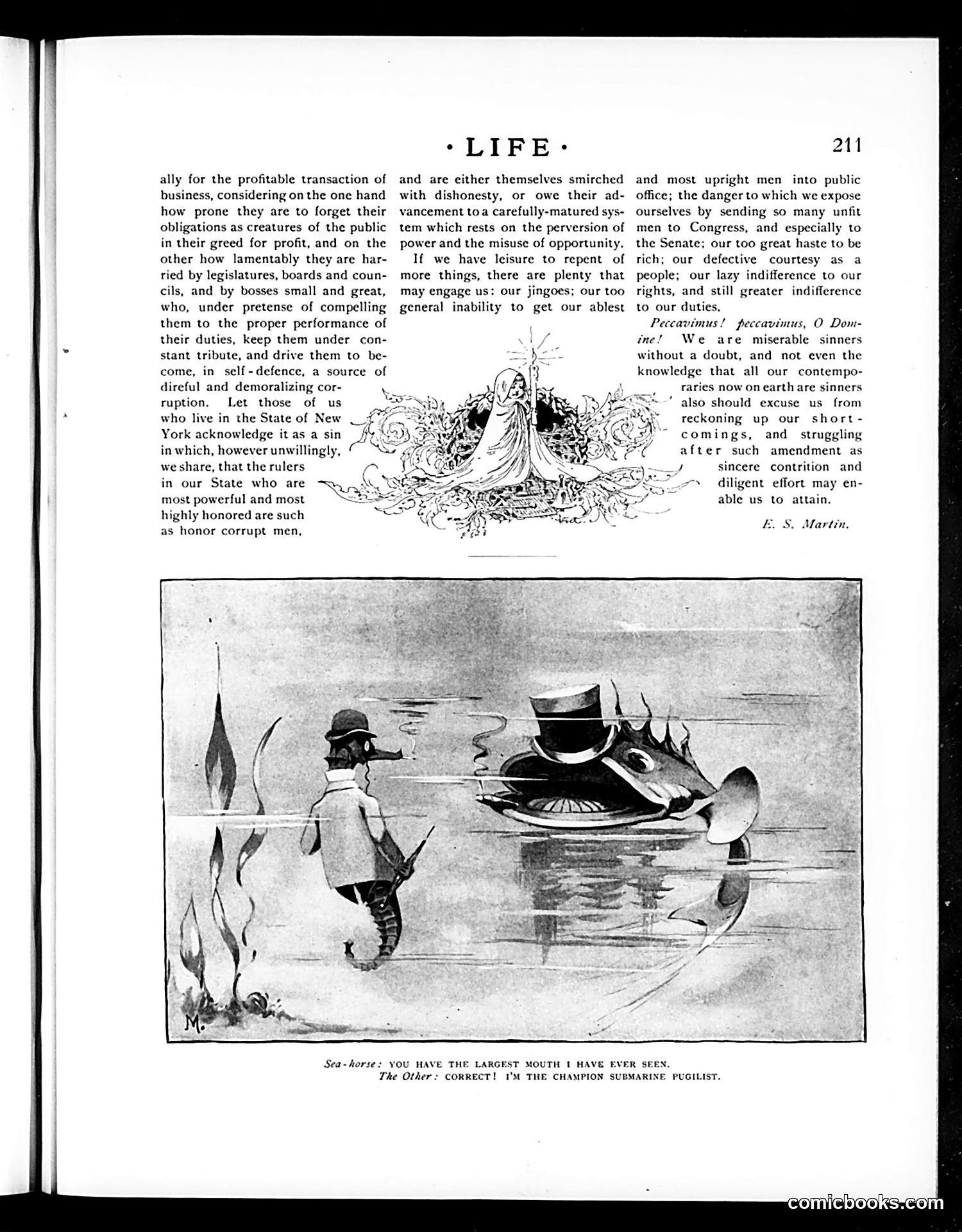
This page contains a humorous cartoon dialogue between a fisherman and a sea-horse. The fisherman, observing an unusually large sea-horse, exclaims "YOU HAVE THE LARGEST MOUTH I HAVE EVER SEEN." The sea-horse replies "CORRECT! I'M THE CHAMPION SUBMARINE PUGILIST." The joke plays on the phrase "big mouth"—slang for someone who talks excessively or boasts. By claiming to be a "champion submarine pugilist" (underwater boxer), the sea-horse uses its literal large mouth as evidence of fighting prowess, though the joke's humor lies in the absurdist non sequitur of a sea-creature boxing champion. The upper text discusses political corruption and moral failings in New York state government, though it's unrelated to the cartoon below.
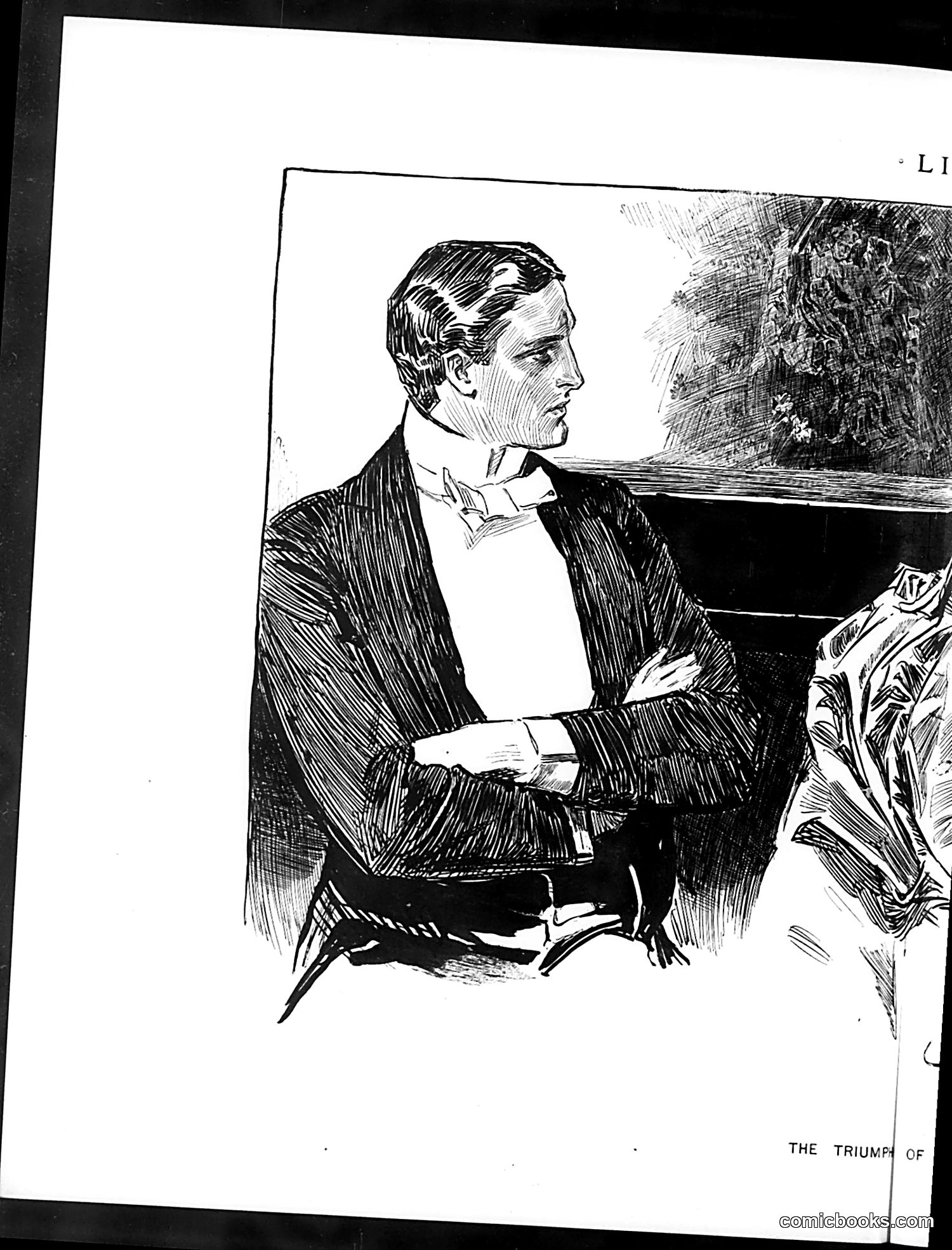
This is a formal portrait illustration titled "THE TRIUMPH OF" (the complete title is cut off). The image shows a well-dressed man in evening wear—tuxedo with bow tie—seated and depicted in profile. The artistic style uses cross-hatching typical of early 20th-century magazine illustrations. Without the complete title visible, the specific political or social reference is unclear. However, the formal presentation and the phrase "triumph" suggest this depicts someone of prominence, possibly celebrating a victory or achievement. The refined artistic treatment indicates this was likely a notable public figure of the era when *Life* magazine published such satirical or illustrative content. To identify the specific figure and context, the complete caption would be necessary.
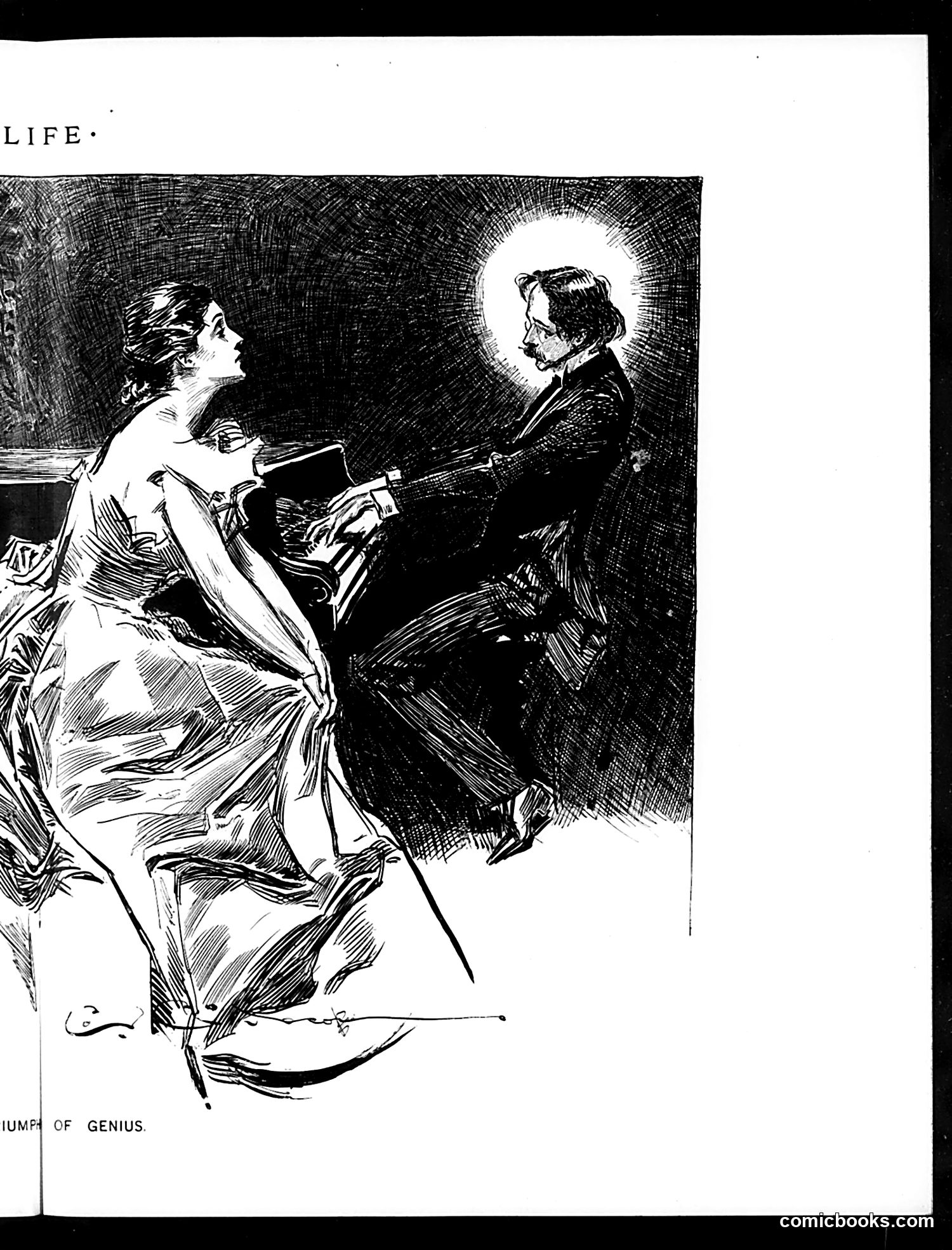
This page from *Life* magazine shows a single illustration titled "Triumph of Genius" (partially visible at bottom). The sketch depicts two figures in what appears to be a dramatic encounter: a woman in flowing white drapery on the left, and a man in dark formal dress with a halo-like glow around his head on the right, presenting her with what appears to be a book or manuscript. The "halo" effect around the man's head suggests he represents genius or intellectual brilliance. The woman's pose and classical drapery suggest she may represent allegorical concepts like inspiration, muse, or perhaps a personification of art or literature itself. Without additional context or dates, the specific satirical meaning remains unclear—it could reference a literary figure, romantic ideal, or social commentary about genius and its reception by society.
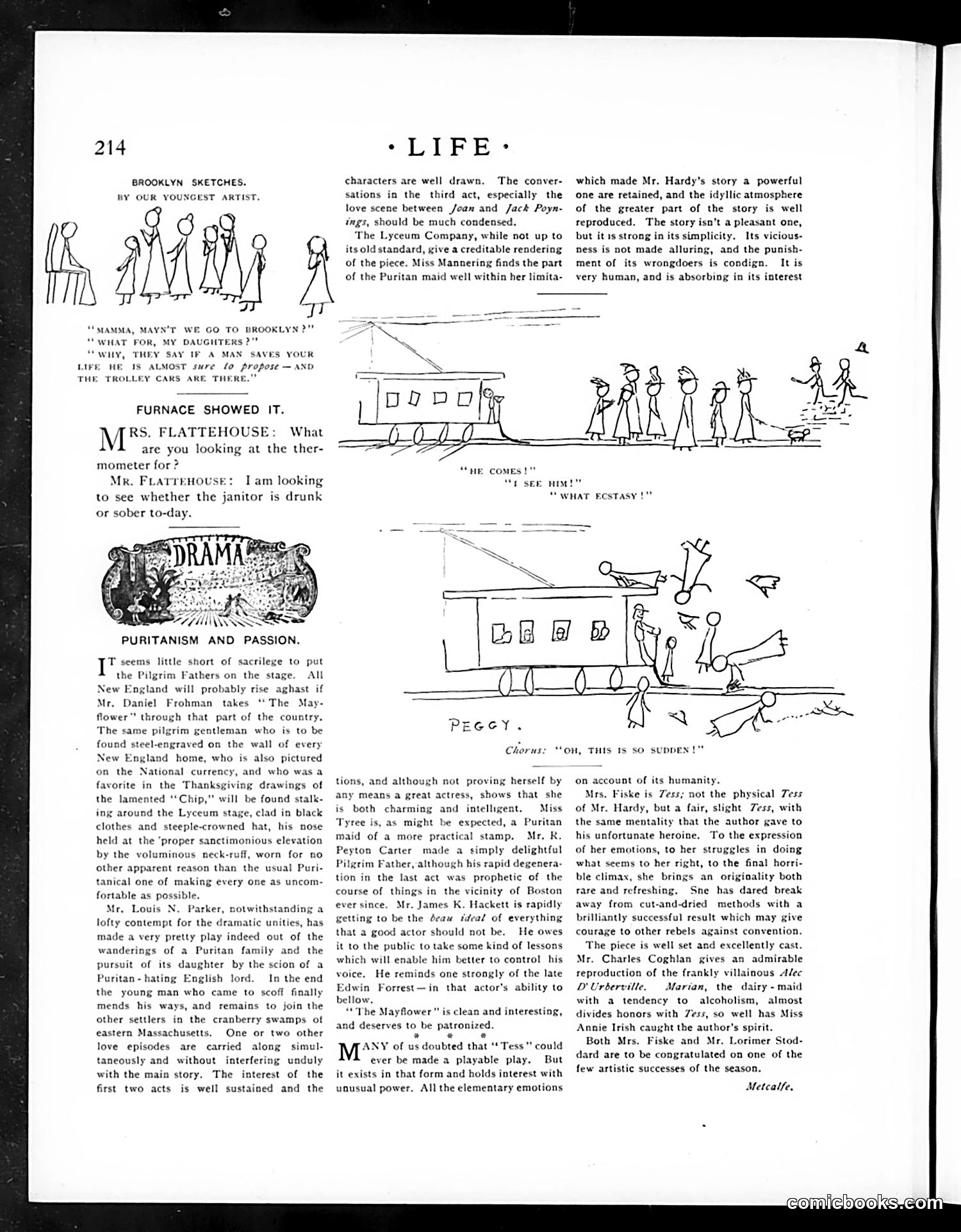
The sketches depict simple line-drawn scenes of Brooklyn life, likely from the early 20th century. The top sketch shows a family discussion about going to Brooklyn, with a child's observation that "a man saves your life he is almost sure to propose—and the trolley cars are dreadful." The lower sketches titled "PEGGY" show a trolley car scene with exaggerated stick figures, including a chorus exclaiming "Oh, this is so sudden!" The humor derives from the mundane absurdity of Brooklyn domestic life—the anxiety about trolley cars as transportation hazards and the running joke about unwanted marriage proposals from rescuers. The "youngest artist" credit suggests these are intentionally naive, child-like drawings meant as comedic commentary on urban middle-class anxieties of the era.
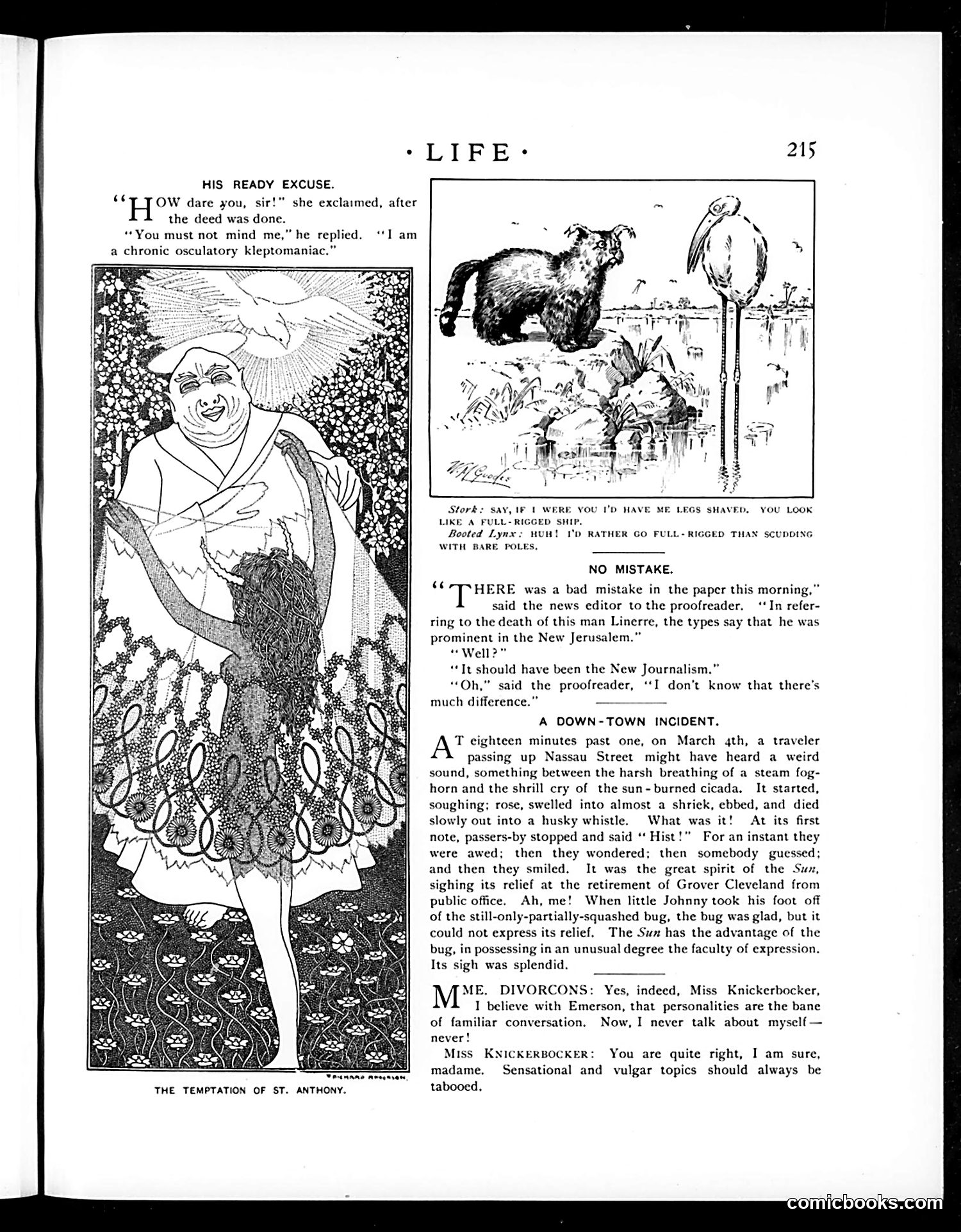
This page contains three distinct humorous pieces satirizing contemporary society: 1. **"His Ready Excuse"** (left cartoon): A man caught kissing a woman claims he's a "chronic osculatory kleptomaniac"—a made-up medical condition excusing compulsive kissing as an involuntary affliction rather than misconduct. The satire mocks men who blame pseudo-scientific excuses for inappropriate behavior. 2. **Animal dialogue cartoon** (top right): A stork and lynx banter about grooming and sailing metaphors, likely a nature-based comedy with no clear political reference. 3. **"No Mistake"** and **"A Down-Town Incident"**: These mock newspaper errors and editorial pretension. The joke plays on **Grover Cleveland's retirement from public office** (likely 1889 or 1897), using absurdist humor—the *Sun* newspaper's "relief" is compared to a squashed bug expressing joy. 4. **"Me. Divorcons"** dialogue: Satirizes affected social conversation where both speakers claim moral superiority while avoiding "sensational" topics, yet both are clearly engaged in gossip. The overall tone mocks urban hypocrisy, journalistic incompetence, and affected gentility.
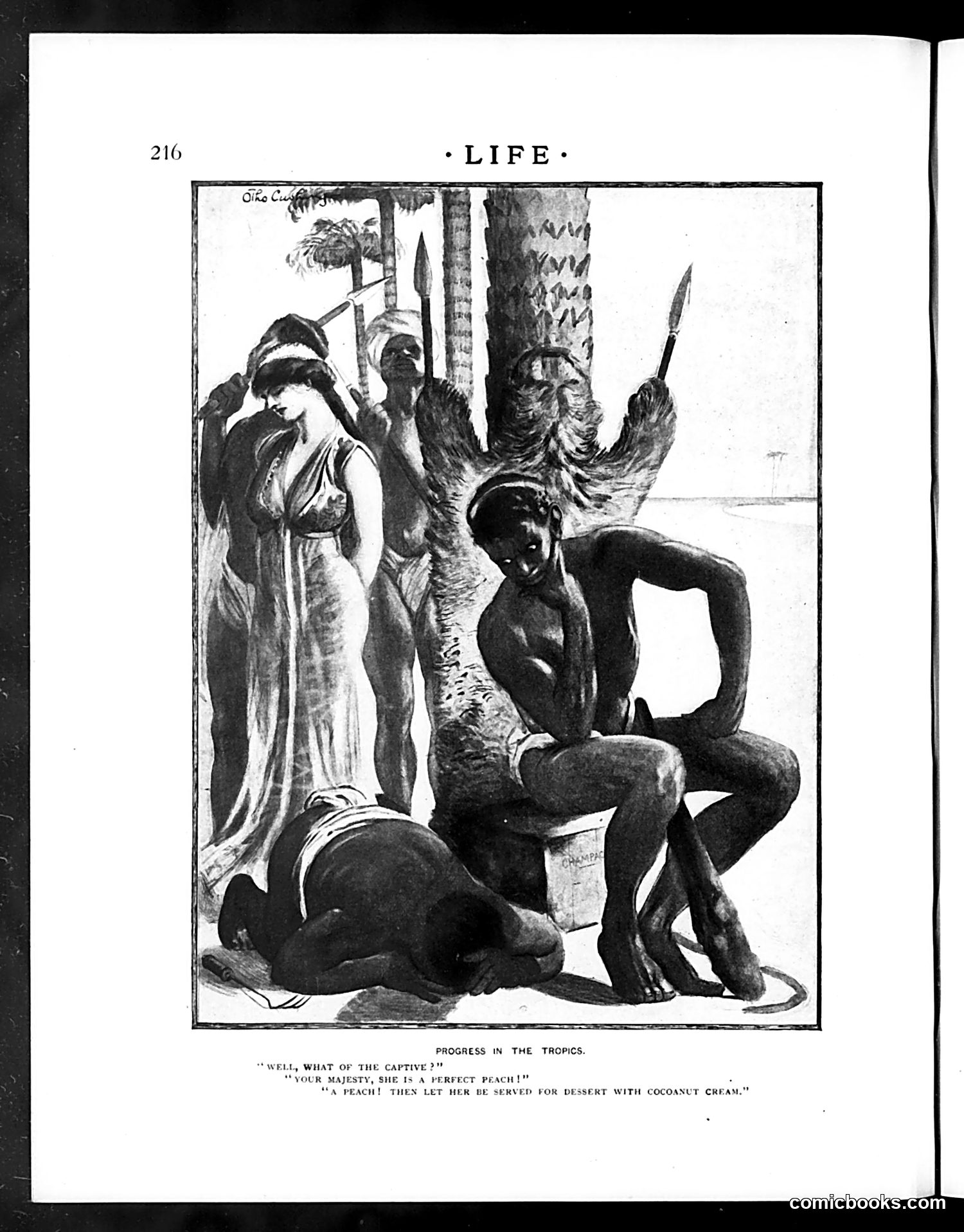
This satirical cartoon depicts colonial attitudes toward indigenous peoples and women. A European woman in classical dress (labeled "Your Majesty") is presented to what appears to be an indigenous ruler, who is shown in a dehumanizing caricature common to the period. The caption's crude joke—treating the captive woman as a "peach" to be eaten as dessert—satirizes both the objectification of women and the racist stereotyping of non-European peoples as uncivilized or cannibalistic. The cartoon likely mocks Victorian-era attitudes about colonialism and "civilizing missions" in tropical regions, while simultaneously reinforcing the very stereotypes it ostensibly critiques through its offensive imagery. The title "Progress in the Tropics" suggests ironic commentary on colonial expansion.
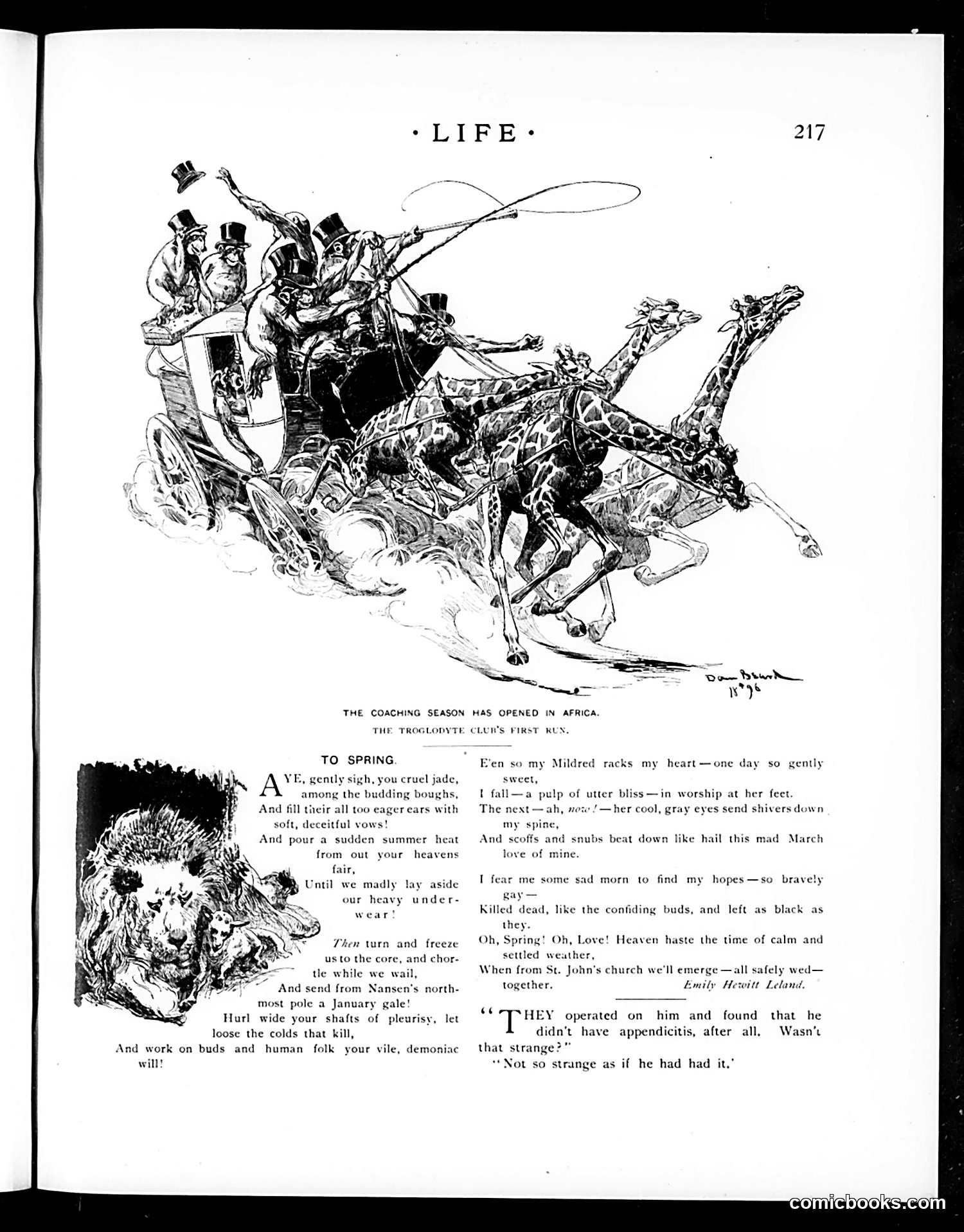
**The Main Cartoon:** The top illustration depicts a chaotic African scene labeled "The Coaching Season Has Opened in Africa. The Troglodyte Club's First Run." It shows elegantly dressed Victorian gentlemen (wearing top hats) riding in a carriage pulled by giraffes across an African landscape. This is satirizing the contemporary British obsession with exotic hunting expeditions and "adventure tourism" in colonial Africa, presenting African wildlife and landscape as novelty entertainment for wealthy Europeans. **The Poetry ("To Spring"):** A romantic lament about spring's inconsistency and its metaphorical connection to a fickle lover named Mildred—using weather imagery (sudden heat followed by freezing) to express romantic uncertainty. **The Bottom Joke:** A brief medical quip about a surgical operation revealing the patient lacked an appendix—playing on contemporary anxieties about unnecessary surgery and the fashion for appendectomies. The page reflects Edwardian-era preoccupations: colonial adventure, romantic sentimentality, and emerging medical skepticism.
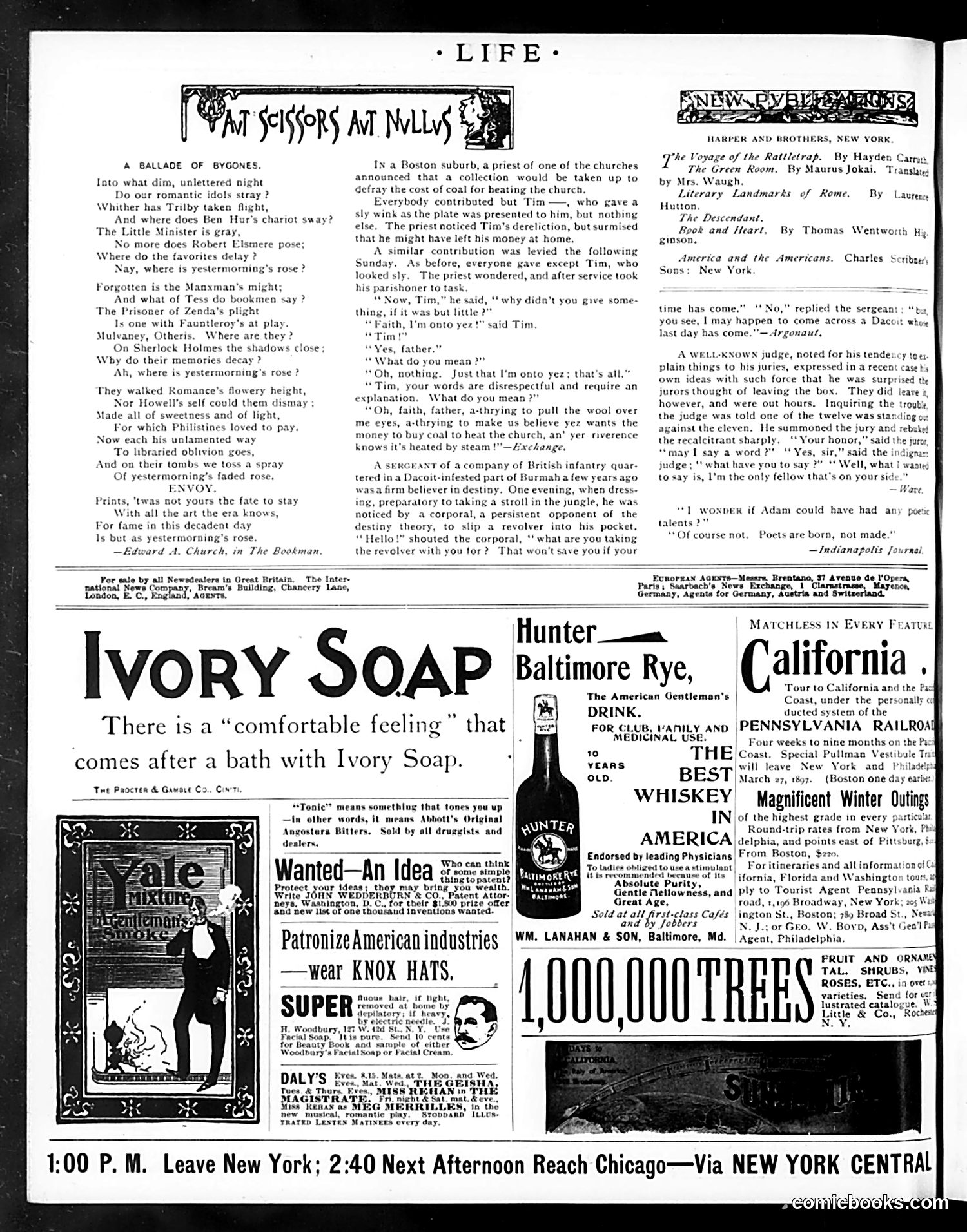
This page is primarily **literary and humorous anecdotes** rather than political satire. The main content includes: 1. **"A Ballad of Bygones"** — a poem lamenting how popular Victorian-era fictional characters (Trilby, Ben Hur, Sherlock Holmes, Tess) have faded from public memory. It's nostalgic commentary on changing literary tastes. 2. **Three brief comic anecdotes** about human nature: - Tim, an Irish parishioner, admits he knows the church uses steam heat, so he refuses to contribute to a coal collection (social commentary on hypocrisy) - A sergeant carries a revolver despite believing in fate, revealing life's contradictions - A judge's harsh instructions drive jurors to disagree with him The humor relies on recognizing **period-specific character references** (Trilby, Ben Hur, Fauntleroy) that were once enormously popular but are now forgotten — exactly what the poem claims about literary fashion. The page demonstrates Life's role as an **intellectual, literary magazine** mixing poetry, witty observations about human nature, and gentle social humor — quite different from modern magazines.
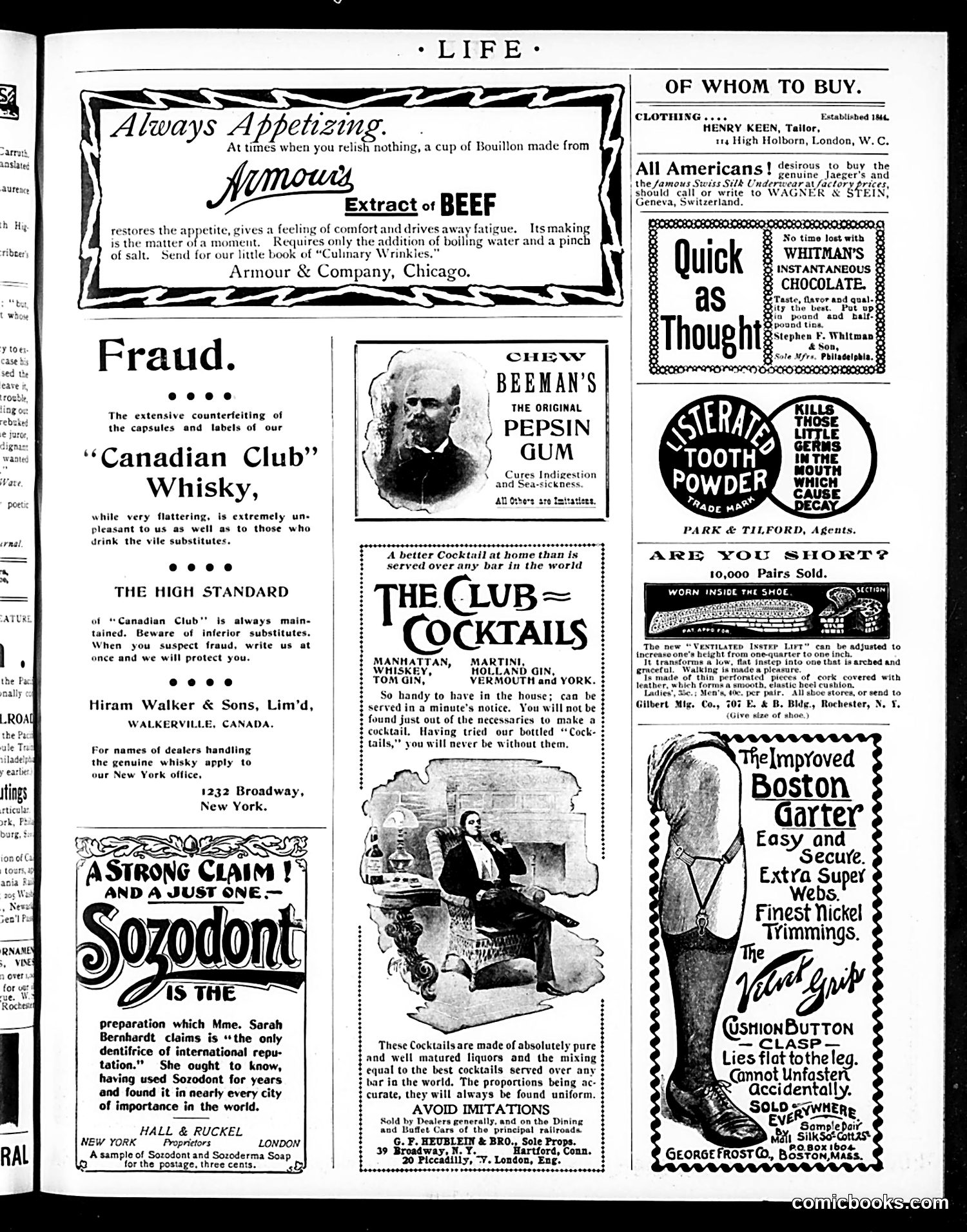
This page is primarily **advertising**, not political satire. It's from Life magazine's commercial section featuring period product endorsements and notices. Key content includes warnings about **counterfeit whisky**—Hiram Walker & Sons alerts readers to fake "Canadian Club" bottles circulating, advising consumers to verify authenticity. This reflects real 19th-century concerns about product fraud and brand protection. Notable is an endorsement by **Sarah Bernhardt** (famous French actress) for Sozodont toothpaste, lending celebrity credibility to the product. The ads showcase consumer goods typical of the era: beef extract, gum, cocktail mixers, clothing, undergarments, dental products, and shoe inserts designed to increase height—revealing period anxieties about physical appearance. The advertisements collectively demonstrate how early commercial culture used celebrity endorsement, warnings against imitation, and appeal to refinement to market products to a middle-class readership.
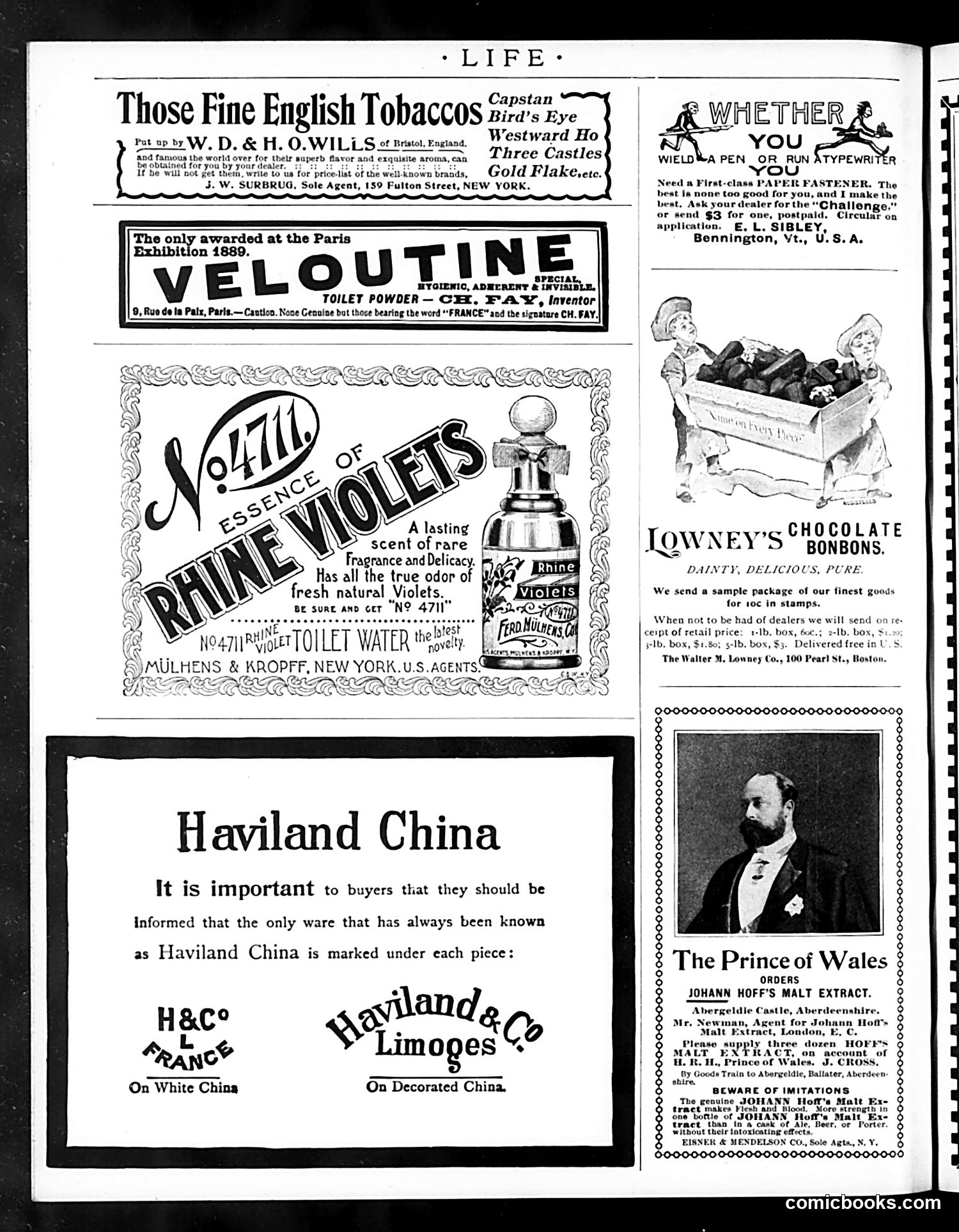
This is primarily a **advertisement page**, not a satirical cartoon page. It features various product endorsements typical of late 19th-century American magazines. Notable content includes: **The Prince of Wales endorsement** (bottom right): A photograph of the Prince with text claiming he ordered Johann Hoff's Malt Extract to "Abergeldie Castle." This represents the common Victorian advertising practice of using royal patronage to sell products—whether authentic or fabricated. Modern readers should note that such celebrity endorsements were largely unregulated and often dubious. **Other ads** promote English tobaccos, French toilet powder and violet water, typewriter ribbons, chocolate bonbons, and Haviland china—all positioned as luxury goods for affluent consumers. The page reflects an era when magazines monetized through advertising and when brands freely invoked prestigious names and locations to suggest quality and sophistication to buyers with disposable income.
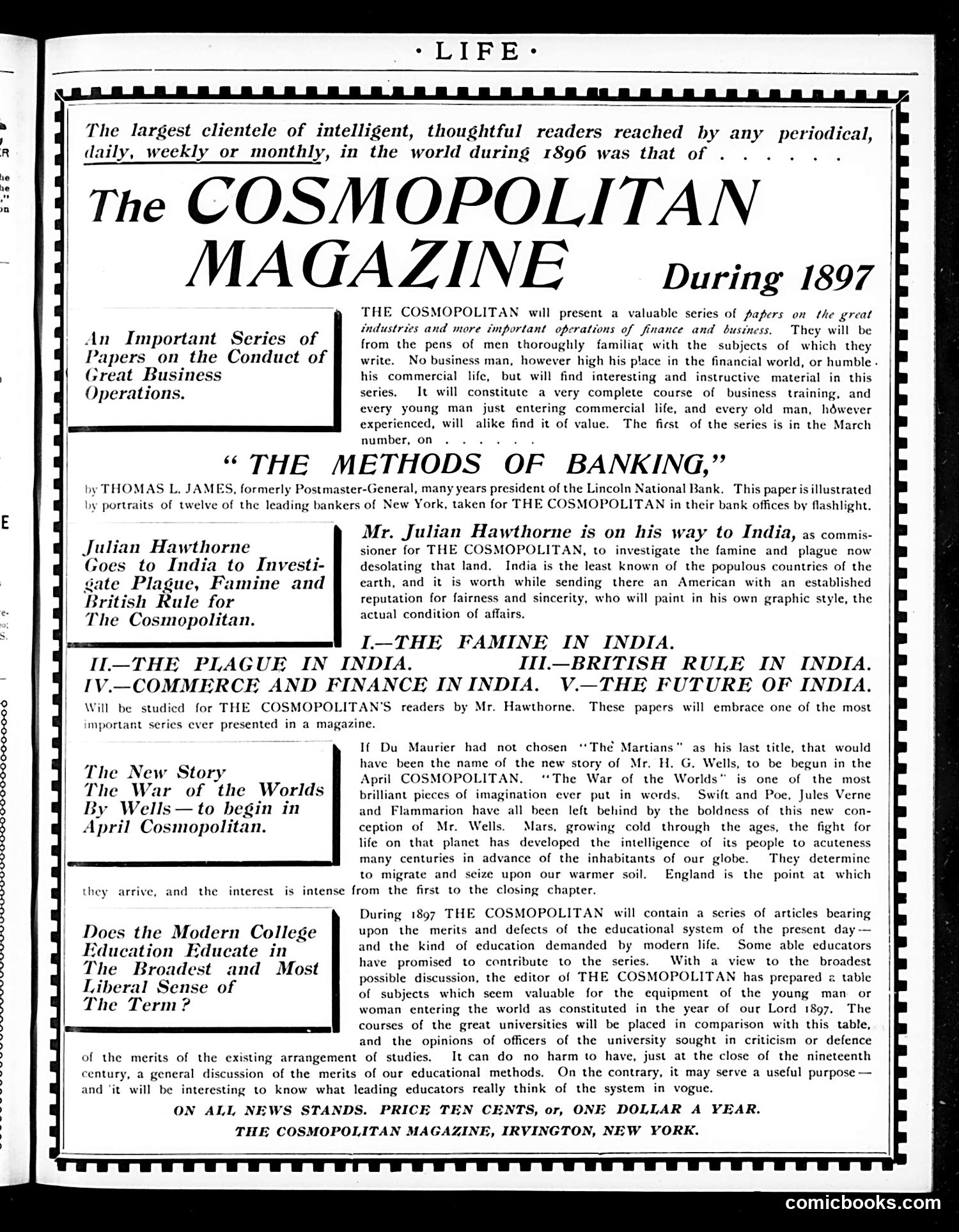
This is primarily an **advertisement for The Cosmopolitan Magazine** (1897), not a satirical cartoon. The page promotes upcoming content rather than presenting political satire. The advertisement announces several major series for 1897: 1. **"Methods of Banking"** — featuring portraits of New York's leading bankers, suggesting the magazine's access to financial elite 2. **Julian Hawthorne's India reporting** — on famine, plague, and British rule, positioning the magazine as serious journalism 3. **H.G. Wells's "The War of the Worlds"** — promoting this serialized science fiction story about Martian invasion 4. **Educational system critique** — examining whether modern college education serves practical needs The page emphasizes *The Cosmopolitan*'s reach and authority: it claims the "largest clientele of intelligent, thoughtful readers" globally in 1896. This is boastful marketing positioning the magazine as essential reading for educated Americans interested in business, current events, and serious literature.
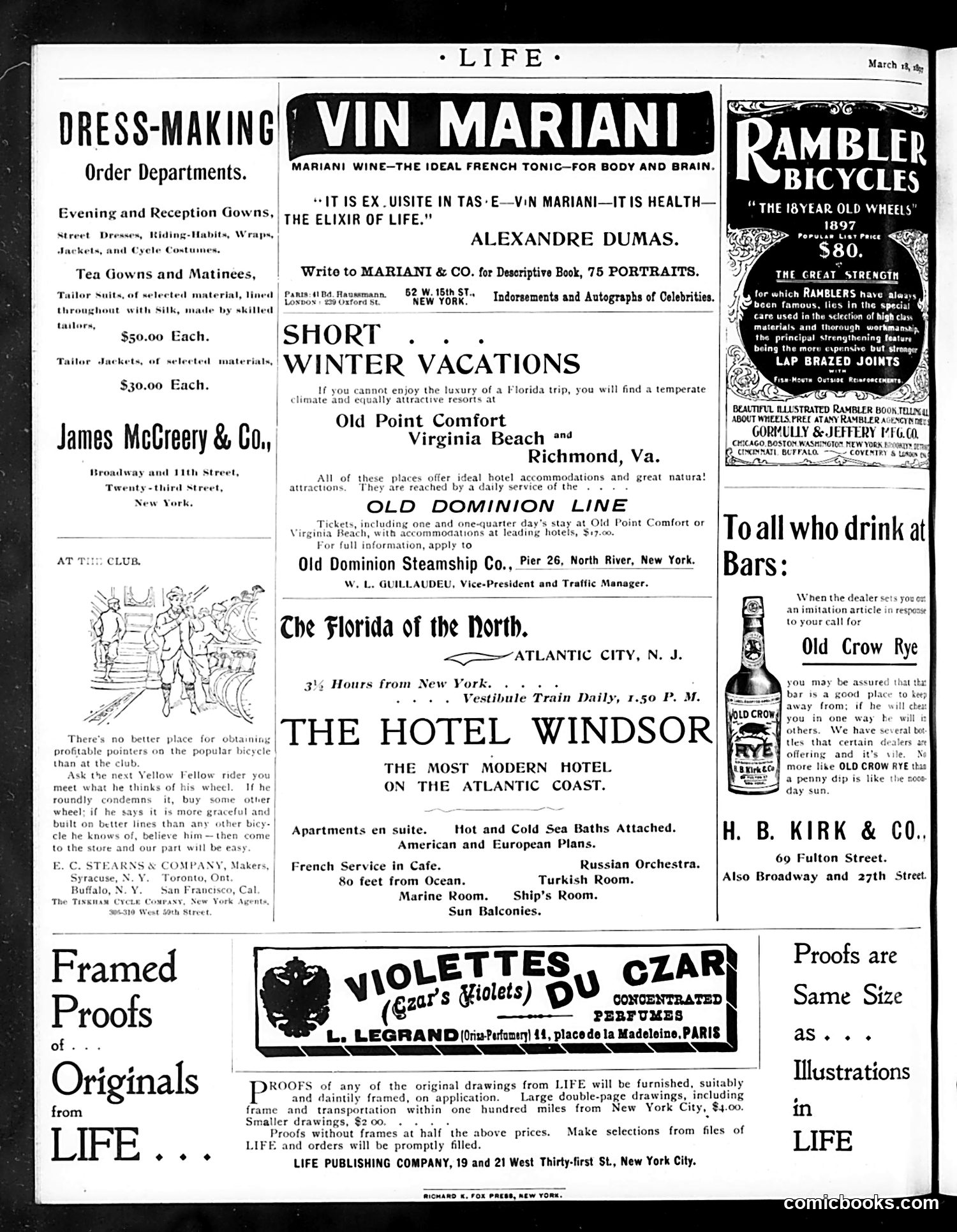
This page is **primarily advertising**, not satirical content. It's a back or interior page from Life magazine circa 1898, dominated by commercial advertisements rather than editorial cartoons or humor. The single cartoon visible (bottom left, "At the Club") appears to show men discussing bicycles—likely satirizing the bicycle craze of the 1890s, where the "Yellow Fellow" brand is endorsed. The joke seems to rely on social commentary about consumer enthusiasm for particular wheel brands. The rest consists of period advertisements: dress-making services, Vin Mariani (a wine tonic endorsed by Alexandre Dumas), vacation resorts, the Hotel Windsor in Atlantic City, Rambler bicycles, Old Crow Rye whiskey, and French perfume. These ads reflect 1890s consumer culture and leisure travel for the wealthy. Without seeing the magazine's editorial content, we cannot determine the satirical intent or political commentary Life intended for this issue.