
Life, 1897-03-18 · page 7 of 20
Life — March 18, 1897 — page 7: what you’re looking at
What you’re looking at
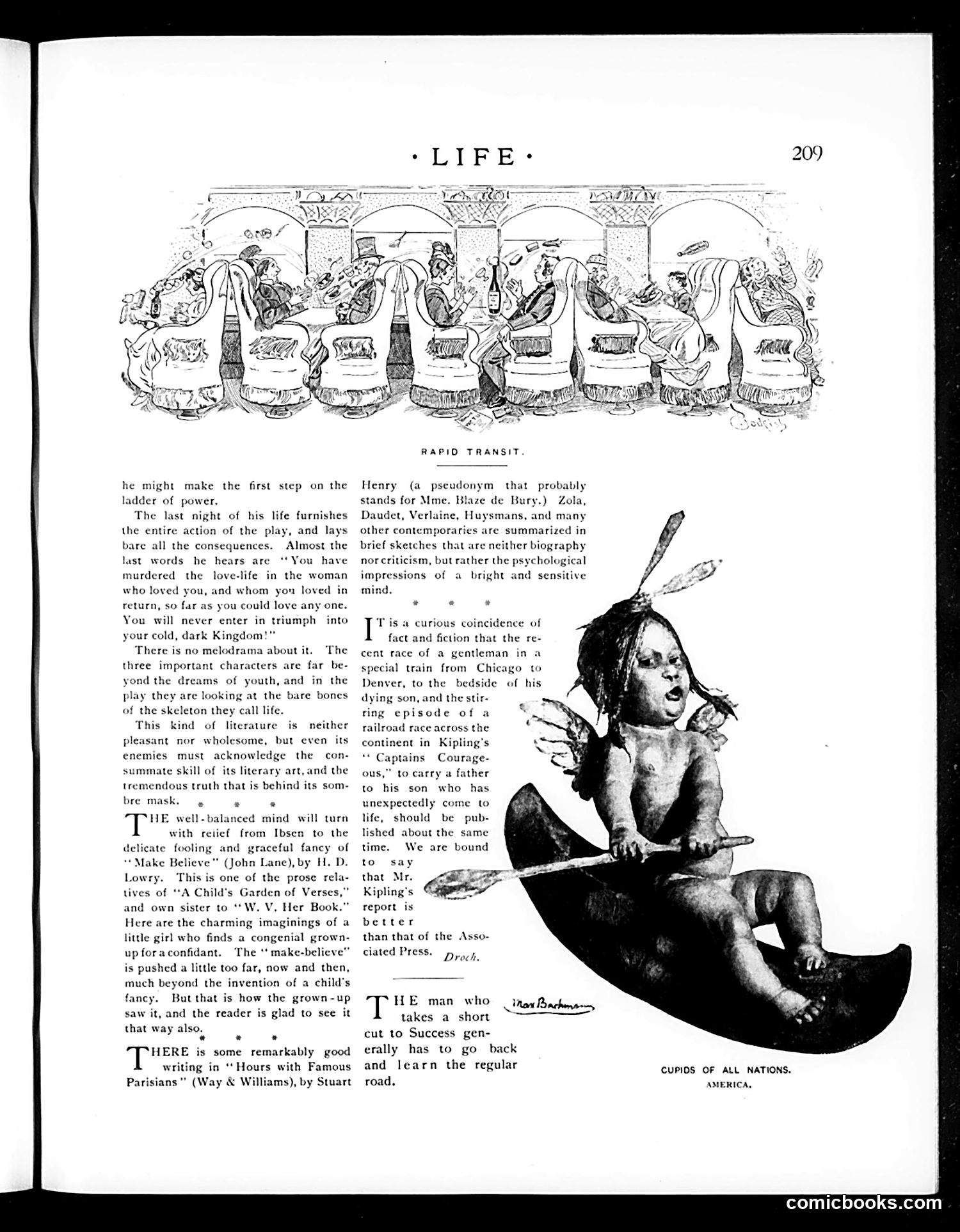
The top cartoon depicts crowded subway cars—a visual commentary on urban congestion and rapid transit systems, likely referencing early 20th-century concerns about overcrowded public transportation in American cities. The illustrated figure on the right, labeled "Cupids of All Nations: America," shows a cherub or cupid character in a somewhat unflattering caricature style, appearing to ride or propel himself forward. This likely satirizes American approaches to love, courtship, or romance compared to other nations—a common theme in Life's "nations" series of comparative humor. The surrounding text discusses various literary works and authors, providing cultural context for the satirical commentary on contemporary society and literature.
📄 Transcribed text from this page (OCR, searchable)
Machine-transcribed from the original scan — historical spelling and the odd misread are preserved.
he might make the first step on the ladder of power. The last night of his life furnishes the entire action of the play, and lays bare all the consequences. Almost the last words he hears are **You have murdered the love-life in the woman who loved you, and whom you loved in return, so far as you could love any one. You will never enter in triumph into your cold, dark Kingdom!" There is no melodrama about it. The three important characters are far be- yond the dreams of youth, and in the play th ¢ looking at the bare bones of the skeleton they call life. This kind of literature is neither pleasant nor wholesome, but even its enemies must acknowledge the con- summate skill of its literary art, and the tremendous truth that is behind its som- bre mask. 9 * * T" well-balanced mind will turn with relief from Ibsen to the delicate fooling and graceful fancy of **Make Believe" (John Lane), by H. D. Lowry. This is one of the prose rela- tives of ‘tA Child's Garden of Verses,” and own sister to ‘*W. V. Her Book.” Here are the charming imaginings of a little girl who finds a congenial grown- upforaconfidant, The ‘make-belicve” is pushed a little too far, now and then, much beyond the invention of a child's fancy. But that is how the grown-up saw it, and the reader is glad to see it that way also. * 8 HERE is some remarkably good writing in ‘Hours with Famous jans"" (Way & Williams), by Stuart RAPID TRANSIT Henry (a pseudonym that probably stands for Mme. Blaze de Bury.) Zola, Daudet, Verlaine, Huysmans, and many other contemporaries are summarized in brief sketches that a ither biography nor criticism, but rather the psychological impressions of a bright and sensitive mind. * * * J sa curious coincidence of fact and fiction that the re- cent race of a gentleman in a special train from Chicago to Denver, to the bedside of his dying son, and the stir- ring episode of a railroad race across the continent in Kipling’s “Captains Courage- ous,” to carry a father to his son who has unexpectedly come to life, should be pub- lished about the same time. We are bound to say that Mr. (eye Kipling’s Cpr report is better than that of the Asso- ciated Press. py. 4, HE man who iter Backemny takes a short ees cut to Success gen- erally has to go back and learn the regular road, CUPIDS OF ALL NATIONS. AMERICA, comicbooks.com