
Life, 1897-03-18 · page 12 of 20
Life — March 18, 1897 — page 12: what you’re looking at
What you’re looking at
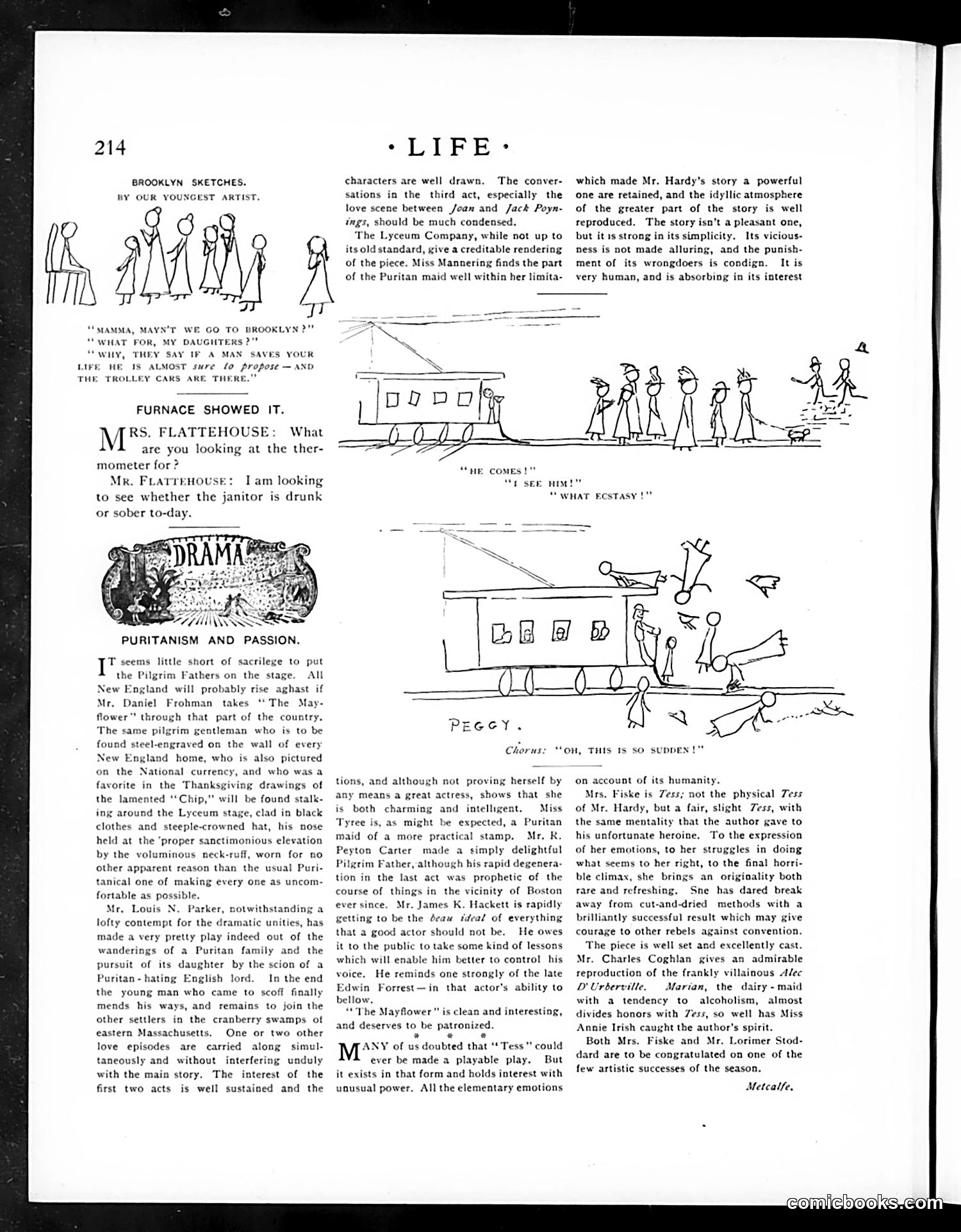
The sketches depict simple line-drawn scenes of Brooklyn life, likely from the early 20th century. The top sketch shows a family discussion about going to Brooklyn, with a child's observation that "a man saves your life he is almost sure to propose—and the trolley cars are dreadful." The lower sketches titled "PEGGY" show a trolley car scene with exaggerated stick figures, including a chorus exclaiming "Oh, this is so sudden!" The humor derives from the mundane absurdity of Brooklyn domestic life—the anxiety about trolley cars as transportation hazards and the running joke about unwanted marriage proposals from rescuers. The "youngest artist" credit suggests these are intentionally naive, child-like drawings meant as comedic commentary on urban middle-class anxieties of the era.
📄 Transcribed text from this page (OCR, searchable)
Machine-transcribed from the original scan — historical spelling and the odd misread are preserved.
214 BROOKLYN SKETCHES. BY OUR YOUNGEST ARTIST. LIFE characters are well drawn. The conver- sations in the third act, especially the love scene between Joan and Jack Poyn- ings, should be much condensed. ‘The Lyceum Company, while not up to its old standard, give a creditable rendering of the piece. Miss Mannering finds the part of the Puritan maid well within her limita- which made Mr. Hardy’s story a powerful one are retained, and the idyllic atmosphere of the greater part of the story is well reproduced. The story isn’t a pleasant one, but itis strong in its simplicity. Its vicious- ness is not made alluring, and the punish- ment of its wrongdoers is condign. It is very human, and is absorbing in its interest ‘MAMMA, MAYN'T WE GO TO BROOKLYN?" “WHAT FOR, MY DAUGHTERS ?" “WY, THEY SAY IF A MAN SAVES YOUR LIFE HE IS ALMOST sure fo propose — AND THE TROLLEY CARS ARE THERE.” FURNACE SHOWED IT. ALY RS. FLATTEHOUS What are you looking at the ther- mometer for ? Mr. FLrarrenouse: Iam looking to see whether the janitor is drunk or sober to-day. PURITANISM AND PASSION. [7 seems little short of sacrilege to put the Pilgrim Fathers on the stage. All New England will probably rise aghast if Mr. Daniel Frohman takes “The May- flower” through that part of the country. The same pilgrim gentleman who is to be found steel-engraved on the wall of every New England home, who is also pictured on the National currency, and who was favorite in the Thanksgiving drawings of the lamented “Chip,” will be found stalk- ing around the Lyceum stage, clad in black clothes and steeple-crowned hat, his nose held at the ‘proper sanctimonious elevation by the voluminous neck-ruff, worn for no other apparent reason than the usual Puri- tanical one of making every one as uncom- fortable as possible. Mr. Louis N. Parker, notwithstanding a lofty contempt for the dramatic unities, has made a very pretty play indeed out of the wanderings of a Puritan family and the pursuit of its daughter by the scion of a Puritan- hating English lord. In the end the young man who came to scoff finally mends his ways, and remains to join the other settlers in the cranberry swamps ot eastern Massachusetts. One or two other love episodes are carried along simul- taneously and without interfering unduly with the main story. The interest of the first two acts is well sustained and the Ki “HE Comes!" iM" “WHAT ECSTASY !"" Chorus: tions, and although not proving herself by any means a great actress, shows that she is both charming and intelligent. Miss Tyree is, as might be expected, a Puritan maid of a more practical stamp. Mr. R. Peyton Carter made a simply delightful Pilgrim Father, although his rapid degenera- nin the last act was prophetic of the course of things in the vicinity of Boston Mr. James K, Hackett is rapidly getting to be the beau fdeal of everything that a good actor should not be. He owes it to the public to take some kind of lessons which will enable him better to control his voice. He reminds one strongly of the late Edwin Forrest—in that actor's ability to bellow. “The Mayflower" is clean and interesting, and deserves to be patronized. . * @ ANY of us doubted that “Tess” could ever be made a playable play, But it exists in that form and holds interest with unusual power. All the elementary emotions ever since. “On, THIS Is so SUDDEN!" on account of its humanity. Mrs. Fiske is Zess; not the physical Tess of Mr. Hardy, but a fair, slight Zess, with the same mentality that the author gave to his unfortunate heroine. To the expression of her emotions, to her struggles in doing what seems to her right, to the final horri- ble climax, she brings an originality both rare and refreshing. She has dared break away from cut-and-dried methods with a brilliantly successful result which may give courage to other rebels against convention. The piece is well set and excellently cast. Mr. Charles Coghlan gives an admirable reproduction of the frankly villainous Avec D'Urberville, Marian, the dairy - maid with a tendency to alcoholism, almost divides honors with 7ess, so well has Miss Annie Irish caught the author's spirit. Both Mrs, Fiske and Mr. Lorimer Stod- dard are to be congratulated on one of the few artistic successes of the season. Metcalfe, i-¢