
Life, 1897-03-18 · page 6 of 20
Life — March 18, 1897 — page 6: what you’re looking at
What you’re looking at
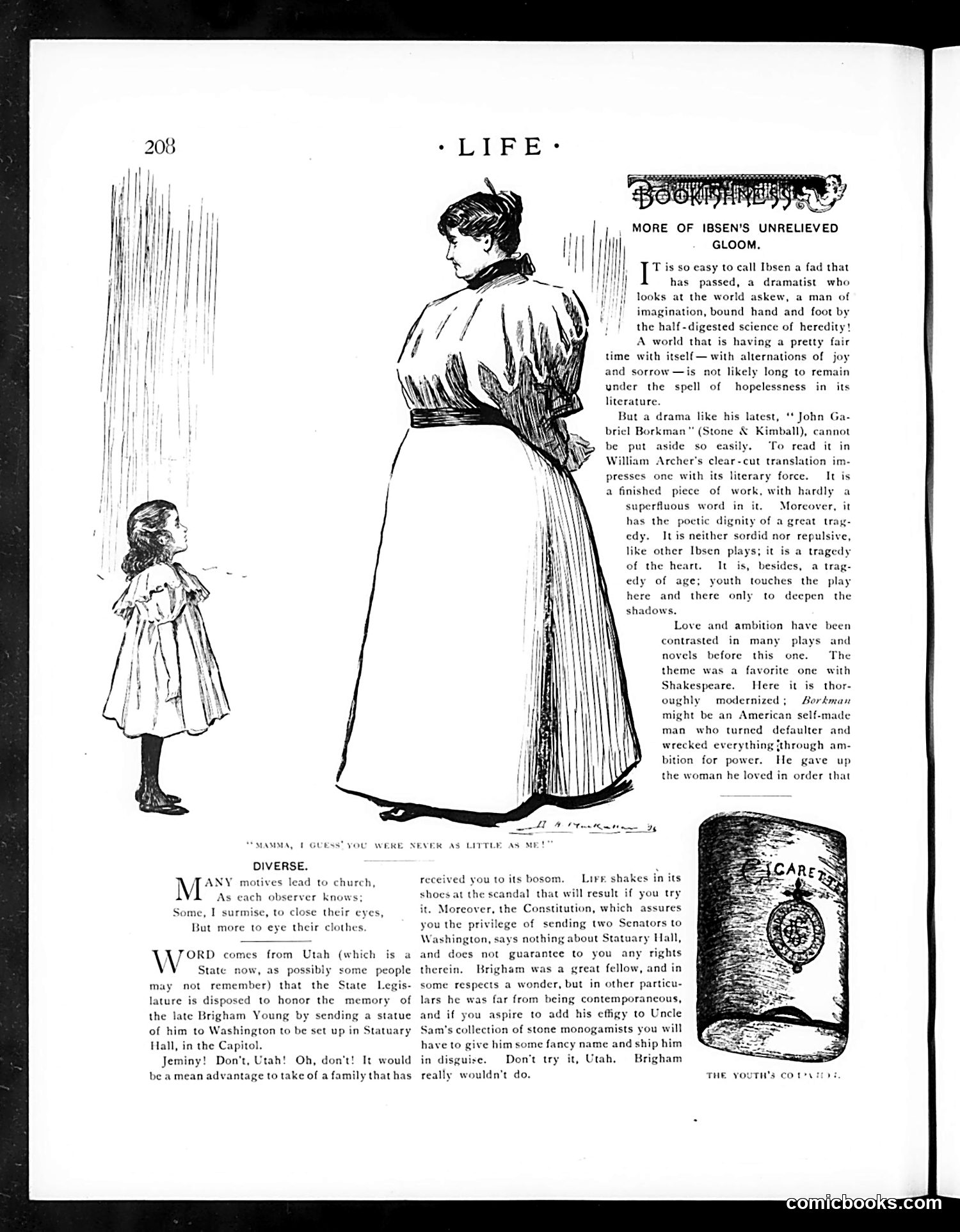
This page discusses Henrik Ibsen's play "John Gabriel Borkman," praising its literary merit despite Ibsen's reputation for pessimism and gloom. The article defends the work against dismissals of Ibsen as merely a "fad." The illustration shows a woman and child in a striking size contrast, captioned "Mamma, I guess you were never as little as me!" This likely satirizes the generational or social gap between parent and child—possibly commenting on how modern society (or modern literature like Ibsen's) creates distance between generations or how childhood innocence contrasts with adult cynicism. The "Diverse" section contains political satire about Utah's Brigham Young statue and state politics, mocking Utah's cultural pretensions. The page is primarily literary criticism with incidental social commentary rather than straightforward political cartooning.
📄 Transcribed text from this page (OCR, searchable)
Machine-transcribed from the original scan — historical spelling and the odd misread are preserved.
MORE OF IBSEN’S UNRELIEVED GLOOM. T is so easy to call Ibsen a fad that has passed, a dramatist. who looks at the world kew, a man of imagination, bound hand and foot by the half-digested science of heredity! A world that is having a pretty fair time with itself—with alternations of joy and sorrow —is not likely long to remain under the spell of literature. But a drama like his latest, ‘t John Ga- bricl Borkman" (Stone & Kimball), cannot be put aside To read it in Archer's clear-cut translation im- s one with its literary force. It is a finished piece of work, with hardly a superfluous word in it. Moreover, it hopelessness in its so easily. has the poetic dignity of a great trag- edy. Itis neither sordid nor repulsive, like other Ibsen plays; it is a tragedy of the heart. It is, besides, of age; youth touches and a trag- the play to deepen the edy here there only shadows. Love and ambition have been plays and The with contrasted novels theme was a Shakespeare. thor- oughly modernized; Bordman might be an American self-made man who turned defaulter and {through am- He gave up the woman he loved in order that in many this one. favorite Here before one it is wrecked everythin bition for power. HM DT mntwtinns _¥s “MAMMA, TF GUESS’ YOU WERE NEVER AS LITTLE AS ME! DIVERSE. NY motives lead to church, As cach observer knows; received you to its bosom. Lire. sh: shoes at the scandal that will result if you try it. Moreover, the Constitution, which assures Buvanore (oepe thelr clothes, you the privilege of sending two Senators to ees Washington, says nothing about Statuary Hall, \ JORD comes from Utah (which is a and does not guarantee to you any rights State Brigham was a great fellow, and in N Some, I surmise, to close their eyes, now, as possibly some people therein. er) that the State lature is disposed to honor the some respects a wonder, but in other particu- lars he was far from being contemporancous, may not rememt Legis- memory of the late Brigham Young by sending a statue of him to Washington to be set up in Statuary Hall, in the Capitol. Jeminy! Don't, Utah! Oh, don't! It would be a mean advantage to take of a family that has and if you aspire to add his effigy to Uncle Sam's collection of stone monogamists you will have to give him some fancy name and ship him in disguise. Don’t try it, Utah, Brigham really wouldn't do. THE YOUTH'S COT