
A complete issue · 22 pages · 1897
Life — January 21, 1897
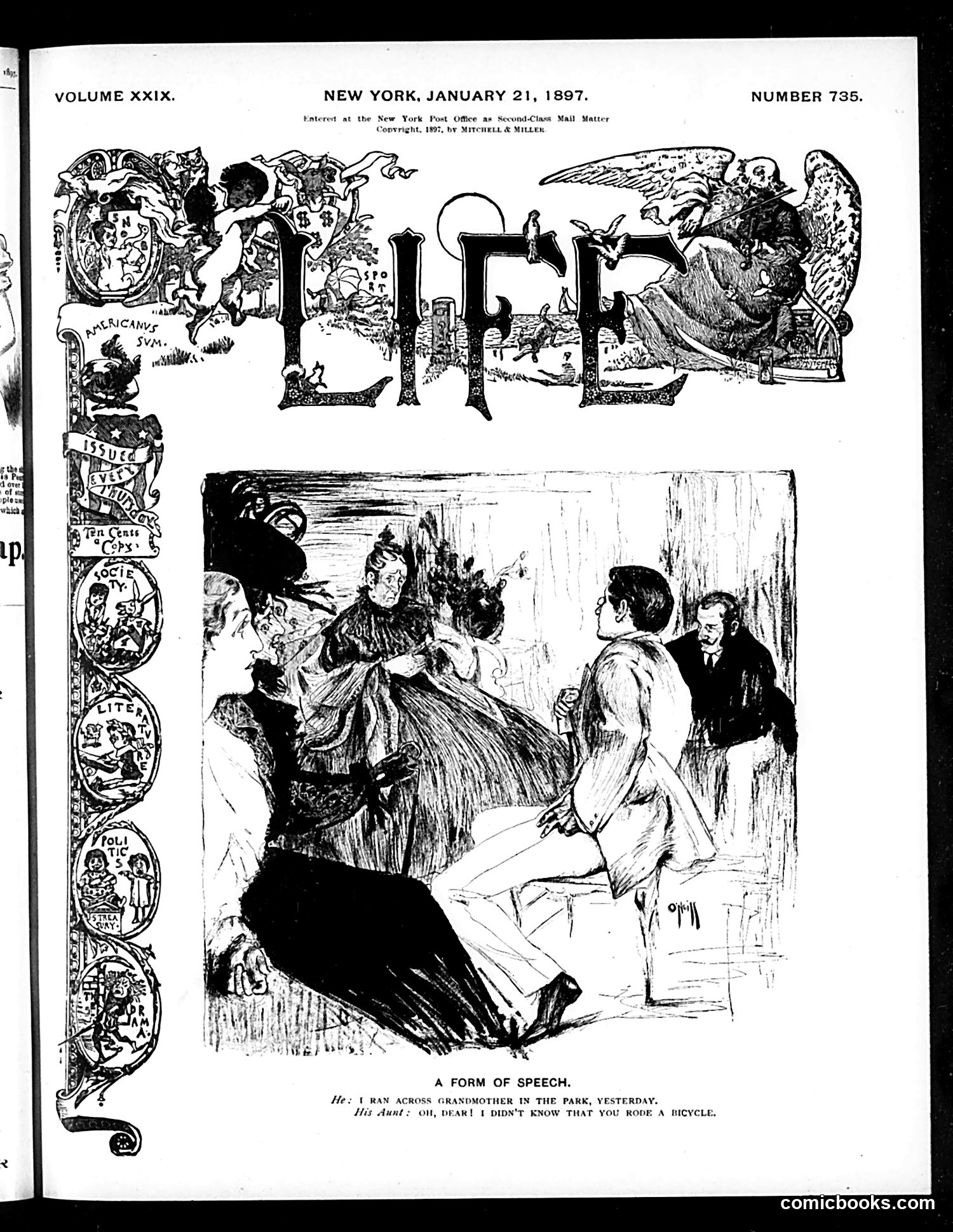
This cartoon satirizes social etiquette and the gap between what people say versus what they actually mean. The caption presents a domestic scene where a man mentions encountering his grandmother in the park riding a bicycle—an unusual activity for an elderly woman in the 1890s. His aunt responds with feigned shock ("Oh, dear! I didn't know that you rode a bicycle"), using indirect language to express disapproval. Rather than directly criticizing the grandmother's unconventional behavior, she employs a sarcastic "form of speech"—a polite but cutting remark that conveys her judgment through implication. The satire mocks Victorian-era social conventions where people masked criticism behind layers of false politeness and innuendo, a common target of Life magazine's humor.
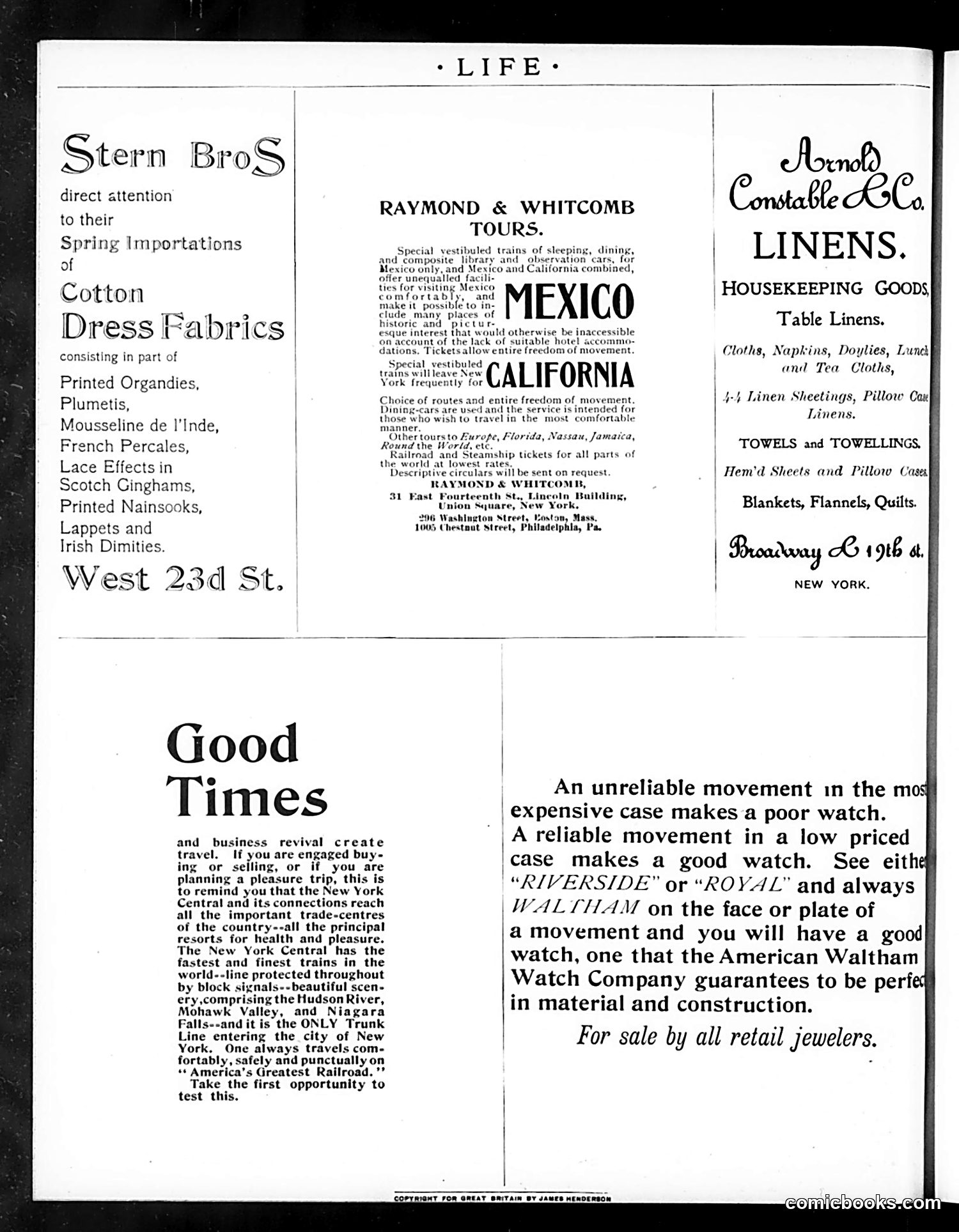
This page is **primarily advertisements**, not satirical content. It contains four commercial ads: 1. **Stern Bros** (West 23rd St.) advertising cotton dress fabrics 2. **Raymond & Whitcomb Tours** promoting travel to Mexico and California 3. **Arnold Constable & Co.** selling linens and housekeeping goods 4. **American Waltham Watch Company** advertising reliable watches 5. A section titled **"Good Times"** discussing the New York Central railroad as America's greatest railway There are **no political cartoons or satirical figures** on this page. The "Good Times" section is travel/business promotion text, not satire. This appears to be a standard advertising page from *Life* magazine, likely from the early 20th century based on typography and product mentions.
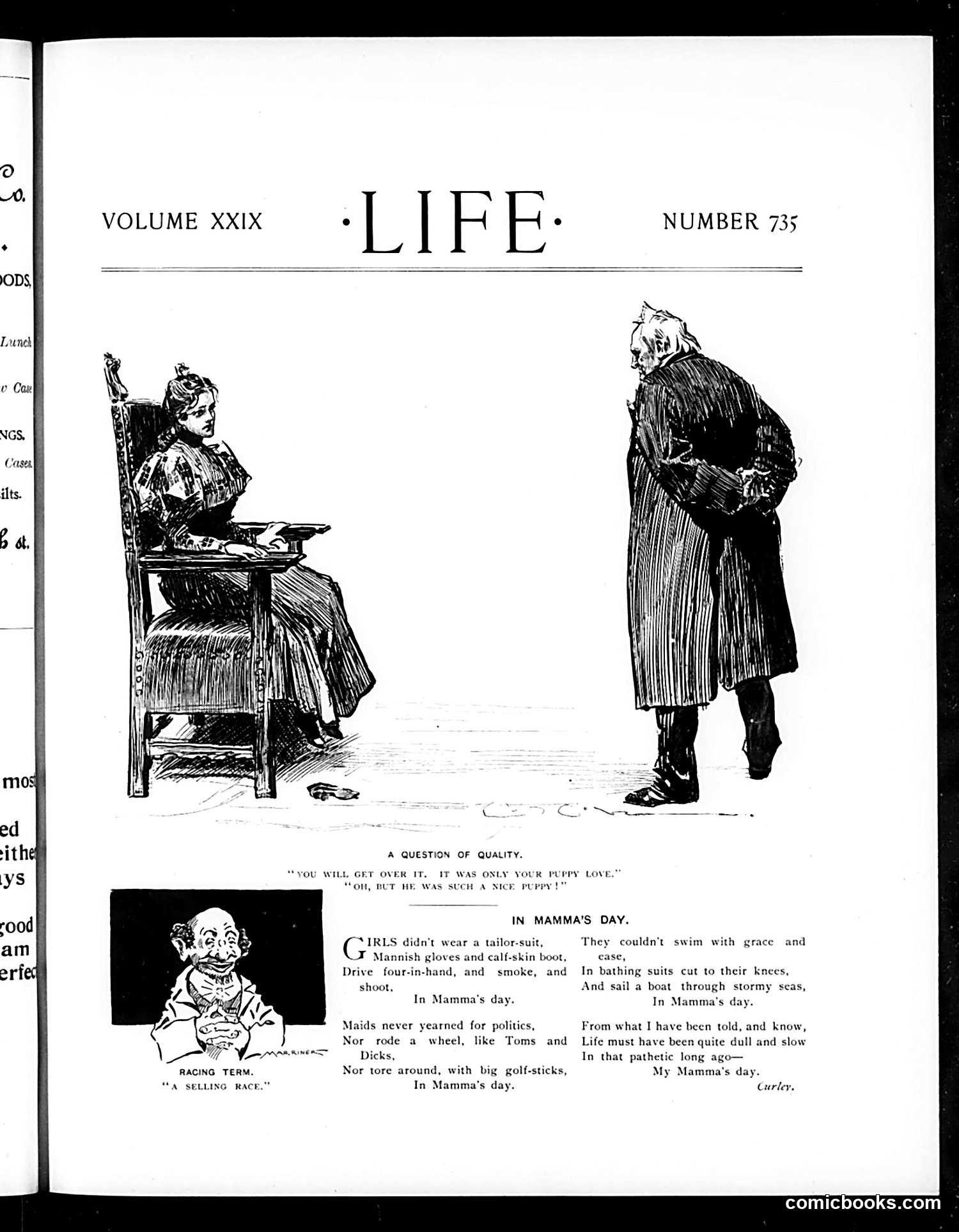
The top cartoon titled "A Question of Quality" depicts a woman seated writing while a man stands nearby. The dialogue—"You will get over it. It was only your puppy love" / "Oh, but he was such a nice puppy!"—is a sarcastic joke about romantic dismissal, mocking how older people minimize young people's emotional attachments. Below, "In Mamma's Day" is a nostalgic poem by Carter contrasting girls' activities then versus now. It humorously suggests Edwardian-era women were more restricted (no tailored suits, couldn't swim gracefully, didn't engage in politics or sports), implying modern women enjoy greater freedoms. The "Racing Term: A Selling Race" cartoon appears to be a separate joke, though its specific reference is unclear from the visible image.
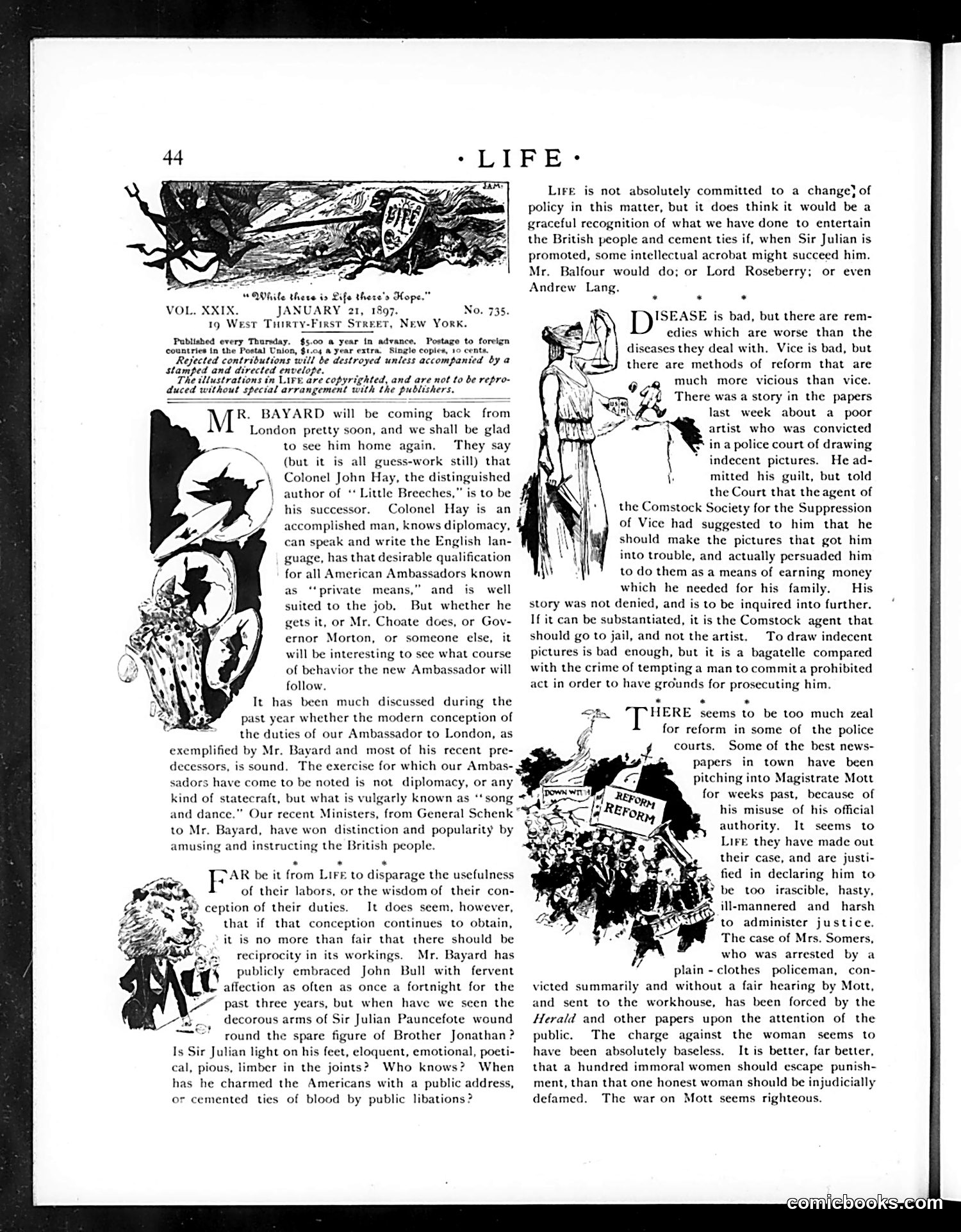
This page contains editorial commentary rather than traditional cartoons. The main topics are: **Mr. Bayard's Ambassadorship**: The text discusses Mr. Bayard's appointment as Ambassador to London, praising his diplomatic qualifications while playfully noting that previous ambassadors like General Schenk and Mr. Choate have been noted for entertainment value ("song and dance") rather than serious diplomacy. **Police and Judicial Reform**: The editorial criticizes excessive zeal in police courts, specifically attacking Magistrate Mott's harsh treatment of Mrs. Somers, a plainly-dressed woman arrested without fair hearing. Life argues the case represents unjust administration of justice, advocating for proportionality in prosecuting moral offenses. The illustrated vignettes support these critiques with satirical imagery.
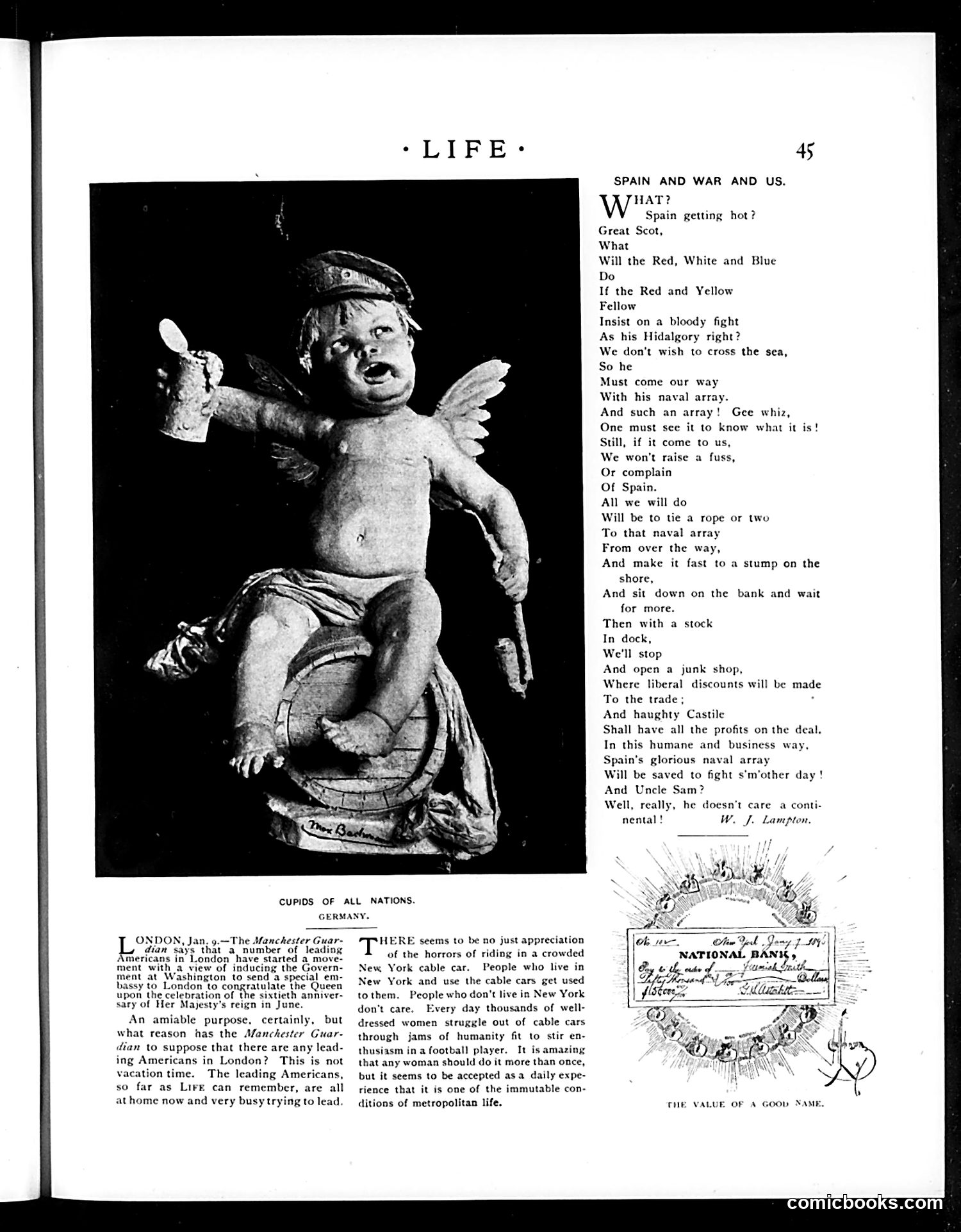
The page contains two distinct items: **Top: "Spain and War and Us"** - A poem by W. J. Lampson responding to potential Spanish naval conflict with the United States. The piece expresses American indifference toward Spain's military capacity, suggesting Americans would simply tie up any Spanish warships and open a "junk shop" to profit from the encounter. The tone is dismissive and jingoistic, reflecting American confidence in naval superiority. **Bottom Left: "Cupids of All Nations"** - A brief news item from London (January 2) noting that Americans in London have started a movement to reduce crowded conditions by importing guardian angels. The piece satirizes American optimism and their tendency toward grand, impractical solutions to urban problems. **Bottom Right:** A bank check illustration titled "The Value of a Good Name," likely advertising financial services.
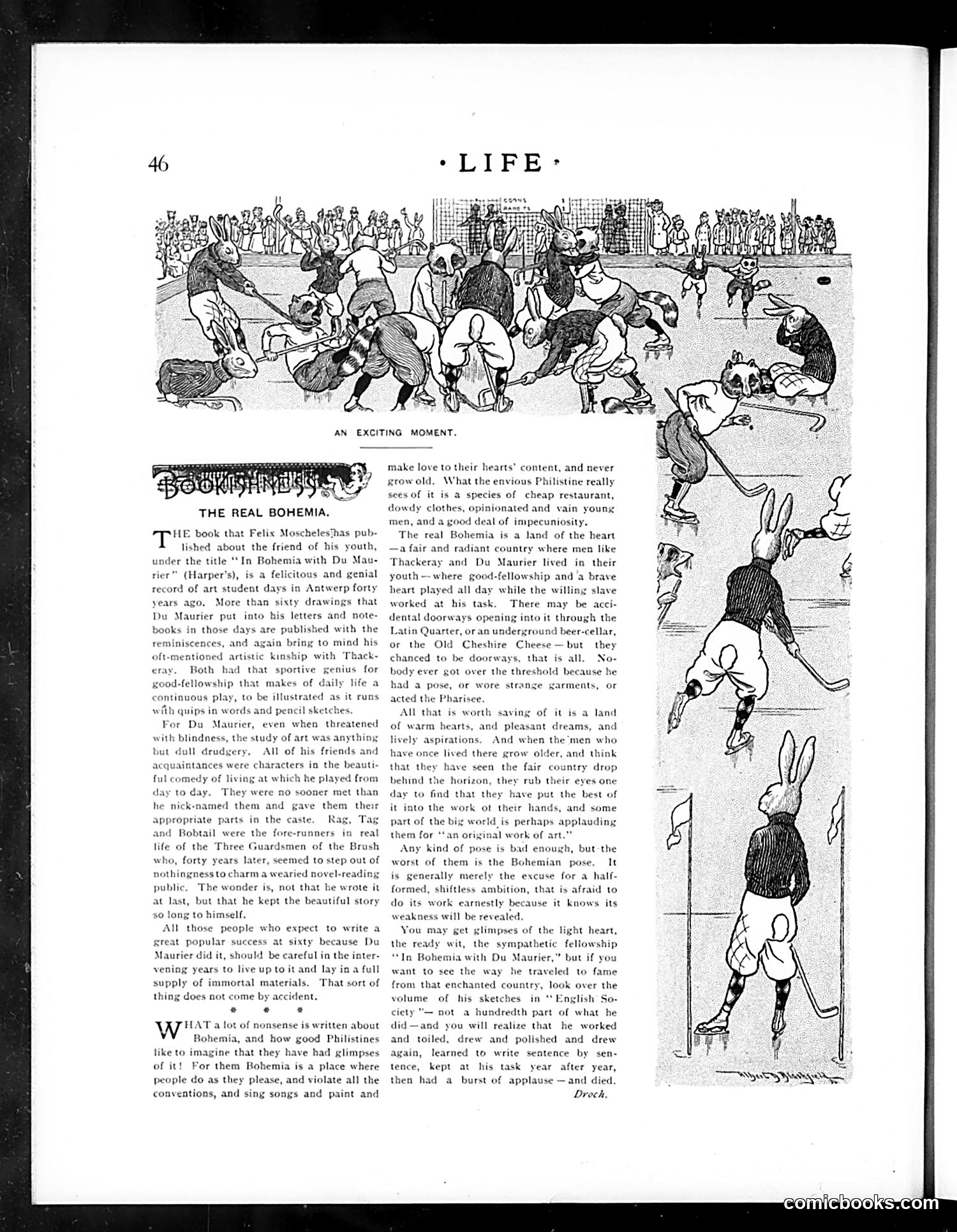
The large cartoon depicts **a chaotic polo match** with players on horseback competing intensely. The title "An Exciting Moment" suggests this captures sport's dramatic tension. The accompanying article, "The Real Bohemia," discusses Felix Moscheles's book about artistic life in Antwerp and Du Maurier's sketches. The text contrasts **authentic bohemian culture** (artistic communities living by passion and good fellowship) with **affected Philistine imitations** (wealthy dilettantes posing as bohemians). The polo scene likely **satirizes upper-class pretension**—showing wealthy elites engaged in an "exciting" but ultimately superficial pursuit, contrasting with genuine artistic bohemia described in the text. The satire targets society's obsession with fashionable sports and shallow status-seeking.
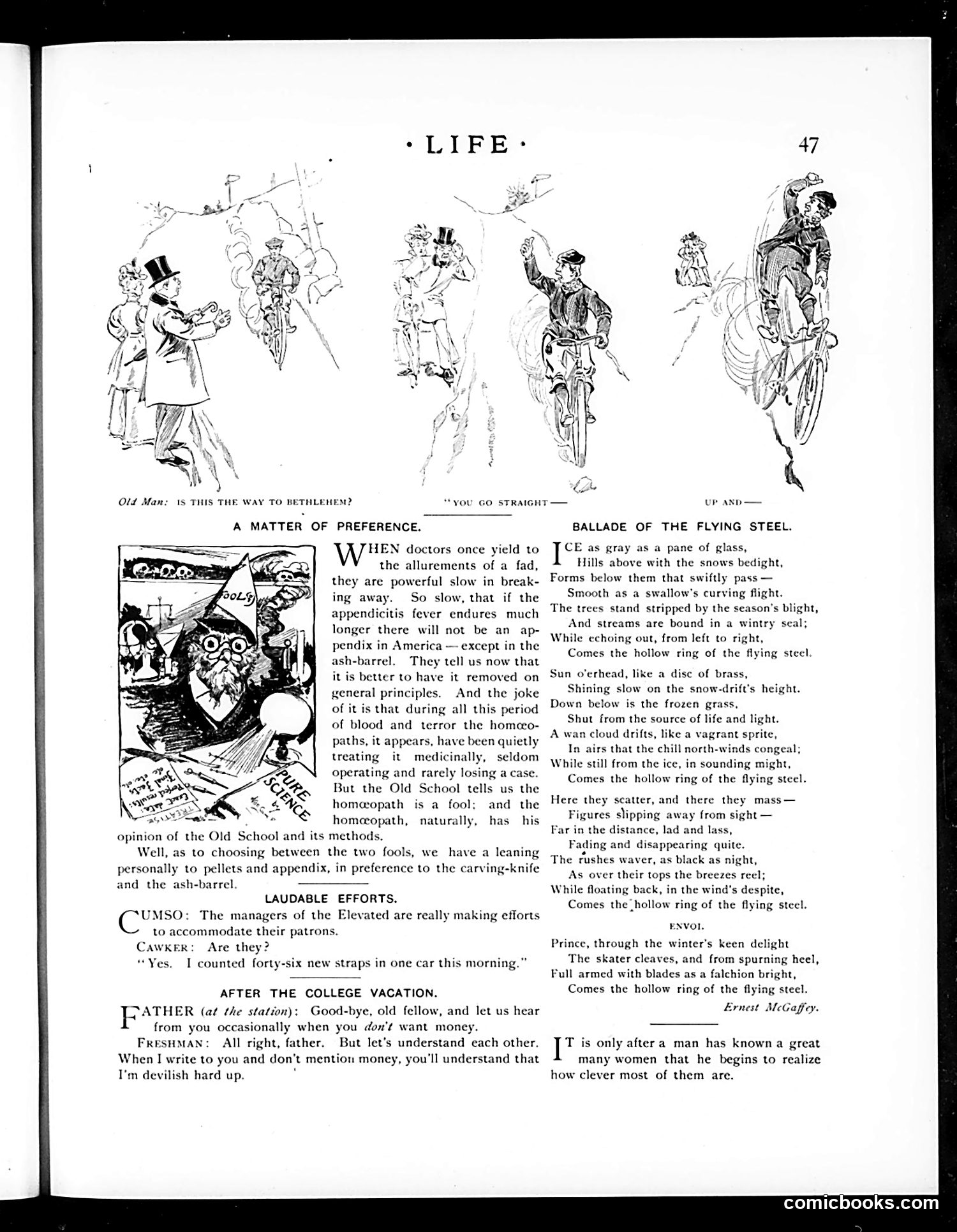
This page from *Life* magazine contains several satirical pieces about early 20th-century urban life: **"A Matter of Preference"** mocks the medical establishment's debate over appendicitis treatment. The cartoon contrasts "Old School" homeopathic methods (slow, ineffective) with modern surgical removal, satirizing doctors who cling to outdated remedies. The joke targets medical conservatism and the absurd reasoning used to justify avoiding necessary procedures. **"Laudable Efforts"** jokes about elevator managers accommodating patrons by adding safety straps—a pointed reference to public anxiety about new elevator technology. **"After the College Vacation"** depicts a father-son conversation about money, satirizing generational misunderstandings and the son's expectations for financial support. The cycling illustrations ("Ballade of the Flying Steel") celebrate bicycle culture, then at its peak of popularity.
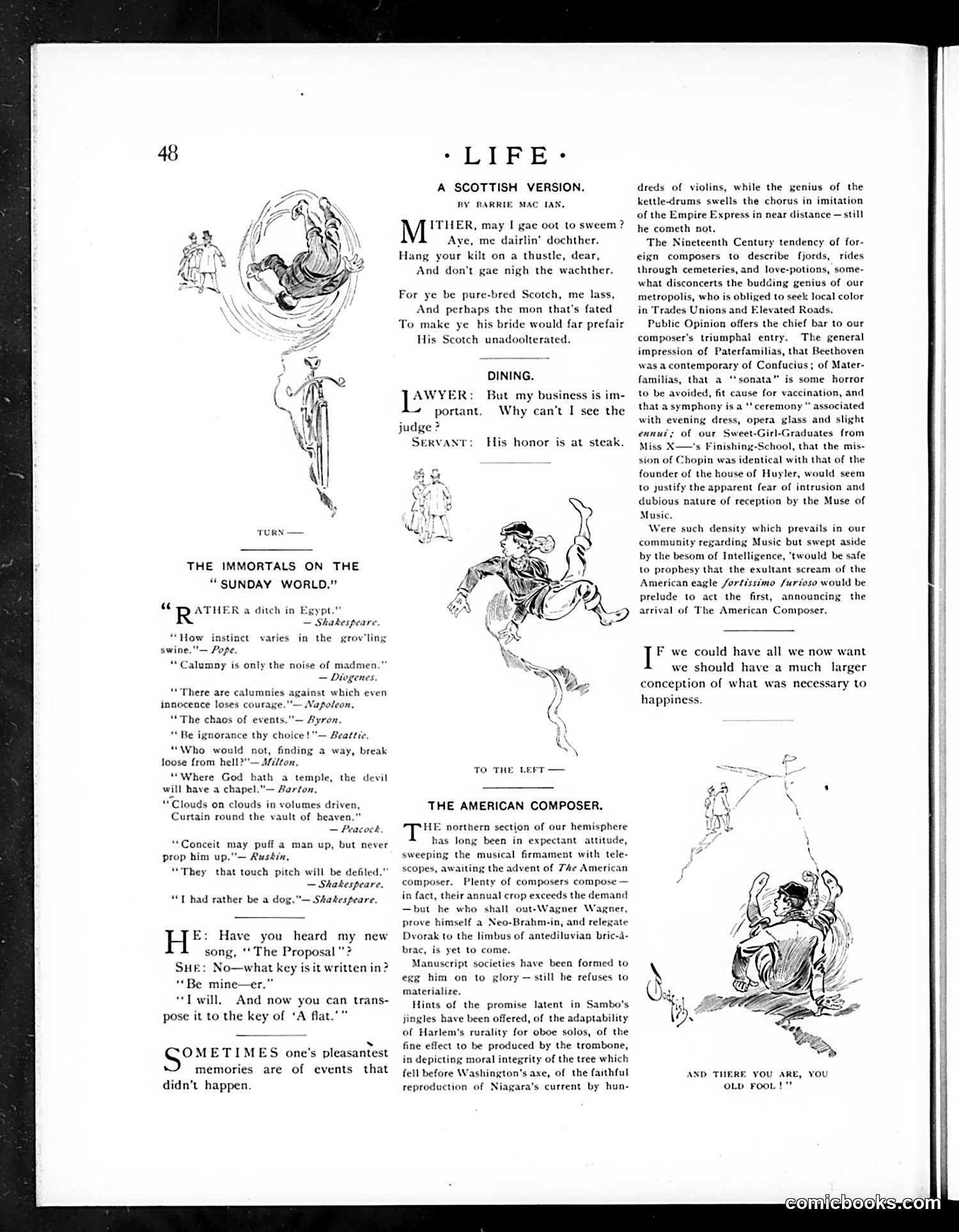
This page contains several satirical sections: **"A Scottish Version"** mocks Scottish dialect through dialogue between characters discussing swimming and marriage. **"Dining"** presents a brief legal joke: a lawyer and servant discuss why a judge cannot attend dinner—his honor is "at stake" (a pun on judicial authority vs. literal stakes/pledges). **"The Immortals on the Sunday World"** collects famous literary quotes about human folly and chaos, attributing them to classical authors like Shakespeare, Pope, and Napoleon. **"The American Composer"** critiques American musical ambitions, suggesting American composers aspire to rival Wagner and Brahms but lack originality, with the manuscript societies refusing to perform their work. The illustrations are whimsical line drawings accompanying these humorous vignettes, typical of Life's satirical house style.
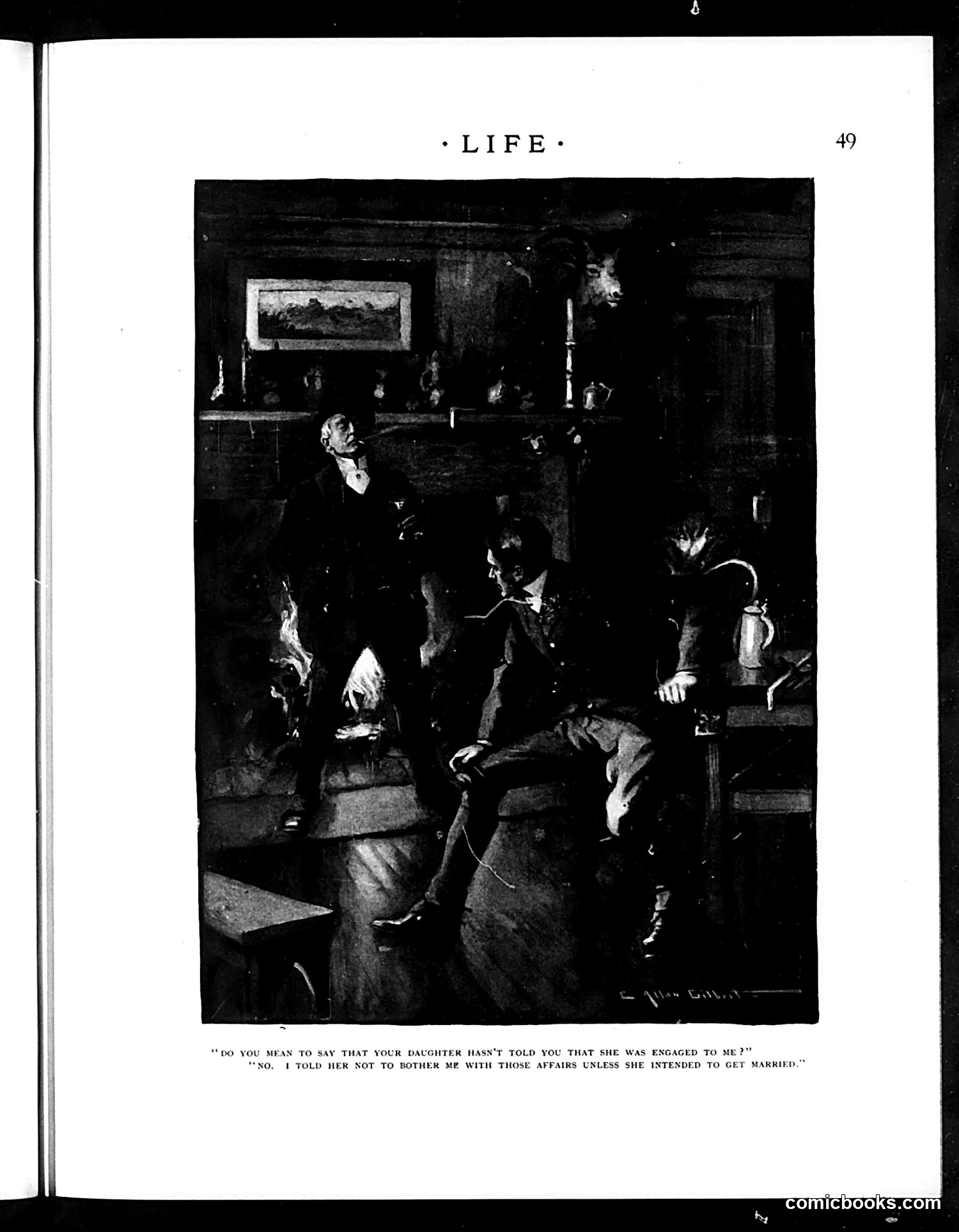
This is a satirical illustration from *Life* magazine (page 49) depicting what appears to be a domestic confrontation scene. The dialogue caption reads: "Do you mean to say that your daughter hasn't told you that she was engaged to me?" / "No. I told her not to bother me with those affairs unless she intended to get married." The cartoon satirizes attitudes about parental authority and courtship conventions of the era. The humor lies in the father's dismissive stance—he refuses to be bothered with his daughter's romantic entanglements unless they're serious enough to lead to marriage. The young man's indignation suggests he expected the engagement to be taken more seriously. The scene reflects early-20th-century social anxieties about women's autonomy, parental control, and courtship propriety. The satire critiques both the father's seemingly callous indifference and the rigid social expectations surrounding marriage.
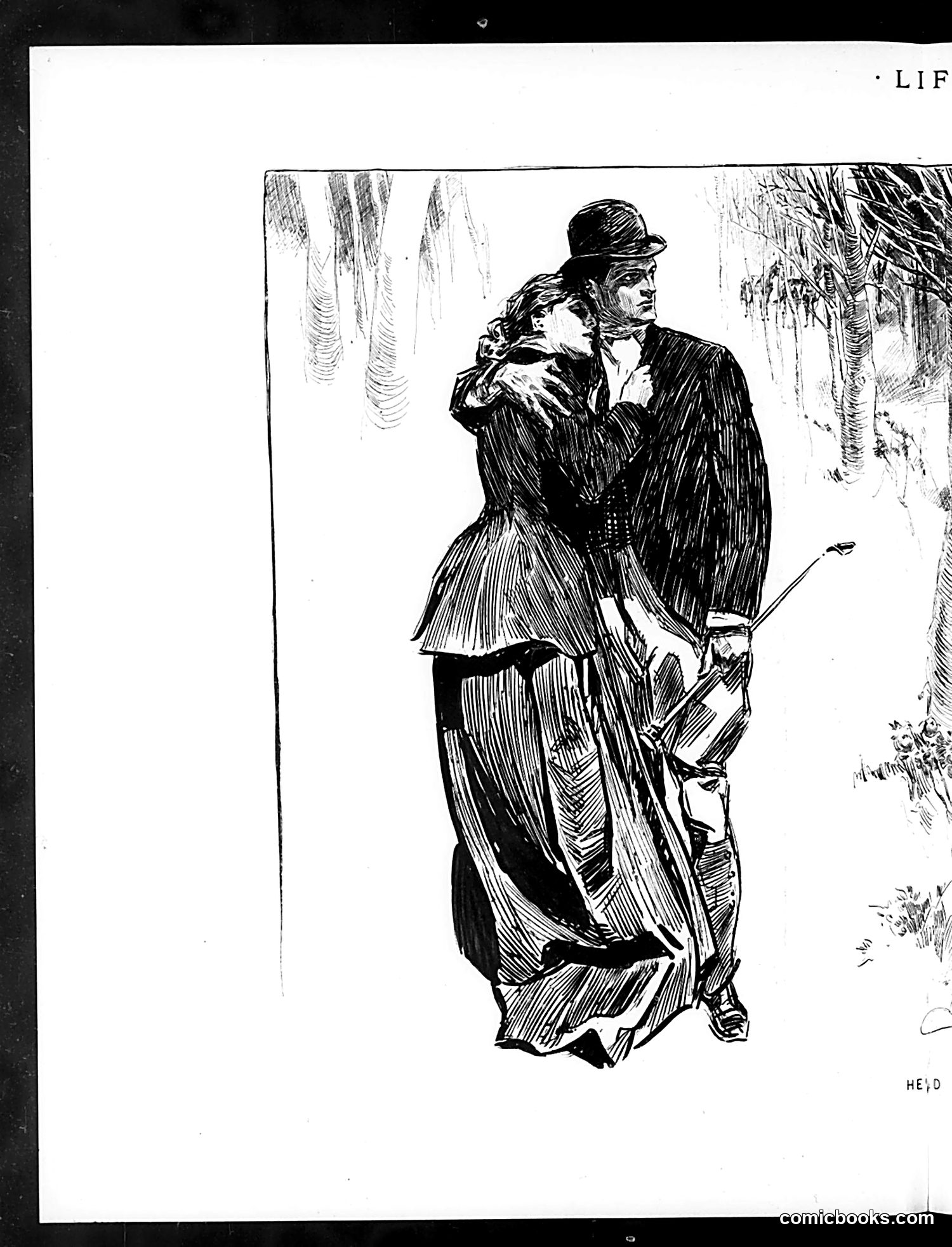
This is a pen-and-ink illustration showing a couple in early 20th-century dress walking together outdoors. The man wears a bowler hat and suit; the woman wears a long dress and hat typical of the Edwardian era. They appear to be strolling through a wooded area with trees in the background. Without additional text or caption visible on this page section, the specific satirical point is unclear. However, given Life magazine's focus on social commentary, this likely comments on courtship, romance, or gender relations of the period—possibly satirizing fashionable couples' behavior or romantic conventions. The artist's signature appears to read "HEYD" in the lower right. The page header shows "LIF" (presumably "LIFE"), confirming the publication.
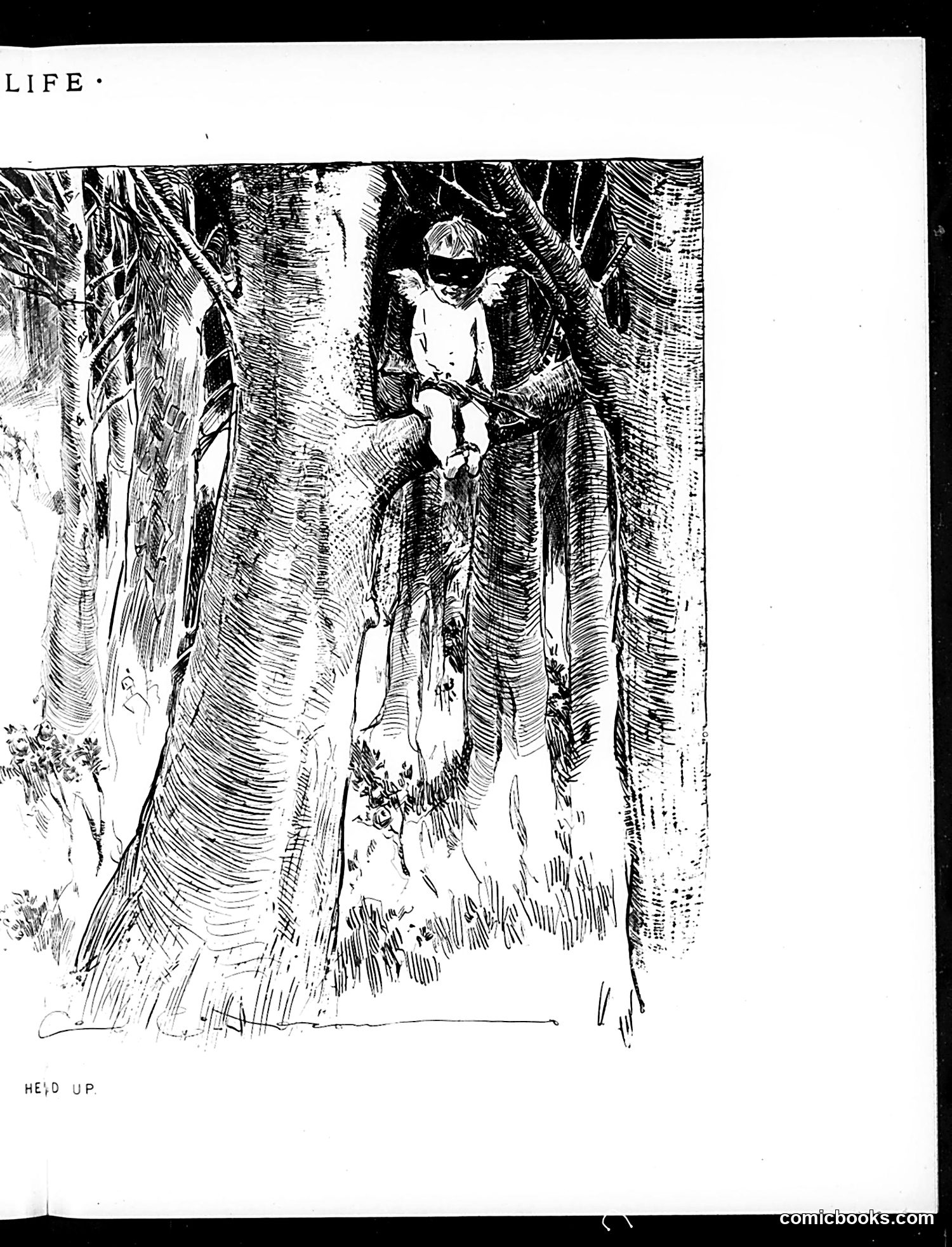
This illustration from *Life* magazine depicts a small child perched precariously on a large tree trunk or branch, appearing to be in danger of falling. The caption "HELD UP" suggests a play on words—literally held up (suspended) in the tree, while also suggesting the figurative sense of being "held up" or delayed/obstructed. The detailed cross-hatching technique emphasizes the precarious situation. Without additional context or visible text identifying the specific figures or political reference, the exact satirical target remains unclear. It may comment on childhood danger, parental neglect, or possibly reference a contemporary news event or social issue, but this cannot be determined from the image alone.
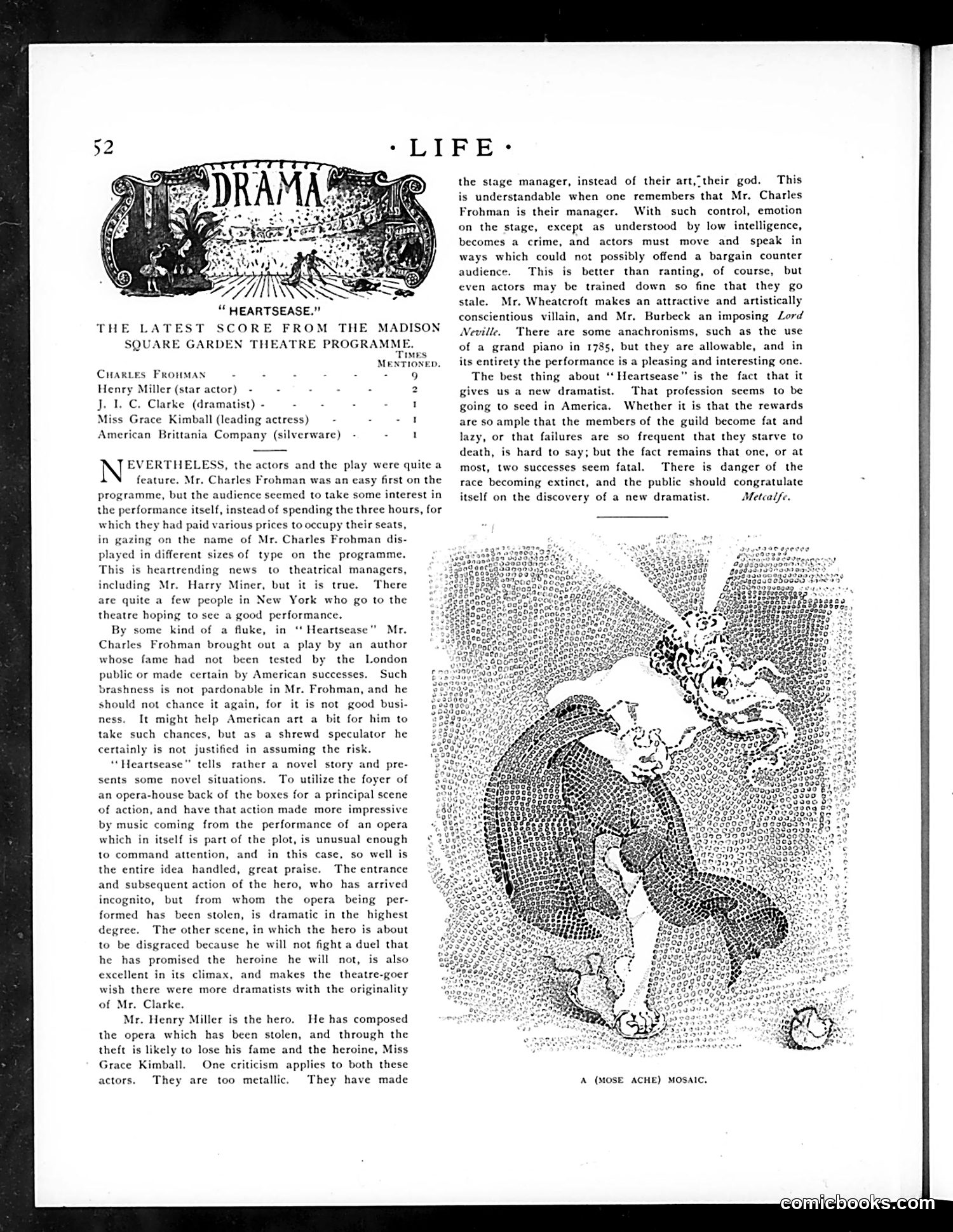
This page reviews a theatrical production called "Heartsease" from the Madison Square Garden Theatre. The drama section discusses the cast, including Charles Frohman (a prominent theater manager), Henry Miller, and Grace Kimball. The criticism focuses on the play's unconventional structure—it uses an opera house setting and musical performance as a backdrop for dramatic action. The reviewer praises this innovative approach but criticizes the actors as "too metallic" and overly stiff in their performances. The mosaic illustration at right appears to be a geographical map, likely depicting a location relevant to the play's plot, though the specific reference is unclear from the visible text. Overall, this is a straightforward theater review for an educated audience interested in contemporary stage productions and dramatic technique.
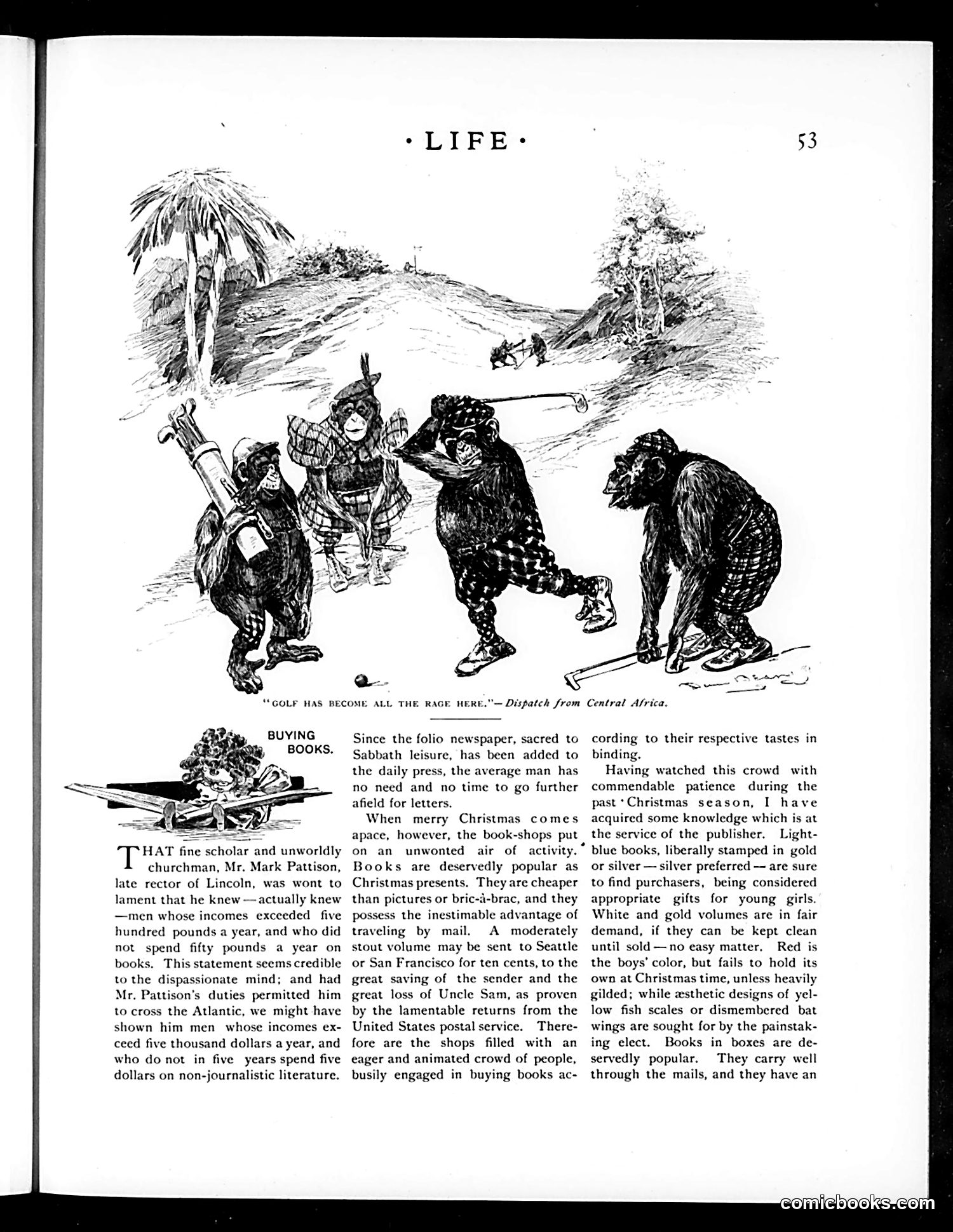
This satirical cartoon depicts **apes or primitive beings playing golf**, captioned as a "Dispatch from Central Africa." The joke targets the absurdity of golf's popularity among the British upper classes—the implication being that even "savages" in Africa have adopted this frivolous pastime. The accompanying article criticizes wealthy men who neglect serious literature while newspapers and leisure reading dominate. It notes that Christmas book-buying presents an opportunity to educate these culturally deficient individuals, though publishers cynically market books based on binding color rather than content. The cartoon's racist imagery was typical of Victorian-era satire, using caricatured Africans to mock British society. The central point: golf represents the triumph of superficial recreation over intellectual pursuits among the supposedly civilized classes—a phenomenon so prevalent it appears even "primitive" peoples have embraced it.
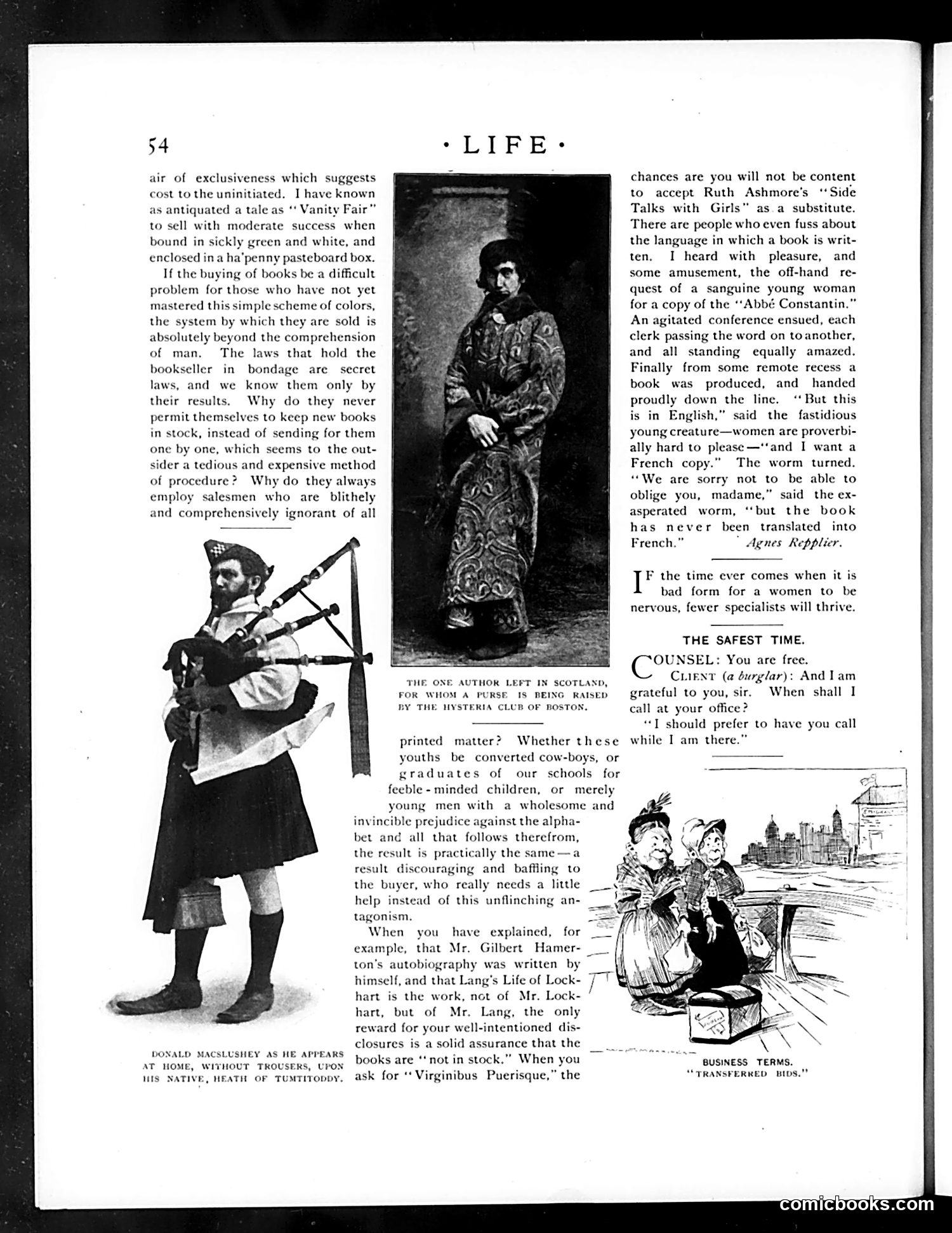
**Main Content:** This page satirizes book-selling practices and customer behavior in late 19th/early 20th-century America. **The Cartoons:** 1. **Donald MacSlushey** (left): A Scotsman in traditional Highland dress without trousers, representing the "one author left in Scotland" for whom Boston's "Hysteria Club" is raising funds—likely satirizing pretentious literary patronage. 2. **"The Safest Time"** (bottom right): A lawyer counseling a burglar, who asks when to call back. The joke: the lawyer prefers the burglar visit while he's absent, implying lawyers' unreliability or that criminals are safer clients than honest ones. **Main Text Complaint:** The article (attributed to Agnes Repplier) mocks booksellers' incompetence: they stock books secretively, employ ignorant salesmen, and frustrate customers seeking specific titles or translations. One anecdote describes a woman requesting a French edition of "Abbé Constantin," only to be told it was never translated—highlighting absurd customer service. The satire targets both pretentious book-buying culture and retailer incompetence.
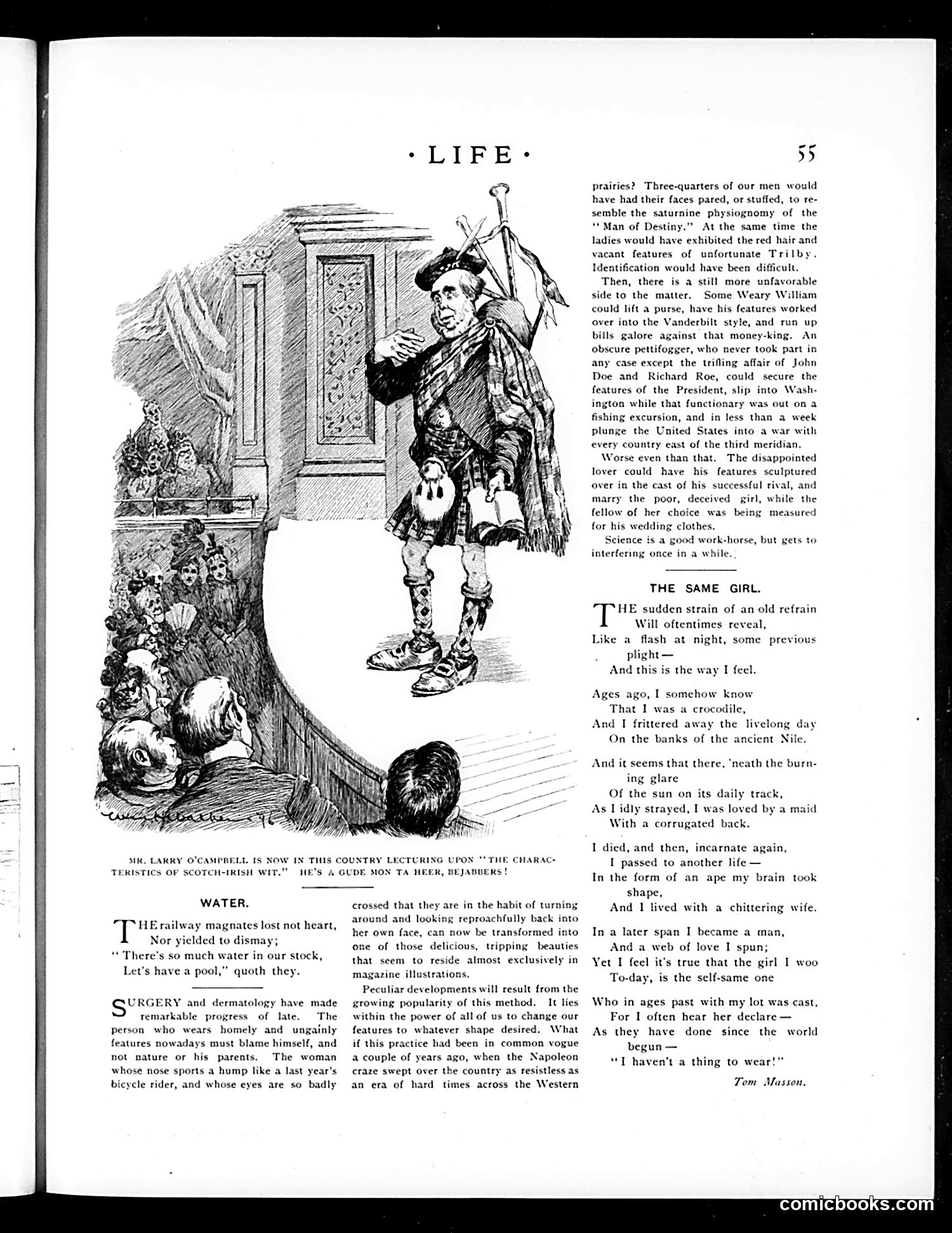
This page contains two satirical pieces from *Life* magazine: **The Cartoon**: Shows a Scottish-Irish lecturer (Mr. Larry O'Campbell) demonstrating "Scotch-Irish wit." The crude stereotype and phonetic dialect ("GUDE MON TA HEER, BEJABDERS!") mock both the lecturer and ethnic stereotypes common in early 20th-century American humor. **"Water"**: Satirizes railroad magnates' greed. When water became abundant, they joked about forming a "pool" (monopoly)—a dark reference to their ruthless business practices during an era of railroad baron scandals. **"The Same Girl"**: A humorous poem about reincarnation, claiming the speaker's current romantic interest is the same soul he's loved across multiple lifetimes (as crocodile, ape, man). The joke's punchline: regardless of incarnation, she always complains "I haven't a thing to wear!"—a jab at women's materialism and fashion obsession, a common satirical target of the era.
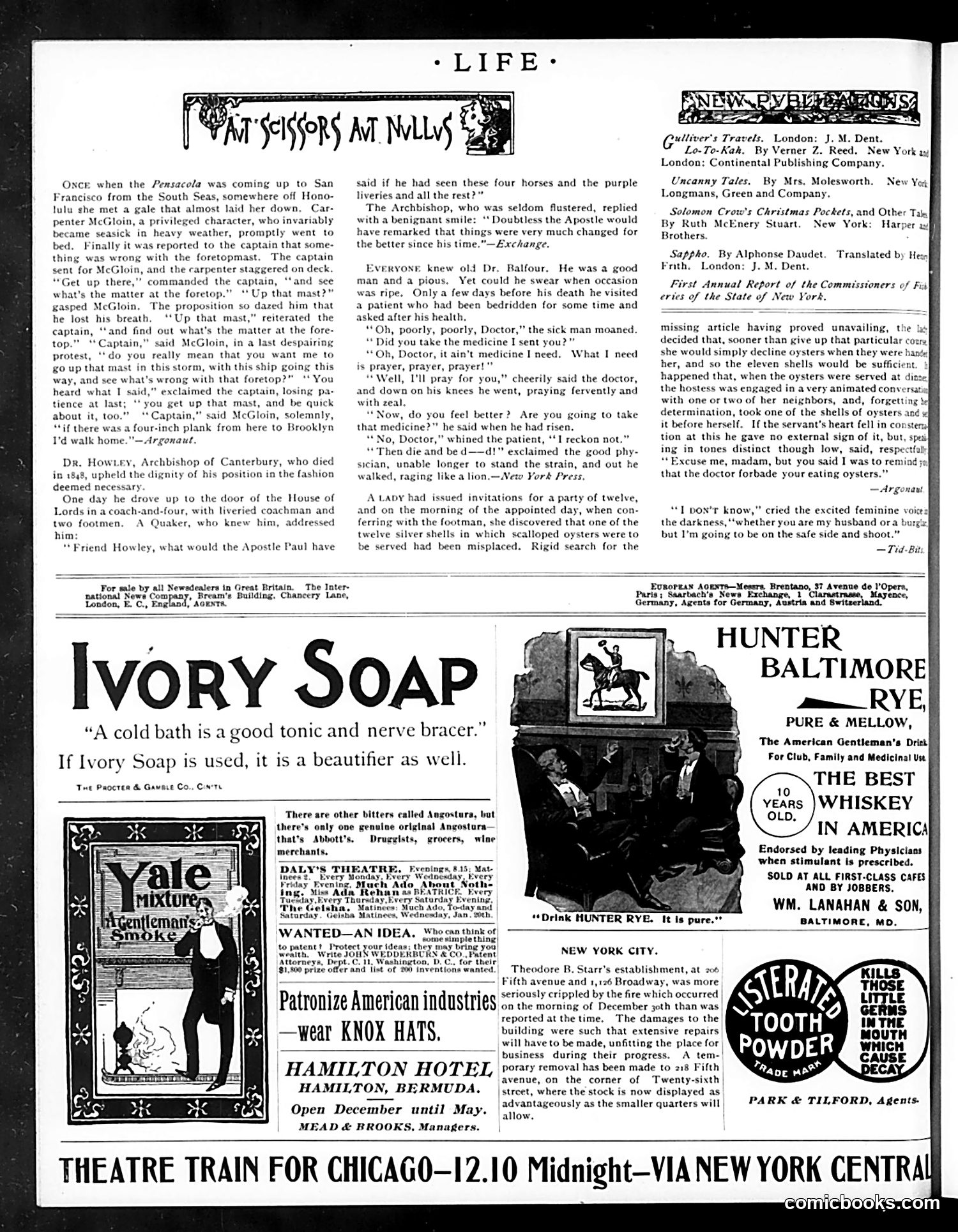
This page from *Life* magazine contains humorous anecdotal stories rather than political cartoons. The three main jokes illustrate character types through dialogue: 1. **Carpenter McGloin** (from the *Argonaut*): A seasick sailor refuses to climb the mast in a storm, claiming he'd rather walk to Brooklyn—absurdist humor about cowardice and exaggeration. 2. **Archbishop Howley**: A Quaker challenges the Archbishop of Canterbury about his ostentatious coach-and-four, questioning what the Apostle Paul would think. Howley's witty reply—that things have "much changed for the better"—satirizes ecclesiastical pretension and the gap between Christian apostolic simplicity and Victorian church hierarchy. 3. **Dr. Balfour**: A compassionate but profane doctor loses patience with a hypochondriac patient demanding prayer instead of medicine, ultimately cursing the man. This mocks both religious excess and medical frustration. The page is primarily **satirical social commentary** targeting Victorian hypocrisy, class pretension, and institutional authority through gentle, anecdotal ridicule rather than visual caricature.
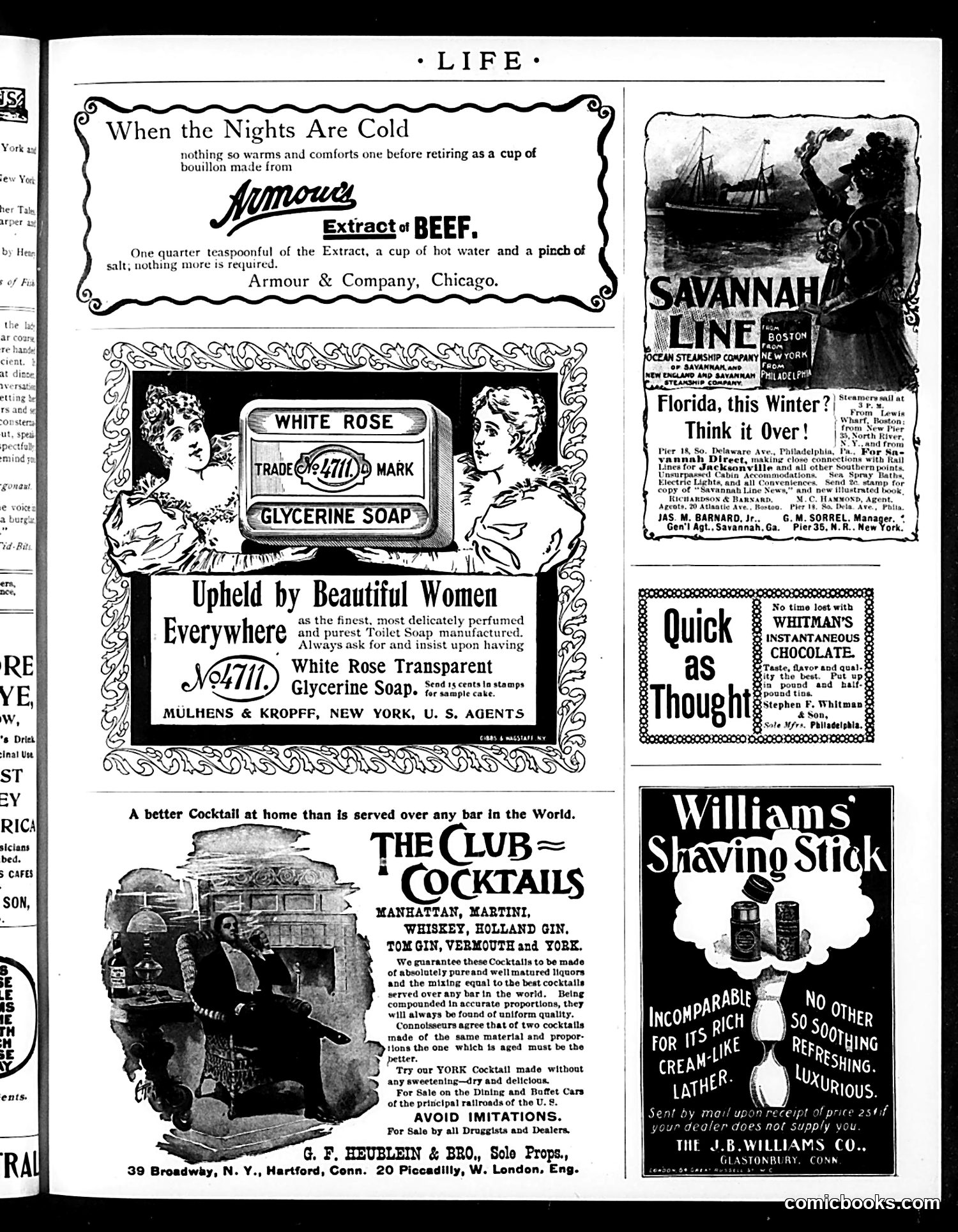
This is primarily an **advertising page**, not a satirical cartoon. It contains five product advertisements from the early 20th century: 1. **Armour's Beef Extract** — a bouillon concentrate for winter warmth 2. **Savannah Line shipping** — promoting Florida travel 3. **White Rose Glycerine Soap** — marketed to women as a beauty product ("Upheld by Beautiful Women Everywhere") 4. **The Club Cocktails** — pre-mixed spirits sold via railroad dining cars, emphasizing quality and consistency 5. **Williams' Shaving Stick** — grooming product The ads reflect period attitudes: women's association with beauty products, the luxury of pre-made cocktails, and travel marketing. The Savannah Line ad notably appeals to wealthy northerners considering winter relocation to Florida—suggesting the era's growing tourism industry. No political satire is apparent; this is straightforward commercial content typical of Life's revenue model during its early years as a magazine.
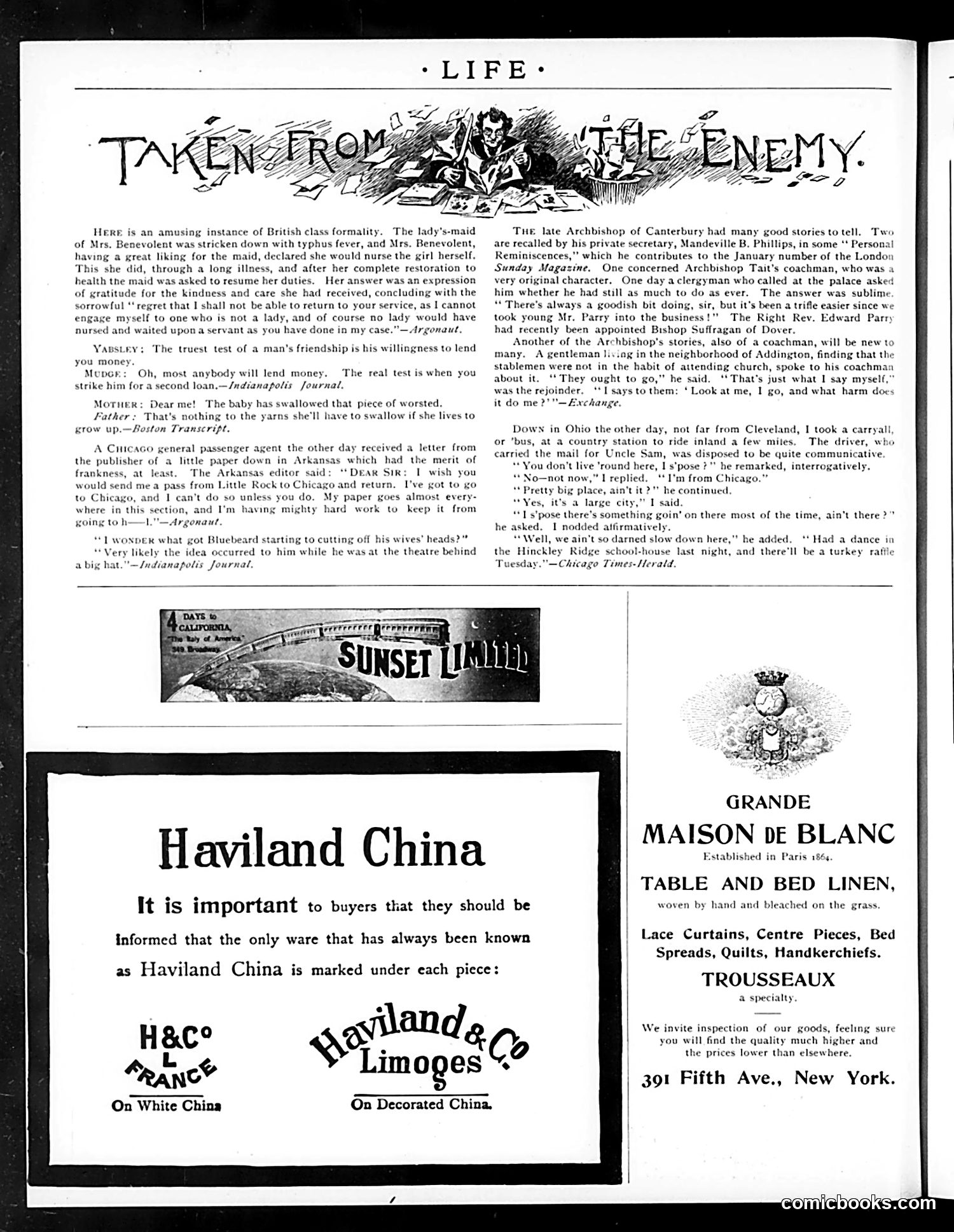
This page from *Life* magazine contains three main elements: **"Taken from the Enemy" Anecdotes**: The header story satirizes British class rigidity. A wealthy woman nurses her ill maid back to health, but the maid refuses to return to service—because only a "lady" would perform such menial work, and no proper lady would nurse a servant. The satire mocks the absurd formality of British social hierarchies that values class distinction over gratitude or practicality. **Additional Short Humor Pieces**: The page includes brief jokes about friendship (testing it through loan requests), British theater etiquette (men wearing large hats), and an anecdote about the Archbishop of Canterbury's coachman—illustrating working-class wit and commentary on religious hypocrisy. **Advertisements**: The bottom half features ads for Haviland China (French porcelain) and Grande Maison de Blanc (French linens from Paris, 1854), typical of high-end luxury goods marketed to wealthy American readers. The page exemplifies *Life*'s satirical approach: humorous observations about social pretension and class absurdities, paired with advertisements for luxury imports.
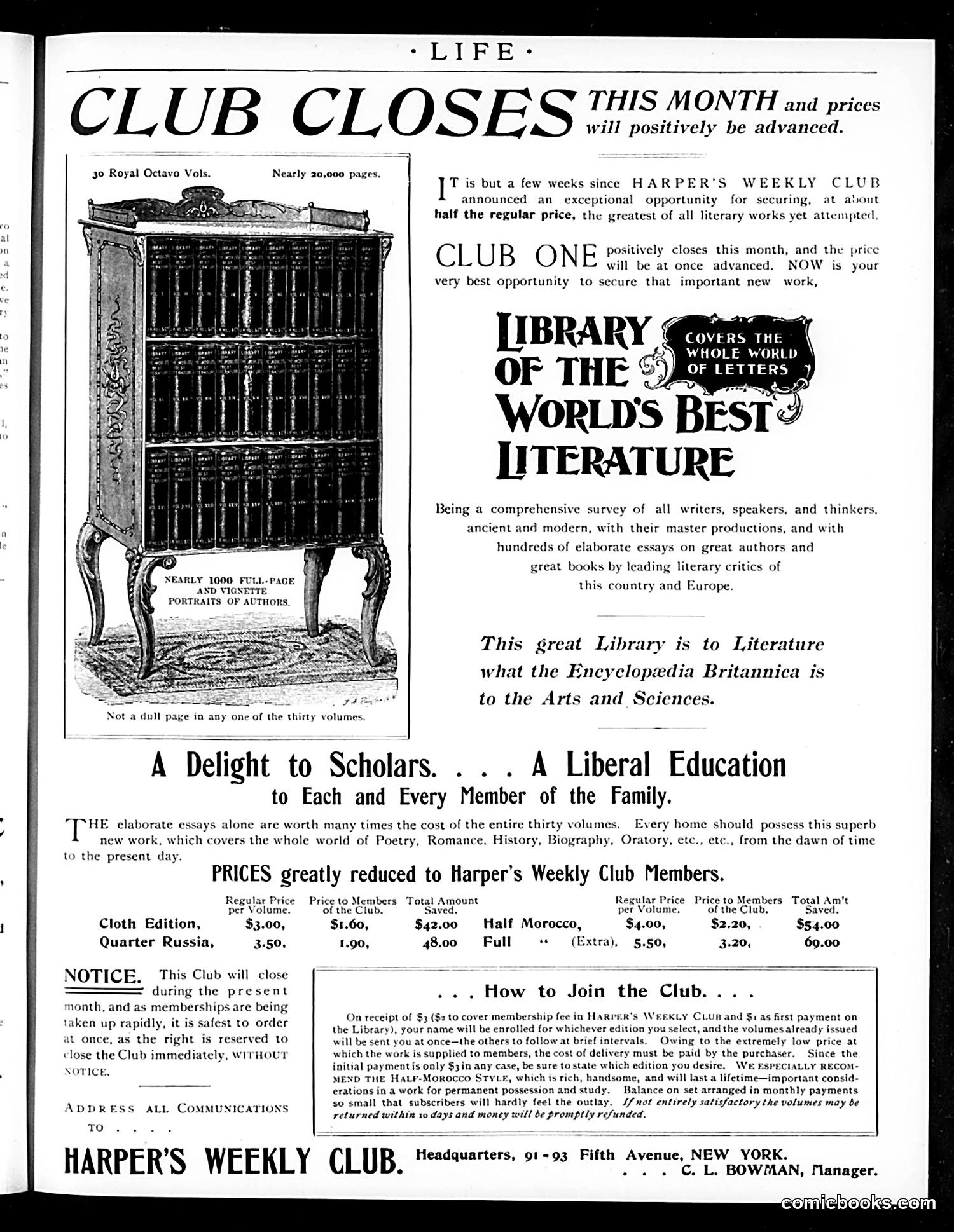
This page is an advertisement, not satire or political commentary. It promotes "Library of the World's Best Literature," a 30-volume encyclopedia-style collection of literary works and critical essays, sold through Harper's Weekly Club. The "cartoon" is merely a decorative illustration of an ornate bookcase filled with the volumes—visual marketing rather than satirical imagery. The key sales pitch: Club membership closes "this month," creating urgency. Members pay reduced prices ($1.60 per volume in cloth binding versus $3.00 regular price). The ad emphasizes comprehensiveness ("nearly 20,000 pages," "1000 full-page portraits of authors"), cultural prestige (compared to Encyclopedia Britannica), and broad appeal ("Delight to Scholars...Liberal Education to Each and Every Member of the Family"). The fine print reassures skeptical buyers: installment payments available, 30-day money-back guarantee, and preference for the half-Morocco binding for durability and appearance. This is straightforward early-20th-century direct-mail marketing for an educational product.
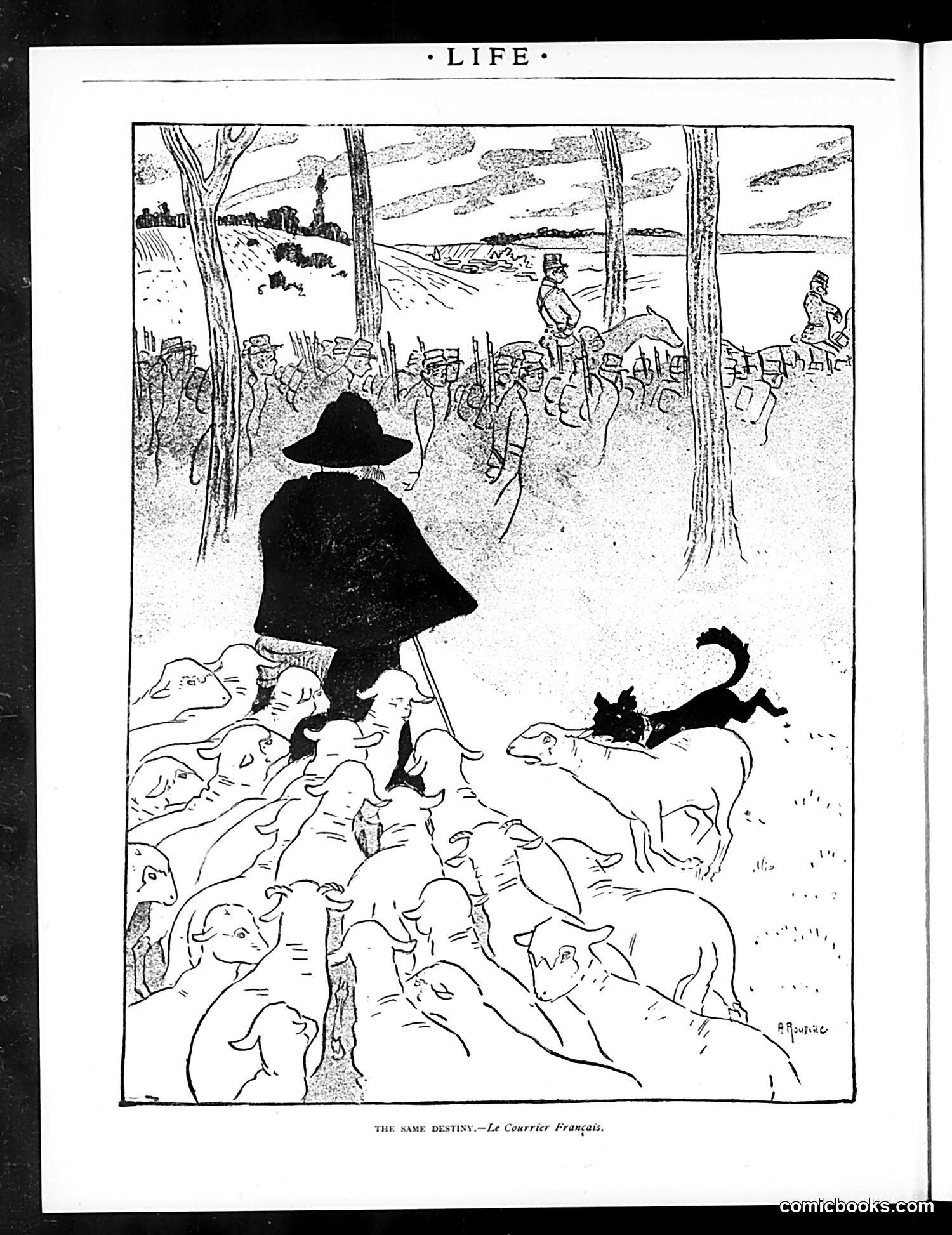
This cartoon from *Life* magazine satirizes the fate of military dogs during wartime. The image shows a woman with an umbrella sheltering several dogs in a forest, while soldiers march in the background and a black dog appears to be chasing or attacking nearby. The caption references "Le Courrier Français" (French Courier), suggesting this comments on French military practices or attitudes toward animals in war. The satire appears to critique either: 1. The indifference of military command to animals' suffering during conflict, or 2. Hypocrisy in how civilian society (represented by the sheltering woman) protects pets while armies use dogs as expendable war materiel The "same destiny" suggests ironic commentary on the dogs' inevitable fates regardless of civilian sentiment.
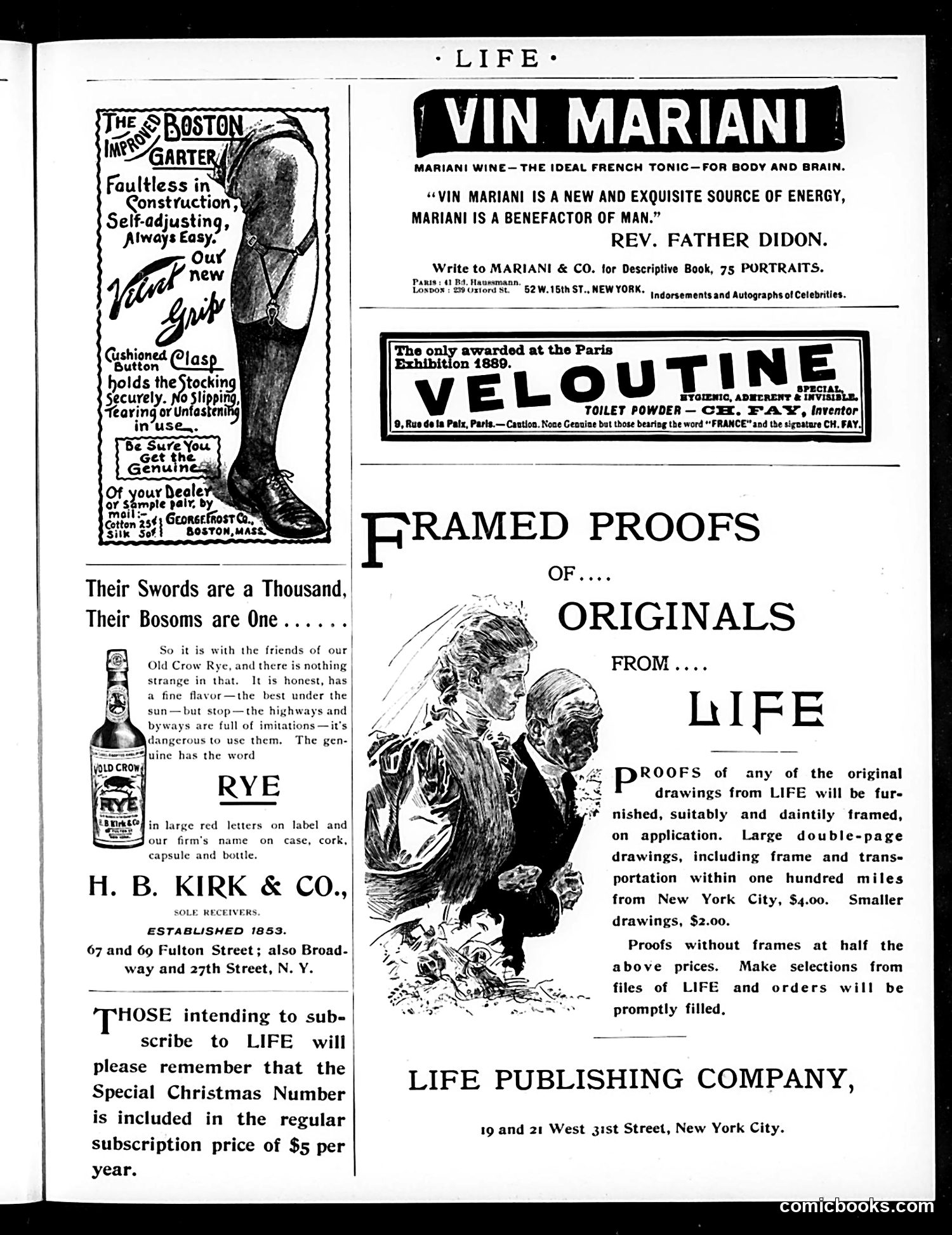
This page is primarily **advertising**, not political satire. It features various product endorsements typical of late 19th-century magazines: - **Boston Garter** (men's hosiery) advertises "faultless construction" - **Old Crow Rye whiskey** warns against counterfeits, emphasizing brand authenticity - **Vin Mariani** (a French wine tonic) quotes a Catholic priest endorsing it as an "energy source" - **Veloutin** (toilet powder) claims a Paris Exhibition award - **Life Publishing** offers framed reproductions of original artwork from the magazine The only potentially satirical element is the Old Crow ad's poetic opener—"Their Swords are a Thousand, / Their Bosoms are One"—which appears to mock grandiose advertising language, though this remains ambiguous. The page reflects how satirical magazines like *Life* funded operations through advertisements, often featuring dubious health products (like cocaine-containing tonics) common in this era.
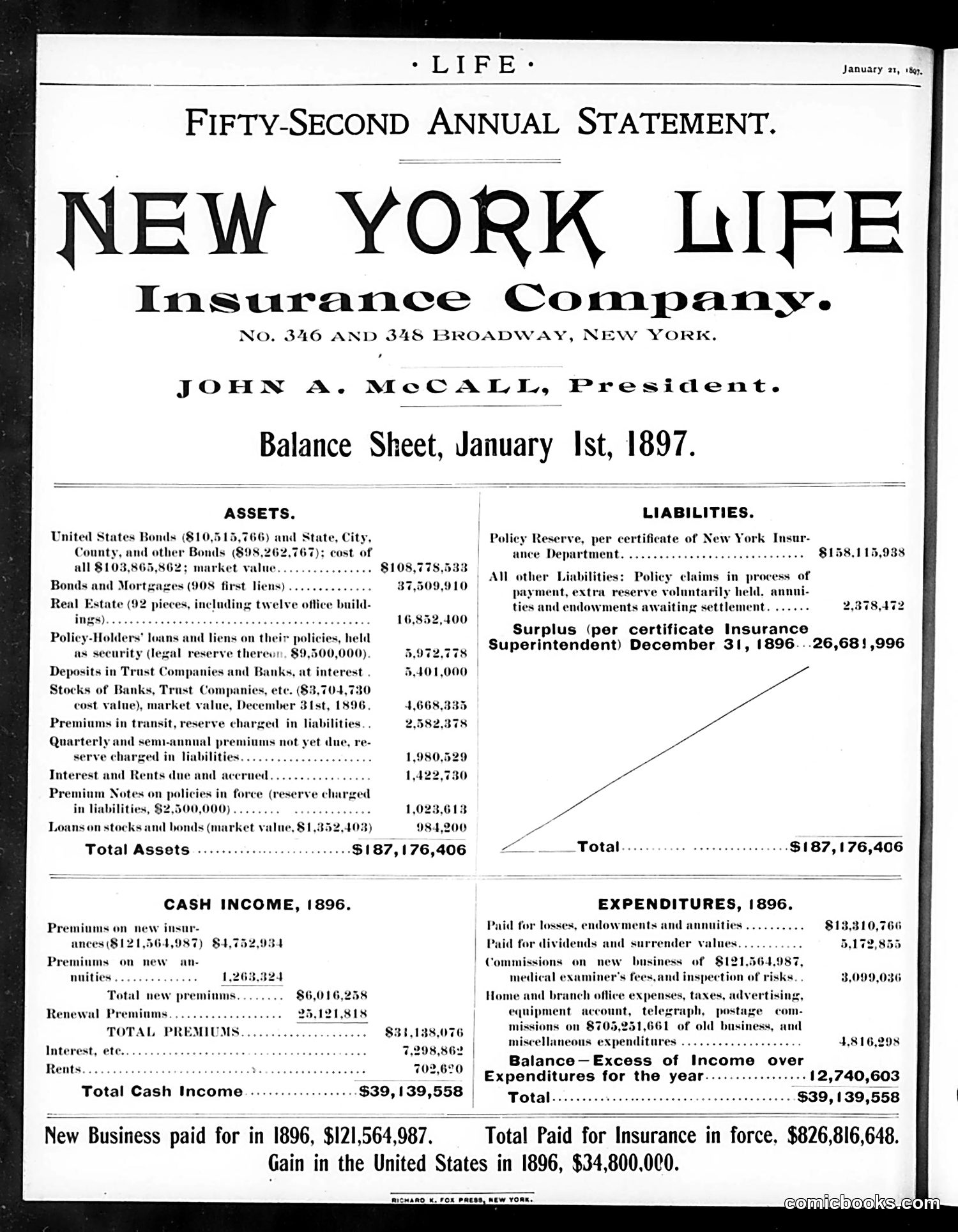
This is **not a cartoon or satirical content** — it's a straightforward financial document: the New York Life Insurance Company's fifty-second annual balance sheet, published in *Life* magazine on January 24, 1897. The page presents: - **Assets** totaling $187,176,406 (including bonds, mortgages, real estate, policy loans) - **Liabilities** and surplus calculations - **1896 Cash Income** of $39,139,558 from premiums and interest - **Expenditures** including payouts for losses, commissions, and overhead - **Key metrics**: $121.5 million in new business written; $34.8 million gain in the U.S.; $826.8 million total insurance in force President John A. McCall's company was reporting robust financial health during the prosperous 1890s. *Life* magazine published such statements to serve as both corporate announcements and proof of institutional solvency — important for reassuring policyholders during an era before modern insurance regulation.