
Life, 1897-01-21 · page 4 of 22
Life — January 21, 1897 — page 4: what you’re looking at
What you’re looking at
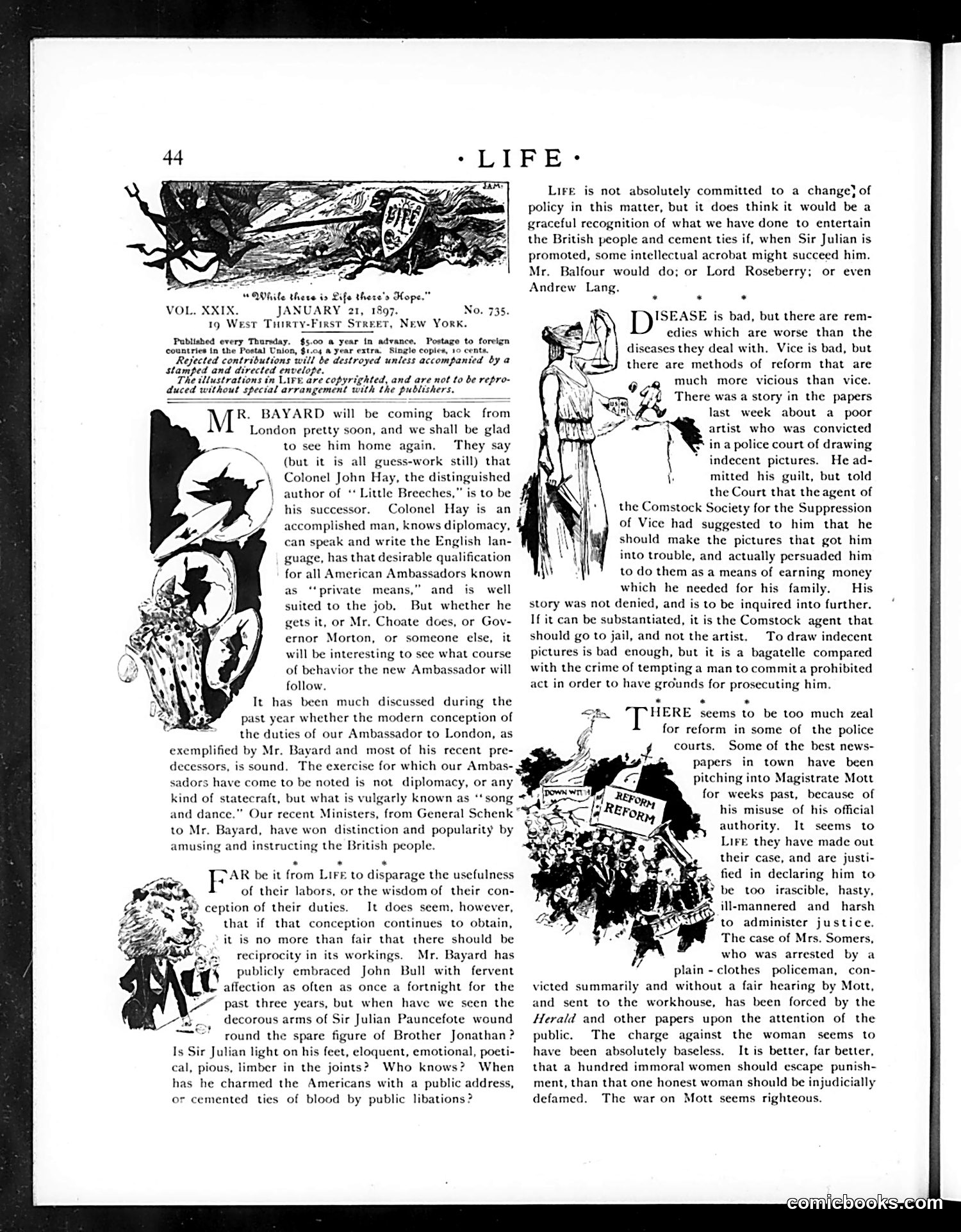
This page contains editorial commentary rather than traditional cartoons. The main topics are: **Mr. Bayard's Ambassadorship**: The text discusses Mr. Bayard's appointment as Ambassador to London, praising his diplomatic qualifications while playfully noting that previous ambassadors like General Schenk and Mr. Choate have been noted for entertainment value ("song and dance") rather than serious diplomacy. **Police and Judicial Reform**: The editorial criticizes excessive zeal in police courts, specifically attacking Magistrate Mott's harsh treatment of Mrs. Somers, a plainly-dressed woman arrested without fair hearing. Life argues the case represents unjust administration of justice, advocating for proportionality in prosecuting moral offenses. The illustrated vignettes support these critiques with satirical imagery.
📄 Transcribed text from this page (OCR, searchable)
Machine-transcribed from the original scan — historical spelling and the odd misread are preserved.
“While there is Life there's Hope.” VOL. XXIX. JANUARY 21, 1897. 19 West Tuirty-First StREET, New York. Published every Thursday. $5.00 a year in advance, Postage to foreign countries in the Postal Union, $1.04 & year extra. Single copies, 10 cents. Rejected contributions will be destroyed unless accompanied by a stamped and directed envelope. The illustrations in LiFe. are copyrighted, and are not to be repro- duced without special arrangement with the publishers. M R. BAYARD will be coming back from London pretty soon, and we shall be glad —~ to see him home again, They say (but it is all guess-work still) that Colonel John Hay, the distinguished author of ** Little Breeches,” is to be Colonel Hay is an ished man, knows diplomacy, can speak and write the English lan- guage, has that desirable qualification for all American Ambassadors known as “private means,” and is well suited to the job, But whether he gets it, or Mr, Choate does, or Gov- ernor Morton, or someone else, it will be interesting to see what course of behavior the new Ambassador will follow. It has been much discussed during the past year whether the modern conception of the duties of our Ambassador to London, as exemplified by Mr. Bz decessors, rd and most of his recent pre- und, The exercise for which our Ambas- sadors have come to be noted is not diplomacy, or any kind of statecraft, but what i and dance.” Our recent Ministers, from General Schenk to Mr. Bayard, have won distinction and popularity by amusing and instructing the British people. vulgarly known as ‘* song . . * ZAR be it from Lire to disparage the usefulness < of their labors, or the wisdom of their con- &.. -¥) ception of their duties. It does seem, however, Ss that if that conception continues to obtain, it is no more than fair that there should be reciprocity in its workings. Mr. Bayard has publicly embraced John Bull with fervent affection as often as once a fortnight for the years, but when have we scen the decorous arms of Sir Julian Pauncefote wound round the spare figure of Brother Jonathan? Is Sir Julian light on his feet, eloquent, emotional, poeti- cal, pious, limber in the joints? Who knows? When has he charmed the Americans with a public address, or cemented ties of blood by public libations? Lire is not absolutely committed to a change} of policy in this matter, but it does think it would be a graceful recognition of what we have done to entertain the British people and cement ties if, when Sir Julian is promoted, some intellectual acrobat might succeed him. Mr. Balfour would do; or Lord Roseberry; or even Andrew Lang. * . . D" ASE is bad, but there are rem- edies which are worse than the diseases they deal with. Vice is bad, but there are methods of reform that are 9G4 van much more vicious than vice. There was a story in the papers last week about a poor artist who was convicted in a police court of drawing indecent pictures. He ad- i mitted his guilt, but told the Court that the agent of the Comstock Society for the Suppression of Vice had suggested to him that he should make the pictures that got him into trouble, and actually persuaded him to do them as a means of earning money which he needed for his family. His story was not denied, and is to be inquired into further. If it can be substantiated, it is the Comstock agent that should go to jail, and not the artist. To draw indecent pictures is bad enough, but it is a bagatelle compared with the crime of tempting a man to commita prohibited act in order to have grounds for prosecuting him. "THERE ‘ms to be too much zeal for reform in some of the police courts. Some of the best news- papers in town have been pitching into Magistrate Mott for weeks past, because of his misuse of his official authority. It seems to Lirr they have made out their case, and are justi- fied in declaring him to be too irascible, hasty, ill-mannered and harsh to administer justice. The case of Mrs. Somers, who was arrested by a plain - clothes policeman, con- victed summarily and without a fair hearing by Mott, and sent to the workhouse, has been forced by the Herald and other papers upon the attention of the public. The charge against the woman seems to have been absolutely baseless. It is better, far better, that a hundred immoral women should escape punish- ment, than that one honest woman should be injudicially defamed. The war on Mott seems righteous.