
Life, 1897-01-21 · page 12 of 22
Life — January 21, 1897 — page 12: what you’re looking at
What you’re looking at
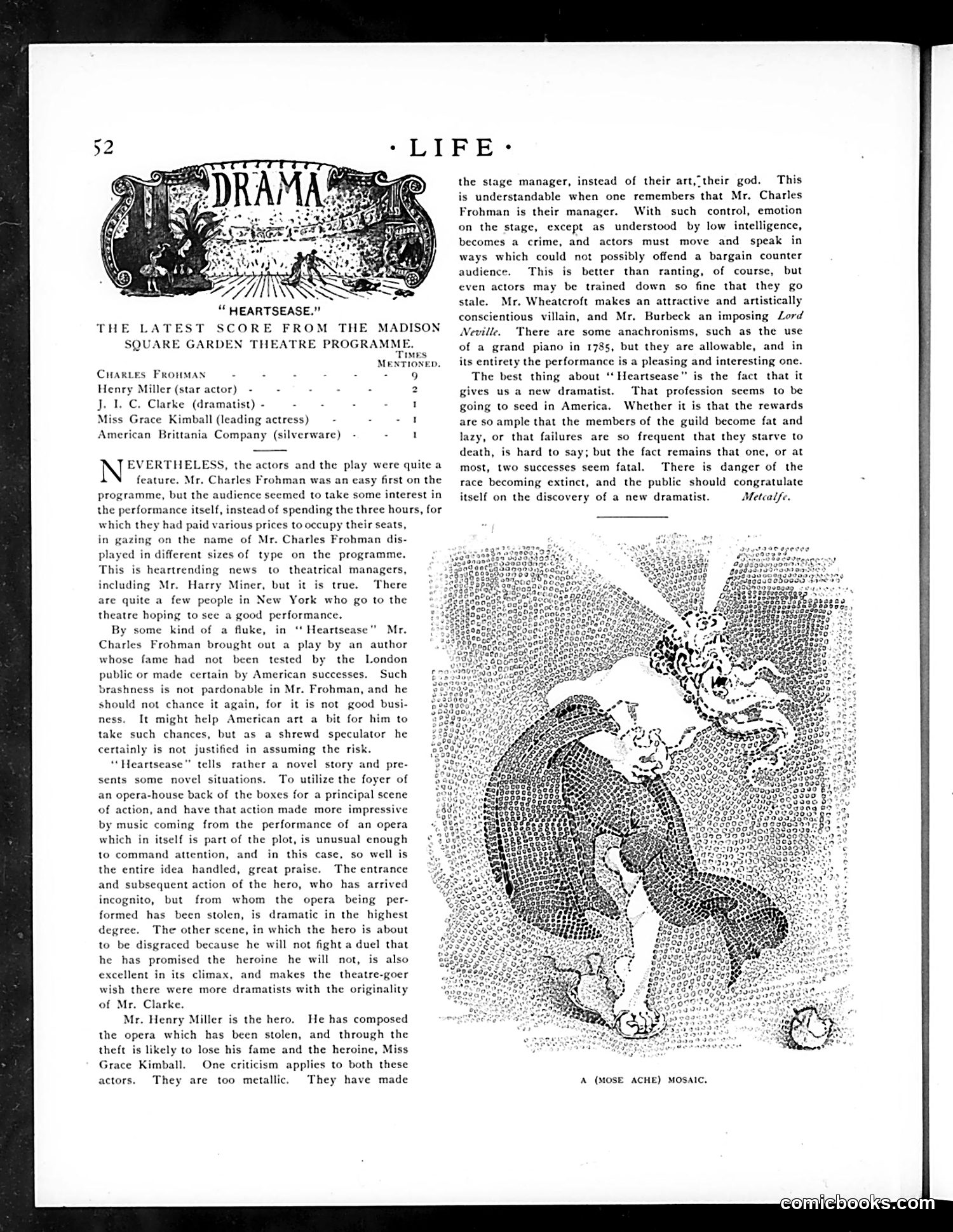
This page reviews a theatrical production called "Heartsease" from the Madison Square Garden Theatre. The drama section discusses the cast, including Charles Frohman (a prominent theater manager), Henry Miller, and Grace Kimball. The criticism focuses on the play's unconventional structure—it uses an opera house setting and musical performance as a backdrop for dramatic action. The reviewer praises this innovative approach but criticizes the actors as "too metallic" and overly stiff in their performances. The mosaic illustration at right appears to be a geographical map, likely depicting a location relevant to the play's plot, though the specific reference is unclear from the visible text. Overall, this is a straightforward theater review for an educated audience interested in contemporary stage productions and dramatic technique.
📄 Transcribed text from this page (OCR, searchable)
Machine-transcribed from the original scan — historical spelling and the odd misread are preserved.
“ HEARTSEASE.” THE LATEST SCORE FROM THE MADISON SQUARE GARDEN THEATRE PROGRAM MENTIONED. CHARLES FROUMAN == z - 9 Henry Miller (star actor) - eo 2 i 2 J. 1. C. Clarke (dramatist)- 9 - = = ot Miss Grace Kimball (leading actress) American Brittania Company (silverware) N EVERTHELESS, the actors and the play were quite a feature. Mr. Charles Frohman was an easy first on the programme, but the audience seemed to take some interest in the performance itself, instead of spending the three hours, for which they had paid various prices to occupy their seats, in gazing on the name of Mr. Charles Frohman dis- played in different sizes of type on the programme. This is heartrending news to theatrical managers, including Mr. Harry Miner, but it is true. are quite a few people in New York who go to the theatre hoping to see a good performance. By some kind of a fluke, in ‘* Heartsease" Mr, Charles Frohman brought out a play by an author whose fame had not been tested by the London public or made certain by American successes. Such brashness is not pardonable in Mr. Frohman, and he should not chance it again, for it is not good busi- ness. It might help American art a bit for him to take such chances, but as a shrewd speculator he certainly is not justified in assuming the risk. “Heartsease” tells rather a novel story and pre- sents some novel situations. To utilize the foyer of an opera-house back of the boxes for a principal scene of action, and have that action made more impressive by music coming from the performance of an opera which in itself is partof the plot, is unusual enough to command attention, and in this case, the entire idea handled, great praise. The entrance and subsequent action of the hero, who has arrived incognito, but from whom the opera being per- formed has been stolen, is dramatic in the highest degree. The other scene, in which the hero is about to be disgraced because he will not fight a duel that he has promised the heroine he will is also lent in its climax, and makes the theatre-goer wish there were more dramatists with the originality of Mr. Clarke. Mr. Henry Miller is the hero. He has composed the opera which has been stolen, and through the theft is likely to lose his fame and the heroine, Miss Grace Kimball. One criticism applies to both these actors. They are too metallic. They have made 1 1 There so well is not, the stage manager, instead of their art,;their god. This is understandable when one remembers that Mr. Charles Frohman is their manager. With such control, emotion on the stage, except as understood by low intelligence, becomes a crime, and actors must move and speak in ways which could not possibly offend a bargain counter audience. This is better than ranting, of course, but even actors may be trained down so fine that they go stale. Mr, Wheatcroft makes an attractive and artistically conscientious villain, and Mr. Burbeck an imposing Lord Neville. There are some anachronisms, such as the use of a grand piano in 1785, but they are allowable, and in its entirety the performance is a pleasing and interesting one. The best thing about ‘‘Heartsease" is the fact that it gives us a new dramatist. That profession scems to be going to sced in America. Whether it is that the rewards are so ample that the members of the guild become fat and lazy, or that failures are so frequent that they starve to death, is hard to say; but the fact remains that one, or at most, two successes seem fatal. There is danger of the race becoming extinct, and the public should congratulate itself on the discovery of a new dramatist. Metcalfe. A (MOSE ACHE) MOSAIC.