
Life, 1897-01-21 · page 6 of 22
Life — January 21, 1897 — page 6: what you’re looking at
What you’re looking at
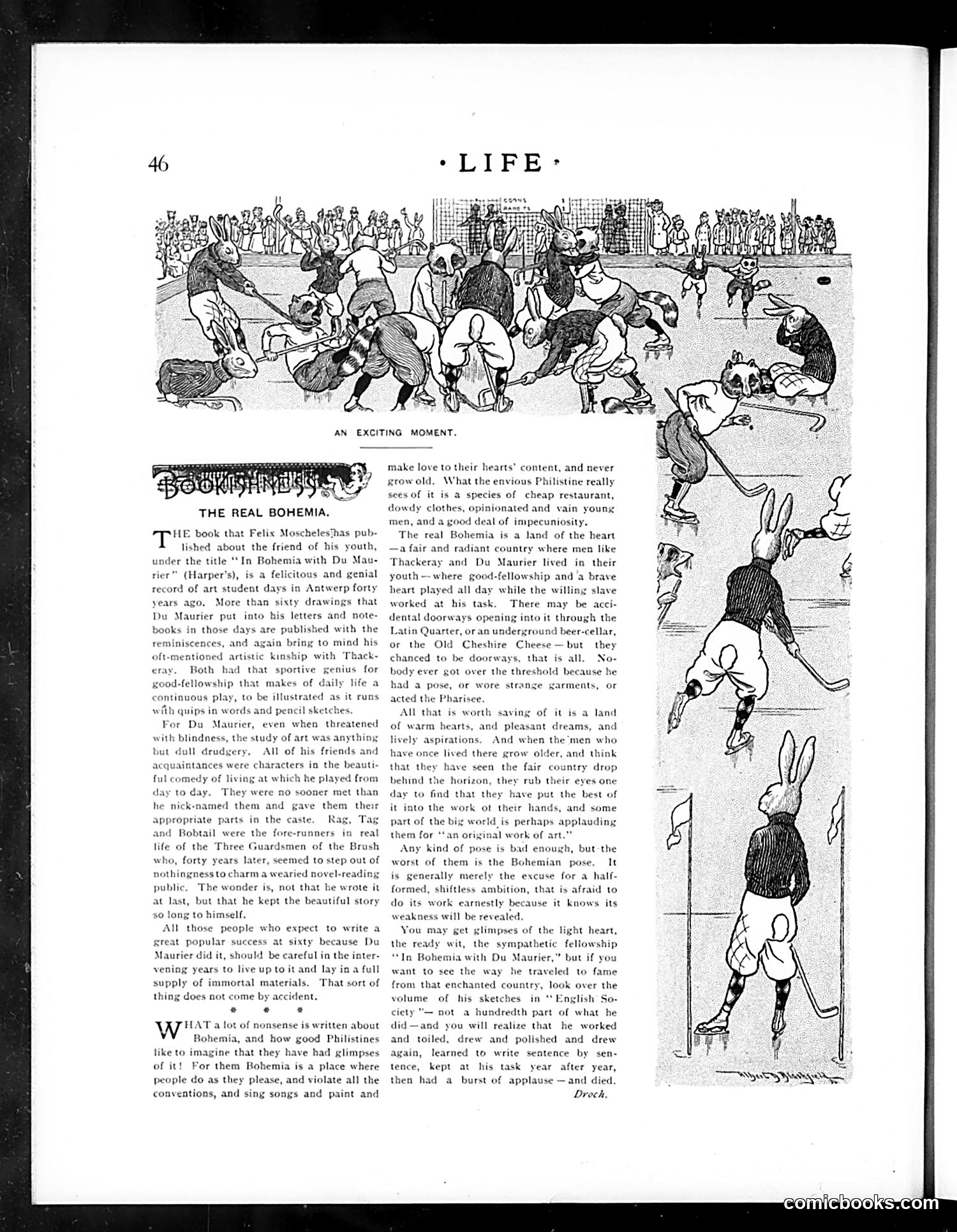
The large cartoon depicts **a chaotic polo match** with players on horseback competing intensely. The title "An Exciting Moment" suggests this captures sport's dramatic tension. The accompanying article, "The Real Bohemia," discusses Felix Moscheles's book about artistic life in Antwerp and Du Maurier's sketches. The text contrasts **authentic bohemian culture** (artistic communities living by passion and good fellowship) with **affected Philistine imitations** (wealthy dilettantes posing as bohemians). The polo scene likely **satirizes upper-class pretension**—showing wealthy elites engaged in an "exciting" but ultimately superficial pursuit, contrasting with genuine artistic bohemia described in the text. The satire targets society's obsession with fashionable sports and shallow status-seeking.
📄 Transcribed text from this page (OCR, searchable)
Machine-transcribed from the original scan — historical spelling and the odd misread are preserved.
THE REAL BOHEMIA. HE book that Felix Moschelesthas pub- lished about the friend of his youth, under the title “In Bohemia with Du Mau- rier” (Harper's), is a felicitous and genial record of art student days in Antwerp forty years ago, More than sixty drawings that Du Maurier put books in those into his letters and note- ed with the 0 mind his Thack- ve genius for ip that makes of daily life a continuous play, to be illustrated as it runs nd pencil sketches. Maurier, even when threatened study of art was anyt All of his friends a ances were characters in the be. e played from er met than hip with good-fellow with quips in words Du with blindne For but dull drudgery, acquain ful come at which day to day. They were ned them and gave appropriate parts in the and Bobtail were th life of the Three Guardsm who, forty years la no soo: he nick n of the Brush , seemed to step out of ss to charm a wearied nove nothingn -reading public. The wonder is, not that he wrote it at last, but that he kept the beautiful story so long to himself, All those people who expect great popular success at sixty t Maurier did it, should be careful in th vening years to live up to it and lay supply of immortal materials. thing does not come by accident. * « # to write a use Du inter- full ‘That sort of HAT a lot of nonsense is written about Bohemia, and how good Philistines like to imagine that they have had glimpses of it! For them Bohe people do as they please, and v ais a place where plate all the conventions, and sing songs and paint and make love to their hearts’ content, and never grow old. What the envious Philistine really seesof it is a species of cheap restaurant, dowdy clothes, opinionated and vain young men, and a good deal of impecuniosity. The real Bohemia is a land of the heart —a fair and radiant country where men like Thackeray and Du Maurier lived in their youth—-where good-fellowship anda brave heart played all day while the willing slave worked at his task. There may be acci- dental doorways opening into it through the Latin Quarter, or an underground beer-cellar, Old Cheshire Cheese —but the chanced to be doorways, that is all. No- or the body ever got over the threshold because he da pose, of wore strange garments, or acted the Pharisee. All that is worth saving of it is a land of warm hearts, and pleasant dreams, and lively aspirations. And when the’men who ce lived there grow o and think the fair country drop behind the horizon, they rub their they have seen es on day to find that they have put the best of it into the work ot their hands, and some part of the big world, is perhaps applauding them for al work of art is bad enough, but-the the Bohemian pose. It is generally merely the excuse for a half- formed, shiftless ambition, that is afraid to “an orig Any kind of po: worst of them do its work earnestly because it knows its weakness will be revealed, You may get glimpses of the | the ready wit, sympathetic fe “In Boh n Du Maurier,” but if you want to see the way he traveled to fame om that enchanted country, look over the volume of “Engl a hundredth part of what did—and you will realize that he worked toiled, drew and polished and drew again, sentence by sen- tence, t heart, jowship aw his sketches in hs ciety "— not learned to write kept at his task then had a burst year after year, applause — and died. Droch.