
A complete issue · 20 pages · 1896
Life — December 10, 1896
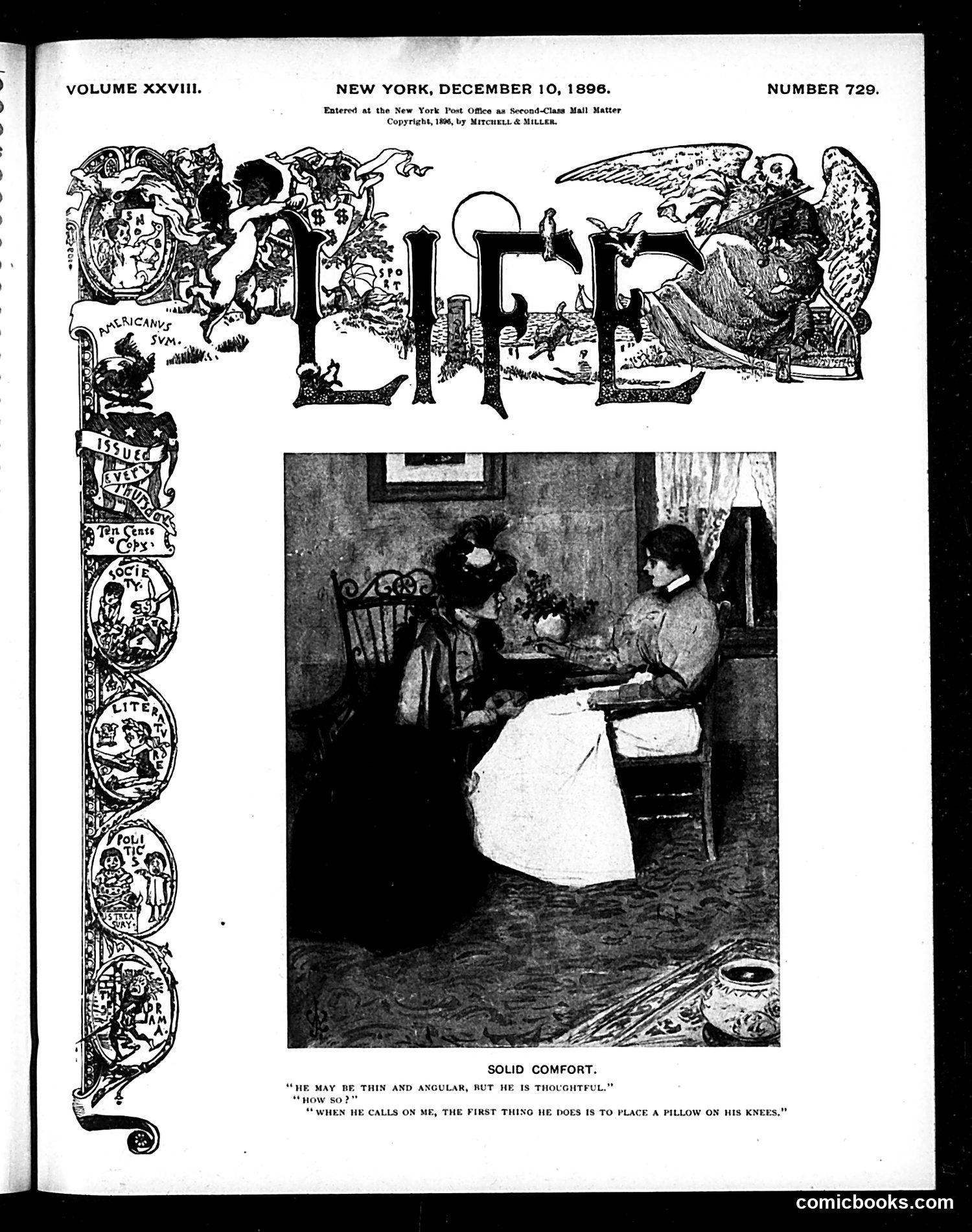
This page features a photograph titled "Solid Comfort" with an accompanying caption suggesting domestic humor about marital relationships. The image shows two women in a modest interior—one seated and one standing—in what appears to be a moment of intimate conversation or interaction. The satirical caption reads: "He may be thin and angular, but he is thoughtful. 'How so?' 'When he calls on me, the first thing he does is to place a pillow on his knees.'" The joke appears to mock courtship customs of the era, suggesting the gentleman places a pillow as a barrier—implying either protection of propriety or perhaps commentary on Victorian courting practices. The ornate decorative border contains seasonal medallions typical of Life's design aesthetic from this period.
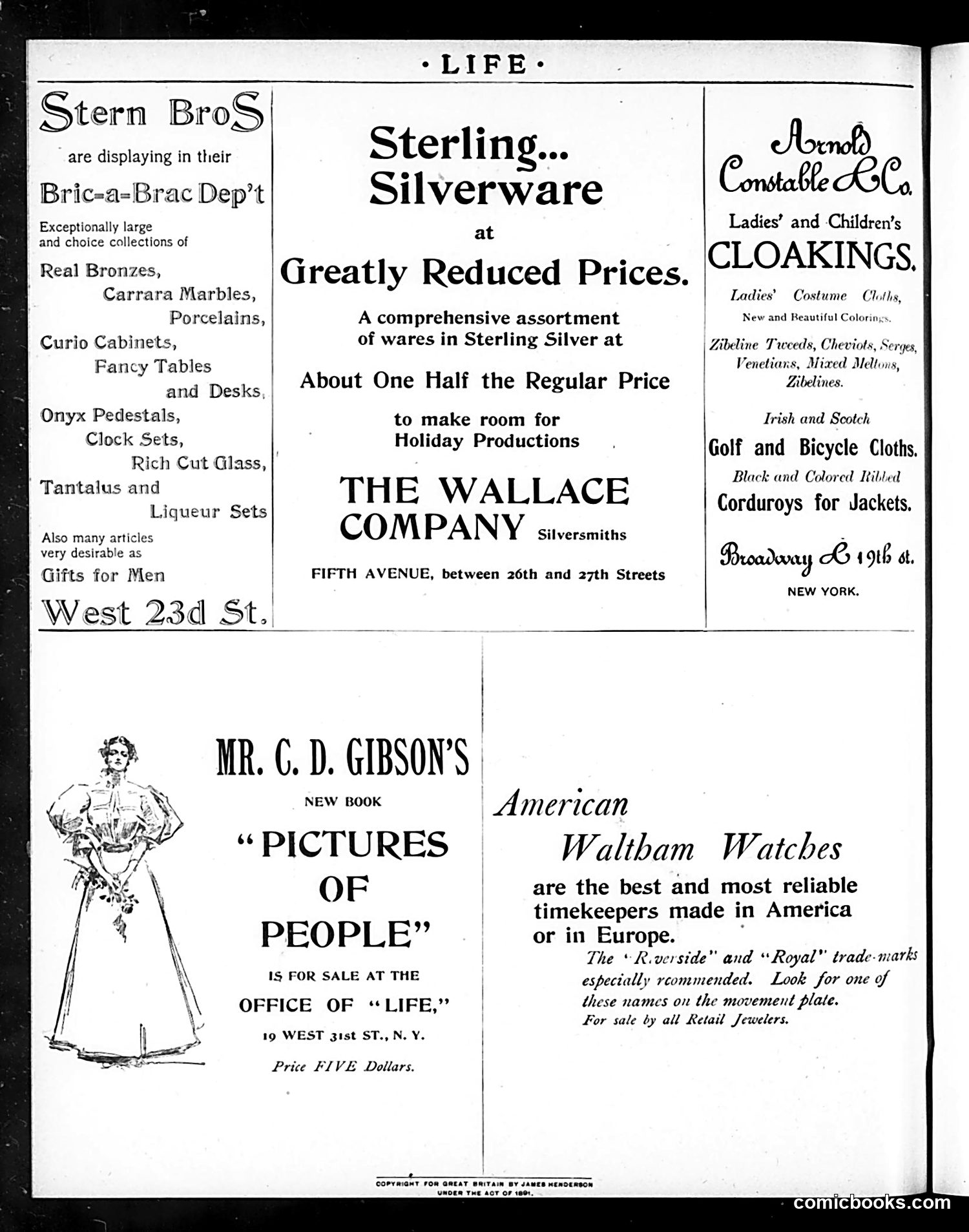
This page is primarily **advertising**, not editorial content or satire. It contains four separate advertisements from the early 1900s: 1. **Stern Bros** (West 23rd St.) – department store selling decorative items 2. **The Wallace Company** (Fifth Avenue) – silverware at reduced prices for holiday shopping 3. **Arnold Constable & Co.** (Broadway) – women's and children's clothing 4. **Mr. C.D. Gibson's "Pictures of People"** – a book for sale at Life magazine's office 5. **American Waltham Watches** – watch manufacturer advertisement There is **no political cartoon or satire** on this page. The Gibson illustration is simply a fashion figure promoting his book, not a political commentary. This represents typical magazine advertising from the period.
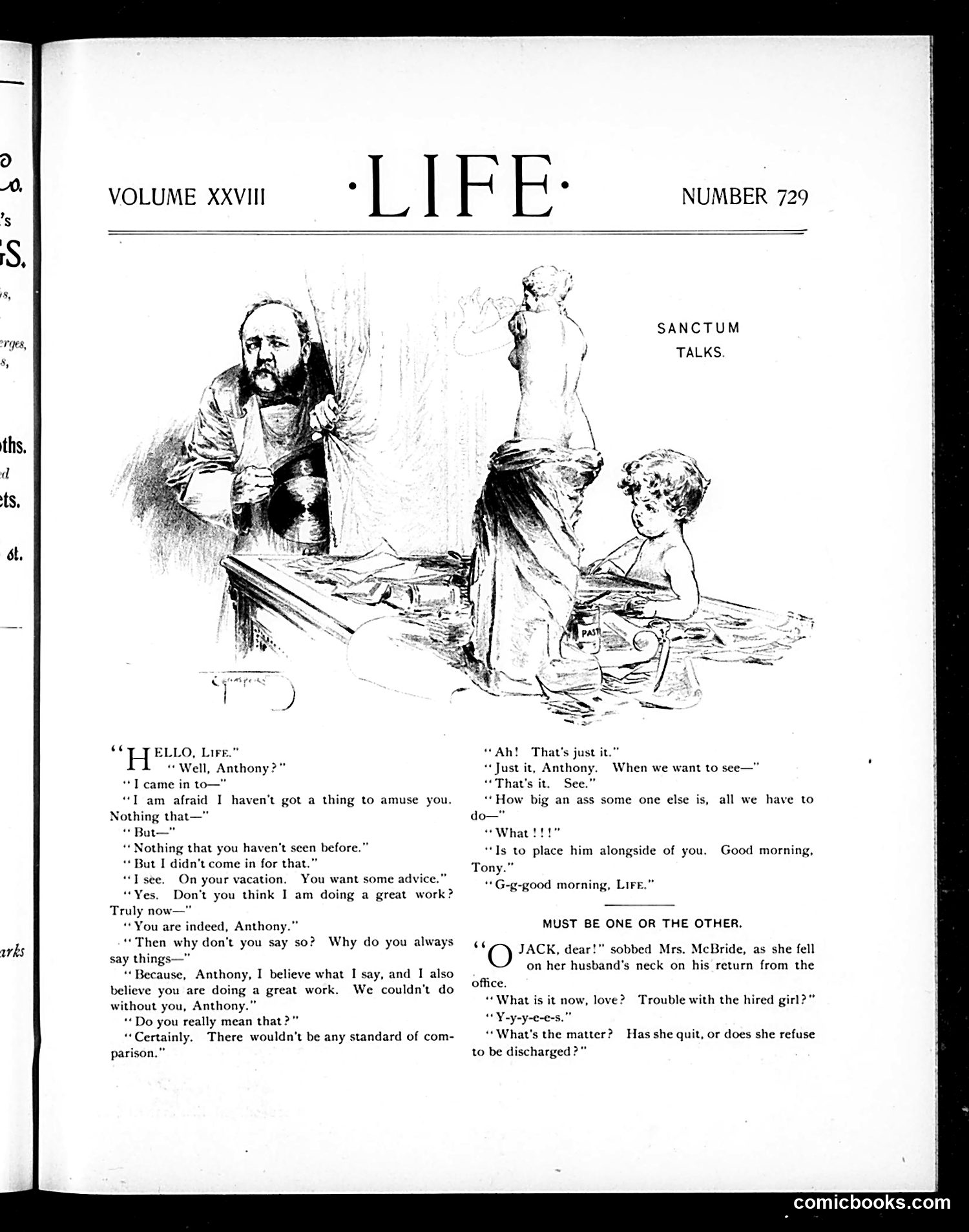
This page contains two satirical dialogues labeled "Sanctum Talks." The first sketch depicts a bearded man (labeled "Anthony") speaking with Life magazine personified as a figure. Life compliments Anthony's work, saying "You are indeed, Anthony" and "We couldn't do without you." Anthony appears modest, asking if Life thinks he's doing great work. The satire seems to mock self-aggrandizing claims about one's importance—Anthony seeks validation while Life flatters him, suggesting ironic commentary on professional vanity. The second sketch, "Must Be One or the Other," shows a domestic scene where Mrs. McBride confronts her husband Jack about a "hired girl" (domestic servant). She demands he choose between her and the servant, hinting at infidelity. The satire addresses class tensions and marital anxiety in early 20th-century households. Both sketches use humor to critique social pretense and domestic drama.
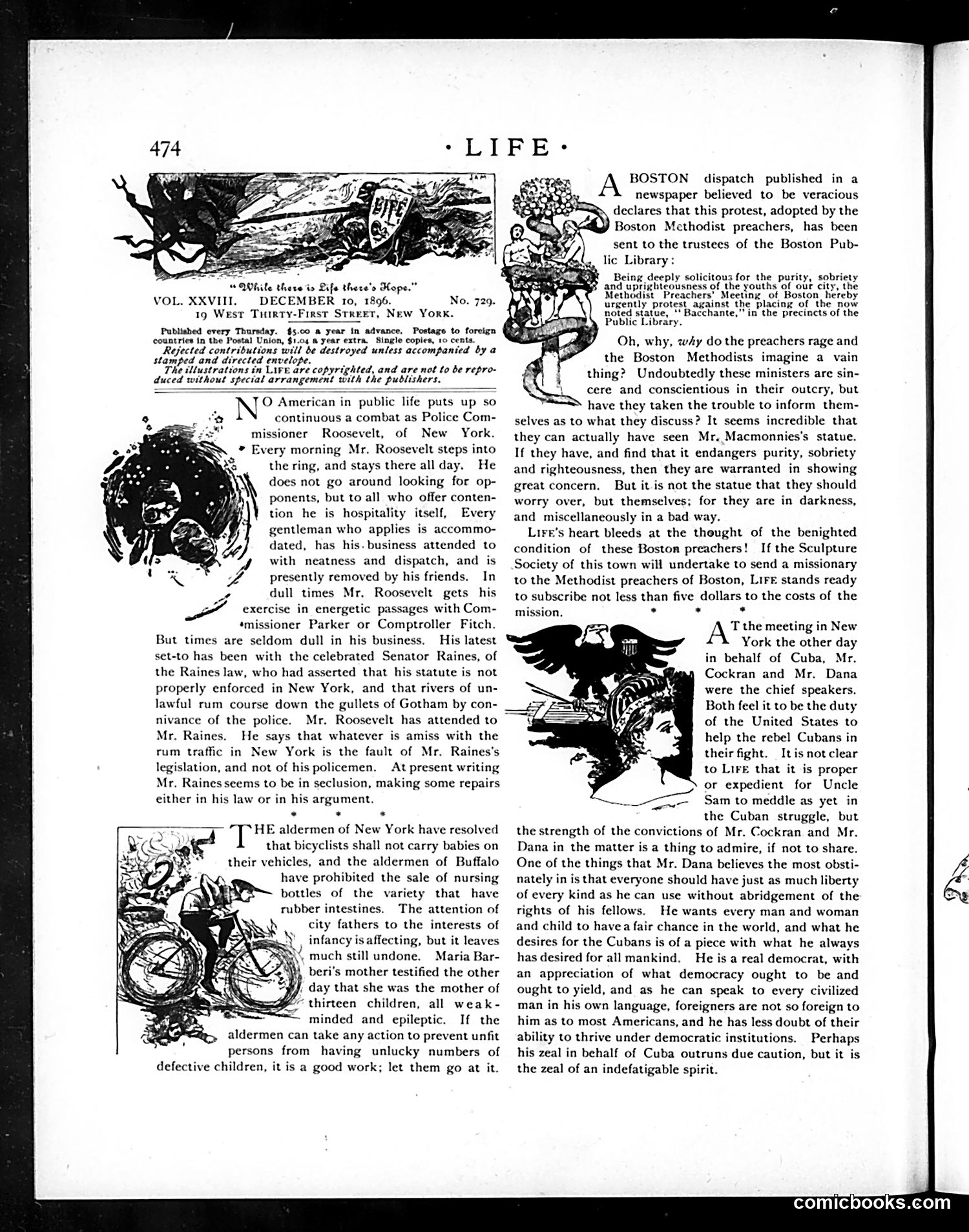
This page critiques **Police Commissioner Roosevelt's** anti-crime efforts in New York City. The text mocks Roosevelt's energetic but possibly ineffective approach—he "stays there all day" but merely "looks for opponents" rather than solving actual problems. The cartoon satirizes **Senator Raines' liquor law**, which Roosevelt enforces but the text suggests is fundamentally flawed. Roosevelt allegedly used the law to harass rivals like Senator Raines himself, suggesting political weaponization rather than genuine reform. A secondary piece praises Cuban independence advocates **Cockran and Dana** for their democratic principles, contrasting their idealism with America's cautious foreign policy. The bicycle and baby-bottle cartoons reference contemporaneous New York aldermanic debates about public health regulations—mundane governance concerns satirized as equally ineffective as Roosevelt's policing theatrics.
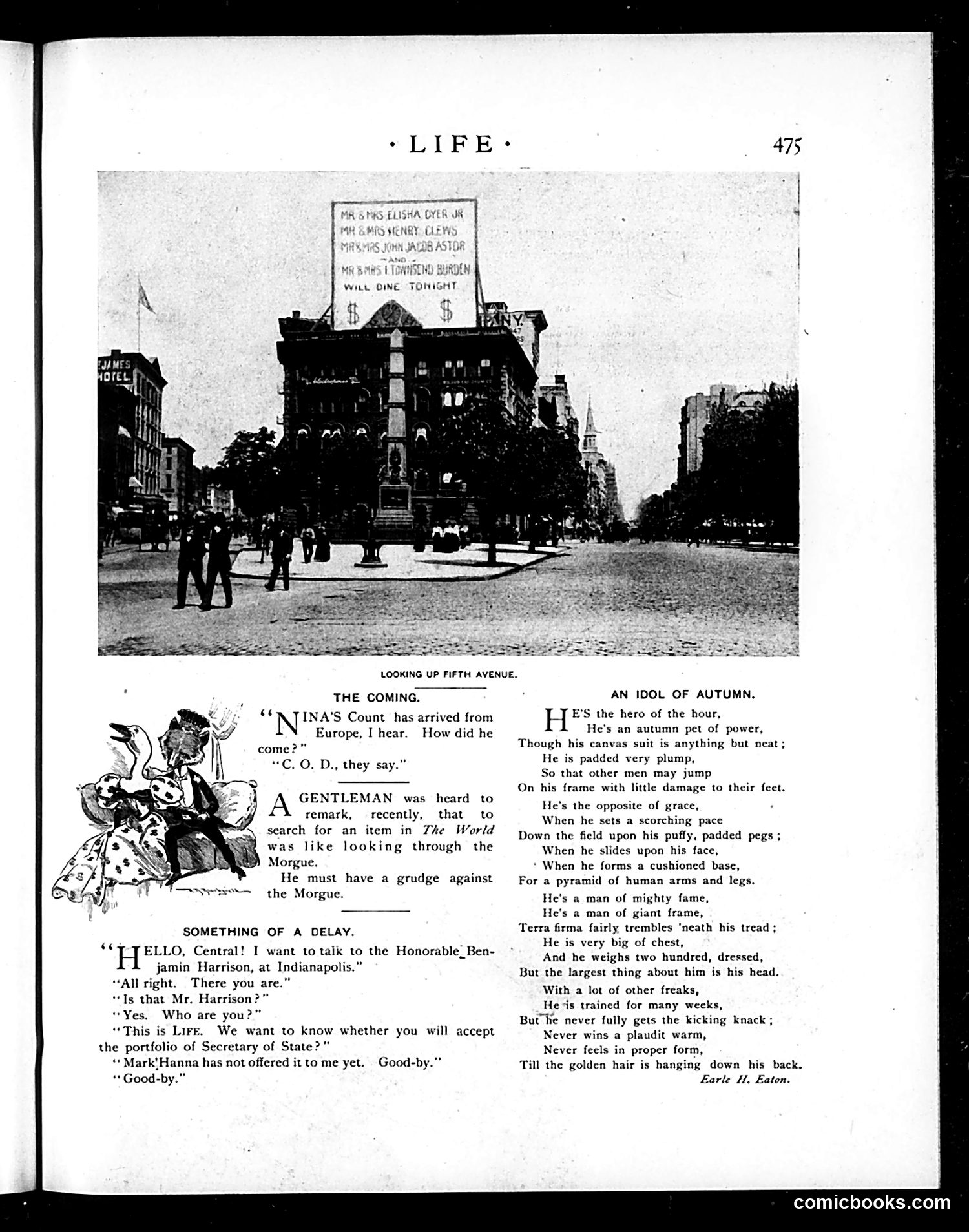
The main photograph shows Fifth Avenue in New York with a large billboard advertisement. Three short humorous pieces appear below: **"The Coming"** jokes about searching for an item in *The World* newspaper being like "looking through the Morgue"—a pun on the newspaper's name and actual morgue. **"Something of a Delay"** depicts a telephone conversation where someone tries to reach Benjamin Harrison (likely former U.S. President) at Indianapolis to offer him the portfolio of Secretary of State, but Harrison hasn't been offered it yet. **"An Idol of Autumn"** is a poem celebrating a polo player—described as powerful, padded, and famous, weighing 200 pounds with golden hair. It's a humorous tribute to the autumn polo season sport. The overall page mixes visual journalism with satirical commentary typical of Life magazine's format.
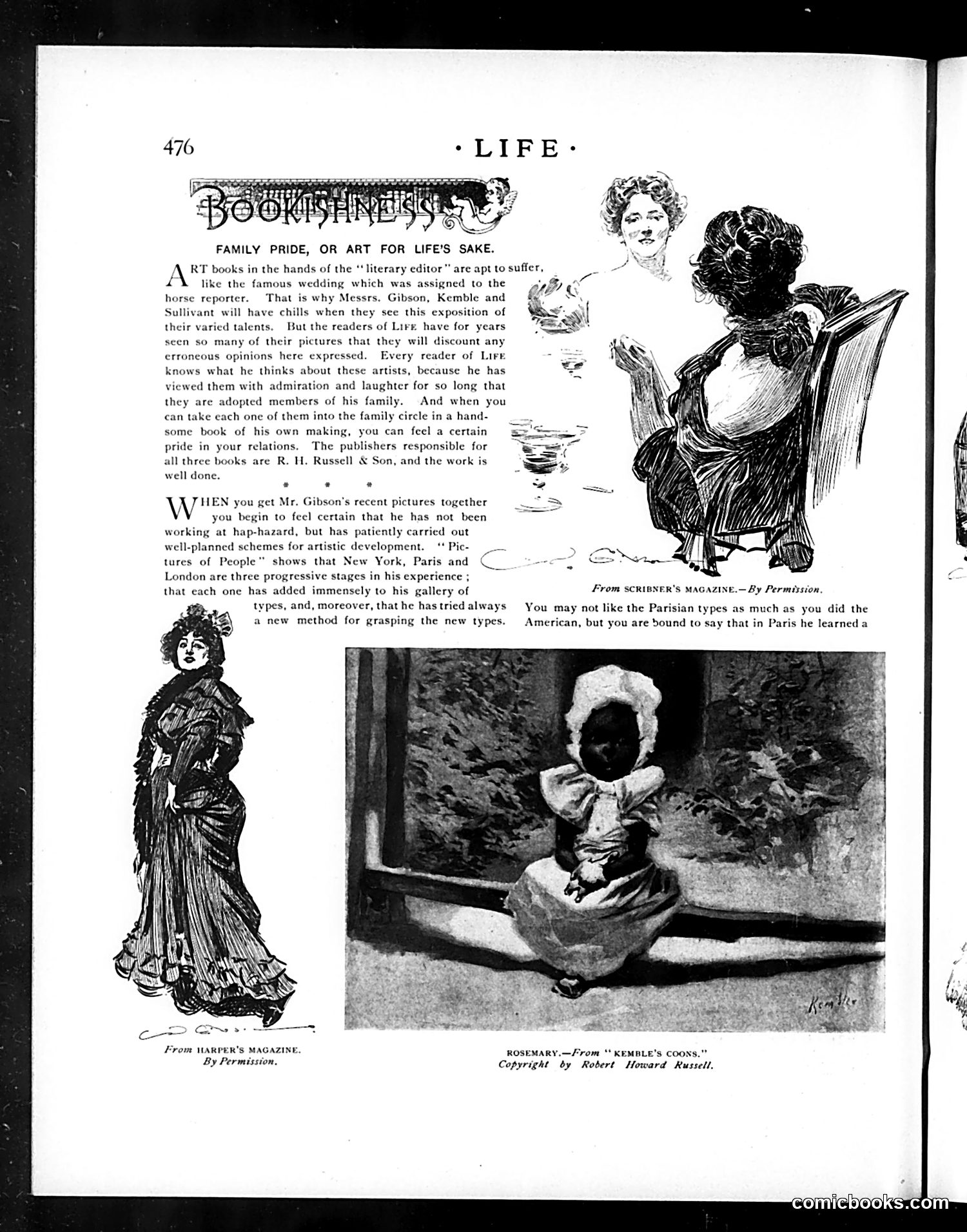
This page celebrates illustrators whose work appears in major publications. The text praises artists Gibson, Kemble, and Sullivan for their varied talents, noting that Life readers have grown so familiar with their work that they've become "adopted members of his family." The page showcases examples: a sketch from Harper's Magazine (left) depicting a fashionable woman, and "Rosemary" from Kemble's "Coons" (bottom)—a photograph showing a child in period costume. The tone is congratulatory toward these commercial illustrators who have achieved celebrity status through their prolific magazine contributions. The point emphasizes how popular illustration creates public intimacy and family-like recognition with artists.
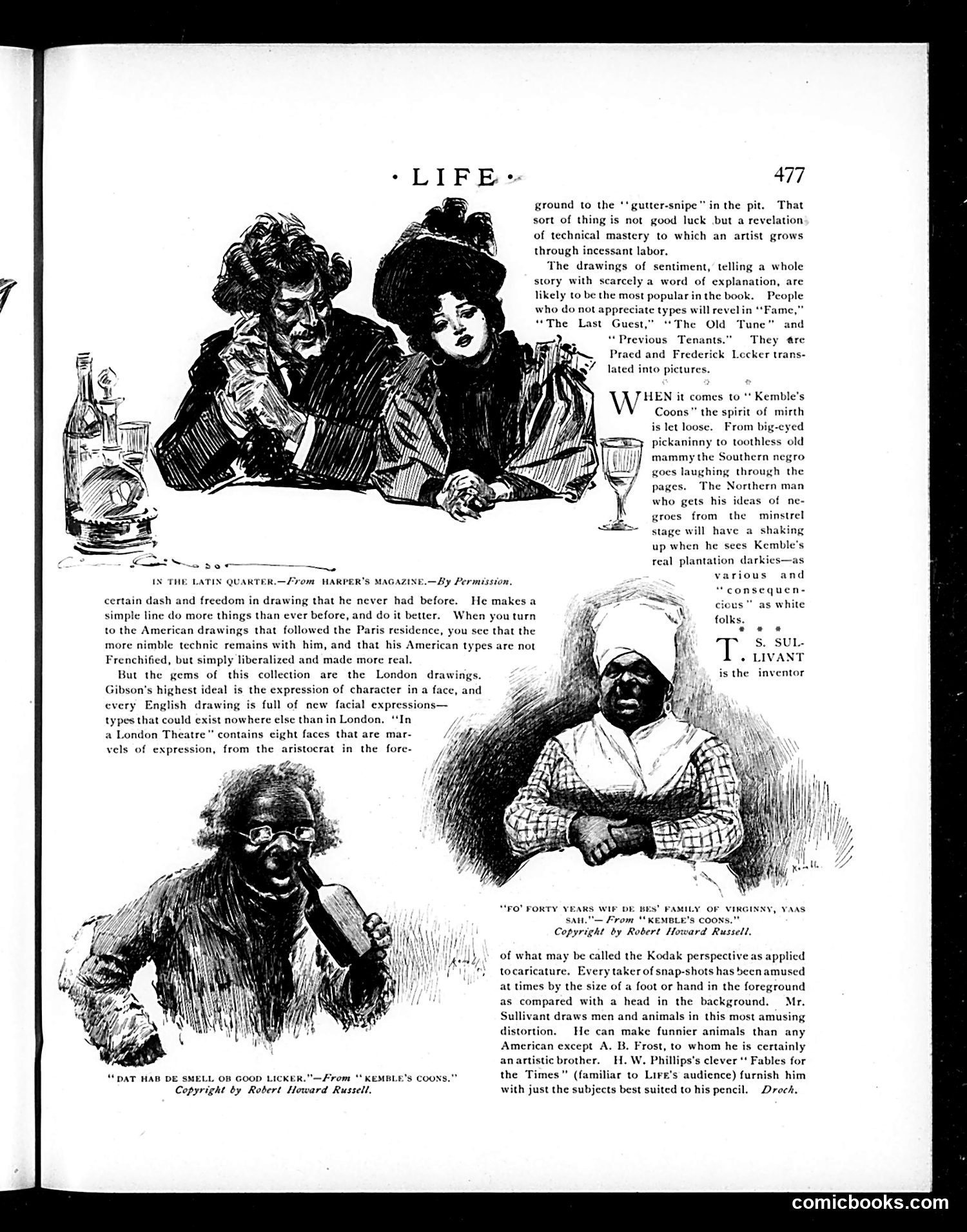
This page discusses illustrations from "Kemble's Coons," a collection of character drawings. The text praises the artist's technical skill in capturing facial expressions and different character types—specifically contrasting Northern and Southern characters, with explicit reference to "plantation darkies" and racial stereotypes. The three sketches shown appear to be from this collection: detailed character studies emphasizing exaggerated features. The captions reference work by Robert Howard Russell and quote from "Kemble's Coons." **For modern readers:** This reflects deeply racist 19th-century American entertainment and illustration traditions. The page celebrates caricatured depictions of Black Americans using period slurs, presenting such racial stereotyping as legitimate artistic achievement. This represents the casual racism embedded in mainstream publications of that era.
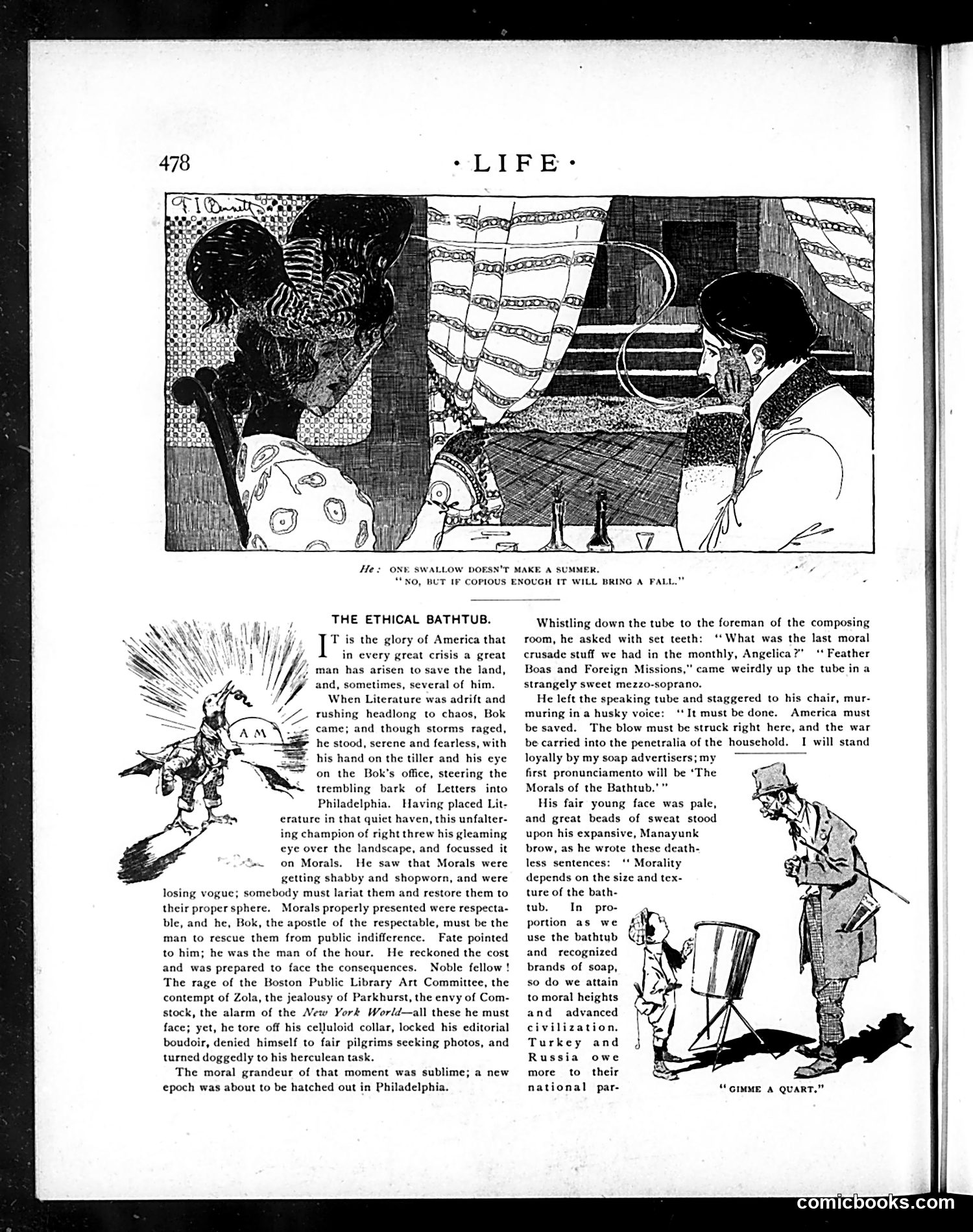
The top cartoon shows a domestic scene with the caption "One swallow doesn't make a summer. 'No, but if curious enough it will bring a fall.'" This appears to be a visual pun about a bird (swallow) potentially causing marital trouble—likely satirizing infidelity or curiosity leading to relationship damage. The main article, "The Ethical Bathtub," satirizes reformers and moralists obsessed with saving America. It mocks a character named Bok (likely Edward Bok, editor of Ladies' Home Journal) who campaigns for moral causes—here, specifically the bathtub as a symbol of civilization and morality. The sidebar cartoons show various crusaders promoting their "ethical" causes. The satire targets earnest progressive reformers of the early 20th century as self-righteous and absurdly focused on trivial concerns disguised as moral crusades.
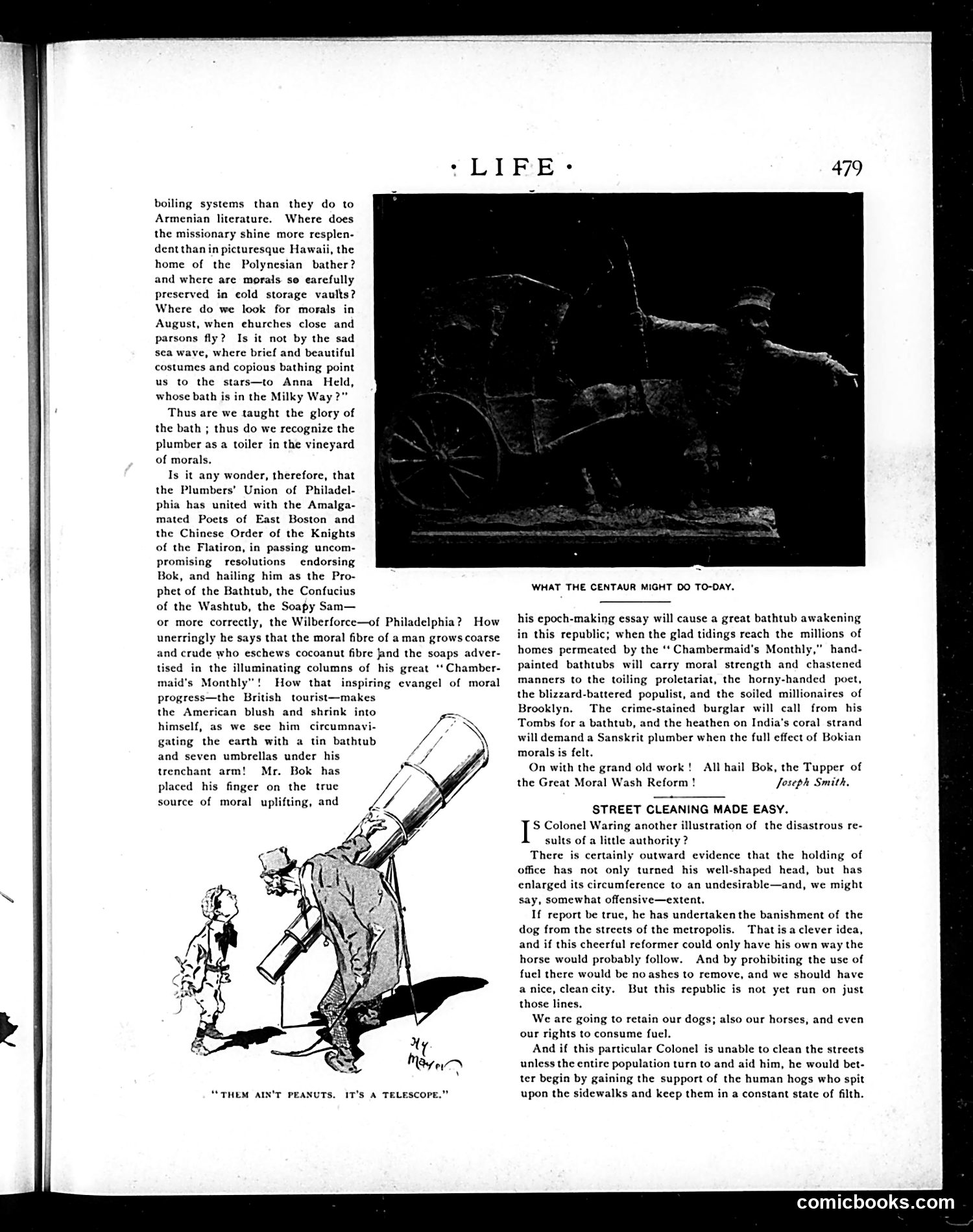
**The Main Cartoon:** Features a figure using a telescope labeled "THEM AIN'T PEANUTS. IT'S A TELESCOPE." The satire mocks Colonel Waring's street-cleaning efforts in Philadelphia by suggesting his claims of success are inflated—he's merely using a telescope to make small improvements appear significant. **The Context:** The accompanying article discusses Colonel Waring's street-cleaning campaign and his attempts to reform urban sanitation. The text satirizes his ambitions and questions whether his methods can truly succeed without broader public cooperation. **The Satire:** The joke ridicules exaggerated municipal claims—implying Waring magnifies minor accomplishments through propaganda ("through a telescope") to appear transformative. It's skeptical commentary on reform movements relying on publicity rather than substantive change.
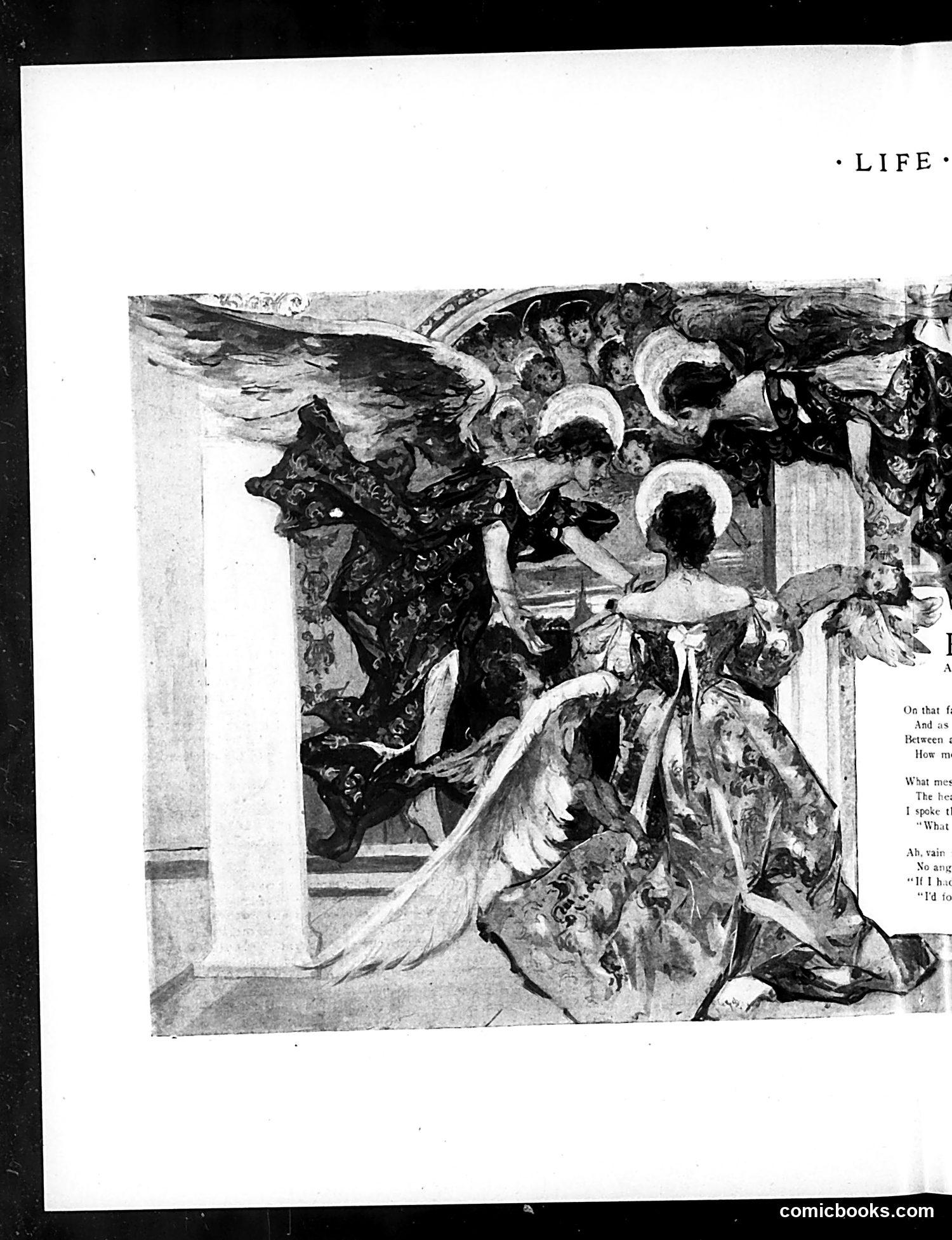
This appears to be a classical or religious artwork rather than a political cartoon. The image shows figures with halos in elaborate period dress gathered in what seems to be a heavenly or divine scene. The composition includes multiple figures in ornate robes, some with wings, arranged in a theatrical manner typical of Renaissance religious art. The OCR'd text is too fragmented to read clearly ("On that f...", "Between a...", "How m..."), making it difficult to determine the specific satirical point. Without legible caption text or clear identifying labels, I cannot confidently identify which historical or political figures are being referenced or what social commentary this satire intended. The page header reads "LIFE," confirming this is from the satirical magazine, but the artistic style and content suggest this may be illustrating a literary work or making an abstract point rather than targeting specific contemporary political figures.
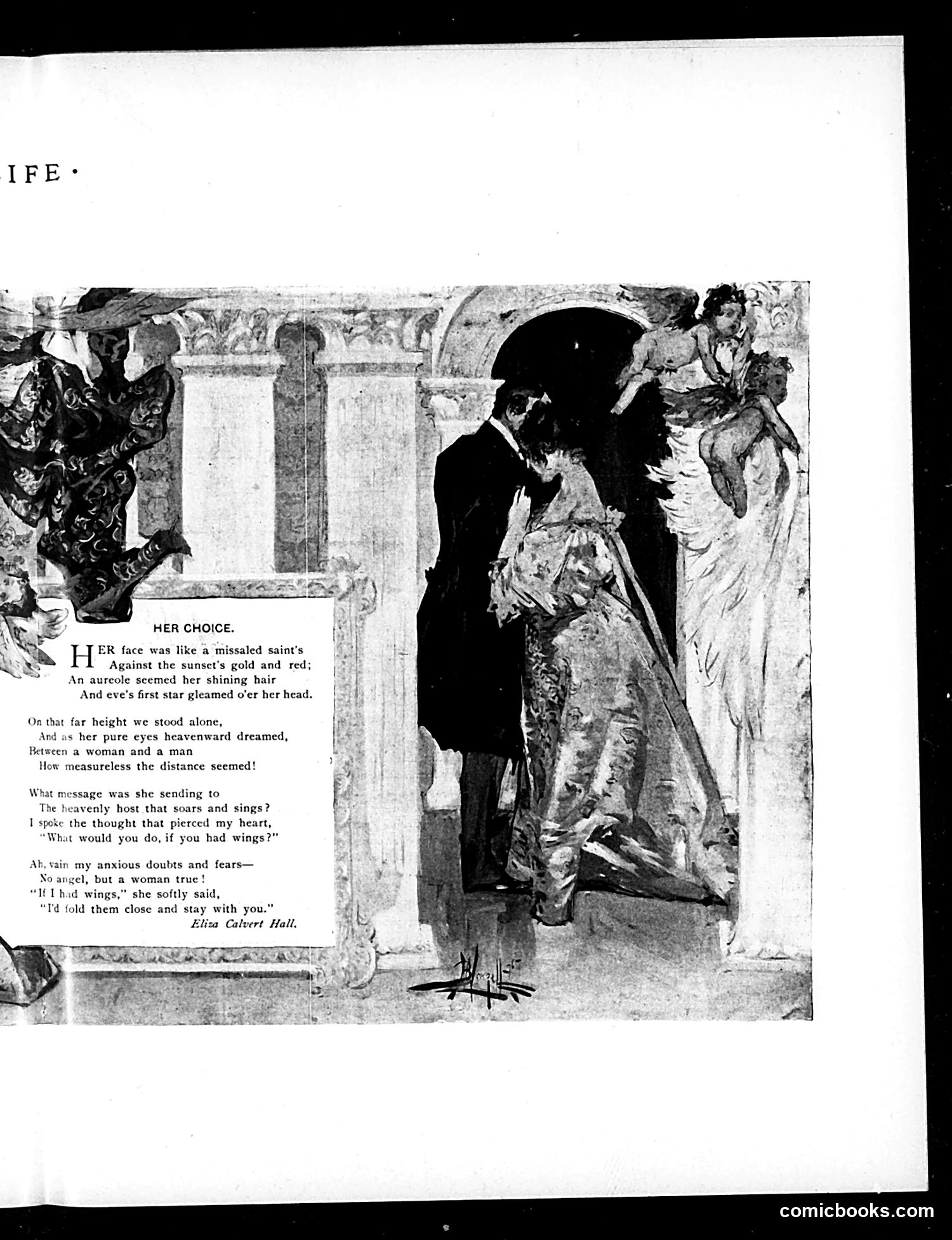
This illustration accompanies a poem by Elisa Calvert Hall about romantic choice and sacrifice. The image depicts a couple in an elegant classical setting—a man in dark formal dress and a woman in an ornate gown—in an intimate moment beneath an archway. The poem's central conceit asks what a woman would do "if you had wings," suggesting escape or transcendence. Her answer—"No angel, but a woman true"—reveals the satirical point: rather than choosing heavenly freedom or independence, she chooses to remain with her male companion, staying earthbound in romantic devotion. This reflects early 20th-century gender expectations, where a woman's ultimate fulfillment was defined by romantic attachment rather than autonomy. The "satire" gently mocks both sentimental romance and women's limited choices.
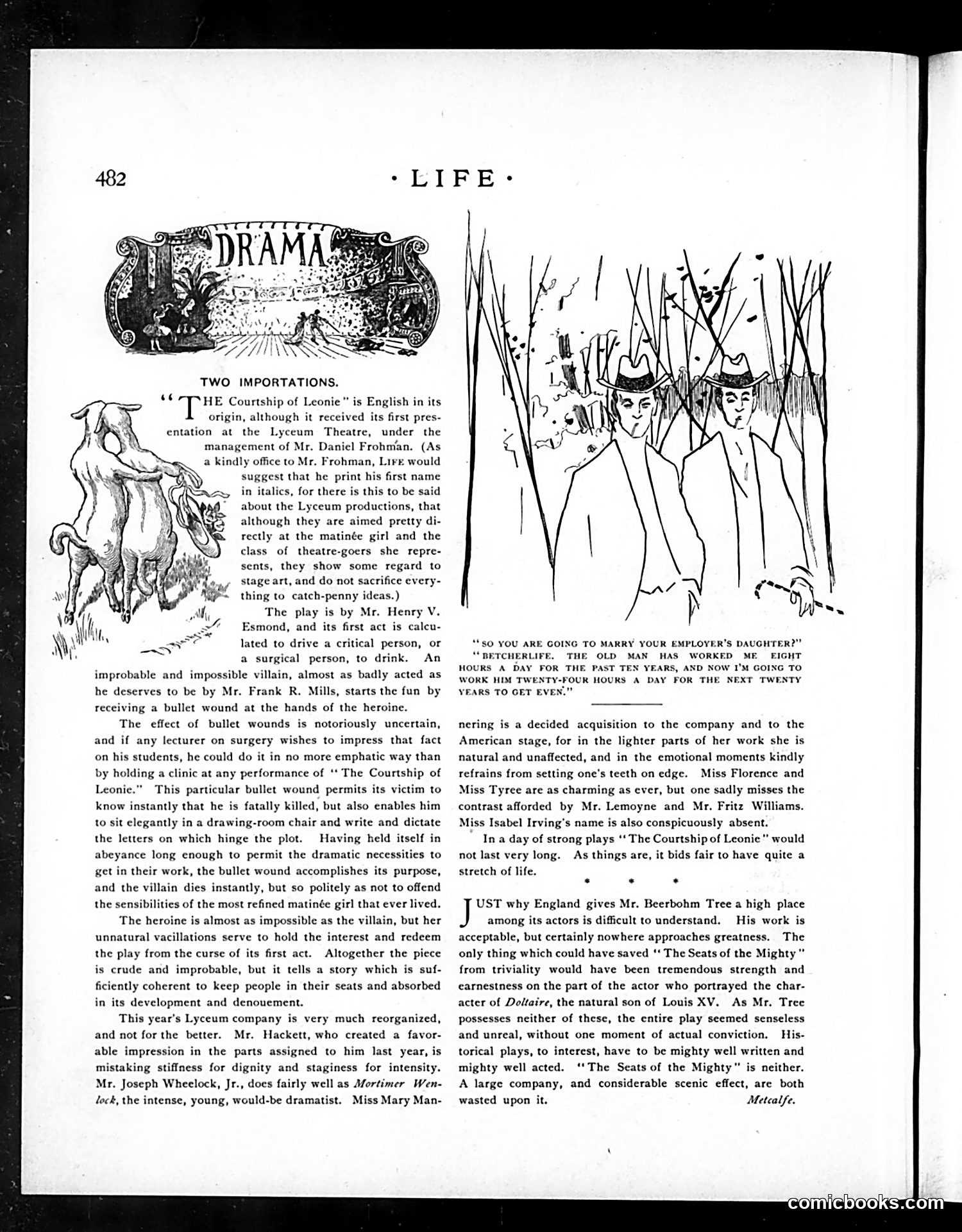
This page contains theater criticism from Life magazine (a satirical publication). The left column reviews "The Courtship of Leonie," a play at the Lyceum Theatre. The critic harshly judges it as poorly constructed—featuring an implausibly villainous character who receives a bullet wound yet somehow remains alive long enough to write letters, only then dying "politely" to avoid offending the refined matinée audience the Lyceum targets. The right illustration appears to be a scene from the play showing characters in period costume (tall hats visible), though the caption is partially illegible in the OCR. The bottom section criticizes English actor Beerbohm Tree, questioning why England ranks him highly when his work merely "acceptable" but lacks greatness. The critic argues Tree's performance in "The Seats of the Mighty" particularly suffered from his inability to convey emotional depth—a crucial flaw in historical drama requiring earnestness. The satire targets both theatrical mediocrity and audience taste preferences of the era.
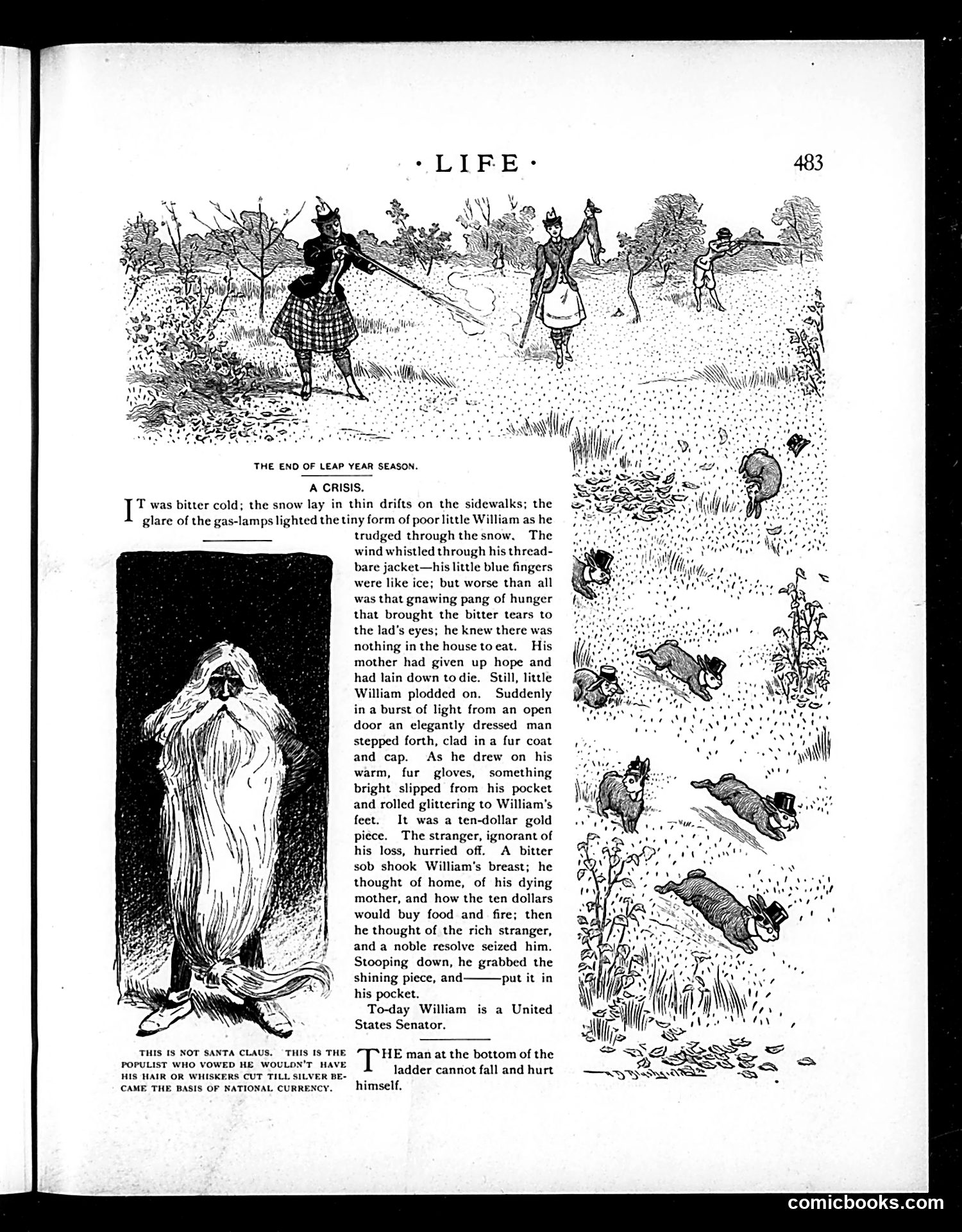
This page satirizes American populism and political corruption through a story about a poor boy named William who finds a ten-dollar gold piece dropped by a wealthy man. Rather than returning it honestly, William keeps the money—and the caption reveals he later becomes a U.S. Senator. The left illustration shows a bearded figure labeled as "the Populist who vowed he wouldn't have his hair or whiskers cut till silver became the basis of national currency"—referencing the late 1800s Free Silver movement. The satire's point: Life mocks both populist politicians (portrayed as hypocritical opportunists willing to abandon principles) and the notion that dishonesty leads to success. The implication is that senators are morally compromised figures who achieved power through corruption rather than merit. The final aphorism about "the man at the bottom of the ladder" suggests those without power are paradoxically safer from temptation than those climbing toward it.
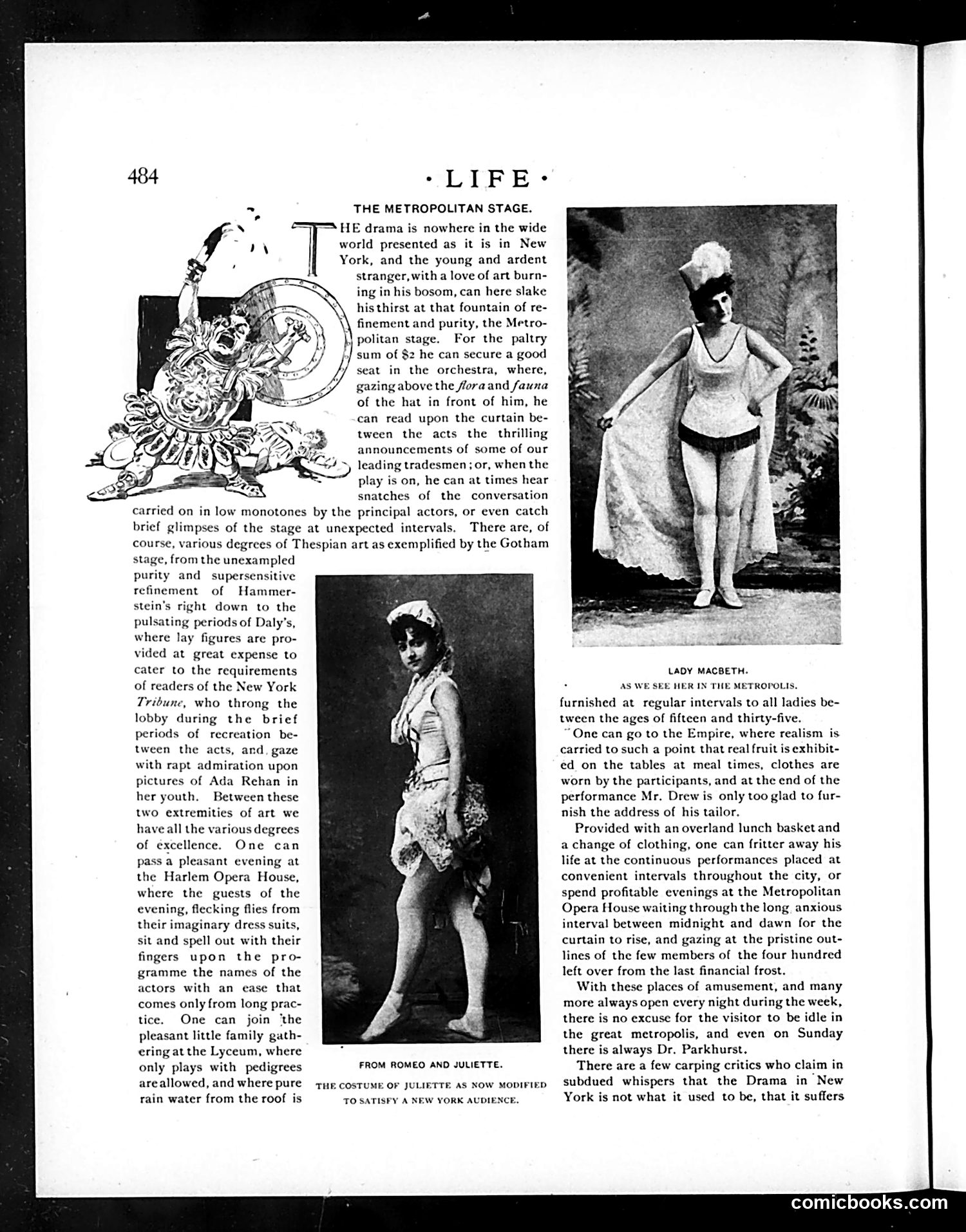
This satirical article mocks New York theater culture circa the 1890s. The piece uses **heavy irony** to critique both theatrical venues and their audiences. The author ridicules: 1. **Theater quality**: For $2, patrons sit behind enormous hats, read advertisements on curtains between acts, and can barely hear actors—presenting this as "refinement and purity." 2. **Specific theaters**: References to the Harlem Opera House (where audiences can't read and spell out actor names), the Lyceum (serving rainwater), and the Empire (where realistic props like fruit are shown off). 3. **Audience pretension**: The "four hundred" (New York's wealthy elite) waiting until dawn at the Metropolitan Opera House; Tribune readers gawking at Ada Rehan pictures in lobbies. 4. **Continuous vaudeville**: Mocking those who "fritter away" life at cheap continuous performances scattered throughout the city. The accompanying images of performers (Romeo and Juliet, Lady Macbeth) illustrate the theatrical subjects being ridiculed. The overall satire suggests New York theater has declined into commercialism and spectacle masquerading as culture.
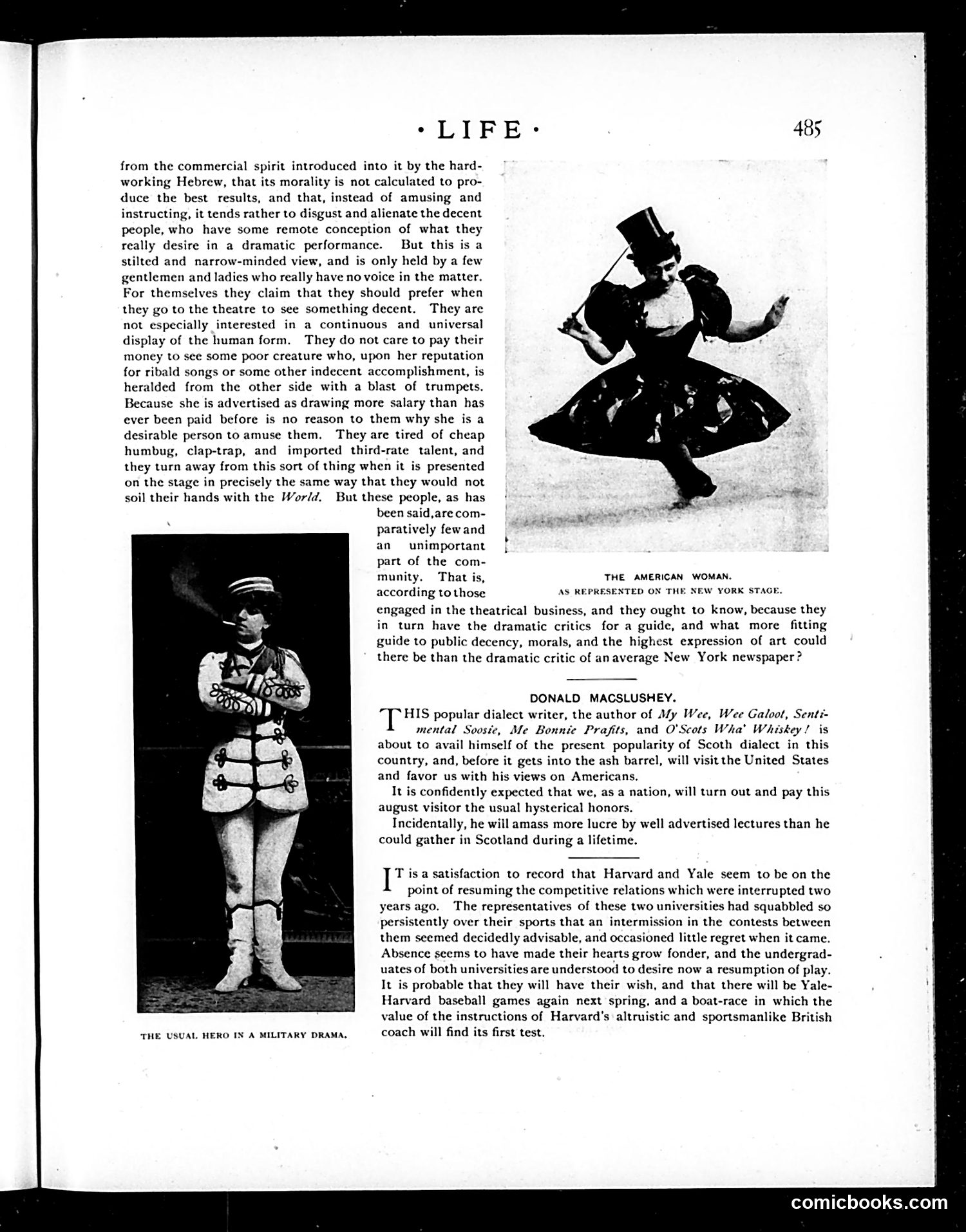
This page combines theater criticism with social satire. The main text attacks New York theater's commercialism and low moral standards—specifically criticizing imported performers advertised primarily for their salaries and "ribald songs" rather than talent. The author sarcastically notes that theater critics (from average New York newspapers) are the proper arbiters of public decency. The two photographs illustrate the critique: "The American Woman as Represented on the New York Stage" shows a performer in a revealing costume; "The Usual Hero in a Military Drama" depicts an exaggerated military character in tights. Both mock theatrical excess and sensationalism. A separate item announces Scottish dialect writer Donald MacSlushey's American visit, predicting Americans will pay handsomely for his lectures despite his mediocre work. The final paragraph celebrates Harvard-Yale athletic competition resuming after a dispute.
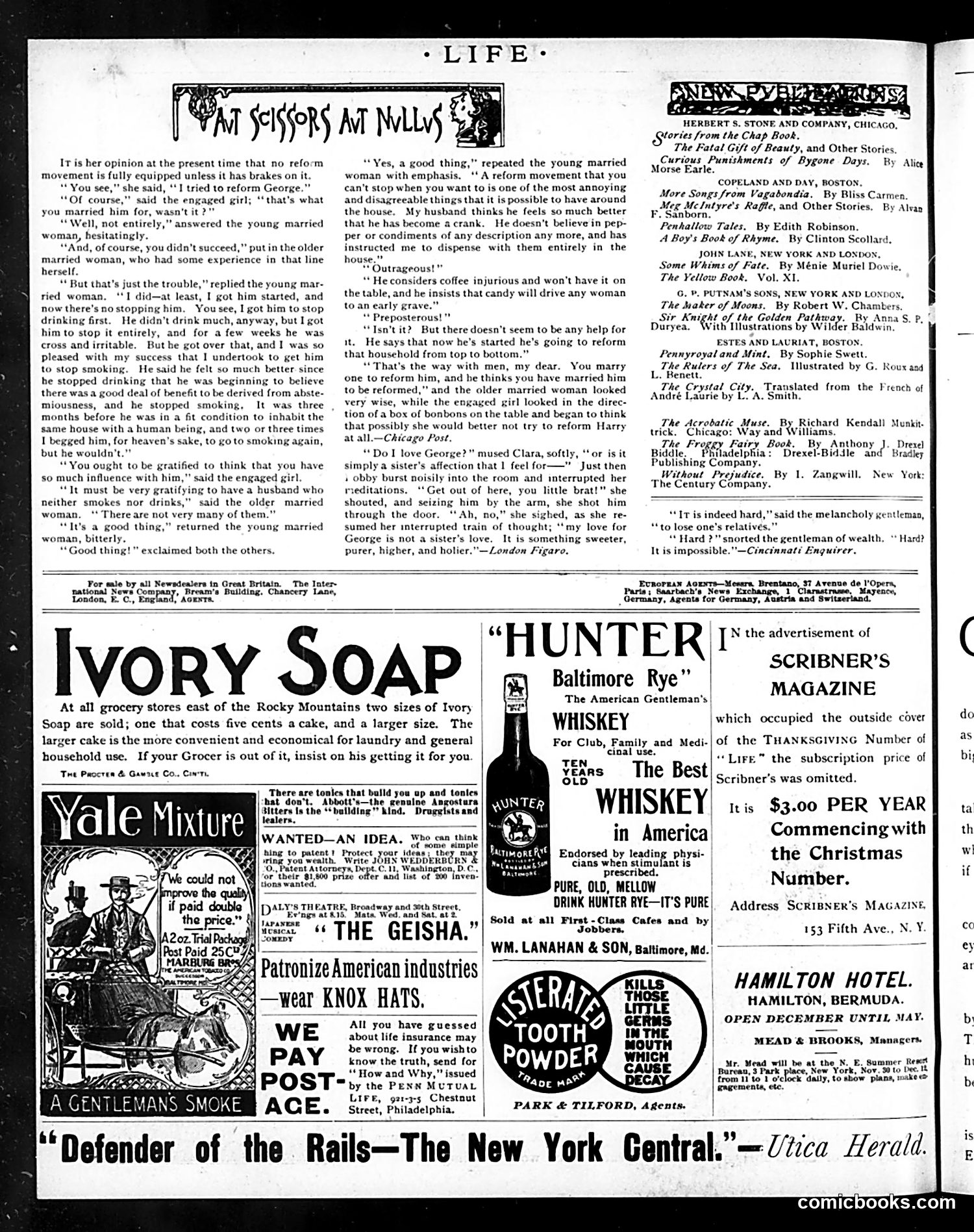
This page presents a satirical short story (credited to the Chicago Post) about the unintended consequences of reform movements, particularly regarding marital dynamics. **The Central Joke:** A young married woman successfully reforms her husband George—getting him to quit drinking and smoking. However, she discovers reform has made him *worse*, not better. Now fanatical about self-improvement, he's become a household tyrant, banning pepper, condiments, coffee, and candy as "injurious." **The Satire's Target:** The piece mocks both the Progressive Era's reform movements and gender relations. It suggests that: - Women marry men intending to "reform" them - Men don't understand they're being reformed and become zealots instead - Excessive reform creates domestic chaos worse than the original vices **The Irony:** The engaged girl listening to this cautionary tale begins reconsidering whether reforming her fiancé Harry is wise—the story's moral being that reform movements need "brakes" or they spiral beyond control. The page is primarily this story with surrounding advertisements (Ivory Soap, Yale Mixture tobacco, Hunter Whiskey) typical of 1890s Life magazine.
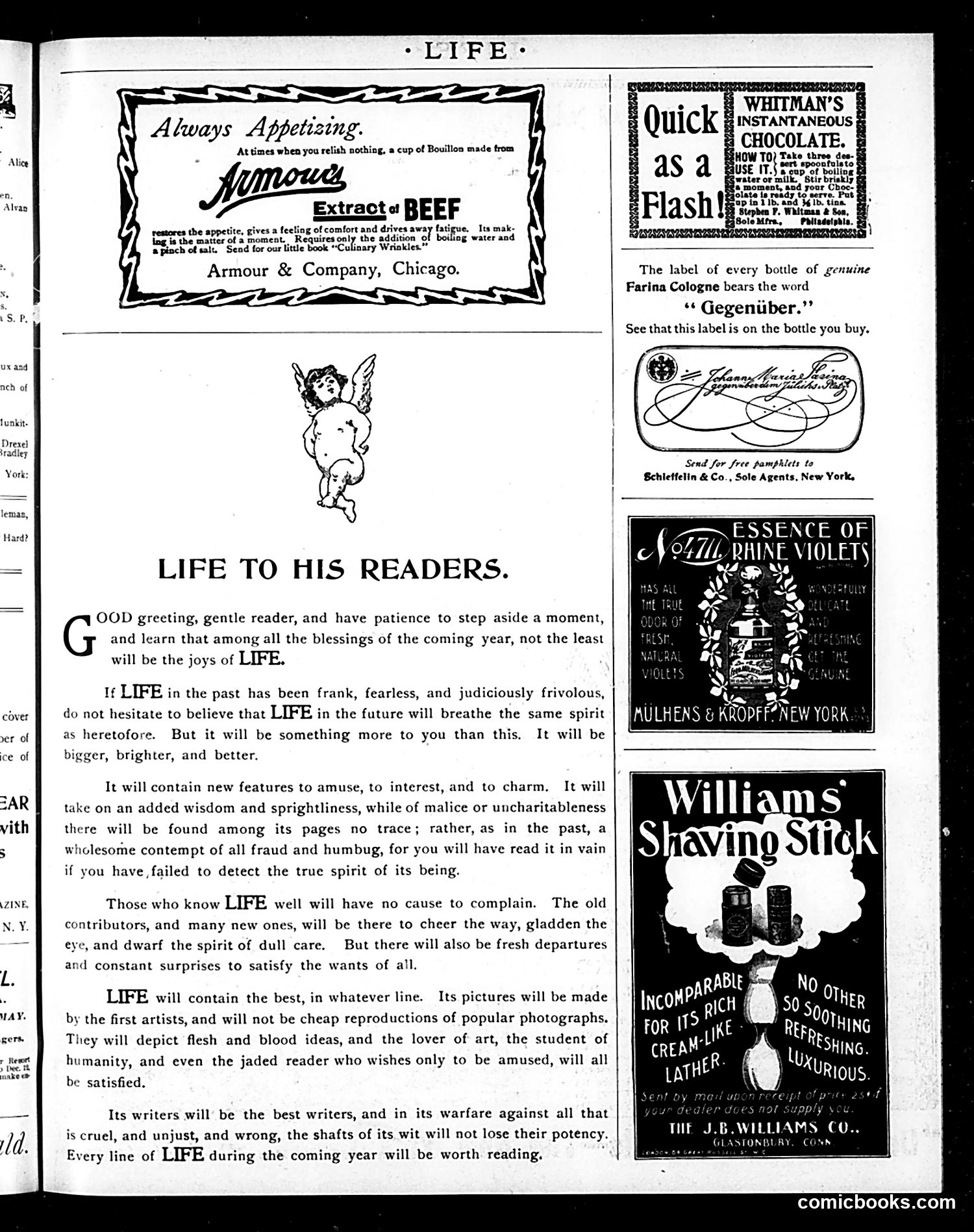
This is primarily a **title/masthead page** rather than a satirical cartoon. The main content is *Life's* editorial greeting to readers for the coming year—likely from around the 1880s-90s, when Life was an established satirical weekly. The message promises readers that Life will remain "frank, fearless, and judiciously frivolous" while improving in quality. Notably, it pledges "wholesome contempt of all fraud and humbug" and promises its writers will wage "warfare against all that is cruel, and unjust, and wrong." This reveals Life's self-image as a **satirical publication with moral teeth**—using humor and wit to expose social problems, not merely entertain. The surrounding advertisements (Armour's beef extract, Whitman's chocolate, Farina cologne, Williams' shaving stick) are period commercial messages, not satirical content. **No specific political figures or events are referenced on this page.**
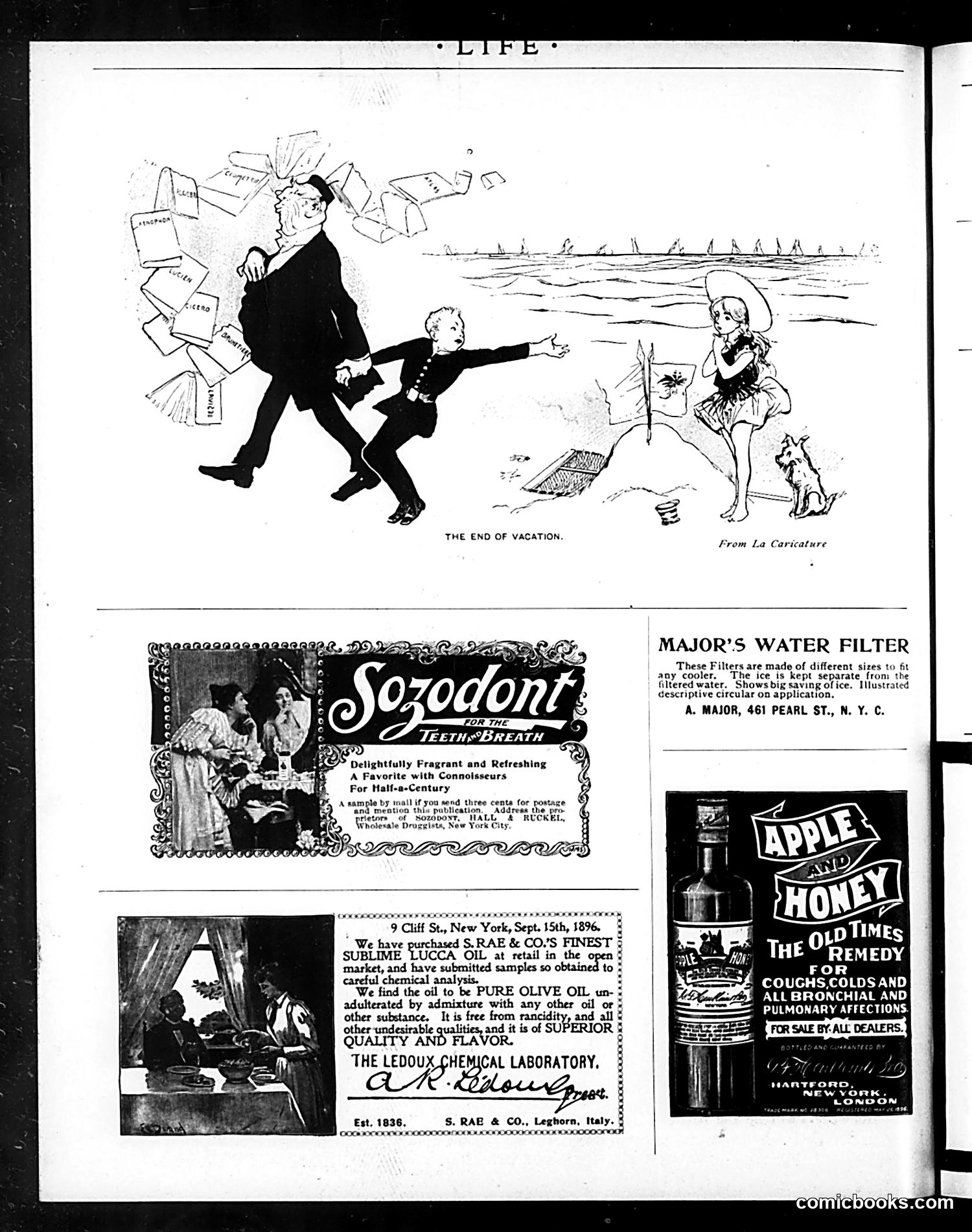
This cartoon, credited to "La Caricature" (a French publication), depicts the common experience of vacation's conclusion through physical comedy. A well-dressed businessman is literally *blown backward* by papers and documents swirling around him—representing the avalanche of work awaiting his return to the office. A young boy (possibly his son) is caught in the same chaotic wind. On the right, a woman and child enjoy a peaceful beach scene, suggesting the carefree vacation lifestyle being left behind. The contrast emphasizes the jarring transition from leisure to work obligations. The joke is universal: no matter one's social status, returning from vacation means confronting an overwhelming backlog of neglected business matters. Published in *Life* around 1896, this resonates because workplace anxieties remain timeless—the cartoon captures the anxiety of re-entry into demanding professional life.
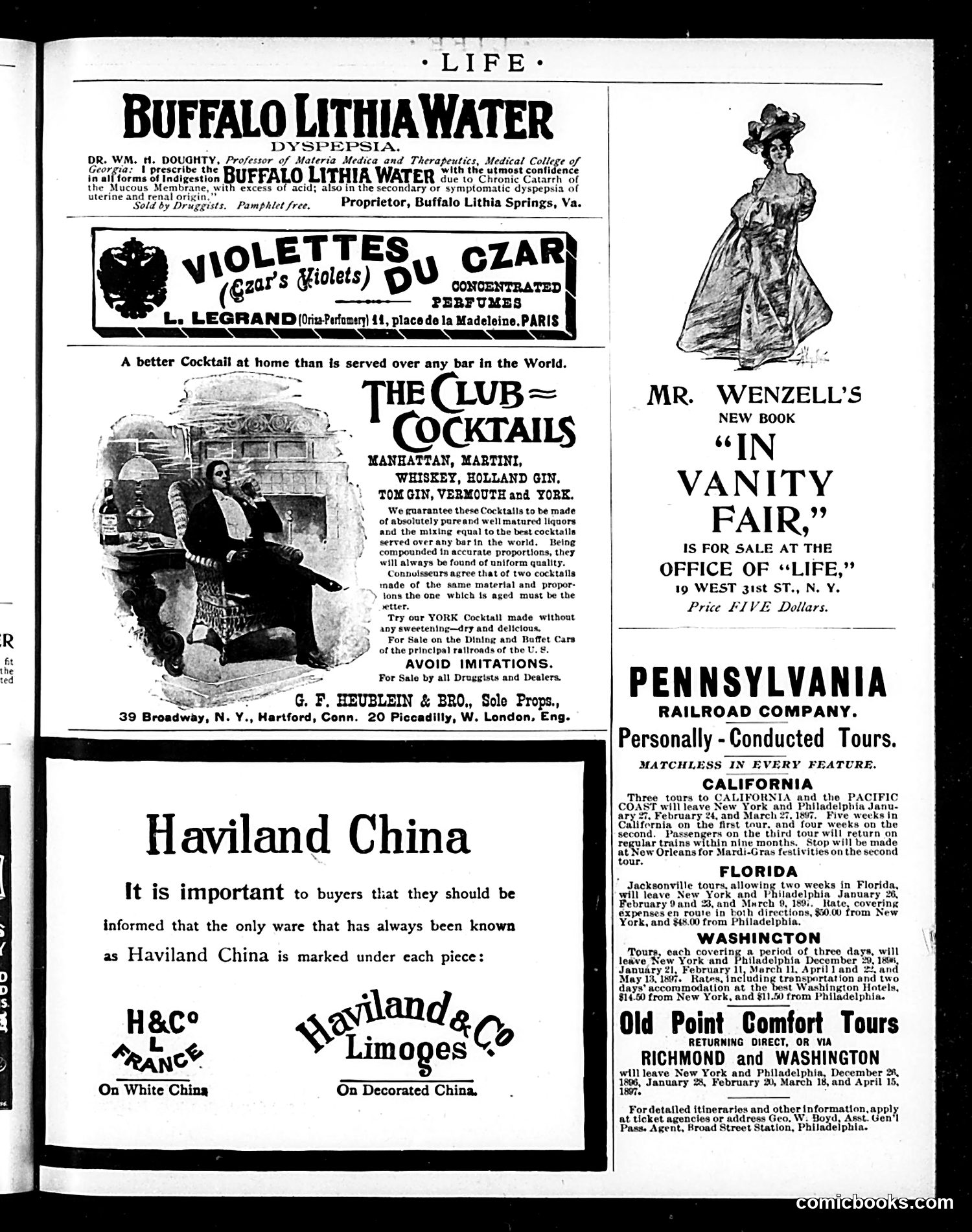
This page is primarily **advertising**, not political satire. It contains: **Medical/Patent Ads:** Buffalo Lithia Water claims to cure dyspepsia (indigestion) with endorsement from a medical professor—typical of the era's unregulated health claims. **Luxury Goods:** Violettes du Czar perfume (invoking Russian imperial prestige) and Haviland China (French porcelain, marked to distinguish authentic pieces from imitations). **Social Recreation:** Heublein cocktail kits for home entertaining—suggesting refined leisure among the wealthy. **Travel:** Pennsylvania Railroad's "personally-conducted tours" to California, Florida, and Washington D.C., targeting affluent Americans seeking organized vacation experiences. **Literature:** Wenzell's book "In Vanity Fair" sold through *Life* magazine's office. The page reflects Gilded Age consumer culture: marketed products promise health, sophistication, and leisure to upper-class readers. No cartoon or political commentary is present—this is a straightforward commercial page.
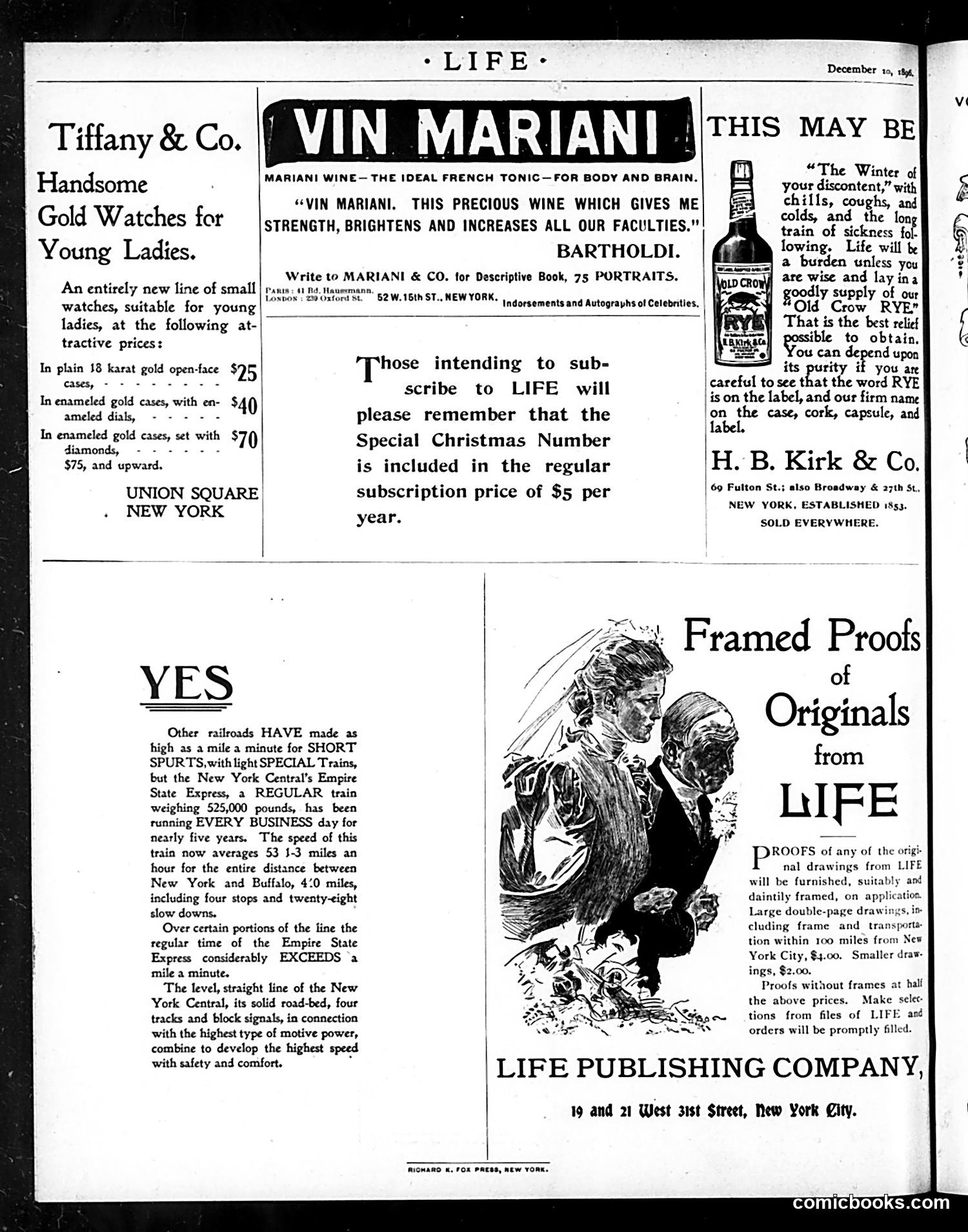
This page is primarily **advertising**, not political satire. It contains several commercial advertisements typical of the 1890s: **Vin Mariani wine** is promoted as a medicinal tonic, citing sculptor Bartholdi (creator of the Statue of Liberty) as an endorser—a common celebrity endorsement practice of the era. The product claimed to cure winter ailments and boost vitality. **Tiffany & Co.** advertises gold watches for young ladies at varying prices. **H.B. Kirk & Co.** promotes "Old Crow Rye" whiskey, emphasizing purity and brand authenticity. **New York Central Railway** advertises the Empire State Express, boasting its speed and reliability as a regular business train (not just special excursion service). **Life Publishing Company** offers framed reproductions of original artwork from the magazine. The page reflects late-Victorian consumer culture and early advertising practices, including dubious health claims and celebrity testimonials. There is no significant political cartoon or satire visible on this particular page.