
Life, 1896-12-10 · page 7 of 20
Life — December 10, 1896 — page 7: what you’re looking at
What you’re looking at
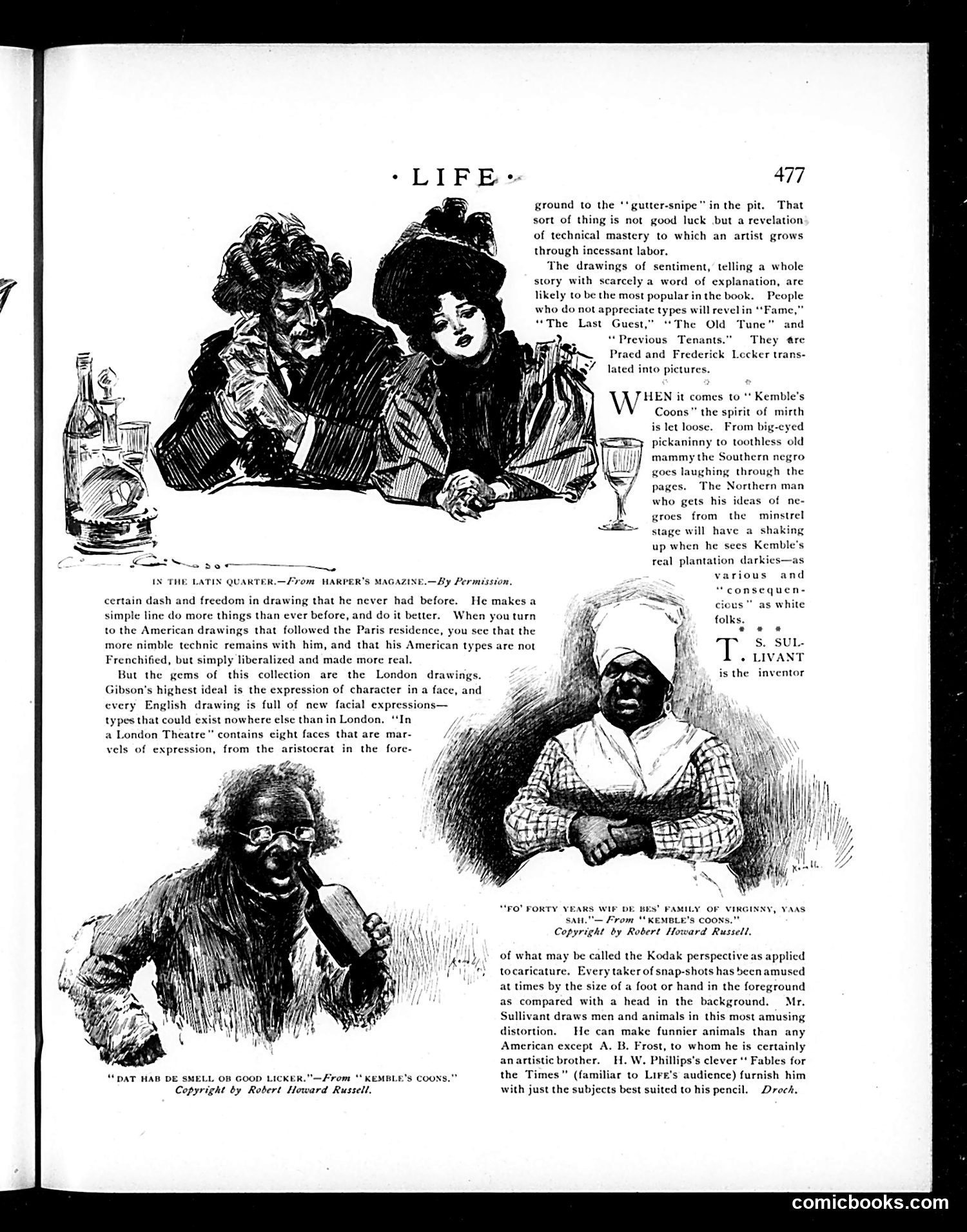
This page discusses illustrations from "Kemble's Coons," a collection of character drawings. The text praises the artist's technical skill in capturing facial expressions and different character types—specifically contrasting Northern and Southern characters, with explicit reference to "plantation darkies" and racial stereotypes. The three sketches shown appear to be from this collection: detailed character studies emphasizing exaggerated features. The captions reference work by Robert Howard Russell and quote from "Kemble's Coons." **For modern readers:** This reflects deeply racist 19th-century American entertainment and illustration traditions. The page celebrates caricatured depictions of Black Americans using period slurs, presenting such racial stereotyping as legitimate artistic achievement. This represents the casual racism embedded in mainstream publications of that era.
📄 Transcribed text from this page (OCR, searchable)
Machine-transcribed from the original scan — historical spelling and the odd misread are preserved.
477 ground to the ‘‘gutter-snipe" in the pit. That sort of thing is not good luck but a revelation of technical mastery to which an artist grows through incessant labor. The drawings of sentiment, telling a whole story with scarcely a word of explanation, are likely to be the most popular in the book. People who do not appreciate types will re “The Last Guest,” ‘The Old Tune” and “Previous Tenants." They @re Praed and Frederick Lecker trans- Coons” the spirit of mirth is let loose. From big pickaninny to toothles mammy the Southern negro goes laughing through the pages. The Northern ma who gets his ideas of ne- groes from the minstrel stage will have a shaking up when he sees Kemble’s real plantation dark various Gat Ss 3. —————_____, IN THE LATIN QUARTER. —From HARPER'S MAGAZINE.—By Permission, + . “consequen- certain h and freedom in drawing that he never had before. He makesa simple line do more things than ever before, and do it better. When you turn to the American drawings that followed the Paris residence, you see that the : i more nimble technic remains with him, and that his American types are not || A) A T Frenchified, but simply liberalized and made more real. j + LIVA But the gems of this collection are the London drawings. foe \ isthe inventor Gibson's highest ideal is the expression of character ina face, and 4 every English drawing is full of new facial expressions— types that could exist nowhere else than in London, “In a London Theatre” contains eight faces that are mar- vels of expression, from the aristocrat in the fore- “FO! FORTY YEARS WIF DE BES’ FAMILY OF VIRGINNY, YAAS. SAu."— From “ KEMBLE’S COONS. Copyright by Robert Howard Russell. of what may be called the Kodak perspecti tocaricature. Every taker of snap-shots has been amused at times by the size of a foot or hand in the foreground as compared with a head in the background. Mr. Sullivant draws men and animals in this most amusing distortion. He can make funnier animals than any American except A. B. Frost, to whom he is certainly anartistic brother. H. W. Phillips's clever ‘' Fables for “DAT HAB DE SMELL OB GOOD LICKER."—From ‘ KEMBLE’S COONS.” the Times” (familiar to Lire’s audience) furnish him Copyright by Robert Howard Russell, with just the subjects best suited to his pencil. Drock. comicbooks.com