
Life, 1896-12-10 · page 4 of 20
Life — December 10, 1896 — page 4: what you’re looking at
What you’re looking at
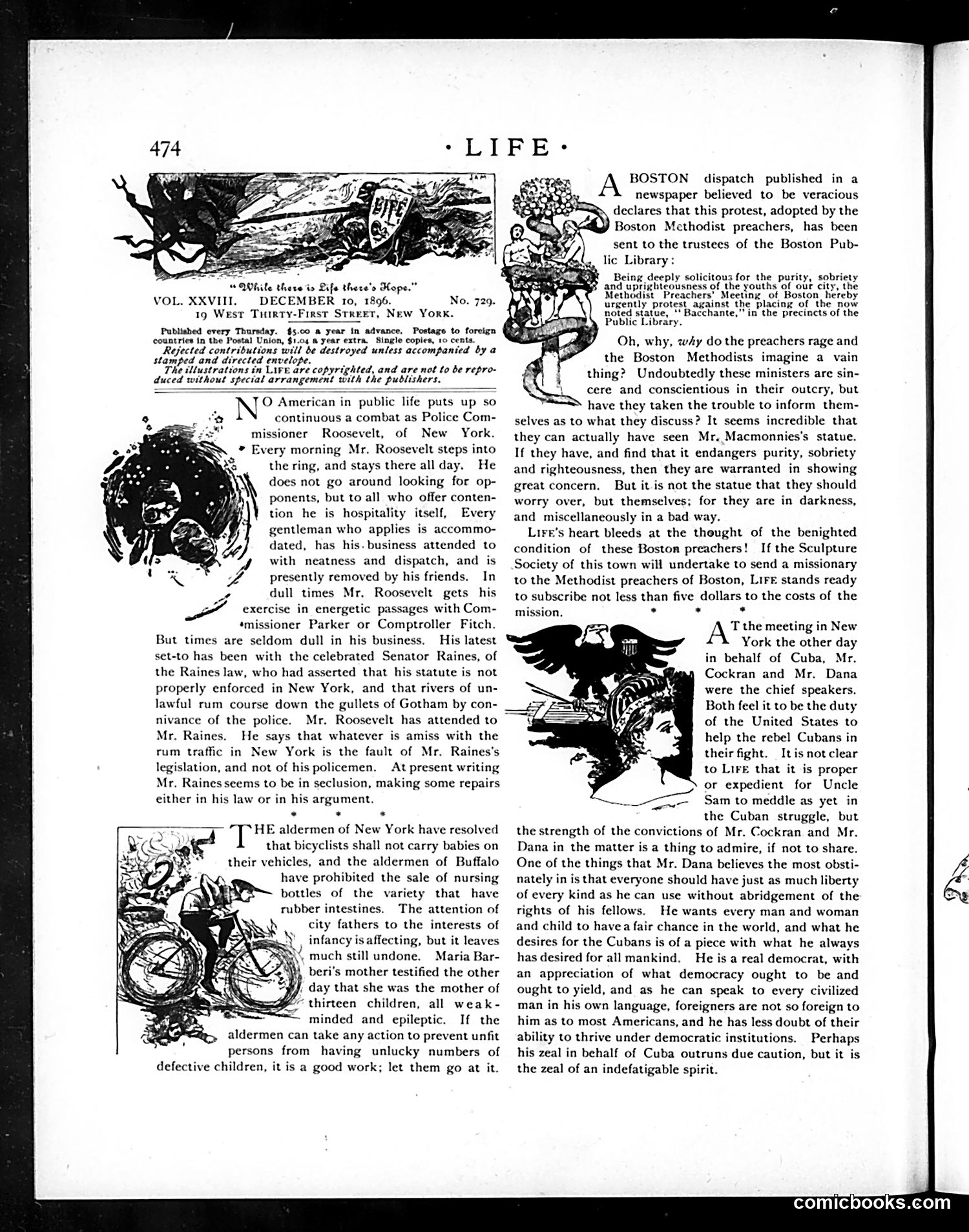
This page critiques **Police Commissioner Roosevelt's** anti-crime efforts in New York City. The text mocks Roosevelt's energetic but possibly ineffective approach—he "stays there all day" but merely "looks for opponents" rather than solving actual problems. The cartoon satirizes **Senator Raines' liquor law**, which Roosevelt enforces but the text suggests is fundamentally flawed. Roosevelt allegedly used the law to harass rivals like Senator Raines himself, suggesting political weaponization rather than genuine reform. A secondary piece praises Cuban independence advocates **Cockran and Dana** for their democratic principles, contrasting their idealism with America's cautious foreign policy. The bicycle and baby-bottle cartoons reference contemporaneous New York aldermanic debates about public health regulations—mundane governance concerns satirized as equally ineffective as Roosevelt's policing theatrics.
📄 Transcribed text from this page (OCR, searchable)
Machine-transcribed from the original scan — historical spelling and the odd misread are preserved.
VOL. XXVIII. E No. 729. eT, New York. Published every Thursday. $5. ear in advance, Postage to foreign countries in the Postal Union, $1.04 a year extra. Single copies, 10 cents. Rejected contributions will be destroyed unless accompanied by a stamped and directed envelope. . The illustrations in Live are copyrighted, and are not to be repro- duced without special arrangement with the publishers. can in public life puts up so tinuous a combat as Police Com- missioner Roosevelt, of New York. * Every morning Mr. Roosevelt steps into x the ring, and stays there all day, He does not go around looking for op- ponents, but to all who offer conten- tion he is hospitality itself, Every gentleman who applies is accommo- dated, has his. business attended to with neatness and dispatch, and is presently removed by his friends. In dull times Mr. Roosevelt gets his exercise in energetic p: s with Com- «missioner Parker or Comptroller Fitch. But times are seldom dull in his busines His latest set-to has been with the celebrated Senator Raines, of the Raines law, who had asserted that his statute is not properly enforced in New York, and that rivers of un- lawful rum course down the gullets of Gotham by con- nivance of the police. Mr. Roosevelt has attended to Mr. Raines. He says that whatever is amiss with the rum traffic in New York is the fault of Mr. Raines's legislation, and not of his policemen. At present writing Mr. Raines seems to be in seclusion, making some repairs either in his law or in his argument. . . . ‘THE aldermen of New York have resolved that bicyclists shall not carry babies on their vehicles, and the aldermen of Buffalo have prohibited the sale of nursing bottles of the iety that have rubber intestines. The attention of city fathers to the interests of , infancy is affecting, but it leaves , much still undone. Maria Bar- 4 beri’s mother testified the other day that she was the mother of ‘thirteen children, all weak- > minded and epileptic. If the aldermen can take any action to prevent unfit persons from having unlucky numbers of defective children, it is a good work; let them go at it. BOSTON dispatch published in a newspaper believed to be veracious declares that this protest, adopted by the Boston Methodist preachers, has been sent to the trustees of the Boston Pub- lic Library: Being deeply solicitous for the purity, sobriety and uprighteousness of the youths of our city, the Methodist Preachers’ Meeting of Boston hereby urgently protest against the placing of the now noted statue, ‘ Bacchante,” in the precincts of the Public Library. Oh, why, wéy do the preachers rage and the Boston Methodists imagine a vain thing? Undoubtedly these ministers are sin- cere and conscientious in their outcry, but have they taken the trouble to inform them- selves as to what they discuss? It seems incredible that they can actually have seen Mr. Macmonnies’s statue. If they have, and find that it endangers purity, sobriety and righteousness, then they are warranted in showing great concern, But it is not the statue that they should worry over, but themselves; for they are in darkness, and miscellaneously in a bad way, Lire’s heart bleeds at the thought of the benighted condition of these Boston preachers! If the Sculpture Society of this town will undertake to send a missionary to the Methodist preachers of Boston, LiFe stands ready to subscribe not less than five dollars to the costs of the mission, bd * * A’ the meeting in New York the other day in behalf of Cuba, Mr. Cockran and Mr. Dana were the chief speakers. Both feel it to be the duty help the rebel Cubans in their fight. Itis not clear to Lire that it is proper or expedient for Uncle = Sam to meddle as yet in the Cuban struggle, but the strength of the convictions of Mr. Cockran and Mr. Dana in the matter is a thing to admire, if not to share. One of the things that Mr. Dana believes the most obsti- nately in is that everyone should have just as much liberty of every kind as he can use without abridgement of the rights of his fellows. He wants every man and woman and child to havea fair chance in the world, and what he desires for the Cubans is of a piece with what he always has desired for all mankind. He is a real democrat, with an appreciation of what democracy ought to be and ought to yield, and as he can speak to every civilized man in his own language, foreigners are not so foreign to him as to most Americans, and he has less doubt of their ability to thrive under democratic institutions. Perhaps his zeal in behalf of Cuba outruns due caution, but i the zeal of an indefatigable spirit. comicbooks.com