
Life, 1896-12-10 · page 12 of 20
Life — December 10, 1896 — page 12: what you’re looking at
What you’re looking at
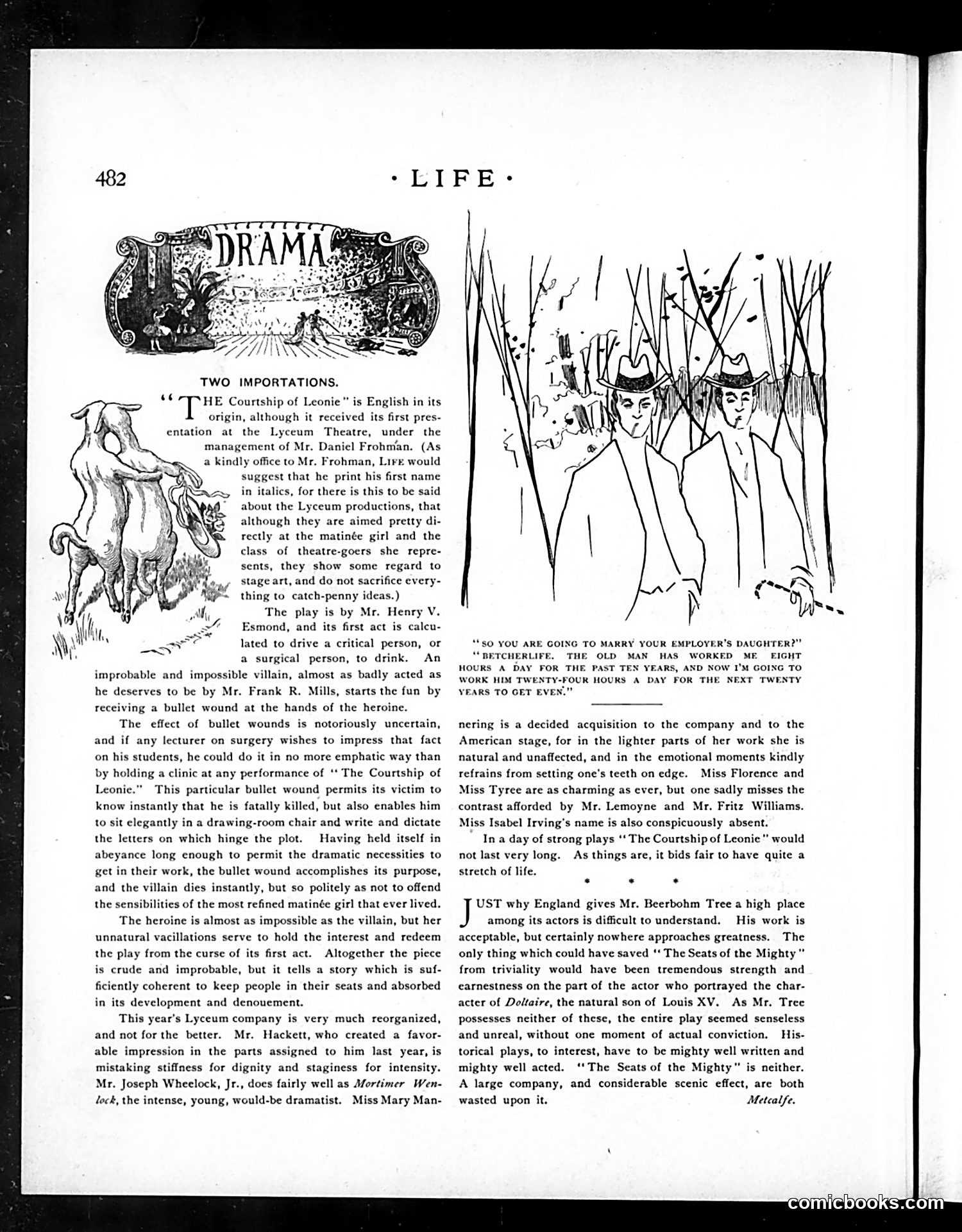
This page contains theater criticism from Life magazine (a satirical publication). The left column reviews "The Courtship of Leonie," a play at the Lyceum Theatre. The critic harshly judges it as poorly constructed—featuring an implausibly villainous character who receives a bullet wound yet somehow remains alive long enough to write letters, only then dying "politely" to avoid offending the refined matinée audience the Lyceum targets. The right illustration appears to be a scene from the play showing characters in period costume (tall hats visible), though the caption is partially illegible in the OCR. The bottom section criticizes English actor Beerbohm Tree, questioning why England ranks him highly when his work merely "acceptable" but lacks greatness. The critic argues Tree's performance in "The Seats of the Mighty" particularly suffered from his inability to convey emotional depth—a crucial flaw in historical drama requiring earnestness. The satire targets both theatrical mediocrity and audience taste preferences of the era.
📄 Transcribed text from this page (OCR, searchable)
Machine-transcribed from the original scan — historical spelling and the odd misread are preserved.
TWO IMPORTATIONS. HE Courtship of Leonie” is English in its origin, although it received its first pres- entation at the Lyceum Theatre, under the management of Mr. Daniel Frohman. (As a kindly office to Mr. Frohman, Lirr would suggest that he print his first name in italics, for there is this to be said about the Lyceum productions, that although they are aimed pretty di- rectly at the matinée girl and the class of theatre-goers she repre- sents, they show some regard to stage art, and do not sacrifice every- thing to catch-penny ideas.) The play is by Mr. Henry V. Esmond, and its first act is calcu- lated to drive a critical person, or a surgical person, to drink. An improbable and impossible villain, almost as badly acted as he deserves to be by Mr. Frank R. Mills, starts the fun by receiving a bullet wound at the hands of the heroine. The effect of bullet wounds is notoriously uncertain, and if any lecturer on surgery wishes to impress that fact on his students, he could do it in no more emphatic way than by holding a clinic at any performance of ‘* The Courtship of This particular bullet wound permits its victim to know instantly that he is fatally killed, but also enables him to sit elegantly in a drawing-room chair and write and dictate Having held itself in abeyance long enough to permit the dramatic necessities to get in their work, the bullet wound accomplishes its purpose, and the villain dies instantly, but so politely as not to offend the sensibilities of the most refined matinée girl that ever lived. The heroine is almost as impossible as the villain, but her unnatural vacillations serve to hold the interest and redeem Altogether the piece is crude and improbable, but it tells a story which is suf- ficiently coherent to keep people in their seats and absorbed in its development and denouement. This year’s Lyceum company is very much reorganized, and not for the better. Mr. Hackett, who created a favor- able impression in the parts assigned to him last year, is mistaking stiffness for dignity and staginess for intensity. Leonic.” the letters on which hinge the plot. the play from the curse of its first act. Mr. Joseph Wheelock, Jr., does fairly well as Mortimer Wen- Jock, the intense, young, would-be dramatist. Miss Mary Man- “ BETCHERLIF! HOURS A DAY OLD MAN HAS WORKED ME THE THE PAST TEN YEARS, AND NO nering is a decided acquisition to the company and to the American stage, for in the lighter parts of her work s natural and unaffected, and in the emotional moments kindly refrains from setting one’s teeth on edge. Miss Tyree are as charming as ever, but one sadly misses the contrast afforded by Mr. Lemoyne and Mr. Fritz Williams. Miss Isabel Irving’s name is also conspicuously absent. In a day of strong plays ‘ The Courtship of Leonie” would not last very long. As things are, it bids fair to have quite a stretch of life. Miss Florence and . . . His work is UST why England gives Mr. Beerbohm Tree a high place J among its actors is difficult to understand. acceptable, but certainly nowhere approaches greatness. only thing which could have saved ‘* The Seats of the Mighty” from triviality would have been tremendous strength and earnestness on the part of the actor who portrayed the char- The acter of Doltaire, the natural son of Louis XV. As Mr. Tree possesses neither of these, the entire play seemed senseless and unreal, without one moment of actual convicti His- torical plays, to interest, have to be mighty well w: mighty well acted. ‘The Seats of the Mighty” is neither. A large company, and considerable scenic effect, are both wasted upon it. Metcalfe.