
A complete issue · 26 pages · 1896
Life — December 3, 1896
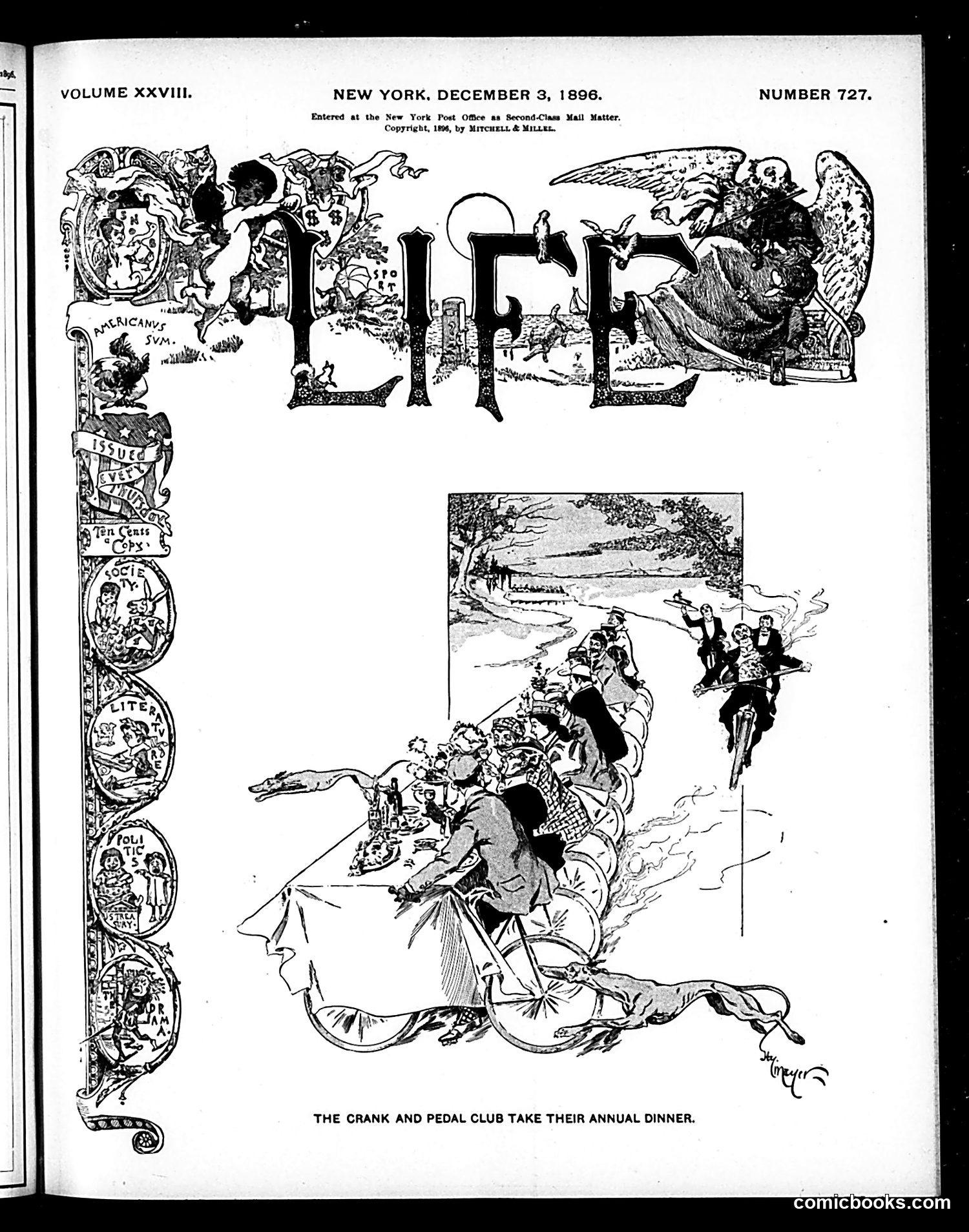
The main cartoon depicts "The Crank and Pedal Club Take Their Annual Dinner." It satirizes bicycle enthusiasts of the 1890s—an era when cycling was a major social craze and symbol of modern leisure. The image shows cyclists riding in a procession that forms a grotesque profile of a face, with riders arranged so their bicycles and bodies create the outline. This visual pun mocks bicycle club culture as absurd and self-absorbed. The ornate left border contains decorative medallions typical of Life's period style. The cartoon reflects contemporary humor about the bicycle fad: cycling clubs were genuinely popular, fashionable social organizations, and this satire gently ridicules their pretentiousness and enthusiastic devotion to the sport. The "crank" reference puns on both bicycle mechanics and eccentric personalities.
This page consists entirely of **advertisements**, not editorial cartoons or satirical content. It contains five commercial ads: 1. **Stern Bros** - clothing retailer advertising women's coats and wraps on West 23rd Street 2. **The Wallace Company** - silversmith offering sterling silverware at reduced prices on Fifth Avenue 3. **Arnold Constable & Co** - silk merchant advertising fabrics for wedding gowns and bridesmaids' dresses on Broadway 4. **Mr. C.D. Gibson's "Pictures of People"** - a book advertisement priced at five dollars 5. **"Fables for the Times"** - a collection of modern fables with illustrations, priced at $1.25 The page reflects early 20th-century consumer culture, featuring luxury goods marketed to affluent New York clientele. There is no satirical content to analyze.
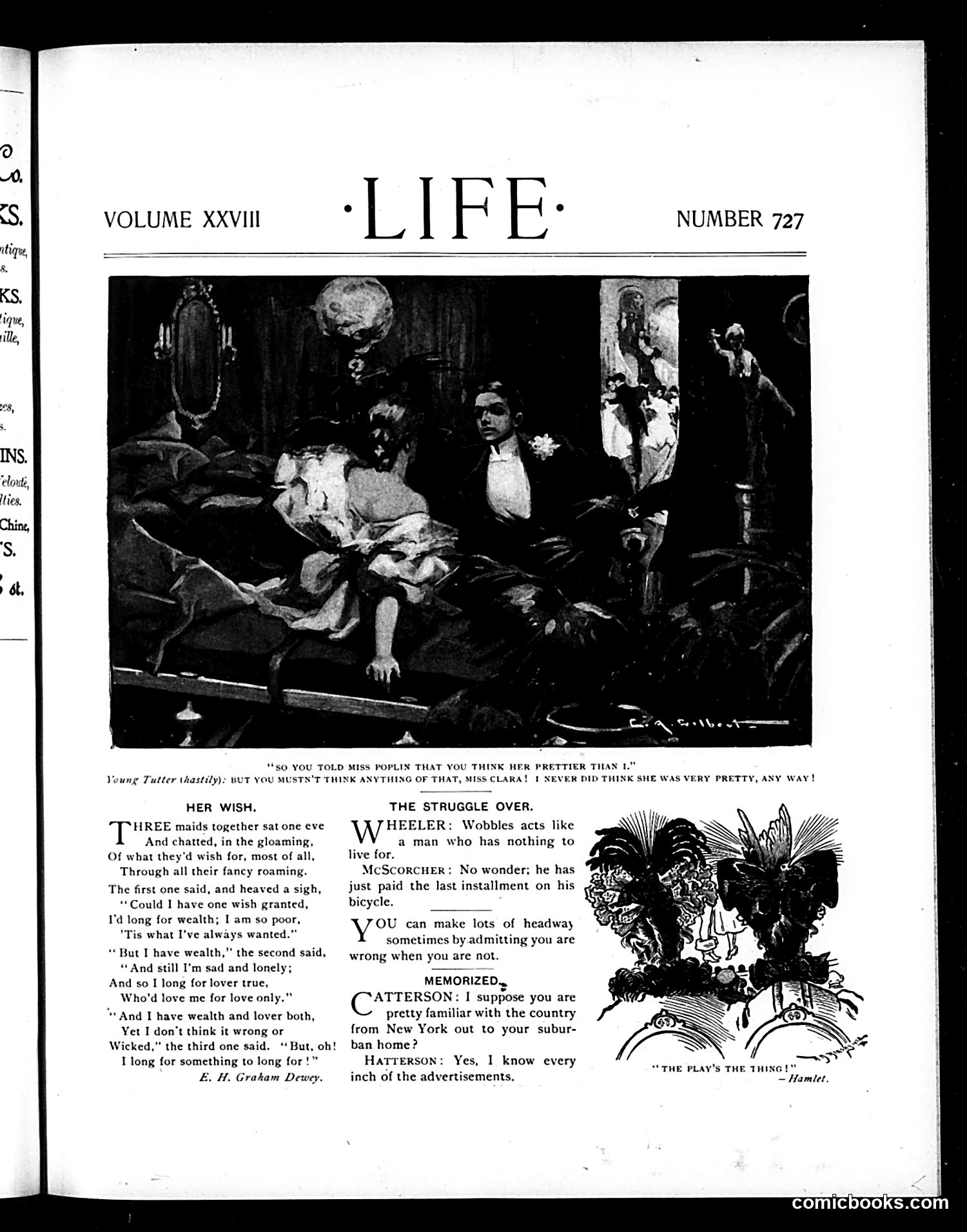
This page contains three distinct humor pieces from *Life* magazine (Volume XXVIII, No. 727). **Top image**: A theatrical scene caption references "Miss Poplin" and "Miss Clara," suggesting a stage production. The joke involves romantic rivalry or comparison of actresses' attractiveness. **"Her Wish"** (left): A poem by E. H. Graham Dewey depicts three maids discussing their desires—wealth, love, or both. The humor lies in their conflicting priorities and the third maid's existential longing for "something to long for." **"The Struggle Over"** (right): A brief satirical exchange between Wheeler, McScorcher, and Hattterson about a man named Wobbles who's financially struggling and can't afford his bicycle payments. The joke mocks working-class financial desperation. **Right illustration**: A decorative sketch labeled "The Play's the Thing" (Hamlet reference) shows theatrical masks, unrelated to surrounding text.
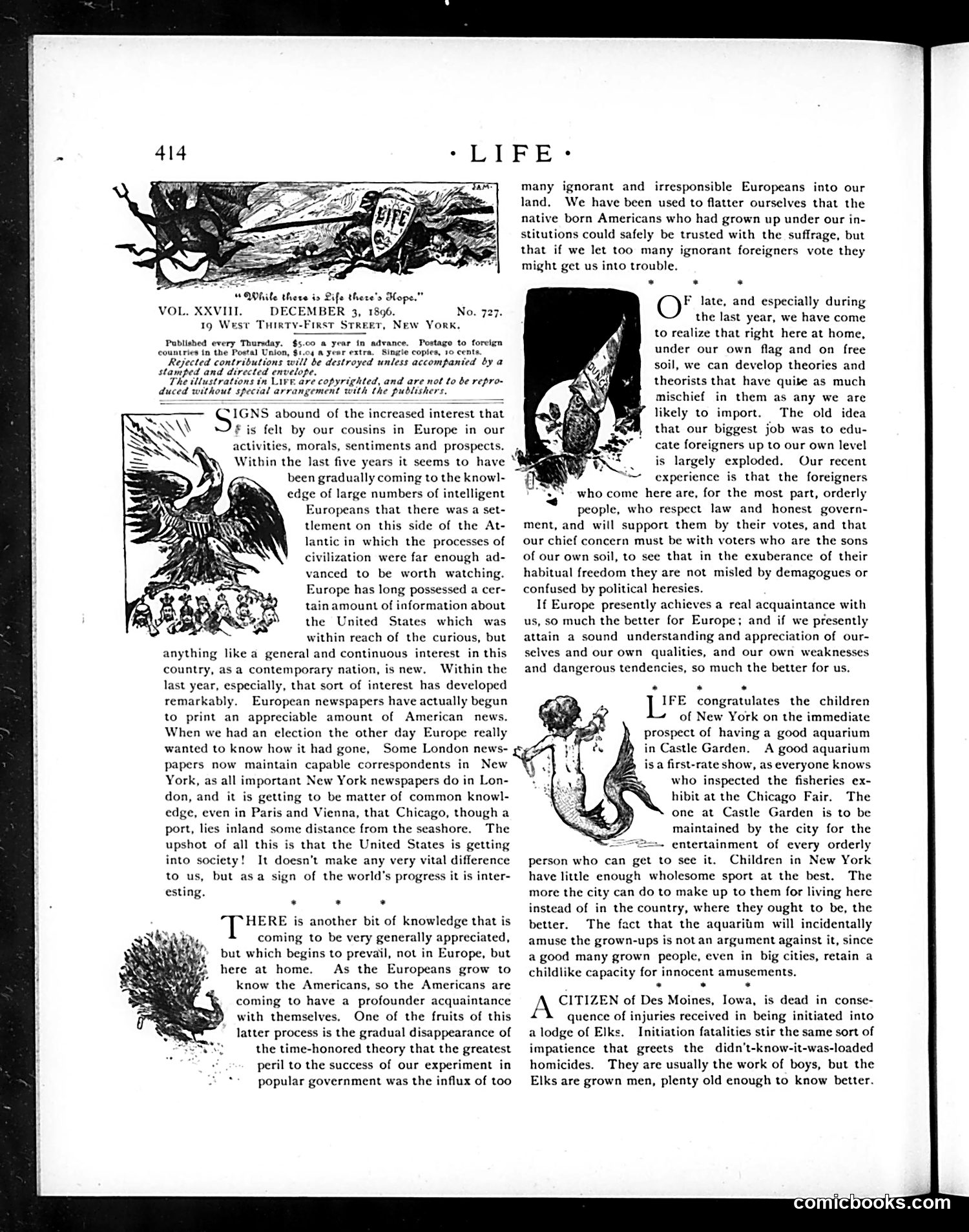
The page contains three editorial cartoons addressing European immigration and American politics. **Top cartoon:** Shows a tangled, chaotic figure labeled "While there is Life there's Hope," likely satirizing concerns about European immigrants and their influence on American society. **Middle cartoon:** Features an eagle, possibly representing American strength or national identity, contrasting with discussion of European misconceptions about the United States. **Bottom cartoon:** Appears to show another figure, though details are unclear in reproduction. The accompanying text criticizes European ignorance about America and warns against allowing too many "ignorant foreigners" to vote. The author argues Americans must educate Europeans about American values rather than importing foreign political ideas. The piece reflects 1890s anxieties about immigration, voting rights, and foreign influence on American democracy—concerns that dominated political discourse during this period.
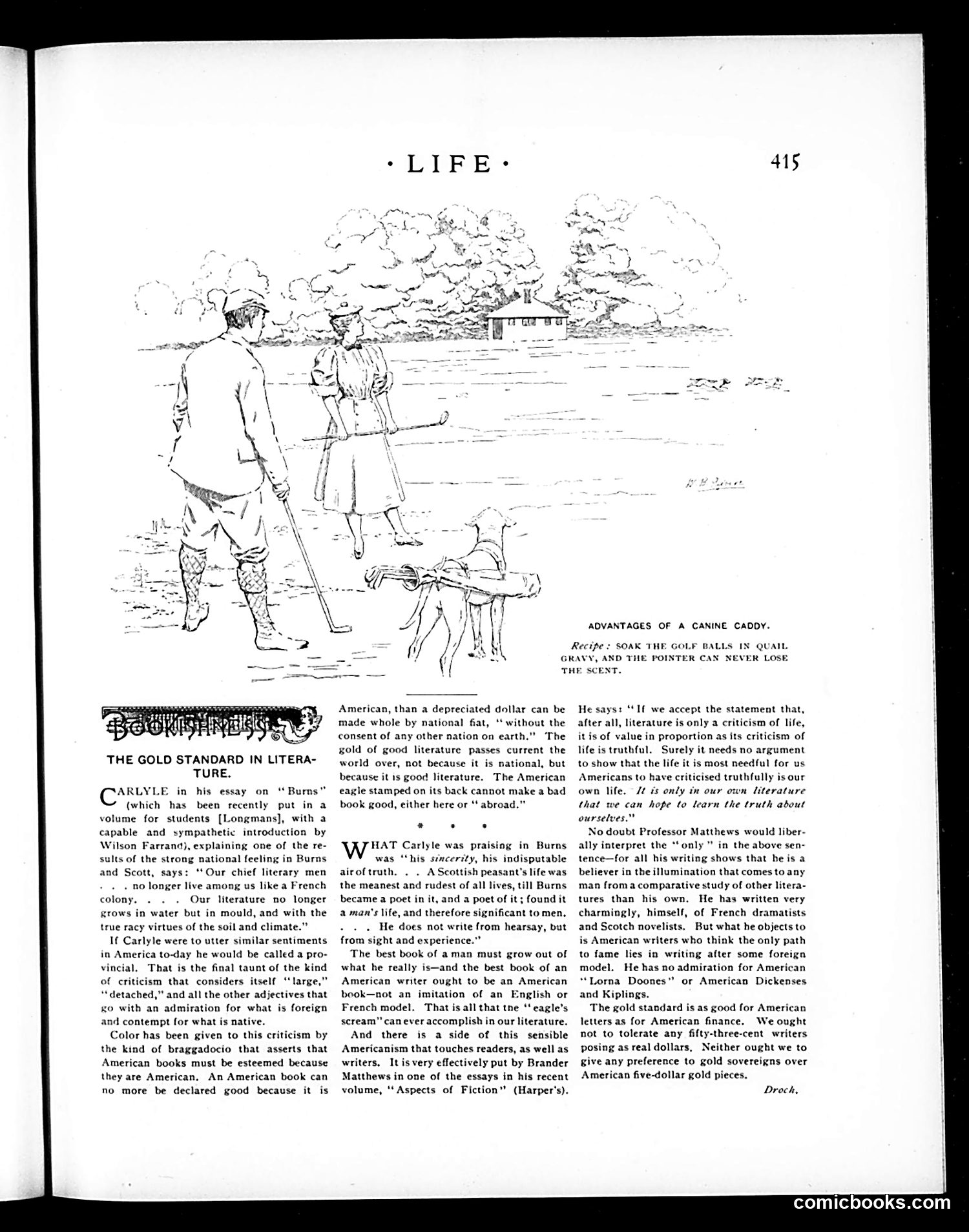
The page contains two distinct sections: **Left side**: A sketch titled "THE GOLD STANDARD IN LITERATURE" showing what appears to be a golf scene with figures and a dog, accompanying an essay by Carlyle praising American literature. **Right side**: An illustration captioned "ADVANTAGES OF A CANINE CADDY" (a humorous recipe about using quail gravy to keep pointer dogs interested in retrieving golf balls), followed by editorial commentary defending American literature against foreign criticism. The satire critiques American literary provincialism—the tendency to dismiss foreign influences while insisting American work stands alone. The author argues American literature deserves respect as American literature, not as imitation of English or French models. The golf/dog imagery appears decorative rather than satirical.
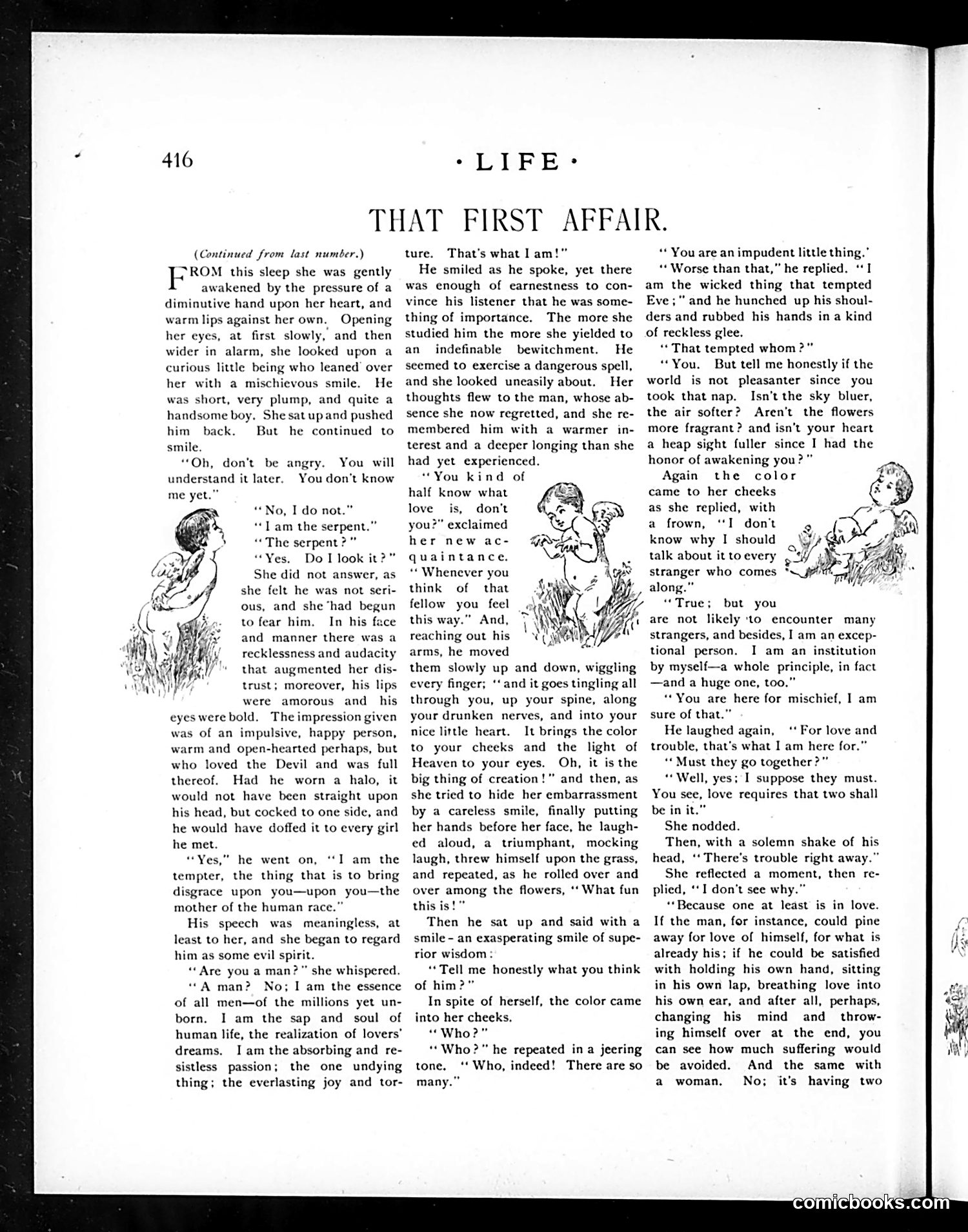
This appears to be a literary excerpt or serialized story rather than political satire. The page presents a romantic narrative dialogue between two characters—a man seducing a young woman by flattering her and appealing to her emotions. The small illustrations show cherubic figures (cupids) scattered throughout, typical decorative elements for romance-themed content in early 20th-century magazines. The text is social commentary on seduction and courtship, with the male character explicitly positioning himself as a "tempter" who brings "disgrace upon you—upon you—the mother of the human race," while the woman alternates between resistance and yielding to romantic temptation. This reflects period attitudes about gender dynamics and morality rather than political satire.
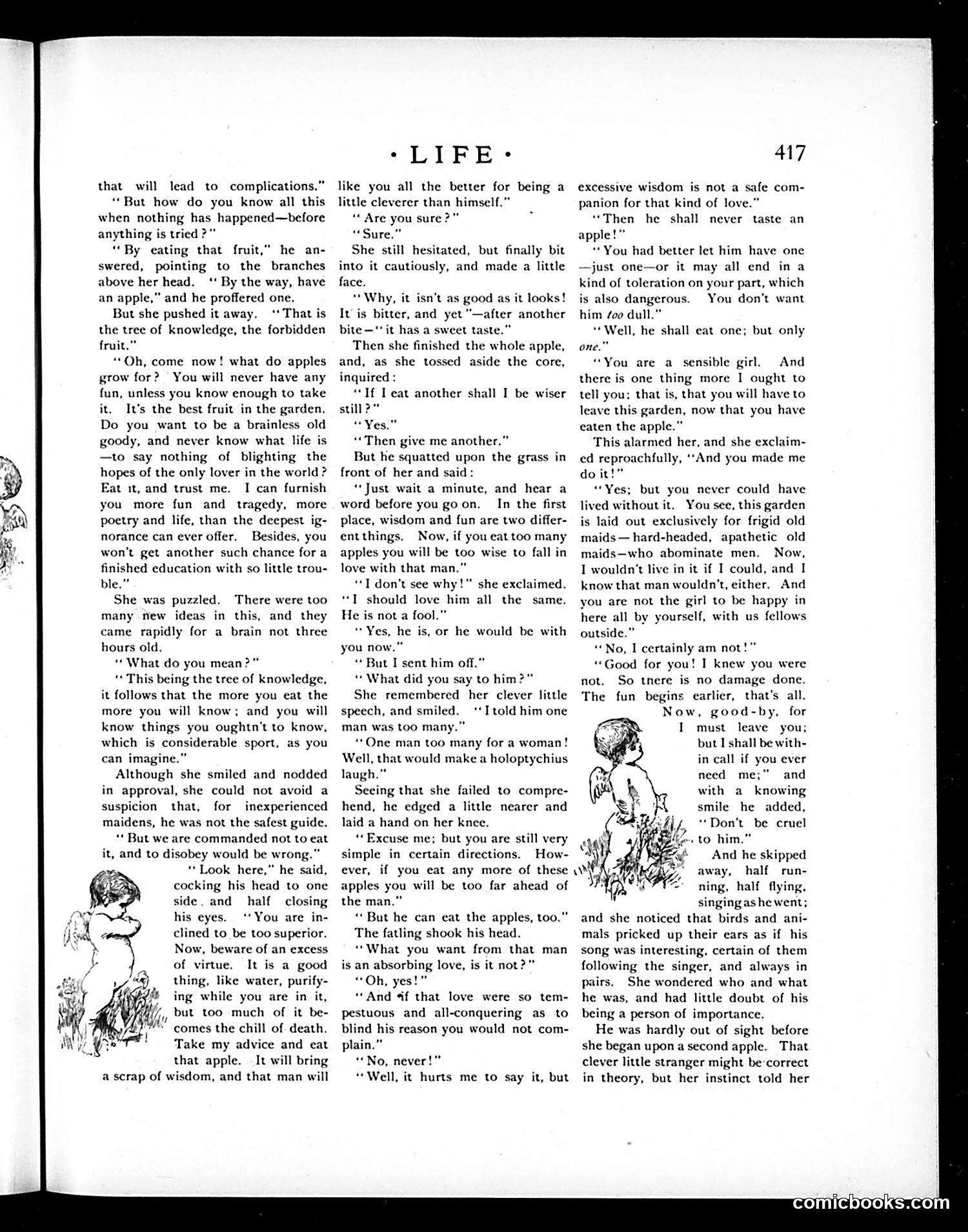
This page presents a narrative dialogue between a man and woman in a garden setting, illustrated with small decorative drawings of figures. The text depicts a moral debate about temptation and knowledge, using the biblical Adam and Eve story as its framework. The dialogue concerns whether the woman should eat apples (symbolic of the forbidden fruit) and accept the man's romantic advances. The satire critiques Victorian-era courtship conventions and gender dynamics—particularly the tension between female innocence and male persuasion. The illustrations show the couple in the garden, reinforcing the Eden allegory. The piece appears to mock both the woman's naive resistance to temptation and the man's sophisticated arguments for her to abandon caution, suggesting contemporary anxieties about changing social relationships and female autonomy in the early 20th century.
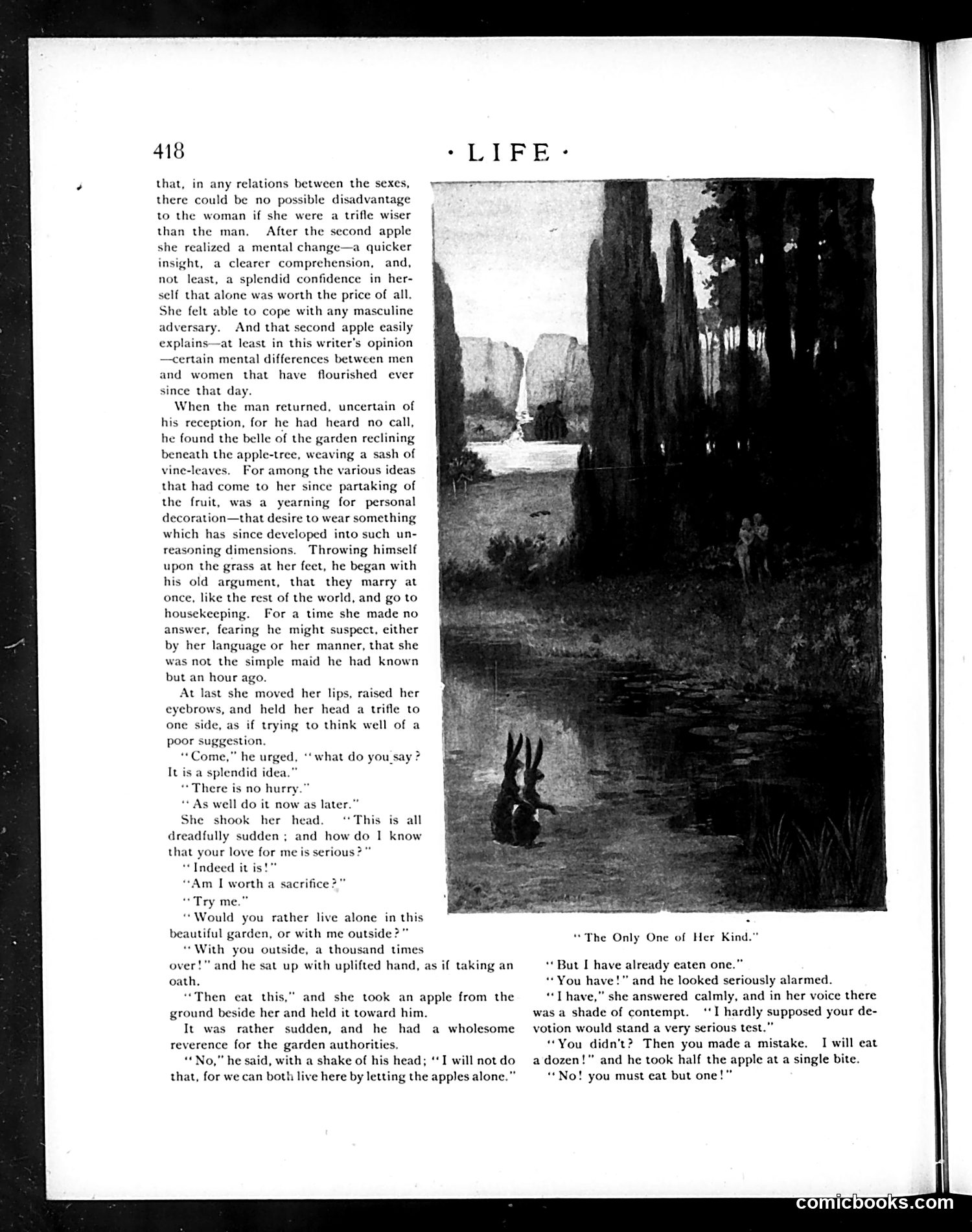
This page from *Life* magazine presents a satirical retelling of the Adam and Eve story. The narrative text (left) and accompanying illustration (right) depict a modern, ironic take on humanity's fall from paradise. The satire mocks both gender relations and human nature. The text suggests that Eve's eating the apple gave her superior mental clarity and confidence—a sardonic commentary on women's intellectual capabilities that inverts the traditional misogynistic interpretation of the Fall. The man's return and subsequent argument over eating the apple plays on domestic conflict and masculine stubbornness. The illustration shows the Garden of Eden with classical figures beside a body of water, emphasizing the idealized setting being abandoned for ordinary "housekeeping." The overall satire critiques how quickly humans abandon paradise and how petty disputes destroy relationships.
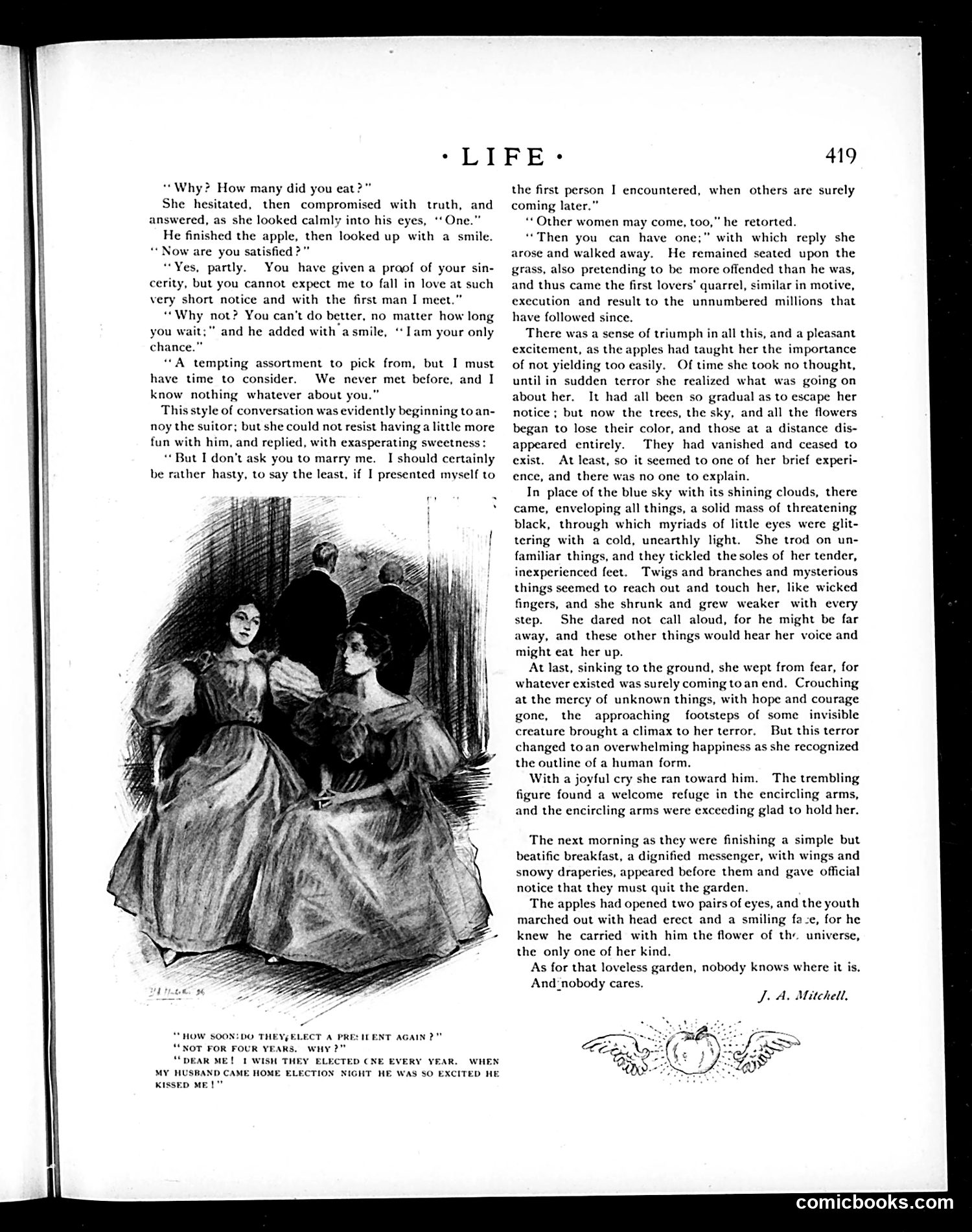
This page presents a serialized short story by J.A. Mitchell titled "Life," featuring narrative text and an illustration of two women in period dress (appearing to be late 19th/early 20th century). The story concerns a romantic encounter—a man urges a woman to marry him, she demurs, and they separate. The narrative then describes the woman's terrifying experience in darkness (likely a garden at night), where she encounters a mysterious male figure who offers comfort and embrace. The illustration shows two elegantly-dressed women in conversation, though the specific dramatic moment depicted relates to the story's romantic tension rather than any political satire. The decorative apple with wings at the page's foot suggests themes of temptation or forbidden fruit, reinforcing the story's romantic/moral dimensions. This appears to be purely literary entertainment rather than political commentary or satire.
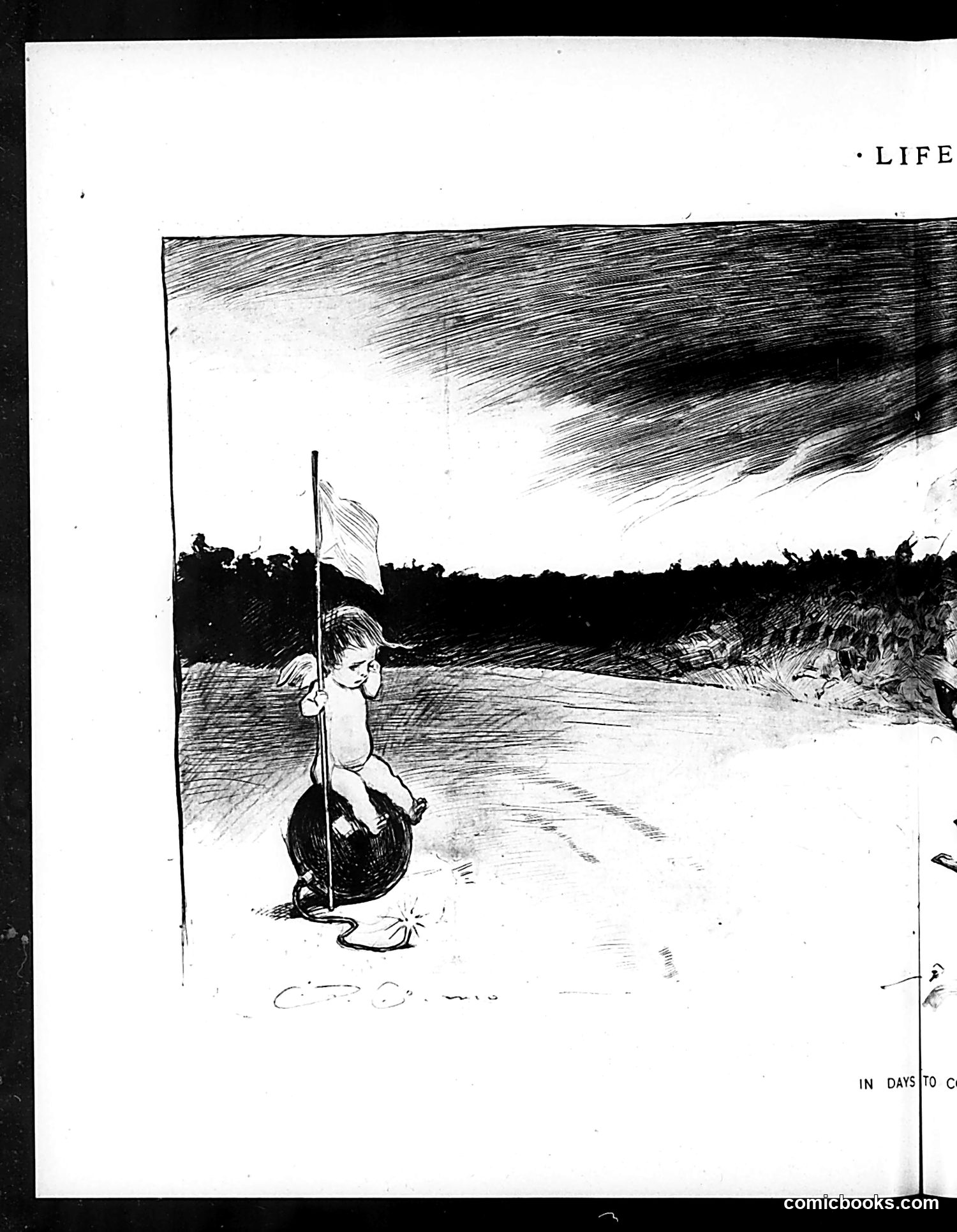
This appears to be a satirical illustration from *Life* magazine showing a figure sitting on what looks like a large bomb or spherical object, holding a flagpole with a flag. The figure is depicted in a beach or shoreline setting with water and trees in the background. The cartoon likely satirizes political tension or military buildup of its era—the bomb imagery suggests weapons/war concerns. The figure's vulnerable position sitting atop the bomb while casually planting a flag suggests ironic commentary on nationalism, territorial claims, or reckless political posturing during a period of international conflict or Cold War anxiety. Without visible text identifying specific figures or dating information, I cannot definitively identify the target of the satire or the exact historical moment referenced.
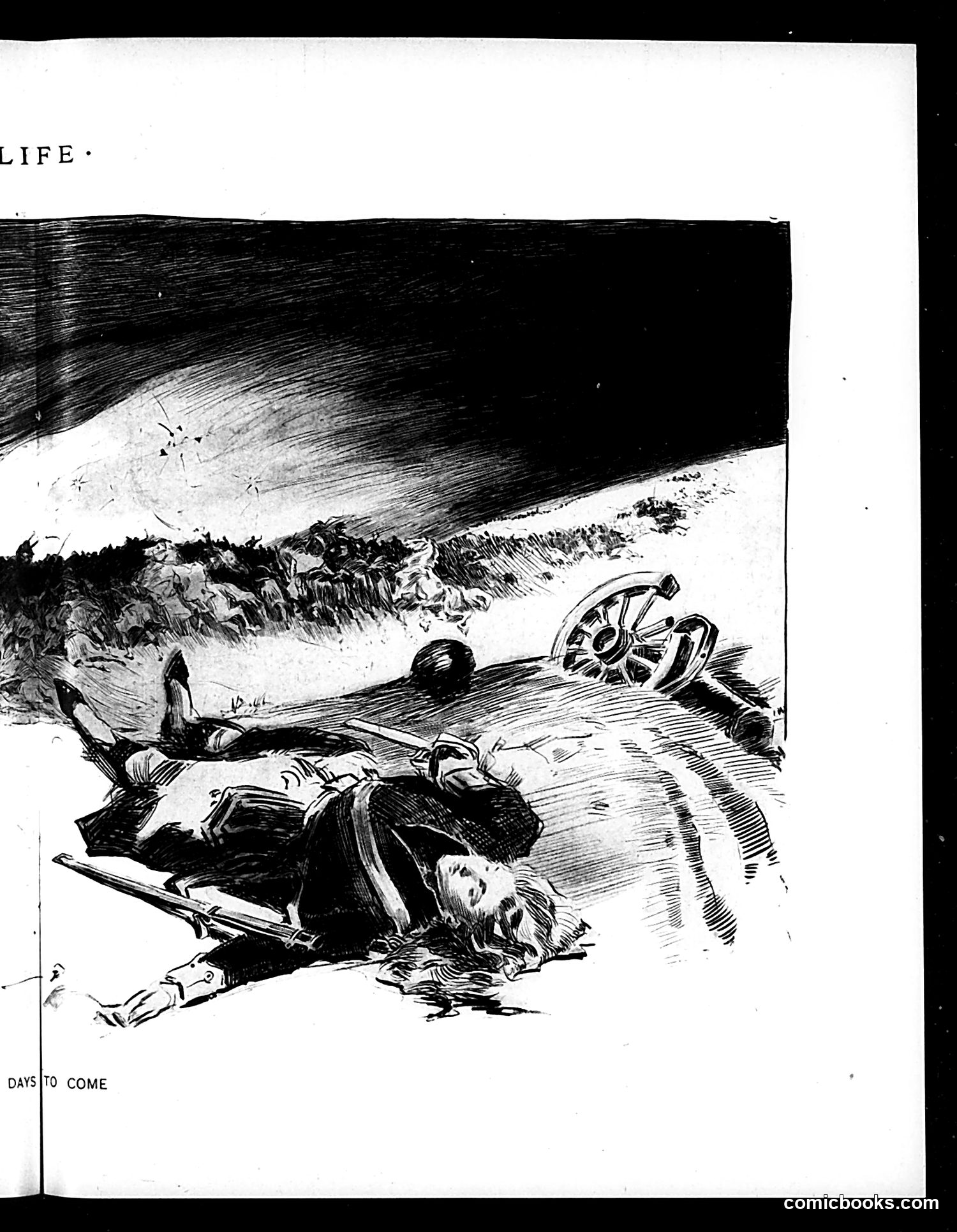
This is a political cartoon titled "Days to Come" from *Life* magazine. The image depicts a fallen soldier lying on a beach or sandy ground near water, with a discarded wagon wheel visible nearby. The dark, ominous sky dominates the upper portion of the composition. The cartoon appears to be an anti-war commentary, likely from the World War I or interwar era given the artistic style. The fallen soldier represents the human cost of conflict. The isolated, desolate landscape and abandoned military equipment suggest devastation and loss. The title "Days to Come" implies a grim warning about future warfare or its ongoing consequences. Without additional context or visible publication date, the specific conflict referenced remains unclear, but the overall message critiques warfare's destructive impact on human life.
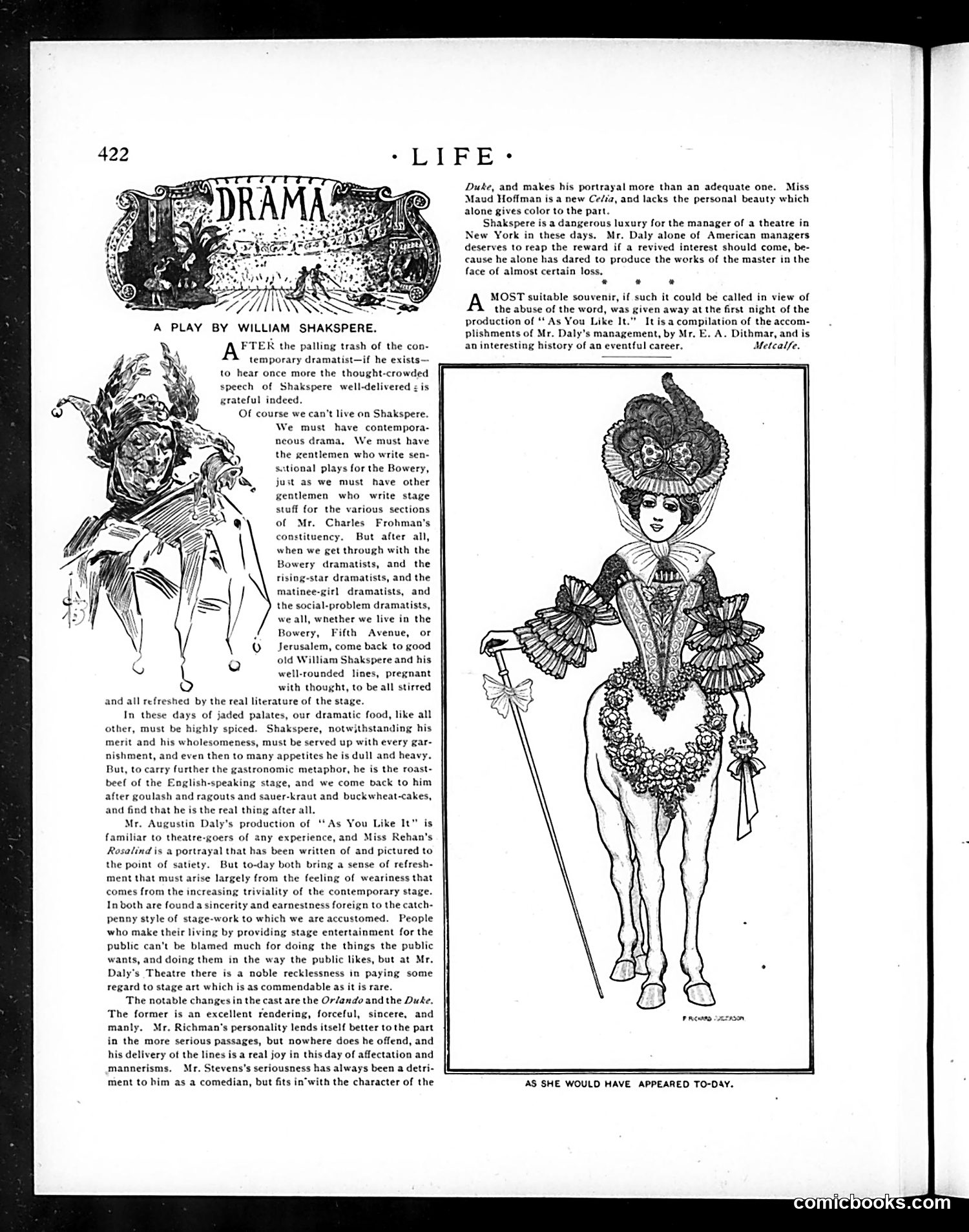
This page reviews Augustin Daly's production of Shakespeare's "As You Like It," starring actress Ada Rehan as Rosalind. The illustration depicts how Rosalind would appear in contemporary (early 1900s) theatrical costume. The article's satire targets contemporary American drama as shallow "trash" compared to Shakespeare—comparing the Bard to "roast-beef" while modern plays are "goulash" and "buckwheat-cakes." The critic praises Daly's rare commitment to staging Shakespeare seriously despite financial risk, while noting that other American theater managers avoid the playwright because he's commercially dangerous. The illustration humorously contrasts historical accuracy with modern theatrical excess, showing an elaborately costumed figure with exaggerated Edwardian fashions and oversized plumage—suggesting contemporary stagecraft prioritizes spectacle over substance, unlike Shakespeare's text-centered approach.
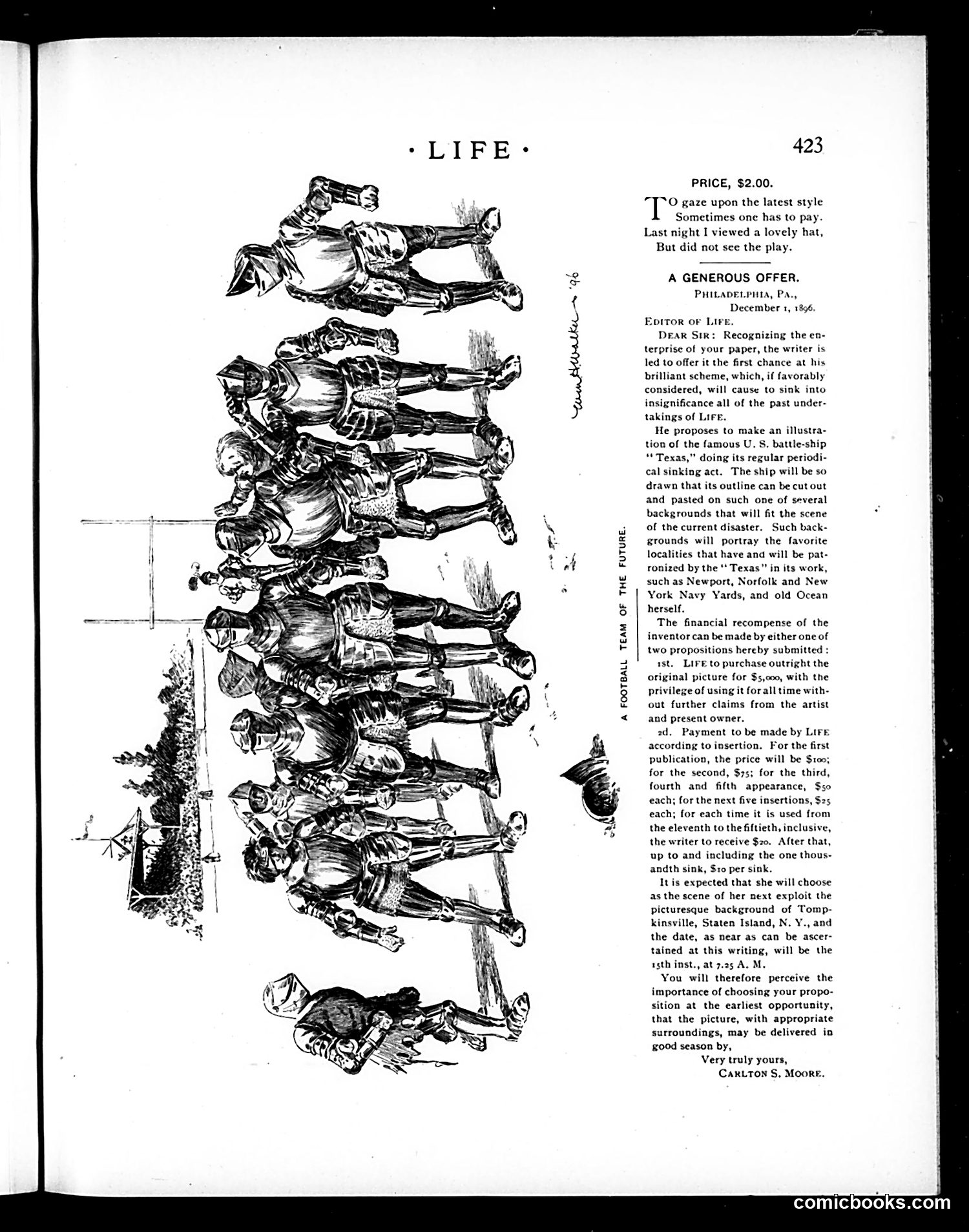
This is a satirical letter to *Life* magazine's editor, dated December 1, 1896, mocking the USS Texas, a U.S. battleship apparently notorious for sinking or nearly sinking repeatedly. The writer, Carlton S. Moore, offers to create a reusable illustration of the Texas sinking, with interchangeable backgrounds (Newport, Norfolk, New York Navy Yards, the ocean) so *Life* can publish it multiple times as the ship inevitably sinks again. The joke lies in the pricing scheme: charging $100 for first use, declining with each subsequent sinking, down to $10 per sink after the 50th disaster—implying the Texas will sink so frequently that the image becomes worthless through overuse. The cartoon above shows figures stacked vertically, likely representing repeated identical occurrences or the absurd notion of the same disaster happening endlessly. This satirizes the ship's apparent chronic instability and mocks both the vessel's poor engineering and the public's morbid fascination with maritime disasters, a popular spectacle in 1890s America.
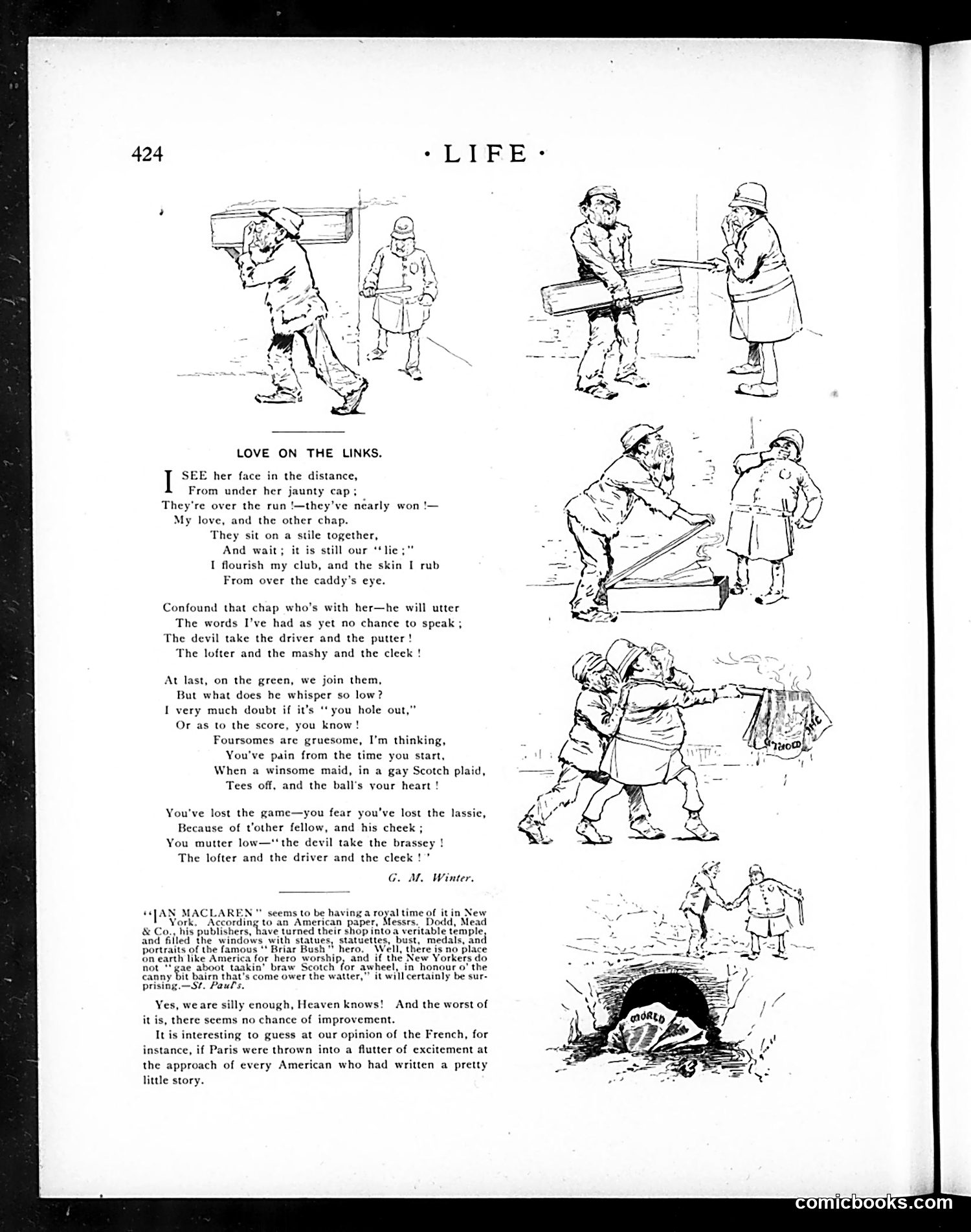
This page satirizes romantic jealousy on the golf course. The poem and accompanying sketches humorously depict a golfer's frustration watching his love interest (a "winsome maid, in a gay Scotch plaid") playing golf with a rival male competitor. The narrator obsesses over their whispered conversations and fears losing both the game and "the lassie" to his better-playing competitor. The satire mocks how golf—a genteel sport—becomes a backdrop for romantic anxiety, with the protagonist cursing various golf clubs in frustration. Below, the editor comments on the American reception of Scottish author "Ian Maclaren" (likely a pseudonym), mocking American "hero worship" of foreign writers. The French comparison suggests skepticism that Paris would fawn similarly over American authors, implying Americans are exceptionally gullible to foreign celebrity.
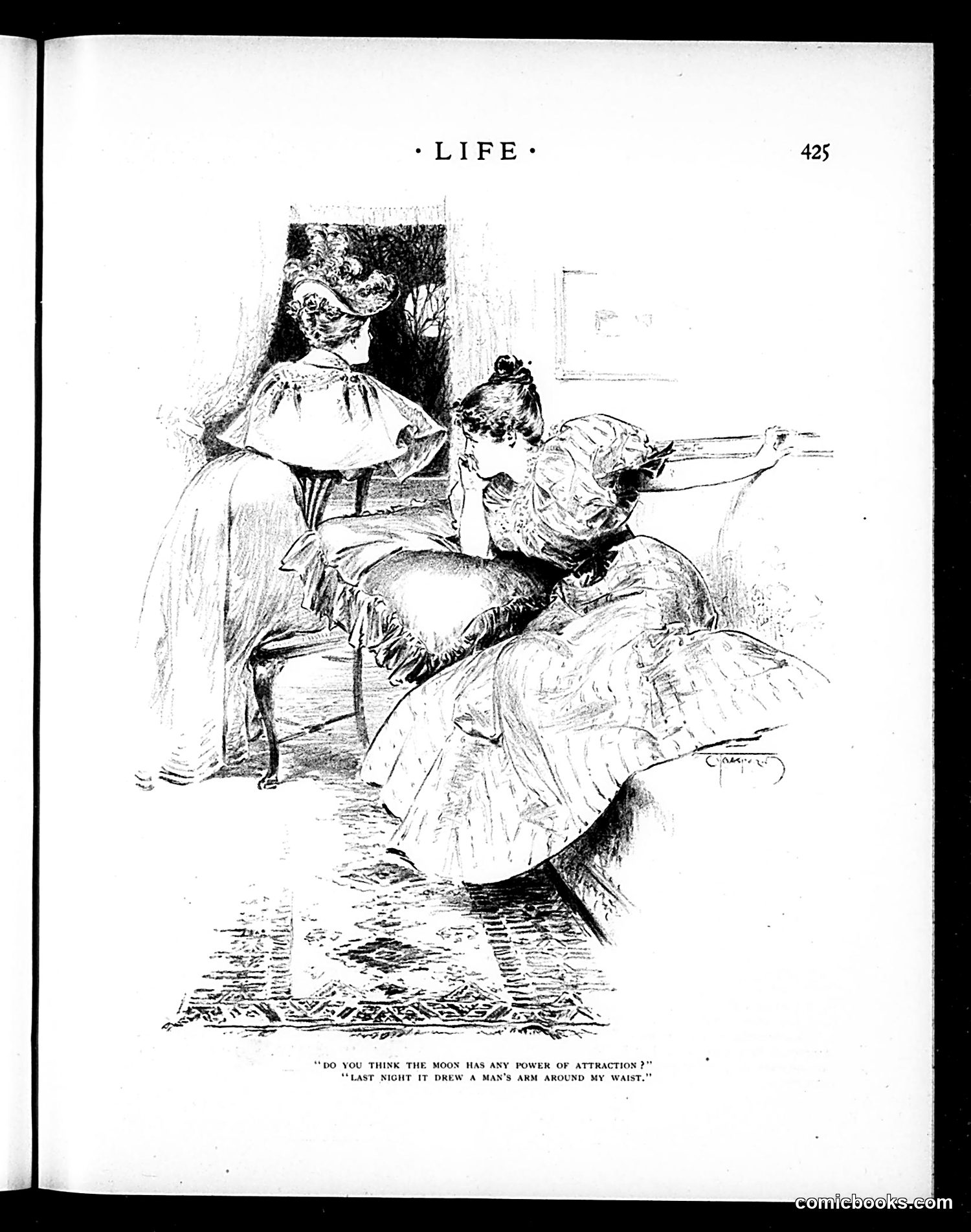
This is a flirtatious cartoon from *Life* magazine featuring two women in conversation. The dialogue is a playful double entendre about the moon's romantic "power of attraction." The first woman asks a philosophical question about lunar influence. The second woman responds with a cheeky implication: the moonlight last night prompted a man to put his arm around her waist—suggesting the moon's romantic atmosphere facilitated physical intimacy. The humor relies on: 1. **Victorian-era courtship codes**: Arm-around-waist contact was a significant gesture requiring romantic interest or boldness 2. **The pun**: "Attraction" shifts from astronomical/scientific to romantic/physical meaning 3. **Coy flirtation**: The woman frames the man's advance as moonlight's doing rather than her own encouragement This reflects early-20th-century satirical commentary on romance, dating conventions, and the excuse-making that accompanied physical affection between unmarried people.
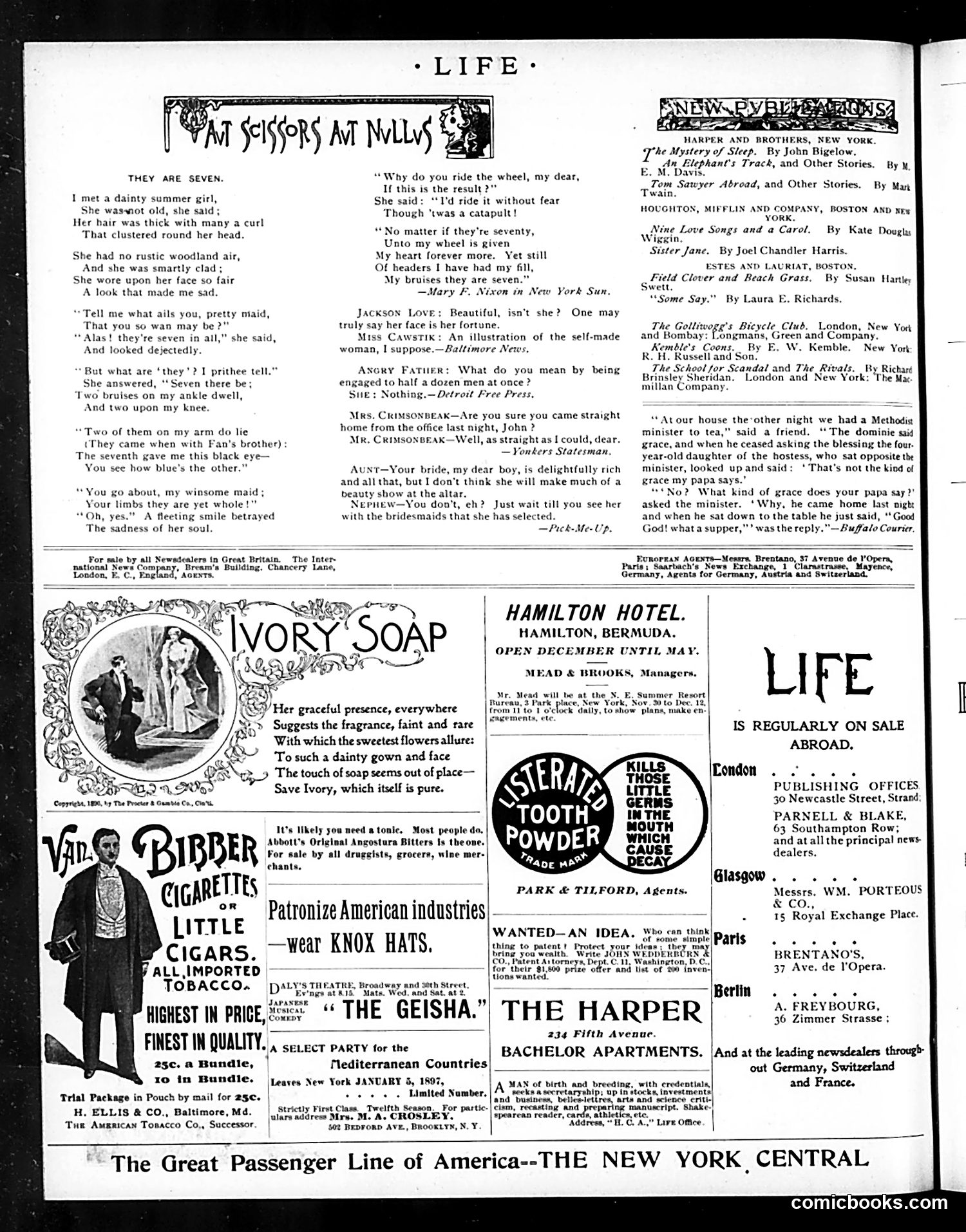
This poem satirizes the dangers—and the absurdity of ignoring them—posed by the bicycle craze of the 1890s. A young woman catalogues seven injuries sustained from bicycle riding: bruises on ankles, knees, arms, and a black eye. Yet she dismisses concerns, declaring she'd ride "without fear / Though 'twas a catapult!" The satire targets the contradictory attitudes toward women cyclists: society celebrated the "new woman's" independence and athleticism, yet bicycle riding was genuinely hazardous (loose skirts caught wheels, unpaved roads were treacherous). The poem mocks both the woman's reckless disregard for obvious injury and perhaps the social pressure compelling her to downplay physical danger to maintain an image of fearless modernity. The accompanying advertisements—for Knox Hats, Ivory Soap, and other consumer goods—reflect how bicycle culture was commercialized and marketed to this "modern" female consumer.
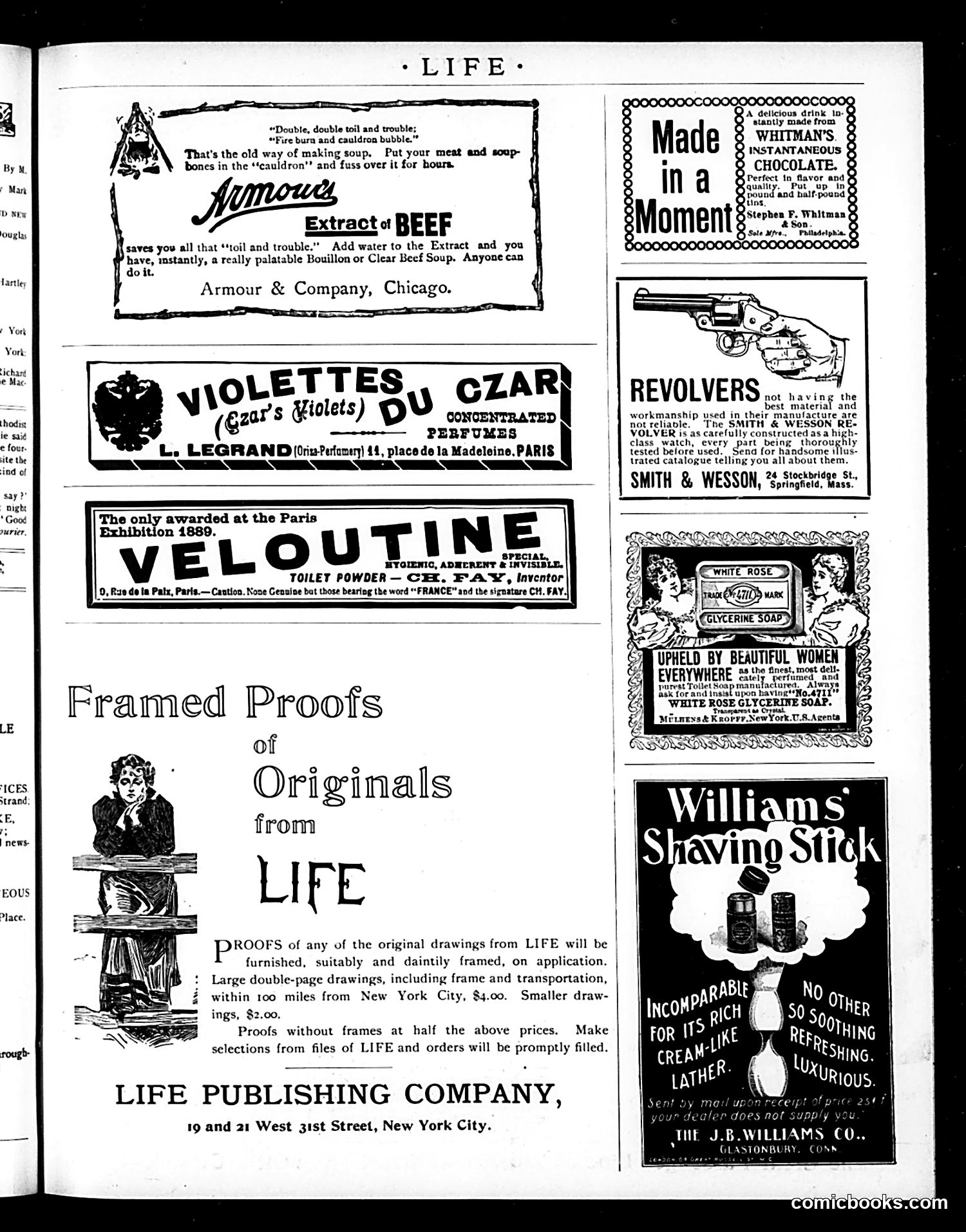
This appears to be a **product advertisement page** from Life magazine, not a page containing political cartoons or satirical commentary. The page consists entirely of commercial advertisements for consumer goods: Armour's Extract of Beef, Violettes du Czar perfume, Veloutine powder, Smith & Wesson revolvers, White Rose Glycerine Soap, and Williams' Shaving Stick. The only editorial content is a notice offering framed reproductions of original Life drawings for purchase. The single potentially satirical element is the opening verse fragment ("Double, double toil and trouble") comparing old soup-making to witchcraft—a mild, humorous advertisement device comparing traditional labor to modern convenience. No political figures or events are referenced. This page demonstrates how Life monetized its readership through premium advertising placements rather than advancing political commentary.
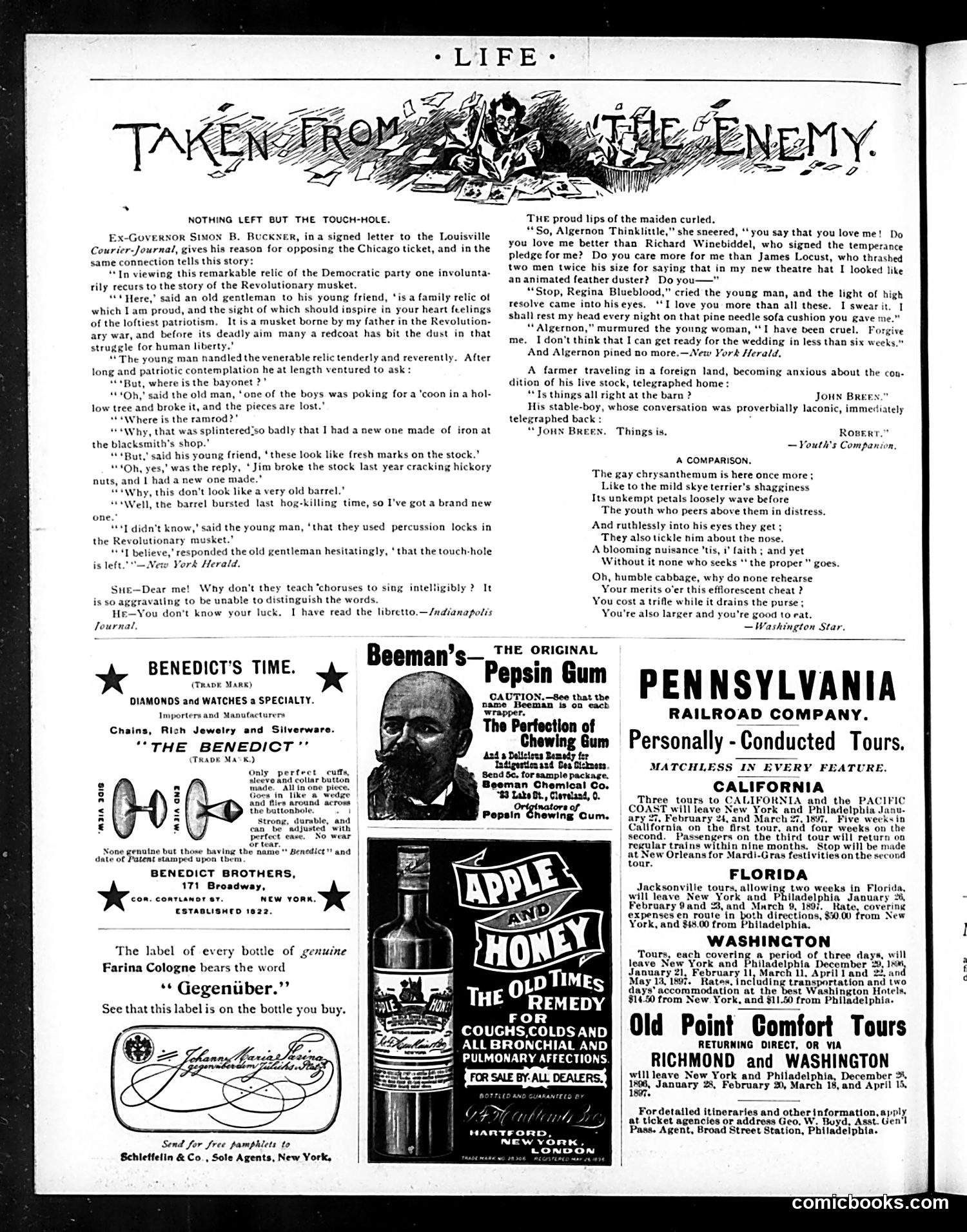
This page's main content is a story-within-a-story told by Ex-Governor Simon B. Buckner opposing the Democratic "Chicago ticket" (likely the 1896 nomination). The central metaphor compares the Democratic Party to a Revolutionary War musket that has been so thoroughly repaired—bayonet lost, ramrod replaced, stock rebuilt, barrel renewed—that nothing remains of the original except the touch-hole (the firing mechanism). The joke: the party has been so compromised and reconstructed that only a technical component survives. By invoking this story, Buckner argues the Democratic Party has lost its essential character and identity through successive alterations and compromises. The page also contains period advertisements and a satirical poem about courtship, but the political allegory is the substantive content critiquing Democratic Party degradation.
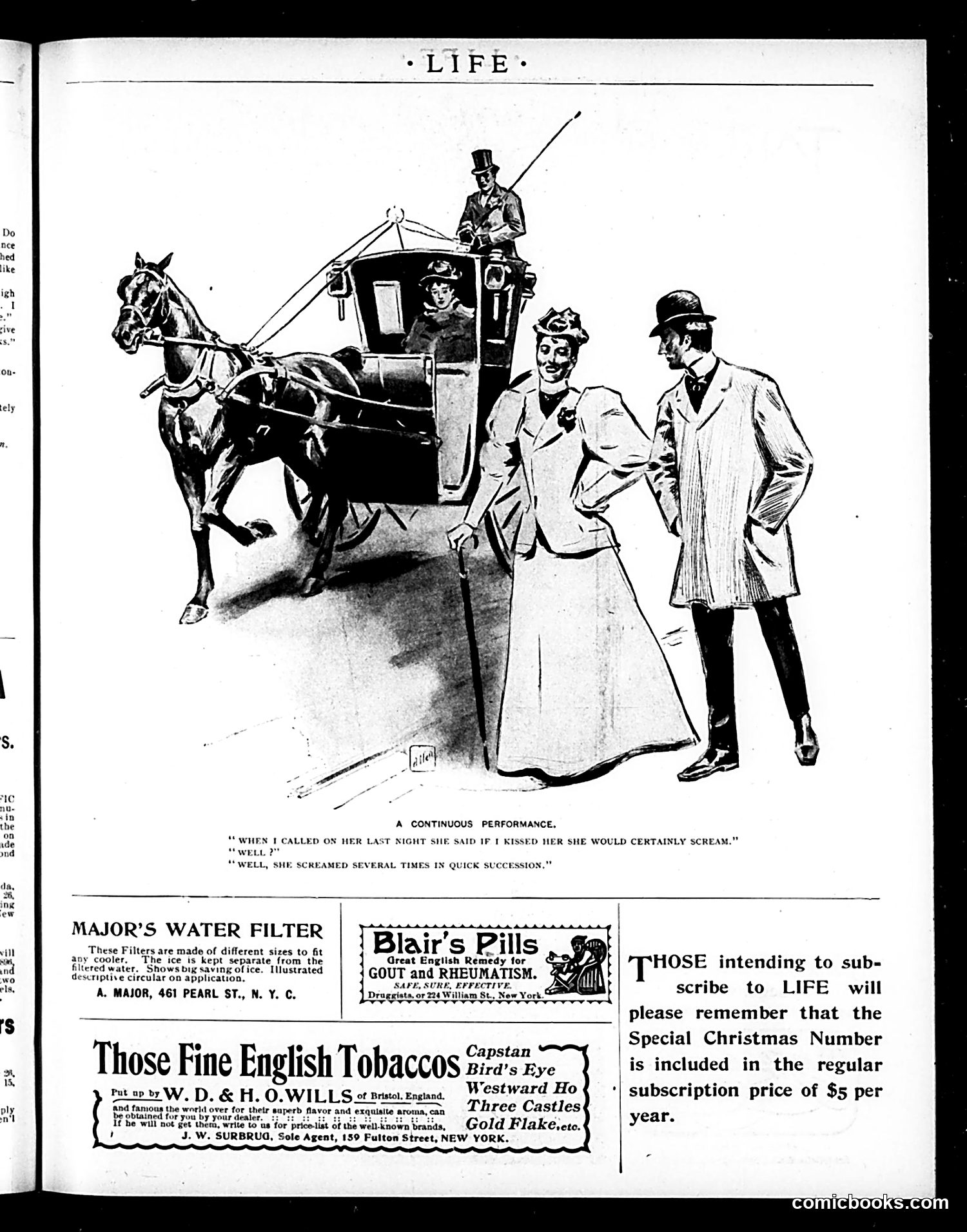
This cartoon satirizes courtship rituals and male persistence. The joke hinges on a misunderstanding: a man claims his date said she'd "certainly scream" if kissed, which he interprets as consent or encouragement. He then reports she "screamed several times in quick succession"—implying repeated kissing—presented as a comedic "continuous performance." The humor reflects early 20th-century attitudes about romantic pursuit: the woman's protests (screaming) are reframed as enthusiastic participation rather than genuine objection. The well-dressed couple and carriage setting indicate middle-class courtship. The cartoon mocks both the man's self-delusional interpretation and, implicitly, social conventions that allowed men to ignore or reinterpret women's stated resistance. Modern readers would recognize this as depicting what would now be considered sexual coercion—the page frames it as lighthearted entertainment.
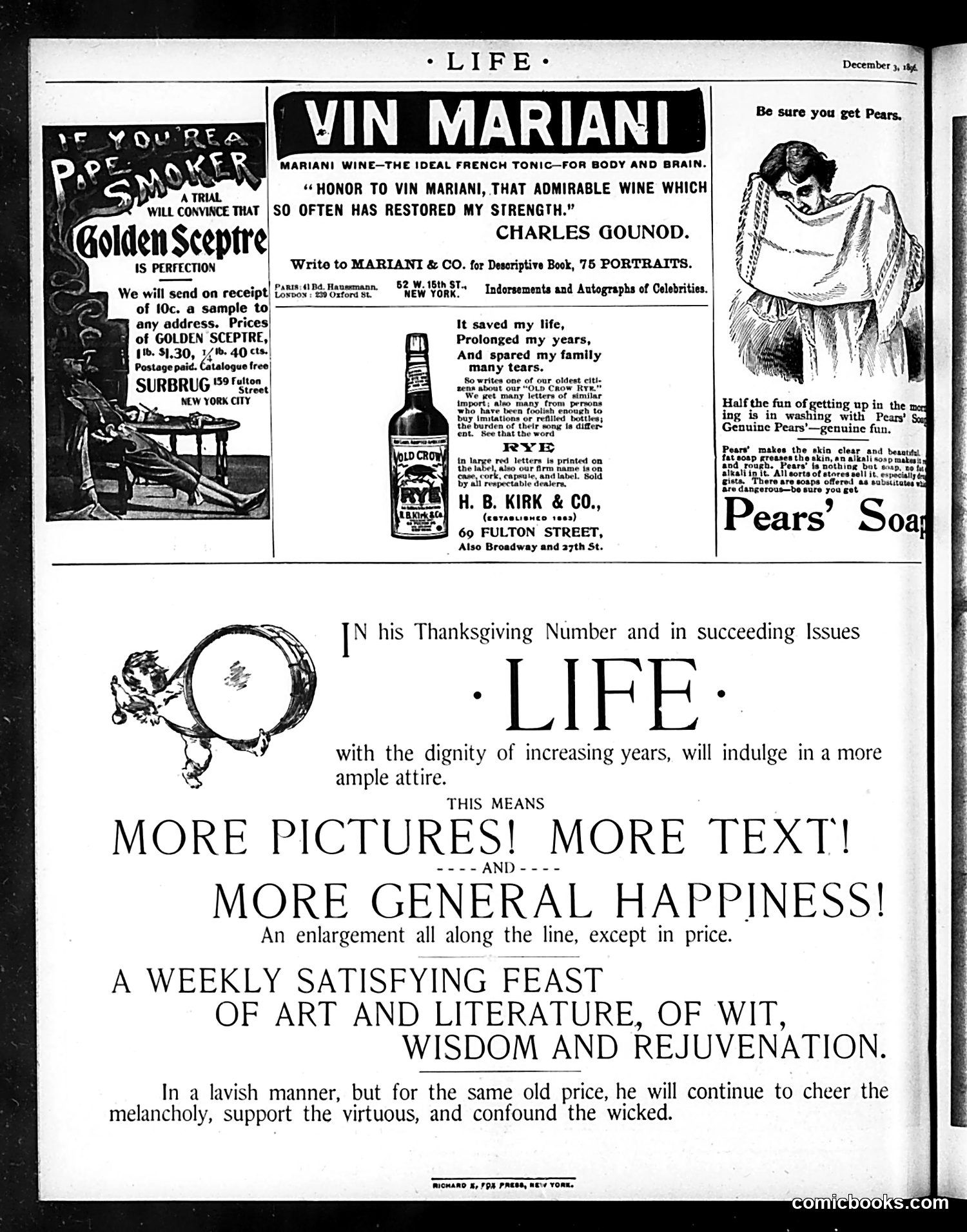
This is primarily an **advertising page** rather than political satire. It contains four product advertisements: 1. **Golden Sceptre Cigars** - a paper smoker product offering a 10-cent sample 2. **Vin Mariani** - a French wine tonic endorsed by composer Charles Gounod, marketed as a health restorative 3. **Pears' Soap** - promoting skin cleansing and beauty 4. **Life Magazine's announcement** - The lower half announces the magazine's upcoming expansion with "more pictures" and "more text" while maintaining the same price The Vin Mariani ad is notable as an example of **patent medicine marketing** common in the era, using celebrity endorsements (Gounod) and vague health claims. The Pears' Soap ad uses gentle humor about morning routines. The Life announcement promises readers increased content value—a typical magazine circulation strategy of the period.
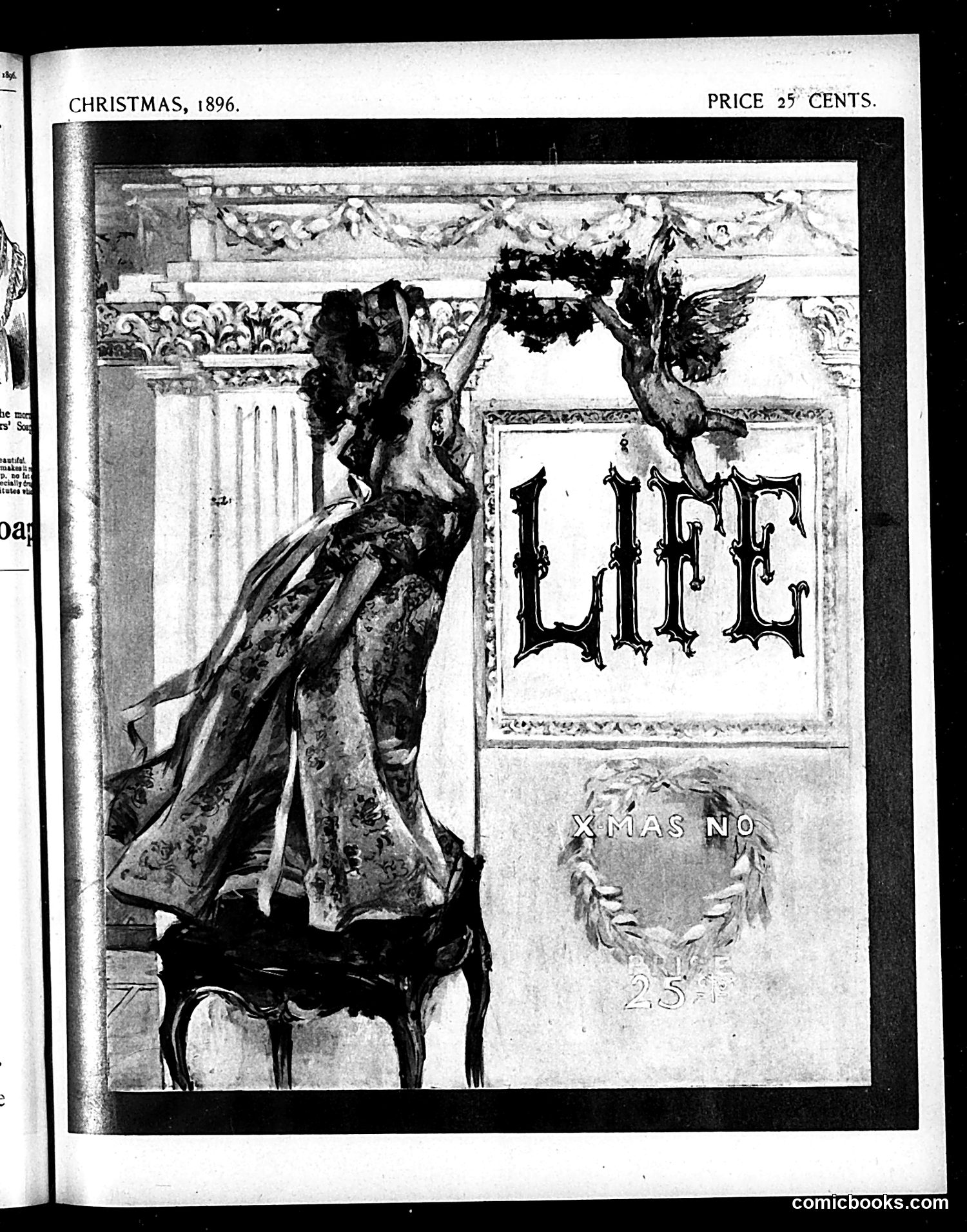
This is a *Life* magazine Christmas cover from 1896. The image shows an elegantly dressed woman in an ornate interior, holding mistletoe above her head in a flirtatious pose. She's seated and wearing an elaborate gown with decorative patterns. The cover's title "LIFE" and text "XMAS NO" indicate this is the Christmas special edition. The satire appears to play on Christmas tradition—specifically the mistletoe custom of kissing beneath it. The woman's coy, inviting posture and refined setting suggest commentary on holiday courtship rituals and romantic expectations, likely mocking either the artificial sentimentality of Christmas celebrations or contemporary gender dynamics during flirtation. Without additional OCR'd article text, the specific satirical target remains unclear, though the image likely critiques Victorian-era romance conventions or holiday commercialism.
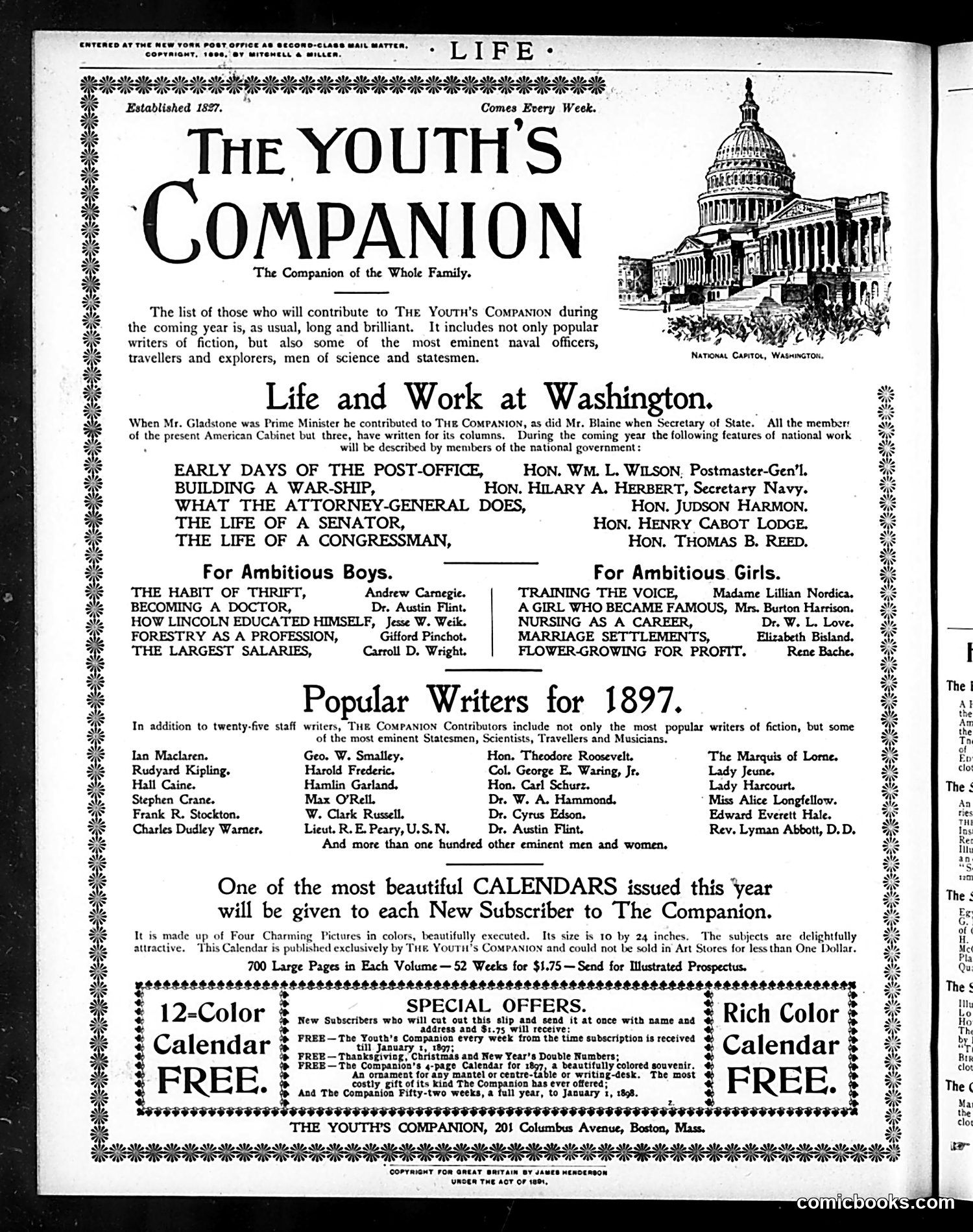
This is primarily a **title/advertisement page for *The Youth's Companion* magazine**, not a political cartoon. It announces the 1897 editorial lineup and subscription offers. The page leverages the prestige of prominent national figures to market the magazine. It lists contributors including President Theodore Roosevelt, Secretary of the Navy Hilary Herbert, and Congressional leaders like Thomas B. Reed—suggesting the magazine offers insider access to government affairs through articles like "Life and Work at Washington" and "Early Days of the Post-Office." The decorative Capitol building illustration reinforces this Washington connection and governmental authority. The page reflects late-19th-century magazine marketing: combining famous-name recognition with genre-specific content ("For Ambitious Boys/Girls") and aggressive promotional offers (free calendars, 52 weeks for $1.75). There is no satire or political commentary visible—this is straightforward advertising designed to appeal to middle-class families seeking educational and literary content for their children.
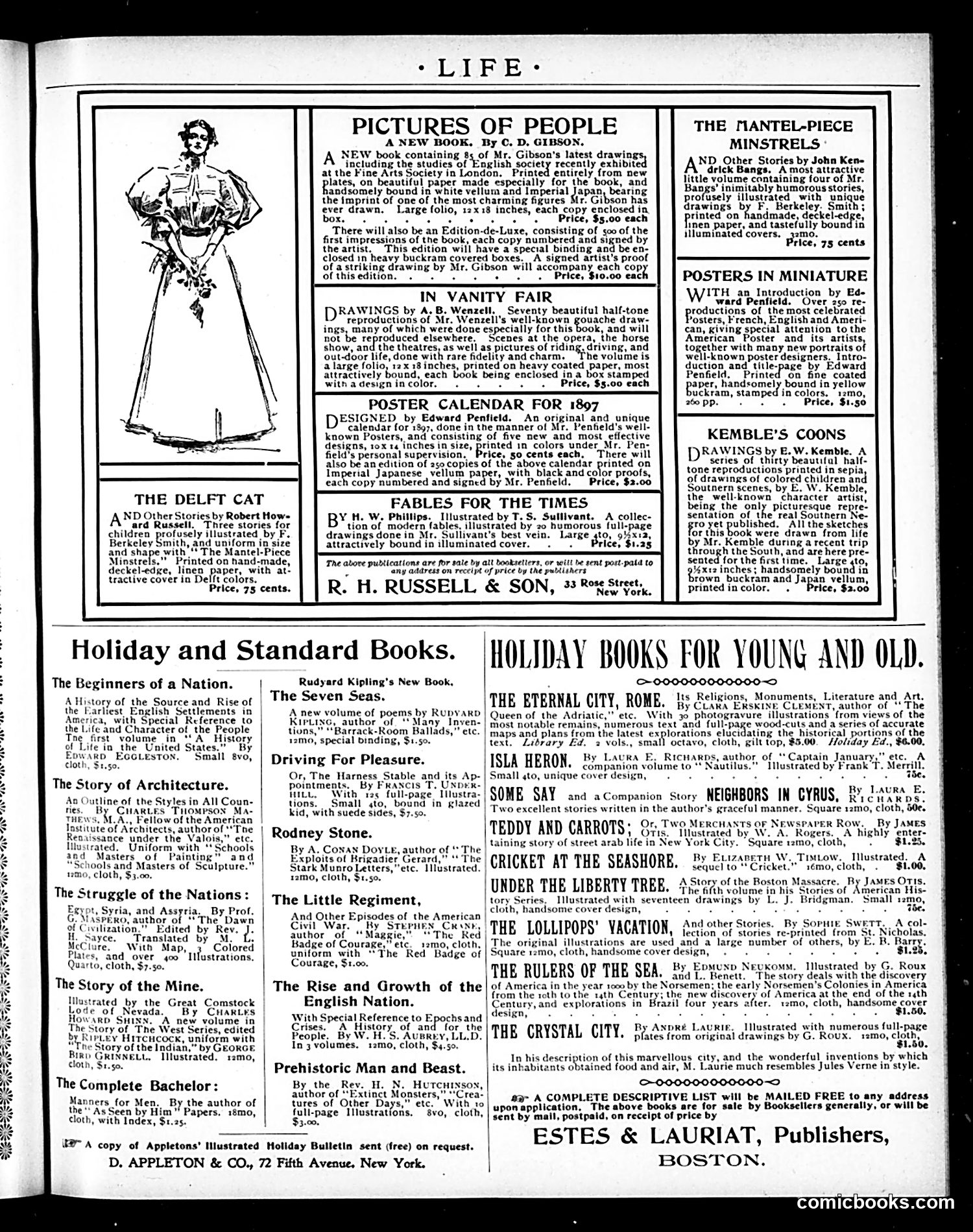
This page is primarily **advertising for books and art publications**, not political satire. The main content consists of publisher announcements for luxury art books and illustrated volumes from the 1890s. The visible illustration shows a fashionable woman in an elegant dress, likely accompanying the advertisement for "In Vanity Fair"—a collection of society drawings by A. B. Wenzell depicting opera, theater, and riding scenes. Notable is an advertisement for "Kemble's Coons"—drawings by E. W. Kemble depicting "colored children and Southern scenes." While Kemble was a respected illustrator, this title reflects the casual racial nomenclature and minstrelsy-influenced imagery of the 1890s period, which modern readers would recognize as offensive. The page otherwise showcases Gibson's "Pictures of People," holiday books for children, and Penfield's poster designs—all luxury publications typical of Life magazine's upper-class advertising base during this era.
This is primarily a **book advertising page**, not a satirical cartoon section. It features holiday book recommendations from major publishers including Lamson, Wolffe & Co., Copeland and Day, Roberts Bros., and Frederick A. Stokes Company. The page showcases late 19th-century literary offerings: historical novels like *King Noanett*, fairy tale collections, poetry volumes, and children's books. Notable are works by established authors like Emily Dickinson's poems and collections from the "Vagabondia" series. The page reflects **Victorian publishing culture** — emphasizing literary merit through glowing reviews (quotes from newspapers and magazines), attractive cover designs by named illustrators, and categorized gift recommendations for different audiences (children, travelers, poetry enthusiasts). There is **no political satire or caricature visible**. This represents straightforward commercial publishing promotion typical of Life's era, when the magazine included substantial advertising sections alongside its satirical editorial content.
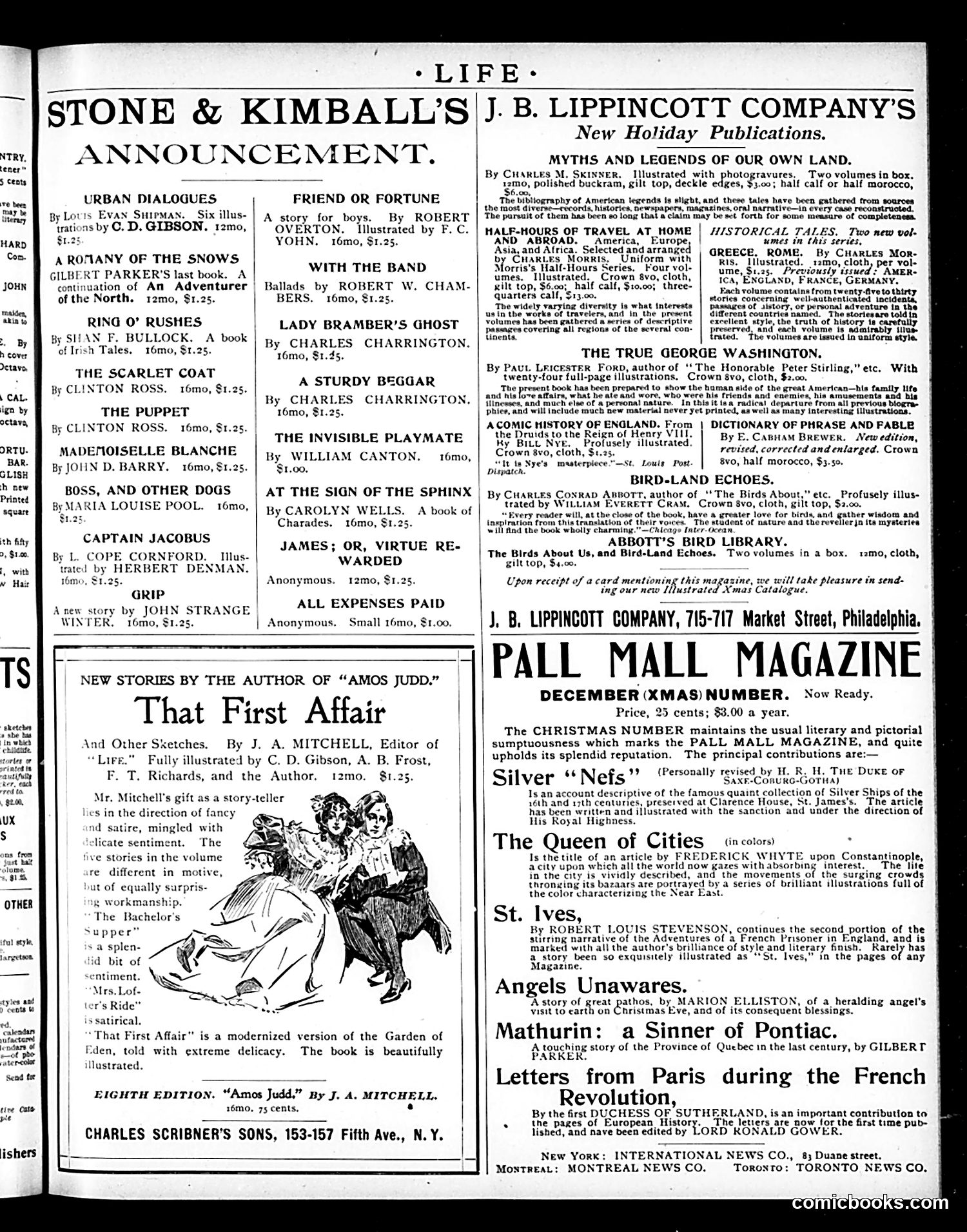
This page is primarily **advertising and announcements** rather than editorial content or political cartoons. It consists of: 1. **Stone & Kimball's book announcement** (left column): A publisher listing new fiction titles like "Urban Dialogues," "Friend or Fortune," and "Ring o' Rushes"—typical late-19th-century novels. 2. **A small illustration** accompanying "That First Affair" by J.A. Mitchell shows a Victorian-era couple in an intimate moment—appears to be satirical social commentary on courtship or romance, typical of Life magazine's gentle satire on middle-class life. 3. **J.B. Lippincott Company's holiday publications** (right column): Educational and historical works including "Myths and Legends of Our Own Land" and "The True George Washington." 4. **Pall Mall Magazine advertisement**: Describes December's Christmas issue with articles on "Silver Ships," "The Queen of Cities," and "St. Ives." **No significant political satire or caricature is present.** This is a holiday publishing catalog page aimed at gift-giving season readers.
This page is primarily **advertising**, not editorial content or cartoons. It consists of two book publisher advertisements from Harper & Brothers and Charles Scribner's Sons, listing newly published titles with prices and brief descriptions. Notable among the books advertised: Woodrow Wilson's biography of George Washington, James Barnes's *Naval Actions of the War of 1812*, George du Maurier's *English Society Sketches* and materials related to *Trilby*, and Mark Twain's works including *Joan of Arc*, *Huckleberry Finn*, and *A Connecticut Yankee in King Arthur's Court*. **There are no visible cartoons or satirical illustrations on this page.** The content is straightforward commercial promotion typical of *Life* magazine's advertising sections, aimed at readers interested in contemporary literature, history, and fiction during the 1890s.