
Life, 1896-12-03 · page 4 of 26
Life — December 3, 1896 — page 4: what you’re looking at
What you’re looking at
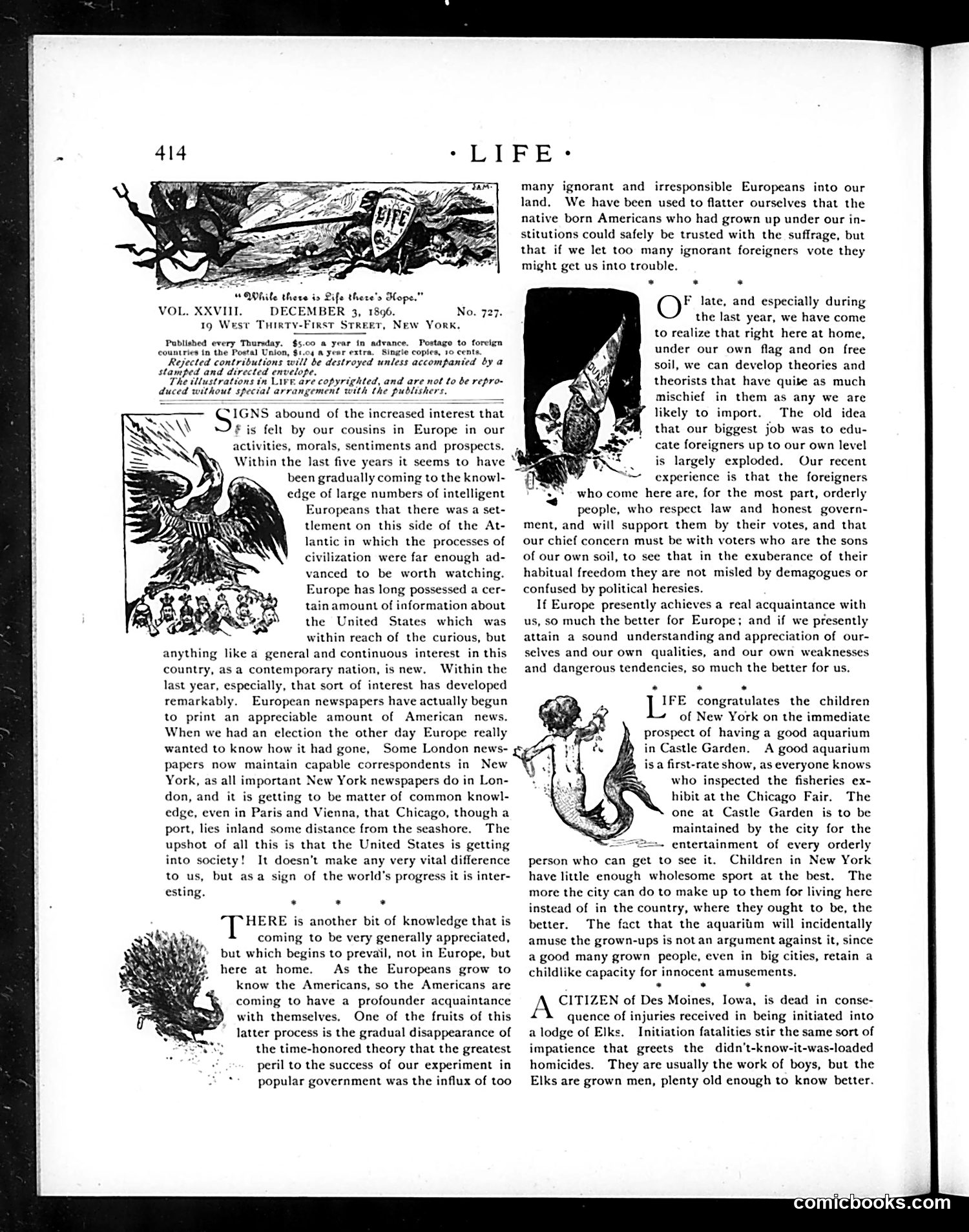
The page contains three editorial cartoons addressing European immigration and American politics. **Top cartoon:** Shows a tangled, chaotic figure labeled "While there is Life there's Hope," likely satirizing concerns about European immigrants and their influence on American society. **Middle cartoon:** Features an eagle, possibly representing American strength or national identity, contrasting with discussion of European misconceptions about the United States. **Bottom cartoon:** Appears to show another figure, though details are unclear in reproduction. The accompanying text criticizes European ignorance about America and warns against allowing too many "ignorant foreigners" to vote. The author argues Americans must educate Europeans about American values rather than importing foreign political ideas. The piece reflects 1890s anxieties about immigration, voting rights, and foreign influence on American democracy—concerns that dominated political discourse during this period.
📄 Transcribed text from this page (OCR, searchable)
Machine-transcribed from the original scan — historical spelling and the odd misread are preserved.
*> LIFE: VOL. XXVIII. DECEMBER 3, 1896. No. 727. 19 West Tuirty-First STREET, New York. Published every Thursday. $5.co a year in advance. Postage to foreign countries in the Postal Union, $1.04 a year extra. Single copies, 10 cents Rejected contributions will be destroyed unless accompanied by a stamped and directed envelope. The illustrations in Live. are copyrighted, and are not to be repro- duced without special arrangement with the publishers, is felt by our cousins in Europe in our act 's, morals, sentiments and prospects. Within the last five years it seems to have been gradually coming to the knowl- edge of large numbers of intelligent Europeans that there was a set- tlement on this side of the At- lantic in which the processes of civilization were far enough ad- vanced to be worth watching. Europe has long possessed a cer- tain amount of information about the United States which was within reach of the curious, but anything like a general and continuous interest in this country, as a contemporary nation, is new, Within the last year, especially, that sort of interest has developed remarkably. European newspapers have actually begun to print an appreciable amount of American news. When we had an election the other day Europe really wanted to know how it had gone, Some London news- papers now maintain capable correspondents in New York, as all important New York newspapers do in Lon- don, and it is getting to be matter of common knowl- edge, even in Paris and Vienna, that Chicago, though a port, lies inland some distance from the seashore. The upshot of all this is that the United States is getting into society! It doesn't make any very vital difference to us, but asa sign of the world’s progr esting. Sess abound of the increased interest that ps it is inter- . . . HERE is another bit of knowledge that is coming to be very generally appreciated, but which begins to prevail, not in Europe, but here at home. As the Europeans grow to know the Americans, so the Americans are coming to have a profounder acquaintance with themselves. One of the fruits of this latter process is the gradual disappearance of the time-honored theory that the greatest peril to the success of our experiment in popular government was the influx of too many ignorant and irresponsible Europeans into our land. We have been used to flatter ourselves that the native born Americans who had grown up under our in- stitutions could safely be trusted with the suffrage, but that if we let too many ignorant foreigners vote they might get us into trouble. . * late, and especially during the last year, we have come to realize that right here at home, under our own flag and on free soil, we can develop theories and theorists that have quite as much mischief in them as any we are likely to import. The old idea that our biggest job was to edu- cate foreigners up to our own level is largely exploded. Our recent ‘ experience is that the foreigners who come here are, for the most part, orderly people, who respect law and honest govern- ment, and will support them by their votes, and that our chief concern must be with voters who are the sons of our own soil, to see that in the exuberance of their habitual freedom they are not misled by demagogues or confused by political heresies. If Europe presently achieves a real acquaintance with us, so much the better for Europe; and if we presently attain a sound understanding and appreciation of our- selves and our own qualities, and our own weaknesses and dangerous tendencies, so much the better for us. . | ee congratulates the children of New York on the immediate prospect of having a good aquarium in Castle Garden. A good aquarium is a first-rate show, as everyone knows who inspected the fisheries ex- hibit at the Chicago Fair. The one at Castle Garden is to be maintained by the city for the =~ entertainment of every orderly person who can get to see it. Children in New York have little enough wholesome sport at the best. The more the city can do to make up to them for living here instead of in the country, where they ought to be, the better. The fact that the aquaritim will incidentally amuse the grown-ups is not an argument against it, since a good many grown people, even in big cities, retain a childlike capacity for innocent amusements. . . . CITIZEN of Des Moines, Iowa, is dead in conse- quence of injuries received in being initiated into a lodge of Elks. Initiation fatalities stir the same sort of impatience that greets the didn’'t-know-it-was-loaded homicides. They are usually the work of boys, but the Elks are grown men, plenty old enough to know better.