
Life, 1896-12-03 · page 7 of 26
Life — December 3, 1896 — page 7: what you’re looking at
What you’re looking at
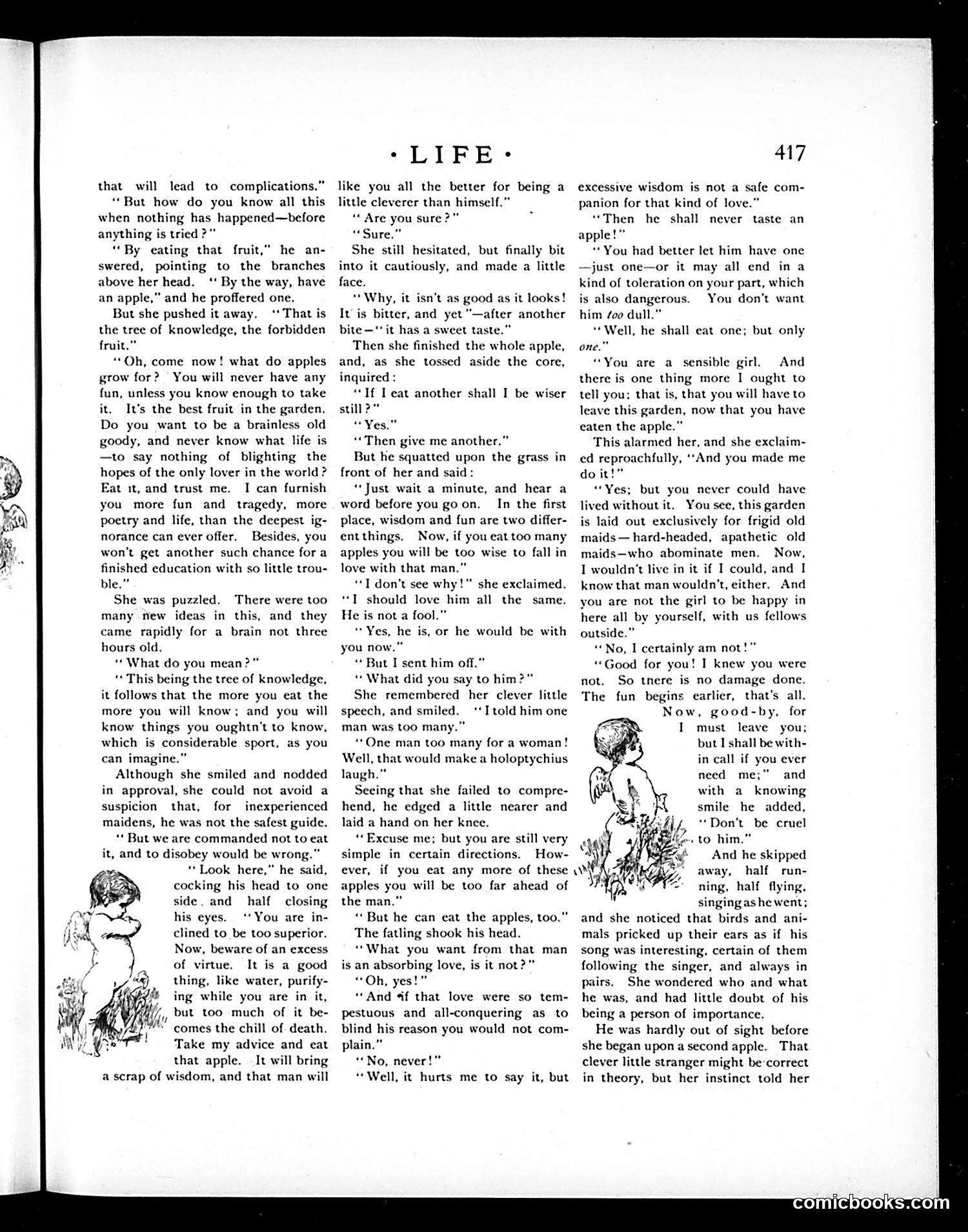
This page presents a narrative dialogue between a man and woman in a garden setting, illustrated with small decorative drawings of figures. The text depicts a moral debate about temptation and knowledge, using the biblical Adam and Eve story as its framework. The dialogue concerns whether the woman should eat apples (symbolic of the forbidden fruit) and accept the man's romantic advances. The satire critiques Victorian-era courtship conventions and gender dynamics—particularly the tension between female innocence and male persuasion. The illustrations show the couple in the garden, reinforcing the Eden allegory. The piece appears to mock both the woman's naive resistance to temptation and the man's sophisticated arguments for her to abandon caution, suggesting contemporary anxieties about changing social relationships and female autonomy in the early 20th century.
📄 Transcribed text from this page (OCR, searchable)
Machine-transcribed from the original scan — historical spelling and the odd misread are preserved.
that will lead to complications.” “But how do you know all this when nothing has happened—before anything is tried?” “By eating that fruit,” he an- swered, pointing to the branches above her head. ‘* By the way, have an apple,” and he proffered one. But she pushed it away. ‘* That is the tree of knowledge, the forbidden fruit.” “Oh, come now! what do apples grow for? You will never have any fun, unless you know enough to take it. It's the best fruit in the garden. Do you want to be a brainless old goody, and never know what life is —to say nothing of blighting the hopes of the only lover in the world ? Eat it, and trust me. I can furnish you more fun and tragedy, more poetry and life, than the deepest ig- norance can ever offer. Besides, you won't get another such chance for a finished education with so little trou- ble.” She was puzzled. There were too many new ideas in this, and they came rapidly for a brain not three hours old. **What do you mean?” “ This being the tree of knowledge, it follows that the more you eat the more you will know; and you will know things you oughtn't to know, which is considerable sport, as you can imagine.” Although she smiled and nodded in approval, she could not avoid a suspicion that, for inexperienced maidens, he was not the safest guide. “* But we are commanded not to eat it, and to disobey would be wrong.” ‘Look here,” he said, cocking his head to one side. and half closing his eyes. ‘You are in- clined to be too superior. Now, beware of an excess of virtue. It is a good thing, like water, purify- ing while you are in it, but too much of it be- comes the chill of death. Take my advice and eat that apple. It will bring a scrap of wisdom, and that man will > LIFE: like you all the better for being a little cleverer than himself.” “Are you sure?" “Sure.” She still hesitated, but finally bit into it cautiously, and made a little face. “Why, it isn’t as good as it looks! It is bitter, and yet "—after another bite—“it has a t taste.” Then she finished the whole apple, and, as she tossed aside the core, inquired : “If Teat another shall I be wiser still?” “Yes.” “Then give me another.” But he squatted upon the grass in front of her and said: “Just wait a minute, and hear a word before you go on. In the first place, wisdom and fun are two differ- entthings. Now, if you eat too many apples you will be too wise to fall in love with that man.” “I don't see why!” she exclaimed. “I should love him all the He is not a fool.” “Yes, he is, or he would be with you now.” ‘But I sent him off.” ‘* What did you say to him?" She remembered her clever little speech, and smiled. ‘*I told him one man was too many.” *‘One man too many for a woman! Well, that would make a holoptychius laugh.” Seeing that she failed to compre- hend, he edged a little nearer and laid a hand on her knee. =xcuse me; but you are still very simple in certain directions. How- ever, if you eat any more of these apples you will be too far ahead of the man.” “But he can eat the apples, too.” The fatling shook his head. **What you want from that man is an absorbing love, is it not?” “Oh, yes!” “And ‘if that love were so tem- pestuous and all-conquering as to blind his reason you would not com- plain.” “No, never!” ‘Well, it hurts me to say it, but same. 417 fe com- excessive wisdom is not a panion for that kind of love “Then he shall never taste apple!” “You had better let him have one —just one—or it may all end in a nd of toleration on your part, which is also dangerous. You don’t want him /o0 dull.” “Well, he shall eat one; but only one.” “You are a sensible girl, And there is one thing more I ought to tell you; that is, that you will have to i this garden, now that you have eaten the apple.” This alarmed her, and she exclaim- ed reproachfully, ‘‘And you made me do it!” “Yes; but you never could have lived without it. You see, this garden is laid out exclusively for frigid old maids — hard-headed, apathetic old maids—who abominate men. Now, I wouldn’t live in it if I could, and I know that man wouldn't, either. And you are not the girl to be happy in here all by yourself, with us fellows outside.” “No, I certainly am not!” ‘*Good for you! I knew you were not. So there is no damage done. The fun begins earlier, that's all, Now, good-by, for I must leave you; but I shall be with- in call if you ever need me;" and with a knowing smile he added, “Don't be cruel 7 2 yes to him.” And he skipped y, half run- ning, half flying, singing as he went; and she noticed that birds and ani mals pricked up their ears as if his song was interesting, certain of them following the singer, and always in pairs. She wondered who and what he was, and had little doubt of his being a person of importance. He was hardly out of sight before she began upon a second apple. That clever little stranger might be correct in theory, but her instinct told her an