
A complete issue · 18 pages · 1896
Life — November 12, 1896
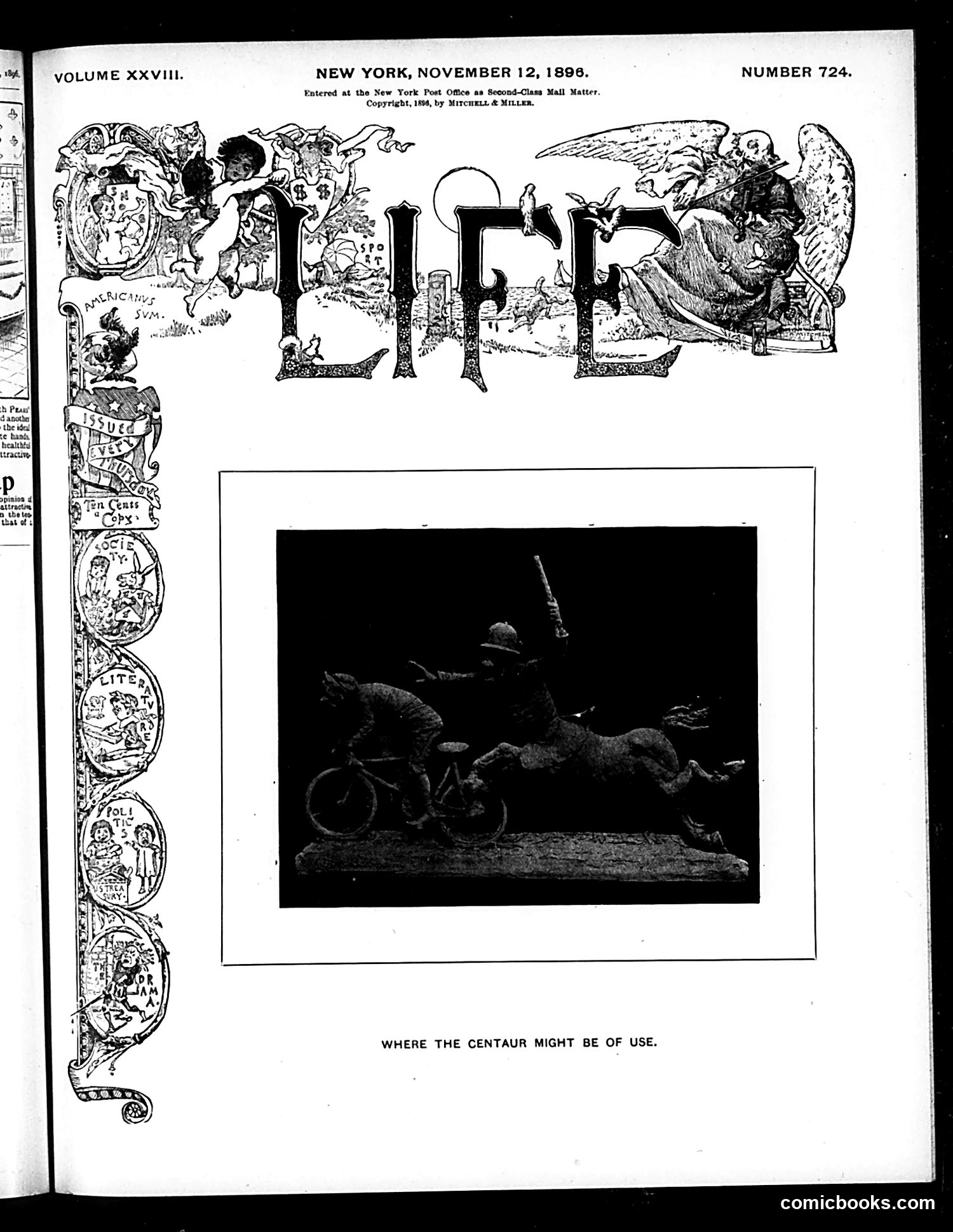
This Life magazine cover from November 1898 presents a satirical cartoon about a practical application for a centaur—a mythological creature that is half-human, half-horse. The image shows a centaur riding a bicycle, playing on the absurdity of such a creature needing mechanical transportation when it already possesses a horse's body. The humor lies in the contradiction: a centaur is already equipped for rapid movement, making a bicycle redundant and ridiculous. This appears to be satirizing either contemporary bicycle craze enthusiasm or perhaps mocking some contemporary figure or proposal by suggesting they're as nonsensical as a centaur on a bike. The elaborate decorative borders and fantastical imagery support the absurdist satirical tone typical of Life magazine's humor during this era.
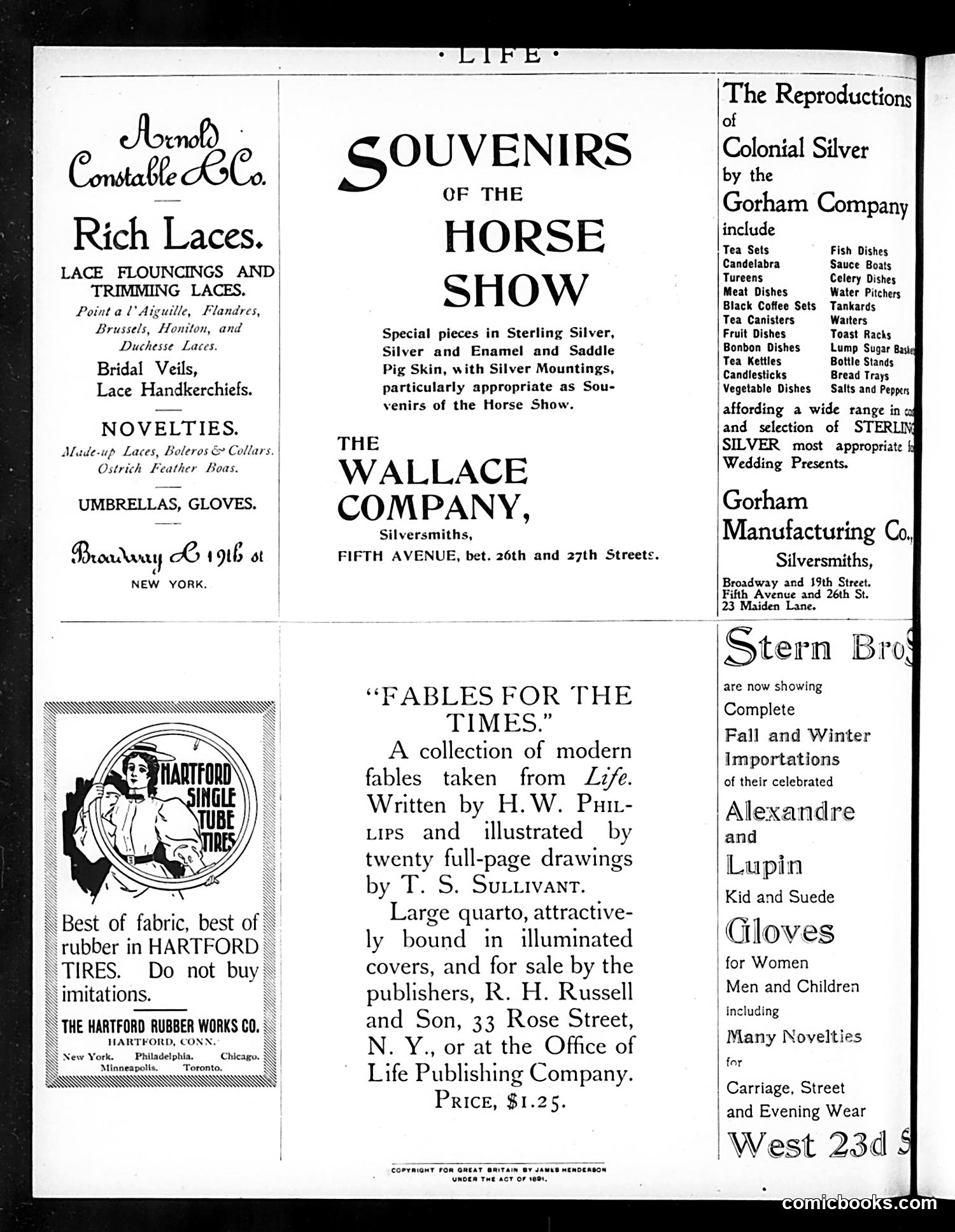
This page is predominantly **advertising**, not political satire. The main content features a Hartford Single Tube Tires advertisement with a circular logo showing a woman in early 1900s dress. The ad's message is straightforward commercial copy: Hartford tires claim superiority in "fabric" and "rubber," warning consumers "Do not buy imitations." The Hartford Rubber Works Company, based in Hartford, Connecticut, used the female figure as a brand mascot to convey quality and reliability. The surrounding advertisements promote luxury goods (silver goods, laces, gloves) typical of Life magazine's wealthy readership. There is no discernible political cartoon or satire on this particular page—it represents standard commercial messaging from the 1916 era.
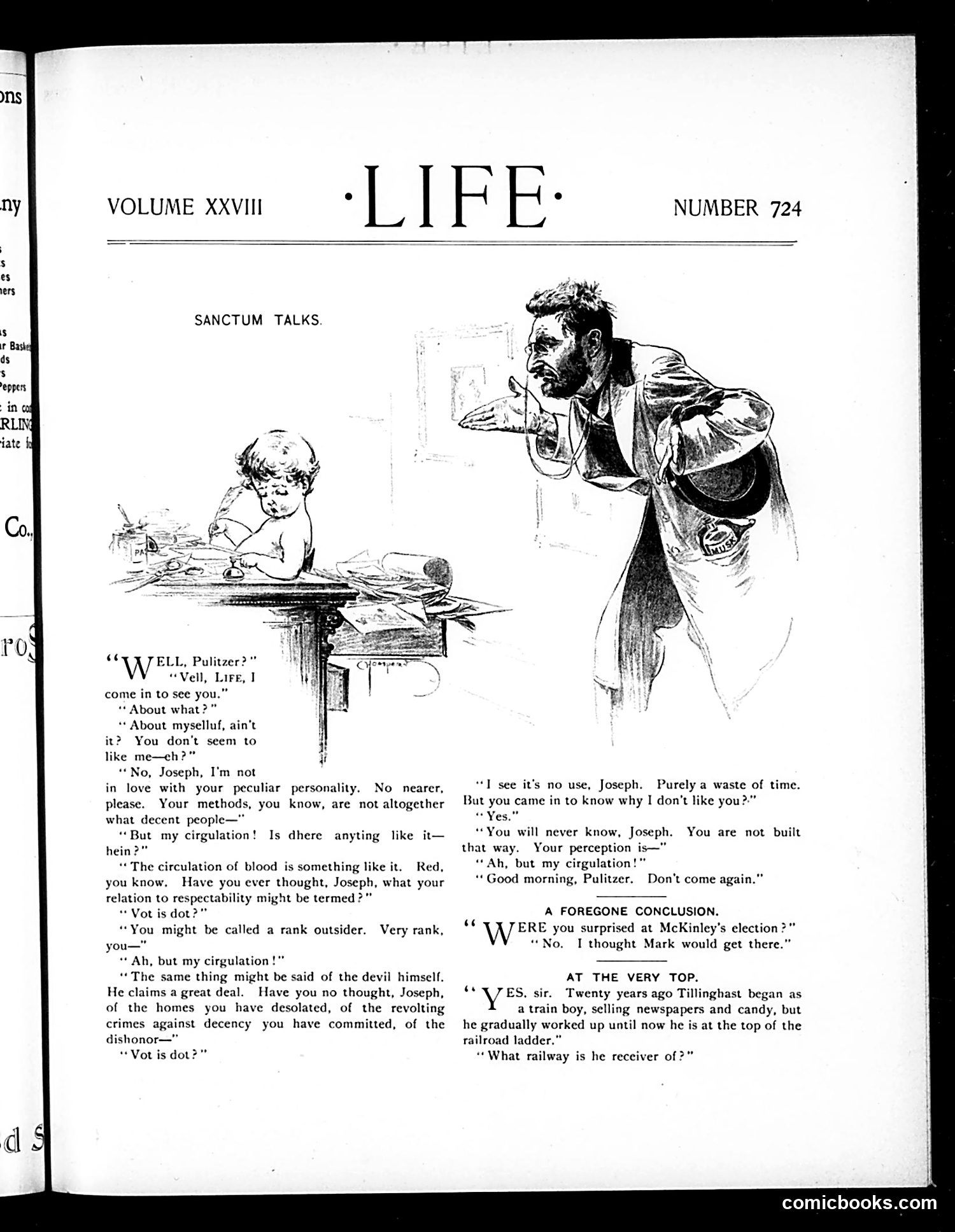
This page contains two satirical dialogues from Life magazine's "Sanctum Talks" feature. The left illustration shows a child at a desk speaking with an adult man (labeled "Pulitzer"), likely referring to Joseph Pulitzer, the prominent newspaper publisher. The dialogue mocks the man's self-importance and moral hypocrisy—he criticizes the child's "circulation" and character while claiming newspapers elevate society, though he himself profits from sensationalism and "crimes against decency." The right section, "A Foreground Conclusion," appears to reference McKinley's election and includes a separate anecdote about someone named Tillinghast who worked his way up from selling newspapers to becoming a railroad official. The satire targets wealthy publishers' sanctimonious attitudes toward morality and progress.
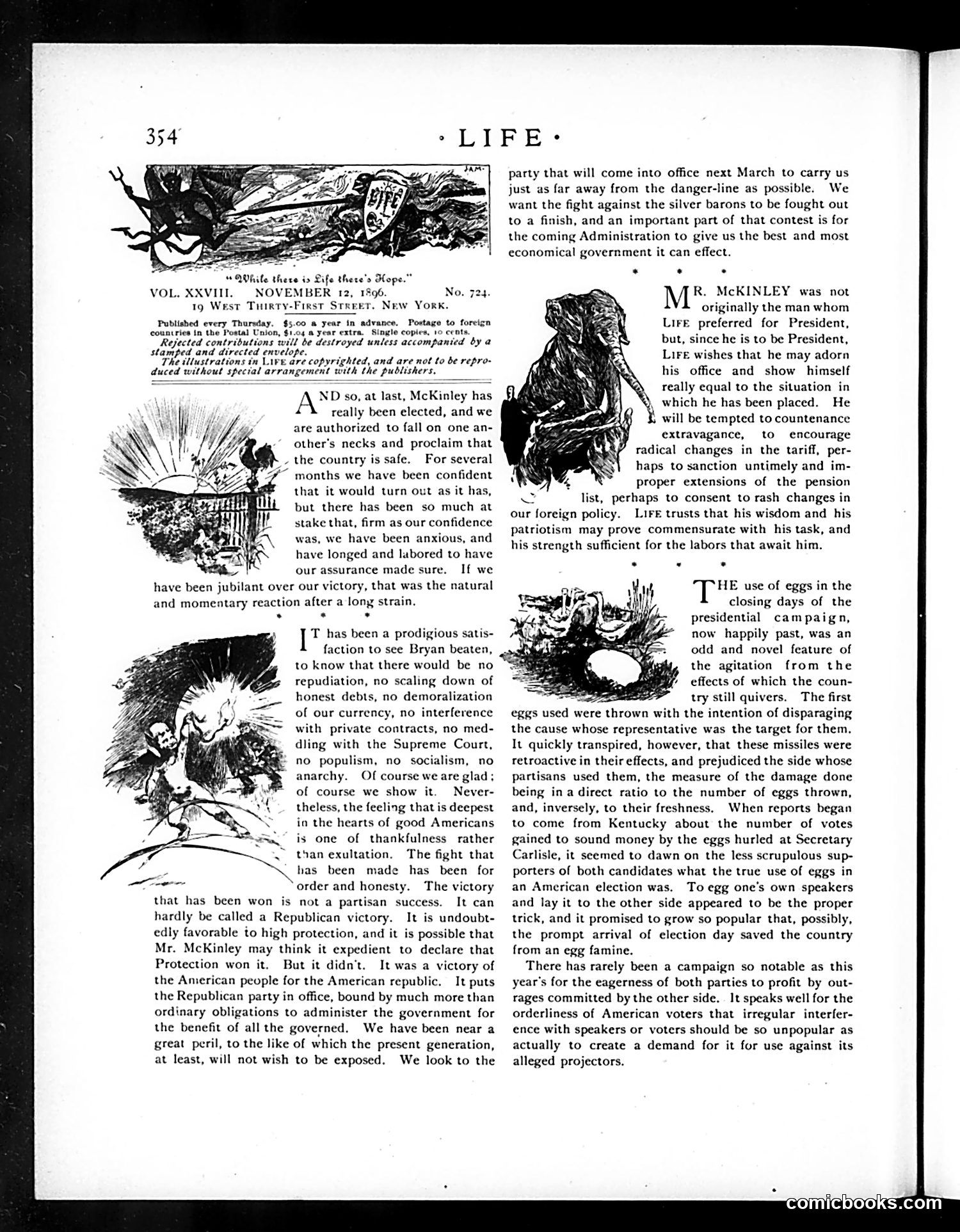
This page celebrates **McKinley's election victory** over Bryan. The text expresses relief that Bryan—associated with radical positions like free silver coinage—was defeated, and praises McKinley as a stabilizing force for "order and honesty." The **egg cartoons** illustrate a peculiar 1896 campaign tactic: eggs were thrown at speakers during the presidential race. The text explains these missiles were initially meant to discredit Bryan supporters, but backfired when used against McKinley surrogates. The satire mocks both sides for this crude form of electoral "interference," while celebrating that American voters ultimately chose stability over what Life viewed as dangerous radicalism. The ornamental illustrations are decorative rather than specifically caricatural.
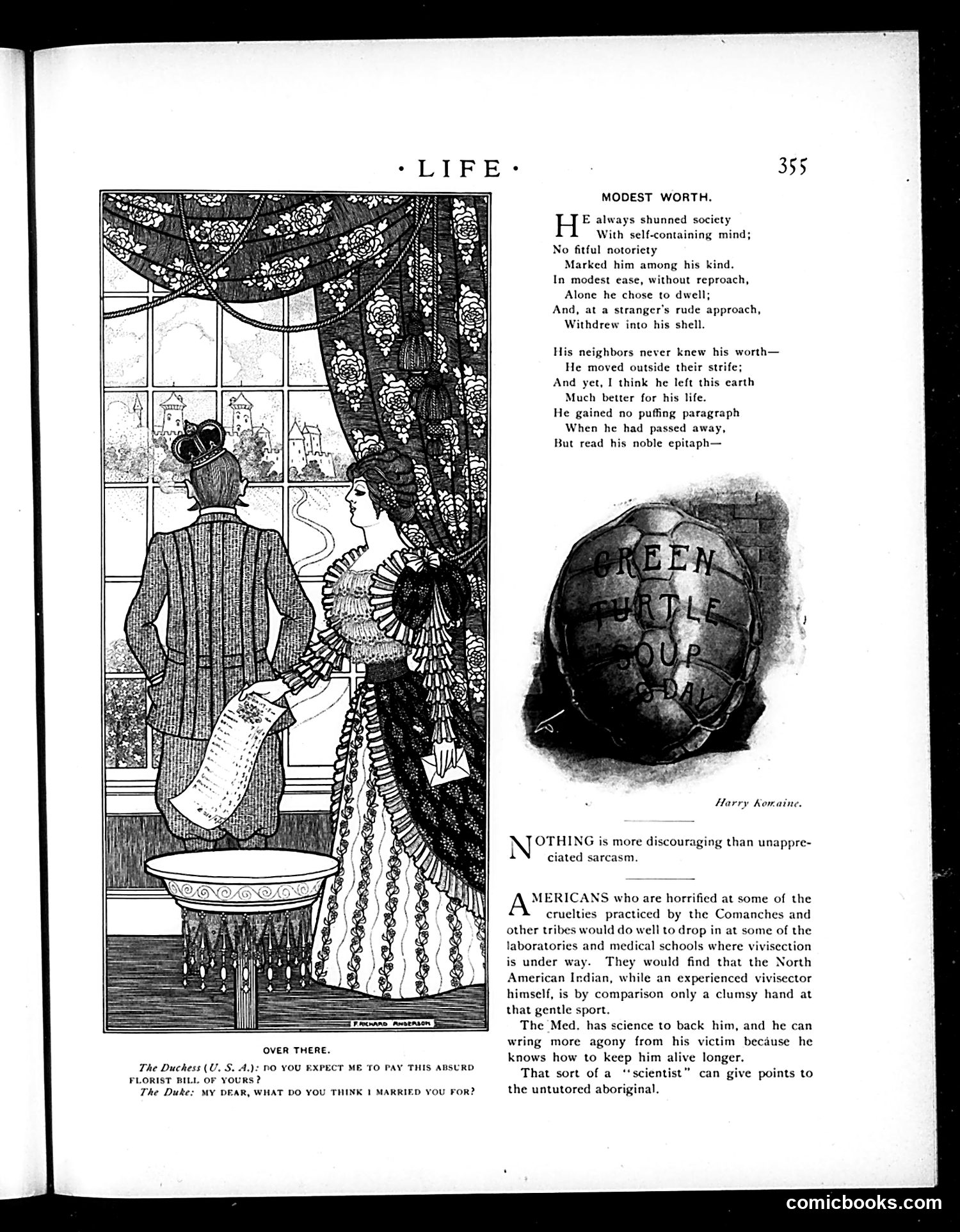
This page from *Life* magazine satirizes wealthy American society's indifference to wartime sacrifice. The cartoon depicts an elegant duchess dismissing her florist's bill with aristocratic disdain, asking "Do you expect me to pay this absurd florist bill of yours?" while her companion asks what she married the duke for—implying mercenary motives. The title "Over There" references the popular WWI song, sarcastically contrasting frivolous high-society concerns with soldiers fighting abroad. The accompanying poem "Modest Worth" celebrates humble integrity in contrast to such vanity. The text below criticizes Americans horrified by Indigenous peoples' practices while ignoring medical exploitation of Native Americans by scientists—another form of cruelty masked by institutional authority.
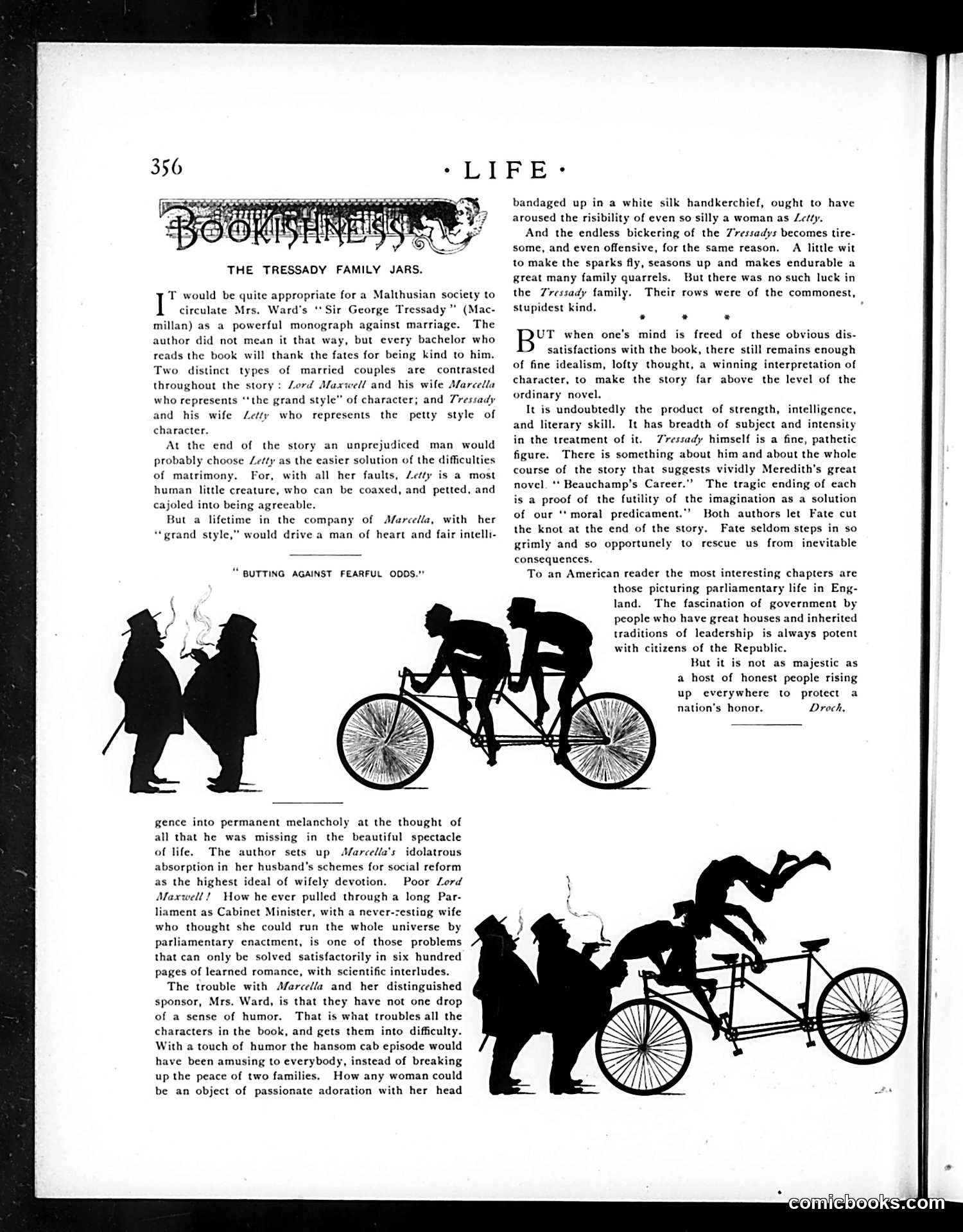
This page reviews "The Tressady Family Jars," a novel contrasting two types of married couples: *Marcella* (representing "grand style") and *Tressady* (representing "petty character"). The silhouette illustrations satirize marital discord. The top image shows two men arguing with gestures of conflict. Below, figures struggle with a tandem bicycle—a visual metaphor for marriage requiring coordination. One figure appears to fall or lose control. The bicycle humor likely references the late-Victorian/Edwardian era when bicycles symbolized both independence (especially for women) and the need for couples to work together. The tandem bike's instability mirrors the novel's theme of marriage difficulties. The review criticizes how *Marcella's* husband pursues social reform schemes while neglecting marital harmony, suggesting the satire targets idealistic reformers whose abstract principles damage personal relationships.
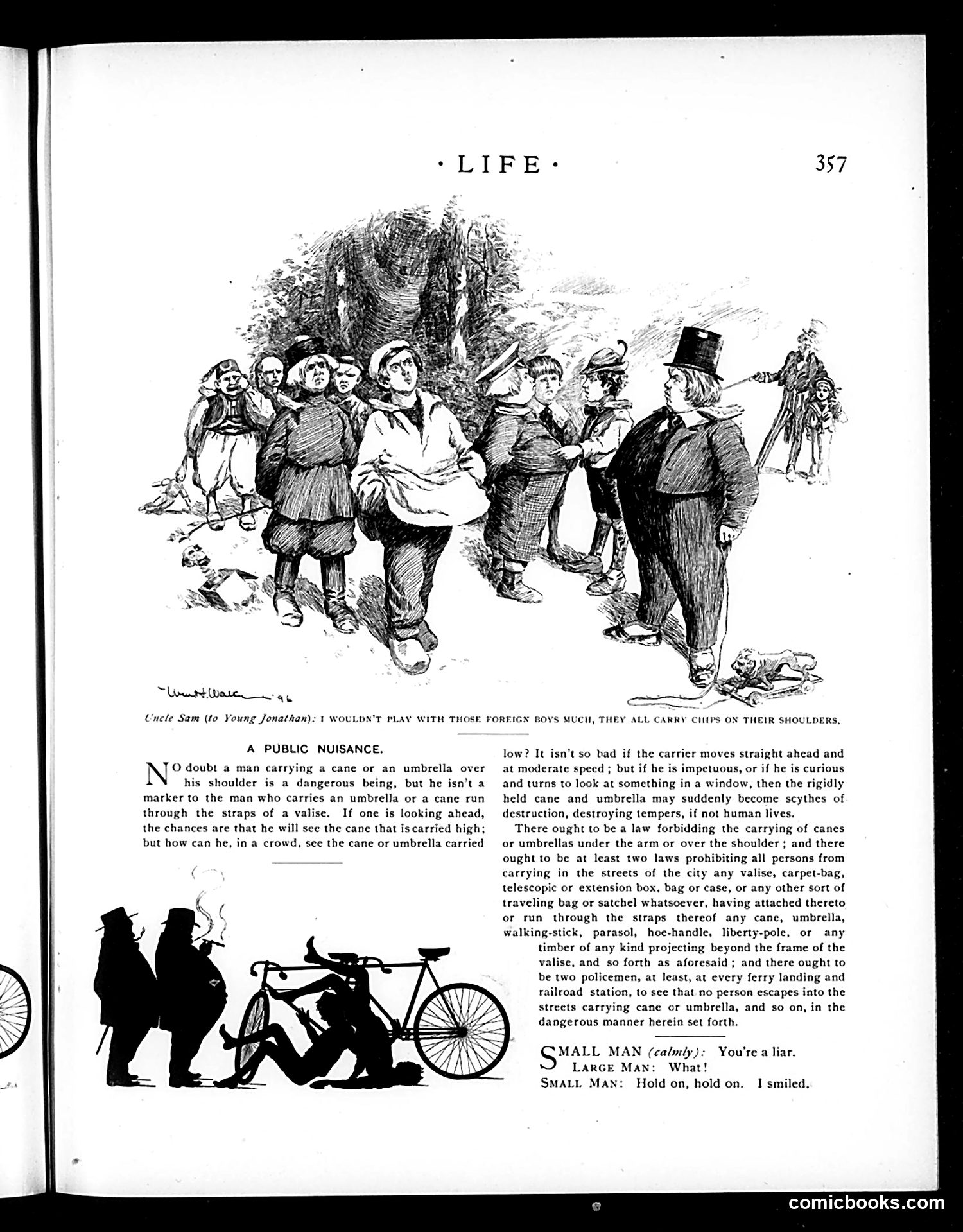
This page satirizes two separate urban nuisances of the era: **Top cartoon:** Uncle Sam (the bearded figure in top hat on the right) warns young Jonathan about foreign boys carrying chips on their shoulders—a metaphor for immigrants or foreign nationals prone to fighting. **Main article & bottom cartoon:** "A Public Nuisance" complains about pedestrians carrying canes, umbrellas, and other projecting objects carelessly through crowded city streets, creating hazards. The silhouette shows a collision between a man with a bicycle and another carrying an umbrella or cane. The text argues for laws prohibiting such behavior and police enforcement at public transit points. The brief dialogue shows a small man calling a larger man a liar after presumably a street encounter gone wrong—illustrating the conflicts these nuisances create.
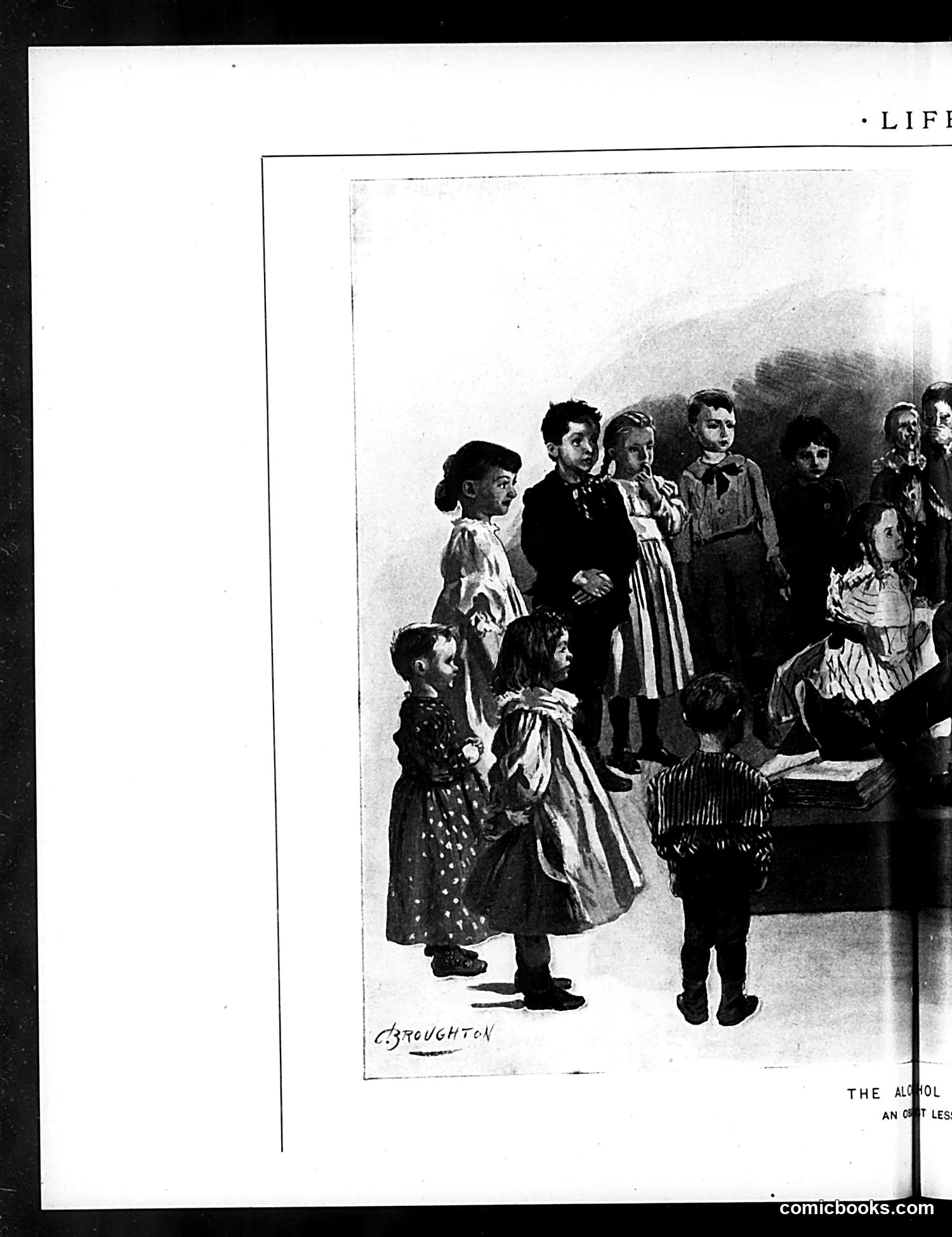
This Broughton illustration appears to depict a social commentary on child welfare or poverty during the early 20th century. The scene shows a group of poorly-dressed children and adults, likely representing impoverished or neglected families. The caption reference to "THE ALCOHOL" (partially visible at bottom) suggests this cartoon critiques the societal impacts of alcohol—possibly arguing that alcohol consumption contributes to child poverty and neglect. The composition emphasizes the contrast between the adults' choices and the suffering of dependent children, a common Progressive Era argument for alcohol prohibition. The children's worn clothing and the somber gathering suggest institutional charity or welfare services. Without the complete caption, the specific satirical target remains partially unclear, but the social criticism centers on vulnerability and institutional response to poverty.
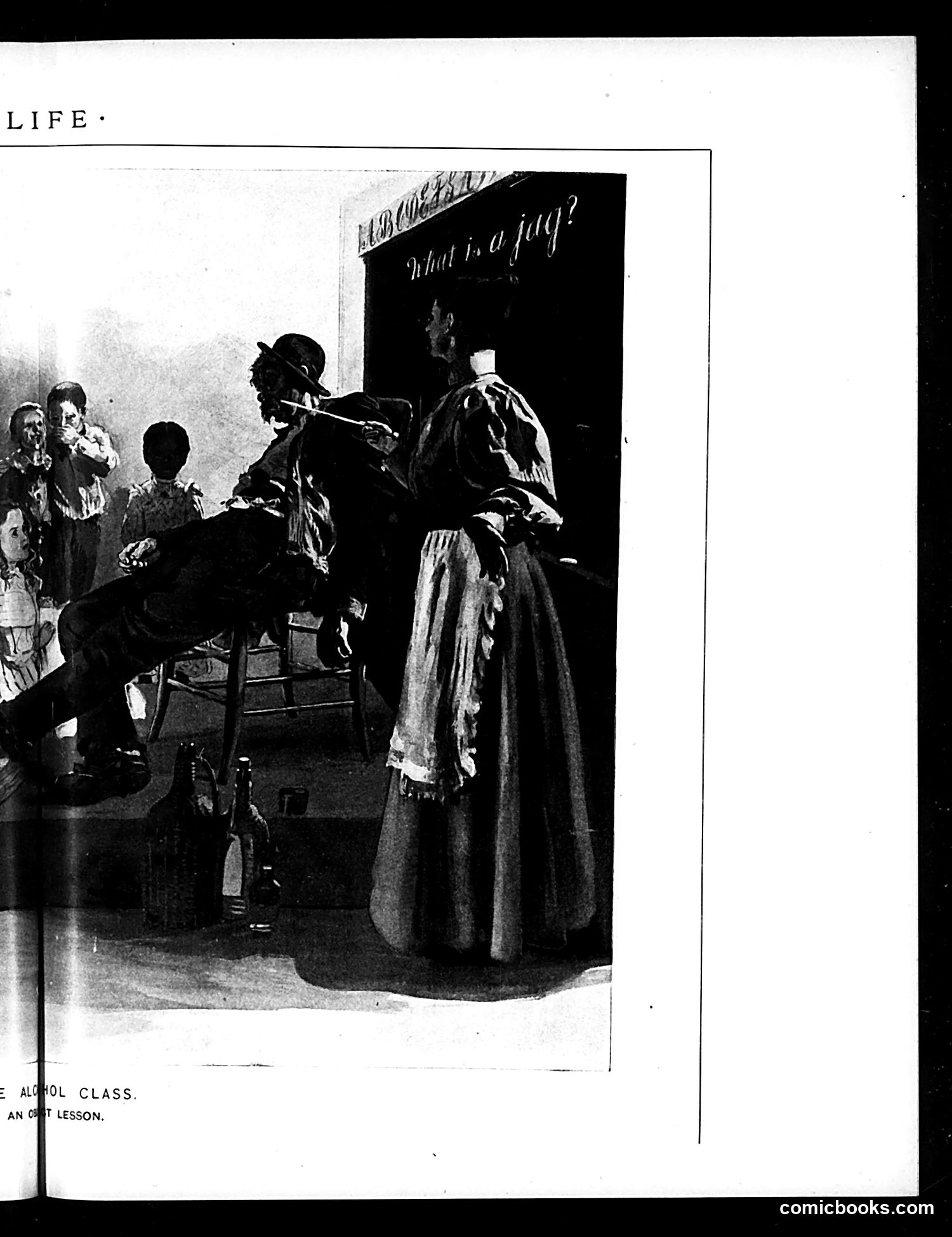
This appears to be an educational or satirical illustration from *Life* magazine showing a classroom scene. The image depicts what seems to be a temperance or anti-alcohol lesson, given the visible text "What is a jug?" on the blackboard behind the instructor and the OCR reference to "ALCOHOL CLASS" and "AN OBJECT LESSON." The scene shows an instructor (possibly a teacher or temperance advocate) demonstrating to students, with what appears to be a large jug as a visual prop—likely used to illustrate the dangers of alcohol consumption. This reflects early-to-mid 20th-century American temperance movement messaging, which used dramatic object lessons to discourage drinking, particularly among young people. The satire likely mocks either the earnestness of temperance advocates or the ineffectiveness of such didactic approaches.
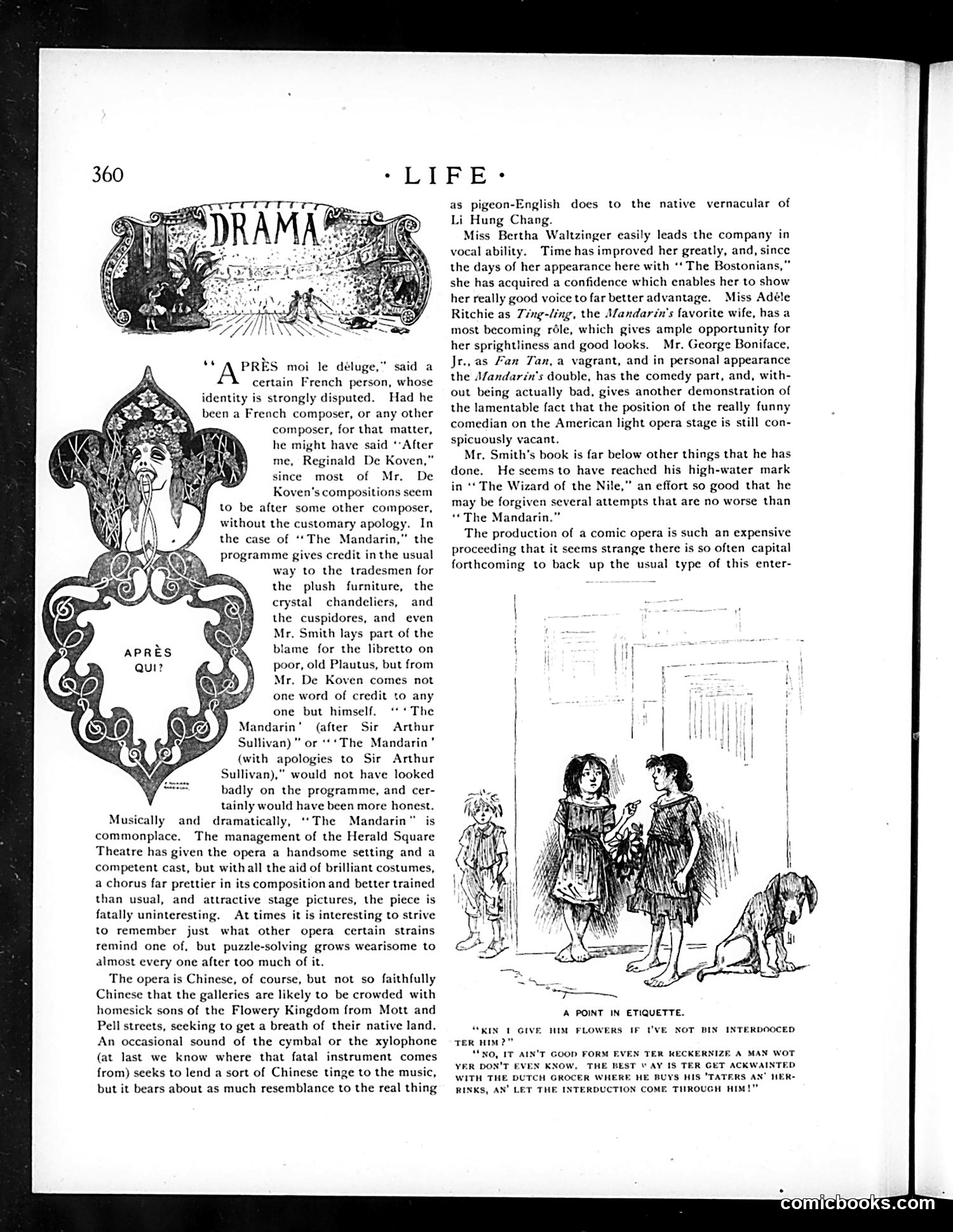
This page reviews a comic opera production of **"The Mandarin"** at the Herald Square Theatre. The text criticizes the show's program credit, sarcastically suggesting that composer Reginald De Koven should receive sole blame rather than crediting a librettist. The review is mixed: it praises the Herald Square Theatre's handsome setting, competent cast, and brilliant costumes, but finds the piece "fatally uninteresting." The critic notes that while the opera is ostensibly Chinese, it actually features homesick characters from Mott and Pell Streets (New York's immigrant neighborhoods) seeking their homeland. The illustration below depicts a scene about social etiquette, showing children in what appears to be a lesson about proper introductions and manners—a typical Victorian-era concern for Life magazine's satirical commentary on society.
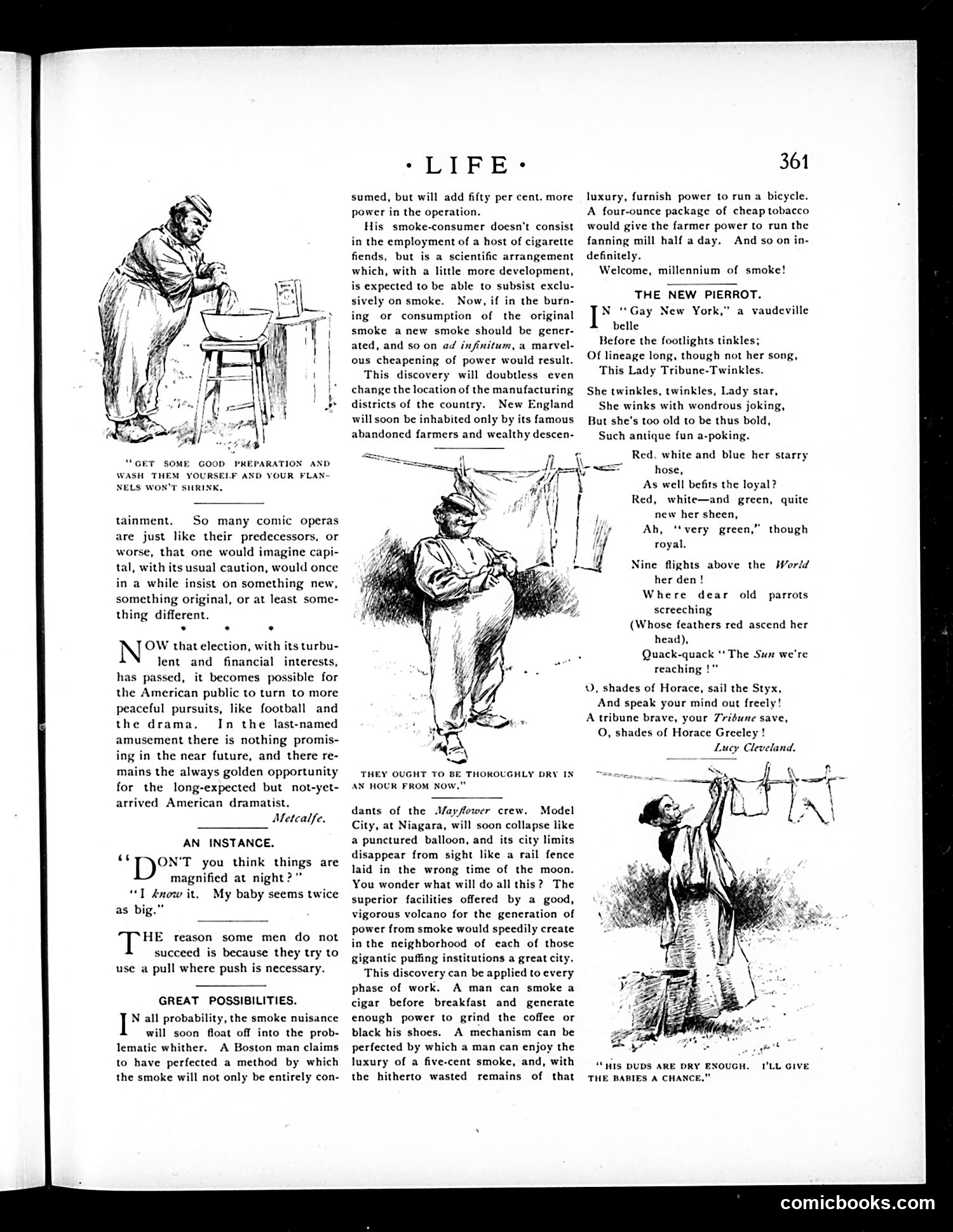
This page contains satirical commentary on absurd ideas rather than political cartoons. The text mocks proposals to solve urban problems through smoke generation—including powering machinery and mills with smoke, and using volcanic smoke to generate city power. The accompanying sketches illustrate these ridiculous schemes: figures operating equipment powered by smoke, and people hanging laundry that gets immediately soiled by smoke pollution. The satire critiques both overambitious inventors proposing impractical solutions and the general smoke nuisance plaguing cities at the time. "The New Pierrot" poem satirizes a fashion-conscious society woman indifferent to real problems. The overall message: absurd "scientific arrangements" won't solve genuine urban issues like pollution and smog.
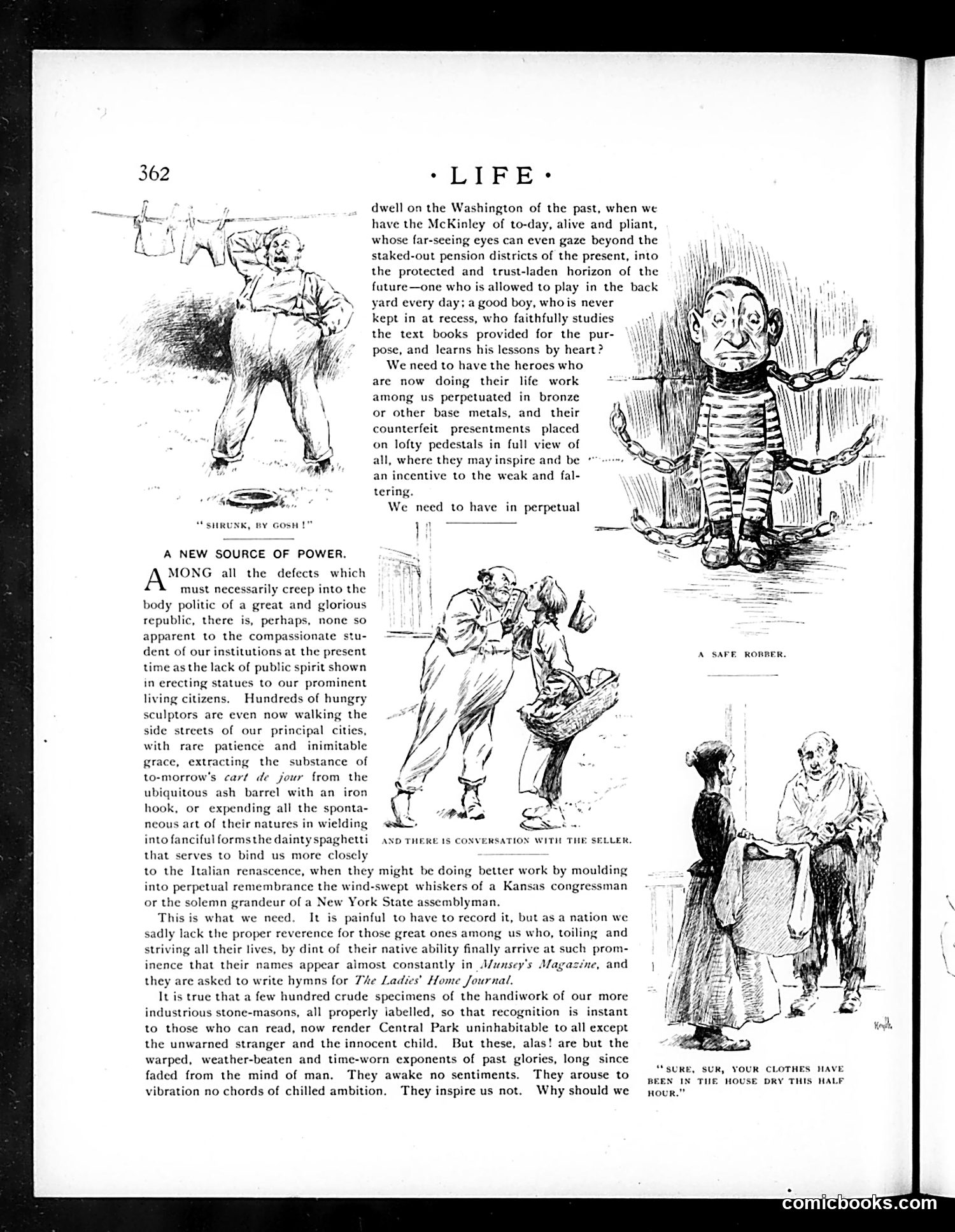
This satirical piece mocks the American impulse to erect public monuments to living politicians and minor officials. The text sarcastically praises President McKinley as worthy of commemoration, then attacks the broader practice of creating statues to mediocre public figures—"Kansas congressmen" and "New York State assemblymen"—whose only distinction is appearing in *Munsey's Magazine*. The cartoons illustrate the absurdity: one shows a comically shrunken figure (labeled "Shrunk, by Gosh!"), another depicts a mummy-like wrapped figure, and a third shows street vendors selling clothes. These visual gags suggest such monuments are ridiculous, preserving the trivial and forgettable rather than genuine heroism. The piece critiques both the vanity of minor politicians and the wasteful labor of sculptors who could be doing meaningful work instead of immortalizing the forgettable in bronze. It's satire about misplaced reverence and institutional mediocrity in America.
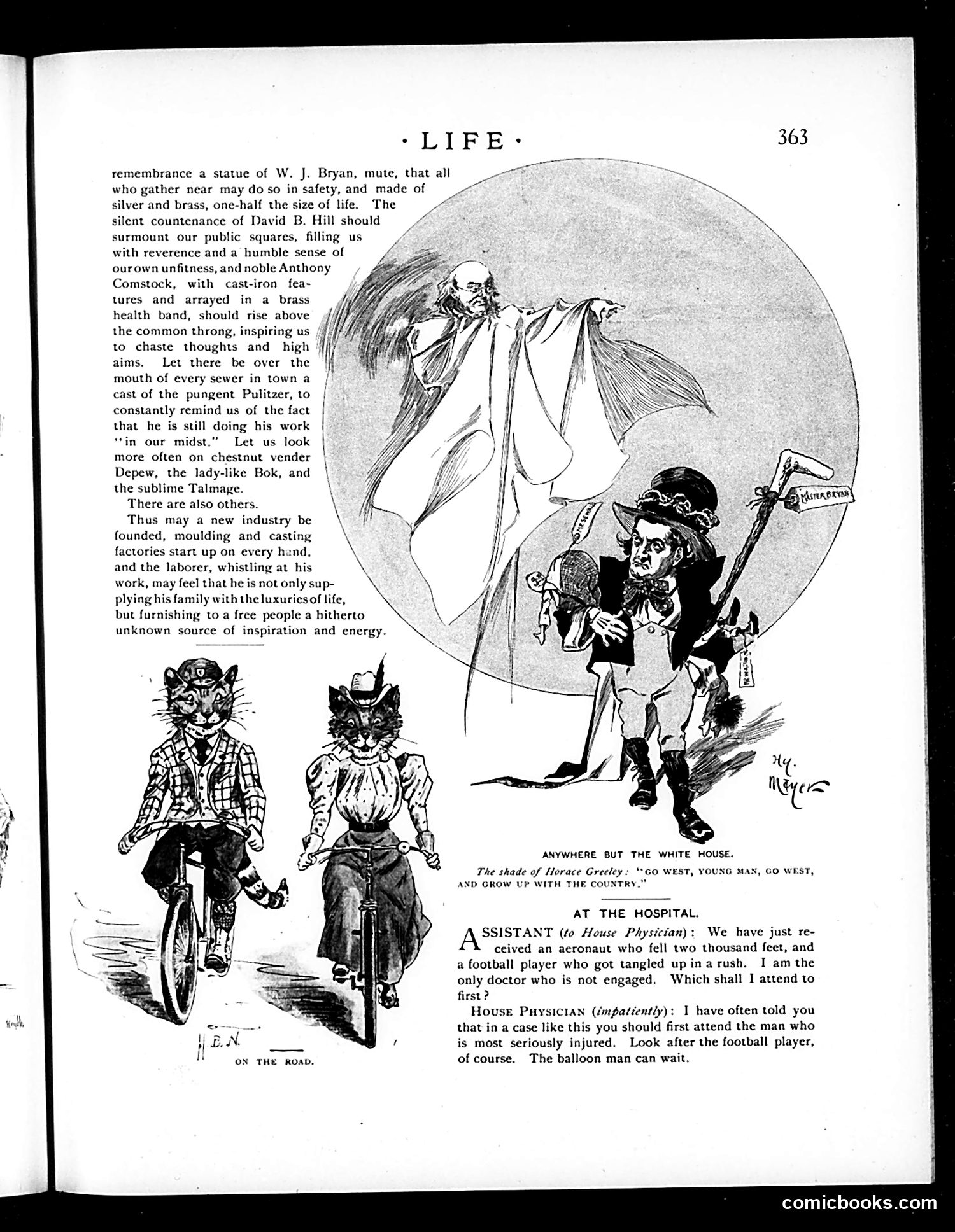
This page contains satirical commentary on prominent late-19th-century American figures. The main text mockingly proposes erecting statues of politicians and public figures—William Jennings Bryan, David B. Hill, Anthony Comstock, Joseph Pulitzer, Chauncey Depew, Edward Bok, and DeWitt Talmage—as sources of public inspiration. The satire suggests these men are so self-important they deserve monuments, while the proposal to place Pulitzer casts over sewers is particularly biting commentary on his influence. The circular cartoon "Anywhere But the White House" references Horace Greeley's famous advice "Go West, young man," suggesting these figures should relocate away from political power. The hospital scene jokes about medical priorities: a doctor must choose between treating an aeronaut (balloon pilot) who fell 2,000 feet versus a football player injured in a rush. The physician prioritizes the football player as "more seriously injured"—dark humor about the era's enthusiasm for the violent sport.
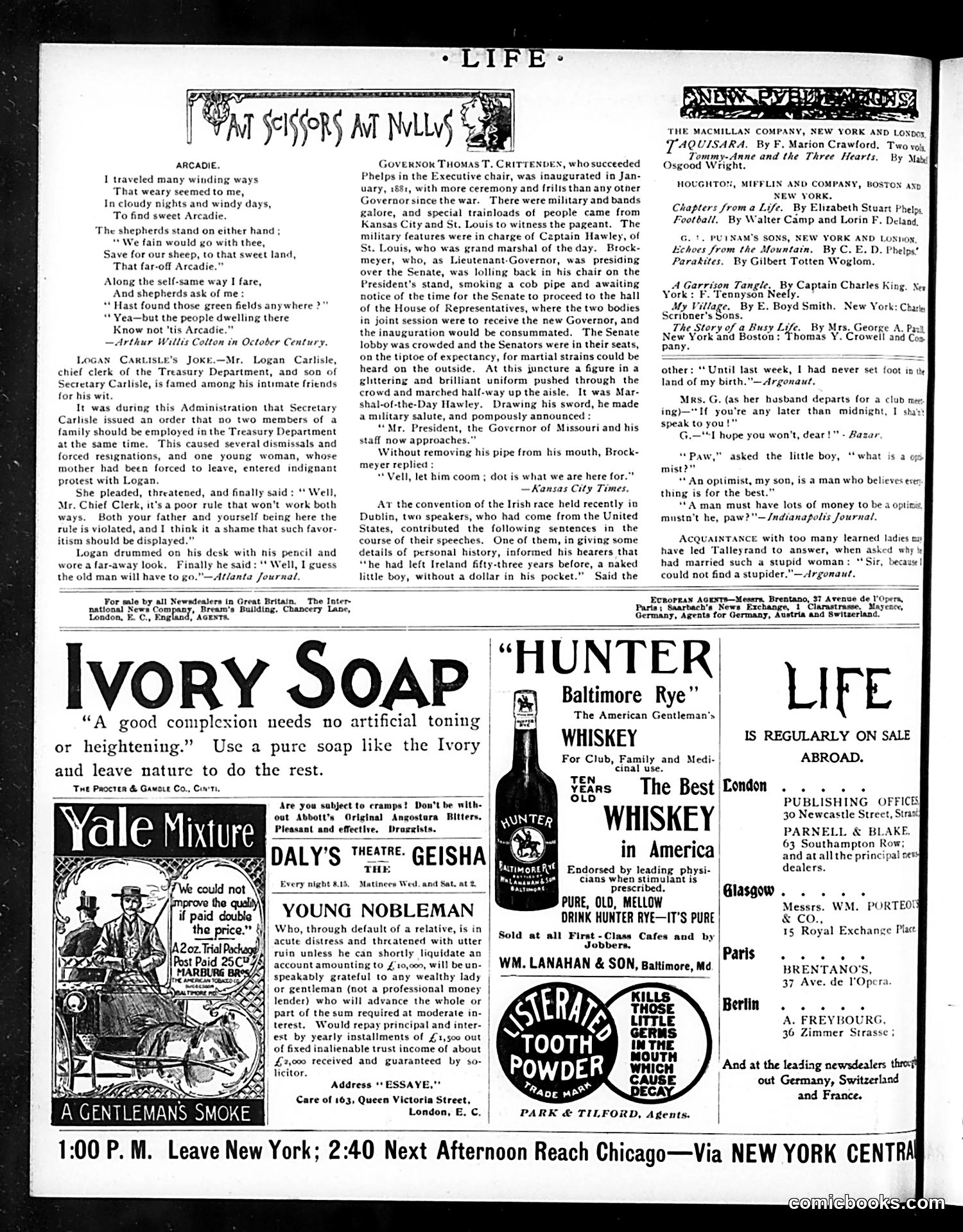
This page contains three humorous anecdotes satirizing American political figures and bureaucratic absurdity: **The Logan Carlisle joke** mocks Treasury Secretary Carlisle's nepotism rule. When a young woman protests that his own son works in the department alongside him, violating his own policy, Carlisle's son Logan cleverly responds that "the old man will have to go"—suggesting his father should resign rather than admit favoritism. The satire targets governmental hypocrisy. **Governor Crittenden's inauguration story** ridicules pompous ceremony. Despite elaborate military pageantry announcing the Governor's arrival, the Lieutenant-Governor (Brockmeyer) remains seated, smoking, dismissively saying "let him coom; dot is what we are here for"—deflating the pretentious spectacle with working-class common sense. **The Irish convention anecdote** (partially visible) appears to contrast American immigrant success stories with another speaker's perspective, though the full satirical point is cut off. All three ridicule governmental pretension and bureaucratic excess characteristic of Gilded Age American politics.
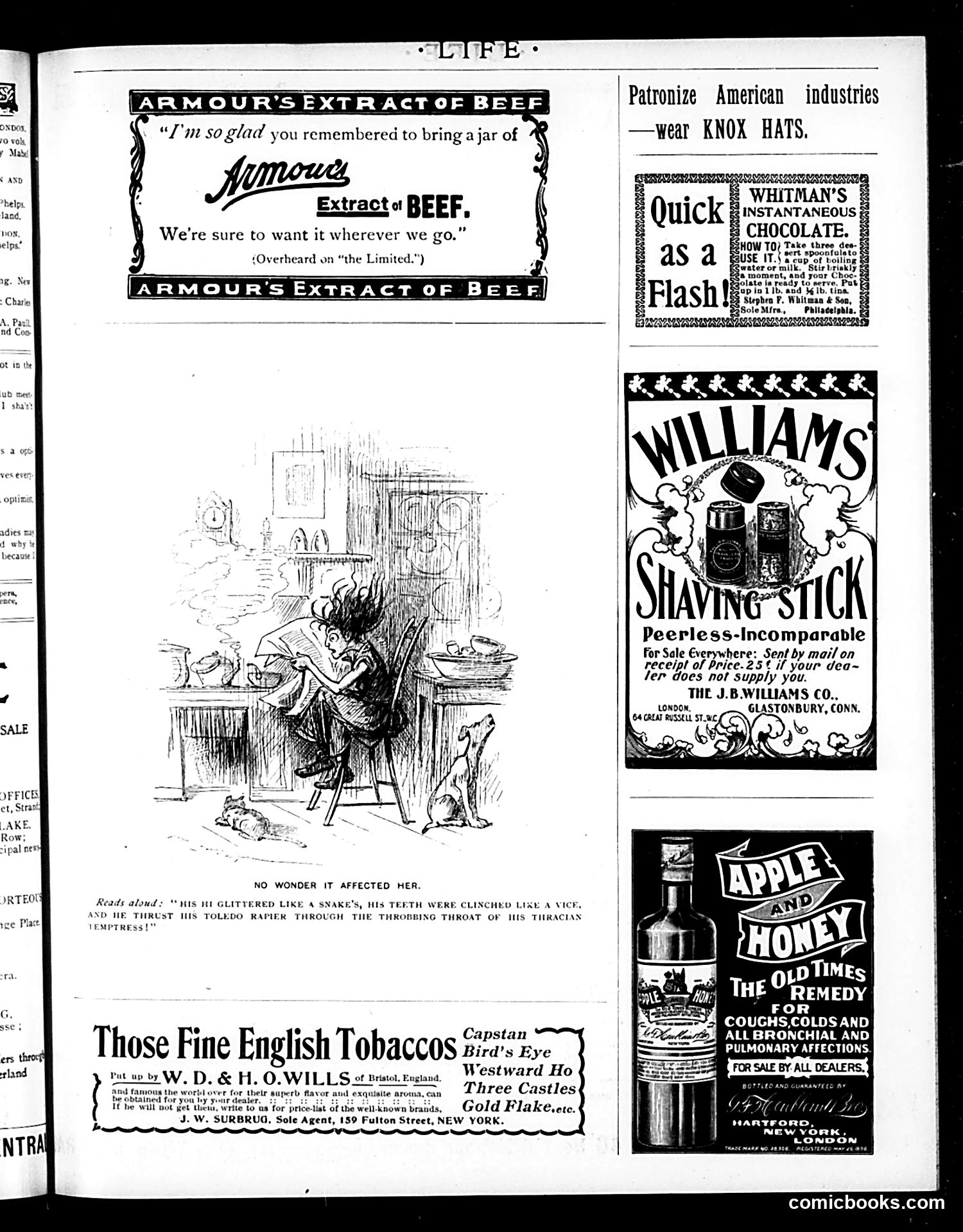
This page is primarily **advertising**, typical of early 20th-century magazines. The main cartoon depicts a woman dramatically affected by reading aloud sensational Victorian melodramatic prose—the caption "NO WONDER IT AFFECTED HER" is the joke. The violent, overwrought language (about glittering eyes, clenched teeth, and a rapier through a throat) causes her visible distress, satirizing the overwrought emotionalism of popular romantic fiction of the era. The surrounding ads for Armour's beef extract, Knox hats, Whitman's chocolate, Williams shaving stick, and Apple & Honey remedy represent typical period consumer products targeting middle-class readers. The tobacco ad promotes English brands, while the medicinal remedy suggests period anxieties about respiratory health. The page reflects both contemporary advertising practices and satirical commentary on sentimental literary tastes.
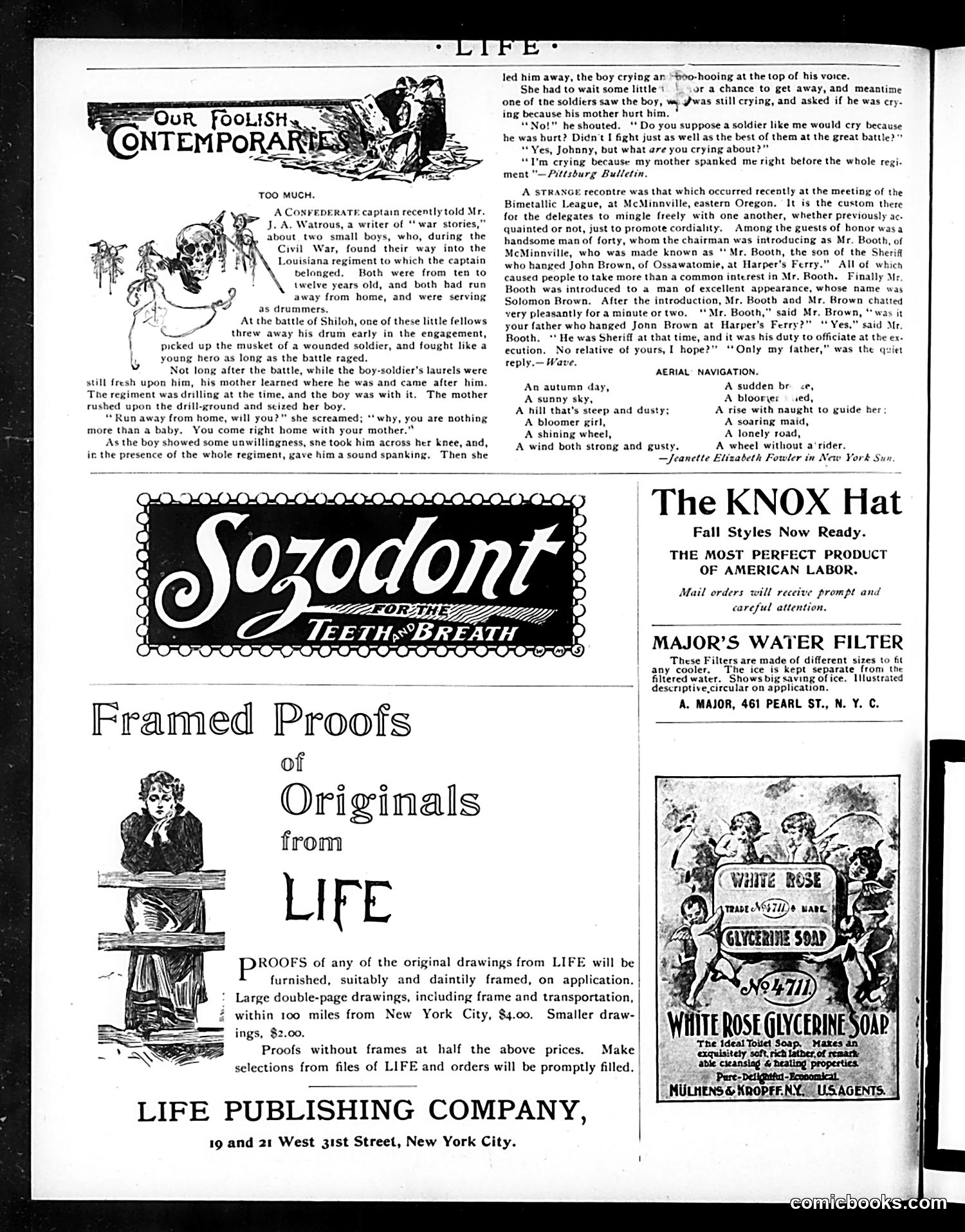
This page contains two separate anecdotes under "Our Foolish Contemporaries," Life magazine's humor section satirizing real events. **"Too Much"** describes an awkward encounter at an 1890s political gathering in Oregon. A man named Booth—whose father, as Sheriff, executed abolitionist John Brown at Harpers Ferry (1859)—is introduced to Solomon Brown, who reveals he is John Brown's son. The joke hinges on the dark irony: these two men, whose families were on opposite sides of America's most violent pre-Civil War conflict, must make polite small talk at a "cordiality" event. For modern readers, this requires knowing John Brown's raid and execution were pivotal moments preceding the Civil War. The second anecdote depicts a Civil War drummer boy who fights bravely in battle, only to be publicly spanked by his mother on the drill ground—mocking both maternal overprotectiveness and soldiers' wounded pride. The page is primarily **advertisements** (Sozodont toothpaste, Knox Hats, etc.) and a promotion for framed Life magazine artwork.
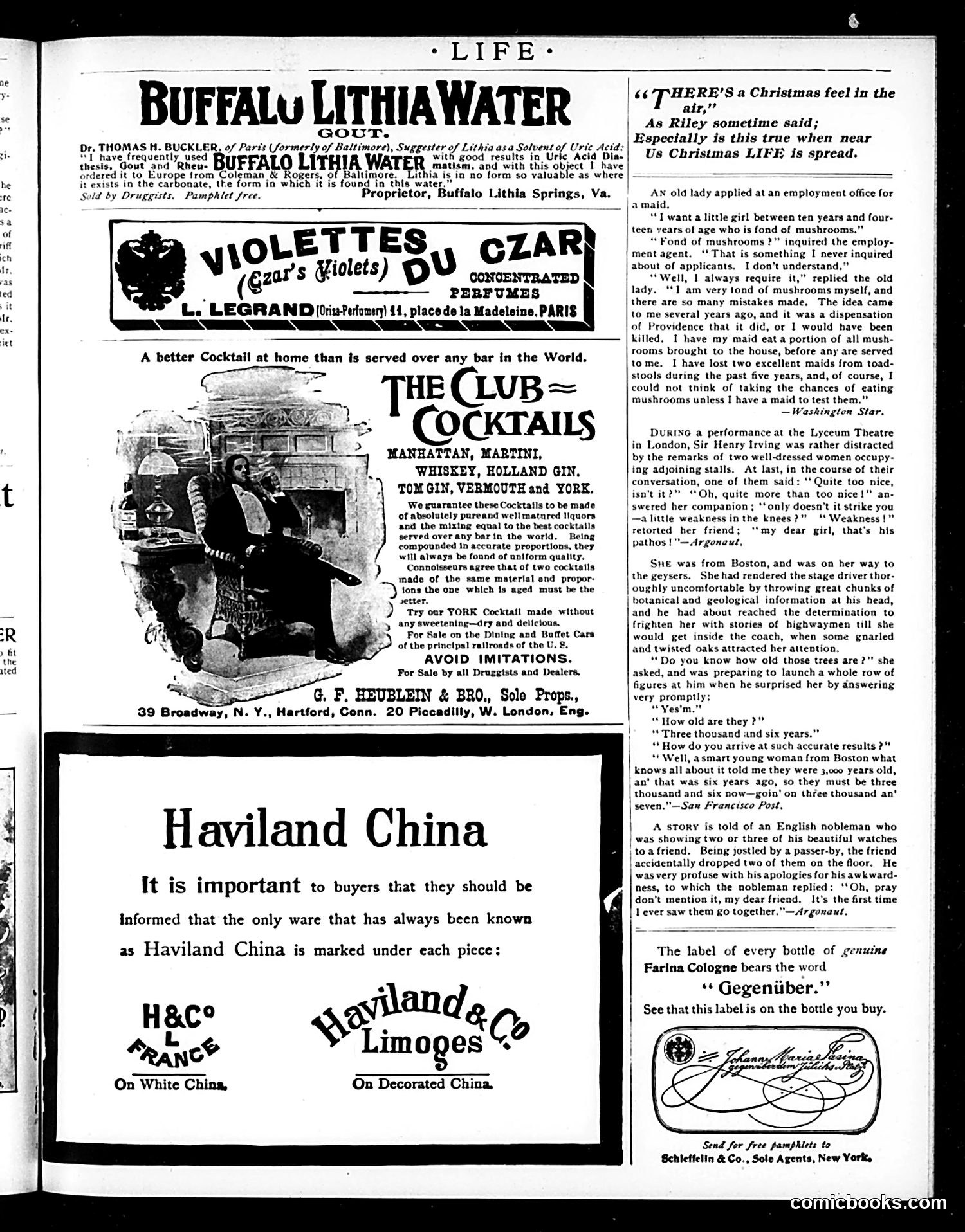
This page is primarily **advertising** for luxury goods and patent medicines popular in the late 19th/early 20th century: Buffalo Lithia Water (marketed as a cure for gout and rheumatism), French perfume, cocktail mixers, and fine china. The right column contains **humorous anecdotes** typical of Life's satirical content: 1. A joke about an old lady hiring a maid specifically to taste-test mushrooms first, after losing previous servants to poisonous toadstools. 2. An anecdote mocking an over-educated Boston woman pestering a stagecoach driver with geological lectures about geysers and ancient trees—satirizing pretentious female intellectualism. These brief stories reflect period attitudes: anxiety about food safety (no regulation), and gentle mockery of women attempting serious intellectual engagement. The page contains no political cartoons, only period advertisements and light social humor.
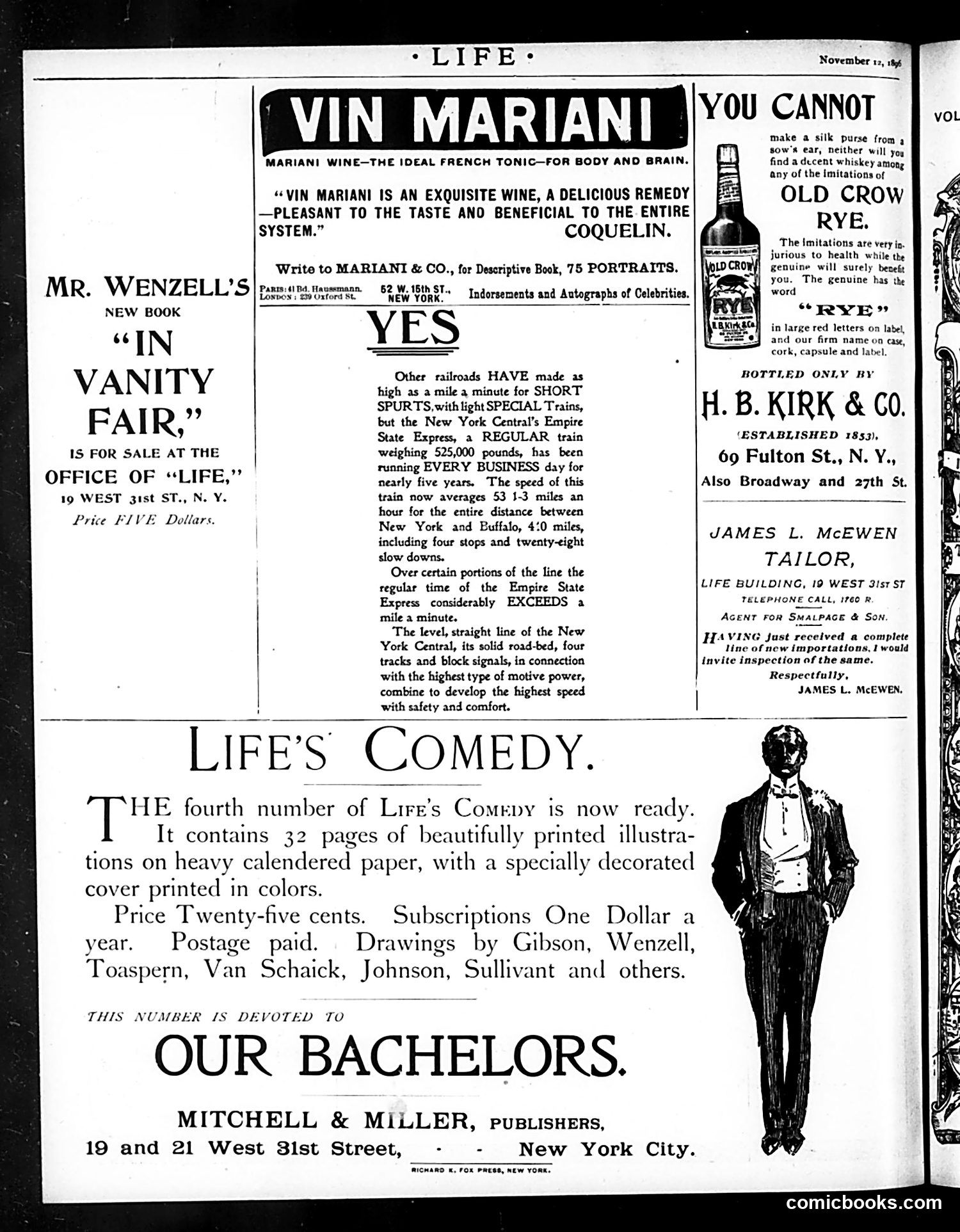
This is primarily an **advertising page** rather than editorial content. The main items are: **Vin Mariani Wine**: An advertisement for a French tonic wine claiming health benefits for "body and brain," endorsed by celebrity Coquelin. This reflects the late-19th-century patent medicine era when alcohol-based tonics were marketed as cure-alls. **New York Central Railway**: A factual advertisement boasting that the Empire State Express achieves sustained speeds of 53⅓ mph—near "a mile a minute"—celebrating modern railroad technology and safety. **Old Crow Rye Whiskey**: A warning against counterfeit whiskey, emphasizing the danger of imitations to health—reflecting contemporary concerns about product authenticity and adulteration. **Life's Comedy magazine**: Announcement for the fourth issue, devoted to bachelor humor, featuring cartoonists like Gibson and Wenzell. The page demonstrates how *Life* magazine subsidized editorial content through advertisements targeting affluent readers interested in luxury goods, health products, and rail travel.