
Life, 1896-11-12 · page 6 of 18
Life — November 12, 1896 — page 6: what you’re looking at
What you’re looking at
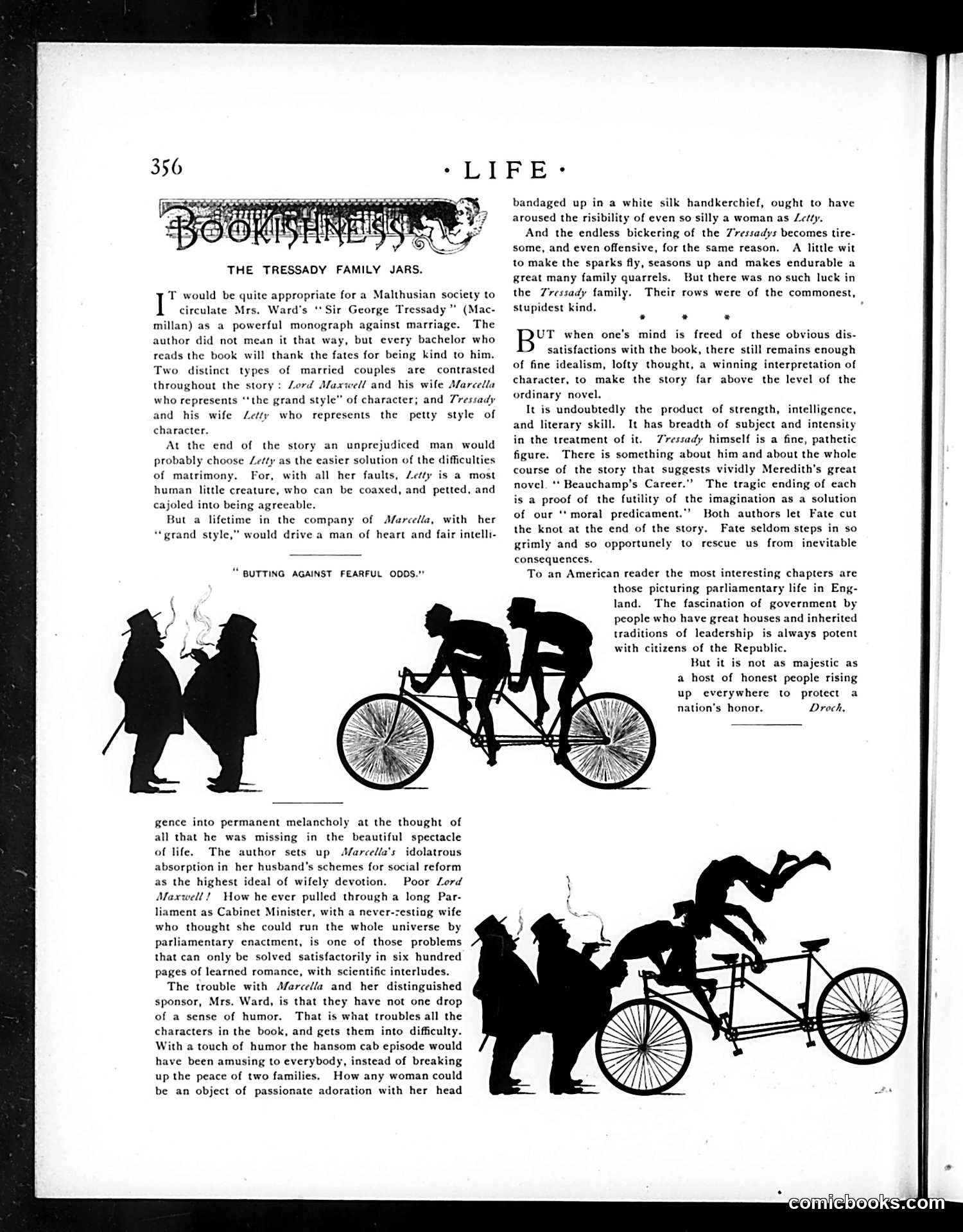
This page reviews "The Tressady Family Jars," a novel contrasting two types of married couples: *Marcella* (representing "grand style") and *Tressady* (representing "petty character"). The silhouette illustrations satirize marital discord. The top image shows two men arguing with gestures of conflict. Below, figures struggle with a tandem bicycle—a visual metaphor for marriage requiring coordination. One figure appears to fall or lose control. The bicycle humor likely references the late-Victorian/Edwardian era when bicycles symbolized both independence (especially for women) and the need for couples to work together. The tandem bike's instability mirrors the novel's theme of marriage difficulties. The review criticizes how *Marcella's* husband pursues social reform schemes while neglecting marital harmony, suggesting the satire targets idealistic reformers whose abstract principles damage personal relationships.
📄 Transcribed text from this page (OCR, searchable)
Machine-transcribed from the original scan — historical spelling and the odd misread are preserved.
*LIFE: THE TRESSADY FAMILY T would be quite appropriate for a Malthusian society to I circulate Mrs. Ward's ‘* Sir George Tressady " (Mac- millan) as a powerful monograph against marriage. The author did not mean it that w but every bachelor who reads the book will thank the fates for being kind to him. Two distinct types of married couples are contrasted throughout the story: Lord Maxwell and his wile Marcella who represents ‘the grand style” of character; and 7ressady and his wife Zetly who represents the petty style of character, At the end of the story an unprejudiced man would probably choose Letty as the easier solution of the difficulties of matrimony. For, with all her faults, Letty is a most human little creature, who can be coaxed, and petted, and cajoled into being agreeable. But a lifetime in the company of Marcella, with her ‘‘grand style,” would drive a man of heart and fair intelli- “ BUTTING AGAINST FEARFUL ODDS.” gence into permanent melancholy at the thought of all that he was missing in the beautiful spectacle of life. The author sets up Marcellas idolatrous absorption in her husband's schemes for social reform as the highest ideal of wifely devotion. Poor Lord Maxwell! How he ever pulled through a long Par- liament as Cabinet Minister, with a never-zesting wife who thought she could run the whole universe by parliamentary enactment, is one of those problems that can only be solved satisfactorily in six hundred pages of learned romance, with scientific interludes. The trouble with Marcella and her distinguished sponsor, Mrs. Ward, is that they have not one drop of a sense of humor. That is what troubles all the characters in the book, and gets them into difficulty. With a touch of humor the hansom cab episode would have been amusing to everybody, instead of breaking up the peace of two families. How any woman could be an object of passionate adoration with her head bandaged up in a white silk handkerchief, ought to have aroused the risibility of even so silly a woman as Letty. And the endless bickering of the 7ressadys becomes tire- some, and even offensive, for the same reason. A little wit to make the sparks fly, seasons up and makes endurable a But there was no such luck in Their rows were of the commonest, great many family quarrels. the Zressady family. stupidest kind. . . . UT when one’s mind is freed of these obvious dis- satisfactions with the book, there still remains enough of fine idealism, lofty thought, a winning interpretation of character, to make the story far above the level of the ordinary novel. It is undoubtedly the product of strength, intelligence, and literary skill. It has breadth of subject and intensity in the treatment of it. 7ressady himself is a fine, pathetic figure. There is something about him and about the whole course of the story that suggests vividly Meredith's great novel. * Beauchamp’s Career.” The tragic ending of each is a proof of the futility of the imagination as a solution of our ‘t moral predicament.”’ Both authors let Fate cut the knot at the end of the story. Fate seldom steps in so grimly and so opportunely to rescue us from inevitable consequences. To an American reader the most interesting chapters are those picturing parliamentary life in Eng- land. The fascination of government by people who have great houses and inherited traditions of leadership is always potent with citizens of the Republic. But it is not as majestic as a host of honest people rising up everywhere to protect a nation’s honor. Droch.