
Life, 1896-11-12 · page 10 of 18
Life — November 12, 1896 — page 10: what you’re looking at
What you’re looking at
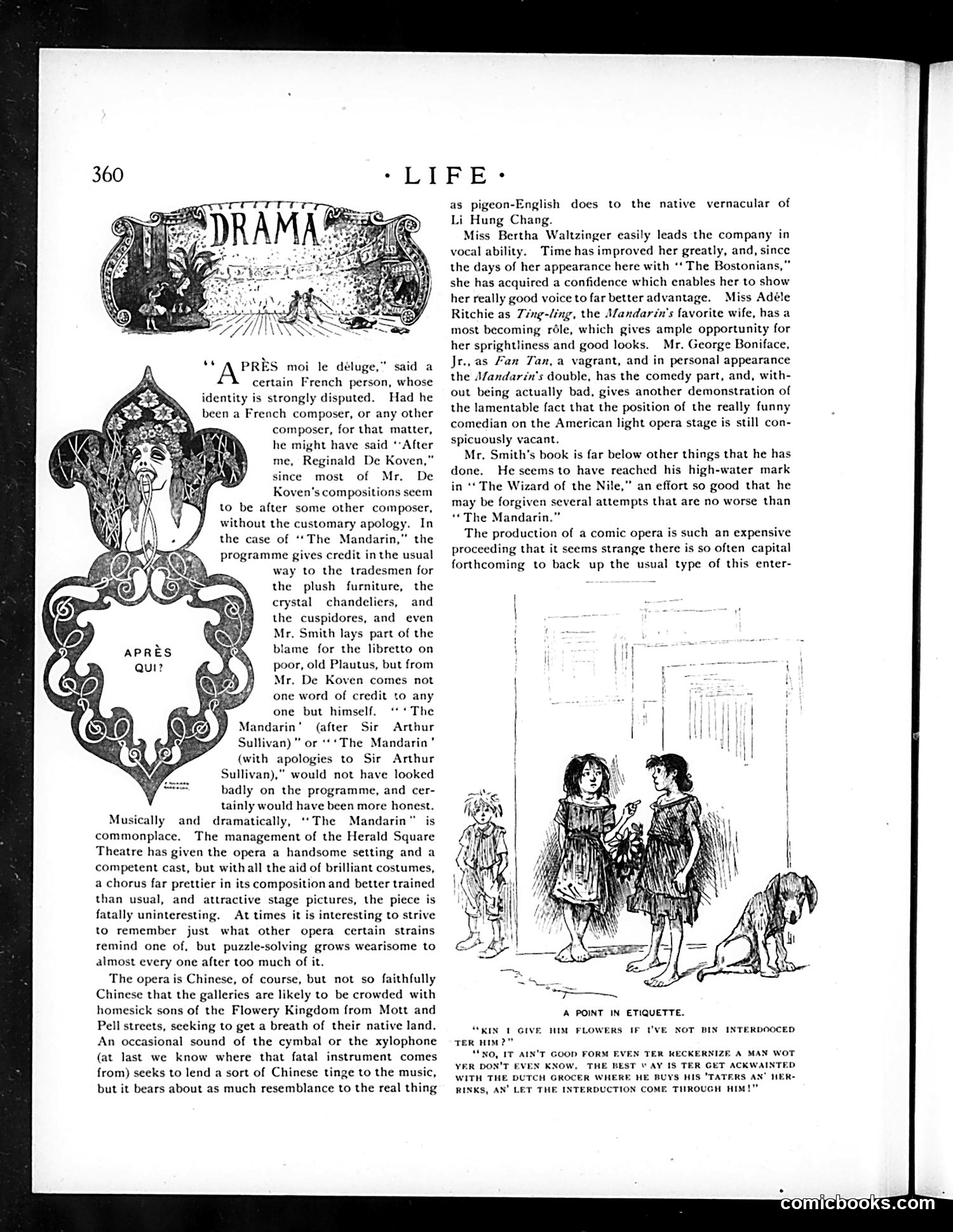
This page reviews a comic opera production of **"The Mandarin"** at the Herald Square Theatre. The text criticizes the show's program credit, sarcastically suggesting that composer Reginald De Koven should receive sole blame rather than crediting a librettist. The review is mixed: it praises the Herald Square Theatre's handsome setting, competent cast, and brilliant costumes, but finds the piece "fatally uninteresting." The critic notes that while the opera is ostensibly Chinese, it actually features homesick characters from Mott and Pell Streets (New York's immigrant neighborhoods) seeking their homeland. The illustration below depicts a scene about social etiquette, showing children in what appears to be a lesson about proper introductions and manners—a typical Victorian-era concern for Life magazine's satirical commentary on society.
📄 Transcribed text from this page (OCR, searchable)
Machine-transcribed from the original scan — historical spelling and the odd misread are preserved.
*LIFE: “A PRES moi le déluge,” said a certain French person, whose identity is strongly disputed. Had he been a French composer, or any other composer, for that matter, he might have said ‘After me, Reginald De Koven,” i most of Mr. De i seem to be after some other composer, without the customary apology. In the case of ‘‘The Mandarin,” the programme gives credit inthe usual way to the tradesmen for the plush furniture, the crystal chandeliers, and the cuspidores, and even Mr. Smith lays part of the blame for the libretto on poor, old Plautus, but from Mr. De Koven comes not one word of credit to any one but himself. ‘* ‘The Mandarin’ (after Sir Arthur Sullivan) " or ‘**The Mandarin’ (with apologies to Sir Arthur Sullivan),” would not have looked badly on the programme, and cer- tainly would have been more honest. Musically and dramatically, ‘‘The Mandarin" is commonplace. The management of the Herald Square Theatre has given the opera a handsome setting and a competent cast, but withall the aid of brilliant costumes, a chorus far prettier in its composition and better trained than usual, and attractive stage pictures, the piece is fatally uninteresting. At times it is interesting to strive to remember just what other opera certain strains remind one of, but puzzle-solving grows wearisome to almost every one after too much of it. The opera is Chinese, of course, but not so faithfully Chinese that the galleries are likely to be crowded with homesick sons of the Flowery Kingdom from Mott and Pell streets, seeking to get a breath of their native land. An occasional sound of the cymbal or the xylophone (at last we know where that fatal instrument comes from) seeks to lend a sort of Chinese tinge to the music, but it bears about as much resemblance to the real thing as pigeon-English does to the native vernacular of Li Hung Chang. Miss Bertha Waltzinger easily leads the company in vocal ability. Time has improved her greatly, and, since the days of her appearance here with ‘‘ The Bostonians,” she has acquired a confidence which enables her to show her really good voice to far better advantage. Miss Adéle Ritchie as 7ing-ding, the Mandarin's favorite wife, has a most becoming réle, which gives ample opportunity for her sprightliness and good looks. Mr. George Boniface, Jr.,as Fan Tan, a vagrant, and in personal appearance the Afandarin’s double, has the comedy part, and, with- out being actually bad, gives another demonstration of the lamentable fact that the position of the really funny comedian on the American light opera stage is still con- spicuously vacant. Mr. Smith's book is far below other things that he has done. He scems to have reached his high-water mark in ‘‘ The Wizard of the Nile,” an effort so good that he may be forgiven several attempts that are no worse than **The Mandarin.” The production of a comic opera is such an expensive proceeding that it seems strange there is so often capital forthcoming to back up the sual type of this enter- A POINT IN ETIQUETTE. “KIN [ GIVE HIM FLOWERS IF UVE NOT BIN INTERDOOCED TER HIM?” ‘*NO, IT AIN'T GOOD FORM EVEN TER KECKERNIZE A MAN WOT YER DON'T EVEN KNOW. THE BEST v AY IS TER GET ACKWAINTED WITH THE DUTCH GROCER WHERE HE BUYS HIS 'TATERS AN’ HER- ET THE INTERDUCTION COME THROUGH HIM!"