
A complete issue · 18 pages · 1896
Life — October 1, 1896
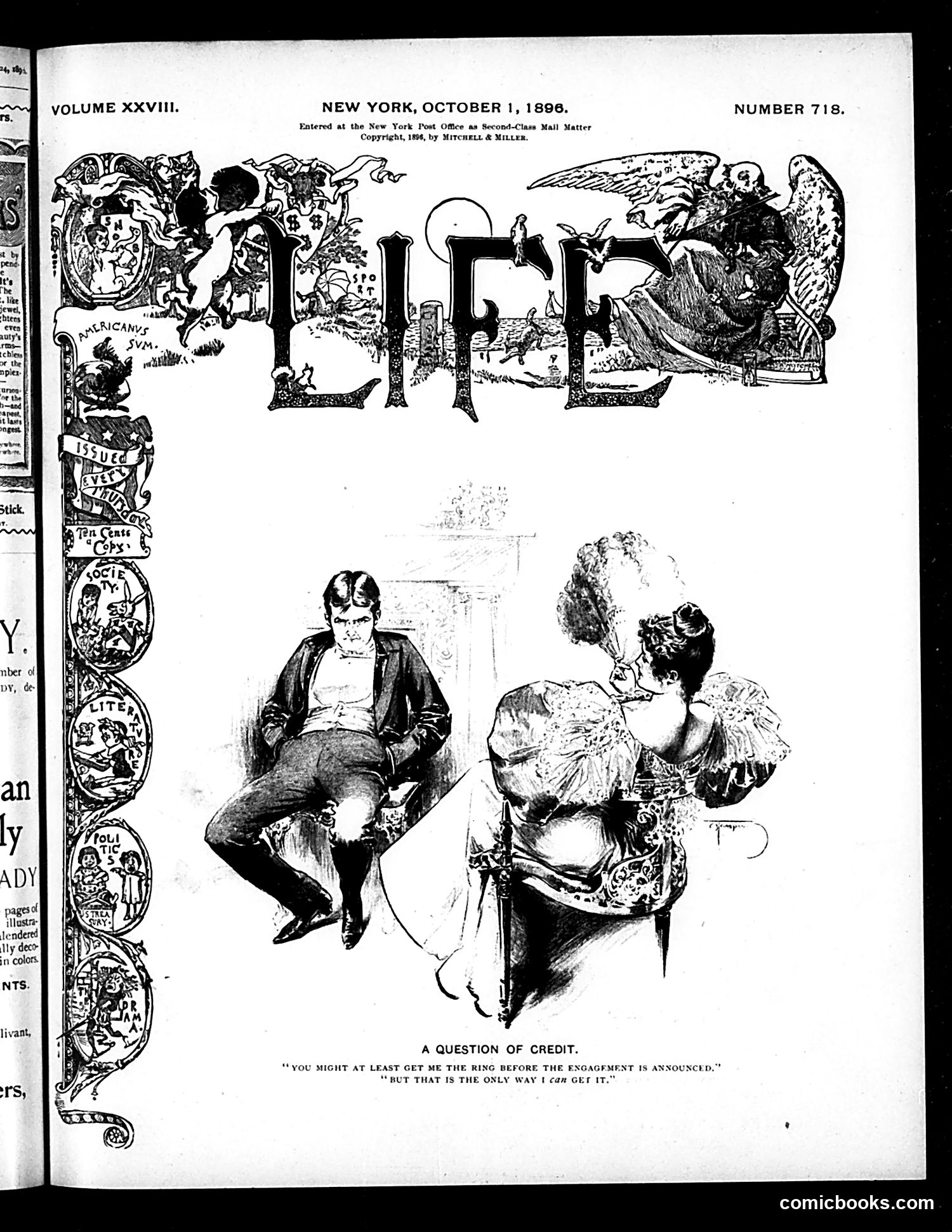
This cartoon satirizes engagement ring financing and marriage economics. A man and woman sit facing each other; the woman holds a ring and makes a demand: "You might at least get me the ring before the engagement is announced," to which the man replies, "But that is the only way I can get it." The satire mocks the financial pressures on men during courtship—specifically, that he cannot afford the ring without using the engagement announcement itself (presumably to borrow money or establish credit). It critiques both the materialistic expectations placed on women regarding engagement jewelry and the financial desperation this creates for suitors. The humor derives from the awkward catch-22: he needs the engagement to afford the ring, but she wants the ring before announcing the engagement.
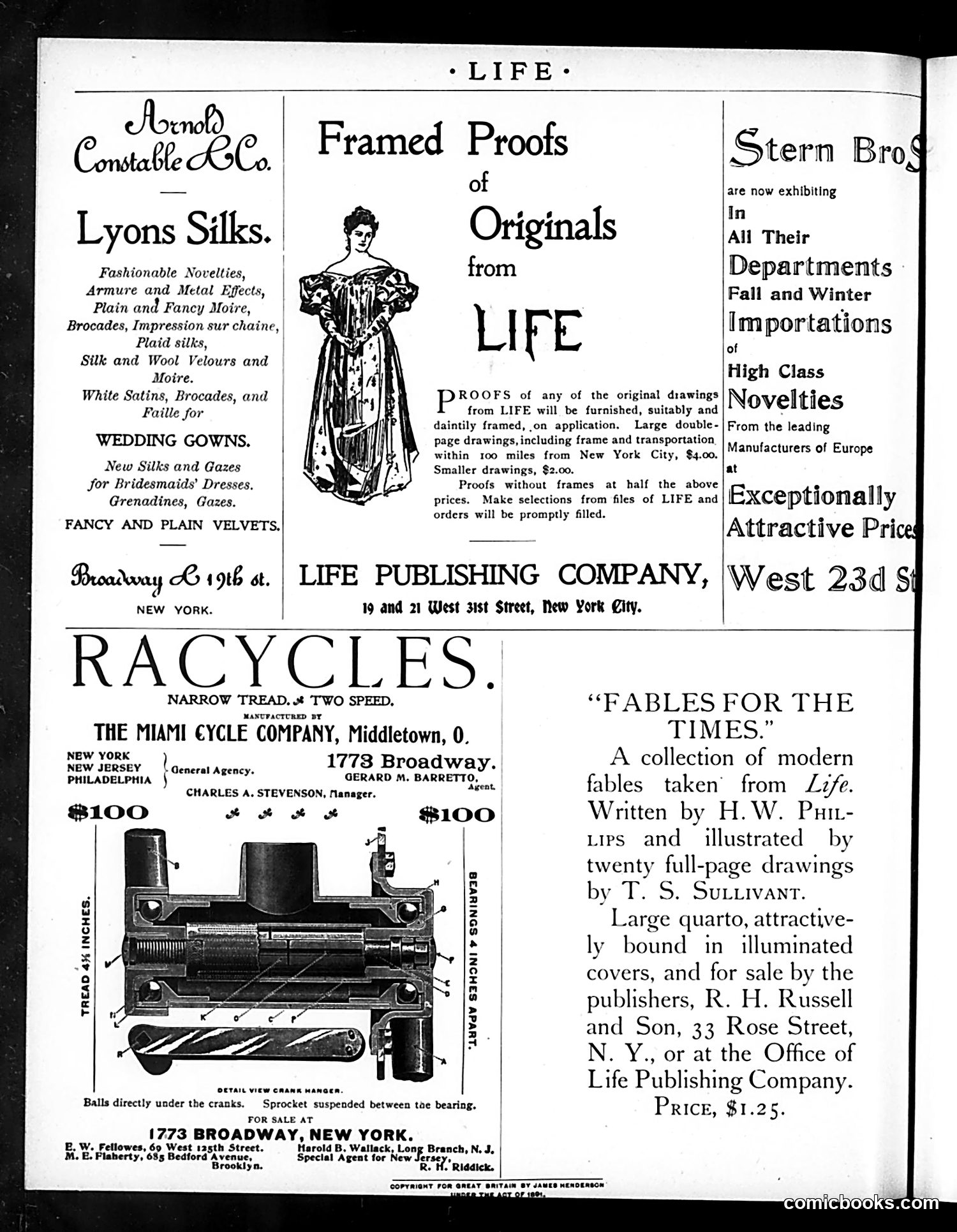
This page is primarily advertising with no political cartoon content visible. The ads promote: - **Arnold Constable & Co.**: silk fabrics and wedding gowns - **Life Publishing Company**: framed proofs of original drawings from Life magazine - **Stern Bros**: fall/winter importations of novelties - **Miami Cycle Company**: racycles priced at $100 - **"Fables for the Times"**: a book by H.W. Phillips illustrated by T.S. Sullivant, described as "modern fables taken from Life," priced at $1.25 The only illustration is a technical diagram of a racycle (an early bicycle model). There are no political cartoons or satirical commentary visible on this page—it functions purely as a commercial advertising section typical of early 20th-century magazine layouts.
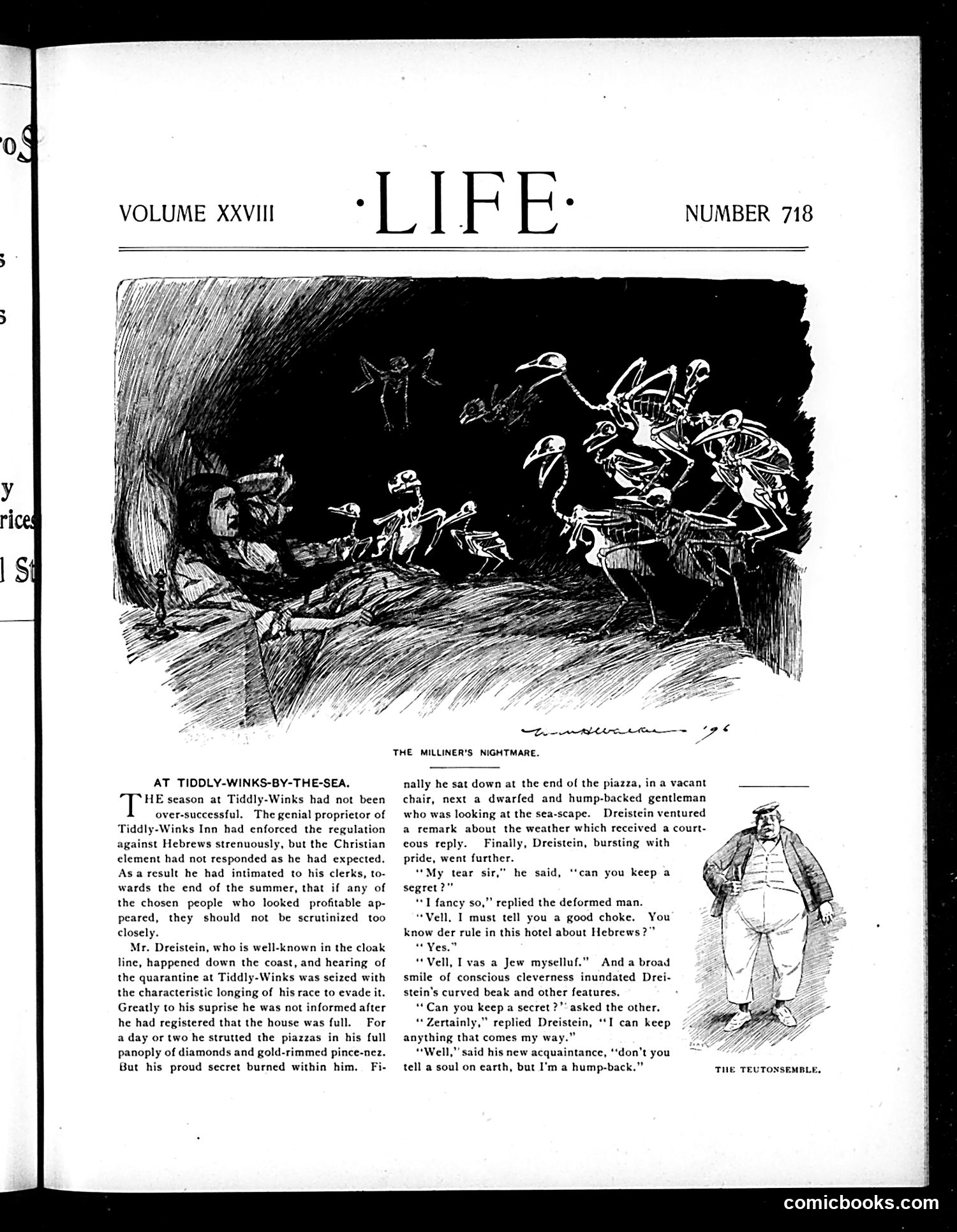
This is a fictional story titled "The Milliner's Nightmare" set at Tiddly-Winks-by-the-Sea, a seaside hotel. The accompanying illustration depicts skeletal, ghostly figures dancing or moving chaotically in a dark cavern-like space, while a man sits observing on the left. The narrative concerns a hotel proprietor named Dreistein who enforces strict quarantine rules against "Hebrews." When confronted by a deformed hunchbacked guest, Dreistein makes a pointed remark about the hotel's anti-Jewish policy. The hunchback responds with dark humor, claiming he can "keep a secret" about being Jewish. The satire appears to mock both discriminatory hotel practices and the absurdity of enforcing such prejudicial policies. The "nightmare" imagery suggests the proprietor's anxiety about his exclusionary practices being exposed or challenged.
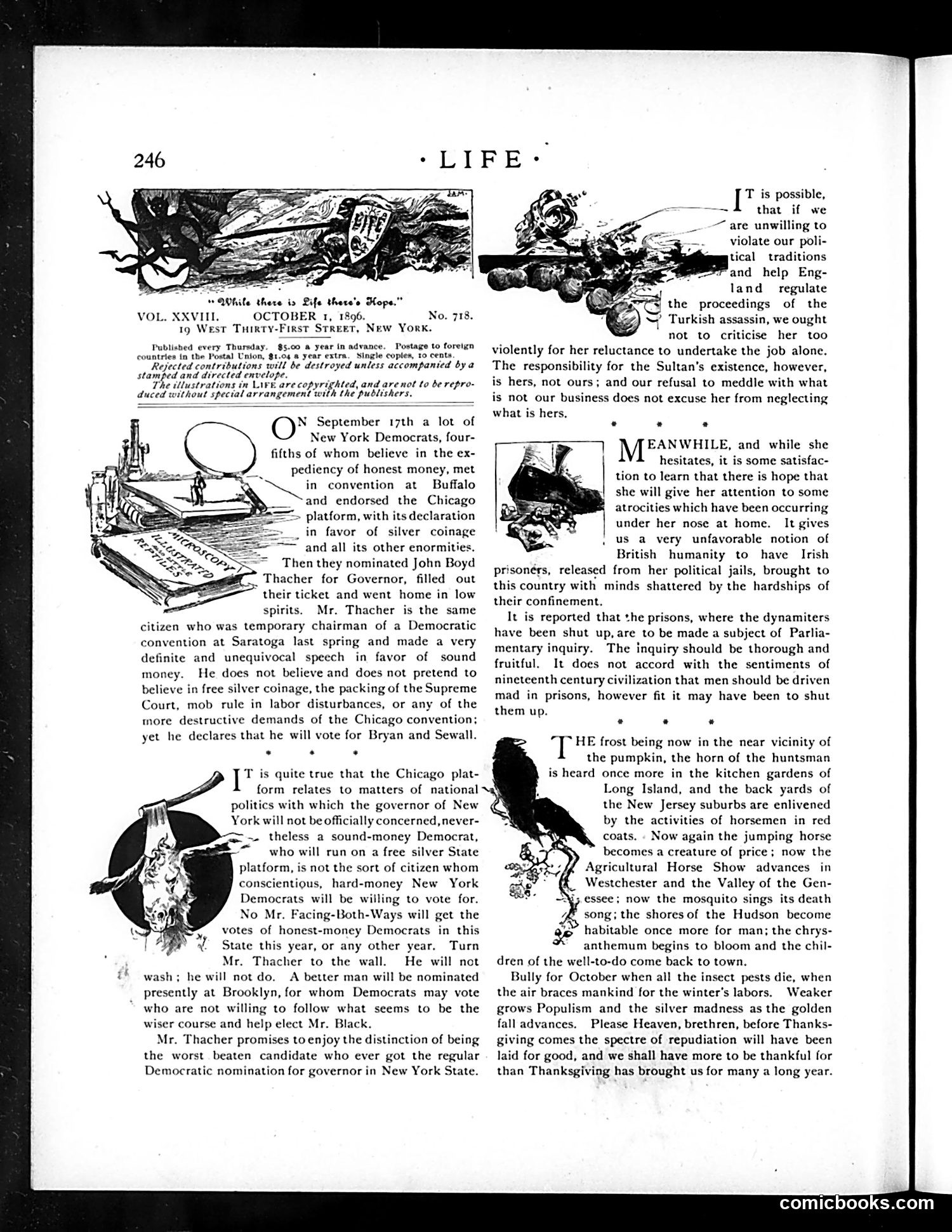
The main cartoon depicts a phonograph labeled with Democratic convention platform statements, satirizing the September Democratic convention in Buffalo. The text criticizes John Boyd Thacher, a temporary Democratic chairman who made speeches favoring "silver coinage and all its other enormities," yet nominated William Jennings Bryan for governor despite these positions. The satire targets the apparent contradiction: Thacher claims to oppose free silver yet supports a candidate presumably aligned with it. The phonograph metaphor suggests he's merely mechanically repeating party talking points rather than holding genuine beliefs. The cartoon mocks Democratic inconsistency and Thacher's political opportunism during the contentious 1896 election cycle when silver coinage was a major divisive issue.
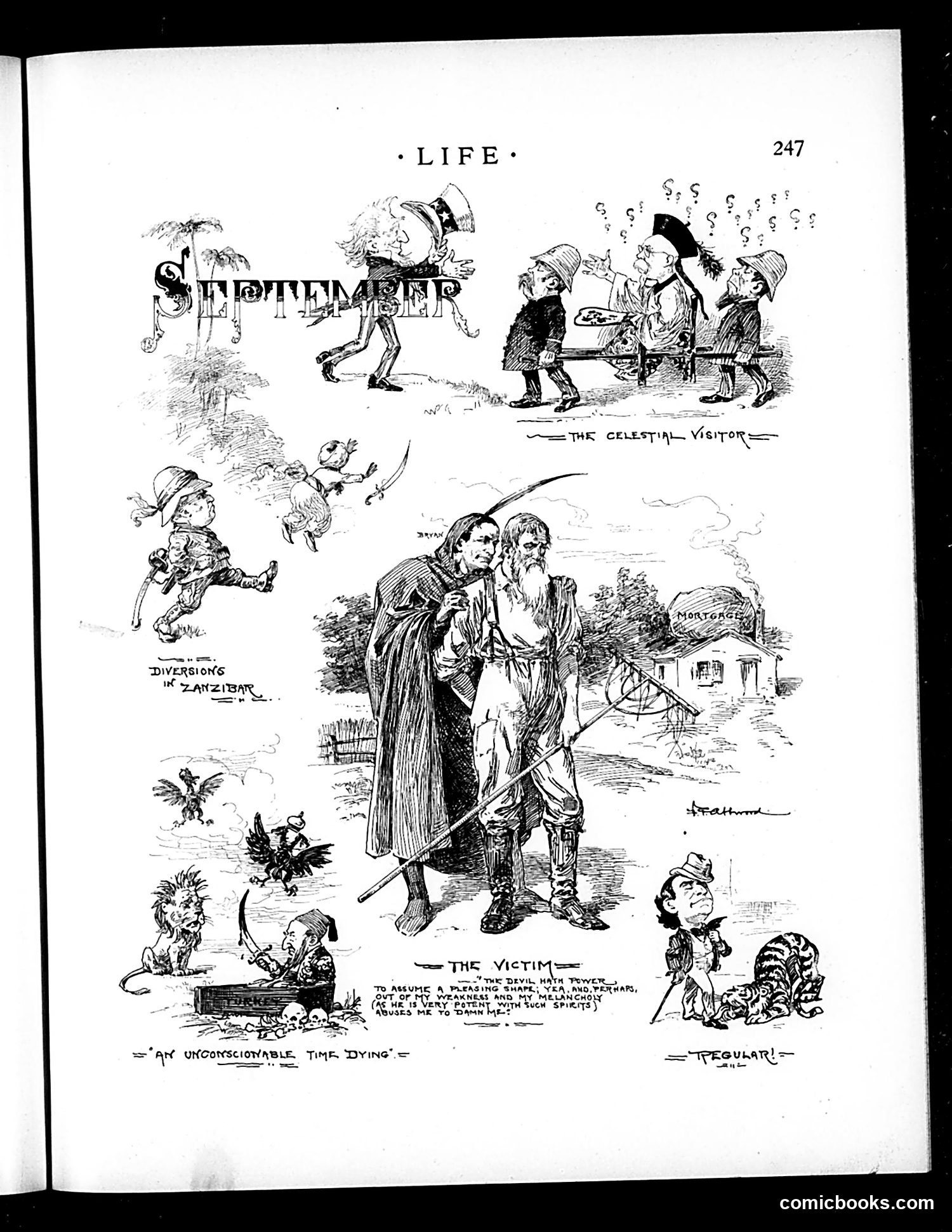
This page contains multiple satirical cartoons commenting on mortality and fate: **"The Celestial Visitor"** (top right) shows figures encountering what appears to be Death or a supernatural being distributing food/fate. **"The Victim"** (center) depicts two men with scythes in a rural setting near a mortgaged house, with accompanying text about assuming "a pleasing shape" and "melancholy" - suggesting Death personified as inevitable creditor or fate. **"Diversions in Vaudeville"** and **"An Unconscionable Time Dying"** (left side) present theatrical/comedic takes on death. **"Irregular!"** (bottom right) shows additional character studies. The page's overall theme explores death and mortality through various satirical lenses—as cosmic visitor, economic hardship, theatrical performance, and social irregularity. Typical of *Life*'s turn-of-century dark humor addressing universal human concerns.
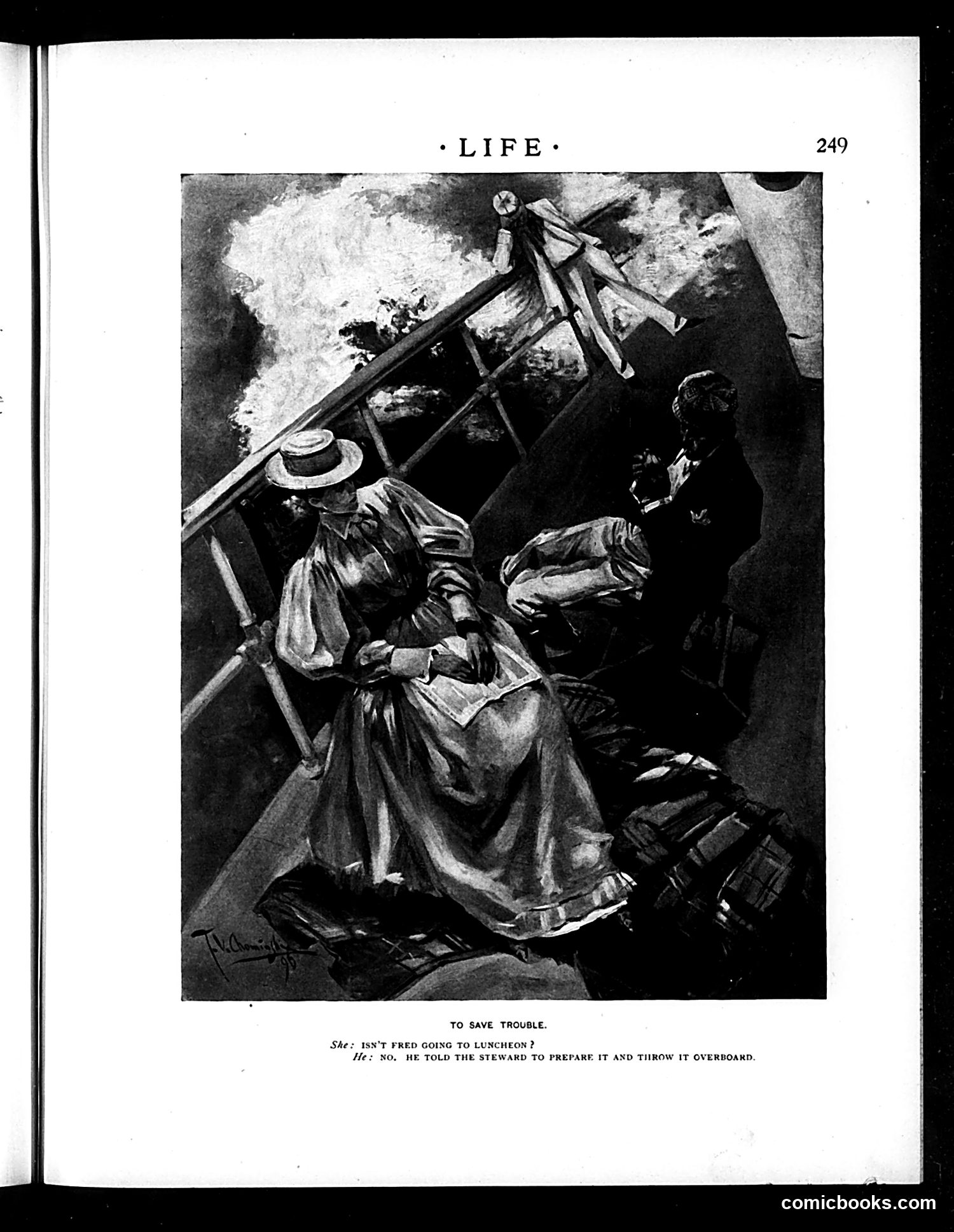
This cartoon depicts a couple on what appears to be a ship or boat. The woman asks if Fred is going to lunch, and the man replies that he's told the steward to prepare lunch and "throw it overboard" instead. The satire mocks seasickness during ocean travel. Rather than Fred bothering with the inconvenience of eating lunch only to get seasick, he's decided to skip the middle step and have the food discarded directly. It's dark humor about the common affliction of maritime illness—so severe that the effort of eating becomes pointless. The cartoon targets the frustration of early 20th-century ocean travelers for whom seasickness was an unavoidable nuisance of crossing.
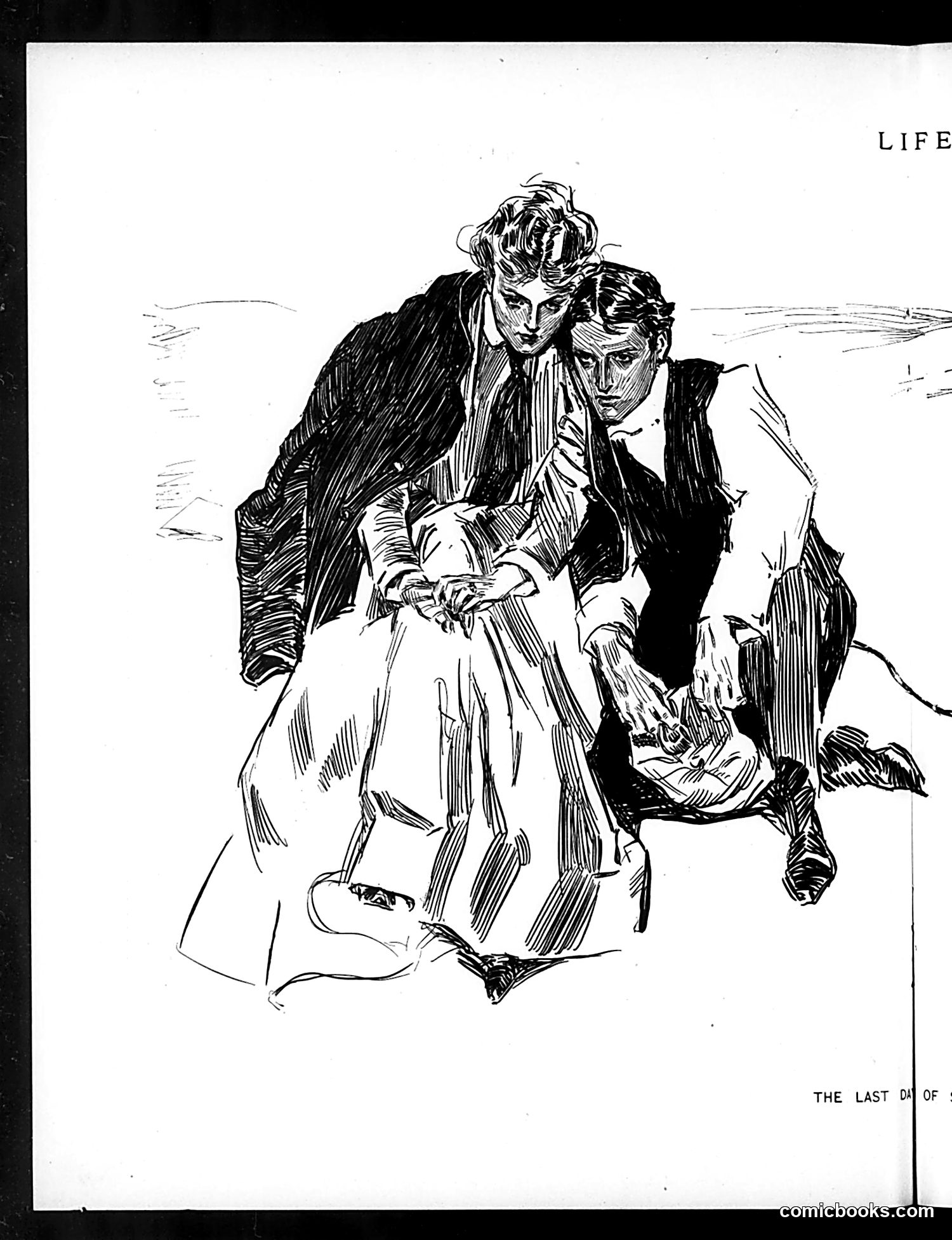
This page from *Life* magazine shows an ink illustration titled "THE LAST DA[Y OF]" (text cut off). The drawing depicts two figures in an intimate moment—a woman in a long skirt seated with a man leaning close behind her in what appears to be a romantic or affectionate pose. Without the complete title visible, the specific reference is unclear, though the artistic style and composition suggest this is satirizing a sentimental or romantic scenario popular in contemporary literature or theater. The skilled line-work is characteristic of *Life*'s editorial illustration style from the early 20th century. The incomplete caption prevents definitive identification of which specific cultural reference or narrative is being mocked here.
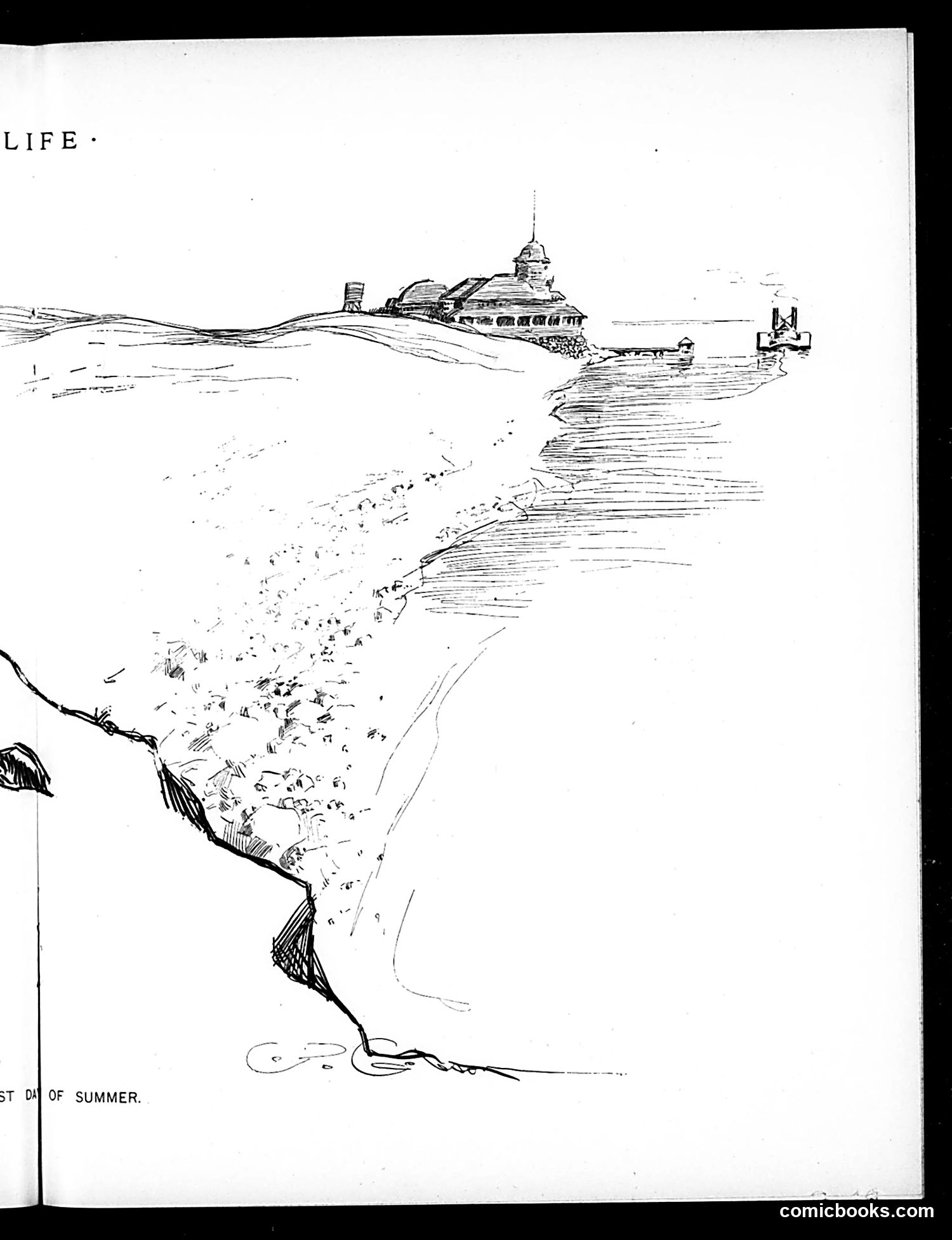
This is a sketch-style illustration titled "LIFE" at the top, with text at the bottom reading "ST D OF SUMMER" (likely "First Day of Summer"). The drawing depicts a seaside resort scene with a large Victorian-era hotel or casino building perched on a cliff or elevated terrain. A beach stretches below with numerous small figures of beachgoers scattered across the sand. A wooden pier or boardwalk extends into the water on the right side. The satirical point appears to be social commentary on summer leisure and beach culture—likely mocking either the crowding of popular seaside destinations, the contrast between the grand architecture and the masses of ordinary visitors, or the commercialization of summer recreation. The precise satirical target remains somewhat unclear without additional context, though the busy beach scene suggests commentary on mass tourism or the democratization of leisure activities.
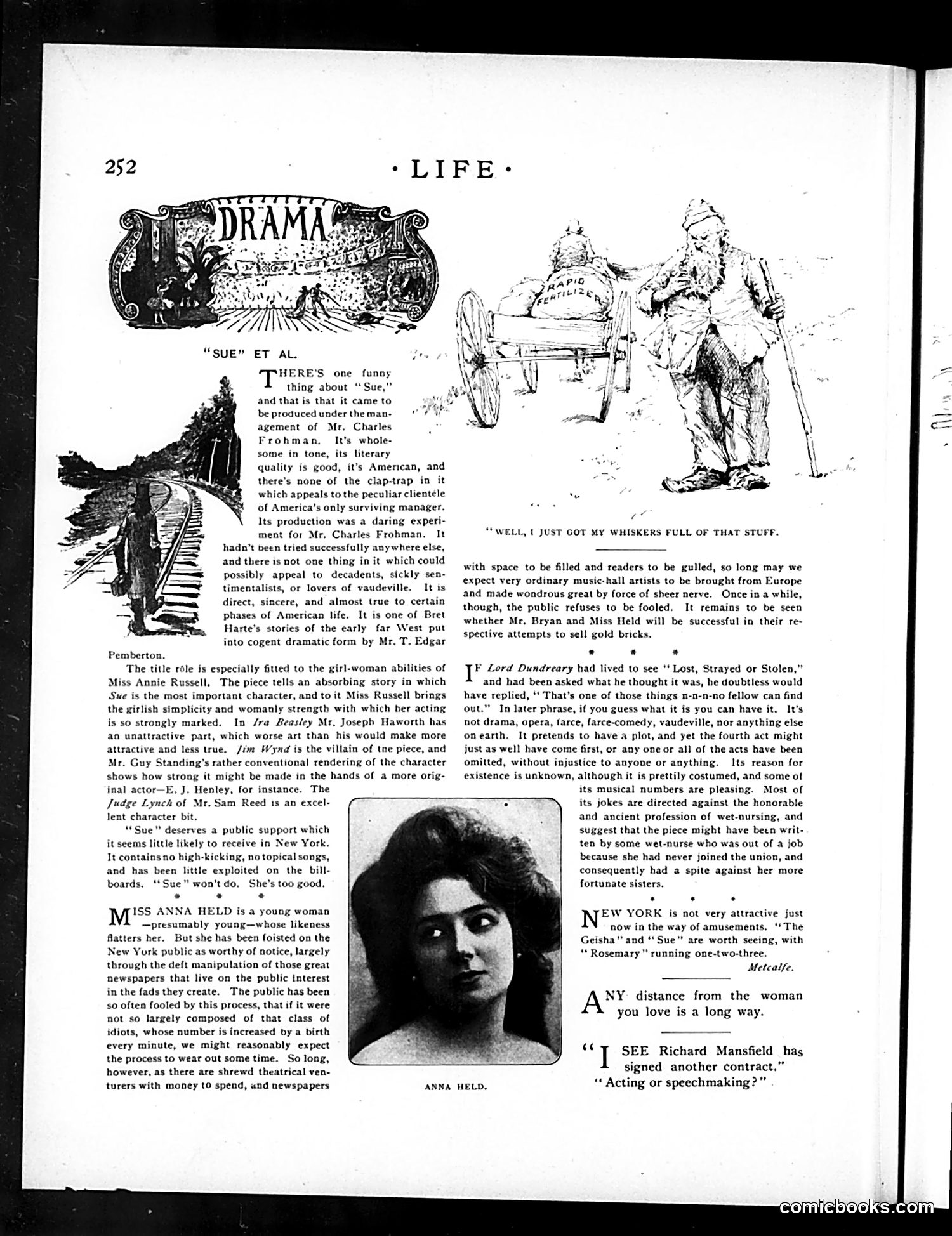
This Life magazine drama page reviews several theatrical productions. The main focus is on "Sue," produced by Charles Frohman, which the critic finds disappointingly ordinary despite its ambitious scope. The review criticizes the play's attempt to address American social issues but notes it lacks the distinctive voice needed to truly impact audiences. The page also discusses "Lord Dundreary" and mentions productions featuring Anna Held (shown in photograph), noting New York's current theatrical offerings include "The Geisha" and "Sue," with a joke about Richard Mansfield signing a new contract. The overall tone is that contemporary Broadway offerings, while numerous, are largely mediocre and artistically uninspired.
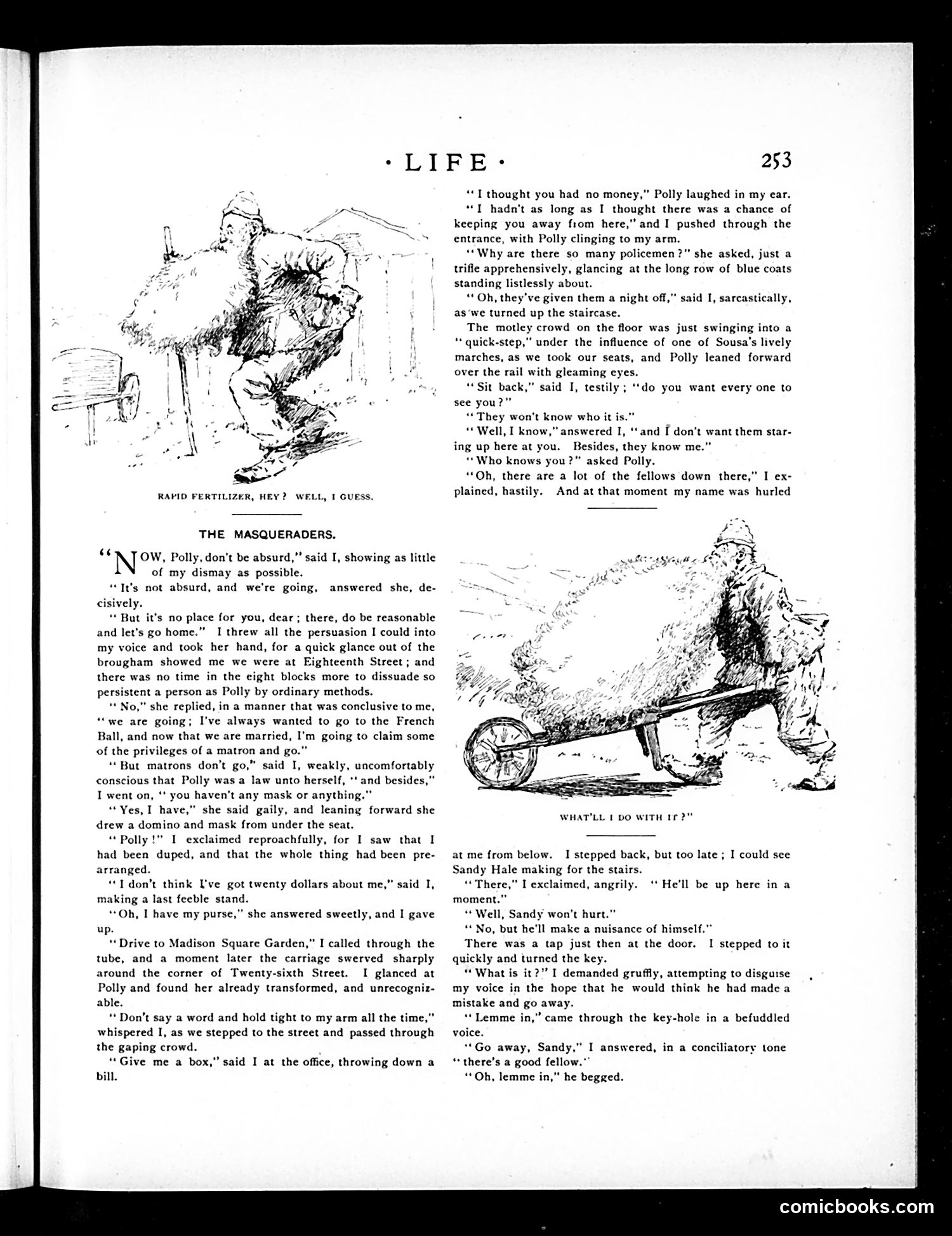
This page contains a story titled "The Masqueraders" with accompanying illustrations. The narrative depicts a social encounter where the narrator attempts to bring a woman named Polly to an upscale venue (the French Hall), but she's reluctant due to concerns about being recognized by police or "fellows down there." The story involves deception and disguise—Polly wears a mask and chemise to hide her identity. A character named Sandy Hale appears to be involved in some kind of scheme or evasion. The satirical point appears to target social hypocrisy around public appearances and hidden identities in high society, though without additional context about specific historical events or figures referenced, the precise social commentary remains unclear. The illustrations show period-appropriate clothing and settings consistent with early-to-mid 20th century America.
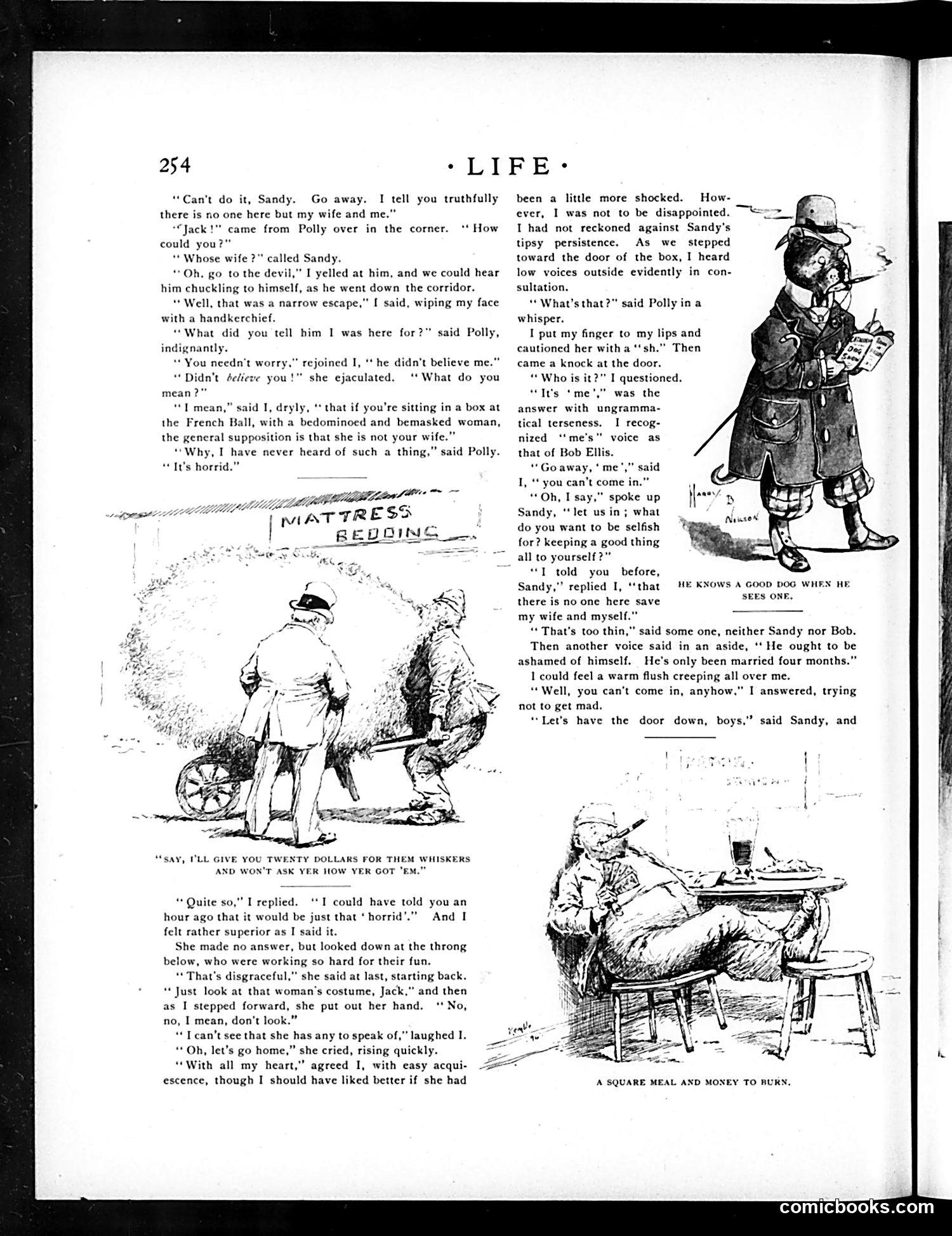
This appears to be a domestic-scandal humor piece typical of early 20th-century Life magazine satire. The narrative follows a man caught in a compromising situation at the "French Ball" with a woman (Polly) who is not his wife. When his friend Sandy and others discover them in a private box, the man insists his companion is actually his wife—a transparent lie that Sandy immediately penetrates. The humor operates on several levels: the absurdity of the obvious deception, the double standard regarding male infidelity (the bystanders condemn the man for being married only four months yet already unfaithful), and the escalating chaos as Sandy threatens to break down the door. The accompanying illustrations depict scenes of rowdiness and excess at the ball, reinforcing themes of moral laxity and social impropriety. The satire targets both the protagonist's transparent dishonesty and the permissive bachelor culture of the era.
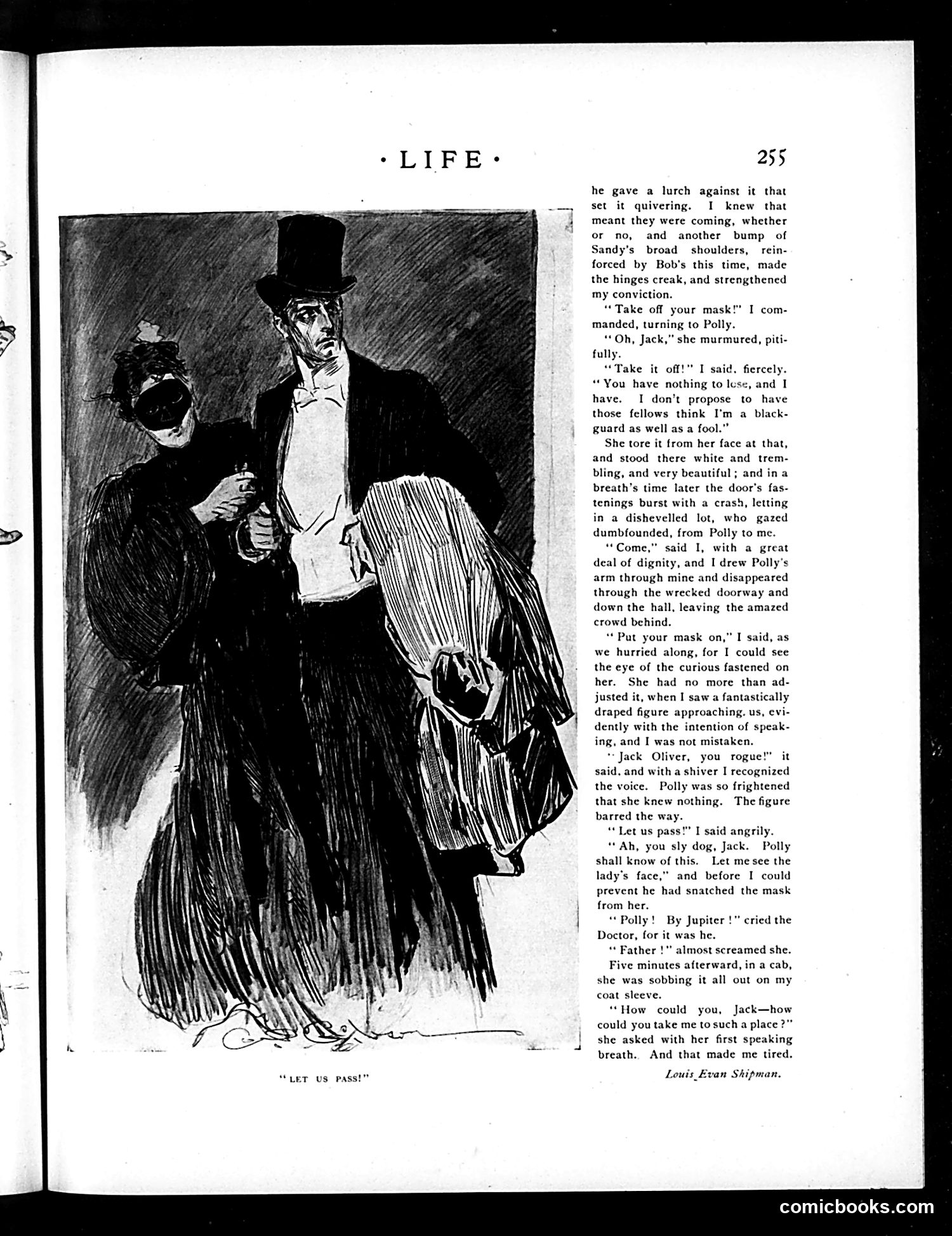
This page illustrates a dramatic scene from a serialized story by Louis Evan Shipman, likely from an early 20th-century *Life* magazine issue. The narrative depicts a masquerade ball scene where the protagonist "Jack" attempts to escort a woman named "Polly" past pursuing figures (Sandy and Bob are battering down a door). The illustration shows two figures in formal masquerade attire—a man in top hat and tuxedo alongside a woman in an elaborate gown and mask. The dramatic moment captures Jack demanding Polly remove her mask to preserve her reputation before the intruders arrive. The plot twist reveals "the Doctor" is actually Polly's father, who unmasks her and discovers the compromising situation. The story explores themes of social propriety, scandal, and consequences—typical melodramatic concerns of the era. The phrase "Let us pass!" captures the desperation of the moment as Jack tries to exit with dignity intact.
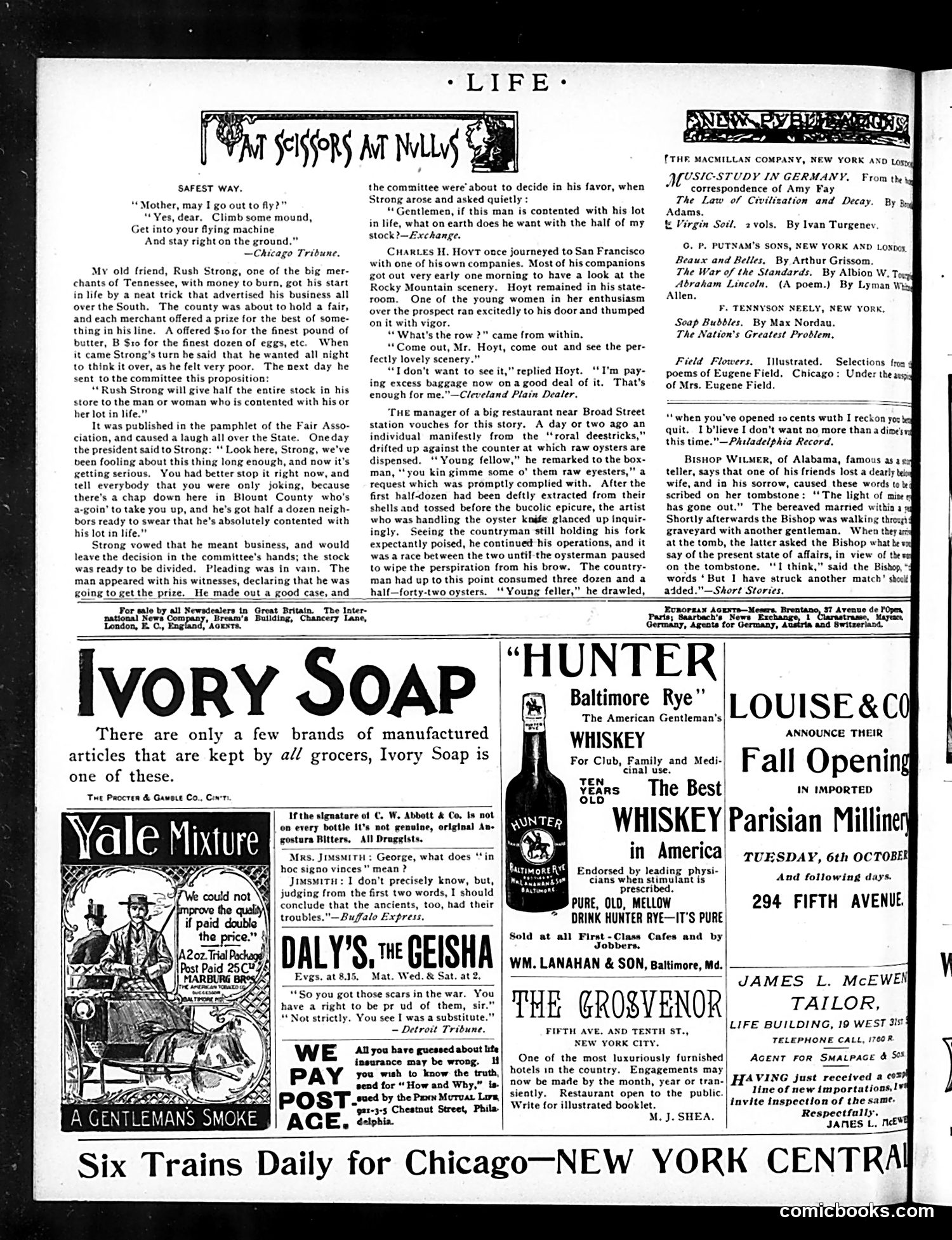
This page consists primarily of three humorous anecdotes rather than political cartoons. The jokes reflect late-19th/early-20th-century American humor: 1. **"Safest Way"** (top): A Chicago Tribune joke mocking early aviation's danger by suggesting flying machines belong on the ground. 2. **Rush Strong story**: A merchant's clever marketing trick—he offers half his store stock to anyone "contented with his lot in life," knowing the paradox will generate publicity. When someone actually tries to claim it, Strong questions the logic: if he's truly content, why does he need more? 3. **Charles Hoyt anecdote**: A playwright traveling refuses to leave his cabin to see Rocky Mountain scenery, claiming he's already "paying excess baggage" for it—a joke about traveling with theater company props. 4. **Oyster-eating contest**: A rural visitor out-eats the oyster-shucker, consuming 42 oysters before the worker quits. These are light social comedies playing on human nature, commercial cleverness, and regional stereotypes (rural visitors as unsophisticated). The page is primarily literary/humorous rather than satirical social commentary.
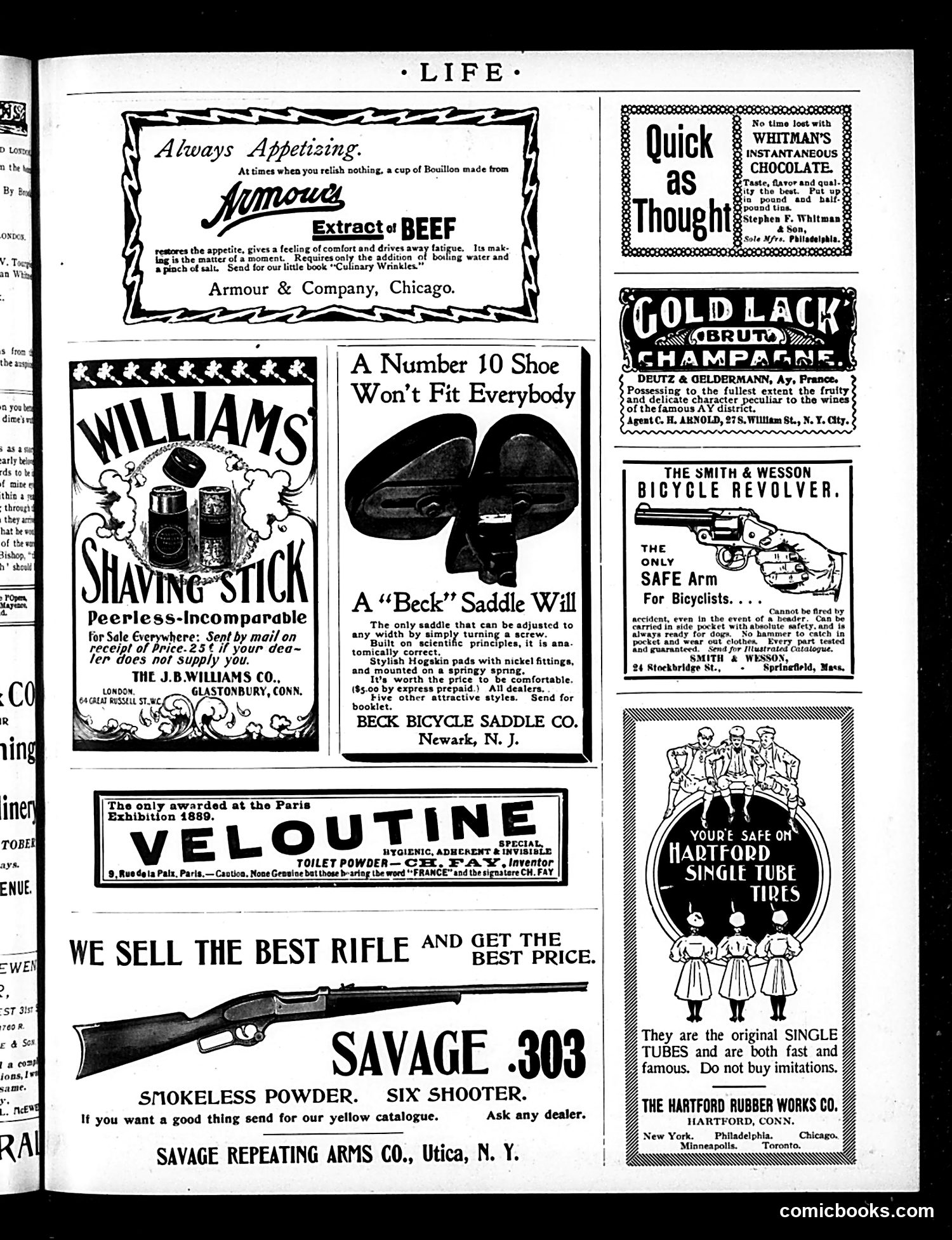
This is primarily an **advertising page** rather than satirical content. It features product advertisements typical of late 19th-century American commerce, with no political cartoons or social satire visible. The ads include: beef extract (Armour & Company), shaving sticks (J.B. Williams), bicycle saddles and accessories (Beck Saddle Co.), toilet powder (Veloutine), champagne (Deutz & Geldermann), rifles (Savage .303), and bicycle tires (Hartford Rubber Works). Notably, there's a "Smith & Wesson Bicycle Revolver" marketed as a "safe arm for bicyclists"—reflecting the era's widespread bicycle craze and apparently casual attitudes toward armed self-defense. The page demonstrates commercial advertising conventions of the period: ornate borders, bold typography, and emphasis on product reliability and convenience. No satirical commentary is present—these are straightforward product promotions aimed at affluent readers.
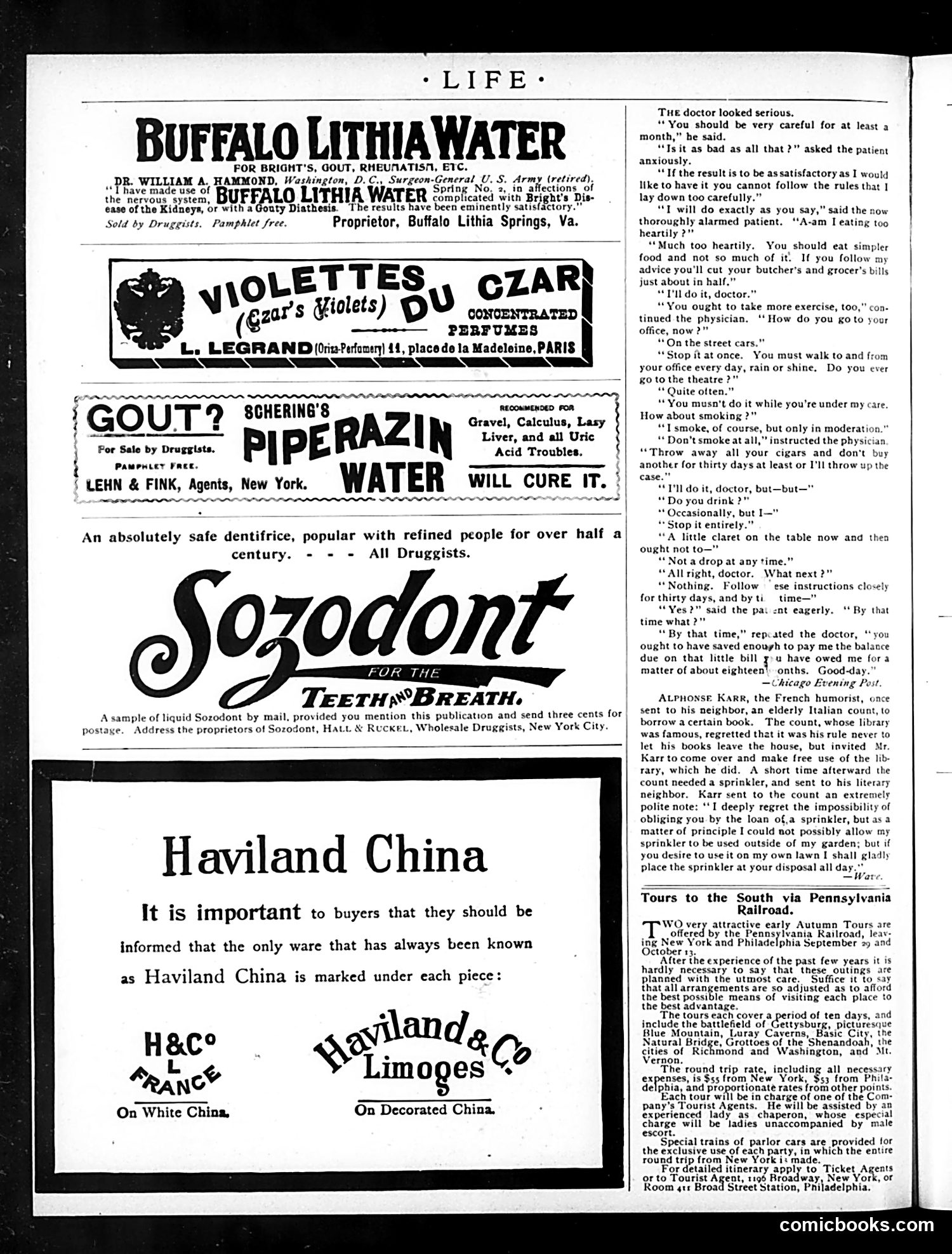
This page is primarily **advertising**, not satire. The left side contains patent medicine ads (Buffalo Lithia Water for gout, Piperazin Water, Sozodont toothpaste, Haviland China) typical of late 19th-century magazines. The right side contains a humorous **short story** (titled "The Doctor Looked Serious") about a patient receiving strict health advice—exercise, diet, abstinence from smoking and drinking—only to realize the doctor's real motive: collecting an overdue bill. The joke relies on the irony that rigorous self-denial was prescribed not for health but for the doctor's financial benefit. Below this is a brief anecdote about French humorist Alphonse Karr, illustrating the principle of reciprocity: when refused to lend books, Karr similarly refuses to lend a garden sprinkler, politely pointing out the absurdity of selective lending. Neither piece is political. Both are light social commentary on medical practice and neighborly etiquette—entertainment typical of *Life* magazine's satirical humor.
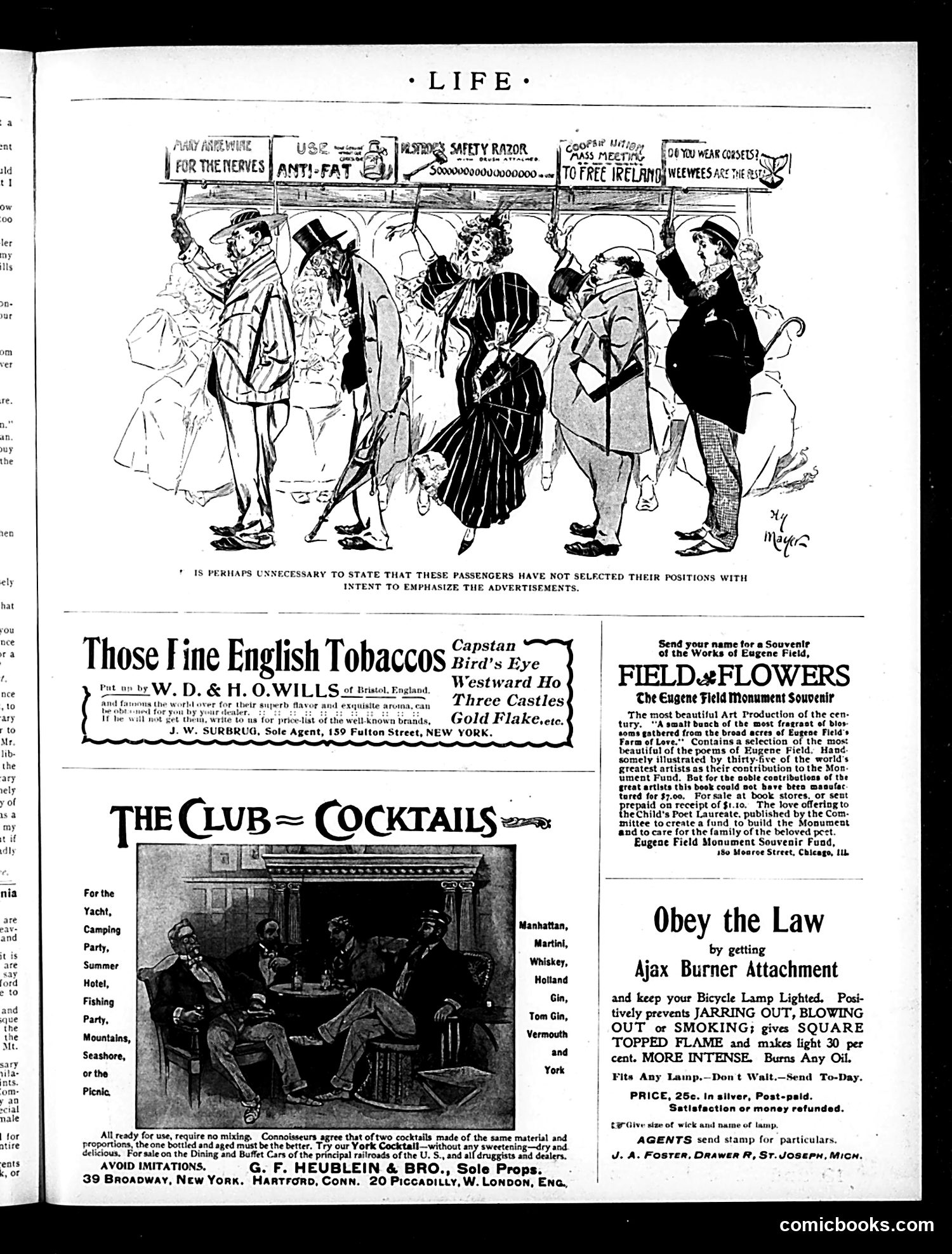
The top cartoon satirizes advertising by depicting subway or train passengers positioned awkwardly beneath product advertisements—a "safety razor," "anti-fat," "free Ireland" relief, and "corsets." The disclaimer below states these passengers didn't intentionally pose to promote these ads, mocking the absurd juxtaposition of human figures with commercial messaging. It's social commentary on how ubiquitous advertising colonizes public spaces and how companies exploit any visual association. The remainder of the page consists entirely of advertisements for tobacco, cocktails, Eugene Field poetry souvenirs, and bicycle lamp attachments—ironically demonstrating exactly what the cartoon critiques: Life magazine's heavy reliance on paid advertising to fund publication. The contrast between the cartoon's satirical jab at advertising and the ad-saturated page itself creates meta-humor about the magazine's own commercial dependencies.
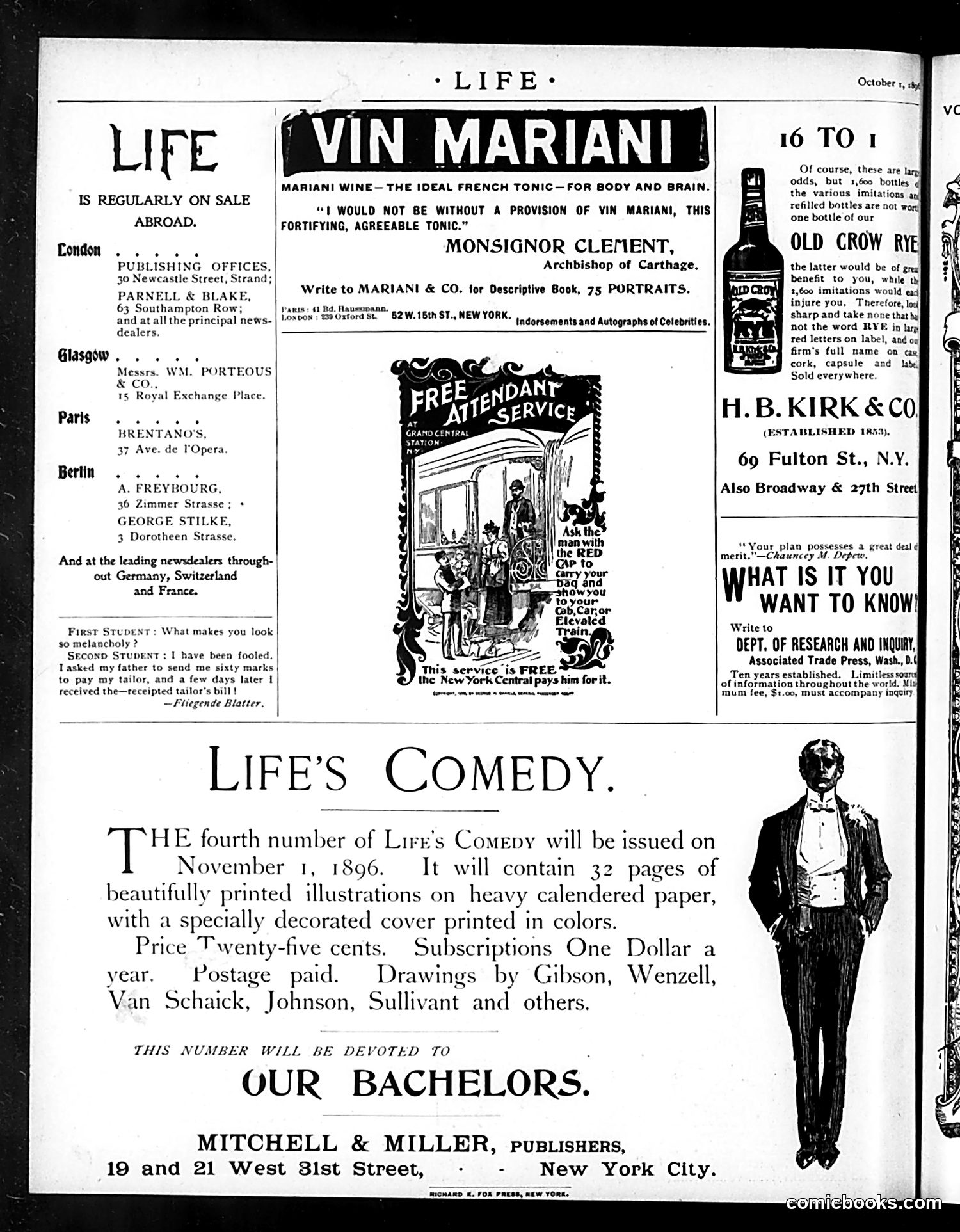
This page is primarily advertisements and publishing notices for Life magazine, dated October 1, 1896. The main content includes: **Vin Mariani advertisement**: Features an endorsement from the Archbishop of Carthage promoting this French wine tonic as beneficial for "body and brain." Such patent medicines were common in the 1890s. **Old Crow Rye whiskey ad**: Uses "16 to 1" odds language, possibly referencing the 1896 presidential election's monetary policy debates (the Free Silver movement), though here applied to whiskey authenticity versus counterfeit imitations. **One cartoon visible**: A brief joke about a student requesting money from his father for a tailor, receiving only a receipted bill—satirizing parental financial disappointment. This appears translated from German humor magazine *Fliegende Blätter*. **Life's Comedy announcement**: Promotes Life's November 1 issue featuring bachelor-themed content with illustrations by Gibson, Wenzell, and others—prominent illustrators of the era. The page reflects 1890s American magazine culture: humor, patent medicine culture, and emerging mass-market illustration.