
Life, 1896-10-01 · page 12 of 18
Life — October 1, 1896 — page 12: what you’re looking at
What you’re looking at
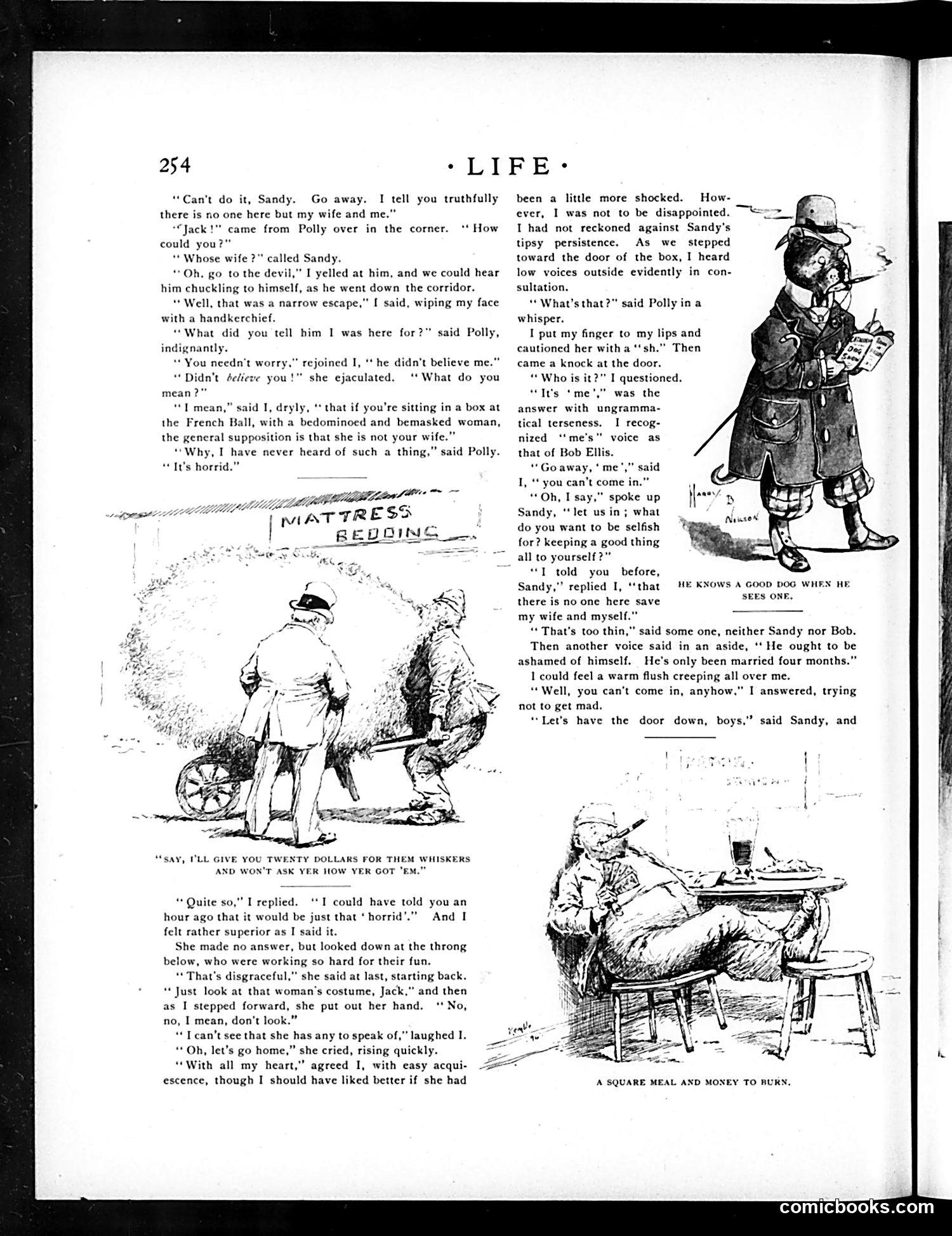
This appears to be a domestic-scandal humor piece typical of early 20th-century Life magazine satire. The narrative follows a man caught in a compromising situation at the "French Ball" with a woman (Polly) who is not his wife. When his friend Sandy and others discover them in a private box, the man insists his companion is actually his wife—a transparent lie that Sandy immediately penetrates. The humor operates on several levels: the absurdity of the obvious deception, the double standard regarding male infidelity (the bystanders condemn the man for being married only four months yet already unfaithful), and the escalating chaos as Sandy threatens to break down the door. The accompanying illustrations depict scenes of rowdiness and excess at the ball, reinforcing themes of moral laxity and social impropriety. The satire targets both the protagonist's transparent dishonesty and the permissive bachelor culture of the era.
📄 Transcribed text from this page (OCR, searchable)
Machine-transcribed from the original scan — historical spelling and the odd misread are preserved.
254 “Can't do it, Sandy. Go away. I tell you truthfully there is no one here but my wife and me.” Jack!" came from Polly over in the corner. could you?” "Whose wife ?" called Sandy. “Oh, go to the devil,” I yelled at him, and we could hear him chuckling to himself, as he went down the corridor. “Well, that was a narrow escape,” I said, wiping my face with a handkerchief. “What did you tell him I was here for?” said Polly, indignantly. ** You needn't worry,” rejoined I, ‘* he didn’t believe me.” “Didn't delieve you!” she ejaculated. ‘What do you mean?” “I mean,” said I, dryly, ** that if you're sitting in a box at the French Ball, with a bedominoed and bemasked woman, the general supposition is that she is not your wife.” “Why, I have never heard of such a thing, “It's horrid.” “How id Polly. “Say, PLL GIVE YOU TWENTY DOLLARS FOR THEM WHISKERS AND WON'T ASK YER OW YER GOT 'EM.” “ Quite so,” I replied. hour ago that it would be just that ‘ horrid’.” felt rather superior as I said it. She made no answer, but looked down at the throng below, who were working so hard for their fun. “That's disgraceful,” she said at last, starting back. “Just look at that woman's costume, Jack,” and then as I stepped forward, she put out her hand. ‘No, no, I mean, don't look.” “Tcan’t see that she has any to speak of,” laughed I. “Oh, let’s go home,” she cried, rising quickly. “With all my heart,” agreed I, with easy acqui- escence, though I should have liked better if she had “I could have told you an And I *LIFE: been a little more shocked. How- ever, I was not to be disappointed. —=22_ I had not reckoned against Sandy's tipsy persistence. As we stepped toward the door of the box, I heard low voices outside evidently in con- sultation. “What's that?” said Polly in a whisper. I put my finger to my lips and cautioned her witha “sh.” Then came a knock at the door, “Who is it?” I questioned, “T's ‘me’,” was the answer with ungramma- tical terseness. I recog- nized ‘tme’s” voice as that of Bob Ellis. Go away,‘ me’,” said ou can’t come in.” “Oh, I say,” spoke up Sandy, ‘let us in; what do you want to be selfish for? keeping a good thing all to yourself?” “1 told you before, Sandy,” replied I, “that there is no one here save my wife and myself.” ‘That's too thin,” said some one, neither Sandy nor Bob. Then another voice said in an aside, ‘‘ He ought to be ashamed of himself. He's only been married four months.” I could feel a warm flush creeping all over me. “Well, you can't come in, anyhow,” I answered, trying not to get mad. ‘Let's have the door down, boys,” said Sandy, and E KNOWS A GOOD DOG WHEN HE SEES ONE, A SQUARE MEAL AND MONEY TO BURN, comicbooks.com