
Life, 1896-10-01 · page 10 of 18
Life — October 1, 1896 — page 10: what you’re looking at
What you’re looking at
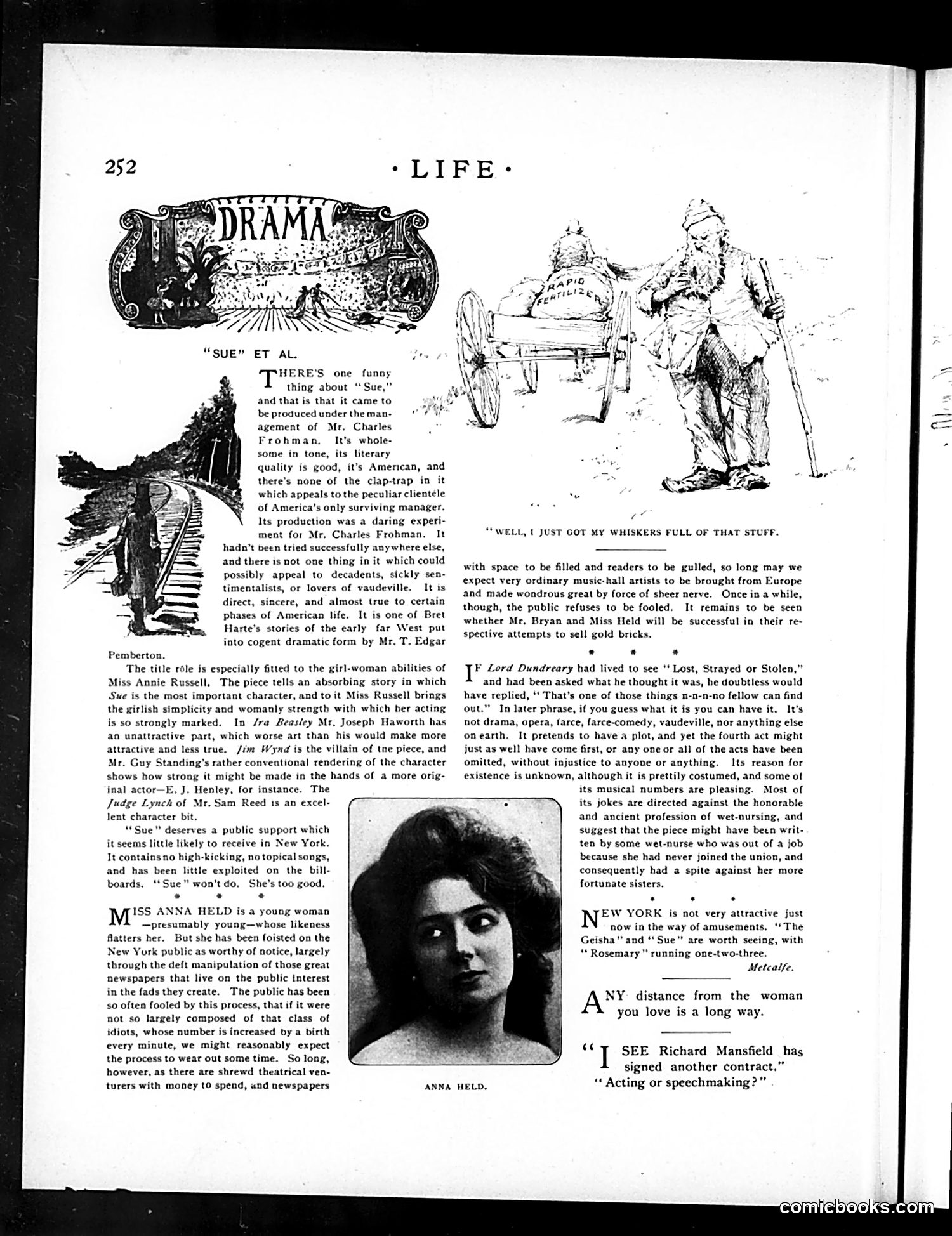
This Life magazine drama page reviews several theatrical productions. The main focus is on "Sue," produced by Charles Frohman, which the critic finds disappointingly ordinary despite its ambitious scope. The review criticizes the play's attempt to address American social issues but notes it lacks the distinctive voice needed to truly impact audiences. The page also discusses "Lord Dundreary" and mentions productions featuring Anna Held (shown in photograph), noting New York's current theatrical offerings include "The Geisha" and "Sue," with a joke about Richard Mansfield signing a new contract. The overall tone is that contemporary Broadway offerings, while numerous, are largely mediocre and artistically uninspired.
📄 Transcribed text from this page (OCR, searchable)
Machine-transcribed from the original scan — historical spelling and the odd misread are preserved.
“SUE” ET AL. HERE'S one funny thing about ‘ Sue,” and that is that it came to be produced under the man- agement of Mr. Charles Frohman, It's whole- some in tone, its literary quality is good, it’s American, and there’s none of the clap-trap in it which appeals to the peculiar clientele of America's only surviving manager, Its production was a daring experi- ment for Mr, Charles Frohman. It hadn't been tried successfully anywhere else, and there 1s not one thing in it which could possibly appeal to decadents, sickly sen- timentalists, or lovers of vaudeville. It is direct, sincere, and almost true to certain phases of American life. It is one of Bret Harte's stories of the early far West put into cogent dramatic form by Mr. T. Edgar Pemberton. The title role is especially fitted to the girl-woman abilities of Miss Annie Russell, The piece tells an absorbing story in which Sue is the most important character, and to it Miss Russell brings the girlish simplicity and womanly strength with which her acting is so strongly marked. In /ra Beasley Mr, Joseph Haworth has an unattractive part, which worse art than his would make more attractive and less true. /im Wynd is the villain of tne piece, and Mr. Guy Standing’s rather conventional rendering of the character shows how strong it might be made in the hands of a more orig- inal actor—E. J. Henley, for instance. The pt “WELL, | JUST GOT MY WHISKERS FULL OF THAT STUFF. with space to be filled and readers to be gulled, so long may we expect very ordinary music-hall artists to be brought from Europe and made wondrous great by force of sheer nerve. Once in a while, though, the public refuses to be fooled. It remains to be seen whether Mr, Bryan and Miss Held will be successful in their re- spective attempts to sell gold bricks, . * * [F Zor Dundreary had lived to see "* Lost, Strayed or Stolen,” and had been asked what he thought it was, he doubtless would have replied, ‘* That's one of those things n-n-n-no fellow can find out.” In later phrase, if you guess what it is you can have it. It’s not drama, opera, farce, farce-comedy, vaudeville, nor anything else onearth. It pretends to have a plot, and yet the fourth act might just as well have come first, or any one or all of the acts have been omitted, without injustice to anyone or anything. Its reason for existence is unknown, although it is prettily costumed, and some ot its musical numbers are pleasing. Most of Judge Lynch of Mr. Sam Reed 1s an excel- lent character bit. “Sue” deserves a public support which it seems little likely to receive in New York. It contains no high-kicking, notopical songs, and has been little exploited on the bill- boards, ‘Sue" won't do, She's too good. . * * ISS ANNA HELD is a young woman —presumably young—whose likeness flatters her. But she has been foisted on the New York public as worthy of notice, largely through the deft manipulation of those great newspapers that live on the public interest in the fads they create. The public has been so often fooled by this process, that if it were not so largely composed of that class of idiots, whose number is increased by a birth every minute, we might reasonably expect the process to wear out some time. So long, its jokes are directed against the honorable and ancient profession of wet-nursing, and suggest that the piece might have been writ ten by some wet-nurse who was out of a job because she had never joined the union, and consequently had a spite against her more fortunate sisters. . . . NEW YORK is not very attractive just now in the way of amusements. “The Geisha” and “Sue” are worth seeing, with “ Rosemary" running one-two-three. Metcalfe. Y distance from the woman you love is a long way. ‘67 SEE Richard Mansfield has however, as there are shrewd theatrical ven- turers with money to spend, and newspapers ANNA HELD, signed another contract.” “ Acting or speechmaking?”