
A complete issue · 18 pages · 1896
Life — September 17, 1896
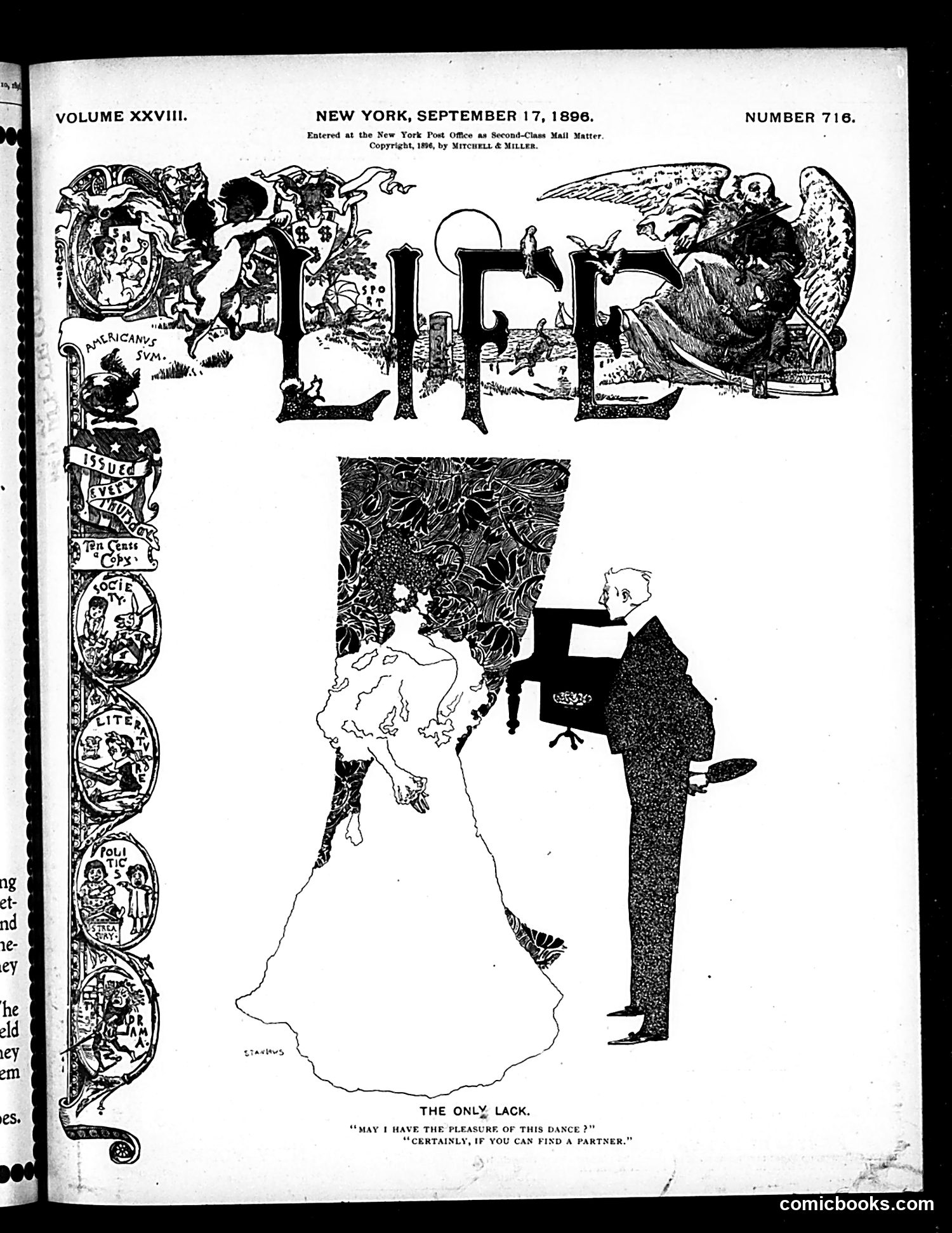
This cartoon satirizes courtship and marriage conventions of the 1890s. A woman in a wedding dress stands beside a man in formal attire. The caption reads: "May I have the pleasure of this dance?" / "Certainly, if you can find a partner." The joke exploits the irony that despite standing directly next to each other, the man claims he cannot find a dancing partner—suggesting the woman herself is somehow unsuitable or undesirable as a partner. The title "The Only Lack" implies her primary deficiency is the absence of a suitable romantic match, playing on period anxieties about unmarried women and marriage prospects. The ornate decorative border on the left is typical of Life's design aesthetic from this era.
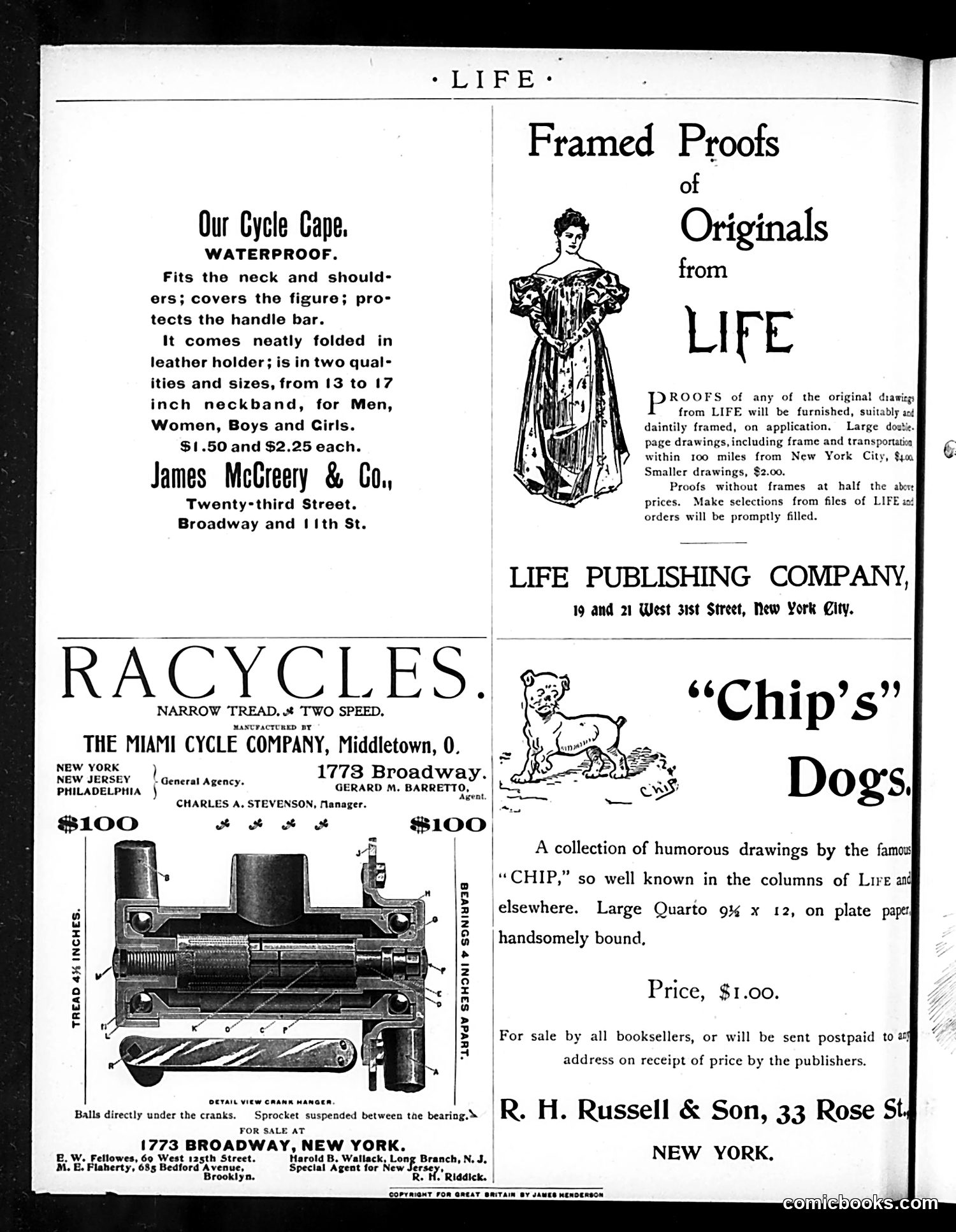
This page is primarily **advertising content**, not political satire or editorial cartoons. It contains four separate product advertisements: 1. **Cycle Cape** (James McCreery & Co.) - a waterproof neck covering for cyclists 2. **Racycles** (Miami Cycle Company) - bicycles priced at $100 3. **Life Magazine's framed proofs service** - offering to frame original drawings from Life magazine 4. **"Chip's Dogs"** (R.H. Russell & Son) - a book of humorous dog drawings by an artist known as "Chip" The only illustration with potential satirical content is the small dog drawing accompanying the "Chip's Dogs" advertisement, but it appears to be simply a cute/humorous illustration promoting the book rather than commentary on current events. The page reflects late-19th or early-20th century consumer culture and the bicycle craze of that era.
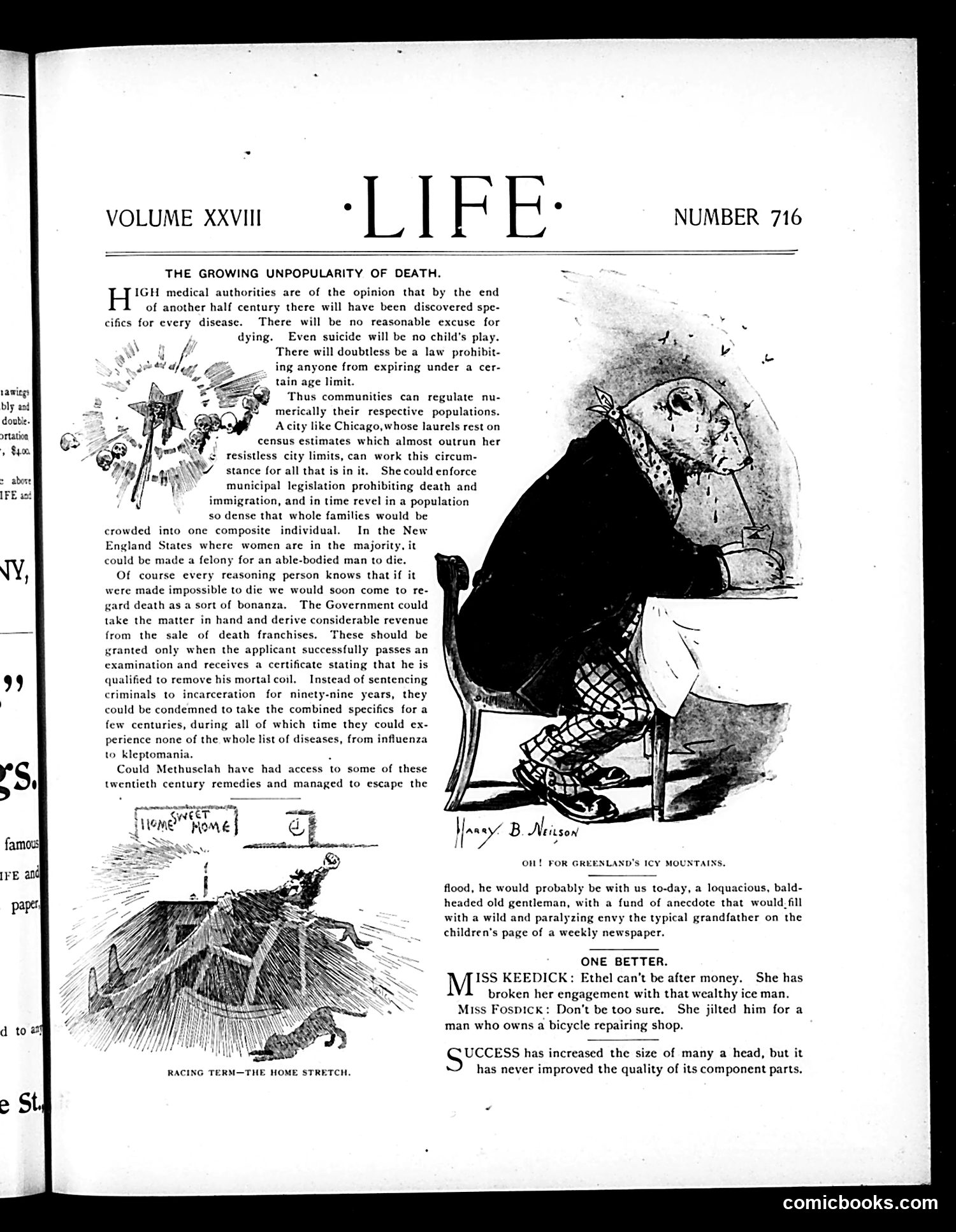
This page contains satirical commentary and illustrations rather than political cartoons. The main article, "The Growing Unpopularity of Death," proposes absurdist solutions to mortality—suggesting governments could regulate death like they regulate population, and even proposing "death franchises" as revenue sources. The illustrations by Harry B. Neilson include "Oh! For Greenland's Icy Mountains" (showing a bundled figure) and "Racing Term—The Home Stretch" (depicting a horse racing scene), though their exact satirical connections to the text are unclear from the image alone. The "One Better" section features a brief comic exchange between Miss Keedick and Miss Fosdick about a woman choosing between a wealthy ice man and a bicycle shop owner—social humor about marriage and economic status typical of the era.
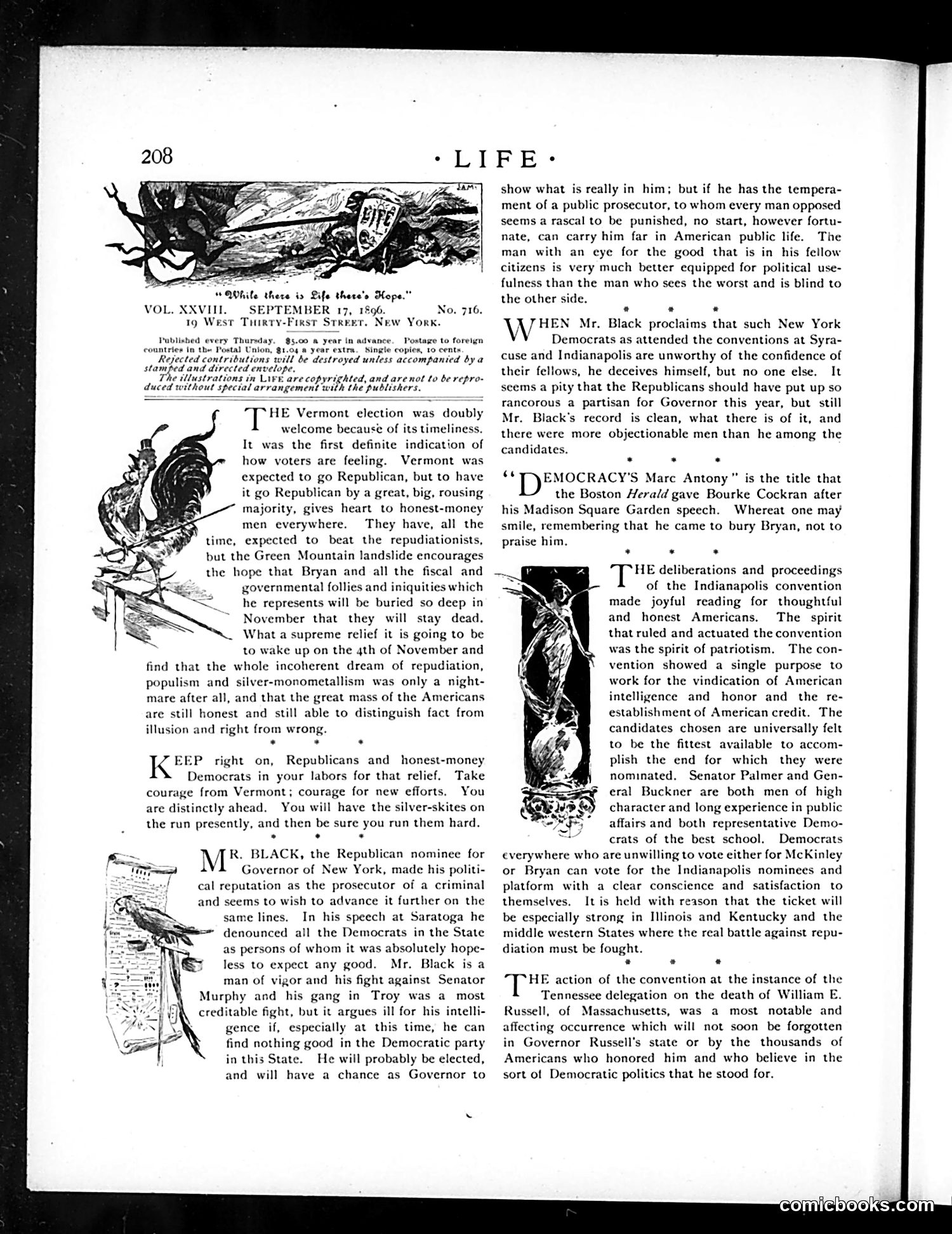
This page contains editorial commentary on the 1896 U.S. presidential election. The text discusses Mr. Black, the Republican nominee for New York Governor, praising him as an honest prosecutor and contrasting him favorably with Democratic opposition. The two political cartoons (crude woodcuts typical of the era) appear to satirize Democratic positions. The left cartoon likely mocks Democratic fiscal policy or populism using exaggerated caricature. The right cartoon seems to critique Democratic candidates or their platform, though the specific figures are unclear from the image. The editorial urges Republicans and "honest-money Democrats" to support the ticket, emphasizing themes of integrity, sound currency, and patriotism—key issues in this era's heated partisan debates over free silver and monetary policy.
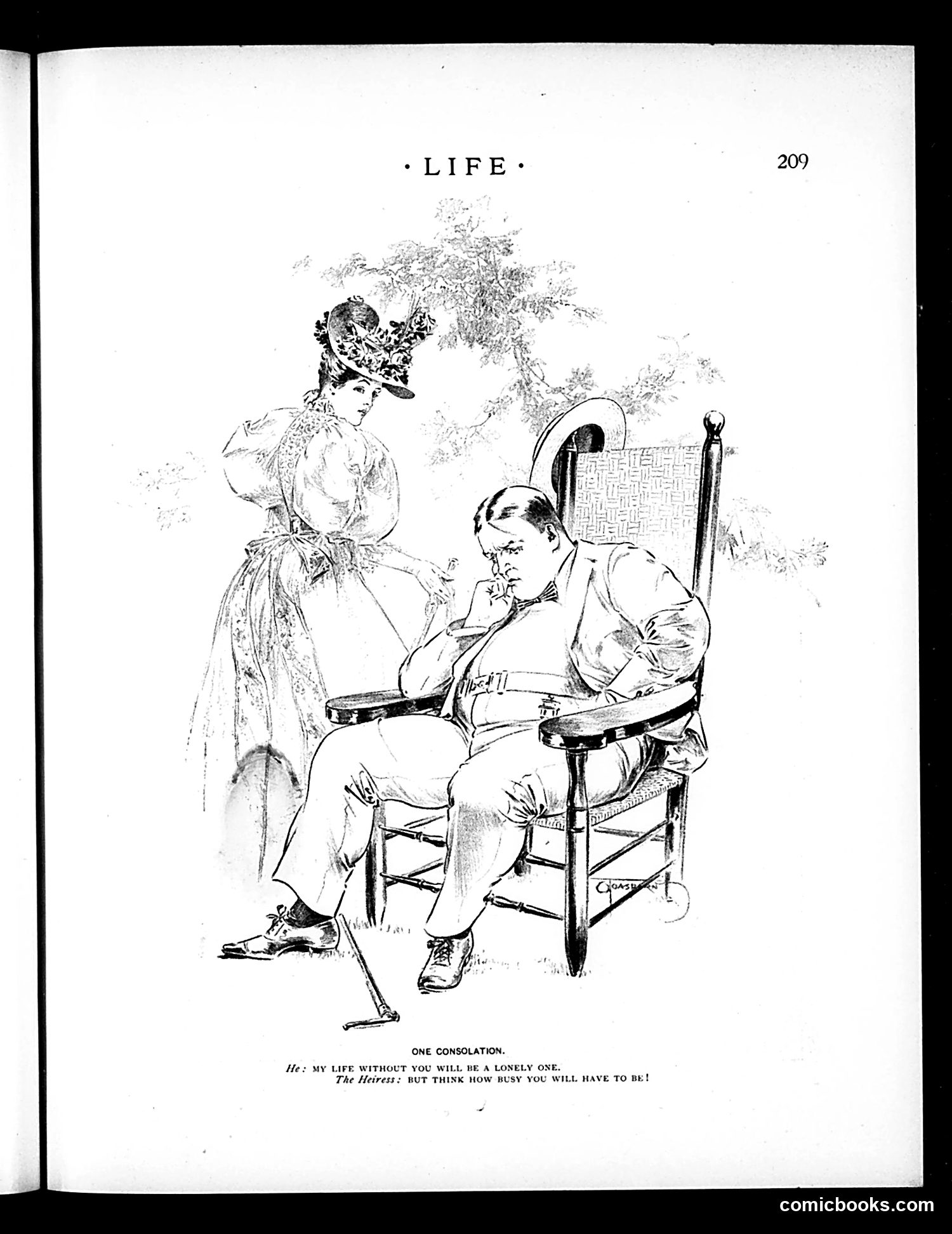
This cartoon satirizes romantic relationships and gender dynamics of the early 20th century. A portly, seated man addresses a stylishly dressed woman standing before him. His dialogue reads: "My life without you will be a lonely one," to which she replies: "But think how busy you will have to be!" The humor lies in a reversal of traditional romantic sentiment. Rather than the woman being consoled by promises of his devotion, she sarcastically suggests he'll be so occupied (presumably with other pursuits or romantic interests) that loneliness won't be his problem. The cartoon mocks the man's sentimental plea while implying the woman's skepticism about his fidelity or his ability to remain devoted during her absence.
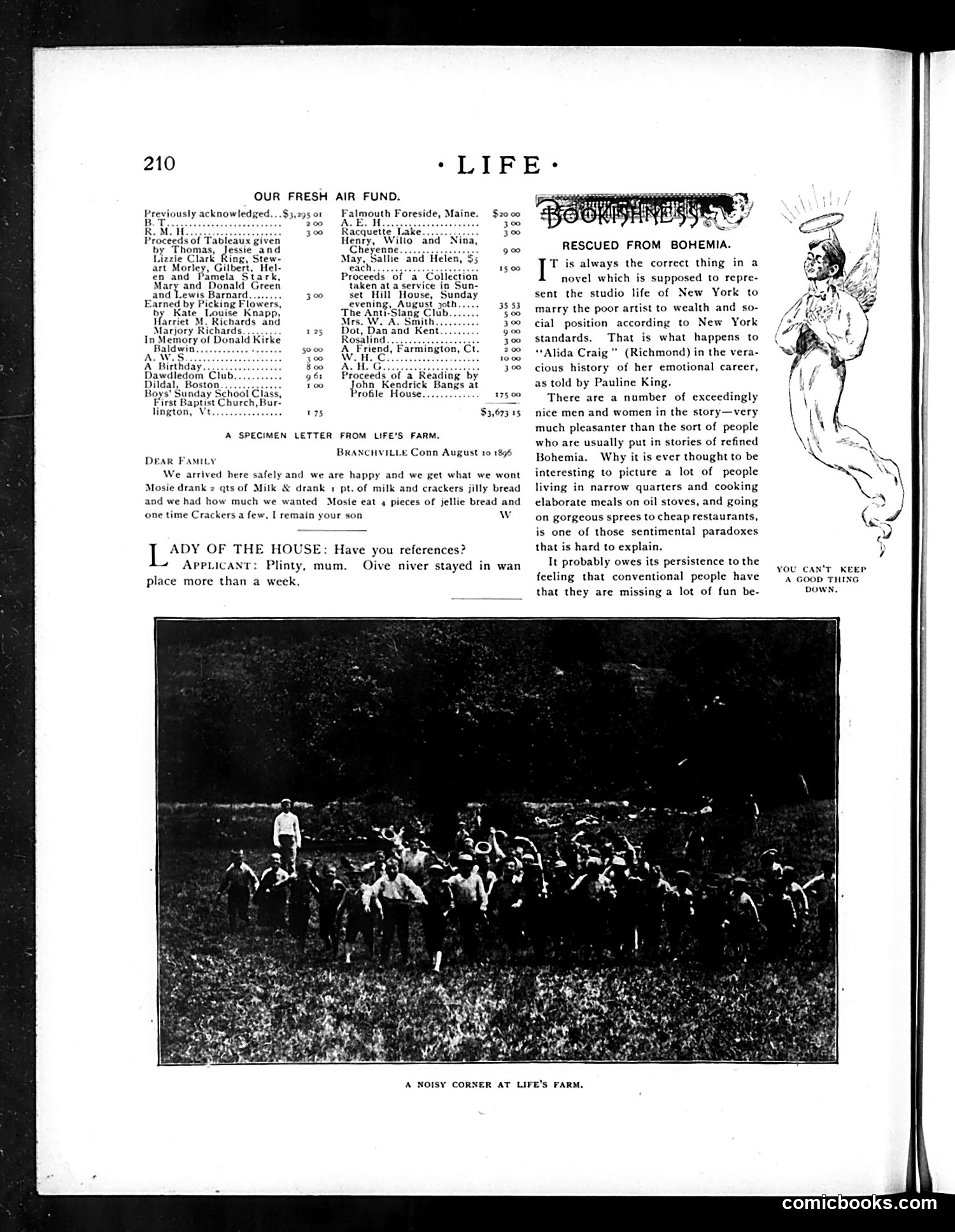
This page contains three distinct elements: 1. **"Our Fresh Air Fund"** - A fundraising list acknowledging donations to a charitable program providing outdoor recreation for urban children. 2. **"Rescued from Bohemia"** - A short satirical article mocking the romanticization of poor artists in New York. It critiques the notion that bohemian poverty is aesthetically appealing, arguing that conventional society's fascination with struggling artists in "narrow quarters" represents sentimental hypocrisy. 3. **A humorous job interview dialogue** where an applicant claims his only reference stayed less than a week—a joke about poor employment history. 4. **Farm photograph** - Shows a large group gathered at "Life's Farm," likely depicting the magazine's actual recreational facility. The page primarily promotes Life magazine's charitable and recreational initiatives rather than presenting political satire.
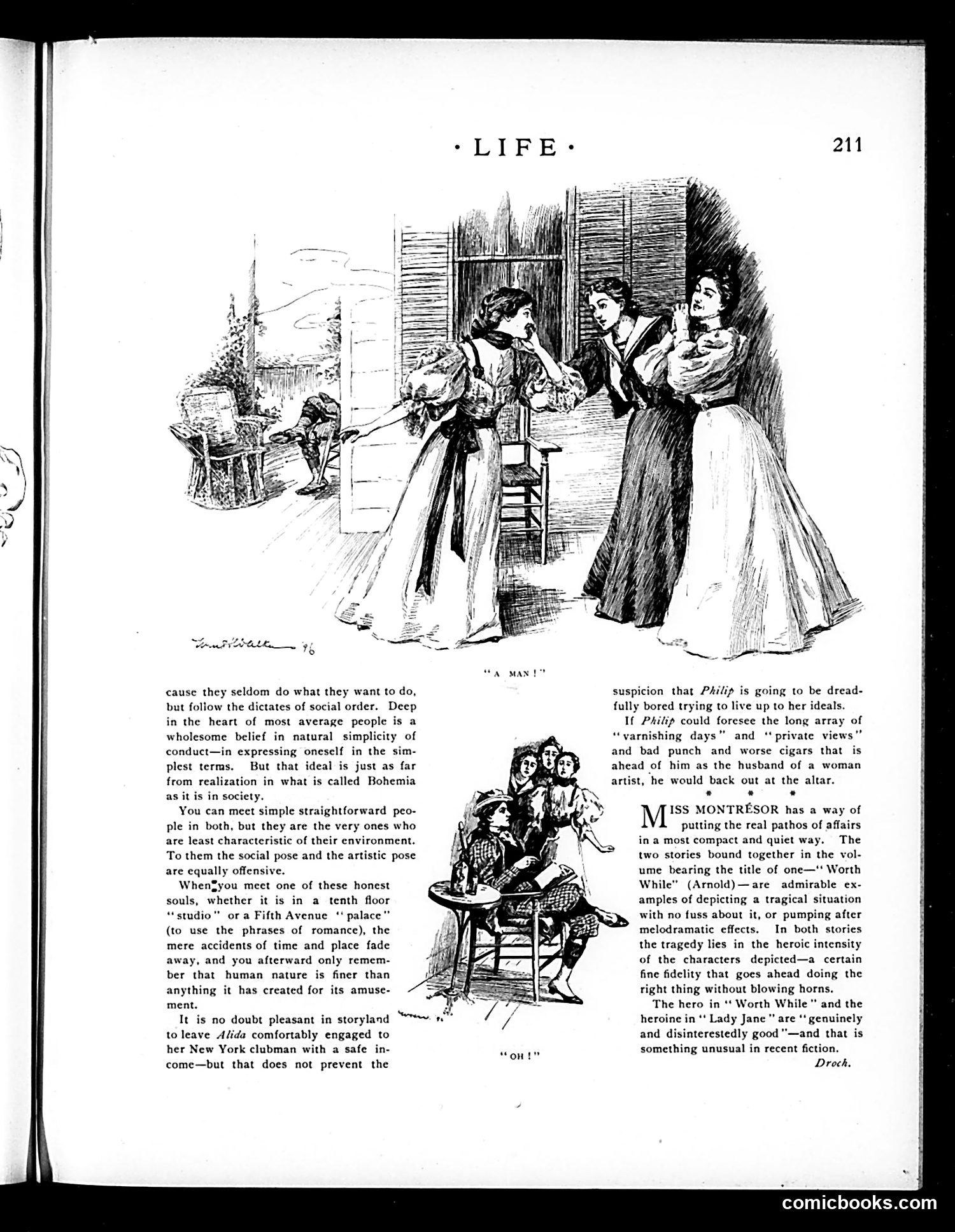
This page contains two sketched scenes satirizing social behavior and romantic relationships among the upper classes. The top cartoon, titled "A Max!", depicts three well-dressed women greeting a man arriving at what appears to be a social gathering or home visit. The satire likely comments on courtship rituals and social performance. The bottom illustration, captioned "Oh!", shows women in an interior domestic scene, apparently reacting with surprise or dismay to news or gossip. The accompanying text discusses Miss Montrésor's literary works, praising her realistic portrayal of characters with "genuine and disinterestedly good" qualities—described as unusual for recent fiction. The text suggests the satire targets both romanticized ideals of bohemian life and the gap between social expectations and actual behavior among educated, artistic circles in early 20th-century America.
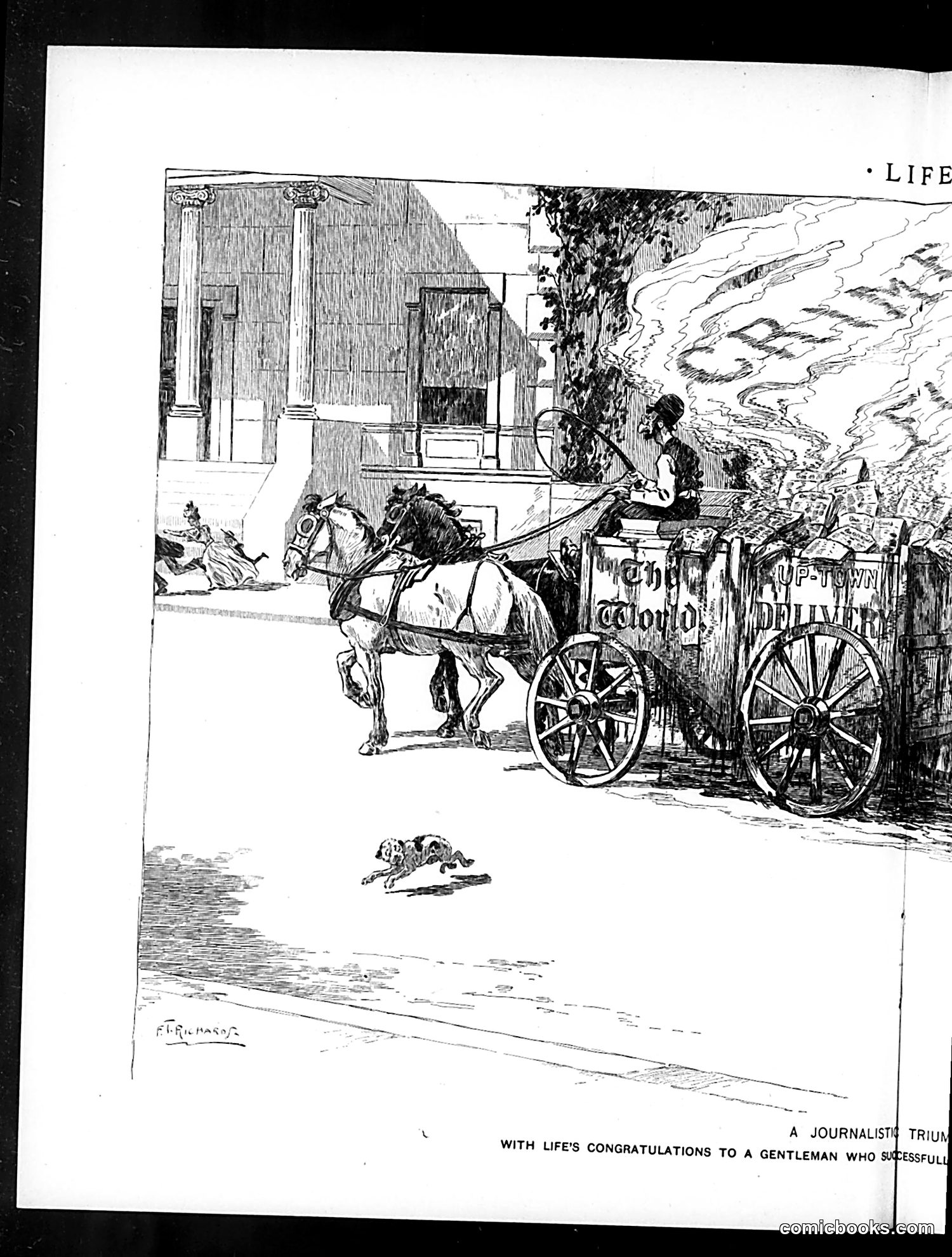
This satirical cartoon depicts an "uptown delivery" wagon—likely a newspaper delivery vehicle—being pulled by a horse through an urban street. The caption reads: "WITH LIFE'S CONGRATULATIONS TO A GENTLEMAN WHO SUCCESSFULLY [text cuts off]." The satire appears to mock a journalist or newspaper figure who has achieved some form of success, though the incomplete caption obscures the specific target. The imagery suggests irony: the delivery wagon and horse represent ordinary, unglamorous work, contrasting with the congratulatory tone. The cartoon likely critiques either journalistic pretensions, a specific news story or scandal, or perhaps mocks someone associated with the newspaper business. The artist's signature appears to be "Flin[?] Nason" or similar. Without the complete caption or historical context, the precise subject remains unclear.
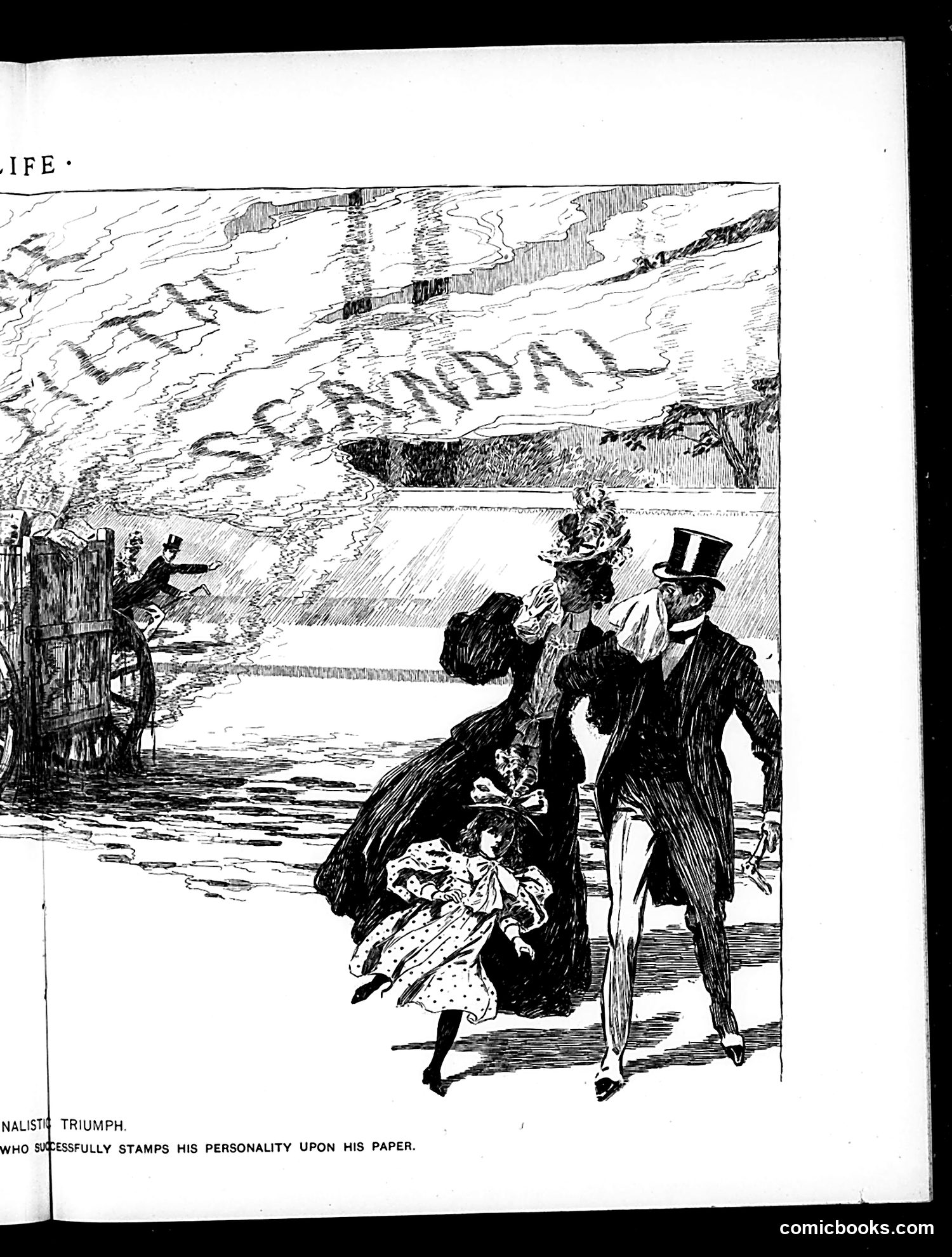
This cartoon depicts a well-dressed gentleman in a top hat and formal coat showing his newspaper to a woman and child. The caption reads: "Who successfully stamps his personality upon his paper." The satire targets newspaper editors or publishers who use their publications as personal vehicles for self-aggrandizement rather than objective journalism. The "triumph" is ironic—the figure proudly displays his work, but the cartoon suggests this ego-driven approach to newspaper publishing is ridiculous or contemptible. The mountainous landscape behind them appears incidental to the social commentary. This reflects early 20th-century concerns about press independence and editorial integrity versus proprietorial vanity.
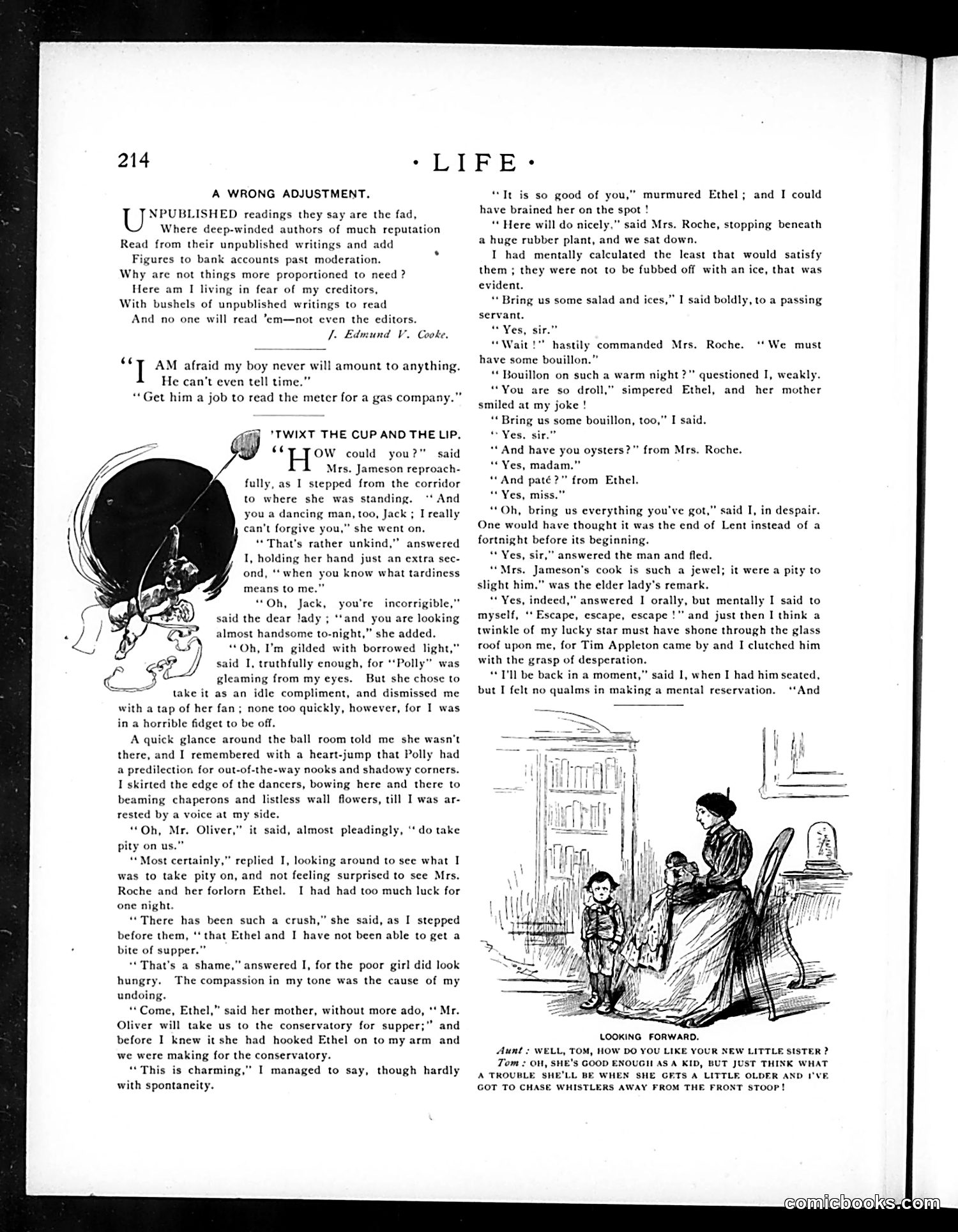
This page contains a short story titled "A Wrong Adjustment" with accompanying illustrations. The narrative depicts a social comedy about a young man attending a ball at Mrs. Jameson's home, where he encounters Mrs. Roche and her daughter Ethel. The story satirizes class anxieties and courtship rituals of the era. The protagonist struggles with social expectations—he's embarrassed about his modest circumstances and worries about making a proper impression. Mrs. Roche's dismissive attitude toward him ("you are so droll") reflects period class consciousness. The bottom illustration shows an "Aunt" lecturing a young girl about a new baby sister, using condescending language typical of Victorian-era child instruction. The satire targets stiff social conventions and patronizing attitudes toward those of lower status or younger age.
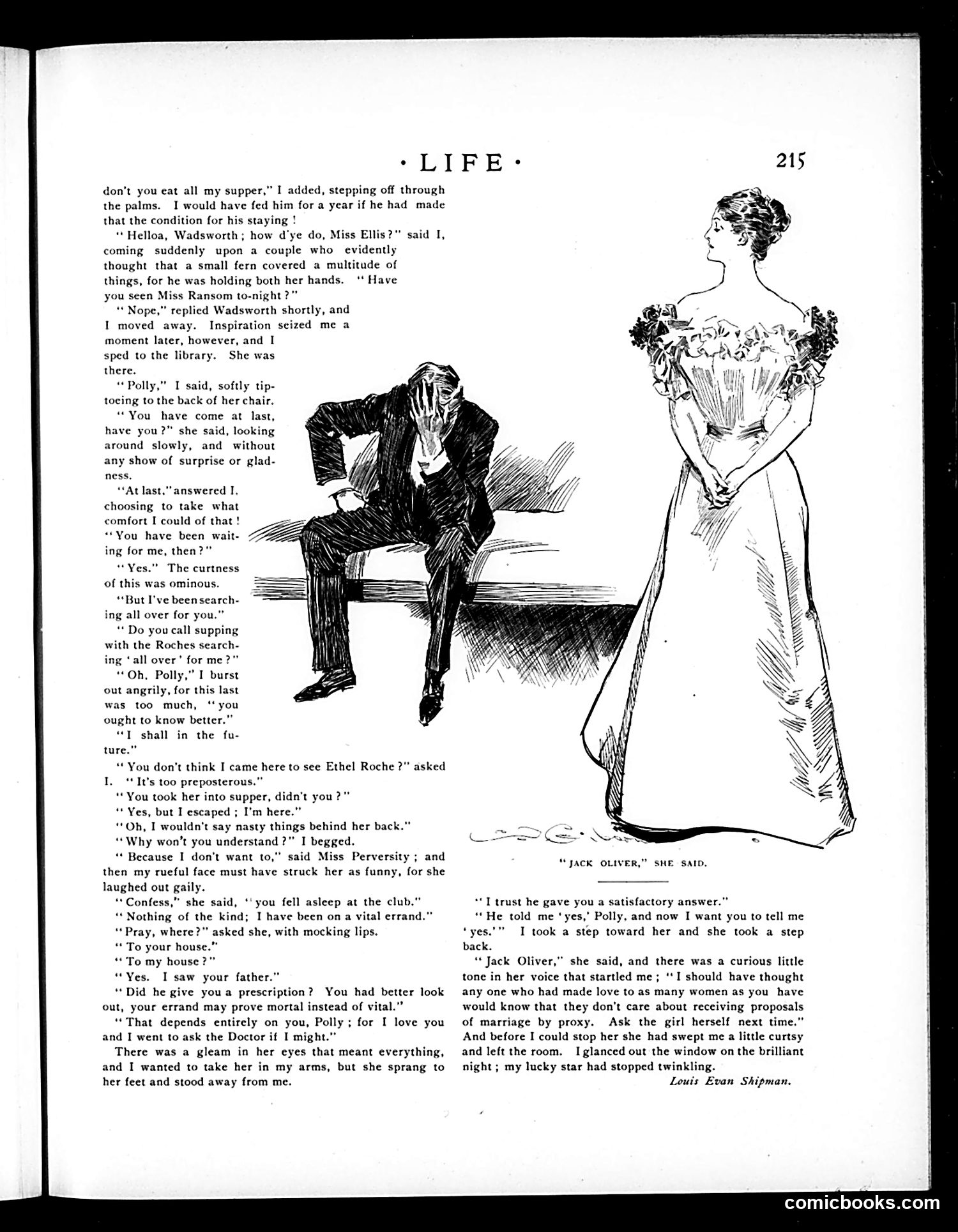
This page contains a serialized short story titled "Jack Oliver," She Said" by Louis Evan Shipman, illustrated with line drawings. The narrative depicts a romantic/dramatic encounter between two characters—a man and a woman named Polly. The story involves the man's romantic pursuit, Polly's initial resistance and evasion, and their verbal sparring about courtship and marriage proposals. The illustrations show the pair in intimate conversation—the man seated on a bench, the woman standing. This is **not political satire or cartooning**, but rather a melodramatic fiction piece typical of Life magazine's literary content. The page demonstrates how Life balanced satirical commentary with serialized stories for early-20th-century readers.
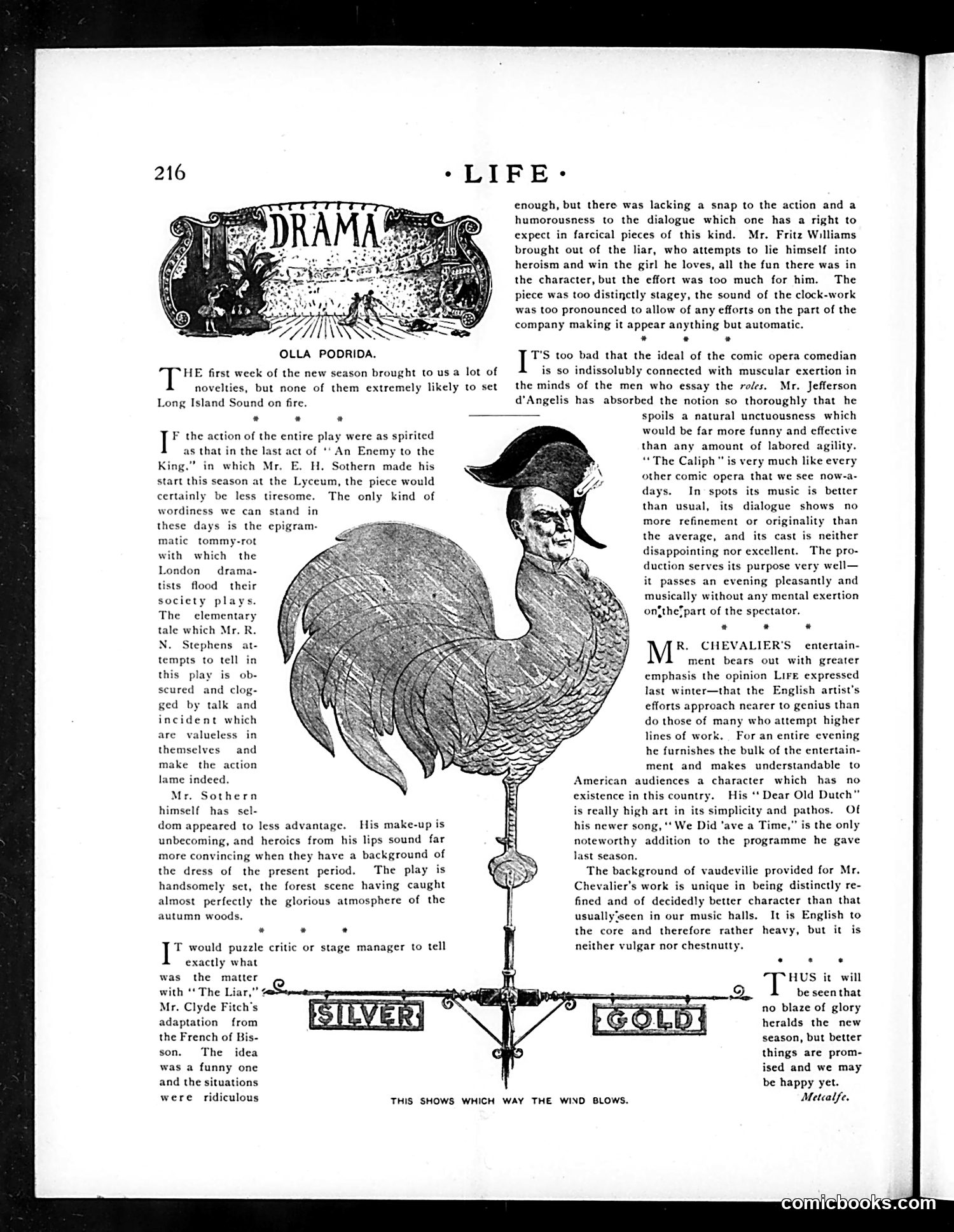
This page reviews several Broadway productions. The central illustration—a figure perched atop a scale marked "SILVER" and "GOLD" with the caption "THIS SHOWS WHICH WAY THE WIND BLOWS"—appears to be satirizing theatrical success and financial performance. The reviews critique: - *An Enemy to the King* (starring E.H. Sothern), called tedious despite good staging - *The Liar* (adapted by Clyde Fitch), a farce with good premise but poor execution - *The Caliph*, a mediocre comic opera - A performance by Mr. Chevalier, praised for artistic merit and his character work The overall tone is dismissive of the theatrical season's offerings, suggesting producers prioritize spectacle and financial returns over genuine artistry—hence the "which way the wind blows" reference to commercial pressure rather than artistic merit.
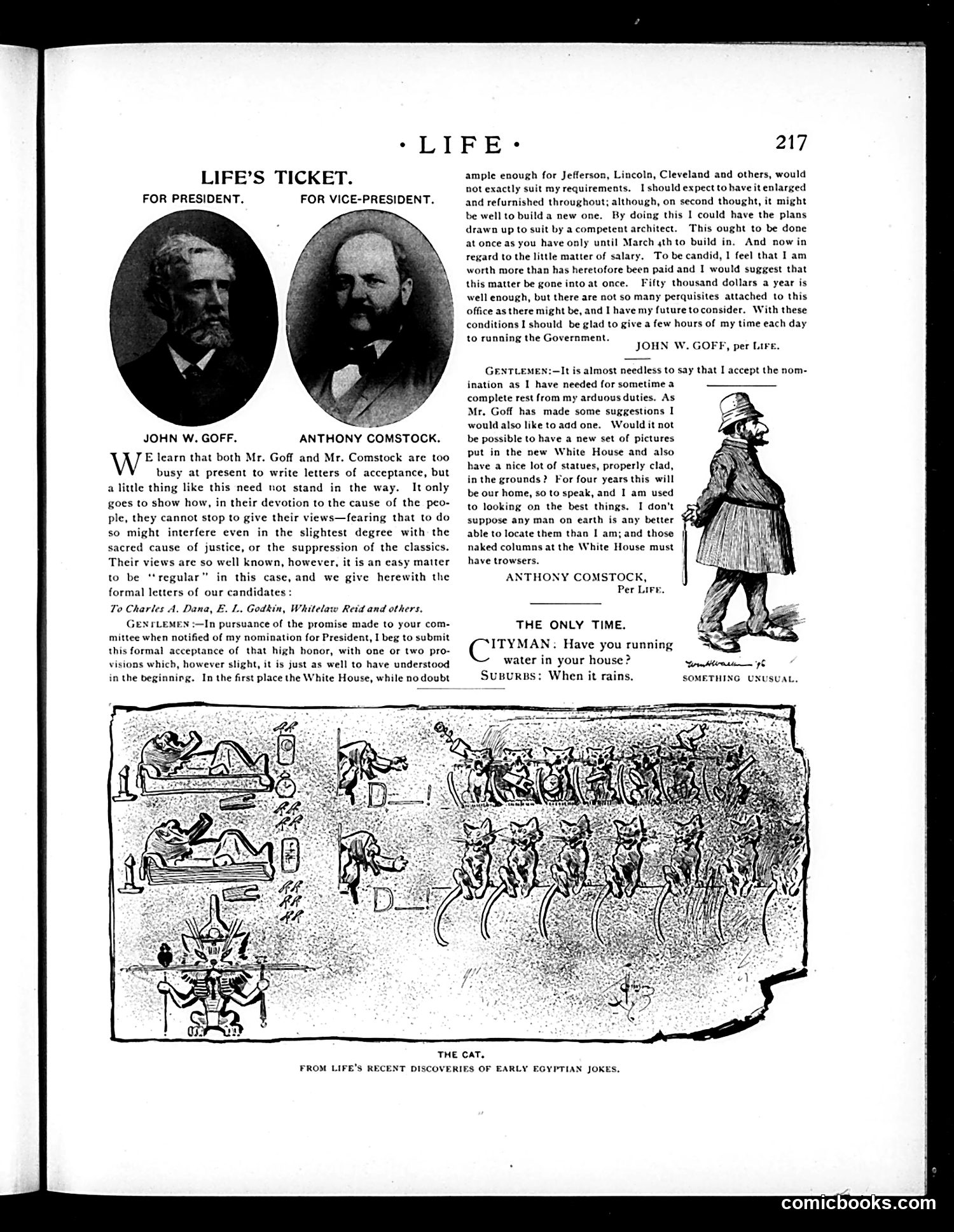
This page mocks two prominent moral reformers as absurd presidential candidates. **John W. Goff** and **Anthony Comstock** were real figures known for aggressive campaigns against vice and obscenity. Life ridicules them by publishing fake acceptance letters revealing their true priorities: Goff demands the White House be rebuilt to his specifications and salary raised to $50,000 annually; Comstock wants new art and statues installed—with clothes on the nude classical columns. The satire targets their self-righteousness and pretension. By having these "crusaders for justice" expose their vanity and materialism in formal letters, Life suggests they're hypocrites using moral reform as cover for personal ambition. The joke is that men claiming devotion to the people's welfare are actually obsessed with luxury and prestige. The small "Something Unusual" joke about running water is unrelated filler humor.
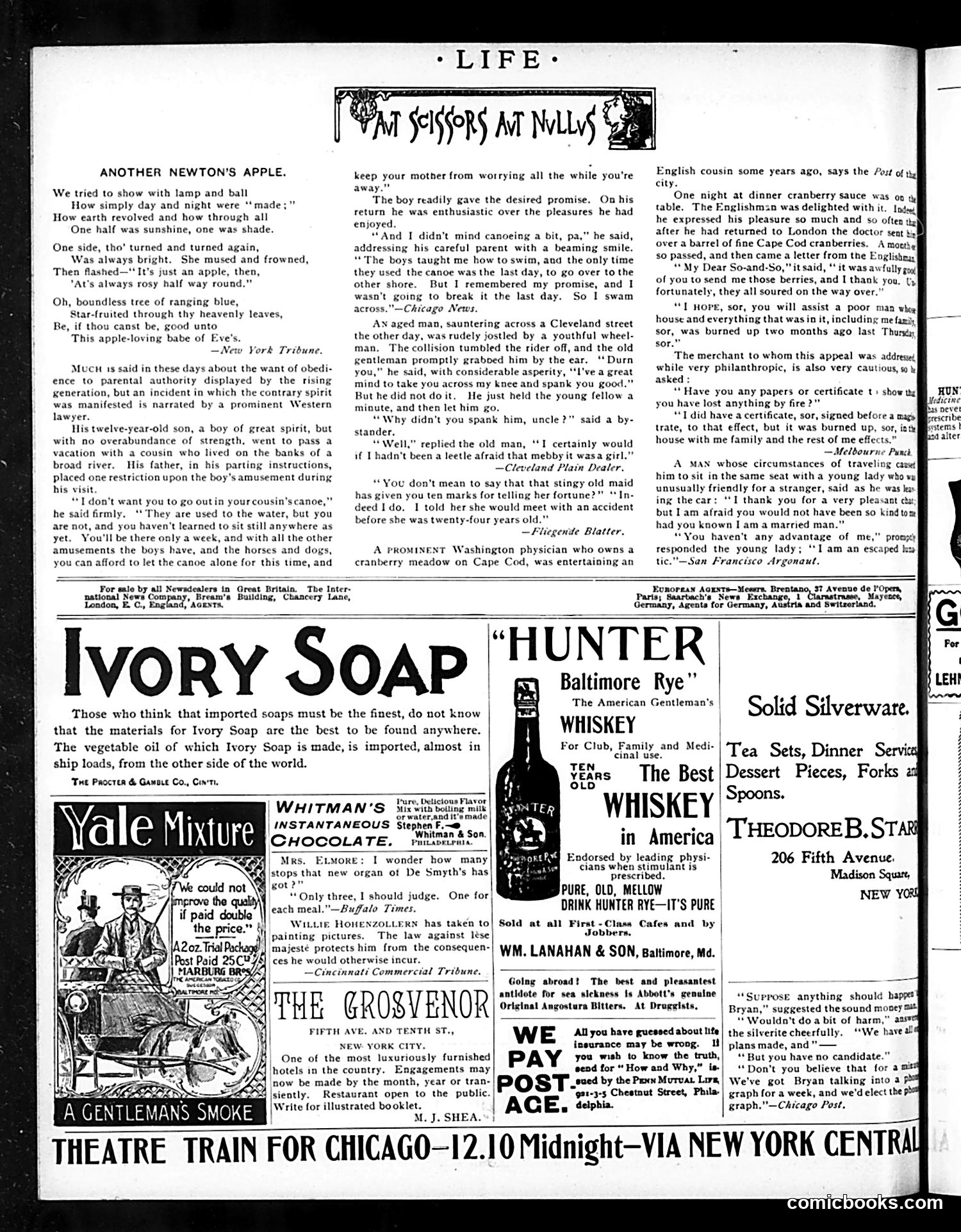
This page from *Life* magazine contains several humorous anecdotes rather than political cartoons. The pieces satirize social attitudes and human nature through short comedic stories: **"Another Newton's Apple"** (poem): A father attempts to explain celestial mechanics to his daughter using scientific demonstration, but she cuts through the complexity with simple, childish logic—the humor lies in naive wisdom defeating adult pretension. **Three prose anecdotes** mock: 1. **Parental obedience**: A boy obeys his father's canoe prohibition so literally (swimming instead) that he technically follows the letter while violating the spirit—satire of rigid rule-following. 2. **Cowardice masquerading as restraint**: An elderly man refrains from spanking a rude youth out of uncertainty about the rider's gender—mocking both chivalry and timidity. 3. **Miserliness**: A fortune-teller's prediction of "accident before age 24" earns only modest payment, revealing the client's stinginess. The page is primarily **advertising-driven**, with promotions for Ivory Soap, Yale Mixture chocolate, Hunter Rye whiskey, and other products dominating the layout.
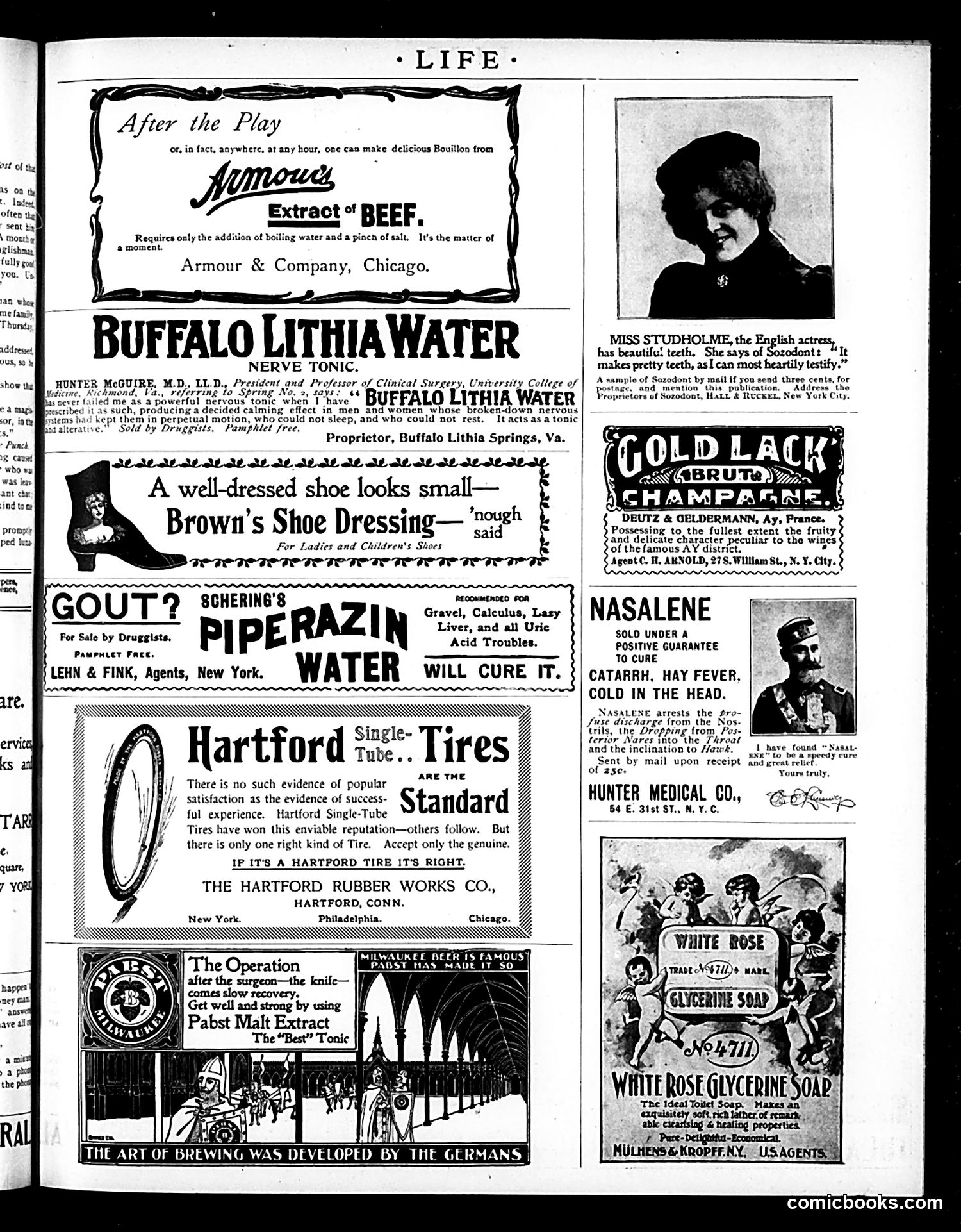
This page is **primarily advertising**, not satire or political commentary. It consists of various patent medicine and consumer product ads typical of early 20th-century magazines. Notable products include: - **Buffalo Lithia Water** ("Nerve Tonic"): endorsed by Dr. Hunter McGuire, promoting it as a cure for nervous exhaustion and insomnia—reflecting the era's obsession with "nerve" remedies for ailments likely caused by modern stress. - **Sozodonts toothpaste**: uses celebrity endorsement (Miss Studholme, English actress) to sell beauty. - **Nasalene, Pipe Razin Water, Gold Lack Champagne**: patent medicines and luxury goods marketed with dubious health claims. - **Hartford Tires, Brown's Shoe Dressing, White Rose Soap**: standard consumer products. The page reveals **modern consumer marketing's origins**: celebrity testimonials, health pseudoscience, and aspirational advertising. These products would today be considered quack medicines; the ads exemplify an era before FDA regulation of medical claims.
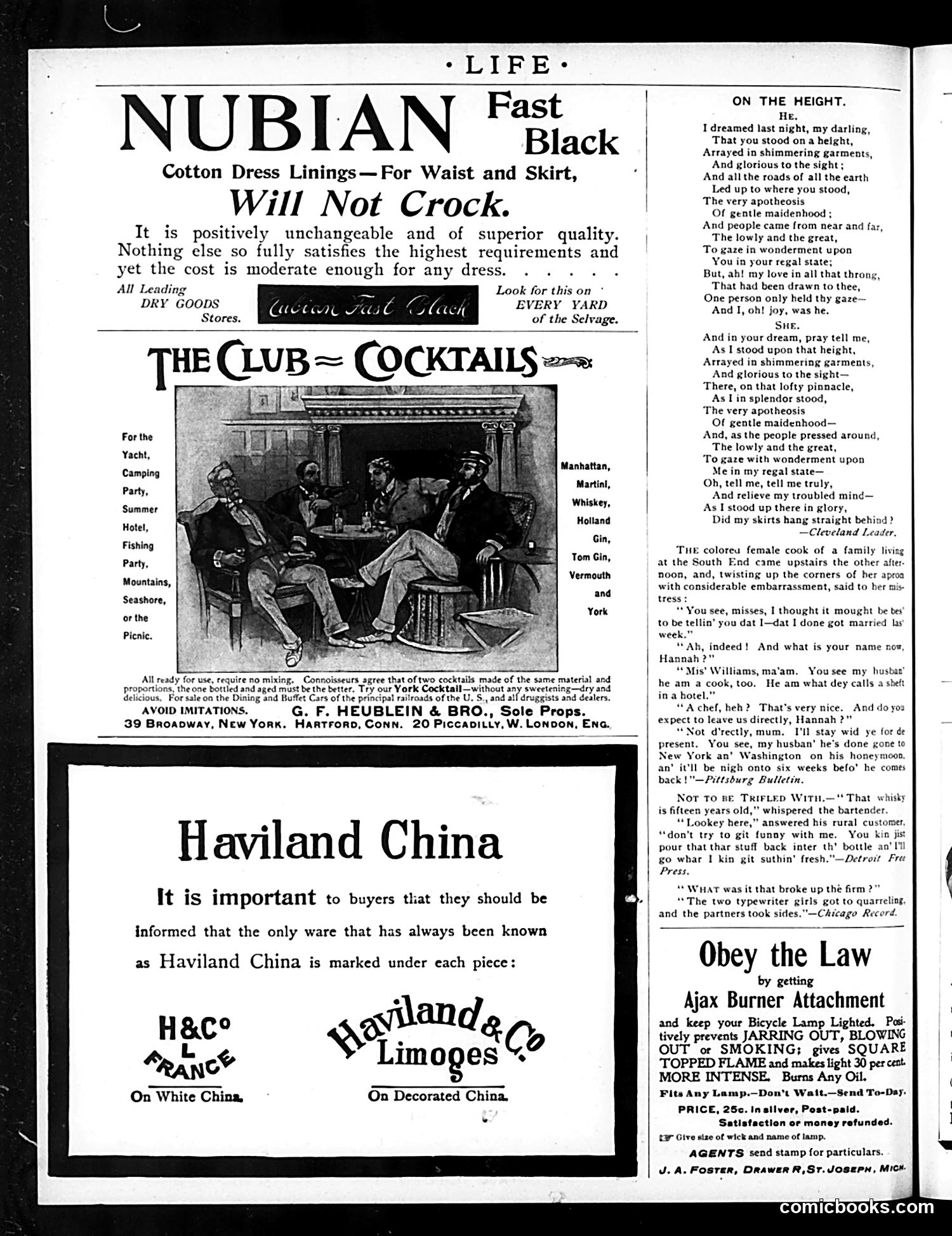
This page from *Life* magazine is primarily **advertising** with some humorous short fiction pieces interspersed. **The main content includes:** 1. **Nubian Cotton Dress Linings ad** — promoting fabric that "will not crock" (won't transfer dye) 2. **Club Cocktails illustration** — shows well-dressed men socializing, advertising ready-made cocktails from G.F. Heublein & Bros., available on railroads 3. **Haviland China ad** — distinguishing authentic French china from imitations 4. **Poetry and humor pieces** — including a sentimental poem about a lover on a height, and comedic anecdotes about: - A Black cook announcing her marriage to a hotel chef - A bartender trying to sell old whisky to a rural customer - Typewriter girls quarreling at a firm The page reflects early 20th-century concerns: product authentication, railroad dining culture, and racial humor typical of the era. The advertisements emphasize quality and genteel consumption for the magazine's affluent readership.
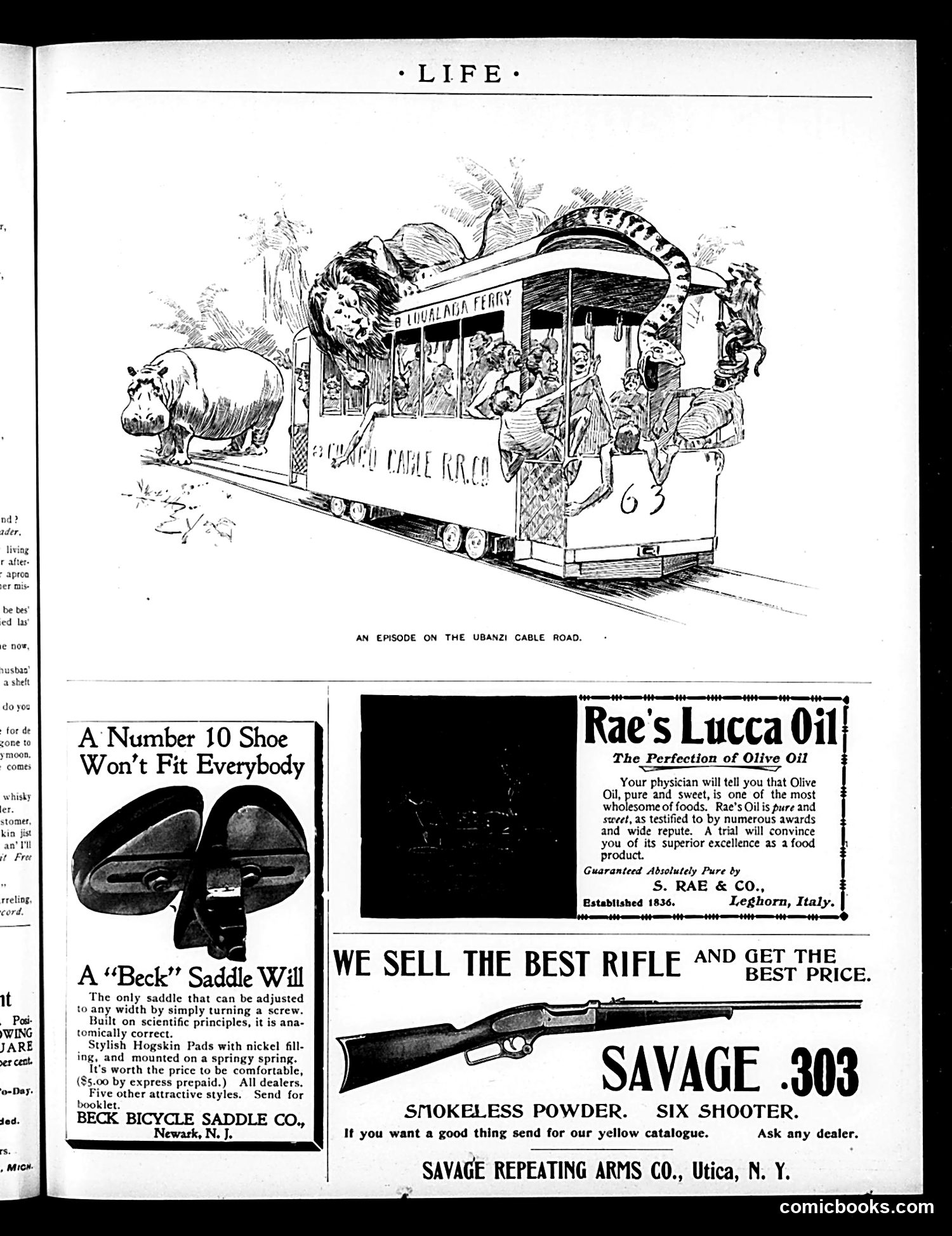
The main cartoon depicts "An Episode on the Ubanzi Cable Road"—a satirical scene of colonial-era Africa showing a cable car operated by the "Ubanzi Ferry & Cable Co." Exotic animals (hippopotamus, lion) and indigenous people crowd the scene in exaggerated, stereotypical fashion typical of early 20th-century depictions of Africa. The joke likely satirizes the absurdity of imposing modern technology (a San Francisco-style cable car) onto the African landscape, or mocks colonial enterprise's grandiose ambitions in remote regions. The reference to "Ubanzi" (likely the Ubangi River) suggests a real colonial context. The page is primarily **advertising**: bicycle saddles, olive oil, and rifles occupy most space. The Savage .303 rifle ad notably markets firearms to this readership, reflecting the era's attitudes toward colonial expansion and hunting. The cartoon's humor depends on racial stereotyping common to its period—something a modern reader would find offensive rather than amusing.
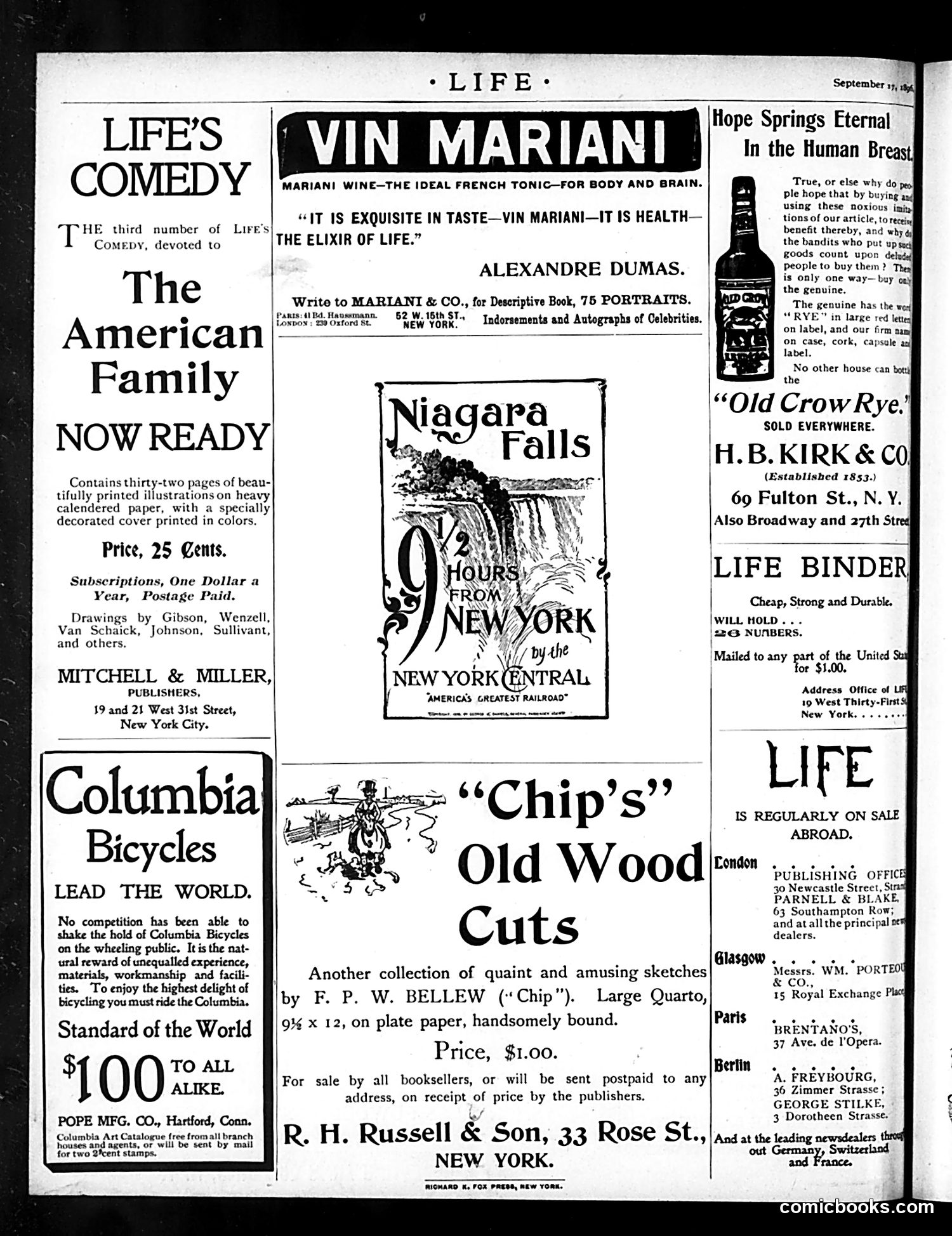
This is primarily an **advertising page** with minimal satirical content. The page features: **Main Advertisements:** - *Vin Mariani*: A French wine tonic marketed as a health elixir, endorsed by Alexandre Dumas. The ad emphasizes its curative properties for "body and brain." - *Columbia Bicycles*: Promoted as industry-leading cycles - *Old Crow Rye*: Whiskey advertisement warning against counterfeit imitations - *"Chip's" Old Wood Cuts*: A book of sketches by F.P.W. Bellew - *Life Binder*: Magazine binding service **Editorial Content:** Life announces its third "Comedy" issue devoted to "The American Family," featuring illustrations by prominent cartoonists (Gibson, Wenzel, Sullivan, others), priced at 25 cents. The page reflects late-19th-century commercial culture: patent medicines, bicycle crazes, and alcoholic tonics marketed as health products—practices that would later face regulation. The irony is implicit rather than explicit.